App for Landlords and Tenants: Communication, Documents, and Tax Filing in One Place
LITSLINK turned a standalone Finnish rental calculator into Rentfol.io – an app for landlords and tenants that combines property listings, in-app messaging, document storage, and tax-ready expense tracking in one cross-platform product.
- → 3 distinct user roles (landlord, tenant, service provider)
- → 1 codebase, 2 platforms (iOS + Android)
- → 1,000+ listings wishlisted in the first 4 weeks
- → European availability – expanded beyond Finland to more users

Project Details
Rentfol.io is a cross-platform mobile marketplace and rental management tool built for landlords, tenants, and service providers in the European real estate market. A six-person LITSLINK team delivered the full product in approximately twelve months.


Business Challenge
Private landlords (especially in the Nordic markets) still handle most of their rental administration manually. Vuokrakulut, a Finnish PropTech company, had built a popular rental expenses calculator used by landlords for basic income and tax tracking. But users kept asking for more: property listings, tenant communication, document storage, and service provider discovery.
The client wanted to evolve the calculator into Rentfol.io – a broader rental management platform for landlords, tenants, and service providers. The existing codebase could not support those features. The team needed a partner to rebuild the product from the ground up while keeping the calculator logic intact.

Fragmented workflows
Landlords juggled spreadsheets for taxes, messaging apps for tenants, and phone calls for plumbers. Each tool held a piece of the puzzle; none held the whole picture.

No verification layer
Tenants had no way to confirm a landlord was real before signing a lease. Fraud reports in online rental listings were rising across the Nordics, eroding user trust.

Finland-only reach
The original app ran only in Finnish and was unavailable outside the Finnish App Store. European landlords with Finnish properties could not access it at all.
Technologies




Our Solution
The core question was: how do you turn a single-purpose calculator into a three-sided marketplace?
We retained the core tax calculator logic, layering property listings, tenant profiles, and service provider discovery on top of it. This transformed a single-use tool into a comprehensive rental-portfolio app that lets landlords manage their entire asset base from a single dashboard.
React Native gave us a single codebase for iOS and Android. Ruby on Rails handled the API and business logic, backed by PostgreSQL. We chose AWS for hosting because the client planned to scale beyond Finland within the first year.
The three-role architecture meant that every API endpoint had to respect permissions: landlords could edit listings, tenants could browse and apply, and service providers could set availability by location and category. We built role-based middleware early in sprint 2 – it saved us from messy permission patches later.
The tax calculator alone had Finland-specific logic for deductible categories, depreciation schedules, and the 30% / 34% flat-rate tax model for rental income. We extracted it into a standalone module so future country expansions would not fork the codebase.
Smart Rental Calculator
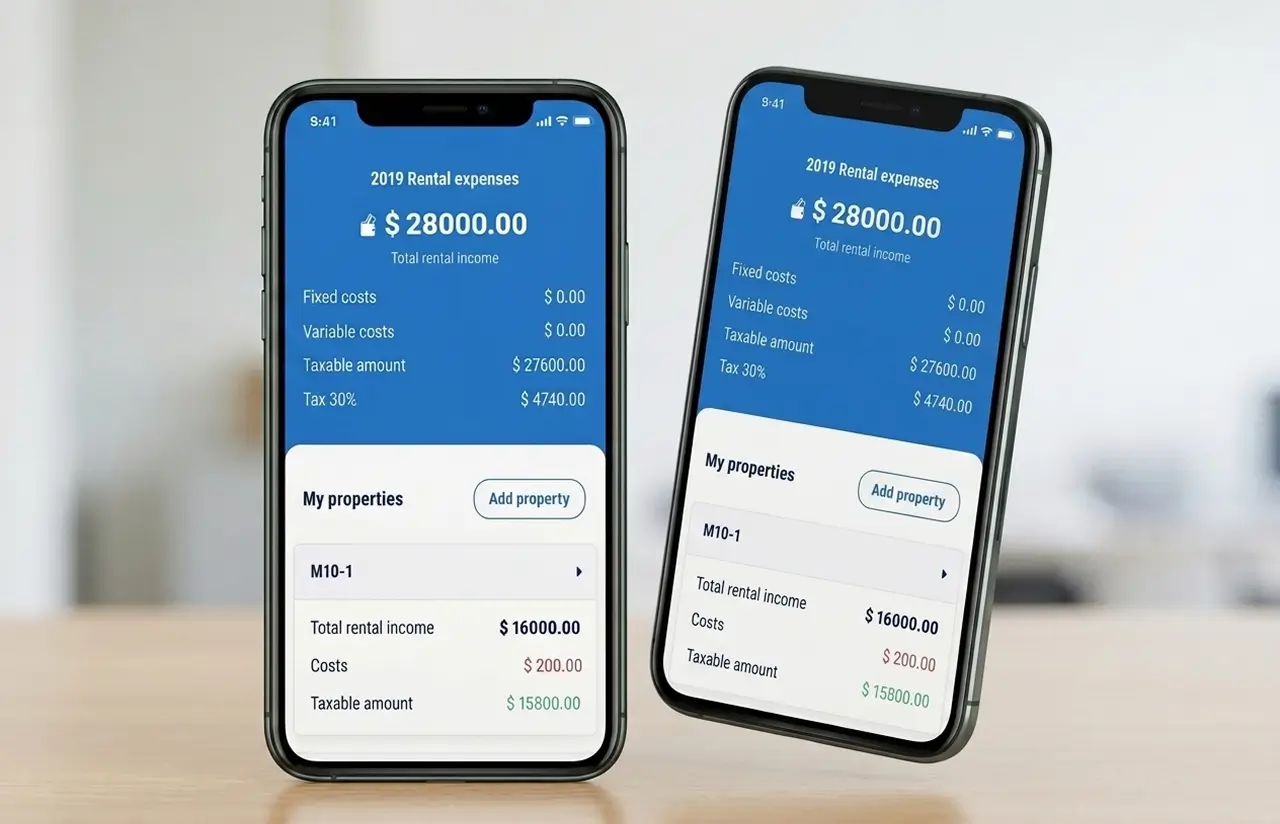
Tracks income, fixed costs, variable costs, taxable amount, and tax liability per property. Landlords see a real-time summary of their entire rental portfolio.
Property Search with Map & Filters
Tenants search by city, price range, area, bedrooms, and availability date. Results appear as cards and as price pins on an interactive map, similar to the pattern Airbnb popularized.
Verified Profiles
Every landlord and service provider profile is checked manually before it goes live. Tenants see a verified badge, which cuts inquiry-to-lease time because trust is already established.
Service Provider Marketplace
HVAC, cleaning, painting, lighting, landscaping – users filter by category, location, price range, reviews, and available time slots. Property owners book maintenance directly from the app.
Paperless Document Storage
Contracts, receipts, invoices, and renovation records live inside the app. Users can comment, share, and export documents for tax filing – a paperless property management system in pocket size.
Scrum Methodology
Project Journey
We ran two-week sprints from day one. The first sprint surfaced a tricky edge case: the original calculator used local storage only – no server sync. Migrating existing user data to a cloud backend without data loss became sprint 3’s top priority.
Discovery covered three user personas (landlord, tenant, service provider), the Finnish tax model, map integration trade-offs (Apple MapKit vs. Google Maps – we shipped both, toggled by OS), and the verification workflow for profiles.
How the product works
- Every user picks a role (landlord, tenant, or service provider), and each one unlocks a different side of the platform. Together, they form a closed ecosystem where every action by one role feeds into another.
- Landlords list properties with photos, pricing, square footage, and availability. Tenants search by location, budget, and filters, browsing results as cards or pins on an interactive map.
- Once a tenant finds the right place, they save it to a wishlist, message the landlord, and schedule a viewing. Service providers enter the picture when a landlord needs maintenance or prep work before move-in. Communication stays inside the app.
- After both sides agree on terms, contracts are signed and stored directly in the platform alongside receipts and invoices. Users can comment, share, and export files – everything stays organized and accessible when tax season comes around.
- The built-in rental calculator consolidates income and expenses for each property, computes the taxable amount, and generates a filing-ready summary. Landlords close the books without jumping between spreadsheets and bank statements.
- Tenants leave reviews after their experience; landlords rate tenants in return. Likes and ratings build a transparent reputation layer that helps the next person make a faster, more confident decision. Service providers grow their client base through positive feedback.
Scrum Process Flow
Mobile app development benefits from tight feedback loops, not waterfall releases. Scrum meant the client reviewed working builds every two weeks and steered the product before small issues became expensive rewrites.

-Timeline
Five Phases of Delivering the Landlord-Tenant Communication App
Discovery & Product Workshop
- Mapping three user personas and their core jobs-to-be-done
- Auditing the legacy codebase and data model
- Defining MVP scope: calculator + listings + verified profiles
UX/UI Design
- Wireframing role-based navigation (landlord vs. tenant vs. provider)
- Designing the property card component and map integration
- Usability testing with 8 Finnish landlords helped reduce onboarding from 6 steps to 4
Agile Development (Sprints)
- Building React Native shared codebase for iOS and Android
- Implementing Ruby on Rails API with role-based permissions
- Integrating Apple MapKit and Google Maps SDK with price-pin overlays
QA & Testing
- Device matrix testing across 12 iOS and 14 Android devices
- Tax calculation regression suite – 47 scenarios from Finnish tax authority rules
- Load-tested the listing search API with 500 concurrent users while maintaining stable response times
Launch & Support
- Publishing to Apple App Store and Google Play
- Monitoring crash-free sessions against a 99.5% target after launch
- Ongoing feature updates – expanding localization beyond Finnish
UI/UX Design
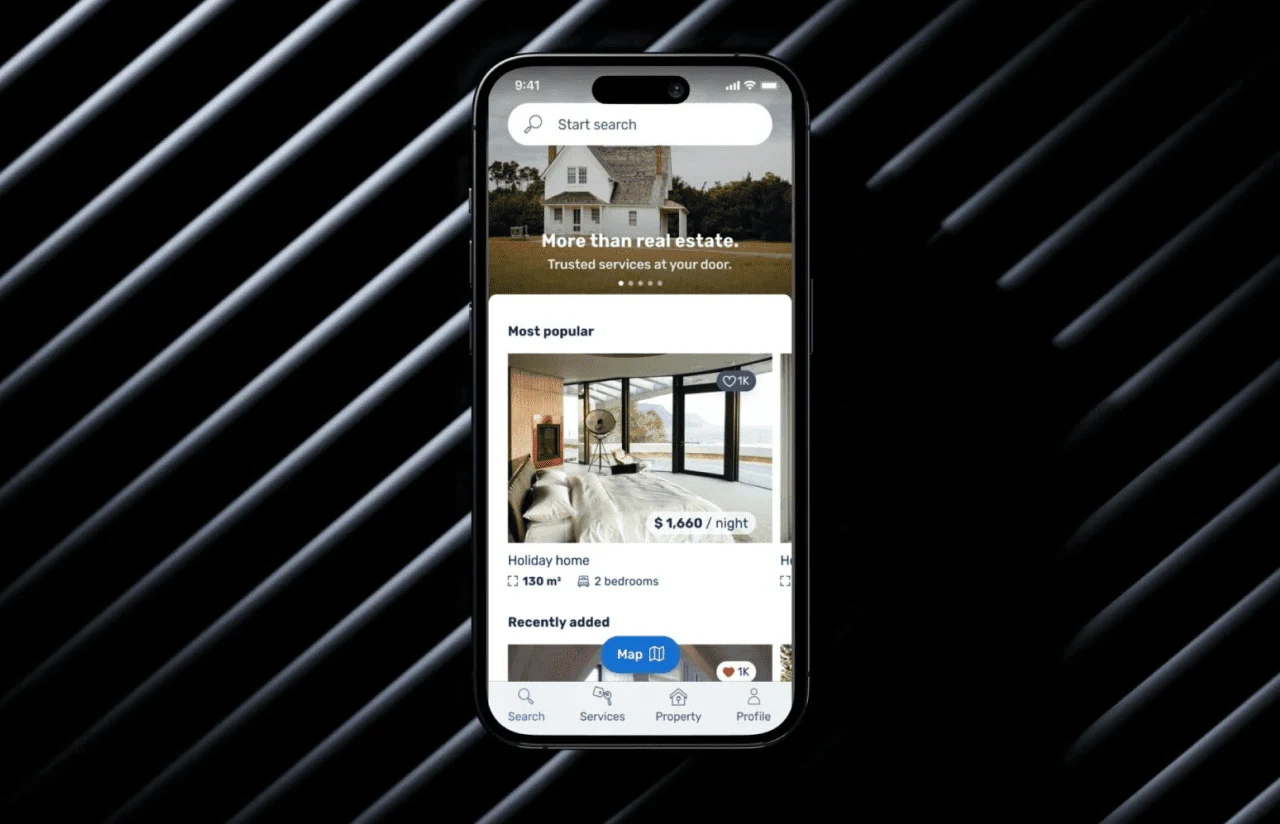
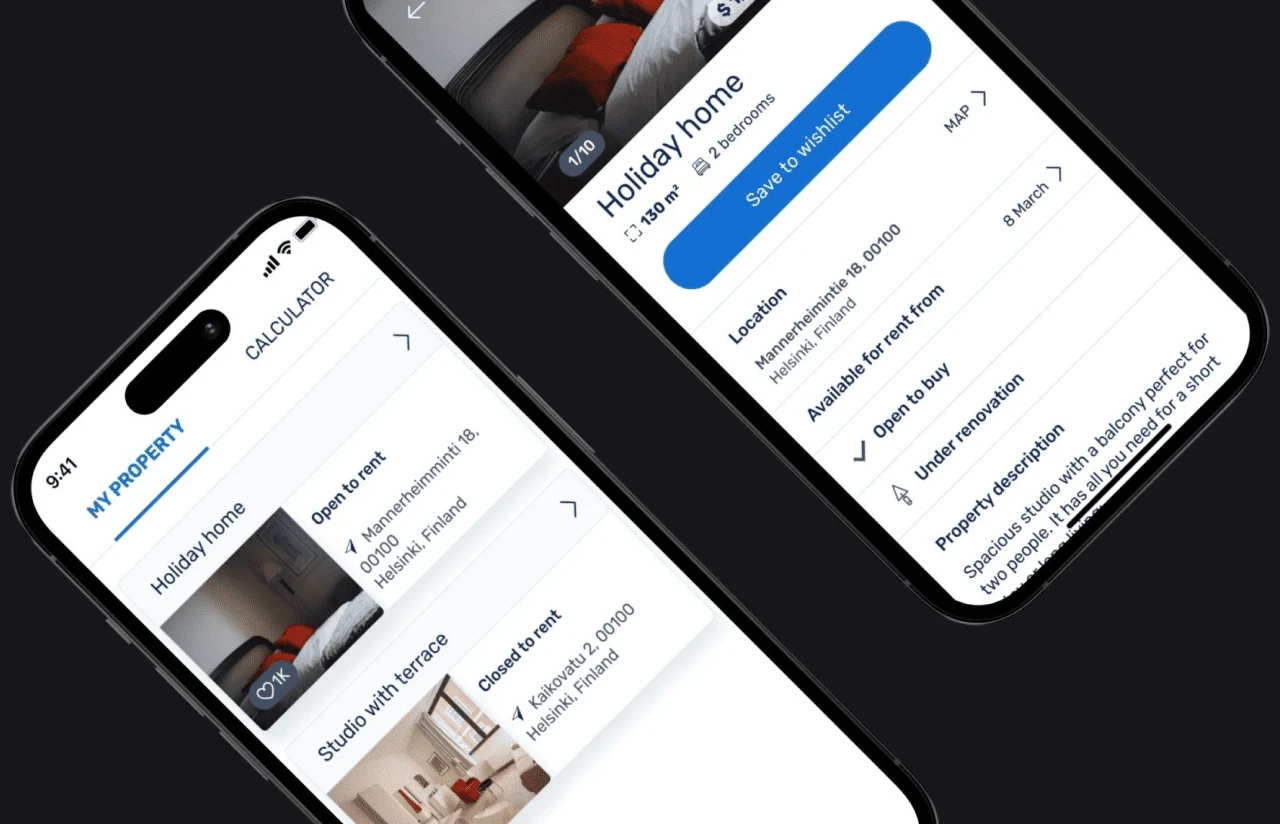
The interface was designed to feel familiar to anyone who has used a rental listing app – but with landlord tools baked in. Property cards show the photo carousel, price, area, and bedroom count in the first glance. One tap reveals full details, a map pin, and a “Save to wishlist” button.
The app shows the home feed with a search bar and “Most popular” section, the property detail screen with location and availability info, the service filter panel (HVAC, cleaning, lighting, etc.), and the rental expense calculator with per-property breakdowns. The color palette is clean: navy and white dominate, with blue accent buttons for primary actions like “Show results.”
The UX challenge was balancing density with simplicity. Landlords needed complex tax breakdowns, while tenants just wanted a clean search interface like Airbnb. We solved this by strictly separating context: the tenant side focuses on map-based discovery through Apple and Google Maps integration, while the landlord’s “My Property” dashboard consolidates tax metrics, tenant chats, and maintenance requests without overwhelming the screen. That separation kept cognitive load low for both audiences.
Navigation follows a four-tab pattern: Search, Services, Property, and Profile. Landlords see a “My Property” dashboard listing all holdings with status labels (“Open to rent,” “Closed to rent”). The calculator sits behind a dedicated tab inside that dashboard – landlords do not need to leave the property context to check their numbers.
Results
Before
- ✕Tax tracking lived in a standalone calculator with no cloud sync – data stuck on one device.
- ✕Landlords communicated with tenants via email, WhatsApp, and phone – no audit trail.
- ✕Property listings required third-party portals (Vuokraovi, Oikotie) with separate logins.
- ✕ Service providers were found through word-of-mouth or Google searches – no reviews, no booking.
- ✕No unified interface connected landlords, tenants, and service providers in one place.
After
- ✔Cloud-synced calculator tracks income and costs across unlimited properties per account.
- ✔ In-app messaging creates a timestamped record of every landlord-tenant conversation.
- ✔Listings, tenant search, and service bookings happen in one app – no portal-hopping.
- ✔ Service providers are filtered by category, location, price, and verified reviews.
- ✔A single platform connects all three user roles with role-based dashboards and shared property cards.

The Impact

-Verified Reviews
Our Reputation on Top Platforms
LITSLINK is consistently rated among the top mobile app and software development companies on Clutch, GoodFirms, and other industry review platforms. Client reviews highlight the team’s technical depth in React Native, communication throughout the engagement, and ability to navigate complex multi-role architectures.


Have the PropTech Project in Mind?
Need an app for landlords and tenants, or a landlord-tenant communication app for your real estate business? Tell us what you’re building – we’ll get back within 48 hours.