





At LITSLINK, we provide custom AI agent development services adjusted to your operations, data, and goals.
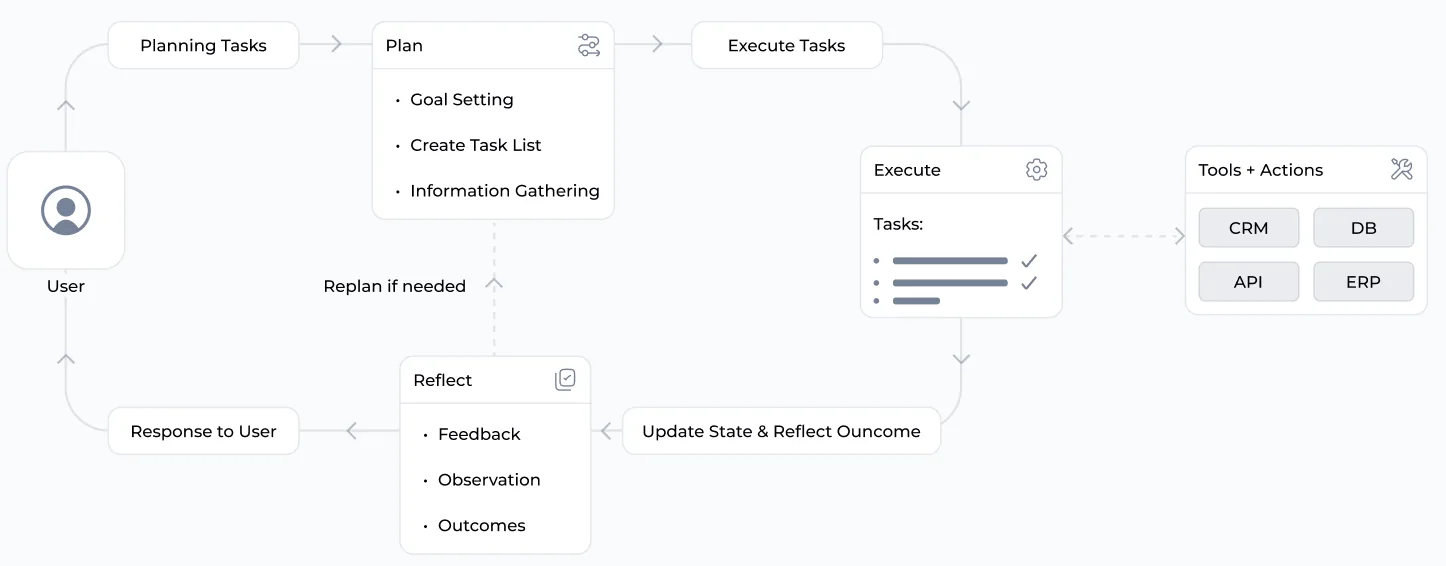
Every project starts the same way: we ask hard questions and figure out where agents can realistically deliver ROI given your actual constraints. Here's what the work typically looks like:
Not sure where to start? We analyze your operations, identify use cases with the clearest ROI potential, and build a prioritized roadmap. This phase alone tends to save clients months of going in the wrong direction.
This is the core of what we do. We design and build custom AI agent development solutions around your goals, infrastructure, and workflows. LLM-powered conversational agents, task-executing automation systems, and complex orchestrated pipelines.
We design multi-agent systems where specialized agents work in parallel – each handling a defined domain, communicating cleanly, and handing off tasks reliably. Orchestration logic, communication protocols, error handling – we consider all of it.
An agent that can't connect to your existing tools is only half as useful. We integrate AI agents with CRMs, ERPs, EHRs, databases, internal APIs, ticketing systems, and third-party services.
Already running something that underperforms? We audit your current setup, identify bottlenecks, update model versions, improve prompt architecture, and optimize retrieval and integration layers.
Not every organization wants to build an internal AI team. We offer managed deployment: you define the outcomes, we handle the infrastructure, monitoring, and ongoing tuning. Predictable cost, no operational overhead.
Ready to explore what agents could actually do for your business?
Let's talk.
Here's where we consistently see the clearest ROI and have helped clients deploy agents now running in production every day.
Agents handle high-volume, repetitive work with consistent accuracy — without proportionally scaling headcount. Cycle times compress. Error rates follow.
Agents work continuously — processing tasks, triggering workflows, and escalating only when human judgment is genuinely required. No queues, no overnight backlog.
HIPAA, GDPR, SOC 2, and CCPA requirements are designed in from day one — not retrofitted once regulators ask questions. Encryption, RBAC, and full audit trails by default.
A focused proof of concept on real data, in a real environment, in 4–6 weeks. Full production systems in 3–6 months. Assumptions get stress-tested before full commitment.
Agents integrate into your current CRM, ERP, databases, and APIs. The goal is for the agent to become part of your operating environment — not a separate system that adds management overhead.
Unlike static software, agents improve over time. Model drift happens, data evolves, new edge cases emerge. We track all of it and push optimizations proactively.
Different problems need different architectures. Here's the range we work across – and what each is actually suited for:
Far beyond scripted Q&A. These agents understand context, hold coherent multi-turn conversations, take actions inside your systems, and resolve issues on their own – escalating to a human only when the situation genuinely calls for it.
Build this type of agent with us →TYPICAL USE CASES
For automating sequences of actions: filling forms, triggering downstream workflows, updating records, sending communications, and making escalation decisions. Structured process execution that adapts when conditions shift.
Build this type of agent with us →TYPICAL USE CASES
For situations where a judgment call is needed based on live data. These agents synthesize signals from multiple sources, evaluate conditions against defined criteria, and recommend or take action – with human-in-the-loop escalation for the decisions where it matters.
Build this type of agent with us →TYPICAL USE CASES
Complex pipelines where specialized sub-agents handle distinct domains in parallel. Document extraction, policy verification, and payment initiation. Built for workflows that are genuinely too complex for a single model to handle reliably.
Build this type of agent with us →TYPICAL USE CASES
For organizations that need intelligent search and synthesis across large document repositories, internal wikis, policies, or product catalogs. These agents retrieve the right context, reason over it, and deliver accurate, grounded answers. Much lower hallucination risk than a generic chatbot pointed at your data.
Build this type of agent with us →TYPICAL USE CASES
For augmenting your team's workflow rather than replacing it. Sales intelligence tools, code review assistants, legal document summarizers, internal knowledge retrieval — AI that makes your people faster and sharper.
Build this type of agent with us →TYPICAL USE CASES
What makes an agent genuinely robust is how the components work together under real operational conditions. Here's what goes into every agent we build:
Our agents are built to process multiple input types simultaneously – structured data, unstructured text, documents, API responses, database records, and real-time event streams. We design the ingestion layer around your actual data environment. In practice, that means handling inconsistent formats, incomplete records, and edge cases.
This is the LLM layer. We design prompt structures, chain-of-thought scaffolding, and decision trees that guide the model toward reliable, consistent outputs for your specific use case. Model selection matters here too: for some tasks, Claude's long context window is the right call; for others, GPT-5's function-calling performance wins. We've run enough head-to-head comparisons on real production workloads to have data-grounded opinions.
Short-term context is relatively straightforward. Long-term memory is harder. We implement vector database retrieval (Pinecone, Weaviate, or pgvector, depending on scale and latency requirements) to give agents persistent access to relevant knowledge. For enterprise deployments, we also build episodic memory layers that let agents learn from past interactions over time.
We build and connect tool libraries that give agents controlled, auditable access to your systems – CRMs, ERPs, internal APIs, databases, communication platforms, third-party services. Every tool call is logged. Permissions are scoped. Write operations go through validation before they touch anything in production. This is the integration work where we've built the most hard-won expertise.
For single-agent workflows, LangGraph gives us stateful, controllable execution graphs. For multi-agent systems, we use CrewAI or AutoGen depending on the coordination pattern. The orchestration layer is what keeps a complex agent pipeline from becoming a complex agent failure cascade.
We build confidence thresholds, output-schema enforcement, semantic-consistency checks, and – for high-stakes decisions – mandatory human-review gates. Hallucination mitigation is a constraint you design around from the start. In regulated environments, this layer also handles the audit trail requirements for HIPAA, GDPR, and SOC 2 compliance.
Every production agent we ship is instrumented at the reasoning step level – not just "did it succeed or fail," but why it made a specific decision, which tool it called, what the input was, and what validation it passed or failed. This makes debugging tractable, performance optimization systematic, and compliance audits something you can actually complete. Most teams don't build this until something breaks. We built it first.
Here's where we consistently see the clearest ROI and where, as an AI agent development agency, we've helped clients deploy agents that are now running in production every day:
Not sure which of your processes is the right starting point?
Start with a strategy consultation. We analyze your operations, identify where agents deliver the clearest value, and help you prioritize.
Over a decade of complex software development means we understand what it takes to build AI agents in environments where data sensitivity, compliance, and operational uptime are non-negotiable.
Patient scheduling automation, medical coding assistance, clinical documentation processing, and diagnostic support tools. HIPAA-compliant architecture from day one, not as an afterthought. We've helped healthcare providers reduce administrative load significantly while improving patient experience.
Fraud detection agents that adapt to new patterns, risk assessment pipelines, compliance monitoring systems, and intelligent document processing for financial workflows. We know the regulatory landscape, and we build accordingly.
Route optimization agents, real-time demand forecasting, automated supplier communication, and disruption management systems that respond to conditions as they change – not after you've already missed a deadline.
Personalization agents, inventory optimization systems, returns processing automation, and customer service agents that actually resolve issues rather than creating more tickets. Built for scale because retail volume is unforgiving.
Internal productivity tooling, AI-powered onboarding workflows, product usage intelligence, smart customer support deflection, and developer-facing AI assistants. We've built for SaaS companies at every stage, from early-stage startups to established platforms.
Contract analysis agents, due diligence automation, document review pipelines, and compliance tracking systems. Work that used to take teams of paralegals days, done in hours – with the paper trail to prove it.
Predictive maintenance, quality inspection automation, production scheduling optimization, and supplier coordination. Enterprise AI agent development in manufacturing environments requires a different discipline – we've learned it in practice.
Property matching, document processing for transactions, tenant communication automation, and market analysis tooling. AI agent app development for real estate moves fast; we've built the systems that back it up.
Over a decade of complex software development means we understand what it takes to build AI agents in environments where data sensitivity, compliance, and operational uptime are non-negotiable.
Discuss your project →A software development team was spending time on the work that happened before any actual building began. Manually decomposing complex tasks into subtasks, pulling out key dates and stakeholders, thinking through risks. Junior teams moved slowly. Senior engineers got pulled into planning conversations instead of building.
We built a planning AI agent powered by GPT-5 that takes a task description as its input and runs it through a structured processing pipeline. The agent extracts named entities, generates a structured subtask list, and surfaces likely risks based on the task type.
A SaaS company had built solid CRM software, but user adoption was slow and inconsistent. New users kept surfacing the same support requests. The support team was fielding questions that should not have needed human answers.
We built an LLM-powered AI agent trained on the CRM's own Q&A documentation, with a library of Selenium-powered scripts that let it perform real actions inside the platform. When a user's request is ambiguous, the agent asks follow-up questions before acting.
A development team was tired of spending time on boilerplate JavaScript functions. The task was to automate the whole loop – but the hard part was making sure the output actually ran before anyone had to touch it.
We used a ReAct agent architecture in LangChain to give the model live access to Google and Stack Overflow during generation. The agent writes the JavaScript function, then executes it in a Docker-based VM. The code is only returned if it actually runs.
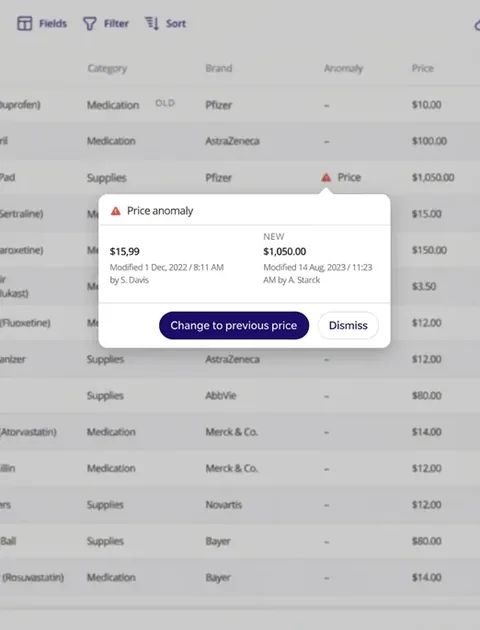
Acensify's data operations team faced a recurring issue: ERP entries that deviated from historical norms weren't flagged until they caused downstream problems. Manual reviews couldn't keep up with the volume.
We built an AI agent that monitors incoming ERP data and flags values that deviate from historical patterns across related tables. It uses a custom unsupervised model for tabular data, combined with rule-based checks for structured fields.
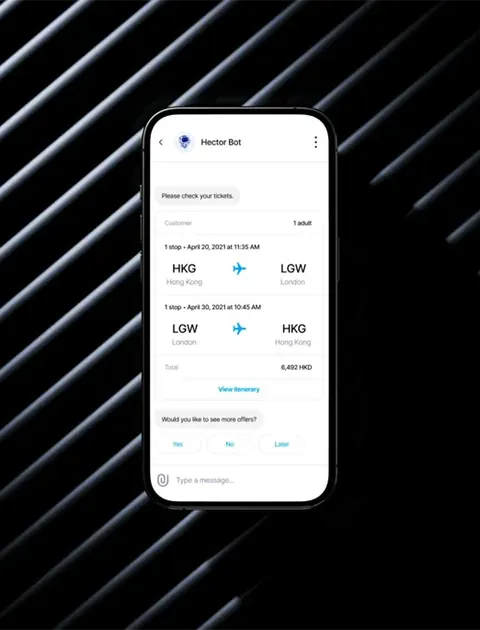
A travel services company needed a smarter way to handle incoming customer queries. A keyword-matching chatbot had already failed them – it did not understand the way real users phrase questions.
We built a conversational AI agent on Google DialogFlow, layered with a custom NER model to correctly identify locations, dates, and trip-specific details. A custom classification model routes each message to the right dialog path.
LITSLINK is recognized across leading industry platforms for delivering high-quality software solutions. See what clients and the design community say about our work.
We pick tools based on what the problem needs, not what's currently generating hype. That said, here's the landscape we work across.
OpenAI (GPT-5, GPT-5.4), Anthropic Claude, Google Gemini, Meta Llama, Mistral – we're model-agnostic and will recommend the right fit for your use case, cost profile, and data privacy requirements.
LangChain, LangGraph, CrewAI, Semantic Kernel, LlamaIndex, Microsoft AutoGen – framework selection depends on your agent architecture and workflow complexity.
Pinecone, Weaviate, Chroma, FAISS – for retrieval-augmented generation and knowledge management.
Apache Airflow, Prefect, Temporal – for reliable task scheduling and workflow management at scale.
AWS (Bedrock, SageMaker), Microsoft Azure AI, Google Cloud Vertex AI – full cloud provider expertise, with no lock-in to a single platform.
TensorFlow, PyTorch – for custom model development and fine-tuning when off-the-shelf isn't enough.
GDPR, HIPAA, SOC 2, CCPA – built in from architecture through deployment. Encryption at rest and in transit, role-based access controls, and comprehensive audit trails.
Node.js, Python, FastAPI, Docker, Kubernetes – production-grade infrastructure for reliable agent deployment at scale.
Model-agnostic by design. We don't lock you into a single provider. Our architecture lets you swap models as the landscape evolves — without rebuilding your entire system.
We've been building complex software since 2014. We've seen enough of those projects – often from clients who came to us after the fact – to understand exactly where things go sideways.
Things work the way your business actually works. Every agent is architected around your specific data environment, integration requirements, and business logic.
Healthcare compliance, financial risk controls, legal document processing – we've done the hard work in environments where mistakes carry real consequences.
A focused proof of concept in 4–6 weeks. Full production systems in 3–6 months. Our delivery process has been refined enough that we move faster than most comparable teams without cutting corners on quality.
AI agents need more than ML expertise. Data engineering, backend development, systems integration, UX, security – all covered internally.
We work around US business hours, communicate clearly, and treat your project with the same urgency you bring to it.
Your data and your customers' data are protected at every layer. We can show you our security posture, not just describe it.
You own the custom architecture, the prompts, the integration code, and the data. We build it for you, and it belongs to your business.
Production rollout is not the finish line. We stay involved to optimize performance, improve workflows, and help your AI agents keep delivering value as your business evolves.
No black boxes, no mystery. Here's exactly how we work — and why each phase exists.
We map your operations, identify where agents can deliver the clearest ROI, and build a prioritized roadmap.
Good agents run on good data. We assess quality, identify gaps, evaluate integration points, and determine what's usable as-is via RAG, while surfacing the constraints that will shape every downstream architectural decision.
We design the architecture that fits your infrastructure, compliance requirements, and budget – and select models and frameworks based on what your specific use case actually needs.
A focused proof of concept on real data, in a real environment, with measurable outcomes. This is where assumptions get stress-tested before full commitment.
We build the connectors to your existing systems and configure guardrails – hallucination mitigation, output validation, access controls – before the agent gets anywhere near production.
Adversarial inputs, edge cases, load testing, and hallucination guardrail validation. Then, a controlled pilot with real users before full rollout. We gather feedback, fix what needs fixing, and confirm the system performs before it carries real operational weight.
Production launch, with monitoring dashboards your team can actually read and act on. Task completion rates, error frequency, latency, and user satisfaction – all tracked.
Agents improve over time. We push optimizations proactively as your data evolves, new edge cases emerge, and model versions improve. The system that goes live on day one should be meaningfully better by month six.
Typical timeline: PoC in 4–6 weeks · Full production in 3–6 months
Security and compliance are baked into our architecture from the start – not retrofitted once regulators ask questions.
Discuss your compliance requirements →Agents only access the data and systems they're authorized to touch, scoped by role and use case.
At rest and in transit across all agent components and integration layers.
Comprehensive records of agent actions, decisions, and data access for compliance review and incident response.
Real-time visibility into agent behavior, latency, error rates, and performance drift.
Output validation, retrieval grounding, and confidence thresholds that catch problematic responses before they reach users.
Structured escalation paths for high-stakes decisions, with clean handoff and resumption logic.
For healthcare, fintech, and other regulated environments where compliance isn't optional.
Project cost depends heavily on scope, integration complexity, and what "production-grade" looks like in your environment. Here's a realistic breakdown.
The AI agent development cost for any given project is shaped by a handful of key factors:
Clean, accessible, well-structured data meaningfully reduces development time
If your team or customers interact directly with the agent, UX matters
Every system connection has its own cost; some are straightforward, some aren't
Cloud-managed versus self-hosted models carry different ongoing operational costs
HIPAA, GDPR, and SOC 2 add architecture and documentation overhead that's real but necessary
What ongoing optimization and incident response looks like post-launch
We'll give you a clear, honest estimate once we understand your actual requirements.
Straight answers to the most common questions about AI agent development, timelines, cost, and what to expect from working with us.
AI agent development is the process of designing, building, and deploying software systems that can perceive their environment, reason over it, make decisions, and take actions – autonomously or with human oversight. Unlike traditional software that executes fixed instructions, agents adapt. They can use tools, call APIs, process unstructured data, and handle multi-step tasks without someone manually directing each move. In practical business terms, it's a system that actually gets things done.
A chatbot follows a script. An AI agent executes. Agents use tools, call APIs, reason through multi-step tasks, and take actions in your systems – without needing a human to prompt every move. If a chatbot is a receptionist who answers questions, an AI agent is the employee who actually processes what comes next.
A focused proof of concept can be running in 4–6 weeks. A full-scale production system with complex integrations and compliance requirements typically takes 3–6 months from discovery to launch. We give you a realistic timeline in the first conversation.
The main platforms include OpenAI (and Azure OpenAI), Anthropic Claude, Google Vertex AI, AWS Bedrock, and Meta Llama for model infrastructure; LangChain, LangGraph, LlamaIndex, AutoGen, and CrewAI for orchestration; and Pinecone, Weaviate, Chroma, and FAISS for vector search and RAG.
Not always. Many use cases work well with retrieval-augmented generation on your existing documents and knowledge bases. Others benefit from fine-tuning on historical data. It depends on the use case – and we figure that out during our data audit before building anything.
It's built into the architecture from the start, not patched on at the end. Encryption at rest and in transit, role-based access controls, and comprehensive audit trails. For regulated industries – healthcare, fintech, legal – we design to HIPAA, GDPR, SOC 2, and CCPA requirements from day one.
We stay involved. Ongoing support and performance monitoring are parts of every engagement. Agents improve over time – model drift happens, data changes, and new edge cases emerge. You're not on your own after go-live.

Yes, that's a core part of what we build. We connect agents to your CRM, ERP, databases, communication tools, and third-party APIs. The goal is for the agent to become part of your operating environment, not a separate system that adds management overhead.
Start with a strategy consultation. We analyze your operations, identify where agents deliver the clearest value, and help you prioritize. A focused analysis typically saves months of building the wrong thing.
The main types are simple reflex agents, model-based agents, goal-based agents, utility-based agents, and learning agents. Simple reflex agents respond to fixed rules, while model-based agents use context about the current environment. Goal-based and utility-based agents make decisions based on desired outcomes and trade-offs, while learning agents improve over time.
The IT industry falls under the influence of AI agents. These smart technologies can learn, reason, and decide independently. Businesses turn to them to s...
6 min readBogged down by repetitive tasks or losing ground to competitors? Building an AI agent can cut costs, boost efficiency, and put you back in the lead—fast...
6 min readMost demos look impressive. Fewer agents survive contact with real production data, complex integrations, and compliance requirements.
6 min read