







Key Takeaways:
- Global AI agents market size reached $12 billion in early 2026. Experts project a steady rise toward $52.62 billion by 2030.
- 2.2 billion AI assistants are expected to be available for people to use by 2030. This signals a permanent shift toward autonomous enterprise operations.
- Nearly 88% of organizations have integrated autonomous agents into their core business workflows.
- Implementing agentic systems can reduce operational expenses by 45%. It also boosts overall productivity by approximately 25%.
- Healthcare, finance, and retail are the primary sectors driving the demand for specialized digital workers.
A recent McKinsey report indicates that 92% of companies plan to increase AI investments within the next 3 years. Companies’ executives believe the statistics that forecast AI agents will increase investments by at least 10% during this time. These artificial tools can improve efficiency by 55% and reduce costs by 35% for companies utilizing them.
ChatGPT, Gemini, or Grok are transforming content creation and customer service. Virtual assistants, such as Amazon’s Alexa and Apple’s Siri, handle multiple tasks, from setting reminders to controlling smart home devices. These statistics underscore the momentum behind real deployments.
How does this apply to you? Machine intelligence has become a crucial tool for business efficiency. It’s time to use its full potential.
AI Agents Global Market Size
AI has rapidly broken into the market, making big companies quickly adapt to its rules and changing customer interactions. According to Statista, the global artificial intelligence market is expected to reach $335.29 billion by 2026. The United States will be the largest donor to this volume, investing approximately $75.14 billion of the total. Experts predict that by 2034, these members will reach $2.48 trillion with a 26.60% CAGR.
The virtual assistant market is expected to reach $14.10 billion by 2030, with a CAGR of 24.3%. This improvement will mainly be due to developments in natural language processing (NLP), machine learning (ML), and the increase in IoT devices.
AI Agents Market Growth Statistics
- In the consumer segment, virtual assistants are projected to reach $14.10 billion by 2030.
- Smart home devices will reach approximately $537 billion by 2030.
- Among the leading industries that actively use artificial intelligence in 2026 are finance, healthcare, retail.
If you want to know how to build your custom virtual agent, we have a comprehensive guide for you. Learn how AI affects jobs in our blog.
How Many AI Agents Are There in the World
The global number of active virtual assistants reached roughly 28 million by the beginning of 2026. Current Statista forecasts suggest a massive surge in this digital workforce soon. Researchers forecast that the number of active autonomous AI agents will exceed 2.2 billion by 2030.
This growth reflects a rapid transition from experimental bots to production-ready digital employees. The same report says that nearly 40% of enterprise applications in the United States now feature integrated task-specific agents. The volume of work these systems execute is even more impressive.
AI Agent Adoption by Industry
From healthcare to retail, companies are leveraging machines to work smarter, faster, and more efficiently. Here’s how several of the largest sectors are deploying these artificial agents to work.
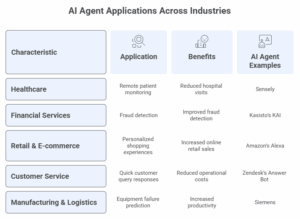
Healthcare: Smarter Diagnostics, Better Patient Care
Virtual nurses such as Sensely are adept at monitoring patients remotely, developing personalized care plans, or sending medication reminders. This results in reduced hospital visits and improved patient outcomes. Artificial intelligence is projected to save the healthcare industry up to $150 billion annually by 2026 through error reduction/enhanced efficiency.
Financial Services: Combating Fraud, Improving Customer Experience
Financial institutions use AI agents like Kasisto’s KAI to provide round-the-clock customer support, analyze financial data, and identify fraud. 70% of financial institutions use these tools to detect fraudulent transactions, which, in turn, helps improve security by 40%.
Retail & E-commerce: Tailored Content & Increase in Revenue
AI assists retailers in customizing shopping experiences, managing inventory, and optimizing supply chains. Assistants such as Amazon’s Alexa or Google’s Shopping Assistant help shoppers find products, compare prices, and make purchases more quickly. Amazon’s AI-powered recommendation engine now accounts for 35% of online retail sales.
Customer Service — Quicker Responses at a Reduced Cost
Chatbots and virtual assistants such as Zendesk’s Answer Bot and Intercom’s Fin, powered by artificial tools, tackle millions of customer queries each day. They shorten response times, increase satisfaction, and lower costs. In fact, these tools can now manage about 80% of all customer service interactions, reducing operational costs by 30%.
Manufacturing & Logistics: More Intelligent Production, Fewer Failures
AI agents forecast equipment failures, optimize supply chains, and minimize downtime. Siemens and GE are among the companies leveraging AI to monitor machinery and schedule maintenance in advance of breakdowns. AI-powered automation might result in a 25%-30% increase in productivity.
Breakdown of AI Agent Report Usage by Industry
| Industry | Current AI Agent Statistics/Market/Key Impact |
| Healthcare | Agentic workflows resolve 95% of routine patient inquiries automatically. AI-driven monitoring reduces physician burnout by approximately 30%. |
| Finance | Roughly 88% of financial institutions leverage autonomous agents for fraud prevention. Implementation of these tools has increased operational security by 40%. Customer satisfaction scores have risen by 32% due to instant support. report |
| Retail & E-commerce | About 78% of top-tier retailers use autonomous systems for hyper-personalized marketing. Currently, AI agents manage nearly 82% of all digital consumer interactions. This shift has boosted average order values by 18% across the sector. |
| Customer Service | In 2026, AI is integrated into nearly 90% of global customer service touchpoints. Transitioning to autonomous support models has decreased average handling costs by 45%. Companies report a significant reduction in human agent turnover. |
| Logistics & Manufacturing | Agent-based automation is integrated into the digital strategies of around 75% of manufacturers. These tools have increased overall production yield by 28%. Predictive maintenance agents have successfully slashed unplanned downtime by 60%. |
Popular Examples in Use Today
Autonomous agents act as essential partners in both domestic and professional environments. These systems have moved beyond simple interfaces to drive core business operations. Following table highlights leading platforms currently shaping the global digital landscape.
| Agent | Description | Core Business Impact |
| OpenAI (ChatGPT & Operators) | Integrated into 85% of Fortune 500 enterprise workflows. | Automates complex reasoning; multi-step decision-making. |
| Google Gemini & Home | Directs intelligent ecosystems for millions of active users worldwide. | Delivers hyper-personalized insights; cross-platform automation. |
| Apple Intelligence (Siri) | Advanced system with deep contextual awareness/privacy-first logic. | Enhances personal productivity through proactive task management. |
| IBM Watsonx | Powerhouse for regulated finance and healthcare sectors. | Executes predictive modeling and large-scale data governance. |
| Autonomous Systems (Tesla & Logistics) | Leading the shift toward self-driving transportation and robotic delivery. | Optimizes global supply chains through independent vehicle navigation. |
AI Agent Adoption Rate
Virtual assistance has become a vital part of everyday life. It’s difficult to find an enterprise or individual who won’t use any LLM. However, there’s still a difference between business assistants and home assistants. Entrepreneurs should consider these differences when planning to design a product for consumers, not corporations.
Businesses have to understand the basic needs their customers face every day. After understanding users’ “pains,” they can start creating solutions to take these “pains” away.
Let’s take a look at the top 5 artificial assistants for businesses and for homes.
Top 5 AI Agent Adoptions By Businesses
This table highlights how AI agents have become essential pillars across key industries in 2025, optimizing operations, improving customer satisfaction, and automating routine tasks.
| Agent Name | Primary Business Category | Key “Agentic” Feature |
| Salesforce Agentforce | Sales & Customer Success | Autonomous Logic: Can handle negotiations; resolve complex service tickets without human intervention. |
| Microsoft Copilot Agents | Operations & Productivity | Cross-App Orchestration: Moves data seamlessly between Teams, Excel, Outlook to automate routine project management. |
| Ruh AI | Digital Workforce (HR/SDR) | Plug-and-Play Employees: Offers “pre-hired” agents like Sarah (SDR) that join your Slack/Teams and start working with zero setup. |
| Beam AI | Finance & Operations | Self-Healing Workflows: Automatically identifies/fixes broken business triggers (like supply chain delays) in real-time. |
| Glean | Knowledge Management | Central Brain: Acts as a unified intelligence layer that searches and acts upon data across all company silos (Slack, Drive, Jira). |
Top 5 AI Agents Adoptions by Homes
| Assistant | Best For | “Agentic” Upgrade in 2026 |
| Amazon Alexa | Device Ecosystem | No longer waits for commands; uses sensors and habits to preemptively adjust lights, security, and energy. |
| Google Gemini (Home) | Intelligence & Search | Can answer complex follow-ups like “Where did I leave my keys?” by checking history from Nest Cam vision logs. |
| Apple Siri | Privacy & Continuity | Processes almost all voice and automation data on-device (HomePod/Apple TV) rather than the cloud. |
| Samsung SmartThings | Complex Automation | Actively manages multi-brand “Matter” devices to optimize for home energy efficiency and cost-saving. |
| Home Assistant (Assist) | Privacy & Power Users | Users can run their own private models (like Llama 3) locally to control their home without any external data sent to the cloud. |
Individuals like applications that are constructed for their personal characteristics. It makes it easier to get the results they are looking for. Big companies, on the other hand, design systems that would be user-friendly for a large number of people.
It means, for personal use, you can create a virtual assistant that would be integrated into a smartphone. That’s what people would prefer to manipulate. Companies would be glad to get massive systems with a good UI/UX design that would manage a lot of daily tasks.
User Engagement and Satisfaction
| Aspect | Statistic / Insight |
| Customer Satisfaction | 41% of consumers feel service has worsened due to poorly implemented AI; however, 72% report improved experiences when assistants are personalized and feature seamless human handoffs. |
| Retail Personalization | AI-driven “Relationship Orchestration” now drives 20–30% revenue increases by moving past basic product suggestions to proactive, context-aware loyalty management. |
| Employee Productivity | Studies show a 25% uplift in task quality and a 42% reduction in time for information-heavy tasks (like research or reporting) when using autonomous tools. |
| Knowledge Worker Usage | 60% of the workforce is now equipped with sanctioned AI tools, with 57% of organizations using solutions to handle complex, multi-stage workflows. |
| Business Workflow Integration | 40% of all enterprise applications now feature task-specific AI agents (up from <5% in 2025), acting as the “backbone” of corporate digital architecture. |
| AI Integration in Strategy | 73% of business leaders view Agentic AI as their primary competitive advantage, with 25% reporting that AI has already “deeply transformed” their core business model. |
| AI Development & Deployment | 90% of organizations use intelligent systems for coding; 42% of tech leaders now trust agents to lead software development projects with only high-level human oversight. |
AI agents help companies save costs, increase productivity, and ameliorate customer experiences. This technology will only proliferate in the upcoming years, with new use cases and abilities demonstrated annually.
Strategic Benefits for Enterprise Operations
Implementing autonomous systems today offers clear wins for any corporate structure. The biggest advantage is how quickly companies can now launch new services. Intelligent tools take over dull, repetitive admin tasks. This allows your best experts to focus on high-level strategy instead. Recent US data shows that AI agents save about 44% of time for office personnel. Beyond speed, these systems virtually eliminate costly human errors in data entry. They also handle complex financial calculations with perfect precision.
Scalability has also become much easier for growing brands. Your digital workforce expands the moment demand spikes. You no longer need to worry about seasonal hiring costs or training delays. Security gets a massive upgrade, too. Autonomous monitors spot network threats in real-time, long before they cause damage. For leaders, these tools provide a solid, data-backed foundation. You can make faster and more accurate executive calls with total confidence.
Why LITSLINK for AI Agents Development
Based on current insights into the AI market and trends in AI agent development, we design, develop, and scale production-grade AI agents that correlate to actual KPIs. What we deliver:
- Strategy & scoping: problem framing, agent use-case shortlist, ROI model, success metrics.
- Solution architecture: tool-use planning, RAG pipelines, function-calling, memory, guardrails, observability.
- Rapid prototyping (2–4 weeks): clickable demo or working POC integrated with your data and apps.
- Production build: hardened agents with evaluation harnesses, cost/latency budgets, and autoscaling.
- MLOps & governance: telemetry, prompt/version control, offline evals, policy checks, red-team tests.
- Security & compliance: SSO, RBAC, data residency, audit trails; GDPR/CCPA readiness, HIPAA-ready setups where required.
We reduce the risk of AI agents’ adoption, transform concepts into quantifiable pilots in a matter of weeks, and scale to production with reliability using this stack and delivery model. See how we approach custom AI agent development with a focus on real KPIs, not just demo.
List of our cases
RIV. An AI-enhanced platform that helps to forecast possible subtasks and challenges that each task can lead to.
Virtual CRM Helper. A user-friendly chatbot that helps newcomers to easily adapt to the new CRM system.
JS Code Generator. A solution that helps to test JavaScript functions to improve developers’ code.
Acensify anomaly detection. A virtual assistant that helps to find errors in users’ inputs, detecting anomalies within the ERP system.
AI Travel Bot. A chatbot with an integrated Google Dialogflow framework that helps to find and plan vacations and travel. It can find tickets, check out the timetable, etc.
Final Thoughts
AI agents have already made their mark in sectors such as healthcare, finance, retail, manufacturing, helping with efficiency, cost reduction, and tailored experiences. With the likes of ChatGPT, Gemini, Windows Copilot, IBM Watsonx becoming household names, our myriad experiences with AI solutions have highlighted the versatility and impact of this technology.
The statistics show a bright future for AI agents. By 2030, the market is expected to reach $52.62 billion, with advancements in natural language processing, machine learning, IoT integration also helping growth. New trends like autonomous decision-making, creative AI, industry-specific solutions will keep redefining the limits of what these virtual agents can do. This projection is consistent with the leading AI agents’ market size analyses for 2030.
Companies implementing this technology today will be able to prosper in tomorrow’s competitive market. For consumers, autonomous tools promise to help make life more convenient, efficient, and personalized.
AI agents provide many opportunities to drive growth and innovation, from automating routine tasks to enhancing customer experiences or gaining data-driven insights.
So don’t lag behind—embrace this technology today! Unleash new possibilities for your business. Reach out to us!
FAQ
Q: What is the current AI agent market size? What are the forecasts?
A: The global market reached approximately $12 billion in 2025. This sum might also be considered for AI agents’ market growth at the beginning of 2026. Experts predict a steady climb toward $1.30 trillion by 2032. This stems from the widespread adoption of standard AI agent technologies.
Q: How many AI agents are there in the world?
A: Recent data suggests there are over 30 million active artificial solutions globally. This number is expected to exceed 2.2 billion by 2030. Most of these digital workers currently focus on software development, customer support, or financial analysis.
Q: Which industries lead in AI agent adoption?
A: Enterprise AI agent adoption statistics show that healthcare, finance, retail are the primary sectors driving adoption. Banks use agents for fraud detection, while clinics deploy them for patient triaging. Retailers leverage autonomous systems to manage logistics and provide hyper-personalized shopping experiences.
Q: How do AI services reduce business costs?
A: These tools automate repetitive workflows, reducing the need for manual data entry. Companies often see operational cost reductions of up to 45%. Additionally, agents minimize human error, preventing expensive mistakes in accounting and supply chain management.
Q: Are AI tools secure for enterprise use?
A: Modern autonomous platforms utilize advanced encryption and private LLM instances to protect data. Standardized API protocols ensure that intelligent instruments communicate securely within a company’s internal network. Continuous monitoring also helps identify and mitigate potential security anomalies in real-time.