
Services.
End-to-end product development — from AI prototypes to scalable web and mobile platforms.
View all services →Not sure where to start?
Book a free discovery call →Software Development
Industries.
Domain expertise that shortens discovery and gets compliance right from day one.
View all industries →Not sure where to start?
Book a free discovery call →
AI Agents.
Custom AI agents that take routine work off your team — built and deployed in weeks.
View all AI agents →Not sure where to start?
Book a free discovery call →AI Agents For
- Job Search AI AgentsCandidate matching and screening
- Marketing AI AgentsContent, campaigns and lead scoring
- Healthcare AI AgentsPatient intake, triage and scheduling
- Insurance AI AgentsClaims processing and policy support
- AI Agents in FinanceFraud detection, compliance and reporting
- AI Legal AssistantsContract review, research and drafting

Technologies.
A modern stack for every layer of your product — pick one or let us recommend.
View all technologies →Not sure where to start?
Book a free discovery call →
Hire.
Vetted senior engineers who join your team in as little as 48 hours.
View all roles →Not sure where to start?
Book a free discovery call →
Case Studies.
1540+ projects delivered for startups and enterprises in 82+ countries.
View all case studies →Not sure where to start?
Book a free discovery call →
Resources.
Guides, live sessions and tools to plan your product and budget.
Visit the blog →Not sure where to start?
Book a free discovery call →
Company.
The team behind 1540+ projects for 1000+ clients worldwide.
Get in touch →Not sure where to start?
Book a free discovery call →In Numbers
- 82+Countries served
- 1000+Clients worldwide
- 1540+Projects delivered

Enter to search·Esc to close
Custom Healthcare Software Development Services in the USA
Every corner of the healthcare industry has a workflow that generic tools get wrong, and that is usually where our healthcare software development services come in. We work with US providers, payers, and HealthTech companies, building EHR and EMR systems, patient engagement software, telemedicine platforms, hospital management tools, and AI features embedded in real clinical workflows.
- 12+ years in custom software development
- 60+ healthcare projects
- Patient and clinician experiences designed for real workflows
- MVP to enterprise scale: architecture, delivery, and support
- HIPAA-ready data security

Healthcare Software Development Services for the US Market
Our custom healthcare software development company is a team of healthcare software developers serving the US market, working US business hours, experienced with health system procurement, and proven through HIPAA audits. We have built for providers, insurers, pharmacies, and HealthTech startups, and we have modernized systems that were older than some of the engineers maintaining them.
Every engagement starts with the same question: what does your staff, your patients, your compliance officer, and your broader healthcare services and healthcare operations environment need this software to do? Then we engineer backward from that.
US business hours & timezone overlap
Your PM is reachable when you are. No 12-hour lag, no async-only communication.
US healthcare product expectations
We know what Epic and Oracle Health integrations look like in production. We have worked through Promoting Interoperability requirements, ONC interoperability mandates, and CMS reporting before, so your project does not pay for our learning curve.
Security-first approach by default
Encryption, audit logging, role-based access, and BAA readiness are engineering decisions we make before the first sprint, and buyers should choose partners who ensure compliance with HIPAA and GDPR; they are the same controls the proposed HIPAA Security Rule update would make mandatory.
Custom Healthcare Software Development Services We Provide
Our custom healthcare software solutions cover the whole run: discovery, architecture, design, build, QA, launch, and the years after launch when the product has to keep up with new rules and new integrations. Every category below is something we have shipped for a US client, and every card lists the technologies we reach for first. If your product sits between two of these categories (most do), that is the normal case, and the estimate accounts for it. These categories are useful for scoping, but teams with specialized workflows usually need custom software solutions over fixed platform categories, and we shape custom solutions around those constraints.
EHR/EMR Development
HL7 FHIR-native electronic health records built around your specific clinical workflows, from charting and orders to patient portals, with seamless integration and secure data exchange across connected systems.
Telehealth Platforms
End-to-end virtual care: video visits, async messaging, e-prescribing, and remote monitoring in one HIPAA-compliant product.
AI-Powered Clinical Tools
Decision support, ML-based diagnostics, predictive analytics, and ambient clinical documentation that fits real provider workflows.
Patient Engagement Apps
Mobile and web apps for chronic condition management, medication adherence, appointment scheduling, care team communication, and RPM with vitals tracking and wearable data sync.
Healthcare CRM Software
Patient acquisition and retention: lead intake, referral tracking, appointment reminders, outreach campaigns, and a 360-degree patient view that syncs with the EHR instead of duplicating it.
Hospital Management Software
Bed management, patient flow, staff scheduling, and administrative automation for health systems that rely on practice management systems and practice management software solutions to run leaner.
VR/AR for Healthcare
Clinical training environments, VR-assisted pain management, and AR-guided procedural tools for hospitals and medical educators.
Pharmacy & Medication Management
Prescription tracking, drug interaction checks, refill automation, and pharmacy workflow software that reduces errors and wait times.
Cloud & Infrastructure
HIPAA-compliant cloud architecture on AWS, Azure, or GCP. Scalable, auditable, and designed for the uptime expectations of healthcare environments.
Healthcare Insurance Software
Claims automation, eligibility verification, member portals, payer-side analytics, revenue cycle management, and medical billing software that supports provider and payer financial workflows.
Healthcare MVP & Software Product Development for Startups
Most HealthTech founders arrive with the same tension: investors want a working product in a quarter, and the first hospital customer wants a BAA, a security questionnaire, and an EHR integration before they will pilot anything. Our healthcare MVP software development services are built for exactly that gap.
LITSLINK's standard MVP track runs 10 weeks from signed contract to a working build. Add HIPAA controls, a FHIR connector, and multi-role access, and a well-scoped healthcare MVP usually lands in 3 to 5 months. We scope the first release around the one workflow that proves the business case, put the PHI handling, audit logging, and access controls in from sprint one (retrofitting them later costs more than building them in), and leave the roadmap open for the features that come after the pilot.
After the MVP, our healthcare software product development services carry the same team into version two: integrations, healthcare data analytics solutions, AI features, and the re-architecture that a platform needs when it goes from one pilot clinic to fifty.
What a healthcare MVP engagement includes
- A 2-to-3-week discovery sprint with a compliance checklist, product brief, and estimate
- One platform first (web, iOS, or Android), with a shared codebase where the product allows it
- HIPAA-ready architecture, PHI encryption, and RBAC from the first commit
- One core integration, usually an EHR, an e-prescribing service, or a payment provider
- Working demos every two weeks and a launch-ready build at the end
Custom Healthcare Software Development for Different Healthcare Organizations
Our software development services for healthcare organizations range from a single-site clinic replacing a paper intake form to a multi-state health system that needs bed management across 14 hospitals. Across the healthcare sector, the problems differ by setting, and so does the software. We work with healthcare providers of many kinds, from diagnostic labs to payers to venture-backed founders. A diagnostic lab cares about result turnaround and HL7 v2 feeds. A payer cares about claims accuracy. A founder cares about time to the first paying customer. Below is who we build for and what we typically build for them.
Hospitals & clinic chains
We build hospital management software and EHR systems that keep patient records consistent across locations and reduce the administrative drag.
Medical practices & clinics
Scheduling, billing, reminders, and documentation that work the way your staff actually works. These management tools streamline daily operations and patient communication.
Healthtech startups
Agile development and fast MVPs for founders who need to move quickly and stay healthcare-compliant from day one.
Diagnostic centers
Test scheduling, result processing, and hospital system integration. These workflows reduce manual coordination and improve audit trails.
Medical device manufacturers
QMS and compliance platforms supporting FDA and ISO certification workflows. Software that keeps pace with regulatory expectations, no manual adaptation needed.
Pharmaceutical companies
We build systems from research management and clinical trial coordination to data analytics software that enhances accuracy and speeds up the path from trial to market.
Mental health providers
Teletherapy and wellness platforms designed for online sessions, mood tracking, crisis workflows, and secure practitioner-patient communication.
Health insurance companies
Claims automation, policy management, and secure member access to digital health data. Systems that reduce the paperwork without reducing the oversight.
Fitness & wellness platforms
We build digital tools that connect health tracking, coach-client workflows, and compliance monitoring into something that actually holds a user's attention past the first two weeks.
CLIENT REVIEWS
What clients say about working with LITSLINK
Selected healthcare projects
Four projects that show the range of our custom healthcare software development work. Each one shipped into a live clinical environment, showing how tailored solutions performed in real healthcare services settings, and each one had at least one issue the brief did not mention.
All case studiesShiftRx
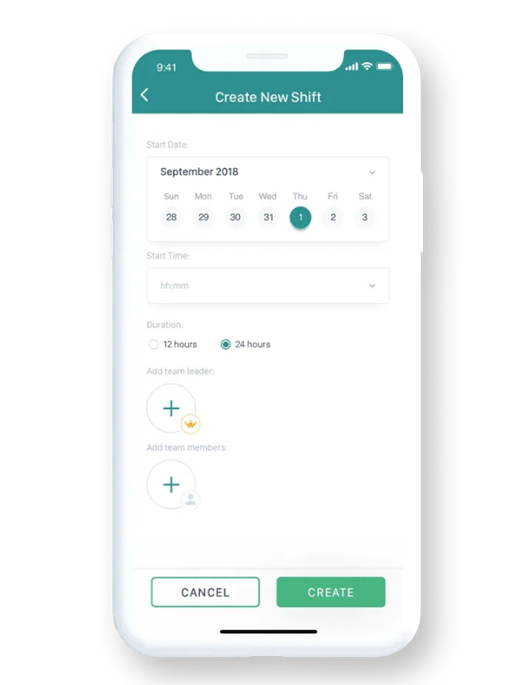
A cross-platform mobile tool that provides physicians with a structured environment to manage the entire shift: patient intake, clinical flags, drug tracking, labs, and a neat handoff summary. This was launched on Flutter for iOS and Android.
- Fragmented patient data across handoff shifts — no structured way to pass critical flags between doctors
- A single codebase had to perform reliably on both iOS and Android in a high-pressure clinical environment
- HIPAA-compliant data handling for drug administration logs and patient records in real time
Mighty Immersion
A VR therapy platform addressing pain management, physical rehabilitation, and pre-procedure anxiety — deployed across hospital networks of varying size and infrastructure. We scaled the system from a pilot handful of kits to 50+ active deployments.
- Scaling from a few VR kits to 50+ hospital deployments without breaking an already live and working system
- Making a complex VR setup manageable for non-technical clinical staff with no dedicated IT support on site
- Maintaining consistent performance across hardware variations and hospital network environments

Dalth
A telemedicine software as a service connecting patients and care providers in minutes. The product is for elderly users and experienced clinicians to use within the same interface, and was a UX challenge in which careful and considered design choices were made.
- Aggregating EHR data from multiple disconnected providers into one unified, real-time patient view
- Designing a single interface that works intuitively for elderly patients and experienced clinicians simultaneously
- Creating a multi-layered hierarchy of users without the user feeling it is complex

Helper
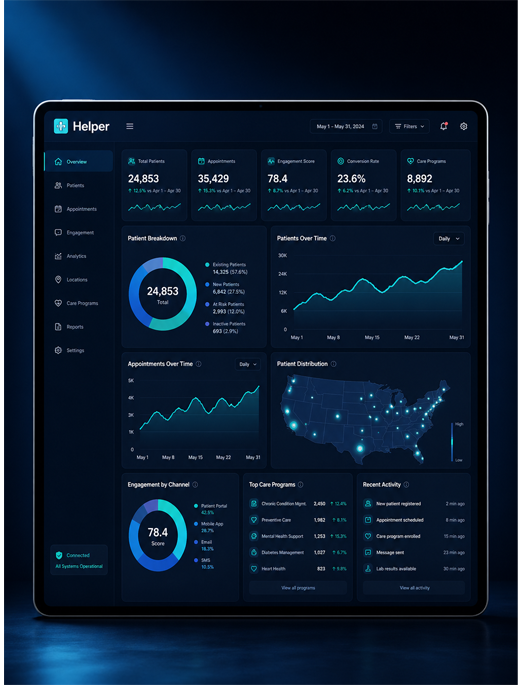
A care coordination platform with role-based access and AI-powered request routing that brings the whole patient support network together in one common area, designed to provide both professional and non-clinical consumers with the same product without sacrificing each group's experience.
- Granular role-based access control. The same patient record is visible to different stakeholders in appropriately scoped ways.
- AI-powered request routing that matches care needs to the right provider without manual assignment overhead.
- UI that feels approachable to a family member but doesn't feel dumbed-down to a specialist using it professionally
Why teams choose LITSLINK as their medical software development company
There are plenty of development vendors. The question is which ones actually understand healthcare and can prove it past the sales pitch.
Healthcare-specific engineering depth
Our specialists have set up HL7 FHIR solutions in production, HIPAA-compliant data pipelines, and EHR connections. When we state that "we handle EHR integration," we mean that we have firsthand knowledge of the nuances of practical processes and systems.
Transparent project management
One PM. Deep product knowledge. Proactive risk management. And when needs evolve, a 300+ specialist organization is ready to step in. You get continuity and flexibility — without the disruption of turnover or fragmented ownership.
Compliance is built into the delivery process
HIPAA, GDPR, and HL7 standards shape architectural decisions from day one — not as a final checkpoint, but as part of how we design and build. Buyers also often ask about quality and security expectations such as ISO 13485 and ISO 27001, so we account for those requirements early. Years of supporting healthcare products through HIPAA audits mean we know exactly where compliance gaps tend to appear.
Long-term partnership mindset
Many healthcare clients come back for a second initiative, then a third. That's not accidental. It comes from delivering on commitments, communicating openly, and building software that holds up long after launch.
Custom vs platform-based
healthcare software
The right call between a platform and custom healthcare software really comes down to what your system actually needs to do. Need something standard up and running fast? A platform works. But if you're dealing with specific clinical workflows, custom is the smarter investment.
Platform works when
- Workflows are standard
- You're okay adapting to the tool
- Launch speed beats flexibility
Custom healthcare solutions are worth it when
- Your care model has unique workflows, especially in regulated environments where ISO 13485 and ISO 27001 certifications are often part of the compliance picture
- You need custom healthcare software solutions for tighter control over workflows and integrations
- Patient or clinician experience is part of how you compete
7 steps from brief
to HIPAA-compliant product
Healthcare software fails when it is designed in a vacuum. Healthcare development services that skip the clinical environment produce a product nobody on the floor will open twice. Ours start with your clinical environment and regulatory obligations, then engineer backward from there. Seven steps, two-week sprints, and a working demo at the end of every one.
Discovery & Requirements
We spend real time upfront understanding your clinical environment, user workflows, and regulatory landscape before writing a single line of code. This phase answers the critical question: 'Are we building the right thing?' We map stakeholder needs, identify compliance requirements, and create a shared vision document that guides everything that follows.
Start discoverySolution Architecture
The entire lifespan of your product is impacted by architectural decisions made early. We design scalable, secure systems with FHIR resource mapping, PHI handling strategies, and integration patterns that support both current needs and future growth. Every technical choice is documented and justified.
Plan architectureUX / UI Design
Clinical UI design follows different rules than consumer apps. We create interfaces optimized for high-stress environments, complex data entry, and WCAG 2.1 AA accessibility standards. Every interaction is tested with real clinicians to ensure it fits seamlessly into existing workflows.
Design experienceTeam Setup
We assemble the right team composition for your project, establish CI/CD pipelines, provision HIPAA-compliant infrastructure, and execute the Business Associate Agreement. This phase ensures everyone is aligned and the technical foundation is rock-solid before development begins.
Set up teamAgile Development
Two-week sprint cycles deliver working demos you can test and validate. HIPAA compliance testing is woven into every sprint, not bolted on at the end. Daily commits, continuous integration, and transparent progress tracking keep you informed and in control throughout the build.
Start buildingQA, Security & Compliance Testing
Penetration testing, PHI handling validation, and audit log verification ensure your product is ready for real-world deployment. We conduct comprehensive security assessments, load testing, and user acceptance testing to identify and resolve issues before go-live.
Test & ValidateLaunch & Ongoing Support
Deployment, go-live support, and ongoing maintenance in a rapidly changing regulatory landscape. We handle infrastructure management, monitoring, and updates so your team can focus on delivering patient care. Comprehensive documentation ensures smooth handoffs and knowledge transfer.
Go liveAI Healthcare Software Development Services
We've integrated AI into healthcare products long enough to know where it works well and where it hinders progress. Our AI healthcare software development services focus on four areas with measurable returns. Increasingly, that work means deploying AI agents in healthcare: systems that take action, coordinate across tools, and operate within defined clinical boundaries with a human signing off. In regulated use cases, AI healthcare software may also need to meet FDA submission requirements for compliance.
Smarter diagnostics support
AI image analysis pipelines that manage pathology, CT, MRI, and X-ray repetitive pattern identification, allowing experts to concentrate on instances requiring their expertise.
- Multi-modality analysis with calibrated anomaly detection
- Continuous model retraining as data volume grows
- DICOM integration and PACS compatibility
- Agents that triage, prioritize, and route findings automatically
Automation of clinical documentation
AI-structured clinical records that sync to the EHR without manual re-entry, ambient voice capture, and live transcription allow doctors to spend more time with patients.
- Automatic classification by encounter type and diagnosis
- Bidirectional EHR sync without manual re-entry
- NLP-powered coding suggestions for billing accuracy
- Continuous RPM data streams
Predictive risk stratification
AI models that proactively identify high-risk patients (readmission risk, chronic illness progression, no-show prediction) so that care teams can take action before crises rather than during them.
- Explainable outputs that clinicians can act on with confidence
- Population-level cohort analysis for care planning
- Integration with care management workflows
Revenue cycle automation
AI-powered CPT and ICD-10 mapping from clinical documentation, pre-submission claim validation, and denial prediction — reducing manual coding overhead and improving collection rates.
- Automated CPT/ICD-10 mapping from clinical notes
- Pre-submission validation that reduces denial rates
- Integration with existing billing system infrastructure
IoT & Remote Patient Monitoring Software
Remote patient monitoring now includes mobile health applications as part of reimbursed remote care delivery, and the software behind it has to handle Bluetooth device pairing, unreliable home Wi-Fi, and a clinician dashboard that only raises the readings that matter. We have built RPM products that pull blood pressure, glucose, weight, pulse oximetry, and wearable data into a patient record and route out-of-range values to the right nurse.
The engineering problems are specific. Device data arrives in vendor formats that need mapping to FHIR Observation resources. Patients forget to charge things. A false alert at 3 a.m. costs more trust than a missed one, so thresholds and escalation rules need clinical input, not defaults. And the CPT codes for RPM (99453, 99454, 99457, 99458) each have documentation requirements the software should satisfy automatically.
What we build
- Patient mobile health applications that pair with Bluetooth medical devices and sync readings in the background
- Clinician dashboards with configurable thresholds, alert routing, and time-tracking for RPM billing
- FHIR-based integration that writes readings into the EHR instead of a separate silo
- Wearable and consumer device sync (Apple HealthKit, Google Health Connect, Fitbit, Withings)
- Secure data pipelines with PHI encryption in transit and at rest
Related work: our remote patient monitoring app case study covers a React Native platform that records checkup data from Bluetooth medical devices, and the employee wellness app shows AI health risk scoring from tracker data.
Home Healthcare Software Development Services
Home health and hospice agencies run a different operation than a clinic. The care team is mobile, the patient's family is part of the workflow, and every visit has to be verified for Medicaid billing under the federal Electronic Visit Verification mandate. Our home healthcare software development services are designed around those three facts.
Typical products include caregiver mobile apps with EVV (GPS or telephony visit verification, offline mode for rural routes, care plan checklists), scheduling and dispatch tools that match caregiver skills and certifications to patient needs and can reduce patient wait times by 35% through better scheduling and dispatch visibility, family portals and patient engagement tools that show visit notes, upcoming appointments, and clearer communication, and billing modules that generate compliant claims from verified visits. Where an agency already uses a platform for one part of the workflow, we integrate rather than replace it.
The same RPM and telehealth capabilities above extend into the home, so a hospital-at-home program or a post-discharge monitoring service can run on the same stack as the agency's daily operations.
Tech Stack We Use for Healthcare Software Development
These are the technologies we reach for most often in healthcare software development engagements, and the ones our engineers know thoroughly. We pick per project: a Flutter mobile app and a Node.js API for a startup, .NET or Java where a health system's IT team will inherit the code, Python for anything with a model in it.
Healthcare API, HIE & EHR Integration Development
One of the most common questions we get regarding our medical software services: "Can you integrate with our EHR?" The answer is yes, and we can tell you upfront where the complexity will be, which most vendors can't. In practice, that means planning for seamless integration with the systems your teams already rely on.
We build both sides of that exchange: the FHIR APIs a payer or health system has to expose, and the client integrations a HealthTech product needs to read from and write to the systems its customers already run. That work is designed for seamless data exchange and secure data exchange between systems and devices, and it often includes projects to modernize legacy healthcare systems.
HL7 FHIR R4 & SMART on FHIR
Resource mapping, API design, CDA document handling, SMART app authorization, and FHIR server configuration. Your EHR partners' expectations.
EHR / EMR Platforms
Tested integrations with Epic, Athenahealth, Cerner, DrChrono, Kareo, and HealthTap. We know where the API documentation doesn't tell the full story.
e-Prescribing & Pharmacy
Surescripts, DoseSpot, DrugBank, DailyMed, and OpenFDA integrations for e-prescribing, drug interaction checking, and formulary management.
Billing, Insurance & Payments
Stripe, Eligible, and insurance eligibility verification APIs for clean billing workflows — from copay collection to prior authorization management.
Is your healthcare software
HIPAA-ready?
Use this checklist as a baseline review for any application handling PHI. Most of these controls are also in the proposed HIPAA Security Rule update, which would remove the old "addressable" category and make MFA, encryption, asset inventories, annual penetration testing, and six-monthly vulnerability scans mandatory.
HIPAA Technical Safeguards Checklist (2026)
15 key controls for healthcare applications handling Protected Health Information
Custom Healthcare Software Development Cost & Timelines
The cost of custom healthcare software solutions varies based on five things: the number of user roles, the integrations, the compliance scope, the platforms you launch on, and whether there is an AI component that needs data and validation. The tiers below are real project ranges from our healthcare work. Use them to get a ballpark, then book a call for a detailed proposal, or try our app cost calculator for a first estimate.
Advanced EHR systems can cost over $2,000,000 when the scope includes broad interoperability, compliance, and multi-site workflows.
For HealthTech founders who need a fast, compliant first version in market.
- Discovery & product brief
- HIPAA-ready architecture
- Single-platform mobile or web build
- Core EHR or e-Rx integration
- 3–5 month delivery
For teams scaling beyond a pilot to a production clinical platform with multiple integrations.
- Solution architecture & FHIR mapping
- Multi-role user flows
- EHR + billing + e-Rx integrations
- Penetration testing & HIPAA audit prep
- Dedicated PM and delivery team
For enterprise health systems and HealthTech leaders deploying AI-powered clinical platforms across multi-state regulatory landscapes.
- Custom AI/ML model development
- Multi-state regulatory compliance
- Multi-system EHR + insurance integrations
- 24/7 production support & SLA
- 6–12 month delivery
Sample costs by healthcare solution type
Telehealth & RPM
From $39,980 to $90,000+For EHR & Clinical Platforms
$77,450 to $230,000+For AI-Powered Clinical Tools
$55,000 to $150,000+For Revenue Cycle & Billing
From $32,000 to $90,000+For Digital Therapeutics & DTx
From $91,000 to $156,000+For Healthcare SaaS & Platforms
From $52,000 to $312,000+Questions you may have
The full cycle: discovery and compliance scoping, solution architecture, UX/UI design, development, QA and security testing, launch, and ongoing support. In terms of healthcare software solutions, we build EHR/EMR systems, telehealth platforms, patient engagement software and RPM apps, hospital management software, healthcare CRM, pharmacy and medication management tools, health insurance software, VR/AR for clinical training and therapy, and AI features such as clinical documentation automation and risk prediction. We also modernize existing healthcare systems and integrate with EHRs, HIEs, and third-party APIs.
Yes, most of our healthcare clients are in the United States. We provide healthcare software development services in the USA from our headquarters in Palo Alto, CA, and an office in Orlando, FL; we work US business hours and have first-hand experience with US regulations, EHR platforms, and the procurement requirements of US health systems.
Yes. Our standard MVP track runs 10 weeks from signed contract to a working build, and a healthcare MVP with HIPAA controls and one EHR or e-prescribing integration usually takes 3 to 5 months. We scope the first release around the single workflow that proves your business case, keep the architecture ready for the features that come after the pilot, and stay on as the product team for version two.
A well-scoped MVP takes 3 to 5 months. A full platform with EHR connectors, compliance auditing, and multi-role user flows typically takes 8 to 12 months. You get working software at the end of every two-week sprint, so there is never a six-month gap between the kickoff and the first thing you can click.
Yes. HIPAA compliance is part of our engineering process from the first sprint. On production healthcare products, we have implemented BAA-ready infrastructure, PHI encryption, audit logging, role-based access, and penetration testing coordination, and we can provide supporting documentation for HIPAA audits. We also track the proposed HIPAA Security Rule update so the controls we build today meet the requirements expected to become mandatory.
Yes. We work with HL7 FHIR R4, HL7 v2, SMART on FHIR, CDA documents, and DICOM, and our integrations are designed to enable seamless data exchange between healthcare providers, EHRs, devices, and third-party APIs; we have integrated with Epic, Oracle Health (formerly Cerner), athenahealth, DrChrono, and others. Beyond the EHR, we connect e-prescribing services (Surescripts, DoseSpot), eligibility and claims APIs, payment providers, wearables, Bluetooth medical devices, and medical device software, plus HIE networks through TEFCA, Carequality, and CommonWell. We can tell you upfront where the complexity will be.
You do. All code and intellectual property developed during your engagement are assigned to you in full upon payment. IP assignment is a standard clause in every contract, and we can sign an NDA before any project details are shared.
Custom healthcare software development makes sense when your clinical or operational needs do not map cleanly to what a SaaS product was designed for: specialty workflows, unusual payer contracts, specific EHR integrations, or compliance requirements that generic platforms leave partly unaddressed. In those cases, tailored solutions are often the better fit because they align with the way your organization actually operates. Custom solutions also give you more control over workflows, integrations, and compliance than a ready-made platform, along with full ownership of the data architecture, which matters more in healthcare than in most industries.
Yes. A large share of our healthcare work involves systems that are 10 to 15 years old, and we modernize legacy healthcare systems that can no longer scale, integrate, or stay compliant without significant rework. We assess what is worth keeping, what needs re-architecting, and what should be replaced, with many healthcare organizations moving legacy systems to cloud-native environments incrementally so nothing critical goes offline. This comes up often in hospital software development, where replacing everything at once is not realistic, and downtime is not an option.
Yes, and we will be honest about where AI earns its place. Clinical documentation automation, diagnostic decision support, predictive risk stratification, and revenue cycle optimization are the areas where AI in healthcare software has shown measurable returns. Our engineers have implemented these inside HIPAA-compliant boundaries, with the logging, explainability, and support for healthcare operations that most general AI teams have not had to build, as well as the healthcare data analytics solutions needed to turn governed data into practical decisions.
Ask three questions of any vendor on your shortlist. Which of their healthcare products are in production today, and can you speak to the client? What does their HIPAA process look like in a sprint, not on a slide? And who exactly will be on your team? The top software development services for healthcare answer all three with names and dates. If a vendor has to check, that is your answer.
Reach out via the form below or book a call directly. The first conversation is free. We will ask about your product, your users, your timeline, and your budget, and give you an honest view of what is realistic. If you would like an NDA before sharing details, we can do that too.
Have a project in mind?
If you are working on a HealthTech product, or exploring digital healthcare services and trying to decide whether one is worth building, we would like to help. Our healthcare software development services work around your goals and requirements. The first conversation takes 30 minutes and costs nothing.
Next steps:
- 1A LITSLINK specialist reviews your request and reaches out to discuss the details.
- 2If needed, we can sign an NDA before moving forward.
- 3We send a project proposal — estimates, timeline, and team CVs included.
- 4After launch, we stay on for any updates your product needs.
Thank you for your message. It has been sent.
Healthcare insights from Litslink's experts
AI Agents in Healthcare: 5 Use Cases that Reduce Costs and Improve Patient Outcomes
AI agents are reshaping healthcare by helping clinics cut costs, reduce paperwork, and improve patient care. These autonomous tools streamline operations a...
10 min readTOP Healthcare Software Types for Automating a Private Clinic: Business Guide
The article explores the most used healthcare software types and shows how they help providers save time, reduce errors, and deliver better patient ca...
8 min readStatistics of AI in Healthcare: Breaking Down for 2026
AI in healthcare is no longer experimental. Hospitals, clinics, and medical professionals use it for documentation, diagnostics, patient engagement, an...
6 min read