Our e-learning software development services deliver scalable platforms, AI-powered content creation, better learner experiences, and actionable data insights to help both businesses and learners achieve their goals.
E-learning software consulting enables educational institutions, EdTech organizations, and businesses to evaluate their ideas, define requirements, and plan practical products before development starts. This service covers technical and business discovery, product strategy, roadmap development, solution architecture, technology selection, AI opportunities, integration planning, legacy assessment, security, compliance, and implementation planning.
Custom E-learning Software Development
Our custom e-learning development helps educational institutions create dedicated tools that work with their internal processes instead of forcing teams into a fixed product. In particular, we develop custom LMS solutions, systems for training and assessment, learner and course management features, personalized learning approaches, collaboration tools, analytics, third-party integrations, AI capabilities, and scalable architecture.
E-learning Mobile App Development
Our e-learning mobile app development services offer learners access to courses, training materials, tests, and interactive learning experiences on iOS and Android devices. Our team builds native and cross-platform mobile learning apps with offline access, push notifications, progress synchronization, multimedia, interactive exercises, and real-time communication between learners and educators.
Legacy E-learning Software Modernization
As legacy e-learning platforms might slow down the development of successful educational projects, we offer a wide range of modernization services. This includes legacy assessment, updating architecture and UI/UX, migrating to the cloud and ensuring efficiency and scalability, and protecting existing educational processes, as well as security risk mitigation.
E-learning Software Integration
Our e-learning software integration service integrates your e-learning software into existing systems that your business already utilizes, such as learning management system (LMS), school information system (SIS), customer relationship management (CRM) system, human resources (HR) and human resource information system (HRIS) platforms, video conferencing tools, payment systems, content libraries, and third-party APIs. We provide single sign-on (SSO) capabilities as well as reliable data synchronization to create a unified environment instead of forcing users to repeat the same work across separate management systems.
E-learning Support & Maintenance
Our support and maintenance services include proactive monitoring, fixing bugs, optimizing performance, conducting security updates, making improvements for compatibility, maintaining infrastructure, scalability improvements, and ongoing technical support. This service ensures e-learning software successfully delivers its functions and continues to remain relevant and useful to users and your business.
Custom E-learning Solutions We Provide
Learning Management Systems (LMS)
Learning management systems (LMS) help to deliver, manage, and track the education and training process. We build custom learning management systems and LMS products, integrate third-party LMS platforms, and customize existing systems around course and learner management, assessments, progress tracking, reporting, user roles, personalized learning, and integrations with HR, CRM, ERP, and other management systems.
AI-Powered Course Authoring Solutions
Course authoring software serves educators, instructional designers, and training teams to create, organize, personalize, and publish digital learning experiences. Our course authoring solutions include several essential functions such as visual course builders, templates, multimedia management, interactive exercises, quizzes, assessments, multi-format publishing, collaboration tools, and AI features for course generation, assessment creation, recommendations, personalization, and adaptive learning.
Educational Games & Gamification Solutions
Educational games and gamification use points, rewards, badges, leaderboards, challenges, and interactive scenarios to support learner engagement and knowledge retention. Our custom solutions connect game mechanics to learning objectives so that the features of the game serve a purpose and do not become just decorations.
Education Portals
Education portals give students, teachers, and administrators access to learning resources, academic information, and educational services. Our custom solutions can provide secure login and role-based access, registration and scheduling, assignment submission, monitoring progress and reporting, communication, and links to educational resources.
Tutor Matching & Booking Platforms
Our tutor matching and booking platforms allow learners to connect with tutors, instructors, or mentors based on subjects, learning needs, availability, and other criteria. We develop custom solutions with tutor and student profiles, intelligent search and matching, scheduling and booking, in-app messaging, video lesson integration, payments, ratings and reviews, notifications, and lesson management capabilities.
Learning Experience Platforms (LXP)
The learner enjoys the central role in the learning experience platform, as it allows them to access valuable content and create personalized learning paths based on their skills, objectives, interests, and progress. Our e-learning software solutions and LXP development provide AI content recommendations, external content integrations, microlearning, social and collaborative learning, skill tracking, learner analytics, adaptive learning, and many other features.
Virtual Classroom Solutions
A virtual classroom creates a live online learning environment where the teacher and learners can interact in real time. We develop virtual classroom solutions with live video and audio, screen sharing, online courses, interactive whiteboards, breakout rooms, chat, file sharing, attendance tracking, session recording, and integration with LMS and other e-learning platforms.
School Management Software
School management software combines academic processes and administration in a single system. We create a variety of tools for student registration and enrollment, attendance, scheduling, maintaining academic records, managing teachers and students, parent communication, billing and payments, reporting, and integration with LMS, SIS, and other educational systems.
Learning Analytics & Reporting Solutions
Our learning analytics and reporting allow for learning performance monitoring and analysis, helping people develop skills. We build dashboards with real-time features for learner activity, progress, assessment results, completion rates, course effectiveness, and skill gaps, giving educators and administrators data analytics and data-driven insights they can act on.
AI teaching assistants perform various functions throughout the learning process, like handling routine work for educators and offering personalized learning support for students. We design assistants for lesson planning, preparation of quizzes and assessments, tracking student performance, cooperation, providing feedback, analyzing content, providing material, and scheduling tasks, notifications, and attendance monitoring.
How E-learning Software Supports Different Industries
EdTech
With the help of custom-built e-learning software, EdTech companies can bring virtual classrooms, live instruction, online proctoring, collaborative learning, and other interactive tools into one environment, giving educators and learners a consistent learning experience across different courses and programs. Moreover, through AI-powered tutoring and learning support, students have a personalized learning process and receive educational content recommendations.
Healthcare
Hospitals and various medical establishments employ e-learning software for personnel training, enhancing their current professional competencies, and offering adequate compliance and safety programs across departments and facilities. Custom platforms may include simulations of medical procedures, certification and competency tracking, secure learner and group management, assessments, and regularly updated learning materials for both clinical and non-clinical staff. The usage of eLearning software often incorporates secure authentication, role-based access, data encryption, compliance with HIPAA rules, and integrations with already existing healthcare systems.
Fintech & Banking
Banks, fintech companies, and other financial institutions apply e-learning platforms to train employees on financial products, internal procedures, cybersecurity, fraud prevention, and changes in regulatory requirements. Custom e-learning platforms may assist with training on AML, KYC, PCI DSS, GDPR, PSD2, SOC 2, FCA, and FINRA compliance, depending on the nature of the organization’s work and the jurisdictions in which they operate.
Manufacturing
Different manufacturing companies use e-learning and educational software to train distributed workers on health and safety, machinery operation, production processes, SOPs, compliance programs, technical skills, and necessary certifications. Using simulations and interactive modules offers a safer approach for employees to learn important procedures before applying them in practice or instructing them on their job duties through role-based course materials. Performance tracking solutions allow managers to monitor the level of employees’ training completion and knowledge gaps.
Automotive
Automotive manufacturers, dealerships, and service providers use e-learning solutions to train employees and partners on vehicles, new technologies, sales processes, service standards, safety programs, and repair and maintenance procedures. Custom-built platforms assist technicians and mechanics with their training through simulations, product demonstrations, and evaluations, as well as through digital training, education materials, and certification programs that ensure their knowledge remains up-to-date in line with the continuously evolving vehicles and technology.
E-commerce & Retail
E-learning software is used by e-commerce and retail companies to enhance their product knowledge and deliver consistent training directly across their offices, stores, warehouses, and distributed teams, covering instructions on how to use POS systems, perform daily tasks, comply with customer service standards, as well as fulfill workplace requirements and regulations. Role-based learning, assessments, monitoring progress, and training analytics help managers identify gaps and maintain consistent performance across locations, even when employees work different schedules or handle different product categories.
Restaurants & Hospitality
Hotels, restaurants, and other hospitality businesses provide their employees with necessary training through e-learning software across several locations and different roles while maintaining the same standards for service, food safety, compliance, and operations. By using custom software solutions, companies can provide role-specific training programs for front-of-house teams, kitchen staff, housekeeping, management, and other employees through microlearning, instructional videos, assessments, and certification programs.
HR & Corporate Training
HR teams and businesses use custom e-learning solutions to manage employee onboarding, training, professional development, reskilling, upskilling, and continuous workforce learning from a centralized environment. There are different programs supported by the platform for every employee, such as employee orientation, skills development, personalized learning paths, career development programs, internal knowledge sharing, mentorship and coaching, skills gap analysis, and progress tracking, depending on the career goals they have set for themselves and depending on the type of activities they carry out in the organization. Integration with HR systems and HRIS systems is also possible, connecting learning records with wider workforce management systems, helping HR teams link training activity with employee data, identify skills gaps, and make better decisions about professional development.
Need an E-learning Solution Tailored to Your Industry?
E-learning software allows users to learn at their own pace. A user who has mastered a topic can move ahead, and someone needing more time can go back over and over again to study the material, practice a skill, and receive extra support.
02
Higher Learner Engagement
Personalized learning outperforms one-size-fits-all learning programs. The software constantly adjusts difficulty, suggests training materials, modifies activities, and presents the course in the format that is most appropriate for the learner based on their performance, mistakes, and interests.
03
Actionable Learning Insights
Learning analytics allows enterprises to track the learners’ performance, level of student engagement with the course, skill development, and course effectiveness. For instance, the HR department can identify the skills gap in a department and provide specific training to particular employees.
04
Lower Training Costs
Custom e-learning solutions can help reduce costs associated with face-to-face classes, traveling, printed materials, and repeated administration work. For instance, a retail chain can resort to centralized digital online courses that employees can access from their stores as an effective substitute for in-person product training.
05
Scalable Learning Delivery
By using custom e-learning software, companies can reach a larger number of people and locations without rebuilding their training process. An international company, for example, can simply create one training course and deliver it to its remote employees abroad while being able to keep tabs on each person’s progress from one place.
Why Choose LITSLINK as Your E-learning Software Development Company
Proven eLearning Development Expertise
With a team of over 300 engineers on board and over 12 years’ experience in software development, we build and modify LMS and LXP platforms, virtual classrooms, learning analytics systems, mobile learning apps, and AI-powered education products. Our e-learning software developers combine product thinking with hands-on technical expertise.
Deep E-learning Industry Expertise
As a software development company, we build eLearning solutions and e-learning software development products for different types of industries, including EdTech, healthcare, FinTech and banking, manufacturing, automotive, e-commerce and retail, restaurant and hospitality business, education sector, and corporate training. This wide range of experience makes us experts in catering to different end users’ preferences, learning processes, training needs, compliance requirements, and business goals.
Security & Compliance by Design
Security is considered at every stage of e-learning development, and based on the product and market that is being targeted, we use secure authentication, role-based access, encryption, privacy controls, and support for GDPR, HIPAA, SOC 2, or FERPA regulations. Centralized user role control makes it easy to manage sensitive learner data, while cloud-based delivery can support secure access to educational content.
End-to-End eLearning Software Delivery
With over 1,540 projects completed for more than 1,000 clients across over 82 countries, we take care of discovery, architecture, software development, integration, testing, deployment, modernization, and support. US-based project management is often supported by European engineering teams throughout the product’s full lifecycle.
100% IP Ownership
As a reliable e-learning app development company, we ensure you have complete ownership over your custom e-learning software architecture, source code, AI components, integrations, and data.
VERIFIED REVIEWS
Our Reputation on Top Platforms
LITSLINK is recognized across leading industry platforms for delivering high-quality software solutions. See what clients and the design community say about our work.
We analyze business and learning goals, target users, functional requirements, existing systems, and constraints in order to define the scope of the work, priorities, and project delivery plan.
Our eLearning software development company designs seamless experiences for both learners and administrators while determining the correct architecture, technology stack, integrations, data flows, security needs, and AI capabilities where they make sense.
Our team of software engineers builds learner and course management, assessments, analytics, collaboration tools, and artificial intelligence features through short cycles of e-learning software development, while providing regular feedback.
Our developers connect LMS with HRIS, CRM, ERP, SSO, payment, video conferencing, and other systems while securely migrating learner, course, and historical data when needed.
Our QA team tests all the features for functionality, usability, performance, security, integration, and device compatibility before launch to ensure a stable learning experience.
We deploy your e-learning solution product, support its launch, perform regular performance checks, resolve issues, and enhance the platform according to your business needs.
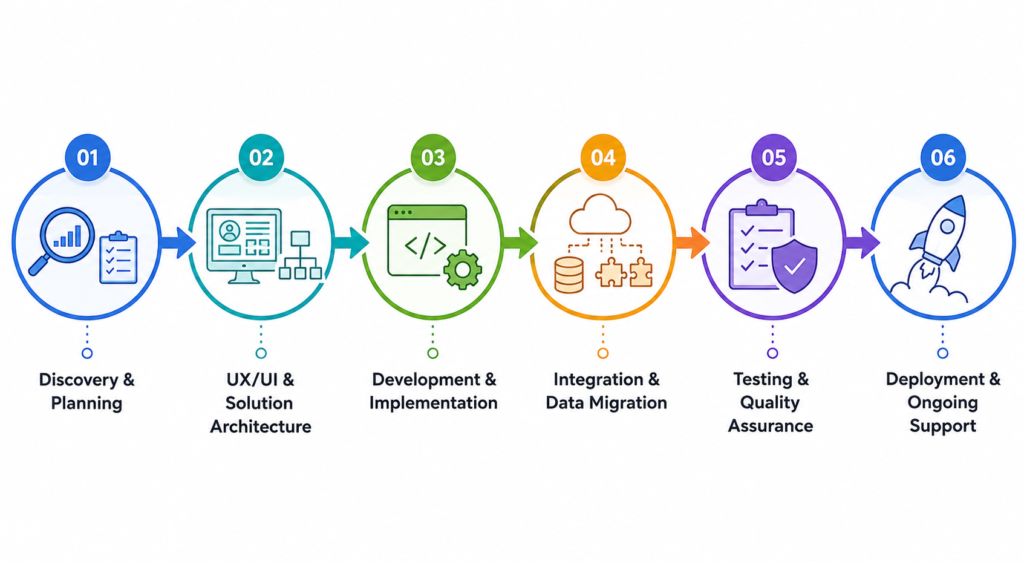
01Discovery & Planning
We analyze business and learning goals, target users, functional requirements, existing systems, and constraints in order to define the scope of the work, priorities, and project delivery plan.
02UX/UI & Solution Architecture
Our eLearning software development company designs seamless experiences for both learners and administrators while determining the correct architecture, technology stack, integrations, data flows, security needs, and AI capabilities where they make sense.
03Development & Implementation
Our team of software engineers builds learner and course management, assessments, analytics, collaboration tools, and artificial intelligence features through short cycles of e-learning software development, while providing regular feedback.
04Integration & Data Migration
Our developers connect LMS with HRIS, CRM, ERP, SSO, payment, video conferencing, and other systems while securely migrating learner, course, and historical data when needed.
05Testing & Quality Assurance
Our QA team tests all the features for functionality, usability, performance, security, integration, and device compatibility before launch to ensure a stable learning experience.
06Deployment & Ongoing Support
We deploy your e-learning solution product, support its launch, perform regular performance checks, resolve issues, and enhance the platform according to your business needs.
Ready to Turn Your eLearning Idea Into a Scalable Product?
Selected eLearning Software Development Success Stories
Cloud-Based Educational Portal
AI-Powered Learning Assistant for Employee Training
AI-Powered Dance Training & Motion Analysis System
AI-Powered Pronunciation Training Avatar
Cloud-Based Educational Portal
Global audience of software engineers
Cloud-based web portal
Course creation for non-technical users
LITSLINK built Educative, a cloud-based e-learning platform that combines course creation, marketplace functionality, subscriptions, payments, and learning delivery in one responsive web application.
The platform provides educators with a browser-based solution for designing programming courses, organizing educational materials, fostering interaction with their students, and measuring the outcomes of their educational activities without the need for complicated software and deep programming knowledge. Educative includes a number of tools such as WYSIWYG editors, interactive courses, communication tools, payment processing options, and user activity tracking, which create a complete environment for both creating and consuming e-learning content.
AI-Powered Learning Assistant for Employee Training
64% faster onboarding
90% of CRM queries resolved without escalation
5+ hours saved per sales rep each week
CRM record completeness increased from 60% to 96%
LITSLINK developed an LLM-driven assistant integrated into the CRM system of a B2B SaaS company based in the USA, trained to help employees learn workflows, respond to users’ intent and questions, as well as handle routine tasks independently. The assistant’s GPT-5 managed user intent and response generation, while validated API calls performed CRM actions and audit logs recorded each change, creating a controlled connection between the AI assistant and business data.
The project took four months to complete, and after being deployed, the B2B SaaS company reduced onboarding time by 64%, and the solution automatically resolved 90% of the queries in the CRM without escalation to a higher level of management, saved more than five hours per sales representative each week, and improved CRM record completeness from 60% to 96%.
Furthermore, the assistant turned routine questions and workflow instructions into an interactive learning experience so users did not need to go through training sessions separately, as they could interactively learn all processes with the CRM using just natural language.
AI-Powered Dance Training & Motion Analysis System
Video-based teacher and student movement comparison
Real-time corrective feedback
Personalized movement practice
LITSLINK built a dance training system, which analyzes videos of the teacher and student’s movements using pose estimation and motion analysis to find differences in rhythm, movement patterns, and posture. It then gives the learner real-time feedback and corrective suggestions during practice.
Therefore, this system creates a personalized training approach whereby students learn from their own performance and individual mistakes rather than general correction given to everyone. Instructors also learn where exactly the student has problems and what type of assistance to provide.
AI-Powered Pronunciation Training Avatar
Text-to-speech pronunciation practice
Lip-synced avatar interaction
Visual and audio learning cues
LITSLINK created a specialized AI-powered avatar that allows students to practice their English pronunciation while receiving feedback visually and auditorily. The technology behind this development is text-to-speech, which synthesizes voice with the necessary pitch, intonation, and expressiveness, while lip-sync technology makes the avatar’s mouth movements correspond with the generated audio.
It is the combination of the voice with different facial expressions and other non-verbal signals that helps students get a lot of information about rhythm, stresses, pronunciation, and emotions while learning English out loud. The solution can be integrated into language learning applications, interactive online tutoring systems, and other e-learning software solutions that need more engaging methods of delivering pronunciation skills.
FAQs
01What Is E-learning?
E-learning is a type of learning that involves using digital resources, content, applications, and other online education tools to provide education or training. It can support self-paced learning, online learning, live teaching, blended learning, assessments, collaboration, and continuous learning, which greatly helps the education industry.
02How to Choose E-learning Software Developers?
To choose the right eLearning software developers, you should seek a team with domain expertise, strong instructional design skills, relevant software development background, security knowledge, integration expertise, and full-lifecycle support capabilities. Find out what processes the team uses when doing discovery, UI/UX design, software architecture, testing, deployment, and post-deployment support.
03How Much Does Custom E-learning Software Development Cost?
The cost of a custom e-learning product development is not fixed, but depends on how many user roles you plan to include, what platforms will be used, what features will be included in the software, integrations you’ll require, content tools, AI capabilities, security needs, and scale. A basic MVP will cost considerably less than a multi-platform with advanced features.
04How Long Does It Take to Develop a Custom E-learning Solution?
It depends on the scope of the project, integration needs, mobile requirements, AI, testing, and migration. Typically, a simple product may take just a few months, while a larger platform may take up to a year.
05Which Types of E-learning Solutions Are in the Highest Demand Right Now?
LMS products, mobile learning apps, AI teaching assistants, learning analytics, virtual classrooms, authoring tools, and personalized training or learning are extremely popular now. Demand heavily relies on the specific users or training problem that they want to solve.
06Can You Customize an LMS or Do You Only Build From Scratch?
As part of our e-learning software development services, we can customize an existing LMS product or build from scratch. We also integrate third-party systems into existing systems.
07Can You Add AI Capabilities to an Existing E-learning Platform?
Yes, you can add AI capabilities to an existing e-learning platform, and this is one of the custom eLearning software development services we offer. To do this, we first assess the existing architecture, data, security model, and user experience before choosing where AI adds real value.
08What E-learning Standards and Specifications Do You Support?
Our education software development services stack supports several e-learning standards and specifications, including SCORM, xAPI, LTI, cmi5, H5P, as well as LRS integrations. LTI connects educational tools to institutional learning environments, while SCORM facilitates the course delivery process and enables tracking.
09Can You Integrate E-learning Software With Our Existing Systems?
Yes, we can integrate it with your existing systems like HRIS, ERP, SIS, and SSO, payment systems, video conferencing, content libraries, and third-party APIs to facilitate data flow and reduce duplicate tasks.
10How Do You Ensure E-learning Software Security and Compliance?
When we develop e-learning software, we ensure security and compliance by using encryption, access restrictions, secure authentication, privacy controls, audit logging, and support for applicable regulations and standards.
Thank you! Your request has been sent — our team will get back to you within 48 hours.
Have a Project in Mind?
Do you have any ideas regarding an e-learning platform development project? Please tell us about your objectives, target audience, current systems, and technical requirements, and our support team will analyze your request and contact you within 48 hours.
Next steps
1
LITSLINK specialist reviews your request and contacts you to discuss the details
2
If needed, we sign an NDA before moving forward
3
We send a project proposal – estimates, timeline, and team CVs included
4
After launch, we stay on for any updates your product needs
PDF
MVP Idea Readiness Checklist (PDF)
Is your product idea ready for an MVP? A short checklist to test it before you spend on development. Leave your email to download it now; we will also send you the link.
Thank you! Your PDF is ready — we have also sent the link to your email.