





SaaS Patient Engagement Platform & EHR Integration – Dalth
- 6 people worked
- 6 user roles
- 1+ years of work
Dalth is a patient engagement platform built to bridge the gap between fragmented healthcare data systems and fast, reliable care delivery.
Request Similar Solution
Project Details
Dalth wants to aggregate EHR data from multiple providers, handle urgent care requests in minutes, and give every user (patients, nurses, administrators) a structured, role-aware interface that makes the work of healthcare measurably easier.
 CLIENTS
- Dalth
 INDUSTRY
- HealthTech / SaaS
 SOLUTION
- Patient Engagement Platform + EHR Integration
 SERVICE
- Product Design + Full-Cycle Web Dev
 PLATFORM
- Web (Vue.js)
 SCOPE
SCOPE- Full-Cycle: Design, Dev, QA
 DURATION
- 1+ year
 LOCATION
- US
Business Challenge
Dalth came to LITSLINK with a clear goal: build a unified healthcare CRM platform capable of consolidating all patient touchpoints, supporting a clinical team of nurses and physicians, and responding to urgent care requests in real time.
There were three distinct structural challenges:
-

Multi-role complexity
The platform needed to accommodate six different user types simultaneously (patients, clinicians, nurses, and admin staff), each requiring different permissions, different information layouts, and a fundamentally different workflow experience
-

Information architecture
Clinical staff don't have time to learn confusing software. Navigation had to be immediate and predictable after first use. Every hierarchy decision had to earn its place
-

Urgency at scale
The promise of a telemedicine service-grade response – urgent care assistance in minutes. It's a technical and UX commitment. The platform had to deliver on it, literally
Technologies We Used
Our Solution
LITSLINK’s approach started with structure. We mapped the information architecture across all six user roles – clarifying how permissions, data visibility, and workflow pathways would intersect without creating confusion.
This groundwork is what separates a SaaS platform for patient engagement and EHR integration that actually works in the field from one that looks clean in demos but breaks under real operational load.
Vue.js was the technology choice for Dalth’s web application. As a Vue.js healthcare app, Dalth benefits from its reactive, component-based architecture, which is essential for a platform surfacing live data from multiple EHR sources.
For a healthcare document upload platform handling sensitive records across providers, responsiveness matters both for user experience and operational accuracy.
-
Patient portal
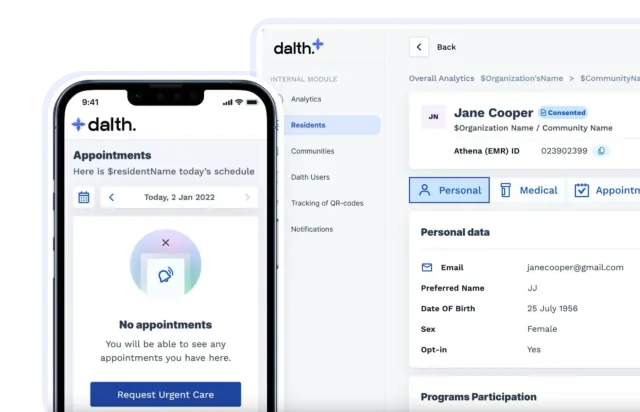
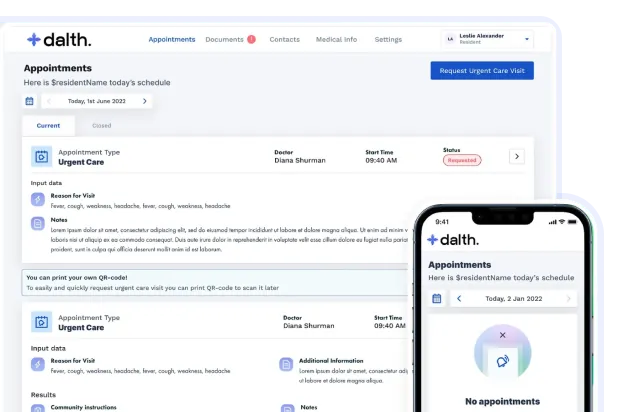
Patients request and track appointments, upload documents, check medical data, and manage contacts from a single interface. The healthcare EHR integration here allows interact directly with its records.
-
Digital consent management
Users sign consent forms digitally within the platform. No printing, no scanning, no manual filing. Consent becomes a trackable workflow step.
-
Appointment management
Users review past appointments and join active ones without navigating between screens.
-
QR-based urgent care
Patients initiate urgent care requests via QR code, enabling the platform to route and escalate in minutes.
-
Six-role user management
Each user type gets the right data at the right permissions level, with a clean interface that doesn't expose irrelevant complexity.
-
Analytics dashboard
Organization-level visibility into opt-in rates, consent rates, community data, and insurance metrics.
Ready to build a healthcare platform that actually connects your workflows?
Tell us about your project→Scrum Methodology
Project Journey
This required 1+ years of work by 6 people. The Dalth project was managed using Scrum methodology – chosen for its iterative approach and ability to surface structural issues early. We engineered for stability. But that iterative process is exactly why the final product is so resilient.
Step-by-Step Process
-
Release Planning
- Establish release goal
- Define highest-priority features
- Set probable delivery date & costs
-
Product Backlog
- Prioritised features list
- Desired by the client
- Refined per sprint
-
Sprint Planning
- Review product backlog
- Set sprint goal
- Estimate & commit
-
Sprint · 1–2 Weeks
- Daily Scrum stand-ups
- Team expands backlog
- Continuous integration
-
Sprint Demo
- Client review every sprint
- Feedback loop
- Sprint sign-off
-
Ready Product
- Shippable increment
- Sprint retrospective
- Inspect & adapt
Scrum Process Flow
Healthcare software development doesn’t benefit from big-bang releases. Scrum’s sprint cadence meant the client saw working software regularly and could give feedback before decisions became expensive to reverse.

Inside Each Sprint
-
Daily Scrum
15-min sync every morning
-
Sprint Review
Demo to stakeholders
-
Retrospective
Inspect & adapt process
-
Increment
Shippable product update
UI/UX Design
Beyond the tech stack, the visual psychology was paramount. The visual system uses Deep Blue (#1F4DAB) as the primary accent (authoritative and trustworthy without being sterile), anchored in Dark Blue (#304057) for depth.
Work Sans as the typeface keeps reading fast; data-rich tables are spacious and scannable; dashboards surface only what’s relevant to the logged-in role. Why does that matter? Well, contrast equals accessibility.
The goal was to make this healthcare CRM platform feel like it was built by people who had seen a clinical environment, not just one that had been spec’d by people who heard about one.
That shows up in small decisions:
- The placement of urgent action triggers;
- The visual weight of consent flows;
- The way role-specific dashboards present only what each user type actually needs.
Timeline
Five phases, clearly defined
-
Consulting
2 months
- Defining clinical roles and permission structure across 6 user types
- Mapping patient journey from urgent care request to resolution
- Risk assessment for EHR data handling and compliance requirements
- Selecting Scrum methodology for iterative feature delivery
-
Product Design
3 months
- Designing role-specific dashboards for patients, nurses, and admins
- Prototyping the QR-based urgent care escalation flow
- Establishing Vue.js as the platform and defining the tech stack
- Assembling a 6-person cross-functional team
-
Product Engineering
6 months
- Building EHR integration with multi-provider data aggregation
- Developing digital consent management and document upload flows
- Implementing 6-role access control and analytics dashboard
- Continuous integration testing across all user role journeys
-
Launch
1 month
- Deploying the web platform with full EHR connectivity
- End-to-end integration and acceptance testing across all roles
- Onboarding clinical staff and validating urgent care response flows
- Verifying HIPAA compliance and data security requirements
-
Support
Ongoing
- Ongoing maintenance and platform monitoring
- Technical support for clinical staff queries and enhancements
- Feature iteration based on real clinical usage feedback
- Regular updates: performance improvements and new capabilities
Results
Before
- Patients and clinicians relied on fragmented systems with no unified view of records, appointments, or documents.
- Urgent care escalation was manual and inconsistent, creating dangerous delays at the worst possible moments.
- No dedicated clinical workspace for nurses and clinicians; workflows were improvised around tools not designed for them.
After
- All interactions (scheduling, document uploads, EHR access, urgent care) are consolidated into a single platform, organized by role.
- QR-triggered urgent care routing delivers responses in minutes with a structured, traceable process.
- Six distinct user interfaces, each tailored to the relevant role with appropriate data access, clear permission controls, and a workflow that matches real clinical practice.

The Impact
We delivered an outstanding patient engagement platform that fundamentally changes how care is administered.
Today, Dalth is actively handling urgent care assistance in minutes. It transformed a fragmented care process into a structured, reliable one. Connecting the patient's living room to the clinician's desk proves that good technology feels like an extension of human care.
Verified Reviews
Our Reputation on Top Platforms
LITSLINK is recognized across leading industry platforms for delivering high-quality software solutions. See what clients and the design community say about our work.
Have a project in mind?
If you’re working on a similar HealthTech product, we’d like to help you build it — shaped around your users, your compliance requirements, and your timeline.
Next steps:
- LITSLINK specialist reviews your request and contacts you to discuss the details;
- If needed, we can sign an NDA before moving forward;
- We send a project proposal – estimates, timeline, and team CVs included;
- After launch, we stay on for any updates your product needs.
- 48h Response
- 500+ Projects
Thank you for your message. It has been sent.


