







Choosing a software development partner in Kuwait is more crucial than ever just three or four years ago. The ICT market is expected to almost double by the year 2029. The Vision 2035 has transformed the thinking around technology procurement by both governments and businesses. Buyer’s expectations have outpaced the growth of local vendors. And yet, somehow, picking software development companies in Kuwait still feels like a manual, heavy-lifting task that makes you wish you had an autonomous AI agent to vet their GitHub repos and Clutch reviews for you.
This article is going to help you find exactly who is worth your investment. We’re breaking down the top players based on real technical competence, verified delivery track records, and their ability to engineer solutions that actually drive business growth.
Key Takeaways
- Kuwait’s ICT market is on track to nearly double, hitting $39.8 billion by 2029
- The real bottleneck isn’t finding developers; it’s finding senior people who genuinely understand CITRA compliance, Arabic-first UX, and data residency rules
- LITSLINK earns the top of the ranking thanks to its hybrid delivery model, 500+ shipped products, and serious AI and cloud capability
- Hybrid models (local oversight, offshore engineering) consistently outperform pure local or pure offshore on mid-to-large Kuwaiti projects
- Don’t sign anything until you’ve scored your shortlist on technical depth, compliance readiness, real case studies, and post-launch support
Quick Comparison
| Company | Best For | Delivery Model | AI/ML Capability | CITRA Awareness |
|---|---|---|---|---|
| Startups, enterprises, AI-first projects | Hybrid (US + Eastern Europe) | Strong | Yes (via hybrid compliance) | |
| CliqTechno | Local businesses needing dev + marketing | Local (Kuwait) | Basic | Yes |
| KUWAITNET | Large enterprises, legacy modernization | Local (Kuwait) | Moderate | Yes |
| Appinventiv | Enterprises needing scale and speed | Offshore (India) + ME presence | Strong | Yes |
| Uniweb IT Solutions | SMBs, e-commerce, budget-conscious | Local (Kuwait) | Limited | Yes |
| Green Torque | Industrial, oil and gas, IoT | Local (Kuwait) | Moderate | Yes |
| MicroSolutions | SMBs want a reliable, long-term partner | Local (Kuwait) | Limited | Yes |
The 7 Best Software Development Companies in Kuwait for 2026
1. LITSLINK
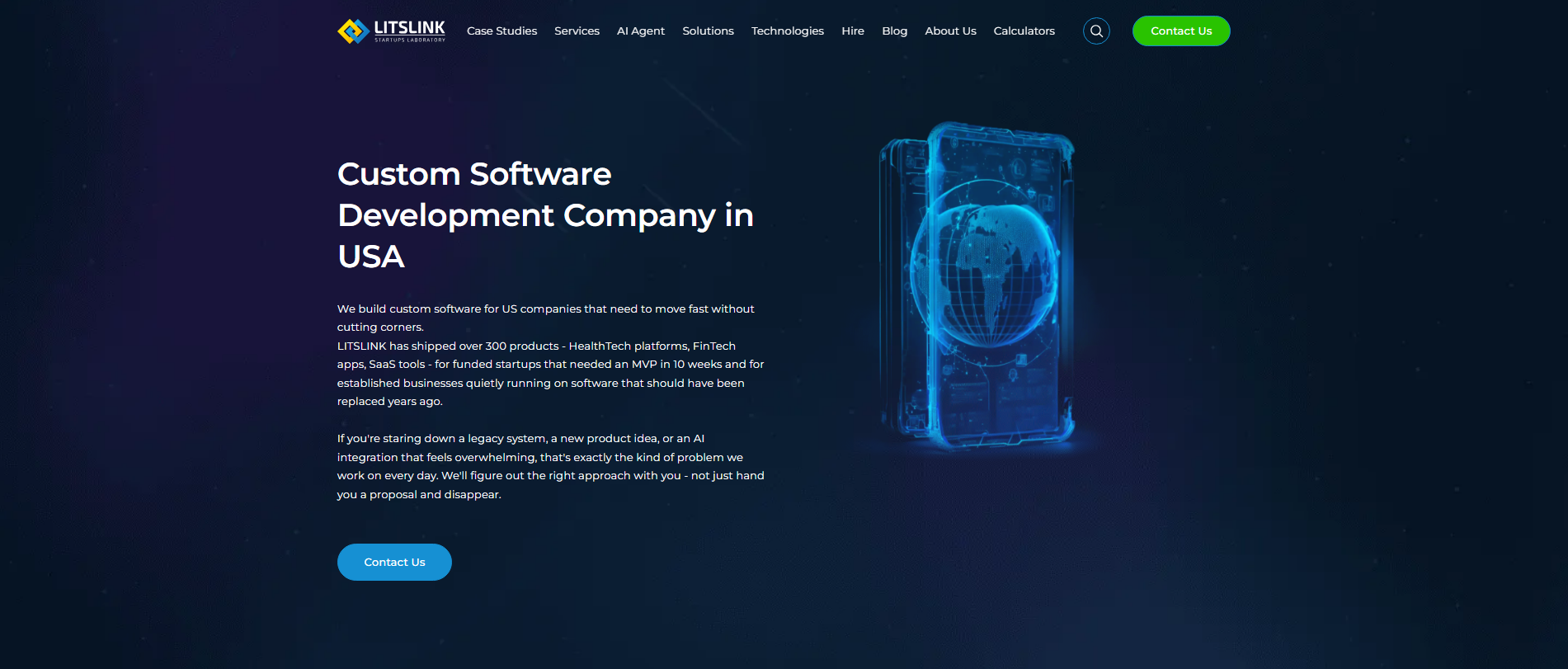
Headquarters: Palo Alto, California (development centers in Eastern Europe)
Founded: 2015
Team Size: 300+ engineers
Core Services: Custom software, AI/ML, mobile and web apps, cloud, VR/AR, QA, DevOps
Industries: Fintech, healthcare, logistics, on-demand, SaaS, government
LITSLINK runs senior strategy and project leadership out of the US. Engineering happens in Eastern Europe. It means you get a partner who understands your business problem at a senior level, while the heads-down code work happens with skilled engineers at rates that won’t liquidate your tech budget by Q2. That combination’s genuinely hard to find. Most dev shops are heavy on one side or the other.
I talked to a couple of people who’ve worked with them. Two themes came up over and over.
One: speed. Their public number — 30 to 50 percent faster than industry average — is apparently more than marketing fluff. Willo, an HR tech company, hit 150% month-over-month user growth after launch. Numbers like that don’t happen if the codebase is wobbly.
Two: communication. Multiple clients described the engagement as feeling less like hiring a vendor and more like gaining a technical co-founder. Subtle distinction. Big practical difference when something breaks at midnight on a Thursday.
If you want a fast gut-check on cost before you even pick up the phone, their AI calculator and app cost calculator are surprisingly useful tools. The case studies page is where you go to figure out whether they’ve actually solved your kind of problem before.
Planning a digital transformation project in Kuwait? Talk to LITSLINK’s team to scope your requirements and get a realistic timeline.
2. CliqTechno
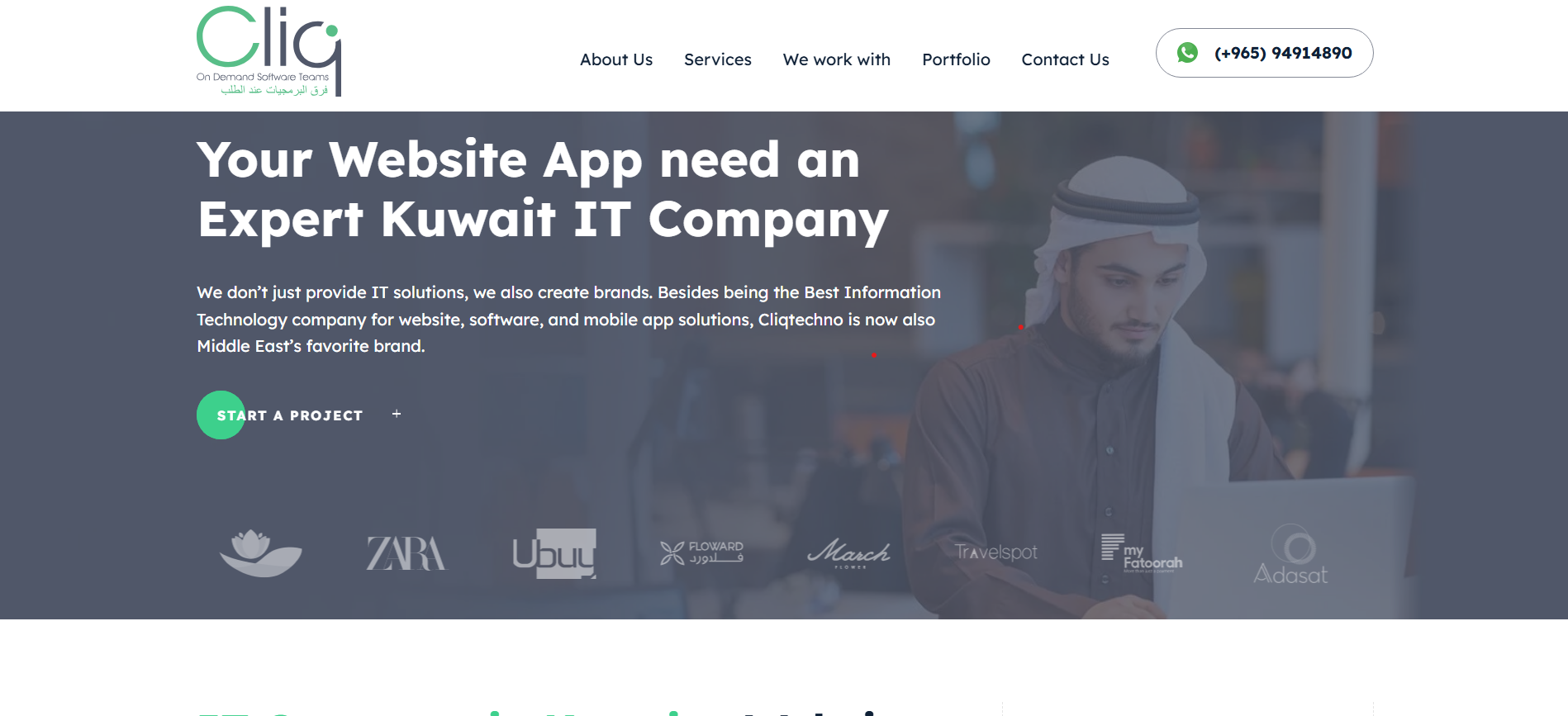
Headquarters: Kuwait City, Kuwait
Founded: 2010
Team Size: 50–100
Core Services: Software development, mobile apps, branding, digital marketing
CliqTechno has established itself as a trusted brand in the Kuwait market for more than 14 years. They are one of the more established local companies with 350+ projects delivered and 100+ satisfied clients. They excel at making this product + go-to-market strategy match that of digital marketing, making them particularly suitable for businesses that require both. They operate in hospitality, healthcare, and government.
3. Nizek
Headquarters: Kuwait City, Kuwait
Founded: 2009
Team Size: 50+
Core Services: Custom software, mobile apps, AI solutions, e-commerce, UX/UI design, strategic consulting.
Nizek is one of those companies that are born in Kuwait that manage to do more than they are expected to do. They have been in existence since 2009 and have worked for businesses in the GCC for more than 15 years on digital products. They have an affinity for product-driven work, from discovery and UX research to a finished mobile or web app. They attended Web Summit Qatar 2026, and their expanding AI practice indicates they have more ambitions than just developing an app. Clients have commended Nizek for posing probing questions and constructing platforms the client didn’t even realize until Nizek was done. Nizek is a mid-stage company whose approach is product-focused instead of feature-focused, which is a rare find in the area, and thus a company worth considering for a hands-on partner.
4. Appinventiv
Headquarters: Noida, India (with Middle East operations)
Team Size: 1,600+
Core Services: Custom software, mobile app development, digital transformation consulting, AI, and ML
Appinventiv has some of the more considered approaches to the Kuwait market and also serious scale. And their recent analysis of the challenges in Kuwait – senior talent, blended solutions – implies that they’re aware of the landscape, not blind to it being just another geographical keyword to target. They are a good option for companies that wish to have a large, experienced offshore partner on the ground in the Middle East.
5. Uniweb IT Solutions
Headquarters: Kuwait City, Kuwait
Core Services: Web design, custom software, e-commerce development, SEO, mobile apps
Among the solid mid-tier solutions that provide small and medium businesses in Kuwait with reliable, affordable digital services is Uniweb. They’re not going to develop a revolutionary AI system, but if you require a robust website, a functional e-commerce store, or anything that works on your mobile device as you expect, they’re a reliable option. They are often more affordable than overseas companies, a factor that can be significant for companies starting their digital transformation.
6. Green Torque
Headquarters: Kuwait
Core Services: IT consulting, ERP systems, IoT integration, cybersecurity, industrial automation
Green Torque is in a special market segment. They specialize in industrial automation and smart technologies, which align well with Kuwait’s manufacturing, logistics, and oil and gas industries. Whereas your digital transformation is more on the operational efficiency side, with sensor networks and smart infrastructure, Green Torque is worth the discussion. They have ERP and IoT capabilities that complement the modernization of the industry as called for by Vision 2035.
7. MicroSolutions
Headquarters: Kuwait City, Kuwait
Founded: 2003
Core Services: Mobile apps, web development, software solutions, branding
Over the last 20+ years, MicroSolutions has become a sort of veteran in the Kuwaiti tech industry. They are known for their reliability and cost-effectiveness, not for cutting-edge new technologies. If your business is focused on dependable delivery, communication, and long-term relationships, rather than a “cool” technology stack, then MicroSolutions is a good choice for you.
Why This Decision Is Trickier Than Most Articles Admit
Kuwait’s tech demand has straight-up outrun its local talent supply. Junior devs? Plenty. But try finding a senior solutions architect who’s wrestled with Sahel integrations, mapped a CITRA-tier data flow, and shipped a serious Arabic RTL interface. That hunt thins out fast. It’s the single biggest reason hybrid models have shifted from a workaround to standard practice.
Then there’s compliance. Kuwait splits data into four tiers. Tiers three and four cannot leave the country. Period. If your partner shrugs at that on the kickoff call, expect a rewrite invoice sometime around month nine.
Here are a couple of additional things that can hit teams where they don’t expect when playing:
- Arabic-first UX is seen as a v2 feature. It isn’t. For anything relating to Kuwaiti consumers, RTLs, fonts not mangling diacritics, and bilingual interfaces should be taken as table-stakes. Avoid them and see your conversion rates have a meltdown.
- The rules are drafted by CITRA. There is a constant change in rules. The Data Privacy Protection Regulation was amended in 2024. If you continue to play from the 2021 playbook, you’re one step back.
- Vision 2035 isn’t a marketing slogan. There, the money is actually spent. Either you’re trying to select a partner who is not well-versed in it, or you’re proposing a project that is not suitable.
To sum it up, it’s best to avoid the companies that rank high on Clutch or in the top few results on Google just because they are on the list, not actually because they are the right companies for your project. You must have an evaluation plan.
Which Model is Appropriate in Kuwait: Local, Offshore, or Hybrid?
This is definitely the most crucial decision that you will make, and most of the best articles overlook it entirely.
There are companies in the local area, such as CliqTechno and KUWAITNET, that are familiar with the regulations, can communicate with local time, and can be physically accessed when sensitive projects are involved. The disadvantage is that there is generally less talent available and, at times, more expensive for specific skills.
But offshore companies such as Appinventiv offer heavy engineering teams and competitive rates. However, there is a lack of cultural sensitivity and regulatory knowledge, which is required on Kuwaiti projects.
Hybrid companies are the best of both worlds. Senior project management and client-facing leadership are hand-in-hand with significant engineering capabilities that operate at global competitive rates. This model works best on projects of a moderate to large size in the state of Kuwait in terms of quality, timeliness, and cost.
While making the decision, consider these questions:
- Do I need to meet stakeholders face-to-face who prefer this?
- Have I created something that is tier three or tier four data (CITRA classifications)?
- Is there a need to rapidly expand or contract the engineering effort for the project as it goes through its various stages?
- Should I pay local market prices or competing world-class (offshore) prices?
Your answers will point you clearly toward one model or another.
Not sure which model fits your project? Let LITSLINK help you figure it out – no obligation, just a practical conversation about what makes sense for your goals.
Frequently Asked Questions
What is the cost of software development in Kuwait?
The truth is, there is no universal answer for this figure. A smaller project, like, say, a simple mobile app or a company website, may fall in between KD1,000 and KD10,000. When you start moving into the realm of enterprise-level work, you’re in the KD 10,000 – 50,000 range, more or less. If the build is using multiple platforms, AI components, or is in a regulated industry like banking, the meager KD 100,000 is nothing unusual. A project cost calculator can be useful at the outset of the process to help set realistic expectations.
Which is better, a local company or a company that works in an offshore service in Kuwait?
It will depend on your preferences. Local companies are familiar with the ins and outs of the regulations, and if there’s something in need of sorting out, you can sit across the table from them. Offshore companies mean more people at lower rates, and that’s when the scope is big. Most clients we have spoken to, however, are somewhere in the middle – our hybrid, where onshore project governance and offshore engineering go hand in hand. In either direction, ensure that the partner truly understands CITRA’s data tiering and Kuwait’s residency. That’s a non-negotiable.
Which industries are currently receiving the most investment in software development in Kuwait?
Banking & financial services are leading the way, and leading the way for a while. The next is oil and gas, and by that point, you’ll get the sense of the magnitude, as KOC alone invested $800 million in digital transformation. The e-services, health care, retail, and real estate sectors are all active buyers following that. Available at the regional level, the Middle East digital transformation market will surge from $71.6 billion in 2026 to $146 billion by 2031. The investment journey is far from over.
What’s the true measurement of a software development firm in Kuwait?
So, begin with case studies or client references and then fill in the website copy. Then start calling the vendors in these lists – a significant number of vendors are eliminated by that. Inquire directly about the Arabic localization process, if they localized their products in your industry prior to the CITRA, and/or the CITRA compliance. Don’t sign anything until you have IP ownership and post-launch support in writing. And advocate for a more formal discovery process, rather than an estimate. Yes, a scorecard-based RFP is a little work to do, but if anyone has seen a project that faltered mid-way through, they will understand its worth.
What is Vision 2035, and why does it matter for software companies?
Kuwait Vision 2035 is the national development roadmap to transform Kuwait into a financial and trading hub in the region. It is conducted in the context of the digital transformation, which refers to smart cities, fintech infrastructure, e-government services, and digitization in the healthcare sector. So the bottom line is it’s easy to see that when it comes down to it, the number of funded projects in the pipeline is huge, it’s government-sponsored, and it’s not likely to change anytime soon, for anyone considering buying or building software in Kuwait.
After you have selected Your Partner, what do you do next?
Finding the best software development companies in Kuwait is not a big problem. The difficult part is selecting the one that is right for your project, budget, regulatory context, and project trajectory.
We’ve provided you with the assessment matrix, the short list, and the market backdrop. It’s now your turn. The one thing I wish to leave you with is this: don’t pick your technology partner because they are No.1 on Google or they have a cool website. Select a team that understands what it takes to build software that works in Kuwait, not just software that works, and has the right questions.
Ready to start your digital transformation? Get in touch with LITSLINK, and let’s determine how to proceed for your business.