








In February 2025, the people who took home prizes at one of Anthropic’s AI hackathons included a personal-injury lawyer, a doctor, a carpenter, and a schoolteacher.
Not a single one of them would describe themselves as a software engineer. A few months earlier, most of them had never shipped a line of production code. And yet there they were, beating people who write software for a living, building working AI tools over a weekend.
That should not be possible. For most of the history of the hackathon, the entire point was that you had to be a coder to play. The word itself was built for programmers, by programmers, in a culture that did not exactly roll out the welcome mat for outsiders. So what changed?
A lot, as it turns out. The rise of virtual hackathons is a big part of the answer. The format went from rooms to screens, threw its doors open to anyone with a laptop, and grew into a global competition that research firms now size in the billions. Somewhere along the way, it quietly stopped being a coding contest and became something closer to an invention sport, one where the person who understands the problem best often beats the person who codes fastest.
This is the long version of that story. What hackathons are, where they came from, how virtual hackathons actually run, who wins them, who pays for them, and what comes out the other end. We will also get into the parts most articles skip: the money, the intellectual-property landmines, a “protocol” that a lot of people seem to believe in but that does not exist, and the question of what gets shared at these events versus what gets locked away.
Start at the beginning, which is more contested than you would think.
What Is a Hackathon, Really (And What the Word Gets Wrong)
So what is it? A hackathon is a time-boxed building sprint. A group of people, usually in teams of three to five, spend a fixed window (most often 24 to 48 hours) building a working prototype around a theme or a challenge. At the end, they demo what they made for the judges. The best projects win prizes.
That is the whole concept. Everything else is a variation on it.
The word trips people up. “Hack” here has nothing to do with breaking into systems or stealing data. It means the older, friendlier thing: clever, fast, improvised problem-solving. The kind of hack where you make something work with whatever is lying around. Stick that next to “marathon,” for the endurance involved, and you get a hackathon. A marathon of clever building.
What happens inside one follows a rhythm that has barely changed in two decades. There is an opening ceremony where the challenges get announced. Teams form, either ahead of time or in a scramble during the first hour. Then the build begins, and it does not stop. People code through the night, fueled by catering trays and a caffeine intake that would alarm a cardiologist. Mentors from the sponsoring companies float around answering questions. At the end, each team gets a few minutes (three is the unofficial standard) to pitch a live demo. Judges score them. Someone wins.
The format works for a reason that has nothing to do with technology and everything to do with human psychology. Constraint kills overthinking. Give a smart team six months to build something, and they will spend five of those months in meetings about what to build. Give them 48 hours and a deadline they cannot move, and they ship. The clock does the thing that no project manager can: it forces a decision.
In-Person Was the Original. Virtual Is What Made It Global.
For the first twenty years, a hackathon meant a physical place. A university hall, a startup office, a conference floor. You showed up with a laptop and a sleeping bag.
Then 2020 happened, and the whole thing moved online out of necessity. Most people assumed it was temporary. It was not.
Virtual hackathons turned out to solve a problem the in-person format never could, which was access. A student in Lagos can now compete in the same event as a team in Berlin and a solo builder in São Paulo, with no plane ticket and no visa. The cost of organizing drops. The pool of who can participate explodes. When Bolt ran its 2025 online hackathon, more than 130,000 people registered. You cannot fit 130,000 people in a building. But you can fit them in a Discord server.

What virtual loss is real, and worth naming. There is an energy at 3 a.m. in a room full of people building the same impossible thing on the same impossible deadline that a video call does not reproduce. The hallway conversation where two strangers realize their projects fit together. The shared misery of the bad coffee. Some of that is gone.
The format most large events landed on is the hybrid: a single global virtual event with dozens or hundreds of local in-person nodes connected to it. NASA’s Space Apps Challenge runs this way, with hundreds of local events feeding into one worldwide competition. Junction in Finland does a version of it. The result is the reach of virtual with at least some of the room energy of in-person. For now, that is the model winning.
Put the three side by side and the trade-offs are hard to miss:
| Format | Cost to organize | Reach | Energy | Accessibility |
|---|---|---|---|---|
| Virtual | Low: ~$3,000–$15,000 | Global | Low | High |
| In-person | High: ~$30,000–$250,000+ | Local / regional | High | Low |
| Hybrid | Medium: ~$15,000–$60,000 (est.) | Broad | Medium | Medium |
None of the three is the right answer for everyone. A scrappy student event optimizes for accessibility and picks virtual. A corporate innovation push wants the energy and picks in-person. The biggest competitions want all of it at once, which is why they keep landing on hybrid.
The First Hackathon Happened Twice, in the Same Month, by Coincidence
Here is a trivia fact that sounds made up: the first hackathon happened twice, in June 1999, on two different sides of the same idea, and the two events had nothing to do with each other.
The first claim comes from OpenBSD, the open-source operating system project. In June 1999 (June 4, to be specific), about ten developers gathered in a house in Calgary, Alberta. There were no talks. There was no schedule. There was a goal, which was to integrate new networking code into the system, and within the week, they had the first IPv6 and IPsec stacks fully integrated into an operating system. One of the project’s founders, either Theo de Raadt or Niels Provos, depending on who you ask, had coined the word “hackathon” in the months before. The OpenBSD model was pure: invitation-only, collaboration-first, build something real, go home.
The second claim comes from the same month, at Sun Microsystems’ JavaOne conference. A Sun vice president named John Gage stood before attendees and challenged them to write a program for the new Palm V handheld, using its infrared port to communicate with other devices. He called it “the Hackathon.” This was the more public, more open-ended version: here is a platform, here is a weekend, surprise us.
I find it genuinely interesting that the two events embody the two poles the format still lives between. OpenBSD was focused on open-source problem-solving by people who already knew each other. JavaOne was an open, creative invention by strangers. Every hackathon since has been somewhere on the line connecting those two points.
From there the format spread the way these things do, slowly and then all at once. Through the 2000s, big companies started running internal hackathons. Google, Netflix, and most famously Facebook, where the practice became cultural scripture. In 2009, a student at the University of Pennsylvania launched PennApps, the first student-run college hackathon, and the collegiate version of the format took off. Major League Hacking was formed to give the student events a league structure, the way the NCAA (National Collegiate Athletic Association) gives college sports one.
The 2010s were the startup-factory years, when real companies started falling out of these weekends. Then 2020 forced everything online. And since roughly 2023, AI has reshaped the whole thing again, changing both what gets built and who can build it.
The Numbers Got Strange Fast
The scale of this is hard to hold in your head, so let me put some numbers down.
The global market for hackathon platforms reached about 1.21 billion dollars in 2024, and one research firm projects it will hit 6.12 billion by 2033, growing at roughly 18.6 percent a year. Treat that figure with the skepticism all market-research numbers deserve, because the methodologies are opaque and the definitions slippery. But even if you cut it in half, you are looking at a real industry, not a hobby.
Devpost, the platform where most large hackathons are hosted, reports more than 4 million registered builders. Major League Hacking says it powers over 300 events a year and reaches more than half a million developers. And NASA’s Space Apps Challenge, the largest single hackathon on the planet, drew over 114,000 participants across 167 countries in its 2025 edition.
A weekend coding session in a Calgary house became a thing that 114,000 people in 167 countries do at the same time. That is the arc.
How a Virtual Hackathon Actually Runs, Hour by Hour
If you have never done one, the format can feel opaque from the outside. Here is what actually happens, start to finish, in the virtual version that now dominates.
Registration and Finding a Team You Don’t Hate
Almost every virtual hackathon registers participants through one of a handful of platforms, usually Devpost, MLH, or a sponsor’s custom site. Registration is nearly always free. You sign up, you read the rules, you join the event’s Discord or Slack.
You can enter solo or as a pre-formed team. Most events cap team size somewhere between three and five people. PennApps caps at four. ETHGlobal allows up to five. Bolt’s 2025 event allowed teams of up to four.
If you are solo, this is the moment that matters most, and it is the one beginners get wrong. There is almost always a team-matching channel where solo participants find each other. Use it early. The single biggest predictor of a good hackathon is not your individual skill. It is whether your team has complementary skills and gets along under pressure. A team of four backend engineers will lose to a team with one backend engineer, one designer, one domain expert, and one person who can stand up and pitch without their voice shaking.


The Build: 48 Hours, One Working Thing
At kickoff, the challenge tracks get announced. A typical event has four to eight themed tracks (more on what those look like later), plus sponsor “bounties,” which are extra prizes for teams that build using a specific company’s API or tool. Win the main prize and a sponsor bounty, and you walk away with two checks.
Then the build window opens, and for virtual events, it usually runs longer than in-person ones, often 48 to 72 hours, to accommodate teams scattered across time zones. The work is continuous. Sponsor engineers hold office hours over video calls. Mentors answer questions in dedicated channels. The Discord server hums with a few thousand people all building at once, which is its own kind of motivation at hour 30 when you want to quit.
The thing nobody tells beginners: most of the projects that win are not technically the most impressive. They are the most finished. A polished demo of one feature that works perfectly beats a sprawling demo of ten features where three of them crash on stage. Every single time.
The Judging Nobody Fully Understands
To submit, a team uploads a working demo, a short video walkthrough (usually two to four minutes), and a written description, almost always with the source code linked on GitHub.
Then, the judges score it. The criteria are remarkably consistent across the major events. ETHGlobal and Bolt both judge on roughly the same four things: how original the idea is, how technically hard it was to build, how much real-world impact it could have, and how good the design and user experience are. Some events add a fifth axis for how well you used the sponsor’s tools.
Prizes range from swag and cloud credits at the small end to genuinely life-changing money at the top. Microsoft’s Imagine Cup grand prize is 100,000 dollars plus a meeting with the CEO. Bolt’s 2025 prize pool topped a million.
The judging is, to be honest, an imperfect science. You have judges watching dozens of three-minute pitches in a row, making fast calls under fatigue. The teams that win understand this and optimize for it. They lead with the problem, show the demo fast, and make the judge feel something in the first thirty seconds. It is less like a code review and more like speed dating, and the people who treat it accordingly do better.


The Best-Kept Secret About Hackathons: You Don’t Need to Code
Back to the lawyer and the carpenter.
The most persistent myth about hackathons is the one that keeps the most people away: the belief that you have to be a strong programmer to participate, let alone win. For most of the format’s history, that was true enough. It is not true anymore, and the organizers will tell you so directly.
Major League Hacking, the official student hackathon league, states it plainly on its own site: you do not have to be a programmer, and you certainly do not have to be majoring in computer science. Junction, the big Finnish event, advertises “no gatekeeping, no prerequisites.” The AI hackathon platform lablab.ai puts it even more bluntly: everyone is welcome, regardless of previous coding or AI experience.
This is not feel-good marketing copy. It reflects a real shift in who hackathons are for.
Part of it is that hackathons always need non-coders more than the coders admitted. A winning team needs someone who understands the actual problem, someone who can design an interface a human wants to use, someone who can model the business case, and someone who can pitch. Code is one ingredient. A team that is all code and no judgment builds a technically brilliant solution to a problem nobody has.
But the bigger shift is AI. The generative-AI tools that arrived in force after 2022 (Cursor, Bolt, Replit’s agent, v0, and the rest) let people with little or no coding background build functional prototypes. This is the single largest change to hackathon accessibility since the format was invented, and it is why a lawyer can now out-build a software engineer over a weekend. The lawyer knows exactly which legal problem is worth solving. The AI handles the part the lawyer can’t.
The Numbers on Who Actually Shows Up
The accessibility is not just rhetoric. The data backs it.
When the student group nwPlus at the University of British Columbia ran its events, they reported reaching up to 40 percent beginner participants, double their original target of 20 percent. MLH’s own survey data suggests roughly half of hackathon attendees are not computer science majors, and around three-quarters are undergraduates, many of them attending their first event. Google Summer of Code, a related open-source program, reported that the overwhelming majority of its 2025 accepted contributors were first-timers.
And then there are the Anthropic “Built with Opus” winners I opened with: the lawyer, the doctor, the carpenter, the teacher. That is not a story about exceptions sneaking through. That is a story about what the format has become.
How Organizers Lower the Bar on Purpose
None of this happens by accident. Organizers work at it.
The standard moves include beginner tracks with simpler challenges and dedicated mentors, so first-timers are not thrown in with veterans on day one. There are events built specifically for groups historically pushed out of tech: MLH runs HACK.COMS for multicultural students, Switzerland has herHACK, and nwPlus runs an all-female event called cmd-f. For in-person events, travel reimbursements lower the financial barrier (SwissHacks reimburses between 50 and 100 Swiss francs). There are team-matching sessions for solo beginners, free food and lodging, and free API credits so that a student is not deciding between rent and the cloud bill needed to run their project.
The whole apparatus is designed to make the answer to “can someone like me do this?” be yes.
What Happens to a Market When Anyone Can Build
This is the part with consequences beyond the events themselves, and it is worth slowing down for.
When the ability to build a working prototype stops being rare, the pool of potential founders stops being limited to people who can code. The doctor who has spent fifteen years watching a specific clinical workflow fail can now build the first version of the fix herself, over a weekend, without hiring anyone. The teacher who knows exactly where students get stuck can prototype the tool that helps. This is a meaningful change to where new products come from.
For companies, it means access to ideas from places engineers would never look. An engineer optimizing a legal-research tool is guessing at what lawyers need. A lawyer building it is not. The closer the builder is to the problem, the better the first version tends to be, and AI hackathons are pulling those domain experts into the building seat for the first time.
There is a catch, and it is a real one. Fast AI-assisted prototypes are not production software. The phrase that emerged for this style of building is “vibe coding,” coined by Andrej Karpathy in early 2025 and named Collins Dictionary’s word of the year. It describes building by describing what you want to an AI and accepting what comes back, often without fully understanding the code underneath. It is fast. It is also fragile, and sometimes insecure, and the hackathon world is starting to reckon with what happens when the thing on stage looks finished but is held together with digital tape. We will come back to that, because it produced a genuine scandal in 2025.
Hackathon Rules and Guidelines: The Fine Print That Costs People Their Ideas
Every hackathon has rules. Most are boring. A few are the kind of thing that, if you ignore them, can cost you the rights to the thing you just built.
The Standard Rules Are Boring. The IP Rules Are Not.
The boring rules are nearly universal and easy to follow. All code must be written during the event, so you cannot show up with a half-finished project and polish it. Open-source libraries and public APIs are fair game, but your own pre-existing proprietary code is not. Teams have size limits. There is a code of conduct, and the MLH standard one (no harassment, respectful collaboration, a safe environment for everyone) has been adopted so widely that it is effectively the industry default. Submissions need a working demo, a video, and usually public source code.
Follow those, and you are fine. The rules that actually matter, and that almost nobody reads, are about who owns what you build.
The general default is that participants own what they create, unless the agreement says otherwise. That phrase, “unless the agreement says otherwise,” is doing enormous work. Corporate-sponsored hackathons frequently include clauses that assign the intellectual property to the sponsor or grant the sponsor a broad license to use whatever you make. If you build something genuinely valuable at an event with one of those clauses, you may have just given it away.
There is a subtler trap, too. Demoing your invention publicly at a hackathon can count as public disclosure, which in many jurisdictions starts the clock ticking on your ability to patent it later, or kills that ability outright. Harvard Business Review flagged this back in 2013, warning that participants are often uninformed or unconcerned about intellectual property, and that the companies sending employees to these events need to pay attention or risk losing valuable IP. The NYU Law Review made a sharper version of the point, noting that many participant agreements simply ignore the question of who owns the output entirely.
I am not a lawyer, and this is not legal advice. But the practical takeaway is simple: read the IP terms before you register, especially at corporate events. The five minutes it takes is cheap insurance against handing a company your best idea for a t-shirt and a free lunch.
The AI Submission Problem Nobody Has Solved
A newer rules question has no settled answer yet: how much AI-generated code should count?
When anyone can generate a plausible-looking app in an afternoon by prompting a model, the old assumption that a submission represents real human effort breaks down. Some events now require participants to disclose which AI tools they used. Others are experimenting with AI-free tracks. Nobody has figured out the right line, partly because the technology keeps moving and partly because the entire premise of a hackathon (build something real, fast) is exactly what these tools are best at.
This is not a hypothetical concern. It blew up publicly in 2025, and I will get to it.


Why Microsoft, Google, and Amazon Spend Millions Running Corporate Hackathons
Corporate hackathons are not charity. When Microsoft puts up 100,000 dollars, or Amazon gives away cloud credits by the truckload, there is a calculation behind it. Actually, there are usually four calculations, overlapping in different proportions: get developers using their platform, find people to hire, generate internal innovation, and build brand goodwill. The mix depends on the company.
Microsoft Pays $100,000 and a Meeting with the CEO
Microsoft’s Imagine Cup has been running since 2003, which makes it ancient by tech standards. The grand prize is 100,000 dollars plus a mentorship session with chief executive Satya Nadella, which, for a young founder, is arguably worth more than the cash.
The recent champions tell a geographic story worth noticing. Team TAWI from Kenya won in 2023. FROM YOUR EYES from Turkey won in 2024. Argus from the United States won in 2025. The winners increasingly come from outside the usual Silicon Valley orbit, and Microsoft leans into that, framing the competition as a launchpad for high-impact startups and routing winners into its Microsoft for Startups program.
Underneath the prestige is the real engine. Microsoft has run more than 30 hackathons on Devpost since 2016, and the motive there is direct: every participant who builds on Azure or Azure OpenAI during an event is a potential long-term cloud customer. The hackathon is a free sample. The cloud bill is the business.
Google Insists It’s Not Recruiting (It’s Doing Something Smarter)
Google Summer of Code has run since 2005 and hit its twentieth anniversary in 2024. The 2025 round drew a record 98,698 registrations from 172 countries, and Google selected 1,280 contributors from 68 of them. Stipends range from around 750 dollars to 6,600, scaled by project size and the contributor’s country.
Google says, explicitly, that this is not a recruitment program. I believe them, and the reason is more interesting than recruiting would be. Google’s products run on a deep foundation of open-source software. Healthy open-source projects with a steady supply of new contributors are, for Google, infrastructure. Paying students to contribute to that open-source base is not hiring. It is maintaining the roads its own trucks drive on.
On top of that, Google has run 16 or more hackathons on Devpost since 2019, engaging more than 58,000 developers across 166 countries. Same logic as Microsoft, different products.
Amazon Pays Winners in Its Own Currency
Amazon Web Services ran a generative-AI hackathon in 2024, built around PartyRock, its no-code AI app builder. It attracted 7,650 registrants who submitted, by Devpost’s count, a record-shattering 1,446 projects. First place went to a project called Parable Rhythm, an interactive crime thriller built entirely without code, and the prize was 20,000 dollars in AWS credits.
That detail (the prize is credits, not cash) is the whole strategy in miniature. AWS has hosted more than 35 hackathons on Devpost since 2016, engaging over 55,000 developers, and it also runs AWS GameDay, a gamified team event focused on cloud architecture. When you win AWS credits, you spend them on AWS, you build your project deeper into AWS, and a year later, you are an AWS customer who has never seriously considered anything else. The credits are not a prize. They are an onboarding ramp with a bow on it.
Meta Built the Like Button at 3 A.M.
Meta’s hackathon story is the internal one, and it is the most famous in the industry for good reason. Facebook held its first official hackathon in 2007 and turned the practice into a core part of its engineering culture. The company’s own line: we are a culture of builders, and hackathons are our time to take any idea and build it into something real.
The list of things that came out of those late nights is genuinely startling. The Like button. Timeline. Chat. Video messaging. Comment-tagging. According to the company, around 60 percent of projects from several of its hackathons had already shipped, internally or to users. One intern’s comment-tagging feature went out to 100 percent of users within two weeks of the hackathon where it was built.
That is the internal innovation case for hackathons, proven at the scale of billions of users. Give your own engineers 48 hours to build whatever they want, and a meaningful fraction of it turns out to be product.
Everyone Else Is Doing It Too
The pattern repeats across the industry. Anthropic runs its “Built with Opus” series with the startup community Cerebral Valley, drawing somewhere between 13,000 and 20,000 applicants for roughly 500 spots, handing each participant API credits and competing for prize pools in the six figures. Coinbase runs on-chain hackathons through its Base platform. IBM has its long-running Call for Code. Salesforce and Netflix run internal events. The specifics vary. The logic does not.
The Commercial Case: Real Companies That Started as Weekend Projects
Here is where the skeptic’s eyebrow should go up. It is easy to dismiss hackathons as a fun distraction that produces nothing lasting. The toys get demoed, everyone goes home, the GitHub repos go quiet. Is anything actually built that survives Monday?
Yes. More than you would guess, and the success stories are the strongest argument for the importance of hackathons as something more than a weekend’s entertainment.
Argus, Microsoft Imagine Cup 2025, 100,000 dollars
Argus is a wearable assistant for people with low vision, built by two Stanford juniors, Daniel Kim and Arjun Oberoi. A small camera clips to a pair of glasses, a computer module slips into a pocket, and the device answers spoken questions about the world in front of you: what is this, who is that, where is the door?
The clever part is not the AI, which plenty of teams can wire up now. It is a wireless protocol called Wi-R that uses the skin itself as a transmission medium and draws about a hundred times less power than ordinary Wi-Fi, which is what keeps the camera light and running all day. The system splits the work, handling simple commands on the device and sending the hard ones to Azure’s cloud models, and it does not need a phone to function at all.
Why it won: the founders built it for their own grandparents, both of whom live with visual impairments, and that personal stake came through in the room. The judges saw a working device aimed at a hundred million people, carried by a real hardware breakthrough rather than a thin wrapper around someone else’s model. The team had already taken the US Red Bull Basement title before this. Now they are talking about clinical trials and FDA clearance, so Argus could be covered by Medicare as durable medical equipment.
FROM YOUR EYES, Microsoft Imagine Cup 2024, 100,000 dollars
A Turkish team led by Zülal Tannur, who lost her sight completely at the age of ten, built a mobile app and an API that describes the visual world in real time to people who cannot see it. Point it at a photo, a video, or a room, and it tells you what is there.
They did not just call an off-the-shelf model and stop. They trained their own image-recognition system on more than fifteen million images, reaching a reported 98 percent accuracy at roughly fifteen milliseconds per image, then handed the output to GPT-4 to turn it into plain language. It works with smart glasses and watches too.
Why it won: the founder was the user. Tannur did not build a solution she imagined someone might want someday. She built the thing she had spent her life looking for and never found. On top of that, the team had already turned it into a business, licensing the technology to other developers through the API and signing partnerships before they ever reached the final. Judges pick a working product with a paying customer over a clever prototype with neither, nearly every time.
TAWI, Microsoft Imagine Cup 2023, 100,000 dollars
Four students from United States International University-Africa in Nairobi built TAWI, an app for children with Auditory Processing Disorder, a condition where the brain struggles to make sense of sound even when the ears work fine.
It uses real-time speech recognition, built on Azure Cognitive Services and OpenAI’s Whisper, to strip out background noise, sharpen the speaker’s voice, and transcribe speech to text as it happens. The child plugs in ordinary earphones. No expensive specialized hardware, which is the whole point. It is cheaper, more discreet, and more reachable than a traditional hearing aid.
Why it won: it solved a genuine medical problem for an underserved group at a fraction of the usual cost, and it was the second Imagine Cup world title for the same Kenyan university in three years, which tells you the result was not a fluke. The name comes from the Kiswahili word for a sprouting leaf. What the judges bought was the combination of real social impact, low cost, and a team that obviously understood the kids they were building for.
Tailored Labs, Bolt Hackathon 2025, grand prize of a million-dollar-plus pool
At the largest hackathon ever held, with more than 130,000 registered builders, the top prize went to one person. Adrian Humphrey built Tailored Labs, an AI-powered video timeline editor that lets a creator cut footage by typing what they want in plain language, analyzes raw video on its own, and can generate a finished edit in a single shot.
The pitch fits in one line. It turns a full day of editing into an eight-minute upload.
Why it won: it hit a problem that millions of creators feel every week, and it did it as a solo builder against a field worth six figures in prizes. That last detail is the story. The Bolt event existed to show what one person armed with AI tools can now ship, and Tailored Labs was the cleanest proof of the thesis on offer. A real, useful product, built fast, by someone who would have needed a whole team to attempt the same thing two years earlier.
Parable Rhythm, AWS PartyRock Generative AI Hackathon 2024, 20,000 dollars in credits
Param Birje took first place at AWS’s PartyRock hackathon with Parable Rhythm, an interactive crime thriller you play your way through. The remarkable part is how it was made: entirely inside PartyRock, AWS’s no-code AI app builder, without writing a line of code.
Why it won: It took a constrained, slightly unglamorous tool and produced something genuinely fun and finished with it. Judges at platform-showcase events love a submission that pushes the tool further than the organizers thought it could go. The barrier to building has dropped so far that an award-winning interactive experience can come from someone who has never opened a code editor.
The Startups
Carousell, the Southeast Asian marketplace, was born at a 54-hour Startup Weekend event in Singapore in 2012. Its founders kept building, and by September 2021, the company was a unicorn, valued at 1.1 billion dollars after a 100-million-dollar funding round led by a South Korean investment firm. A weekend project became a billion-dollar company.
GroupMe came out of the TechCrunch Disrupt hackathon in 2010. Two builders, Jared Hecht and Steve Martocci, made a group-messaging tool over a weekend. Skype acquired it roughly 370 days later, in a deal reported at around 85 million dollars (later reporting suggested 43 million upfront with the rest tied to performance, which is its own lesson about how acquisition headlines work).
EasyTaxi started at Startup Weekend Rio in 2011 and expanded to more than 30 countries and 420-plus cities. Zaarly came out of an LA Startup Weekend the same year and raised over 15 million. Appetas, an AngelHack project from 2012, was acquired by Google in 2014. Qwiki, from TechCrunch Disrupt 2010, was bought by Yahoo for around 50 million in 2013.
| Project | Event | Prize | Background | Outcome |
|---|---|---|---|---|
| Argus | Imagine Cup 2025 | $100K | 2 Stanford undergrads | FDA clearance talks |
| FROM YOUR EYES | Imagine Cup 2024 | $100K | Blind founder | Licensing API to devs |
| TAWI | Imagine Cup 2023 | $100K | 4 Nairobi students | Shipping product |
| Tailored Labs | Bolt 2025 | $1M+ pool | Solo builder | Shipping product |
| Parable Rhythm | AWS PartyRock 2024 | $20K credits | Zero code | Proof of no-code ceiling |
These are not flukes that prove nothing. They are a pattern. The constraint that makes hackathons good at producing demos is exactly the constraint that makes them good at producing startups. A hackathon project is a forced minimum viable product. Some MVPs turn out to be companies.
The Features That Shipped to Billions
Then there is the internal version, where the output is not a startup but a feature inside an existing product. Facebook’s Like button is the headline example, but the deeper point is the process. A 48-hour prototype proves the concept cheaply. If it works, the company resources it into a real team and ships it. The hackathon is the cheapest possible way to test whether an idea is worth real investment, and at Meta’s scale, even a low hit rate pays for the whole program many times over.
How to Prepare for a Hackathon Without Wasting the First Six Hours
Enough theory. If you are going to actually do one of these, the difference between a good experience and a miserable one comes down to preparation. A hackathon for beginners is entirely winnable, but only if you arrive ready, and there are a few tips and tricks nobody tells first-timers until it is too late.
Before You Show Up
Research the tracks and the sponsors before the event starts. If you build with a sponsor’s API, you become eligible for their bounty on top of the main prizes, and that is free money for a decision you can make in advance.
Set up your development environment ahead of time. Install your tools, create your accounts, test your API keys, and make sure your deploy pipeline works. The clock starts at kickoff, and there is nothing more demoralizing than burning the first two hours fighting a dependency error while other teams are already building.
Form your team early if you can. I have said this already and I am saying it again because it matters more than anything else: the composition of your team determines your ceiling. Aim for complementary skills, not four people who all do the same thing.
For virtual hackathons specifically, test your setup. Check your audio and video. Join the Discord the moment it opens and get familiar with the submission platform before you need it at 2 a.m. on deadline night.
During the Build: Scope Like Your Demo Depends on It (It Does)
The number one mistake, by a wide margin, is trying to build too much. Beginners scope a project that would take a funded team three months and then act surprised when it is half-broken at hour 47.
Cut ruthlessly. Pick the one thing your project does that matters, and make that one thing work end to end before you touch anything else. A clean demo of a single feature beats a broken demo of ten, and judges can smell the difference instantly.
Prototype first, polish second. Get something working before you make it pretty. Use everything that already exists: open-source libraries, no-code tools, pre-trained models, and AI coding assistants. Building from scratch is a trap that feels virtuous and costs you the prize.
And sleep. Not much, but some. Sleep-deprived code is buggy code, and a sleep-deprived pitch is a bad pitch. The team that pulls a true all-nighter usually looks worse on stage than the team that got four hours and showed up coherent.
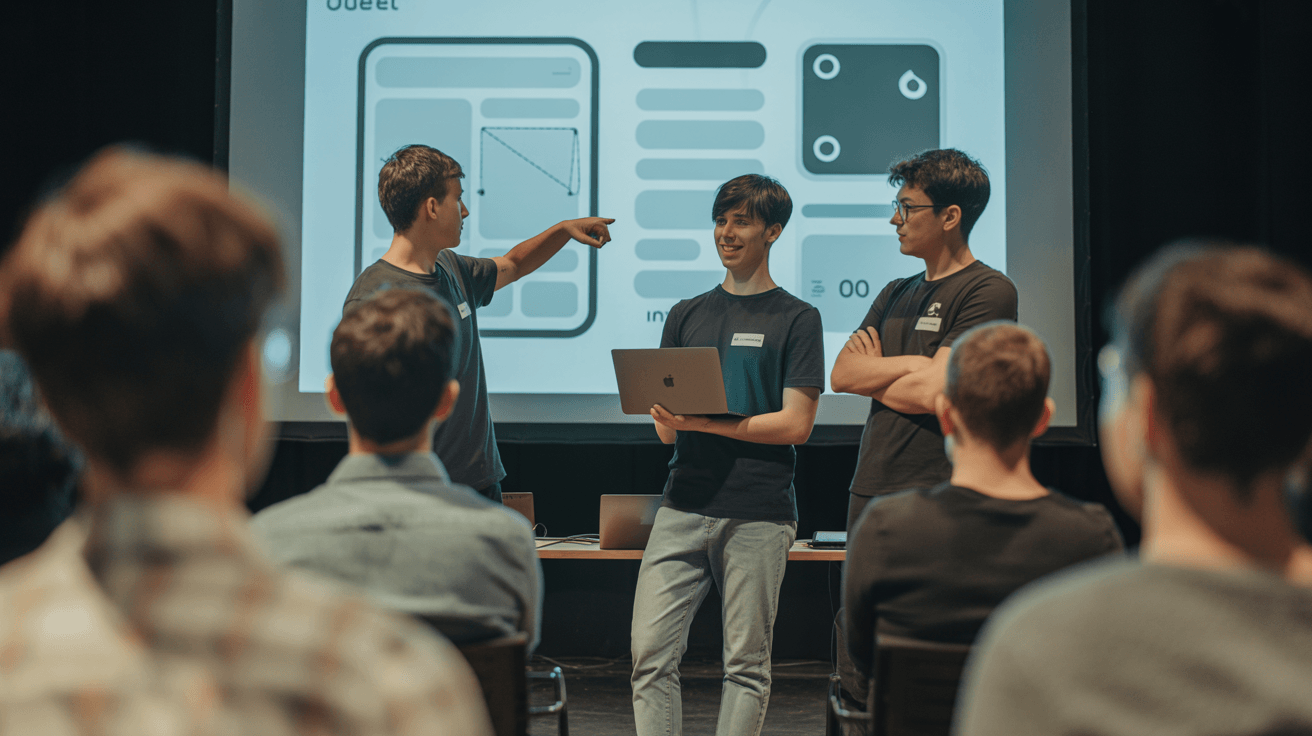

The Pitch That Wins Is Not About Your Code
The pitch is where hackathons are won and lost, and most technical people get it backward.
Lead with the problem, not the technology. Judges care about why your thing matters before they care about how you built it. Show a live demo, not slides, because a working prototype is worth more than any deck. Keep it under the time limit, because going over is the fastest way to irritate a judge who has watched forty pitches already. And practice it once before you record the video. Watch it back. Fix the obvious problems. The bar is lower than you think, and clearing it puts you ahead of most of the room.
Hackathon Challenges and Project Ideas Judges Actually Reward
The hardest part for a lot of first-timers is not the building. It is deciding what to build. Hackathon project ideas feel like they should come easily, but do not when the clock is running.
The Tracks You’ll See in 2026
The challenges at most events cluster into a predictable set of themes, and knowing them in advance helps you arrive with half an idea already formed.
AI and machine learning is, right now, the dominant category by a wide margin. Build an AI agent, fine-tune a model, and solve a real problem with a language model. Climate and sustainability tracks ask for carbon tracking, energy optimization, and disaster-response tools. Health tracks want patient tools, mental-health apps, and medical-data analysis, often with a privacy or HIPAA angle. Finance and crypto tracks ask for on-chain tools, fraud detection, and financial literacy apps. Education and civic-tech tracks round out the usual set, asking for tutoring tools, accessibility, government transparency, and community infrastructure.
What to Build
The projects that stand out share a quality that has nothing to do with technical flash: they solve a real, specific problem for a real, specific person.
Generic “look at this cool tech” demos lose to focused tools that fix something the builder actually understands. The winning formula is almost embarrassingly simple. Take a problem you personally experience. Build a working prototype that addresses it. Explain clearly why the existing solutions fail. That is the structure underneath most winning hackathon projects, from Tailored Labs winning the grand prize at Bolt’s 2025 event to that no-code interactive crime thriller taking first at the AWS PartyRock hackathon. Specific beats clever. Working beats ambitious. Solve one real thing all the way.
The Best Hackathon Tools in 2026
You can have the best idea in the room and still lose if your tooling slows you down. The best hackathon tools fall into three groups: where the event lives, what you build with, and the stack specific to virtual events.
Where Hackathons Live
Devpost is the dominant platform for hosting hackathons, with its 4-million-plus registered builders and most of the major corporate-sponsored events. Major League Hacking runs the student league side, powering hundreds of collegiate events a year. lablab.ai has become the go-to for AI-specific hackathons, often built around a particular model provider. HackerEarth handles a lot of corporate and internal hackathons and hiring challenges. AngelHack, one of the older organizers, now focuses heavily on Web3 and AI events.
| Platform | Community size | Best for |
|---|---|---|
| Devpost | 4M+ builders | Corporate & student events |
| MLH | 500K+ students | Collegiate circuit |
| lablab.ai | AI-focused | AI model hackathons |
| HackerEarth | Enterprise-focused | Corporate & hiring |
| AngelHack | 300K+ | Web3 and AI |
| DoraHacks | Web3-native | Blockchain ecosystems |
What Wins Them
The build stack in 2026 looks different from what it did even two years ago because of AI. The AI coding assistants (Cursor, GitHub Copilot, Replit’s agent, v0, Bolt) are the “vibe coding” tools that let teams move several times faster than they could by hand. For prototyping, Figma covers design, Vercel handles deployment, and Supabase or Firebase gives you a backend, database, and authentication without building any of it yourself. For collaboration, it is GitHub for code, Discord for communication, and something like Notion or Linear for tracking who is doing what. And the APIs worth knowing cold include OpenAI, Anthropic’s Claude, Google’s Gemini, Stripe for payments, Twilio for messaging, and Mapbox for anything with a map.
The Virtual-Specific Stack
Virtual hackathons add their own layer. Event platforms like Hopin, Airmeet, or Gather create the virtual venue. Tools like Loom or screen.studio let you record the demo video fast and clean. And for teams scattered across time zones, a timezone converter and an async standup habit do more for your sanity than any productivity app.
What You Actually Get Out of Attending Hackathons
The prizes are nice. They are also not the point, and the people who go only for the prize money tend to have the worst time. The real benefits of attending hackathons are the things that do not fit on a check.
Skills You Can’t Get From a Course
A hackathon teaches one thing better than almost any classroom: how to ship under pressure. Real engineering work is not the calm, well-scoped exercise that coursework pretends it is. It is messy, time-constrained, and full of decisions about what to cut. A hackathon is that experience compressed into 48 hours, and learning from hackathons in that specific way transfers directly to a real job in a way that a tidy course project never does.
You also learn cross-functional collaboration in real time, rapid prototyping under a real deadline, and how to pitch to a skeptical audience. These are the skills that separate people who can build from people who can build and ship, and the second group is the one that gets hired.
Networking That Goes Somewhere
Hackathon networking opportunities are unusually high-quality because everyone in the room is self-selected for the thing you have in common. The sponsor engineers are real people who work at the companies you might want to work at, and a hackathon gives you hours of face time with them that a job application never would. Your teammates become future co-founders, colleagues, and references. MLH likes to point out that one in three graduating computer science students in the US is an alumnus of its programs, which is less a statistic than a description of a network you want to be inside. For virtual events, the Discord communities often outlive the event by months, and some of the best opportunities come from a connection made at hour 20 that turns into something a year later.
The Portfolio Argument
A hackathon project is a deployed, working demo with a video walkthrough and public source code. Compare that to a resume bullet that says “proficient in Python,” and it is not close. For people changing careers, the value compounds. “I am a lawyer who built an AI legal-research tool that won an Anthropic hackathon” is a story that makes a recruiter lean in, and it is a story the hackathon hands you on a plate.

Hackathon Winners: The Countries Quietly Running the Table
If you only followed the funding headlines, you would assume hackathon winners cluster in San Francisco. The actual results tell a more interesting story, and it is a global one.
Microsoft Imagine Cup
The Imagine Cup champions over the last three years came from Kenya (Team TAWI, 2023), Turkey (FROM YOUR EYES, 2024), and the United States (Argus, 2025). The pattern across the competition’s longer history is that countries with a fraction of the Valley’s resources punch far above their weight. Talent, it turns out, is distributed more evenly than capital.
NASA Space Apps Is the Biggest of Them All
NASA’s International Space Apps Challenge is the largest annual hackathon on Earth, and it is not close. The 2024 edition drew 93,520 registered participants across 163 countries, who produced 9,996 submissions, from which NASA chose 10 global winners. The 2025 edition grew again, to more than 114,000 participants at 551 events in 167 countries. Winners get invited to NASA facilities. The entries come from everywhere, from Bhutan to Brazil to Bangladesh, which makes this the most geographically distributed competitive event of any kind I can think of.
ETHGlobal
The crypto world runs its own circuit through ETHGlobal, and the prize pools are serious. ETHGlobal Bangkok, held after the Devcon conference in November 2024, had a 750,000-dollar prize pool, the largest in the series’ history, drawing 713 submissions judged by figures including Ethereum’s Vitalik Buterin. ETHGlobal Brussels in July 2024 pulled 1,100-plus developers from 72 countries who built 355 projects. ETHGlobal Singapore in September 2024 had 930-plus developers competing for 325,000 dollars. The winning teams skew heavily international, drawing from regions with strong crypto-developer communities like India, Nigeria, Eastern Europe, and Southeast Asia.
Junction
Junction, based in the Helsinki area and running since 2015, is the flagship European hackathon, a 48-hour event that pulls 1,300 to 1,500-plus participants from more than 90 nationalities. Past winners include suju.online (a 2016 self-driving bus-routing project), Signvision (2017), and Oneiro (2018). It remains one of the events that serious hackers plan their year around.
The Largest Hackathon Ever Held
And then there is the record-holder. The 2025 hackathon presented by Bolt was fully online, with a prize pool above a million dollars, and according to Bolt, it had more than 130,000 registered builders, making it the largest hackathon ever held by a wide margin. The grand prize went to Tailored Labs, and the judging panel included the indie-builder figure Pieter Levels and the investor Sarah Guo. It is the clearest proof of the thesis this whole piece keeps returning to: virtual is what lets the format reach a scale the physical world cannot contain.
Student Hackathon Opportunities and the Universities That Built the Culture
A huge share of the energy in this space comes from universities, and student hackathon opportunities are where most people in tech got their start. The collegiate hackathon is, in many ways, the purest version of the format.
The Schools
PennApps at the University of Pennsylvania started it all in the fall of 2009, the first student-run college hackathon. It grew to around 2,000 participants from 147 universities across 11 countries, with 36-hour builds and more than 30,000 dollars in prizes. After that the format spread across the top engineering schools, and the names that consistently rank near the top of the collegiate circuit include HackMIT, CalHacks at Berkeley, TreeHacks at Stanford, Hack the North at Waterloo (Canada’s largest), HackGT at Georgia Tech, and the events at Princeton, Harvard, and the University of Toronto.
The University of Texas at Dallas runs HackUTD, one of the largest student hackathons in the US by in-person attendance, with well over a thousand participants. Smaller schools run their own flagship events, like SteelHacks at the University of Pittsburgh. The whole structure runs on student labor, with computer-science clubs and ACM chapters organizing, fundraising, and operating the events themselves.
The MLH Machine
Holding the collegiate circuit together is Major League Hacking, which functions as the league office for student hackathons the way a sports association governs a season. MLH provides the standard code of conduct, tracks performance across events in a season, and gives top performers visibility that turns into recruiting. Its claim that one in three graduating US computer-science students has been through its programs is the kind of number that, if even roughly true, explains why the major tech companies treat the student hackathon circuit as a primary talent pipeline. MLH also runs a Fellowship, a paid program that connects the hackathon world to real work experience.


Quantum Hackathons: Building on Machines That Barely Work Yet
There is a whole category of hackathons where the computer you are building on does not really work yet, and that is the entire point.
Quantum hackathons are what they sound like: time-boxed events built around quantum computing instead of ordinary software. The catch is that quantum machines in 2026 are still noisy, error-prone, and limited to a modest number of qubits. You are not walking out with a slick consumer app. You are writing quantum circuits, testing algorithms, and in many cases running your code on real quantum processors from companies like IBM, IonQ, or QuEra to see what comes back. Sometimes what comes back is mostly noise. That is part of the lesson.
The work looks different from a normal hackathon, too. Instead of front-end and back-end, teams tackle optimization problems, quantum machine learning, cryptography, error correction, and the unglamorous but crucial layer of compilers that turn a quantum program into instructions a fragile machine can actually run. At MIT’s 2026 event, a team of PhD students from Clemson spent the weekend improving a quantum compiler, working out cheaper ways to break a program down into operations the hardware can handle. Not exactly a photo-sharing app.
The toolkits are their own small world. Qiskit from IBM, PennyLane from Xanadu, Cirq from Google, Amazon’s Braket, and platforms like qBraid and Classiq that bundle the dependencies so teams are not fighting their environment for the first three hours. Same scoping discipline as any hackathon, very different stack.
The Events That Actually Matter
The flagship academic one is MIT iQuHACK, MIT’s annual quantum hackathon, now in its seventh edition. It runs in late January or early February with both an in-person track on real hardware and a virtual track for everyone else, and the 2026 event pulled in around fifteen quantum companies as sponsors, including NVIDIA, IonQ, IQM, QuEra, and Alice & Bob. For something this technical, it is unusually welcoming to beginners, with a Quantum Winter School to get people up to speed and travel grants aimed at students from underrepresented backgrounds.
QHack, run by the quantum company Xanadu, is the other heavyweight. It is a world-renowned annual event that stretches over about two weeks, pairing hands-on workshops with structured programming challenges that scale from beginner to genuinely hard.
unitaryHACK takes the open-source route. Instead of a weekend sprint, it runs as a two-week bounty hunt, where participants claim real bugs and feature requests on widely used quantum software and get paid for landing them. The 2025 edition drew more than a thousand participants who claimed 172 bounties for over nineteen thousand dollars, and the 2026 run is scheduled for June.
Then there is the government-funded tier, which has grown fast. The UK’s national quantum body runs the UK Quantum Hackathon every year, with the 2026 edition at the University of Warwick. Berlin runs an ambitious one with the startup Kipu Quantum: a six-week event handing teams more than twenty quantum backends and twenty thousand euros in compute credits, with challenges submitted by real Berlin organizations on problems like brain-computer interfaces and crew scheduling. Zurich’s ETH has its own weekend version. None of this is an accident. Governments are spending real money to build domestic quantum talent, and a hackathon is a cheap way to find the people worth investing in.
Why Anyone Bothers Building on Hardware This Young
The recruiting logic from earlier in this piece applies here at full volume. Quantum talent is genuinely scarce, far scarcer than ordinary software talent, so every hardware company on that sponsor list has a direct interest in getting developers fluent in its specific stack before a competitor does. When a quantum hackathon pays out prizes in hardware credits rather than cash, it is running the same onboarding ramp AWS runs, just for machines that cost a fortune to operate.
There was also a one-time accelerant. The United Nations declared 2025 the International Year of Quantum Science and Technology, marking a century since quantum mechanics was first worked out, and the result was a wave of extra quantum hackathons worldwide, many of them pointed at sustainable-development problems.
If you are wondering whether you need a physics PhD to take part, the honest answer is no, but it helps to show up with some linear algebra and a basic grip on how a quantum circuit works. The winter schools and beginner tracks exist precisely because the field knows its barrier to entry sits higher than a typical web hackathon. The events that do this well treat the first day as teaching rather than competition, which is the same move the best beginner-friendly hackathons everywhere have already figured out.
This is also, as it happens, where a good deal of the confusion around mysterious “quantum protocols” tends to come from, which brings us to the strangest part of this whole piece.
Top Global Hackathons and Upcoming Events in 2026
If you want to actually plan around the top global hackathons, here is the map of where they have been and what is coming.
Where They’ve Been
The major annual events, roughly by character: NASA Space Apps runs globally across hundreds of local nodes in well over 160 countries, the broadest event by geography. Junction anchors Europe from Finland. ETHGlobal rotates between cities like Bangkok, Brussels, Singapore, and San Francisco for the crypto crowd. HackZurich in Switzerland was long billed as Europe’s largest, though as of mid-2025, its site listed it as on hiatus, which is worth checking before you plan around it. Hack the North anchors Canada from Waterloo. PennApps anchors the original collegiate tradition from Philadelphia. Microsoft’s Imagine Cup runs globally with virtual rounds and an in-person championship. And Bolt’s event, fully virtual, holds the all-time scale record.
What’s Coming in 2026
For upcoming hackathons in 2026, a few are already confirmed, and the rest follow reliable annual cadences.
OpenBSD’s c2k26 hackathon is confirmed for Isla Mujeres, Mexico, running February 5 to 12, 2026, which is a nice full-circle detail given that OpenBSD started the whole tradition. NASA Space Apps should return in October 2026 on its annual schedule. Junction should return in November 2026 in the Helsinki area. ETHGlobal typically runs four to six events a year across rotating cities, so expect a full 2026 calendar. Microsoft’s Imagine Cup should open its 2026 cycle in the spring, and Google Summer of Code typically opens applications in January or February. The MLH season for 2026 to 2027 will bring hundreds of collegiate events between roughly August 2026 and May 2027.
One honest caveat: dates and locations shift, and events occasionally pause (see HackZurich). Confirm against Devpost, MLH, and each event’s own site before you book anything.
| Event | Date | Location | Format | Focus |
|---|---|---|---|---|
| unitaryHACK | June 3-17, 2026 | Online | Virtual | Open-source quantum |
| MLH Global Hack Week and Season 2026-27 | July 2026 kickoff, runs into spring 2027 | Global | Hybrid | Student / general |
| UK Quantum Hackathon (NQCC) | August 18-20, 2026 | Warwick, UK | In-person | Quantum |
| NASA Space Apps Challenge | Early October 2026 (expected) | 550+ local events worldwide | Hybrid | Space, data, AI |
| Junction | November 2026 (expected) | Helsinki area, Finland | Hybrid | General / AI |
| ETHGlobal (multiple events) | Through late 2026 | Rotating cities | Hybrid | Crypto / Web3 |
What Actually Gets Shared at Hackathons, and What Gets Locked in a Vault
This issue is worth answering properly: how does scientific and technical information actually move at these events, and does any of it ever get classified or hidden?
The Open Default
For the overwhelming majority of hackathons, the default is openness, and the whole model assumes it. Most hackathon code ends up published on GitHub. The sponsor workshops and tech talks exist specifically to transfer knowledge (how to use a new model, a new SDK, a new platform) from the company to the participants. Teams working on different problems trade techniques informally, and at virtual events with public channels, where cross-pollination happens in the open, where thousands of people can see it. The norm is sharing, not secrecy.
The Cases Where the Government Classified Everything
The exception, and it is a real one, shows up when governments run hackathon-style programs, and here the picture flips completely.
The clearest example is Hack the Pentagon, the first federal bug-bounty program in the United States, which ran its pilot in 2016. More than 1,400 people registered, they found 138 valid vulnerabilities, and the program paid out 75,000 dollars. None of those findings were published. They were classified and quietly fixed, which is the entire point of a security program.
It went further. The Department of Defense set up a tiered structure where the most sensitive work went to a vetted-researcher platform called Synack. The first Synack challenge, in early 2017, had 80 highly vetted researchers spend more than 2,500 hours probing an internal file-transfer mechanism that moved data between sensitive networks. That work was fully classified. The follow-on programs (Hack the Army in 2016, Hack the Air Force in 2017, Hack U.S. in 2022, with its 648 reports) all operated the same way, with findings restricted by default.
So the rule, stated cleanly: when companies and universities run hackathons, the outputs are open, and the participants generally keep their IP. When governments run them on sensitive systems, the outputs are classified, and you never hear about them again. Both are hackathons. They sit at opposite ends of the secrecy spectrum.
There is a quieter middle ground, too, in fields like quantitative finance, where the QuantMinds hackathon openly acknowledges that confidential treatment of code and prompts is not practical in a competition setting. Translation: if you submit it to a contest, assume people can see it. Some corporate events do require NDAs when they hand teams access to proprietary datasets, with deletion required afterward, but there is no universal rule governing any of this. It is negotiated contract by contract, event by event.
The Part of the Pitch Deck Nobody Shows You
I would be selling you something if I ended on pure celebration, so here is the counterargument, taken seriously.
The Free-Labor Argument
In 2017, the sociologists Sharon Zukin and Max Papadantonakis studied seven hackathons in New York City and published a paper with a pointed thesis: that sponsors use these events to outsource work, crowdsource innovation, and burnish their reputations, all while reframing what essentially is unpaid and precarious labor as an extraordinary opportunity. The popular-press version of the study put it more bluntly, calling hackathons events that dupe people into working for free.
The criticism has teeth, and it is sharpest exactly where the money is. When a company sponsors an event, retains a license to everything built there, and gets a weekend of free R&D from hundreds of talented people in exchange for pizza and a chance at a prize, the exchange is not as balanced as the marketing suggests. The counterpoint is real too: most participants genuinely do gain skills, connections, and portfolio pieces they value, and they show up knowing the deal. The exchange is not zero-sum. But the power asymmetry is real, and it is worth going in with your eyes open, especially about that IP clause.
The AI Integrity Problem
The newer problem is the one I promised to come back to. In 2025, Coinbase’s Base platform ran an event called the Onchain Summer Awards, with a 200,000-dollar prize pool and more than 500 teams. Afterward, a researcher alleged that AI-generated shell projects, things that looked finished but had little real functionality, had been placed in the top awards, and that some were possibly linked to Coinbase employees. Treat the specifics as allegations rather than settled facts, because the response was limited. But the underlying problem is not going away.
When AI tools make it trivial to generate a plausible-looking project in a few hours, the judging rubrics built for an era of genuine human effort start to break. A demo that looks polished on stage might be held together by nothing. Judges watching forty pitches under fatigue cannot easily tell the difference. The hackathon world has not solved this, and it is the question that will define the format over the next few years: how do you reward real building when fake building has gotten so convincing?
That tension is not a reason to avoid hackathons. It is a reason to pay attention to how the good ones adapt.
Twenty-seven years after ten people crammed into a house in Calgary to build networking code over a week, the format has outgrown almost every prediction anyone made about it. It survived the move online, absorbed AI instead of being replaced by it, and pulled in a lawyer who can now out-build the engineers. The next version is already taking shape, and the only safe bet is that it will look stranger than this one.
Wherever your next build starts, a hackathon win, a napkin sketch, or a prototype that needs to become a product, LITSLINK can help you turn it into software people actually use. Start a conversation.
Frequently Asked Questions
What is a virtual hackathon?
A virtual hackathon is a time-boxed building event, usually 24 to 72 hours, run entirely online, where teams build a working prototype around a theme and present it to judges. Participants collaborate over Discord or a hosting platform instead of meeting in person, which lets people compete from anywhere in the world.
Do you need to know how to code to join a hackathon?
No. Most hackathons welcome non-coders, and many winning teams include designers, domain experts, and people who handle the pitch. AI tools now let people with little coding background build working prototypes, which is why recent events have been won by a lawyer, a doctor, and a teacher.
How much do hackathon winners get paid?
Prizes range from free swag and cloud credits to serious money. Microsoft’s Imagine Cup grand prize is $100,000, the 2025 Bolt hackathon had a prize pool above $1 million, and ETHGlobal events have paid out $750,000. Smaller events often award a few hundred to a few thousand dollars, frequently in API or cloud credits.
What are the best hackathon platforms and tools?
Devpost and MLH host most events, lablab.ai is popular for AI hackathons, and HackerEarth is common for corporate ones. For building fast, teams rely on AI coding assistants like Cursor and Bolt, plus Figma, Vercel, Supabase, GitHub, and Discord.
How long does a hackathon last?
Most run 24 to 48 hours straight. Virtual hackathons often stretch to 48 to 72 hours so teams in different time zones can take part, and some open-source events run as multi-week sprints.
Are hackathons free, and who can participate?
Most are free to enter, and almost anyone can join. Students, working professionals, career-changers, and complete beginners all take part, and large events like NASA Space Apps charge nothing while providing mentors, food, and sometimes travel support.
How does a hackathon actually work?
After an opening kickoff and challenge briefing, teams of three to five form, build a prototype during a fixed window, then demo it to judges in a short pitch. Judges typically score on originality, technical difficulty, real-world impact, and design.
What are the biggest hackathons in 2026?
NASA Space Apps Challenge is the largest, with more than 114,000 participants across 167 countries. Other major events include Junction in Finland, ETHGlobal’s crypto series, the UK Quantum Hackathon, unitaryHACK, and MLH’s collegiate season.
Who owns what you build at a hackathon?
Usually you do, unless the rules say otherwise. Corporate-sponsored hackathons sometimes include intellectual-property assignment or licensing clauses, so read the terms before you register.
Are hackathons worth attending?
For most people, yes. They build real skills under pressure, leave you with a portfolio project that has a working demo, and create direct connections with the sponsor companies that recruit from these events.