






Key Takeaways
- CLI AI agents are changing software development, no longer just assisting developers like traditional AI coding tools, but also enabling them to execute entire tasks. So, prompt engineering is slowly turning into automated agent orchestration.
- Vertical artificial intelligence agents that leverage industry-specific knowledge, regulations, and workflows offer a new way to outperform traditional AI models.
- Since many users prefer natural conversations over text-based IM, voice AI will be the primary technology for communicating with AI agents.
- Multi-agent approaches are transforming entire industries, letting specialized agents collaborate on complex workflows and secure a lasting competitive advantage.
- Standards like MCP and A2A are paving the way for enterprises to adopt agents fast, improve agent interoperability, and gain a competitive edge.
If you are a business leader considering how to use AI agents, a developer building smart AI systems, or an entrepreneur seeking fresh automation business ideas, it helps to stay informed about where AI agent trends are headed. This piece discusses major AI agent trends that will characterize 2026. These trends are already reshaping industries and redefining how organizations operate.
Generative AI vs. Agentic AI
Enterprise technology is changing fast. For example, the share of enterprise software products integrated with agentic AI is expected to increase from less than 1% in 2024 to 33% by 2028, according to recent statistics. In addition, some experts foresee that by 2029, agentic AI will be able to independently handle 80% of routine customer service problems, thereby reducing operational expenses by about 30%. Also, AI will make 15% of day-to-day work decisions autonomously by 2028, up from 0% just four years earlier.
Such rapid changes in AI agent technology are altering how companies and individuals work. Currently, 52% of executives say they are using artificial intelligence agents in production, indicating that this technology is no longer solely for experimentation. What was conceptual only a year ago is being integrated into the very fabric of business activities, software development, customer service, e-commerce, and personal productivity.
To really understand these new changes, we first have to separate traditional generative AI from real autonomous systems. Simple generative AI tools, such as ordinary chatbots, are working in a cycle of request and response only. They always need human prompting, don’t remember the external environment, and can’t carry out actions in the real world on their own.
However, agentic AI today completely changes the game by enabling autonomous systems to act independently to accomplish complex tasks. These agents are programmed to operate, reflect, and make changes independently. They are capable of comprehending a broad goal, gathering information, planning, breaking the goal into a series of steps, using built-in tool functions, and correcting themselves when mistakes occur. For example, a standard traditional AI model simply generates text for an email about a shipment delay, but a state-of-the-art artificial intelligence agent will initiate a delay detection in the ERP system, get customer data from CRM systems, check for alternative shipping options, update the delivery status, and finally carry out these mundane tasks by sending a personalized update without human intervention.
This ability to plan, conduct complex reasoning, plan long-term, and carry out multi-step work processes to achieve a goal is exactly why organizations focused on the future see investing in custom autonomous AI agents as a top priority over simple conversational interfaces.

10 AI Agent Trends Defining 2026
The pace of AI automation and innovation is unprecedented, so it’s not feasible to discuss every new development in a single article. What we have done instead is to point out the top 10 AI agent trends in 2026, which not only deliver great business outcomes unlike traditional AI but also influence the future of automation.
1. The Rise of CLI AI Agents in Software Development
Autocomplete AI helpers are giving way to autonomous CLI agents. Although old-fashioned Integrated Development Environment (IDE) extensions usually provide code snippet suggestions or write separate functions, contemporary CLI agents handle entire development workflows from start to finish. They are proving indispensable by programming and deploying entire applications and controlling the path from idea to final product.
Claude Code, Cursor CLI, and Windsurf are among the tools driving this shift. Coding agents help automate coding and debugging; they can create local environments, execute test suites, interpret terminal errors, debug a whole codebase step by step, and even write code without any human help. Developers report achieving remarkable productivity gains, and most often, they can reduce the time needed to refactor legacy code or create boilerplate architecture by up to 50% simply by not writing code line by line.
In the end, engineering professions are evolving; software experts are becoming coordinators of multiple agents rather than writing code by hand. Following a well-planned, orderly AI agent development procedure will help ensure these tools are introduced safely into enterprise environments.
2. Personal AI Is Going Mainstream
We won’t be stuck with basic virtual assistants anymore that only answer questions or set simple timers. The major change in the consumer space is the move towards personal AI agents that are fully capable of taking real, cross-platform actions in several applications with minimal supervision — and some can reason through problems independently. Large leaps in large language models, better contextual reasoning, longer context windows, and deeper software integrations have been the main factors behind this transformation. Fueled by these advancements, the market is rolling out specialized tools that have real persistent memory, i.e., they can retain context from years of personal documents, calendar history, and past decisions, rather than clearing themselves after every session.
40% of enterprise applications will have AI agents embedded by the end of 2026. Currently, personal agents can handle complex personal finances, track investments, negotiate digital subscriptions, plan travel itineraries that optimize for changing flight prices, and automatically tidy up very disorganized email inboxes.
Instead of being merely passive chatbots with human oversight that constantly need prompting, today’s personal AI systems have advanced goal-planning and action modules. Unlike traditional AI, they can securely monitor real-time data streams, read and organize incoming mail, and carry out multi-step research or administrative workflows natively in the background. Due to their heavy involvement in handling these multi-step, boring digital routines, personal AI is almost invisibly becoming part of everyday professional life, serving as a tireless digital assistant that frees users to focus on strategy and creative work.
3. Browser Agents Are Becoming Everyday Tools
Browser automation has changed from strictly rule-based, fragile scripts to adaptable AI browser agents. These agents, which can understand through computer vision, reason in a way similar to humans, and change their paths when needed, can recognize and use any web interface just as a human user does. Because of this, they do away with the requirement of strict backend APIs.
Browser agents are becoming essential tools in business operations. Many organizations use agents for web testing in at least one browser, automatic form filling, data extraction across different platforms, competitive market analysis, and workflow automation for old-style websites that lack modern API infrastructure. These agents can navigate web pages, solve CAPTCHAs, manage pop-ups, and collect organized data.
4. Vertical AI Automation: Industry Applications
Vertical AI agents are dramatically changing the enterprise market because they operate with much greater accuracy and efficiency than general-purpose models. These specialized agents, grounded in deep domain knowledge, have prebuilt industry workflows and are natively aware of regulatory requirements, enabling them to deliver immediate business value in specific niches. Customized AI agents for business automation are quickly becoming the industry standard.
Healthcare
In clinical settings, AI agents can boost business value by enhancing diagnostic capabilities, supporting precise treatment decisions, and enabling smart, continuous patient monitoring. Rather than serving as mere reference points, these agents become experienced healthcare professionals deeply involved in healthcare workflows, such as processing medical images, identifying hidden patterns in electronic health records, and organizing patient care schedules, showing how AI agents in healthcare move from advisory tools to active participants in clinical workflows.
Financial Sector
The financial services market size for AI agents was nearly $1.75 billion in 2025, and projections indicate it could surge to $5.7-$6.7 billion over the next 10 years. Financial institutions rely on agents to offer detailed financial planning, measure credit risk in real time, conduct in-depth data analysis, provide automated customer service, and detect fraud in real time. Large institutional players such as JPMorgan Chase and NICE Actimize leverage such autonomous workflows to efficiently secure their assets and ensure compliance, thereby transforming conventional ways of working. This is how AI in finance is reshaping the way institutions integrate intelligent systems across their operations.
Logistics
Global supply chain executives depend heavily on AI agents to handle the complexity of physical-world functions. Some widely recognized applications include high-accuracy demand forecasting, automated predictive maintenance for vehicles, continuous inventory management, and real-time vehicle routing. In addition, AI-powered predictive maintenance has been shown to reduce emergency repairs by 60-80%.
Such procedures end up saving huge amounts of money. To illustrate, UPS managed to cut $300 million from its logistics costs by using agents. Many companies continue to leverage such intelligent machines to address issues related to fuel volatility, weather disturbances, and labor shortages with minimal disruption — proof of how AI in logistics is driving down operational costs across the supply chain.
5. The Boom of Agentic AI in E-Commerce
E-commerce is moving toward a fully agentic system, with the prediction that artificial intelligence agents will handle a large share of e-commerce transactions very soon. Yes, forecasts predict that by 2028, 90% of B2B purchases will be conducted through agent intermediaries.
Gone are the days of product recommendation carousels, as automated agents can find, compare, and purchase products on users’ behalf without risk. Fueled by widespread enterprise AI deployment and increased consumer trust, this occurrence is radically reshaping the infrastructure of online retail. Real-world examples include the automation of subscription management, the development of complex price comparison engines, the use of personal shopper agents, and autonomous corporate procurement. These shifts are reshaping marketing and sales strategy, as the latest AI in e-commerce statistics make clear.

6. Voice Assistants Are Becoming the Primary Interface
Today’s AI agents can read and comprehend much more than text-based input. They can present text, voice, visual, and contextual cues and even read the user’s subtle emotions or cues all at once. Voice agents have transformed today, to the point of being integrated into enterprise business workflows for instant clarification and advanced customer engagement. Moving towards voice-first AI agents offers a faster, more natural, and more intuitive UX, eliminating the need for typing and making hands-free digital execution real in the physical realm. Adoption by enterprises and consumers is also accelerating for use cases such as live customer support, organizing interactive corporate meetings, augmenting field productivity through true hands-free operations, and rolling out leading-edge digital assistants in cars or on mobile devices.
Platforms like ChatGPT Voice, Gemini Live, Alexa+, Siri with Apple Intelligence, and Microsoft Copilot Voice demonstrate how the global market leaders are making massive investments in voice-centric ecosystems. This movement towards extremely flexible, real-world execution was exemplified by another development from LITSLINK: an intelligent voice assistant designed to streamline phone reservations for the hospitality industry. The AI assistant will field a call from a restaurant patron, monitor the audio streamed through its microphone in real time, and maintain the same natural flow of time as an otherwise human host throughout the booking conversation.
After getting a general idea of what the caller wants, it can glean additional specifics such as the number of guests, the reservation date, and time, and then securely cross-reference all that information with the internal booking systems at the destination site. If the caller gives an ambiguous response or changes their mind midway through the reservation, the bot will nevertheless guide them through by asking questions as needed.
7. The Growth of Multi-Agent AI Systems
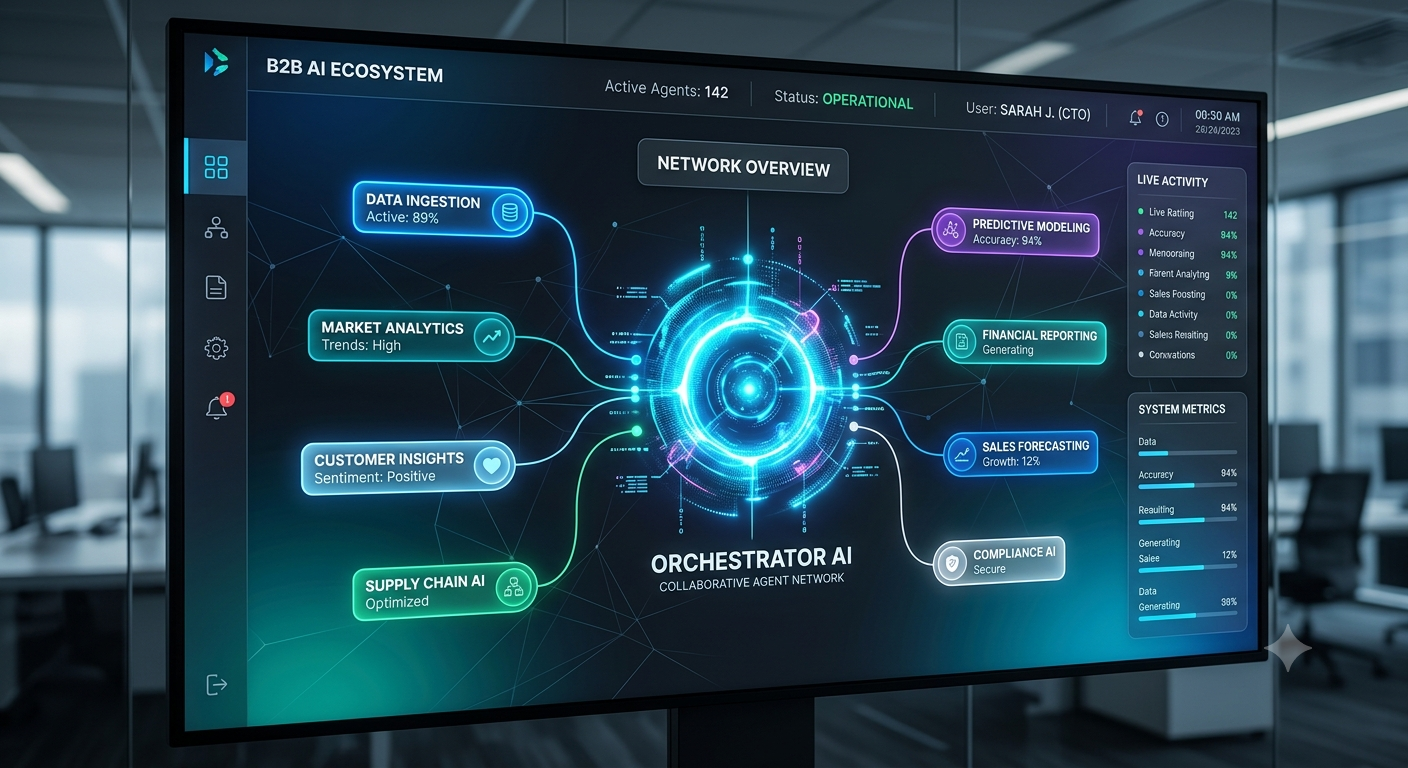
Even though a single AI agent can do a lot, the real breakthrough in enterprises comes from multi-agent systems. The industry is quickly moving away from single agents working in isolation and toward collaborative structures in which multiple agents work side by side, like digital assembly lines, to tackle complex enterprise problems. In fact, multi-agent workflows have grown by up to 327% recently, and organizations using multi-agent systems resolve problems 45% faster on average. In these types of collaborations, one agent serving as a central orchestrator can smoothly control the AI agents, dispatching small tasks to individual agents specialized and optimized for specific activities. Teams of specialists work closely together through digital collaboration to solve complex problems in specific domains, thereby enabling areas such as compliance auditing, HR onboarding, detailed market research, and strategic business planning.
In this example, LITSLINK developed a complex multi-agent platform tailored for the veterinary sector to perform complex pet health evaluations. By developing different digital expert personas, such as a triage expert for emergencies and a dietary consultant, the platform is built on collaborative workflows in which a primary care agent evaluates patients first and then refers complex cases. These separate agents dynamically compare symptoms with medical records and guidelines, smoothly changing the user from one specialty to another to resolve complex care issues simultaneously.
8. Standardized Protocols Are Powering AI Agents
With the ecosystem growing, setting a standard for how AI agents interact with software, their own data storage systems, and other agents becomes crucial. Standardized protocol usage guarantees that companies won’t need extensive custom integrations or dependency on a single provider to integrate agents with various enterprise systems, external developer tools, and different third-party platforms.
The Model Context Protocol (MCP) is one of the main systems that standardizes how agents connect to external tools, secure databases, and key APIs, and enables the system to maintain context over lengthy conversations. Similarly, the Agent-to-Agent Protocol (A2A) formalizes communication between agents, enabling them to collaborate smoothly even when they are from different vendors. Open standards for enterprises imply greatly eased integration, reduced vendor lock-in, and the ability to gradually grow from a single experimental agent to a fully connected multi-agent enterprise ecosystem.
9. The Evolution of AI Governance
The regulatory environment for artificial intelligence is evolving rapidly. Active AI governance, once merely a boardroom suggestion, is now legally binding in many jurisdictions. The European Union’s AI Act is the leading global regulatory standard, but various frameworks and strict requirements are being rapidly introduced in the United States, China, and other major financial centers.
When companies decide to expand their AI projects, they should be able to keep pace with rapid innovation while ensuring compliance across the organization. This includes checking that the AI systems are secure, transparent, and have audit trails. Most importantly, human judgment should be an integral part of decision-making processes, mainly for critical decisions in enterprise workflows such as healthcare diagnostics, credit approvals, or legal reviews. In addition to human judgment, strict human oversight and explicit human intervention points should be present to maintain accountability and safeguard against both algorithmic bias and errors.
10. AI Agents Are Moving from Experiments to Business Value
The experimental AI proof-of-concept window is closing for early movers as companies realign their focus from exploration to delivered results. The global artificial intelligence agents market is forecast to grow to $52.62 billion by 2030, up from $7.84 billion in 2025, at an astounding 46.3% CAGR, according to a wide-ranging market study by MarketsandMarkets. To get into greater detail about how these market figures are shaking up global trade, we’ve assembled a selection of major AI Agent Statistics. The million-dollar influx is apparently justified because a fundamental breakthrough in autonomous reasoning has been achieved: today’s agents are less brittle than ever, as they are totally adaptive. They do not crash when faced with unfamiliar variables.
They have greater reflective power and are even capable of self-correction: they can recognize dead ends and failed API calls, flexibly adapt their execution plans, and spontaneously switch on the spot to identify other means of achieving the most sophisticated enterprise goals. If the main data sources go down, the system will not stall; it will look for alternative routes.
Innovative companies generate the greatest value by taking a deliberate roadmap approach to this transition, rather than a frantic rollout. The most successful players take a stepwise approach to AI adoption by first identifying high-ROI use cases that can be quickly automated, such as customer support or order processing in warehousing.
Then they quickly expand their infrastructure while upskilling their workforce. Finally, the only way one can deliver true value back to the enterprise is through profound transformation of the business and thoughtful reengineering of operational processes during AI agent deployment across a customer’s infrastructure. Papering over legacy processes with automated agents will achieve very little. The real strategic edge is achieved when a company redesigns its workflows around a model where human oversight and AI agents work together.
The Re-engineering of Customer Service & Support
As agentic AI evolves from being experimental to functional, the customer support ecosystem is undergoing a massive change. Agents demonstrate their worth here by cutting average response times from hours to near-real time while handling 60-70% of routine inquiries without human assistance. Based on the latest data from Gartner, customer service teams will have to deal with a new type of customer — machine customers, autonomous AI agents that are buying and negotiating on their own.
This creates a very difficult problem for service teams used to working only after customers have raised requests and only through human-to-human communication. According to Gartner, companies need to rethink how they handle inbound client service interactions, as automation becomes the default mode of operation for support teams.
How Support Leaders Must Prepare For Agentic AI
- Invest in Scalable Infrastructure: Self-serve channels should be designed to handle high-volume, autonomous bot traffic smoothly and to provide secure agent access when necessary.
- Revise Service Models: Ensure dynamic routing schemes are in place to distinguish between human customers and artificial intelligence agents.
- Establish AI Interaction Policies: Set up clear rules, including data confidentiality, system safety, and escalation procedures to human agents, to assure quality control.
- Collaborate with Product Teams: Internally, work with Product Teams to develop native, embedded agents directly into consumer products for proactive, automated issue detection.
Proving the Bottom Line: Unprecedented ROI Measurement
One of the clearest signs that businesses are moving from trials to real deployment shows up in the financials. Early movers are reporting meaningful gains in capital efficiency, with strong first-year returns on their AI agent investments — though results vary widely by use case and maturity.
What is more, 88% of agentic AI early adopters achieve positive ROI in at least one use case. This strong financial feasibility is driven first and foremost by the goal of reducing costs; when compared with traditional support models, AI agents can reduce interaction costs by up to 90%.
The trend with artificial intelligence agents is that they are becoming more and more like the most agile players in the market; not only can they understand when something isn’t working, they can also quickly change their plan of action and even independently decide to work on a different approach altogether to achieve highly complicated corporate goals. Enterprises that have done their homework and committed end up making the best use of limited resources, achieving the highest returns by starting with high-ROI targeted use cases and then increasing their operational capacity over time while continuing employee training.
Why Choose LITSLINK AI Agents for Your Business Transformation
To navigate this fast-growing, agentic environment, you need a trustworthy technical partner with deep expertise that will help you deploy AI agents. Off-the-shelf AI tools usually don’t meet the specific security, compliance, and agent architecture requirements of a modern enterprise. LITSLINK is recognized as the leading engineering partner for businesses seeking custom artificial intelligence agents and highly resilient, complex, production-ready systems. With an international team of more than 300 skilled engineers, LITSLINK is focused on building agents that are secure, very scalable, and completely tailored to industry-specific needs for real-world applications.
We have in-depth knowledge of the entire modern AI stack:
- Custom Agent Architectures: From start to finish, creating custom artificial intelligence agents, systems with multiple agents working together, and tools for browser automation.
- Advanced AI Implementation: Sophisticated LLM integration, use of Retrieval-Augmented Generation (RAG) to build enterprise knowledge bases, and handling complex vector databases to help you manage AI agents.
- Modern Integration Standards: Effortless rollout of the Model Context Protocol (MCP) to safely link agents with corporate databases, cloud infrastructure, and exclusive APIs.
- Enterprise Infrastructure: Direct connection to enterprise systems like CRMs, ERPs, secure communication networks, and sophisticated financial or healthcare software.
Whether you operate in healthcare, financial services, logistics, retail, or e-commerce, LITSLINK brings the technical proficiency you need to convert these 2026 AI trends into concrete business results and real value. Reach out to LITSLINK now to talk about your custom artificial intelligence agents project and speed up your AI-enabled business transformation.
FAQ
What are AI agent trends?
AI agent trends are about the changing dynamics, technological advancements, and adoption practices in agentic AI. Unlike conventional generative AI tools that generate outputs such as text or code on user-supplied prompts, agentic AI is more about autonomy, long-term understanding, and self-correction. In 2026, the key insights are the move from a single agent to multi-agent collaboration, increased usage of open communication protocols like Model Context Protocol (MCP), and re-architecting how entire companies operate around digital workforces.
Which AI agent trend will have the biggest business impact?
The emergence of multi-agent systems and collaboration among different companies is really changing corporate profits on a large scale. One agent operating alone can only perform a limited number of small, repetitive tasks. But if one is able to coordinate a whole network of agents, each having specific expertise, then it will enable the automation of very complex and multi-department business processes. This trend is supported by open standards for interoperability like the Agent-to-Agent (A2A) protocol, which is capable of connecting the business digital ecosystems with external suppliers, partners, and customers in a very secure way. It will change the way the company is operating by transforming it from rigid, instruction-based software that is limited to only a few functions to a completely flexible, intent-based automation solution.
Which industries will benefit most from AI agents?
The widespread use of autonomous technology will trigger a large-scale business change all over the world. However, three major verticals are currently reaping the greatest immediate benefits:
- Banking, Financial Services, and Insurance (BFSI): Users mainly focus on real-time credit evaluation using specialized vertical agents. Automated compliance tracking is another user area. Algorithmic fraud detection and client onboarding, which are instant, are the two other most heavily capitalized target areas.
- Healthcare: Advanced agents are instrumental in handling the overload of administrative tasks, among other things. The agents also help in facilitating insurance claims processing and in the analysis of electronic health records (EHR). Also, in clinical patient monitoring, these agents contribute to the optimization of this process.
- Logistics and Supply Chain: International route optimization is done in real-time with the help of multi-agent systems. In conjunction, the systems manage automated inventory precisely and also do predictive maintenance, which results in reduced downtime of a fleet.