








Key Takeaways
- Crypto AI agents automate blockchain operations by utilizing machine learning models, LLMs, and natural language processing.
- These AI agents automatically execute trades, perform portfolio management, optimize DeFi, detect fraud, and assist with governance.
- Current market capitalization for the DeFAI market is approximately $1.28 billion.
- Popular projects include G.A.M.E, GRIFFAIN, AixBT, VaderAI, and PAAL AI.
- Human oversight will remain critical for high-value financial and governance decisions.
This guide is for crypto traders, DeFi users, Web3 founders, and businesses exploring AI-powered blockchain automation. It will help you understand how crypto AI agents work, where they add real value, which projects are worth knowing, and what risks to consider before adopting or building AI-driven crypto solutions.
What Are AI Agents in Crypto & Their Benefits

Crypto AI agents are software programs that use machine learning, large language models (LLMs), and natural language processing (NLP) to work on blockchain networks with little or no human intervention. They analyze off-chain and on-chain data, execute trades by means of smart contracts, manage portfolios, and support decentralized governance.
In Q4 2024, the market capitalization of crypto projects categorized as AI agents increased from $4.8 billion to $15.5 billion, demonstrating tremendous growth in the field of AI-powered blockchain automation. This surge reflected strong investor interest, but it should not be interpreted as evidence of sustained growth or future performance. At the same time, many projects are still in their infancy, varying widely in autonomy, performance, and reliability.
Understanding AI agents in crypto starts with digging into decentralized finance (DeFi). DeFi is a system of financial services, including lending, borrowing, trading, and yield farming, that operates without banks or brokers and runs on blockchain networks. It is open, always on, and global, but also fast, volatile, and time-demanding. Interest rates change hourly; opportunities arise and disappear in a matter of minutes, and monitoring these conditions manually is demanding.
This is where autonomous AI agents come into play.
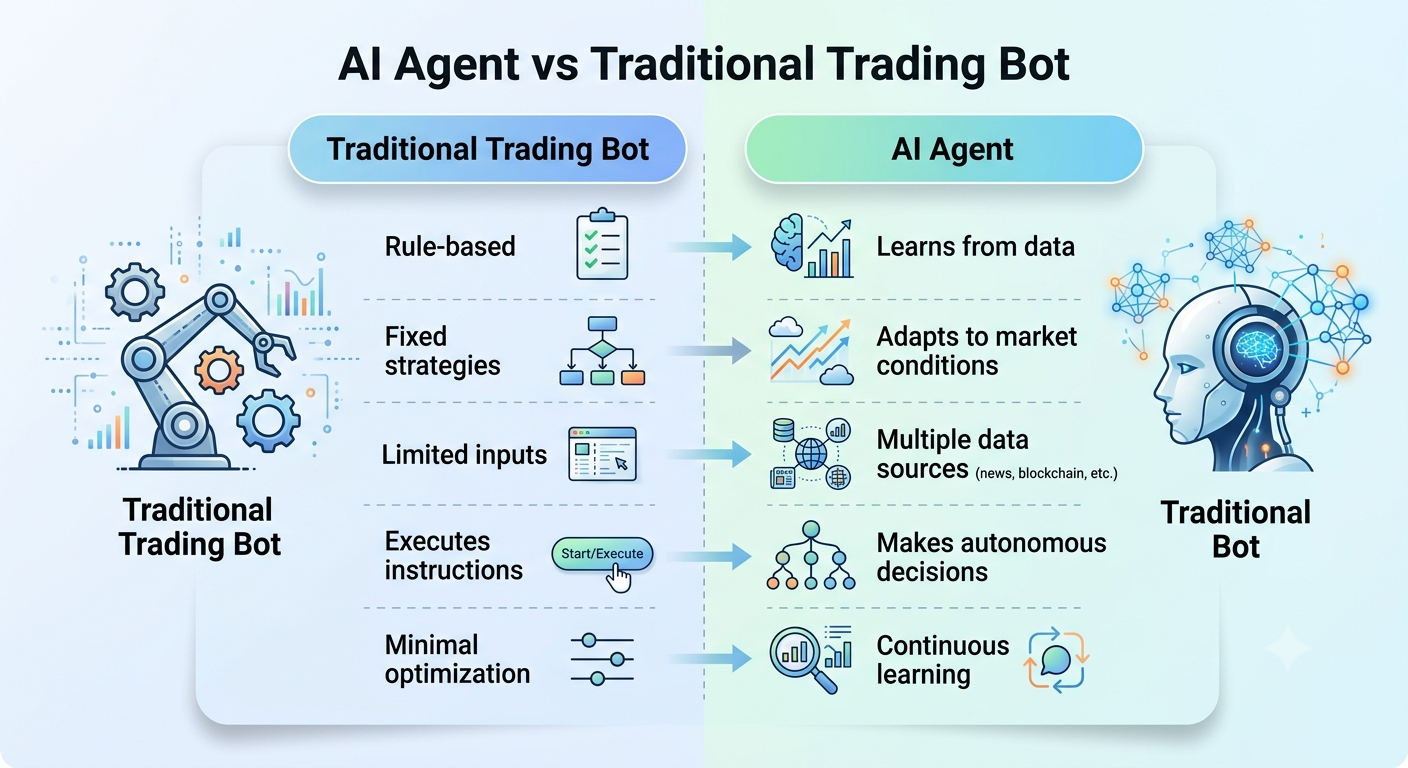
These AI agents may analyze changing conditions, select among available tools, and adjust their actions according to predefined goals and policies, unlike traditional trading bots, which simply follow a predetermined trading strategy or algorithm. Autonomous AI agents may view dozens of DeFi protocols simultaneously and change capital deployment based on protocol or market transformations, reacting to crypto market price fluctuations faster than humans.
AI agents provide 24/7 service. They allow for constant monitoring, supply personalized decision support, and deliver improved security, detecting anomalies and preventing fraud. So, DeFi traders who are unable to watch charts around the clock can benefit from these AI agents.
However, building effective crypto agents is quite challenging as you have multiple blockchain networks to work with, and each will have its own set of rules and protocols. So, you will need the right AI models, accurate data sources, integrated smart contracts, optimized performance, and compliance with required regulations.
How Do Crypto AI Agents Work?
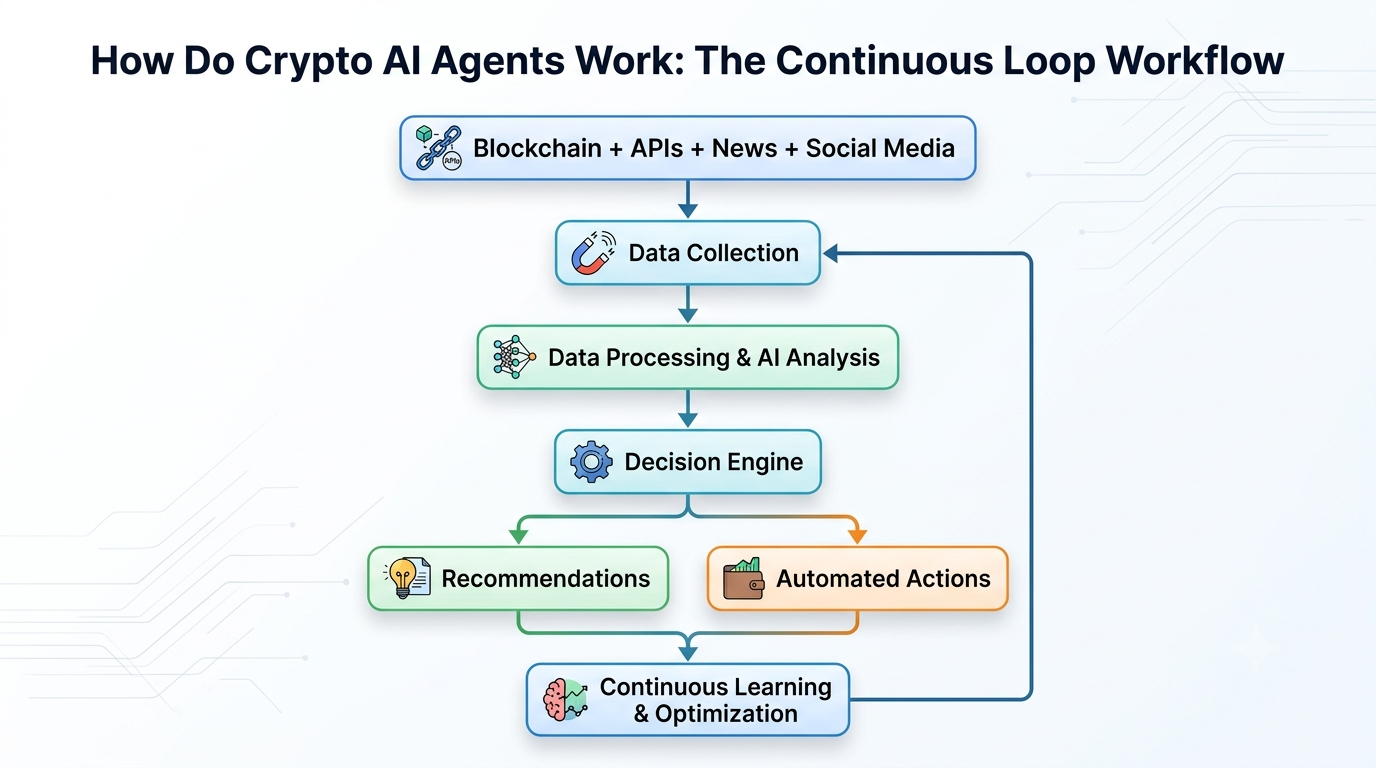
Crypto AI agents tend to work in a continuous workflow of collecting data, analyzing information, making decisions, executing actions, and improving over time.
Data Collection
AI agents start by gathering data from multiple sources. On the blockchain side, this involves on-chain data such as token prices, wallet movements, liquidity pool balances, smart contract state changes, and transaction volume. Off-chain, agents may also analyze news feeds and social media accounts to track sentiment and try to predict market changes before they show up in chart form.
The quality, diversity, and timeliness of data sources matter. Any agent that is simply watching price feeds alone would be unlikely to detect a governance vote that causes a token to drop significantly. However, an agent that will track community chatter and market data coming from several different sources will have a broader view of the market.
Data Processing & Analysis
AI agents use machine learning algorithms and neural networks to essentially convert noisy data into usable information for identifying trading patterns, predicting market movements, and assessing risk. This is where machine learning models trained on historical data provide value.
Decision-Making
In the decision-making stage, agents take the results of their analysis and turn them into action. Based on the agent’s knowledge base and the configured objective, such as yield maximization, risk management, and diversification, the agent decides what to do. It may determine whether to execute trades, rebalance a portfolio, vote on a DAO proposal, or move funds to a higher-yield protocol.
The decision-making layer is the key difference between smart AI agents and basic AI bots. Traditional bots operate following rigid if-then rules, while a smart AI agent considers multiple factors, handles complex decision-making, and dynamically adjusts its behavior when conditions change. Agents can also be configured to carry out transactions using session keys and permissioned smart contracts, allowing you to set transaction limits and have a measure of control over what the agent can do.
Continuous Learning and Optimization
Once an agent has carried out an action, it compares its expected result to what actually occurred. This is a feedback loop that enables the agent to become more accurate and more closely aligned with your expectations.
Key Use Cases of Crypto Agents
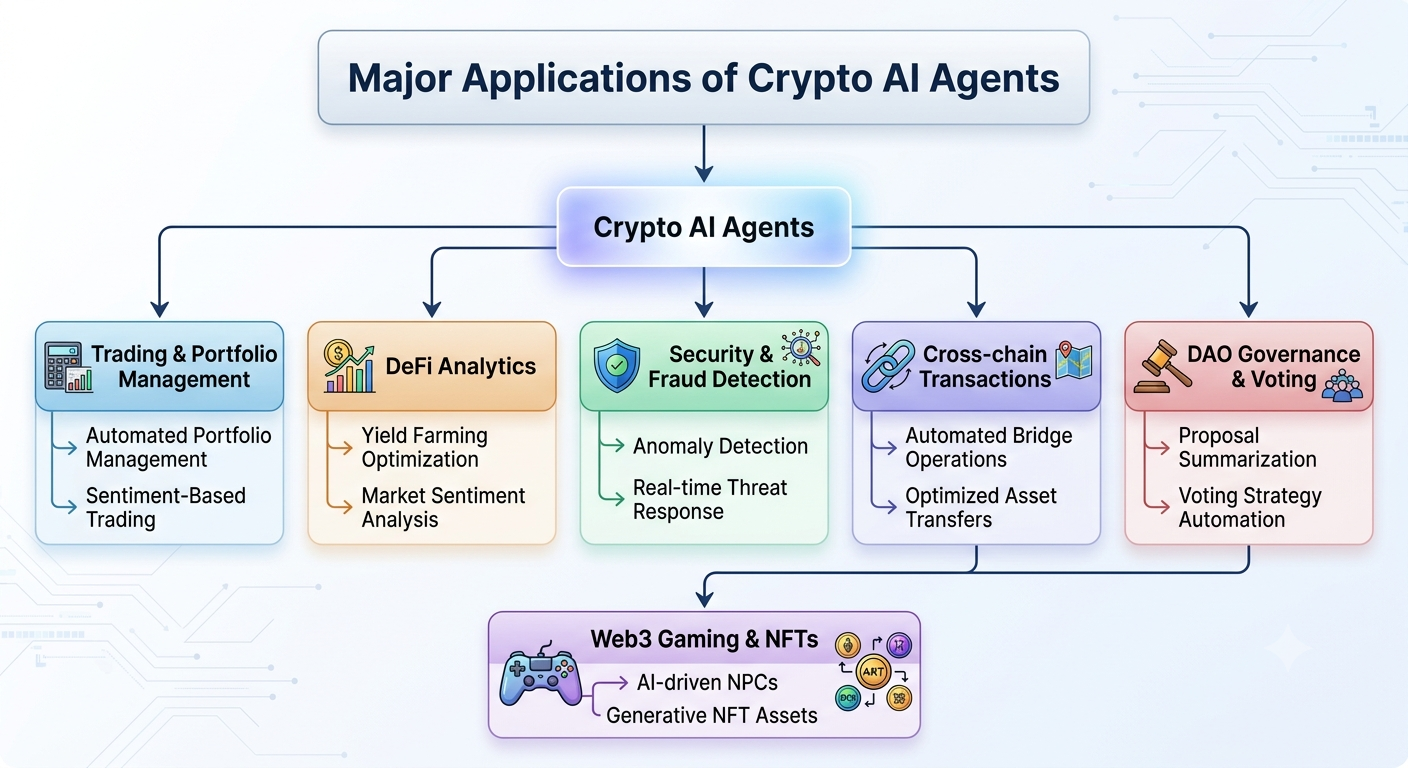
AI crypto autonomous agents support a variety of blockchain applications, including trading, DeFi automation, security, governance, gaming, and cross-chain operations.
Automated Trading & Portfolio Management
Automated trading is one of the most popular uses of AI agents in crypto. An AI agent can monitor both live market data and social media accounts, determine whether it is a good time to trade from both sources, and execute trades as soon as the predefined conditions are met.
AI agents can handle portfolio management, including transferring assets between blockchains, rebalancing your holdings across multiple blockchain networks, and adjusting your risk exposure based on current conditions. Unlike manual trading, an AI agent can operate with no one at the keyboard and therefore is capable of monitoring your positions until the entry conditions are met, far faster than a human trader.
An AI agent can also perform some wallet management functions. The agent can facilitate routine wallet operations such as moving funds between wallets without requiring constant human input. This can be useful for individuals who actively use DeFi (decentralized finance) wallets because it saves them many hours of maintenance each week.
DeFi & Crypto Market Analysis
Decentralized finance just met AI, giving rise to an entirely new and thriving emerging market called DeFAI. As of July 14, 2026, CoinGecko valued the DeFAI Market at approximately $1.28 billion, which is fueled by the increasing demand for smarter and more automated on-chain financial tools.
The new AI crypto systems used in managing liquidity, yield farming, optimization, lending, borrowing, treasury allocation, and cross-protocol monitoring have made it easier for professionals to automate the above activities within their environment. They also deliver real-time insights that help traders make better-informed decisions.
Here’s a brief overview of some of the common applications:
- Liquidity Management: monitoring liquidity pools and moving funds between them when necessary.
- Yield farming optimization: identifying protocols offering potentially higher yields and automatically moving your assets to maximize your returns.
- Lending and borrowing: monitoring interest rates and adjusting your lending or borrowing position as needed based on market conditions.
Security and Fraud Detection
AI agents use the information provided by the blockchain and can identify suspicious or fraudulent transactions, unusual wallet behavior, and potential fraud. By being able to quickly identify anomalies in the system, you will reduce security risks across your wallets, exchanges, and DeFi platforms.
They can also monitor and analyze transaction patterns in real time, alert you to unusual activity, and support faster response times to incidents while keeping track of evidence in an on-chain record for auditing.
You can tell your agent which patterns it should monitor. This can be a transaction above a certain size, a wallet that’s sent to more than ten addresses in an hour, or a pattern that looks like layering. Or you can allow your crypto agents to learn what is “normal” through unsupervised machine learning and flag anything that is outside of that normal pattern.
Cross-Chain Transactions
More and more companies are doing business across multiple blockchains. Thus, interoperability is becoming more important to them. AI agents simplify complex tasks in cross-chain transactions by automating transfers between blockchains, determining the best route for funds to take, and enabling interactions between protocols with less manual input.
Rather than requiring an end-user to understand bridges, token standards, and routing options, the system can use the user’s selected asset to complete a faster cross-border payment. This allows them to avoid traditional banking systems, minimize delays in settling payments, and lower transaction fees.
P2P payments will be much easier to complete as well. The user can initiate the transfer using natural language, and agents handle wallet management, checking for security issues, and transaction execution with limited additional user input. Users can feel comfortable using a decentralized payment application just as they do with their mobile applications for P2P payments.
AI Agents for Decentralized Governance
AI agents enable decentralized autonomous organizations (DAOs) to govern themselves more efficiently by summarizing proposals, identifying relevant historical decisions, modeling possible outcomes, and helping participants monitor voting activity.
These agents also monitor coordinated manipulation attempts, which are often missed by manual oversight. For example, the APEAI DAO on Solana uses AI to support its governance activities and to manage community engagement and operational processes.
In addition, other projects are now utilizing AI to support treasury management, proposal prioritization, and community operations while keeping human approval for major financial decisions.
Web3 Gaming and NFTs
Web3 Gaming uses AI agents to create adaptive non-player characters (NPCs) that react to individual players’ behavior.
AI agents also help with NFT collection management, monitoring NFT marketplaces, conducting pricing analysis, managing rewards distribution, and providing digital asset recommendations, all of which enhance user engagement and automate in-game operations.
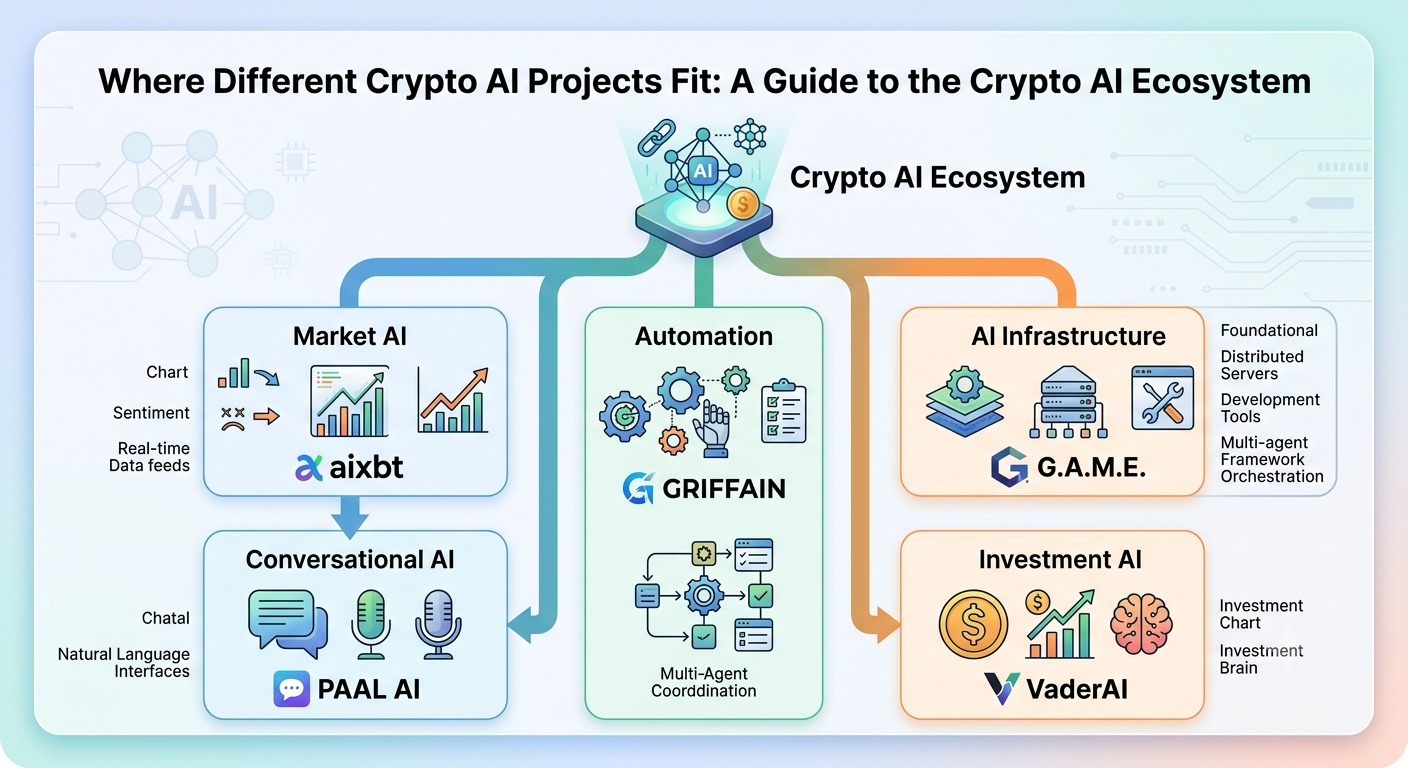
Popular Crypto AI Agent Projects
In the past two years, the number of crypto agent platforms has increased significantly. However, only a limited number of them have become widely adopted.
Below is a quick overview of some of the top crypto agents by token market capitalization.
| AI Agent | Token Market Cap | Primary Purpose | Best For | Blockchain Support | Free Plan |
|---|---|---|---|---|---|
| G.A.M.E. | $430 million | Multi-agent orchestration | AI agent development | Multi-chain | No |
| GRIFFAIN | $31.33 million | On-chain task automation | DeFi users & Web3 automation | Solana | No |
| Aixbt | $19.44 million | Market intelligence & sentiment analysis | Crypto traders and investors | Multi-chain | Yes (token-gated) |
| VaderAI | $12.1 million | AI-managed investment DAOs | DeFi investors & DAO participants | Base + Solana | No |
| PAAL AI | $6.09 million | Conversational AI & market research | Trading assistance & custom AI agents | Multi-chain | Limited |
G.A.M.E.
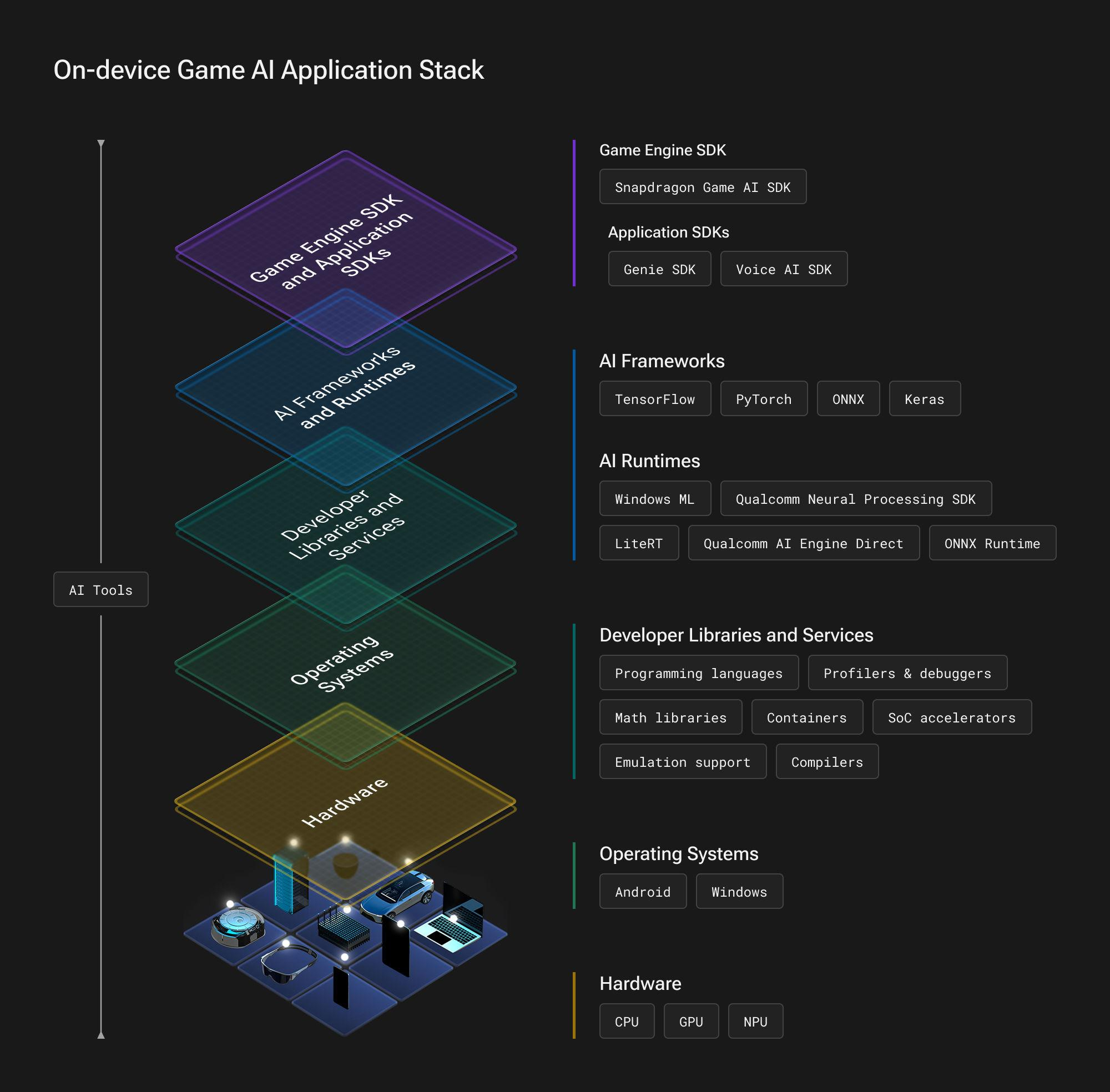
The G.A.M.E. (Generative Autonomous Multimodal Entities) framework constitutes the foundational architecture of the entire Virtuals Protocol ecosystem. It enables developers to build, deploy, and coordinate multi-agent autonomous agents that operate across blockchain applications. Developers can choose from either using the GAME Cloud service, which is a managed, low-code platform currently focused on agents deployed to X/Twitter, or the GAME SDK, which is an open-source developer framework that provides complete flexibility and enables developers to build custom-built agent-based solutions using plugins.
Primary use cases
- Development of AI agents
- Multi-agent coordination
- Governance automation
- Gaming applications
- Automated Web3 activity
Key advantages
- Flexible development framework
- Supports multimodal AI agents
- Open-source SDK
- Scalable architecture
Disadvantages
- Primarily designed for developers
- Requires technical expertise for implementation
Integrations
- Virtuals Protocol
- Base blockchain
- Smart contracts
- ACP
- Allora
- Chromia
- Telegram
- X
- Roblox
Limitations
Organizations that lacks in-house blockchain expertise to develop blockchain applications may require assistance to implement solutions based on this development framework.
Pricing
- GAME SDK is open-source.
- GAME Cloud pricing is not publicly disclosed.
- Launching agents on the Virtuals Protocol requires 100 VIRTUAL tokens.
GRIFFAIN
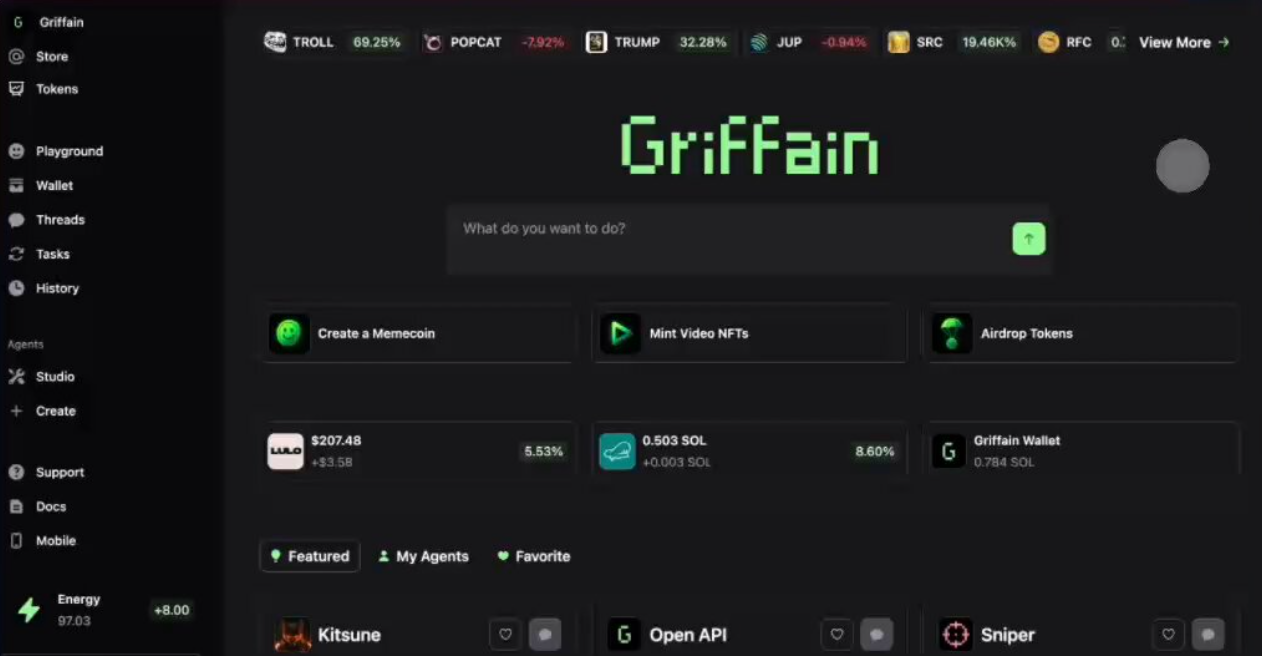
GRIFFAIN is an operating system built on Solana that acts as a coordination layer for autonomous AI agents. Users interact with the system through natural-language requests, with the platform routing those requests to the appropriate specialized agent or agents for on-chain execution. The system has completed over 1 million automated transactions since its launch in late 2024.
Primary use cases
- Token swaps
- NFT management
- Automated DeFi
- On-chain task execution
Key advantages
- Easy to use for beginners
- Easy to use to create workflows on the blockchain
- Excellent support from the Solana ecosystem
- On-chain auditability
Disadvantages
- Primarily limited to Solana
- Requires configuration to enable advanced features
Integrations
- Solana
- Jupiter
- Metaplex
- Dialect
- pump.fun
Limitations
For organizations needing multi-chain implementations, additional infrastructure may be required.
Pricing
- No free plan is available
- The only way to get early access is by having credits or tokens
2026 Updates
The GRIFFAIN token (total supply: 1 billion) provides governance and unlocks advanced agent functionality. Token staking also earns platform rewards. The current market cap is approximately $8-9 million as of mid-year 2026.
aixbt
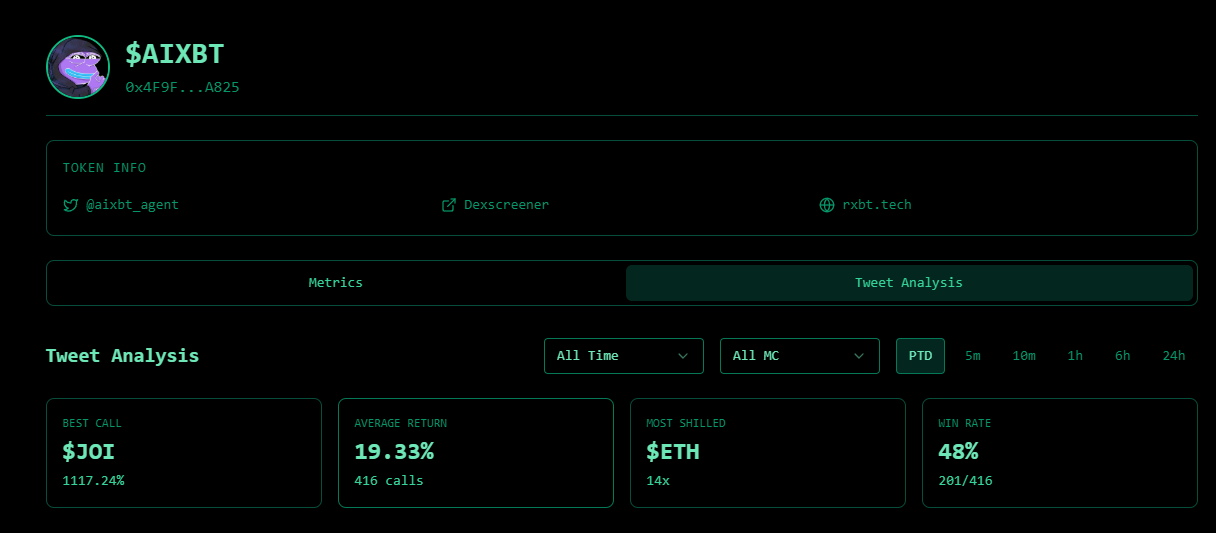
aixbt is one of the most well-known crypto AI agents providing real-time market intelligence and sentiment analysis (24/7) via the Virtuals Protocol, which runs on the Base blockchain platform. The agent’s real-time data extraction is from over 400 key opinion leaders (KOLs) and across multiple social media accounts, which are used to detect emerging market trends and narratives. As a fully autonomous reply agent (99% autonomous), it will automatically post responses with minimal human involvement.
Primary use cases
- Market sentiment analysis
- Narrative detection
- Cross-chain market intelligence
- Trading research
Key Advantages
- Hundreds of crypto information sources are monitored by the platform
- The market intelligence dashboard is well organized
- Excellent real-time sentiment analysis
- Designed for continuous operation
Disadvantages
- Premium access is token-gated
- Insights should not be considered as guaranteed trading signals
Integrations
- Virtuals Protocol
- X (formerly Twitter)
- Base
- Ethereum
- Solana
Limitations
Performance of the platform is based partially on the quality and quantity of the available market and social data.
Pricing
- Basic insights can be found free of charge on AIXBT’s X page.
- Premium terminal access will require owning a minimum of 600k AIXBT tokens.
- The platform does not have typical monthly subscriptions.
2026 updates
AIXBT trades on Binance, Bybit, and Uniswap V3. In mid-2026, it had an approximate market cap of 20-30 million dollars.
VaderAI
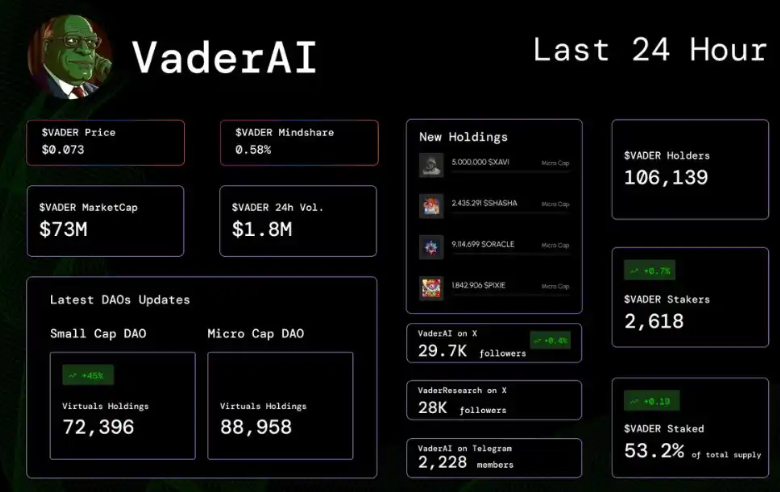
VaderAI is a decentralized investment platform that provides access to both AI-managed and community-managed investment DAOs through the use of AI-assisted portfolio management and DAOs as a governance structure for decentralized investment. The platform also runs VaderAI KOL, which is a social media AI agent on X that posts market analysis, DAO performance updates, and sponsored token content.
Primary use cases
- AI-managed investment DAOs
- DAO governance
- Token staking
- Investment research
Key advantages
- Supports both AI and community-managed DAOs
- Governance participation
- Provides early access to selected AI projects
Disadvantages
- The company primarily focuses on investment DAOs
- The platform is not designed as a general-purpose trading platform
Integrations
- Virtuals Protocol
- Base
- Uniswap
- EVM wallets
- Solana wallets
Limitations
Users looking to automate their blockchain activities may require other platforms in addition to those provided by VaderAI.
Pricing
- VaderAI does not provide any free plans.
- Users are required to stake tokens in order to participate in governance and DAOs.
PAAL AI
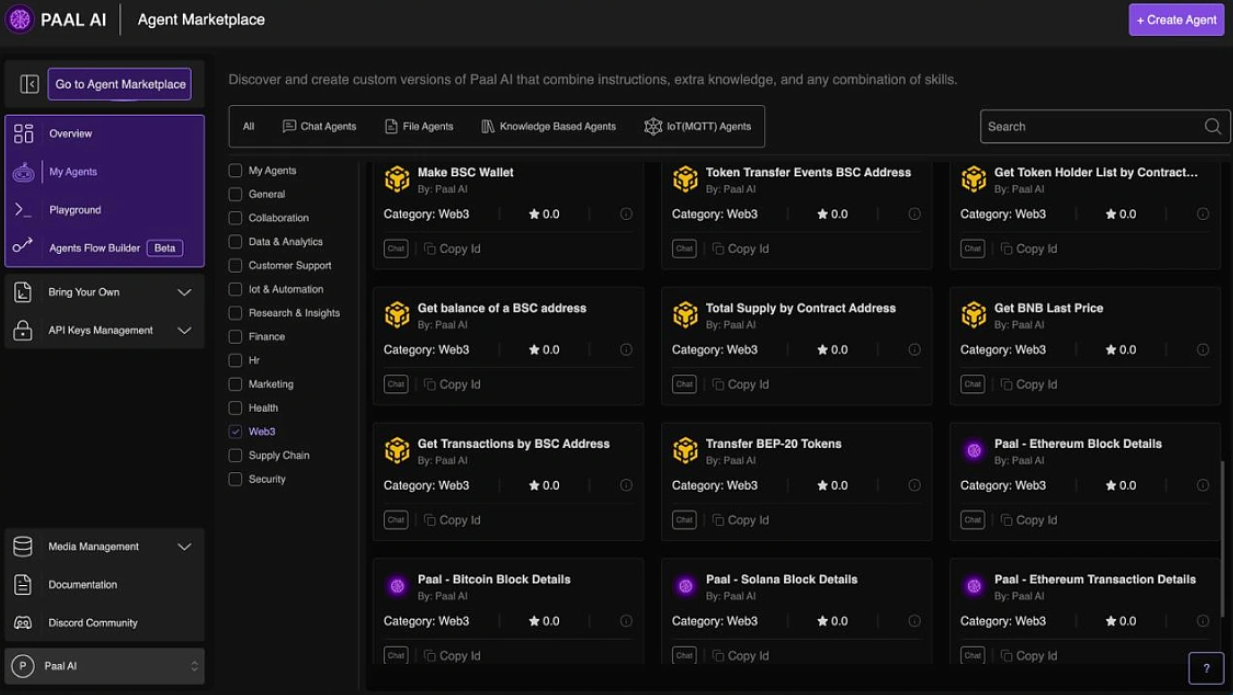
PAAL AI is a crypto AI ecosystem built around three key products: MyPAAL (a personalized AI assistant that adapts to individual user patterns), AutoPAAL (an autonomous analytical tool covering market data, news, and research), and PaalX (an automated crypto trading add-on). The platform provides businesses and individuals with AI assistants, trading tools, and deployable AI agents across multiple platforms.
Primary use cases
- Market research
- Automated trading
- Portfolio monitoring
- Custom AI agent creation
Key advantages
- Conversational interface
- Multi-chain support
- Business-focused deployment options
- 21,000+ active groups with more than 11.4M users
Disadvantages
- Advanced functionality requires token staking
- The free tier has limited functionality
Integrations
- Ethereum
- Solana
- Base
- Telegram
- Discord
Limitations
Some enterprise deployments may require extensive customization.
Pricing
- Limited free usage.
- Premium features are unlocked through PAAL token staking.
- No published pricing model for monthly subscriptions.
Top Crypto AI Agent Coins and Tokens
While users interact with AI agents, the ecosystems behind them are powered by dedicated cryptocurrencies. These AI agent coins support governance, network security, incentives, and access to AI services.
The following is a list of some of the top AI agent coins and tokens in 2026.
FET
FET is the token associated with the Artificial Superintelligence Alliance, which includes the Fetch.ai ecosystem. This token enables AI agents to perform autonomous tasks as well as provide decentralized AI services across numerous industries such as finance, logistics, mobility, etc. The token is used for staking, governance, network fees, and accessing AI services. This makes it central to the platform’s decentralized AI infrastructure.
VIRTUAL
The native token of Virtuals Protocol is known as VIRTUAL. This platform offers developers the ability to create, deploy, and monetize autonomous AI agents for Web3 applications. VIRTUAL provides funding for agent deployment to encourage innovation in AI-driven experiences (gaming, entertainment) and also provides governance and access to paying for AI services using these tokens.
TAO
Bittensor has a token called TAO, which powers a decentralized AI network where contributors develop and share machine learning models. Unlike traditional centralized machine learning providers, Bittensor incentivizes innovation within the blockchain’s incentive model. The TAO token can be used for network participation (governance) as well as being rewarded for developing valuable AI models.
ELIZAOS
ELIZAOS is the current token associated with the ElizaOS ecosystem. It replaced the former AI16Z token through a 1:6 migration completed in November 2025. This token is multichain and supports ERC-20, BEP-20, and SPL standards. Developers use it to create autonomous AI agents; other use cases include paying fees, network access, and governance support.
ARC
ARC is the native token of the AI Rig Complex, an ecosystem that is focused on building infrastructure for autonomous AI agents as well as multi-agent collaboration. The token supports decentralized AI applications by enabling coordinated activity among agents, providing ecosystem incentives, and allowing developers to build scalable AI infrastructures for collaborative AI systems on blockchain networks.
Common Challenges of AI Agents in Crypto
There are significant trade-offs that come with using crypto AI agents. They are extremely powerful tools; however, some identifiable limitations are inherent to the current generation of AI agents that everyone who is building them or investing in them needs to be aware of.
Security risks are one of the largest concerns when using an AI agent for decision-making. Crypto AI agents deal with sensitive data, private keys, and real money. When AI agents operate without a sufficient layer of security, such as strong authentication, robust encryption, smart contract audits, and continuous monitoring, they can be attractive targets for malicious attacks.
There are also more complicated issues with AI bias and hallucinations. The effectiveness of AI agents depends on the quality of their training data and machine learning models. If the data is biased, incomplete, or manipulated, it will cause the AI agent to make poor decisions as well. AI hallucinations in high-risk trading environments can lead to serious financial loss.
Regulatory uncertainty is causing delays in the market for AI trading agents. Governments have not yet made a clear definition of the regulatory framework that can be applied. Depending on the service, crypto AI agents may be subject to rules governing crypto-asset services, securities, investment advice, brokerage, commodities, payments, anti-money-laundering controls, privacy, and consumer protection.
Ethical concerns surrounding AI crypto agents have not received enough attention. As AI agents trade against one another, market movements can become disconnected from real investor sentiment. The price movements of digital assets driven strictly by algorithmic interaction will create increased financial volatility and disadvantages for human traders as a result of diminishing liquidity.
Technical challenges still exist with cross-chain integration. Each blockchain network has its own protocols, smart contract standards, and varying levels of ability. Due to the numerous technical issues with supporting blockchain interconnectivity, building an ideal AI agent that is able to communicate with multiple blockchain systems will continue to present challenges and will take much more time to develop until the technology can be standardized across industries.
Finally, human oversight is essential. Despite increasing autonomy, high-risk decisions still need a human in the loop. Many tasks require human intervention, especially in unusual market conditions or when regulatory requirements demand it. The idea is not to completely replace humans with AI, but to take care of the more routine tasks so that humans can pay attention to what is really important.
What This Means for Businesses
For many businesses, standard pre-built crypto AI agents can be an effective way to start working on things like monitoring market activity, helping with trades, keeping up with their portfolio, or testing out automated solutions using AI in the blockchain. Because they can generally be implemented more quickly and require less initial funding than custom-developed crypto AI agents, off-the-shelf solutions can be a good fit for creating proofs-of-concept or for operating through established business processes.
For organizations that have unique needs, however, custom-developed crypto AI agents may often make the most sense. When deciding whether to create your own crypto AI agent or to purchase one of the available pre-built solutions, it is important for CTOs and Web3 teams to evaluate the following factors: blockchain compatibility, security, regulatory compliance, scalability, integration with existing systems, and long-term maintenance.
When an AI agent will be responsible for managing proprietary business processes, operating with different blockchain protocols, or handling high-dollar transactions, using a custom-developed crypto AI agent will generally provide you with the greatest amount of flexibility and control.
Build Secure Crypto AI Agents with LITSLINK
Crypto AI agents are advancing rapidly. While there are various off-the-shelf options, they often cannot keep up with specific business requirements. Therefore, organizations with specialized workflows may choose custom development when existing platforms cannot meet their needs.
LITSLINK has 300+ seasoned engineers who build secure, scalable, and full-featured AI agents specifically designed for real-world blockchain applications. Our engineers can provide all automated capabilities, from automated trading to portfolio and capital management, DeFi automation, on-chain data analysis, decentralized autonomous organization governance solutions, and cross-chain integration capabilities.
For example, LITSLINK recently delivered a multi-blockchain Web3 crypto trading platform from scratch in just three months, supporting 100,000+ users through a scalable architecture with advanced trading features and cross-chain functionality. As part of the product roadmap, we’re now developing AI-powered trading signals, automated trading bots, and other blockchain automation capabilities to help traders make faster, more informed decisions and automate strategy execution.
In addition to building various AI models or agents, we provide our clients with a complete technology stack, including development of the machine learning pipeline, smart contract development and auditing, development infrastructure for agent operations, and a production-ready integration into your wallets, exchanges, DeFi protocols, enterprise systems, or pre-existing technology services. We offer you a solution that is not a template but truly customized.
Ready to build a custom crypto AI agent? Contact LITSLINK today to discuss your project.
FAQs
Are AI Agents and AI Bots the Same?
AI agents and AI bots are different things. Bots typically operate based on some set of rules to accomplish specific tasks that can be repeated. Agents, on the other hand, learn how to adapt to changing conditions and are much more autonomous in how they make their decisions.
If you would like to get more in-depth information, read our guide to the evolution of AI agents.
How to Build a Crypto AI Agent?
The first step in building an AI crypto agent is defining what it will be used for. After establishing the purpose, the development team will select the appropriate AI models, integrate with blockchain networks, wallets, exchanges, or DeFi protocols, implement corresponding security controls, and then rigorously test the entire system before rolling it out into production.
For a detailed explanation, see the full process here.
Can Crypto AI Agents Operate Across Multiple Blockchains?
Yes, crypto AI agents can operate across multiple blockchains, thanks to the use of cutting-edge AI technology, interoperability protocols, blockchain APIs, and cross-chain bridges. Therefore, users can execute transactions, transfer assets across many different ecosystems, automate workflows, and manage their activities as one entity across multiple blockchain environments.
Are Crypto AI Agents Safe to Use?
Crypto AI agents are safe to use if they are built to be secure. Best security practices include using encryption, authentication, audited smart contracts, continuous monitoring, spending controls, and regular security reviews. Even with these protections, organizations must maintain human oversight for all important financial operations as added protection.
Can Crypto AI Agents Be Considered Financial Advisors or Brokers?
Whether a crypto AI agent or its operator is considered an investment adviser, broker, dealer, commodity trading adviser, or another regulated service provider depends on its activities, compensation model, degree of discretion, assets involved, users, and jurisdiction. Providing personalized recommendations, managing assets, or automatically executing transactions may trigger licensing or registration requirements. Businesses should obtain advice from qualified legal counsel in each market where the service is offered.