








Key Takeaways
- 97% of organizations are already using or planning to use AI-powered cybersecurity tools, and 73% run agentic AI inside their security function (All About AI 2026; CISO AI Risk Report 2026).
- AI and automation cut the average breach by $1.9 million — $3.62M with AI versus $5.52M without, a 34% reduction (IBM Cost of a Data Breach Report 2025).
- The fastest recorded eCrime breakout time is now 27 seconds; the average is 29 minutes, 65% faster than 2024 (CrowdStrike 2026 Global Threat Report).
- AI-driven phishing jumped 204% — one malicious email every 19 seconds, and AI-written messages are clicked 4× more often than traditional ones (Hoxhunt / The European 2026).
- The AI in cybersecurity market reaches $25.53 billion in 2026 and is projected at $50.83 billion by 2031 (MarketsandMarkets); Gartner puts AI-related security spend near $51.3 billion this year.
- EU AI Act enforcement for general-purpose AI begins August 2, 2026, with penalties up to €35M or 7% of global annual turnover.
In 2025, the world generated roughly 181 zettabytes of data — and 2026 projections push that figure to approximately 221 ZB, according to IDC. Traditional security tools were never built for this scale. And they weren’t built for adversaries who can put together a convincing phishing email in five minutes flat. Each employee still opens up to 200 attack vectors. The math hasn’t gotten friendlier.
What has shifted is the nature of the threat. CrowdStrike’s 2026 Global Threat Report documented that AI-enabled adversaries increased operations by 89% year-over-year. The fastest recorded eCrime breakout time — the window between initial compromise and lateral movement — is now 27 seconds. If your security stack is still running on scheduled scans and signature-based detection, you’re not just behind. You’re exposed before you’ve finished your morning coffee.
This article covers AI in cybersecurity statistics that reflect the real landscape in 2026, drawn from IBM, Gartner, Darktrace, CrowdStrike, Microsoft Security, Experian, and others publishing current data — not recycled 2024 roundups.
AI in Cybersecurity Statistics 2026: Key Metrics at a Glance
AI is already embedded in both offense and defense. These 2026 benchmarks reflect where the industry actually stands:
| Metric | Data | Source |
| Organizations using or planning AI cybersecurity tools | 97% | All About AI 2026 |
| Security teams actively scaling AI/agentic AI | 81% | Industry Aggregate 2026 |
| Organizations with agentic AI in cybersecurity | 73% | CISO AI Risk Report 2026 (Q4’25–Q1’26) |
| AI-enabled adversary operations growth (YoY) | +89% | CrowdStrike 2026 Global Threat Report |
| AI-generated phishing emails detected | 82.6% of all phishing | Hoxhunt / Stationx 2026 |
| AI phishing click rate vs. traditional | 4× higher | Hoxhunt 2026 |
| Malicious phishing email arriving every | 19 seconds | The European 2026 |
| Time to craft phishing email: AI vs. human | 5 min vs. 16 hr | IBM X-Force 2025 |
| Fastest recorded eCrime breakout time | 27 seconds | CrowdStrike 2026 |
| Average eCrime breakout time | 29 min (65% faster than 2024) | CrowdStrike 2026 |
| Security leaders saying AI significantly increases threat volume | 87% | Darktrace State of AI Cybersecurity 2026 |
| Security pros worried about AI agent risk | 76% | Darktrace 2026 (n=1,540, 14 countries) |
| Security leaders saying AI strengthens defense | 97% | Darktrace 2026 |
The dual-role dynamic is the defining story of 2026: AI is simultaneously the most effective defensive capability available and the adversary’s preferred force multiplier.
AI Cybersecurity Market: Growth and Spending 2026
| Indicator | Value | Source |
| AI in cybersecurity market size 2026 | $25.53 billion | MarketsandMarkets 2026 |
| Projected market by 2031 (CAGR 14.8%) | $50.83 billion | MarketsandMarkets |
| Alternate CAGR scenario (24.4%) | $93.75B by 2030 | Grand View Research |
| Aggressive forecast | $163B by 2033 (CAGR 22.3%) | Precedence Research |
| Gartner: AI cybersecurity spend 2026 | $51.3 billion | Gartner Q4 2025 forecast |
| Total information security spend 2026 | $244.2 billion (+13.3% YoY) | Gartner Q4 2025 |
| Cloud security growth rate 2026 | +28.8% (fastest sub-segment) | Gartner |
| Enterprises on AI-amplified security by 2028 | >75% (vs. <25% in 2025) | Gartner |
| Cybersecurity spend tied to AI by 2027 | >40% (vs. 8% in 2023) | Gartner |
| IT leaders actively investing in AI security | 94% | Industry aggregate |
| SMBs planning cybersecurity spend increase (next 12 mo.) | 60% | IDC 2026 |
| Projected global cybercrime cost 2026 | $10.5T–$11.88T | Cybersecurity Ventures / Proxyrack |
| Projected global cybercrime cost 2028 | $13.82 trillion | Forecast aggregate |
These aren’t long-range projections. Gartner’s Q4 2025 forecast found that by 2027, more than 40% of enterprise AI security spending will directly tie to AI-driven tooling — a jump from just 8% in 2023. The reallocation is already underway, not pending.
Breach Economics: What IBM’s Data Actually Shows
IBM’s Cost of a Data Breach Report 2025 produced one of the year’s most cited findings: the global average breach cost dropped to $4.44 million, down 9% from $4.88M in 2024. Taken at face value, that looks like progress.
The real story lives in the breakdown. Organizations with extensive AI and automation in their security stack averaged $3.62M per breach. Organizations running without it averaged $5.52M. That $1.9 million gap — a 34% reduction — is now the clearest ROI argument any security team can bring to a budget conversation.
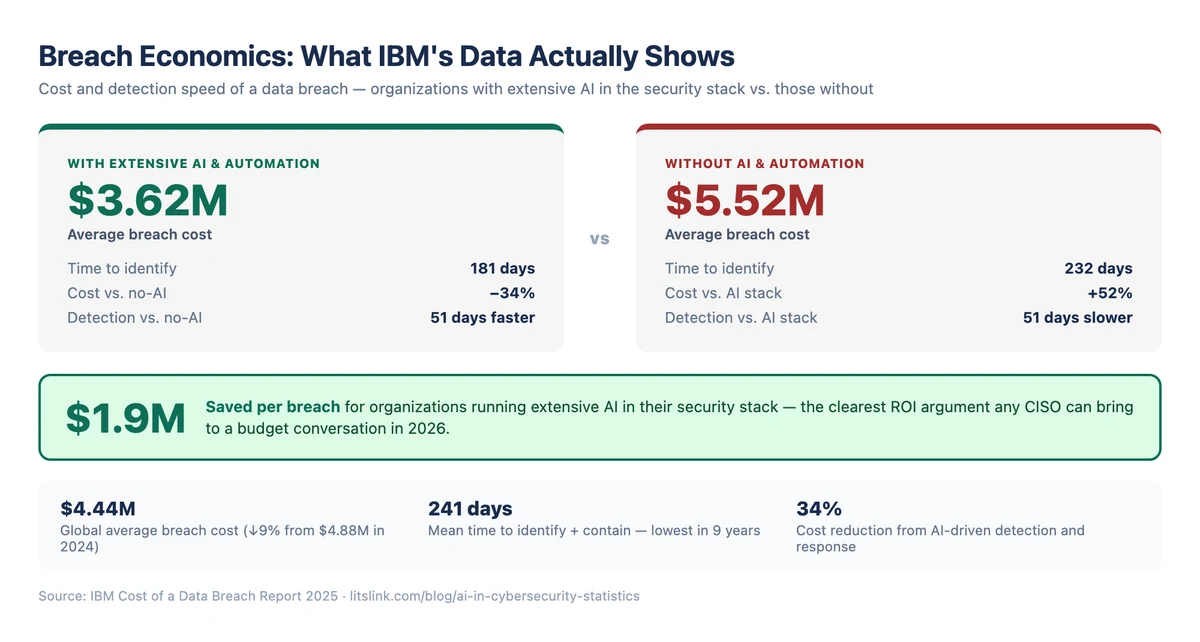
Speed improved alongside cost. AI-deployed organizations identified breaches in 181 days on average versus 232 days without AI — 51 days faster. Mean time to identify and contain reached 241 days, the lowest recorded in nine years.
IBM did flag an “AI oversight gap” in the same report: AI adoption is outrunning governance. Security tools are being deployed before risk frameworks exist to manage them. For CISOs scaling AI-powered defenses in 2026, that’s the operational risk hiding inside the good news.
The Dual Role of AI: Defense vs. Malicious Use
AI doesn’t choose sides. The same capabilities that accelerate threat detection are being turned against organizations at a scale that wasn’t technically possible three years ago. Understanding both trajectories is the only way to build a realistic security posture.
AI Threat Detection and Prevention
The foundational use cases for defensive AI are well understood at this point. The numbers:
| Use Case | Impact | Source |
| Detection time reduction | From 168 hours to seconds | Industry benchmark |
| Threat detection improvement over legacy tools | 60% | Industry aggregate |
| Phishing detection accuracy (ML-based) | 98% | Industry benchmark |
| Fraud prevention by Visa (2023 baseline) | $40 billion | Visa |
| Average detection time: AI-deployed vs. legacy | 181 days vs. 232 days | IBM 2025 |
The 2026 landscape adds several new data points that change the scale of what “fast” means in threat response:
- CrowdStrike’s 2026 Global Threat Report recorded a 27-second eCrime breakout time — the fastest on record. At that speed, human response alone is structurally insufficient.
- IBM X-Force’s 2026 Threat Index found AI-driven attacks escalating broadly, with basic gaps — unpatched systems, weak credentials, missing MFA — remaining the most exploited entry points despite years of remediation guidance.
- 1.8 billion credentials were stolen by infostealers in just H1 2025 (IBM X-Force data).
- 1 in 8 AI-related breaches now involves autonomous agents operating without direct human oversight.
- Microsoft Security reported in March 2026 that threat actors exploited legitimate GenAI tools against more than 90 organizations using malicious prompt injection — turning enterprise AI tools into attack vectors.
IBM’s threat monitoring platform processes 150 billion+ security events per day. That’s the baseline processing requirement for modern defense. It’s not achievable without AI-driven triage and prioritization.
Malicious Use of AI in 2026

Phishing is where the AI-enabled escalation is most visible and most documented:
| Threat Type | Data | Source |
| AI-driven phishing surge | +204%, 1 malicious email every 19 seconds | Hoxhunt / The European 2026 |
| Phishing emails showing AI indicators | 56% by Dec 2025 (up from 4% in Nov 2025) | Hoxhunt |
| AI-generated phishing click rate vs. traditional | 4× higher | Hoxhunt 2026 |
| Ransomware groups active (YoY) | +49% | CrowdStrike 2026 |
| Ransomware dark web cases in 2025 | 9,251 (+45% YoY) | Securelist 2026 |
| AI-authored ransom notes: payment conversion uplift | +40% | Securelist 2026 |
| Dark web AI-malware marketplace growth in 2025 | +29% | Securelist 2026 |
| Global deepfake fraud losses through Mar 2026 | $2.19B cumulative; $1.65B in 2025 alone | Brightdefense / Keepnet 2026 |
| AI-enabled fraud growth rate 2025 | +1,210% vs. +195% traditional | Experian 2026 Fraud Forecast |
| Predicted GenAI fraud (financial sector) by 2027 | ~$40B/year | Industry consensus |
| Organizations losing >$100K to deepfake attacks | 61% | The World Data 2026 |
| Organizations with no deepfake defense budget | 63% | Keepnet 2026 |
| Smishing share of phishing | 35% (+40% YoY) | Stationx 2026 |
| Voice phishing increase (2023→2024) | +442% | Stationx |
One case study worth citing: in January 2026, a European bank was targeted by AI-generated deepfake calls impersonating C-suite executives. The attack resulted in $12 million in unauthorized wire transfers on February 3, 2026. Not a red team exercise. A live breach.
Experian’s 2026 Fraud Forecast documented AI-enabled fraud growing at 1,210% compared to 195% for traditional fraud methods in the same period. And 63% of organizations have no dedicated deepfake defense budget to respond to it.
AI for Cyber Defense: What’s Shipping in 2026
Several major vendors expanded agentic AI security capabilities in Q1 2026:
- CrowdStrike launched “Charlotte AI Agent” in March 2026 for autonomous threat response — detection, investigation, and remediation without constant analyst input.
- Palo Alto Networks shipped “XSIAM Autonomous Response” in March 2026 for real-time, cross-platform threat containment.
- Microsoft Defender introduced purpose-built agentic AI capabilities specifically to protect enterprise AI agents from attacks targeting the agent layer itself.
- Google Cloud Next 2026 unveiled autonomous threat hunting and detection engineering agents within Security Command Center.
- Darktrace “ActiveAI” continues deployments — at Aviso, a Canadian wealth management firm with $140B+ AUM, it generated 73 actionable alerts, autonomously investigated 23 million events, and blocked 18,000+ malicious emails that legacy filters had cleared through.
The emerging agentic AI security market stands at an estimated $1.65 billion in 2026, with MarketsandMarkets projecting $13.52 billion by 2032 at a 42.0% CAGR. This sub-segment is growing faster than the broader AI cybersecurity market.
Agentic AI: The Double-Edged Frontier of 2026

Agentic AI — autonomous systems that plan, execute, and adapt with minimal human supervision — is reshaping the security landscape in both directions.
Adoption data from Q4 2025 and Q1 2026 surveys:
- Gartner predicts more than 80% of enterprises will run autonomous AI agents in production by end of 2026, up from less than 5% at the start of 2025.
- 73% of organizations already use or are actively developing agentic AI within cybersecurity (CISO AI Risk Report 2026 survey).
- 81% of enterprises are actively scaling agentic AI across security teams.
- Darktrace’s 2026 study (1,540 security leaders, 14 countries) found 92% are concerned about security implications of deploying AI agent workforces.
- 47% of executives described themselves as “very or extremely concerned” about AI agents with access to sensitive enterprise data.
- 1 in 8 AI-related breaches now involves autonomous agents operating without direct human oversight.
CISA’s late-2024 guidance identified agentic AI as a new and expanding attack surface. That framing has only become more relevant since. The “Shadow Agent” problem — unauthorized or untracked AI agents operating within enterprise environments — is shaping up as 2026’s version of the Shadow IT problem that IT teams spent the previous decade trying to contain.
Shadow AI: The Threat Nobody Mapped
Shadow IT had a playbook. Shadow AI doesn’t — at least not yet.
The 2026 numbers show how quickly the problem scaled:
- 75% of CISOs discovered unsanctioned GenAI tools already operating in their environments; another 16% weren’t certain they hadn’t.
- Shadow AI is a contributing factor in 1 of every 5 breaches.
- 67% of CISOs report limited visibility into AI activity across their environments.
- More than 38% of employees share sensitive information with AI tools without organizational permission.
The risk isn’t just data leakage in the obvious sense. Shadow AI tools frequently arrive pre-wired with embedded credentials, API tokens, and OAuth connections that carry elevated permissions and leave minimal audit trails. They plug into enterprise systems and operate quietly. Finding them requires purpose-built AI discovery tooling that most organizations didn’t budget for in 2024 — and many still haven’t prioritized heading into 2026.
Regulatory Context: EU AI Act and the 2026 Compliance Deadline
Enforcement timelines are no longer hypothetical. The EU AI Act’s full General-Purpose AI model obligations take effect on August 2, 2026.
For cybersecurity teams, the practical requirements are substantial:
- High-risk AI system obligations include: risk management systems, data governance processes, technical documentation, logging and audit trails, transparency requirements, human oversight mechanisms, and — explicitly — cybersecurity requirements including robustness and accuracy standards.
- Non-compliance penalties: up to €35 million or 7% of global annual turnover for the most serious violations.
- AI models already on the market before August 2, 2025 have until August 2, 2027 to comply.
In the US, the NIST AI Risk Management Framework functions as the de facto baseline and is increasingly referenced in federal procurement. ISO/IEC 42001 is emerging as the third pillar alongside EU AI Act and NIST AI RMF — particularly for organizations operating across jurisdictions.
For security teams, the operational implication is direct: AI systems used in access management, threat detection, and incident response now require documented governance processes. Deployment without governance is a compliance exposure, not just a technical risk.
Enterprise vs. SME: The 2026 Adoption Landscape
| Segment | Metric | Value |
| Financial services (US) | AI security integration rate | 82% (highest sector) |
| Europe | AI cybersecurity market share | $8.0B / 28% of global |
| SMBs | Planning cybersecurity spend increase (next 12 months) | 60% |
| Senior security leaders using AI | Reporting current budget insufficient for AI threats | 85% |
| SMEs (10+ employees) | Using at least one AI-powered tool (often unlabeled) | Majority |
The 85% “insufficient budget” finding among senior security leaders is worth pausing on — given the scale of investment being made. The problem isn’t awareness or intent. It’s that the threat surface is expanding faster than any realistic budget cycle can follow. AI tools help close that gap, but they’re not free, and the governance overhead adds cost that’s easy to underestimate at the procurement stage.
FAQ: AI in Cybersecurity 2026
97% are using or planning to use AI-powered cybersecurity tools (All About AI 2026). Of those, 73% already have agentic AI deployed or in active development within their security function.
IBM’s Cost of a Data Breach Report 2025 documented a $1.9M average reduction per breach for organizations with extensive AI and automation — $3.62M average versus $5.52M for those without. That’s a 34% cost difference.
Shadow AI refers to unsanctioned AI tools employees adopt without organizational approval or visibility. 75% of CISOs found these tools in their environments. Shadow AI is now a contributing factor in 1 in 5 breaches, and most organizations lack the discovery tooling to find and inventory them.
The fastest recorded eCrime breakout time in 2026 is 27 seconds (CrowdStrike 2026 Global Threat Report). The average is 29 minutes — 65% faster than 2024’s average.
Estimates range from $10.5 trillion to $11.88 trillion globally. The 2028 projection reaches $13.82 trillion (Cybersecurity Ventures, Proxyrack, forecast aggregate).
Starting August 2, 2026, organizations deploying high-risk AI systems in security-critical contexts face mandatory governance requirements: risk management, logging, robustness, and documented human oversight. Penalties reach €35M or 7% of global annual turnover for serious violations.
Autonomous agents can hunt threats, respond to incidents, and investigate alerts without human input — which expands defensive capacity significantly. But they also create new attack surfaces: 1 in 8 AI-related breaches now involves autonomous agents, and “Shadow Agents” operating outside IT governance are an emerging blind spot without a standard playbook yet.
The names appearing in every major analyst report: CrowdStrike (Charlotte AI Agent), Palo Alto Networks (XSIAM Autonomous Response), Microsoft (Defender agentic AI), Darktrace (ActiveAI), IBM (X-Force), and Google Cloud (Security Command Center). All launched or significantly expanded AI-native capabilities between Q4 2025 and Q1 2026.
Future Outlook
The short-term trajectory points toward more complexity, not less:
- Cybercrime is projected to reach $13.82 trillion by 2028.
- Post-quantum cryptography is moving from theoretical concern to active threat: ransomware families began adopting PQC ciphers in 2026. The post-quantum cryptography market is forecast to grow from $0.42B (2025) to $2.84B by 2030 (MarketsandMarkets).
- Gartner projects that 40% of enterprise applications will include task-specific AI agents by end of 2026 — up from less than 5% at the start of 2025. Every new agent is a new attack surface.
- The World Economic Forum noted in May 2026 that AI has the potential to democratize cybersecurity — making enterprise-grade capabilities accessible to organizations that previously couldn’t afford dedicated security operations. That’s the optimistic scenario, and it’s worth taking seriously alongside the threat data.
- 84% of security professionals still flag AI training data quality as a fundamental reliability concern. Darktrace’s 2026 data layers in a different worry: 92% are concerned specifically about the security implications of deploying AI agent workforces.
- 85% of senior security leaders using AI say current budgets are insufficient to address AI-driven threats at current scale.
The signal across every major 2026 source is consistent: AI is the defining force in both the attack and the defense, it’s compounding, and organizations that haven’t moved past legacy tooling are falling further behind with each passing quarter — not holding steady.
Build AI-Powered Security Solutions with LITSLINK
LITSLINK builds AI-powered cybersecurity products for organizations that need real, production-grade capabilities — not off-the-shelf integrations that create their own shadow AI footprint. Whether you’re building a threat detection layer, an intelligent SOC assistant, custom AI security tooling, or agentic workflows for incident response, our engineering team brings depth in LLM applications, real-time data pipelines, and production AI systems.
Related reading: explore LITSLINK’s AI development services and more analysis from our Artificial Intelligence blog.