








Key Takeaways
- The global AI in healthcare market is projected to grow from $36.7B in 2025 to $505.6B by 2033 (38.9% CAGR)
- The FDA has authorized ~1,450 AI/ML-enabled medical devices, with 295 cleared in 2025 alone. Radiology represents the largest share.
- AI adoption among U.S. physicians increased from 38% in 2023 to 66% in 2024 (AMA).
- AI could deliver $200–$360B in annual U.S. healthcare savings, with many organizations already seeing positive ROI (McKinsey).
- Real-world deployments show impact: Cleveland Clinic’s AI sepsis program detected 46% more cases with fewer false alerts across 13 hospitals.
- Key AI healthcare applications include diagnostics, predictive analytics, automation, robotic surgery, and virtual assistants.
Artificial Intelligence (AI) is revolutionizing industries worldwide, and healthcare is at the forefront of this transformation. With its unparalleled ability to quickly and accurately analyze vast amounts of data, AI is fundamentally changing how healthcare providers diagnose, treat, and manage patient care.
The statistics are compelling: AI can reduce diagnostic errors by up to 85%, streamline administrative tasks to save 20% of a healthcare provider’s time, and personalize treatments to improve patient outcomes by 30% to 40%. Imagine you can minimize diagnostic errors that cost the U.S. healthcare system over $100 billion annually or automate routine tasks that can save your practice thousands of hours each year. AI makes all this possible.
In this article, we will delve into the key uses of AI in healthcare, share compelling real-world examples, and outline its myriad benefits. As a healthcare business owner, understanding these advancements is not just a matter of staying competitive but also a key to providing the best care possible. Keep reading!
The Evolution Of AI In Healthcare
AI has steadily transformed the healthcare industry over the past decade. Here’s a look at the key milestones in the evolution of AI in healthcare.
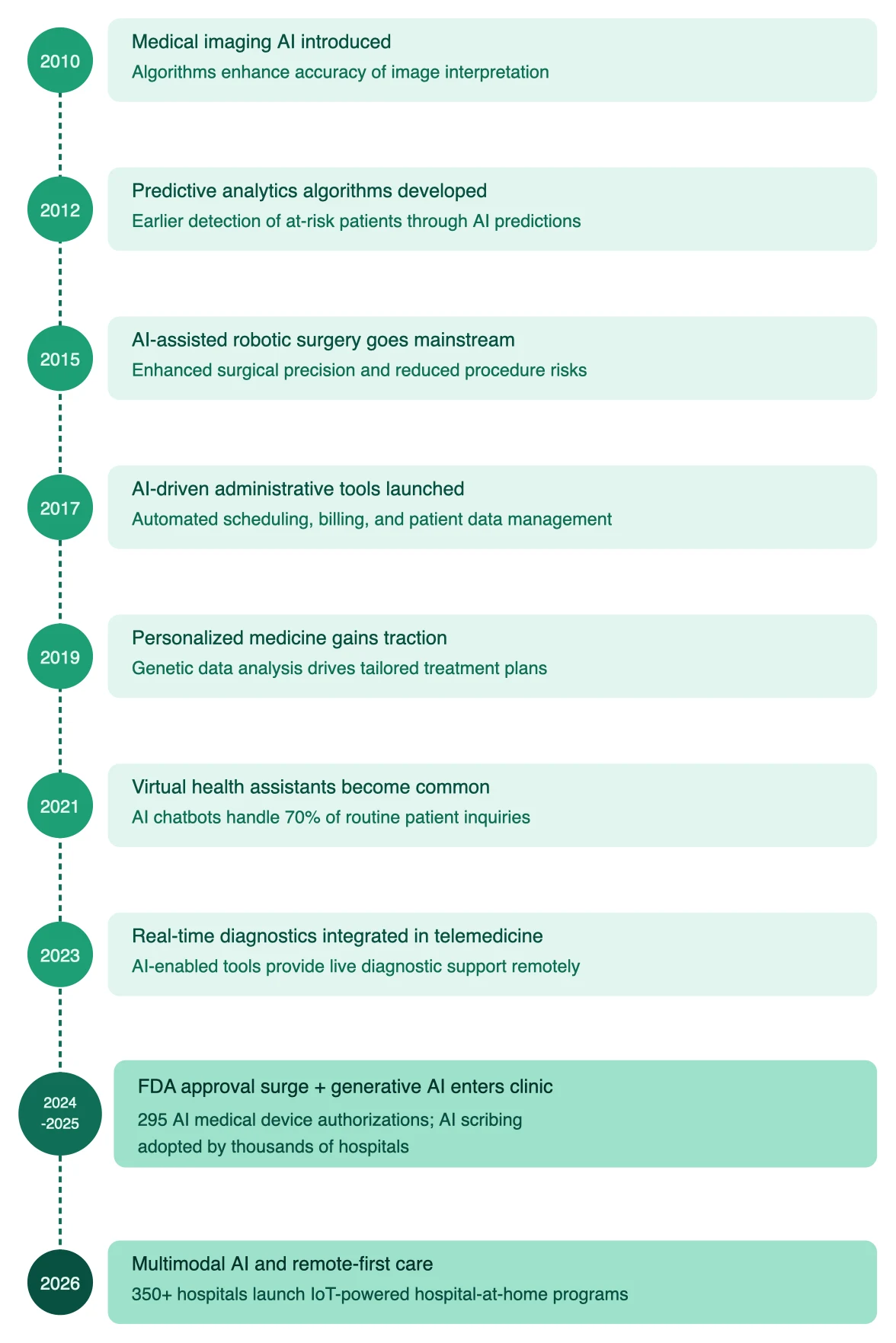
2010: Introduction of AI in Medical Imaging
- AI began to make its mark with medical imaging.
- Algorithms were developed to enhance the accuracy and speed of interpreting medical images, which led to more accurate diagnoses.
2012: Development of AI Algorithms for Predictive Analytics
- AI algorithms started to be used for predictive analytics. This allowed healthcare providers to predict patient outcomes and identify at-risk patients earlier, thus improving preventive care.
2015: AI-Assisted Robotic Surgery Becomes Mainstream
- AI-assisted robotic surgeries gained popularity. This offered enhanced precision and reduced the risks associated with surgical procedures.
- These robots could assist surgeons with high-precision tasks, leading to better patient outcomes.
2017: AI-Driven Administrative Tools Launched
- The launch of AI-driven administrative tools revolutionized healthcare administration.
- These tools automated routine tasks such as scheduling, billing, and patient data management and were available on-premise or via the cloud, depending on your needs. Our article explains more about cloud computing in healthcare.
2019: AI in Personalized Medicine Gains Traction
- AI’s role in personalized medicine began to expand.
- AI algorithms can analyze genetic data to create tailored treatment plans for patients, improving the efficacy of treatments.
2021: AI-Powered Virtual Health Assistants Become Common
- AI-powered virtual health assistants became increasingly prevalent, aiding healthcare providers in managing patient interactions more effectively.
- These assistants could handle routine inquiries, provide medical information, and even assist in checking symptoms.
2023: Integration of AI in Real-Time Diagnostics and Telemedicine
- The integration of AI in real-time diagnostics and telemedicine marked a significant advancement.
- AI-enabled tools could provide real-time diagnostic support during telemedicine consultations, enhancing the quality of remote care.
2024–2025: FDA Approval Surge and Generative AI Enters Clinical Workflows
- AI adoption accelerated as healthcare organizations moved from experimentation to real-world deployment.
- The FDA authorized more than 1,400 AI/ML-enabled medical devices by the end of 2025, with radiology accounting for about 76% of all approvals.
- Generative AI entered clinical workflows through AI-powered medical scribes, documentation assistants, and patient communication tools. A multisite study of 8,581 clinicians found that AI scribe adoption was associated with 16 fewer minutes of documentation time per visit and nearly 0.5 additional weekly visits per clinician.
- Hospitals increasingly adopted AI assistants to reduce administrative workload and allow physicians to spend more time on patient care.
2026: Multimodal AI and Remote-First Healthcare Expand
- Multimodal AI systems are becoming a major focus, combining medical images, clinical notes, patient records, and real-time monitoring data to support more comprehensive decision-making.
- Remote-first healthcare models continue to expand, supported by AI monitoring and connected devices. CMS’ Acute Hospital Care at Home initiative has collected nearly five years of data on hospital-level care delivered in patients’ homes, showing growing adoption of alternative care models.
- AI-powered platforms help providers monitor patients continuously, identify risks earlier, and deliver personalized care beyond traditional hospital settings.
How Has AI Impacted the Health Industry?
AI has made significant inroads in the healthcare industry and transformed various aspects of patient care, diagnostics, and administrative processes.

The impact of AI in healthcare is evident through numerous advancements and the statistics that highlight its benefits.
Benefits of AI in Healthcare
Enhanced Diagnostics and Imaging
- AI algorithms have significantly improved the accuracy of medical imaging and diagnostics.
- For instance, AI can detect breast cancer with 94.5% accuracy, compared to 88.4% for human radiologists.
- AI-assisted diagnostic tools can reduce diagnostic errors by up to 85%.
Predictive Analytics and Personalized Medicine
- AI enables predictive analytics, which helps detect diseases earlier and personalize treatment plans. Usually, computer vision is used to build such diagnostic tools.
- Predictive analytics can identify at-risk patients and reduce hospital readmissions by 20%.
- Personalized treatment plans powered by AI have improved patient outcomes by 30%.
Administrative Efficiency
- AI streamlines administrative tasks and reduces the burden on healthcare staff.
- Automated administrative tasks can save healthcare providers up to 20% of their time.
- AI-driven scheduling systems reduce patient no-shows by 35%.
Robotics and Surgery
- AI-driven robotic systems enhance the precision and efficiency of surgical procedures.
- Robotic surgeries have reduced complication rates by 21% and recovery times by 30%.
- AI-assisted robotic surgeries are associated with a 40% decrease in surgical errors.
Virtual Health Assistants
- AI-powered virtual assistants improve patient engagement and management.
- Virtual health assistants can handle up to 70% of routine inquiries and free up staff for critical tasks.
- AI chatbots reduce response times for patient queries by 50%.
Statistics Table
| AI Application | Impact/Improvement | Statistic |
| Medical Imaging & Diagnostics | Increased accuracy in detecting diseases | 94.5% accuracy in breast cancer detection |
| Predictive Analytics | Reduction in hospital readmissions | 20% |
| Personalized Medicine | Improved patient outcomes | 30% |
| Administrative Tasks | Time saved for healthcare providers | 20% |
| Scheduling Systems | Reduction in patient no-shows | 35% |
| Robotic Surgeries | Reduction in surgical complications | 21% |
| Virtual Health Assistants | Handling routine inquiries | 70% |
| Patient Query Response Time | Reduction in response times | 50% |
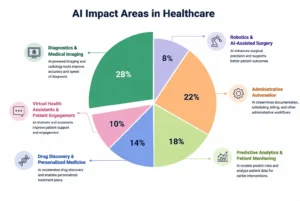
AI Impact Areas in Healthcare
The diagram below highlights the main areas where AI is transforming healthcare:
AI in Healthcare Market Size and Adoption (2025–2026)
The benefits above are no longer early experiments — they are funded, regulated, and deployed at scale. The global AI in healthcare market sat near $36.7 billion in 2025 and is on track to roughly $50.7 billion in 2026, with Grand View Research projecting $505.6 billion by 2033 at a 38.9% CAGR. North America holds about 54% of that revenue, and software plus machine learning make up the largest technology segments.
Adoption is rising just as fast. The FDA has now authorized roughly 1,450 AI/ML-enabled medical devices, and 295 of those clearances came in 2025 — a record single year — with radiology representing close to three-quarters of all authorizations (FDA). On the clinician side, the American Medical Association found that 66% of U.S. physicians used health AI in 2024, up from 38% in 2023 — a 74% jump in a single year. And the financial case is concrete: McKinsey estimates AI could deliver $200–$360 billion in annual U.S. healthcare savings within five years, with administrative automation as the highest-potential area.
| Metric | 2025–2026 figure | Source |
| Global AI in healthcare market | $36.7B (2025) → $50.7B (2026), $505.6B by 2033 (38.9% CAGR) | Grand View Research, 2025 |
| FDA-authorized AI/ML medical devices | ~1,450 cumulative; 295 cleared in 2025 (record) | FDA, 2025 |
| Physician adoption of health AI | 66% in 2024, up from 38% in 2023 | AMA, 2025 |
| Projected annual U.S. savings from AI | $200B–$360B within ~5 years | McKinsey, 2025 |
| Generative AI implementation (US health orgs) | 50% in 2025, up from 25% in 2023 | McKinsey, 2025 |
One named example shows what these numbers look like in a hospital. Cleveland Clinic, working with Bayesian Health, deployed an AI sepsis-detection system across 13 hospitals that identified 46% more sepsis cases while firing 10x fewer false alerts than the prior rules-based tool (Cleveland Clinic, 2025). Regulation is keeping pace too: the FDA issued draft guidance in January 2025 for AI-enabled device software using a Total Product Life Cycle approach — requiring manufacturers to address model drift, bias, and data poisoning — while the EU AI Act’s rules for general-purpose AI models began applying in August 2025.
Real-World Examples of AI in Healthcare
AI has already begun transforming healthcare practices globally. This showcases its potential through various real-world applications. Here are some notable examples demonstrating how AI is revolutionizing the healthcare industry.
1. IBM Watson for Oncology
- Overview: IBM Watson for Oncology uses AI to help oncologists analyze large volumes of medical literature and clinical data to provide personalized treatment recommendations for cancer patients.
- Impact: In studies, Watson for Oncology matched oncologists’ treatment recommendations in over 90% of cases. As a result, this significantly reduces the time needed to analyze patient data and enhances the accuracy of treatment plans.
2. Google’s DeepMind and Moorfields Eye Hospital
- Overview: DeepMind, a subsidiary of Google, has developed an AI system in collaboration with Moorfields Eye Hospital in London that can recognize over 50 types of eye diseases based on routine medical scans.
- Impact: The AI system achieved 94% accuracy in diagnosing eye diseases. This matches the performance of expert ophthalmologists and enables earlier detection and treatment of conditions such as age-related macular degeneration and diabetic retinopathy.
3. Aidoc’s Radiology AI
- Overview: Aidoc’s AI-powered radiology tools assist radiologists in detecting abnormalities in medical images, such as CT scans and MRIs, across multiple body systems, including the brain, spine, chest, and abdomen.
- Impact: Hospitals using Aidoc’s technology have reported a 30% reduction in turnaround times for critical cases, which improves patient outcomes by enabling faster diagnosis and treatment.
4. PathAI in Pathology
- Overview: PathAI develops AI-powered technology to assist pathologists in diagnosing diseases by analyzing tissue samples and identifying potential abnormalities.
- Impact: PathAI’s platform has demonstrated improved accuracy and efficiency in diagnosing conditions such as breast cancer and prostate cancer. Indeed, this reduces diagnostic errors and enables more precise treatment plans.
5. Zebra Medical Vision
- Overview: Zebra Medical Vision offers AI solutions in healthcare that analyze medical imaging data to detect various conditions, such as cardiovascular diseases, liver diseases, and bone density issues.
- Impact: Their AI algorithms have achieved high accuracy rates. This aids in the early detection of diseases and reduces the workload on radiologists. As a result, this has led to improved patient care and streamlined diagnostic processes.
6. Buoy Health’s AI Chatbot
- Overview: Buoy Health has developed an AI-powered chatbot that interacts with patients to assess their symptoms, provide preliminary medical advice, and direct them to appropriate care.
- Impact: The chatbot has helped reduce unnecessary emergency room visits, guided patients to the right level of care, and alleviated the burden on healthcare facilities.
7. Microsoft and Apollo Hospitals’ AI Network for Healthcare
- Overview: Microsoft partnered with Apollo Hospitals in India to develop an AI-powered cardiovascular disease risk score API. This tool leverages machine learning to predict the risk of heart disease in patients.
- Impact: The AI model has improved the accuracy of predicting cardiovascular diseases and led to better preventive care and treatment planning for high-risk patients.
The above examples highlight how AI is being used to enhance diagnostic accuracy, personalize treatment plans, streamline administrative tasks, and improve patient outcomes. As AI continues to evolve, its applications in healthcare will expand, offering even more innovative solutions to meet the challenges of modern medicine.
Frequently Asked Questions About AI in Healthcare
The global market was about $36.7 billion in 2025 and is projected to reach roughly $50.7 billion in 2026 and $505.6 billion by 2033, growing at a 38.9% CAGR (Grand View Research, 2025). North America accounts for roughly 54% of revenue.
The FDA has authorized about 1,450 AI/ML-enabled medical devices to date, with 295 cleared in 2025 — a record year — and radiology making up close to three-quarters of all clearances (FDA).
The five most common uses are medical imaging and diagnostics, predictive analytics and personalized medicine, administrative automation, AI-assisted robotic surgery, and virtual health assistants. Each is covered with examples and benefits above.
Yes. McKinsey estimates AI could deliver $200–$360 billion in annual U.S. healthcare savings within five years, with administrative automation as the highest-potential area, and most adopters already report positive or anticipated ROI (McKinsey, 2025).
Increasingly. The FDA issued draft guidance in January 2025 for AI-enabled device software covering model drift, bias, and data poisoning, and the EU AI Act’s rules for general-purpose AI models began applying in August 2025.
Conclusion
AI is transforming healthcare by enhancing diagnostic accuracy, personalizing treatment plans, streamlining administrative tasks, and improving patient engagement. The benefits are clear: AI in the medical field reduces errors, increases efficiency, saves time, and improves outcomes.
For healthcare business owners, adopting AI is essential to stay competitive and provide top-notch care. The real-world examples and statistics we’ve shared demonstrate AI’s significant impact.
At LITSLINK, we specialize in AI software development tailored to healthcare needs. Whether you need a new AI application or want to integrate existing AI technologies, we are here to help.
Contact us today to discover how our AI solutions can elevate your healthcare practice. Let’s work together to bring the future of healthcare to your business.