






AI integration into corporate operations is now a necessity rather than a luxury in today’s rapidly evolving digital landscape. A stack of AI technologies may be the spark that increases productivity, lowers operating expenses, and streamlines corporate procedures. By automating processes, improving decision-making, and streamlining workflows, a strong AI technology stack helps businesses of all sizes remain competitive.
What is an AI software stack, though, and why is it so crucial for contemporary companies? The main elements of an AI tech stack are examined in this article, along with the significance of AI in optimising business processes and actual instances of how companies are using it to boost productivity and expansion.
What Is an AI Tech Stack?
The set of tools, frameworks, and technologies used to create and execute artificial intelligence solutions inside a company is known as an AI tech stack. It consists of the software and hardware layers that cooperate to allow companies to use AI for tasks like automation, data analysis, machine learning (ML), and natural language processing (NLP).
Combining different tools for data processing, model training, deployment, and scaling is necessary to build an AI technology stack and guarantee smooth communication between the various parts of the stack. These stacks are intended to give companies the tools they need to create AI-driven applications, process massive volumes of data effectively, and improve operational workflows.
Read more about how AI assistants can simplify both your personal and professional life.
Key Components of an AI Tech Stack
The various layers and parts that make up the AI tech stack each have a distinct purpose in facilitating the seamless deployment of AI-driven solutions. Let’s examine the fundamental components of an entire AI stack:
Data Collection and Storage
Data is essential to creating a successful AI solution. In the data collection layer, information is gathered from a variety of sources, including social media, IoT devices, and internal databases. This data must be safely stored and arranged in databases such as SQL, NoSQL, or cloud storage by the storage layer.
Data Processing and Preprocessing
Before applying AI algorithms, data must be cleaned and processed. This step includes tasks such as data normalization, outlier detection, and handling missing values. Large amounts of data are processed by tools like Google BigQuery, Hadoop, and Apache Spark to make sure they are prepared for analysis.
Machine Learning Frameworks
The core of AI is machine learning. Tools and libraries such as TensorFlow, PyTorch, and Scikit-learn are part of the ML frameworks layer and aid in the development, training, and testing of machine learning models. These frameworks offer the algorithms required to examine and forecast results from past data.
AI Model Training and Development
Model training is the process of creating predictive models with AI algorithms. To guarantee accuracy and efficacy, this step necessitates choosing suitable models and training them on enormous volumes of data. Businesses typically concentrate on developing a strong AI tech stack during this stage, selecting tools and technologies that will facilitate the model’s deployment and training. These models are frequently made using well-known frameworks like Keras, which are crucial parts of the AI technology stack for predictive analytics and machine learning.
Deployment and Monitoring
The AI model needs to be implemented in a real-world setting after it has been trained. Using tools like Docker, Kubernetes, and AWS SageMaker to integrate the model into business processes is crucial to building the best AI tech stack.
These tools guarantee scalability and seamless deployment: AI tech stack layers and monitoring tools aid in preserving peak performance after deployment. Selecting the appropriate AI tech stack examples for smooth integration is crucial, as ongoing monitoring enables updates that guarantee the model stays effective and current.
Scalability and Performance Optimisation
The demands placed on the AI system will increase as the business expands. To provide the infrastructure required for scalability, tools such as Microsoft Azure AI and Google Cloud AI are essential. With the help of these tools, companies can scale their AI applications to accommodate growing data loads and guarantee peak performance.
Benefits of a Well-Integrated AI Tech Stack
Using an integrated AI software stack can revolutionise business operations and offer several essential advantages. These consist of:
| Benefit | Description | Business Impact |
| Improved Efficiency | Automation of routine and repetitive tasks allows employees to focus on strategic work. | Increases productivity and operational efficiency. |
| Enhanced Decision-Making | AI models process large volumes of data to identify trends and provide valuable insights for decision-making. | Supports informed and timely business decisions. |
| Cost Savings | Reduces operational costs by eliminating manual labor and optimizing workflows. | Lowers expenses and improves profitability. |
| Personalisation | Analyzes user behavior and preferences to deliver personalized customer experiences. | Enhances customer satisfaction and loyalty. |
| Scalability | Ensures AI applications can handle more complex tasks and larger data volumes as the business grows. | Supports business growth without loss of performance. |
How to Build the Best AI Tech Stack for Your Business
Your unique needs and objectives will determine which AI tech stack is best for your company. When choosing and constructing an AI stack, keep the following steps in mind:
1. Define Your AI Objectives
Determine exactly what issues you wish to use AI to address first. Your goals will dictate which AI tech stack components and technologies you choose, whether that means using chatbots to improve customer service, automating data analysis, or improving product recommendations.
2. Choose the Right Components
Choose the best tools for data collection, storage, processing, model development, and deployment based on your business needs. When selecting each component, be sure to take cost, scalability, and ease of use into account.
3. Integrate with Existing Infrastructure
Your current infrastructure and your AI technology stack should work together harmoniously. Make sure it works with the databases, software, and cloud services you currently have.
4. Focus on Security and Compliance
When developing an AI tech stack, data security is essential because companies need to handle sensitive data with care. Protecting data and user privacy requires that the tools you select adhere to industry standards and regulations, such as GDPR or HIPAA. In addition to shielding your company from possible data breaches, choosing secure platforms and encryption techniques helps you gain the trust of your clients. Businesses can maximise AI’s potential while reducing risks thanks to a well-secured AI technology stack, which ensures that data is processed, stored, and transmitted securely.
5. Continuously Monitor and Optimise
Following deployment, it’s critical to keep an eye on your AI models’ performance to make sure they continue to meet business goals and produce reliable results. You can track a variety of performance metrics, including efficiency, accuracy, and response times, by using sophisticated monitoring tools. You can spot any possible problems or drift in model behaviour by monitoring your models’ performance in real time.
Your AI tech stack will continue to be effective and adaptable to changes if you make the necessary adjustments, such as retraining the model with updated data or adjusting parameters, ensuring high performance and ongoing value for your company.
AI Tech Stack Examples
Let’s examine a few real-world examples better to grasp the potential of an AI tech stack:
AI for Customer Service: Chatbots and Virtual Assistants
AI software stacks are being integrated by numerous companies to automate customer service. Businesses can lower customer service expenses, offer round-the-clock assistance, and provide real-time answers to consumer questions by implementing chatbots and virtual assistants driven by NLP models like GPT-5.
For instance, Zendesk’s customer support tools are powered by AI, which enables companies to automate responses and optimise customer service processes.
For more examples of AI-powered tools, check out our article on AI medical diagnosis apps.
AI in E-Commerce: Personalised Recommendations
Businesses in the e-commerce sector are using AI to examine user behaviour and provide tailored suggestions. Machine learning models that examine past purchases, browsing patterns, and product ratings are used to accomplish this.
For instance, Amazon offers tailored product recommendations through an advanced AI tech stack, boosting sales and enhancing the customer experience.
Learn more about AI in e-commerce in our blog.
AI in Finance: Fraud Detection
By examining vast amounts of transaction data, financial institutions employ AI models to identify fraudulent transactions. In real time, machine learning algorithms spot trends and flag potentially fraudulent activity.
For instance, PayPal protects users from fraud by using AI to track transactions and identify anomalous activity.
Check out how AI is revolutionising finance in our article, AI in Finance.
Future Trends in AI Tech Stacks
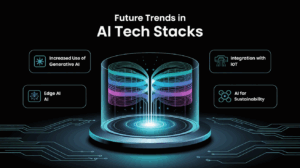
The elements and resources that comprise the AI tech stack will also change as AI technology advances. Keep an eye out for the following trends:
Increased Use of Generative AI
The use of generative models, such as GPT-5 and DALL·E, in content creation, creativity enhancement, and automation is growing in popularity.
For more on generative AI, visit our AI scheduling assistants blog post.
Integration with IoT
By facilitating better decision-making and real-time insights, the integration of AI and IoT devices is assisting businesses in streamlining their operations. Large volumes of data are produced by IoT devices, and when combined with AI algorithms, this data can be examined and used to spot trends, forecast patterns, and boost operational effectiveness.
Businesses can use AI, for instance, to analyse data from Internet of Things sensors to automate maintenance schedules, monitor equipment performance, and identify possible failures before they occur. By delivering data-driven solutions in real time, this synergy enables businesses to improve customer experiences, decrease downtime, and streamline operations.
Edge AI
Because edge computing makes it possible to directly deploy AI models on devices—like smartphones, IoT devices, and sensors—for quicker processing and lower latency, it is becoming more and more popular. Businesses can drastically reduce the amount of time it takes to make decisions and react to events in real time by processing data locally, at the network’s edge.
This is especially helpful in applications like industrial automation, healthcare monitoring, and driverless cars, where milliseconds count. Edge AI optimises bandwidth usage and boosts system efficiency by reducing the need for continuous communication with cloud servers.
AI for Sustainability
Companies are using AI to optimise energy use, cut waste, and improve supply chain efficiency to advance sustainability. AI technologies use real-time data analysis to spot trends in energy use, allowing for more environmentally friendly use. AI forecasts demand, simplifies logistics, and reduces environmental impact in supply chains. It also optimises production processes, cutting waste and excess. Businesses can increase their profitability and environmental responsibility by integrating the AI tech stack.
How Can We Help You Build Your AI Tech Stack?
Businesses hoping to remain inventive and competitive in the fast-paced market of today must build a strong AI tech stack. Businesses can improve customer experiences, automate procedures, and make data-driven decisions with the help of a well-integrated AI stack. LITSLINK designs and implements AI solutions to boost growth and productivity.
Our group is committed to providing state-of-the-art AI technology stack solutions that complement your strategic objectives.
Get in touch with us right now to find out how we can help you create and deploy a strong AI technology stack that will optimise your business processes, boost productivity, and improve your ability to make decisions.
Our team is available to assist you in creating a unique solution that supports your company’s objectives and promotes long-term growth, whether your goal is to automate procedures, use data to gain deeper insights, or develop AI-driven solutions. Allow us to assist you in realising AI’s full potential for your company!