









Key Takeaways:
- 61% of Americans understand they need to take care of their health, but they need guidance.
- US primary care market is expected to reach $8.09 trillion by 2034, making now a good time to enter it.
- Generative AI has become one of the most popular tools among remedial executives. 85% plan to use it in 2026.
- Right now, innovations that might find support in primary care must be fast, affordable, and require no human intervention.
- The strongest AI healthcare business ideas now attract serious capital: U.S. digital health startups raised $14.2 billion in 2025, up 35% from 2024, and AI-enabled companies captured 54% of that funding (Rock Health; Menlo Ventures).
- Ambient documentation, prior authorization automation, and patient-engagement AI each passed the $100M+ market mark in 2025 — categories that barely existed two years earlier.
It is a prominent time for medical startups to bring their AI healthcare business ideas to life. A recent data survey from Abbott shows that 61% of Americans believe that they should do more to remain healthy. Moreover, 74% of respondents believe that chronic conditions, such as cardiovascular disease or diabetes, are preventable, but only a few know how to do that. In this case, medical business ideas have significant potential as people become more interested in staying healthy.
Digital health solutions, remote care, and artificial intelligence are transforming our understanding of wellness. AI-driven platforms are lowering costs, increasing accuracy, and facilitating access to primary care, from mental health support to diagnostics.
In this article, we present an insider guide to 15 healthcare business ideas that could attract users’ attention in 2026. There is something here to get your mind going, whether you are an investor, clinical student, or founder.
Why AI Healthcare Business Ideas Are Booming in 2026
The money followed the technology. U.S. digital health startups raised $14.2 billion in 2025 — a 35% increase over 2024 and the highest total since 2022, according to Rock Health. AI-enabled companies captured 54% of that total, up from 37% a year earlier, and commanded a 19% premium on average deal size. Adoption moved just as fast: 22% of healthcare organizations had deployed domain-specific AI tools by late 2025, a 7x jump over 2024, based on a Menlo Ventures survey of 700+ healthcare executives.
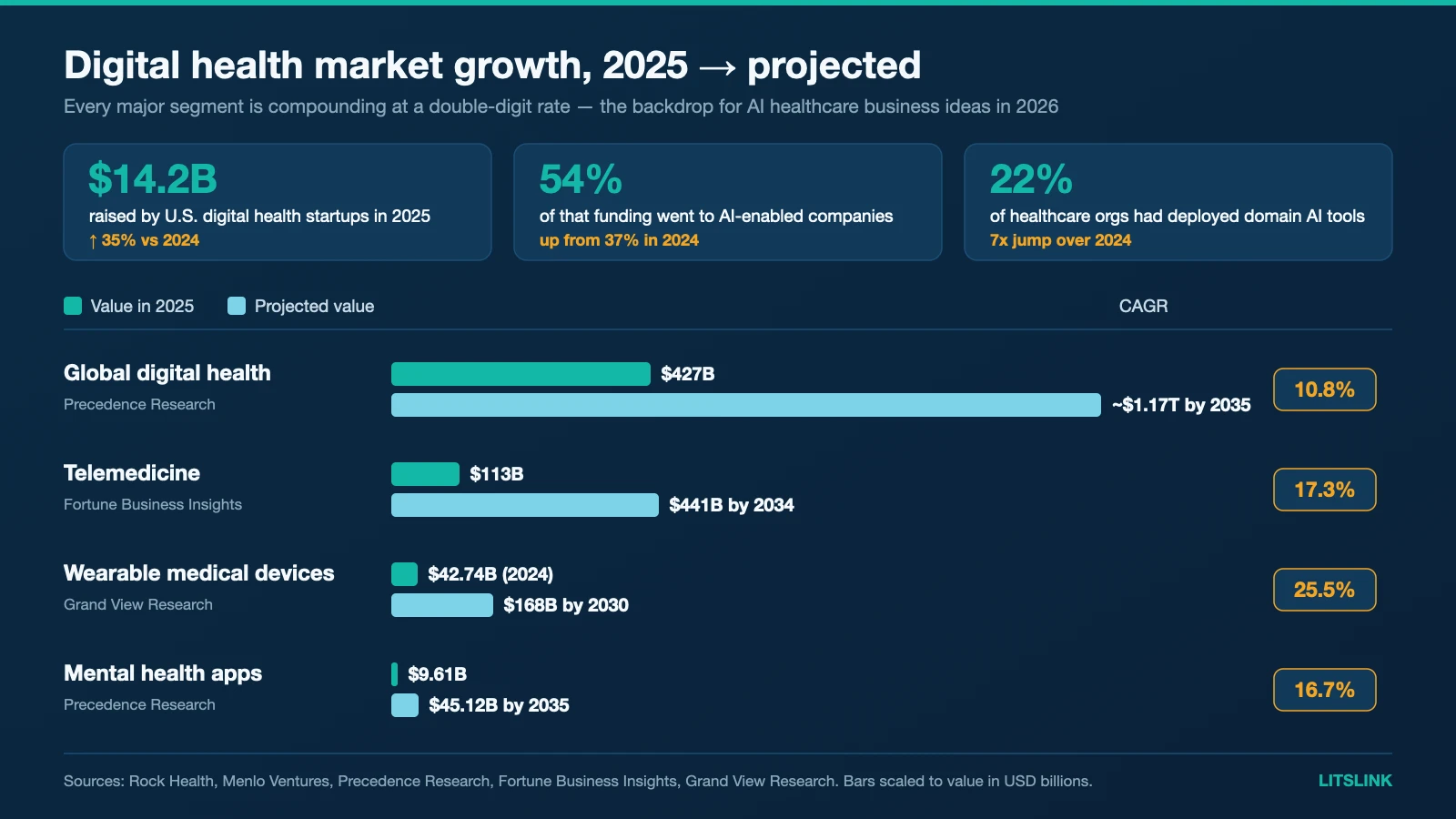
Every major digital health segment is expanding at a double-digit clip, which sets the backdrop for the ideas below:
| Segment | 2025 value | Projected value | CAGR | Source |
| Global digital health | $427B | ~$1.17T by 2035 | 10.8% | Precedence Research |
| Telemedicine | $113B | $441B by 2034 | 17.27% | Fortune Business Insights |
| Wearable medical devices | $42.74B (2024) | $168B by 2030 | 25.53% | Grand View Research |
| Mental health apps | $9.61B | $45.12B by 2035 | 16.73% | Precedence Research |
Greg Yap, Partner at Menlo Ventures, framed the shift directly: “Long dismissed as a digital laggard that trailed years behind every major innovation wave, healthcare has flipped the script. The $4.9 trillion industry… is now deploying AI at more than twice the rate (2.2x) of the broader economy.” For founders, the takeaway is simple: the market is rewarding software that removes administrative work and needs little human intervention.
Healthcare Startup Business Ideas that Worked
There are many strong reasons to start a healthcare startup. You may make a major difference by supporting the elderly and those dealing with substance misuse. Furthermore, advances in science and technology, together with an increased interest in health and well-being, have resulted in a thriving market for healthcare businesses. There is a great need for creative startup solutions that give business owners the chance to address pressing issues and create profitable, long-lasting healthcare projects.
Analysts predict that the healthcare market will expand, both in terms of overall monetary value and share of GDP. The healthcare industry accounted for more than 18% of the US GDP in 2023, and healthcare expenditures are expected to approach 20% by 2031, according to the Peter G. Peterson Foundation.
Virtual Operation Room
Insight: What if we could create a virtual space where surgeons can make virtual operations that would feel like real ones?
Realization: Developers of FundamentalXR make in life one of the most innovative business ideas in the medical field. They created a virtual space for physicians to practice their skills on virtual operations that look/feel like real ones.
Results: Over 200 clinical institutions in 50+ countries are already using technology. It helps improve the learning process by 40% and raises the skill retention rate to 95%.
Smart Ring
Insight: What if we could design a device that would gather information about our body, yet would be almost “invisibly” worn?
Realization: In 2013, a group of tech enthusiasts in Finland came up with one of the most interesting healthcare entrepreneurship ideas. They designed the Oura Ring, a simple device that can gather all necessary information about a user’s body conditions and advanced sleep patterns.
Results: The rings have gained real popularity worldwide. The total number of sold devices to date is over 5.5 million. In 2025, it generated $1 billion in sales and is projected to double this number in 2026. Oura also closed a Series E at an $11 billion valuation in late 2025, cementing the smart ring as a durable healthcare category rather than a fad.
AI Model For Biology
Insight: What if we can create a platform that would gather all the data on modern biology?
Realization: In 2024, a French company, Bioptimus, appeared on the market with a pretty bold vision. Tech and science enthusiasts were planning to design a fully functional AI foundation model that would work with all stages of biological organisms.
Results: The startup has already raised $76 million in funding, creating two platforms during 2 years, H-Optimus and M-Optimus. In 2026, it also announced the launch of STELA, the largest clinically linked spatial biology atlas.
Our Top 15 Healthcare Business Ideas
1. AI-Agent for Predictive Health
An innovative digital ecosystem that uses artificial intelligence (AI) and natural language processing (NLP) to forecast potential risks based on user input and prevent pain. See how NLP is changing the medical field.
2. Rural Teletherapy Platform
There are a few mental health services available in rural areas. This enormous gap might be filled by some online healthcare business ideas. With such a platform, you can access secure, comfortable virtual consultations, eliminating geographical barriers. Do you want a real next level? Imagine a VR combined with mental health. Think about it like one of the nice home-based healthcare business ideas.
3. Niche Wearable Ecosystems
People with chronic conditions or developing diseases, like epilepsy or Parkinson’s, need applications that constantly monitor their health. These apps might collect data and then transmit it to local clinics to help prevent potential risks. The application might work using a subscription method.
4. Customized Meal Planning for Chronic Illnesses
An AI-powered app that develops meal plans for people with heart disease, diabetes, or other dietary needs. Excellent for a medical venture startup concept.
5. Virtual Reality Pain Management Tool
For non-opioid pain relief, use virtual reality. It has been shown to lessen procedure-related anxiety. It is immersive and non-invasive. From immersive pain management to cognitive therapy, such a tool empowers clinicians and transforms patients’ lives worldwide.
6. Marketplace for Physicians’ Staff
Uber for medical professionals, such as nurses. A digital platform that allows hospitals to make on-demand reservations for qualified professionals.
7. Remote Patient Monitoring Dashboard
Create a B2B SaaS solution that enables hospitals to remotely monitor patients with chronic illnesses. Analytics, alerts, and real-time vitals in one location.
8. Hyper-Personalized VR Companions
Chatbots have gradually become apps where everyone can access fast, free psychological assistance. A more advanced system might bring even more attention, especially if it is personalized by a virtual doctor and fits the user’s specifications.
9. Blockchain-Based Medical Records System
Bid farewell to misplaced files. Blockchain guarantees patient data that is safe, decentralized, and readily exchangeable. Are you curious about its technological aspects? This is the evolution of medical software.
10. Elderly Care Coordination App
Use a single app designed for family members/carers to manage appointments, medications, and home care services.
11. Fitness App for Post-Surgery Recovery
A mobile application that can help patients monitor their progress in recovery after surgeries and feed information back to their care teams.
12. On-Demand Lab Test Booking Platform
Such platforms let you order lab tests from home. Convenient, quick, secure blood tests help you better understand your overall health and wellness.
13. AI Diagnostic Tool for Skin Conditions
Develop a machine learning model to use images to identify skin conditions. It’s accessible and scalable — see how machine learning is already enabling this in the medical field.
14. Longevity Gamification
An application that rewards users with real prizes for achieving health goals can be one of the most profitable healthcare business ideas. Moreover, we can change the rules of the game: players don’t have to level up, but reduce some of their “characteristics”: weight, blood pressure, or sugar level. This feature allows them not only to receive pleasant “achievements” but also to see the results of their work.
15. Holistic Corporate Wellness Operating System
A fully digital ecosystem in which every user is granted a full stack of necessary services, from annual checkups to biohacking. Every service is easy to access and is available with just a few clicks. For someone, it sounds like something that belongs in science fiction. For others, it might be a potential health-related business idea.
Three AI-Native Ideas Gaining Funding Right Now
These categories barely registered on competitor lists two years ago. In 2025 they turned into funded markets, and each solves a concrete administrative pain point.

Prior Authorization Automation. Physicians complete an average of 40 prior authorizations per week, and 94% say the process feeds burnout. Prior authorization AI is already a $100M+ market growing 10x year over year (Menlo Ventures). The regulatory tailwind is real: the CMS Prior Authorization rule mandates FHIR-based APIs for prior authorization effective January 2026, which forces health plans to modernize and creates compliance-driven demand overnight.
Ambient Clinical Documentation. Voice AI that listens to a visit and drafts the clinical note generated $600 million in 2025, up 2.4x year over year. Abridge, the category leader, reached $100M in ARR and a $5.3B valuation in 2025, deployed across 100+ health systems including Kaiser Permanente and Mayo Clinic. At St. Luke’s, the tool cut after-hours charting time by 35%.
Voice AI for Patient Engagement. Patient-engagement AI is a $100M+ market growing 20x year over year, with roughly $400M raised across voice platforms by mid-2025. Startups like Hippocratic AI and Assort Health handle appointment scheduling, care navigation, and post-discharge follow-ups — work that used to require a call center.
Regulatory Tailwinds Founders Should Know
Two policy shifts change the economics for healthcare startups in 2026. Medicare telehealth flexibilities were extended through December 31, 2027, with no geographic restrictions — patients anywhere in the U.S. can receive reimbursed telehealth from home. CMS also authorized a 3.85% physician reimbursement increase for 2026, the first raise after five straight years of cuts.
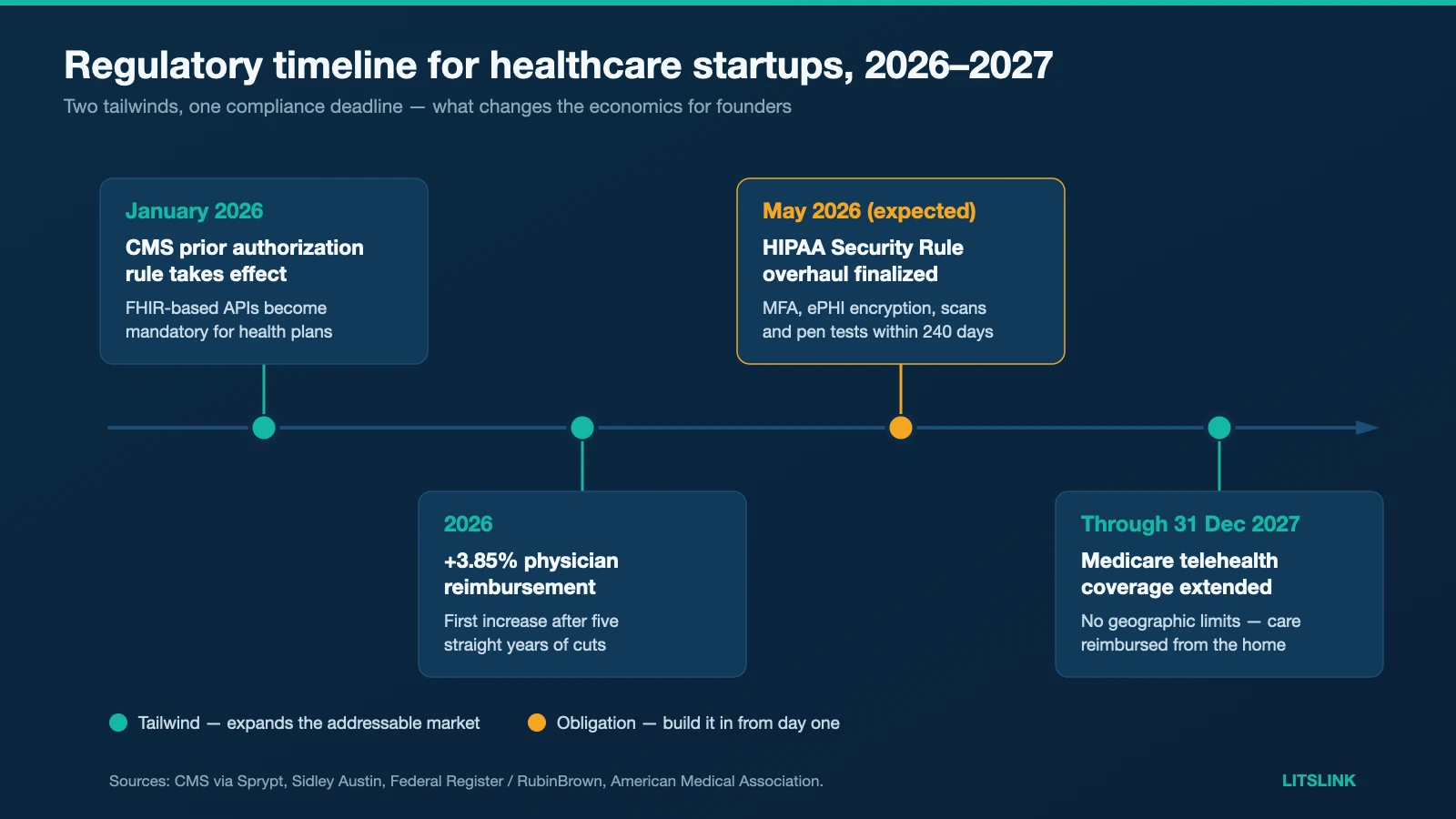
Compliance is tightening at the same time. A HIPAA Security Rule overhaul — the most sweeping since 2013 — is on track for finalization in May 2026. It would make multi-factor authentication, encryption of ePHI, biannual vulnerability scans, and annual penetration testing mandatory within 240 days of adoption. Build security in from day one, not as an afterthought.
How to Get Started
If you want to bring your medical-related business ideas to life, you need to follow a few key steps to ensure everything is done correctly.
We created a road map that might come in handy:
| Step | Phase | Key Actions | Tools & Focus |
| 1 | Market Verification | Analyze pain points, evaluate competitors, confirm market demand. | Reddit, Google Trends, target audience surveys. |
| 2 | MVP Development | Build a minimum viable product to test core functionality with minimal investment. | Rapid iteration, focus on essential features, cost-effective testing. |
| 3 | Smart Scaling | Enhance the product based on real user feedback and technical stability. | UX/UI design, secure cloud hosting, feature optimization. |
| 4 | Strategic Success | Navigate industry complexities through dedication, flexible management. | Perseverance, regulatory compliance, long-term sustainability. |
Market Situation: Opportunity for Medical Startup Ideas
U.S. medical market shows strong potential for companies ready to enter the field. A report by Market Data Forecast shows a significant growth over the next eight years. In 2026, US medical market is valued at $5.15 trillion. By 2034, this number will grow to 8.09 trillion at 5.80% CAGR.
Another report, conducted by Deloitte, provides additional information on three strategic sectors that healthcare executives will focus on in 2026.
- 80% of med facilities will pay more attention to regulatory and policy changes.
- 45% will concentrate on generative/agentic AI solutions, as well as convergence and consolidation.
- 41% will provide transformations in care delivery.
With this information in mind, startups won’t have any problems coming up with some outstanding business ideas for healthcare professionals.
Startup’s Position in the Healthcare Industry
There are numerous ways to assist people and satisfy their health needs, making it a fantastic idea to come up with a medical business idea. These concepts cover significant facets of healthcare, such as renting out medical equipment, developing apps for improved health, or utilising technology for remote consultations.
There are many chances for innovation and expansion in the business in the healthcare industry. Entrepreneurs entering this industry need to keep up with changes in regulations and technological advancements. A successful endeavour can be achieved by concentrating on user experience, data security, and cooperation with medical specialists. Startup concepts that are flexible, creative, and patient-focused will prosper in the rapidly changing healthcare sector.
Startup concepts that exhibit flexibility, creativity, and a patient-centered mindset are well-positioned to prosper as the healthcare industry grows. The healthcare sector is changing quickly, and digital tools like websites and apps are essential to changing the way services are provided.
Establishing a med company that uses web/app development requires technical know-how, a strategic approach, and adherence to industry standards.
LITSLINK. We Help Startups Rise
With over 300 professionals on board, our company has helped small entrepreneurs and big corporations launch their platforms from scratch for end users. We offer a wide range of digital solutions, including VR/AR, blockchain development, cloud storage, and AI-driven platforms.
We believe that even small business ideas in healthcare might have great potential. And we are ready to work hard to prove this.
Related reading: explore startup trends shaping 2026, how machine learning is reshaping healthcare, and real-world NLP use cases in medicine.
Conclusion
There are a ton of opportunities ahead, whether you’re looking for health startup insights or researching the best medical businesses to start. As US medical sector grows, prospective business owners can make money by helping independent service providers and healthcare organizations increase profits, reduce costs, and deliver high-quality care.
Recall that any entrepreneur starting this journey needs to possess dedication, flexibility, and perseverance. Remember that new healthcare business ideas come up every day, but only a few have a chance to shine.
So, which healthcare business idea do you want to launch first? The one that uses technology to solve a real problem and improve people’s health. In the highly competitive healthcare sector, successful management of a medical practice is essential.
Let’s build it together. Take advantage of our healthcare app development services to make your idea a reality.
FAQ
In our opinion, there is no one niche in healthcare that can be considered the best. Some people prefer preventive healthcare business ideas that might help reduce the risks of disease development. Others have given preferences to AI multi-agents or healthcare services. Business ideas must resolve people’s “pains.” If they do that, they are already the best.
The US medical sector is constantly growing and making huge investments in technologies. So, for the next few years, it can be a safe space to start business projects.
$5000 can be a first investment. We need to create a pilot project that can be shown to the rest of the potential investors. So, you should invest this money into a pilot.
Best healthcare business ideas attract people’s attention in the first months. One of your vital tasks is to provide good media coverage for your project. Then it will work for itself.
Sure. You can contact us! We offer our expertise on your plans, help you understand whether they are feasible, and bring them to life!
Ambient clinical documentation, prior authorization automation, and voice AI for patient engagement lead the field — each became a $100M+ market in 2025. Broadly, AI healthcare business ideas that remove administrative work and require little human intervention attract the most funding and the fastest adoption.