






| Key takeaways With growing adoption across age groups, apps with enabled voice assistant technology help businesses deliver faster service, reduce operational costs, and gain new revenue streams like voice commerce. Powered by AI, NLP, and speech technologies, modern voice assistants support personalization, security, and multimodal interactions, making them a strategic investment for companies aiming to stay competitive in a voice-first digital future. |
If you’ve been wondering whether voice assistant technology is worth attention or if it’s a flash in the pan, the steady growth of popularity among users says it all. Even the most skeptical consumers have to admit that voice-based solutions are advancing faster than expected.
With more than 154 million voice assistant users in the US in 2025 (according to eMarketer), Alexa, Siri, and Cortana have become new friends of Millennials and their peers in Y and X generations. Large, small, and medium-sized businesses couldn’t help but notice this growing trend. In this article, we’ll talk about how exactly businesses can benefit from voice technology, so you can see what’s in it for you.
Having substantial expertise in the field, we’ll provide you with the main stats and facts on voice assistants, uncover the primary pitfalls, and come up with practical recommendations on how to boost your app’s performance with AI-based voice solutions.
Hire our team of AI-focused engineers now.
What is Voice Assistant Technology?
Voice assistant technology is the ability of software or devices to capture and interpret speech and understand commands using artificial intelligence.
You’ve probably heard of Siri, Alexa, and Cortana. People address them daily with a variety of requests starting from setting up alarms and ending up with making suggestions on what dish to cook for dinner. However, voice assistant applications go far beyond that. Businesses of all sizes have already realized the growing potential of solutions backed by the technology.
Voice Assistant Technology Statistics
As they say, facts hit hard, so to better understand the consuming volume and potential of the technology, here are some persuasive statistics:
- More than 1 billion searches are performed every month via voice search technology;
- 77% of people in the age range of 18 to 34 use smartphones to conduct voice searches;
- 85% use voice search for quick answers, followed by listening to music (65%) and checking weather;
- 71% of online consumers prefer using voice search over typing;
- Around 43% of people with voice assistant tools use them to shop online;
- By 2028, voice search is expected to generate $45 billion in consumer spending;
- Around 50% of the total U.S. population uses some form of voice search every day;
- 41% of users trust voice assistant answers “most of the time”;
- Apple, Siri, and Google Assistant are the top players in the global voice assistant market by technology, often cited at 36% each, followed by Amazon Alexa.
- Millennials are the primary target audience for voice-based apps, but the technology is quickly gaining traction among users across all age groups.
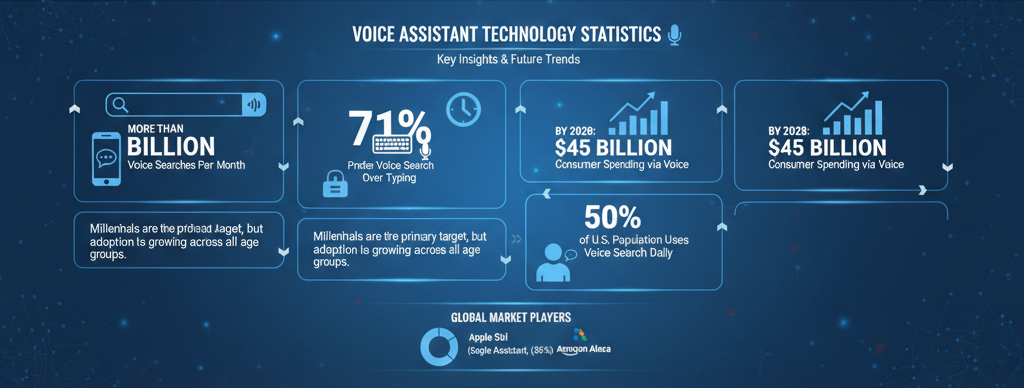
The figures point to a positive tendency as voice recognition technology will become more widespread in the future. What does it mean for you? Adjusting AI-based solutions today will help your business stay aligned with future market realities and remain competitive.
How Do Voice Assistants Work?
Recalling a classic quote: “Easy reading is damn hard writing,” the same is true for how voice assistants work. Behind a convenient and hassle-free use of this AI solution, there is a lot of work by software engineers. So, voice assistant technology — how does it work?
The typical voice assistant workflow in an app includes:
Voice Input (Speech Capture)
It all begins with capturing audio through a microphone. This audio stream can come from:
- Mobile devices;
- Smart speakers;
- Car systems;
- Call center recordings;
- Web browser mic input.
To detect when the human is speaking, the system uses voice activity detection (VAD).
Automatic Speech Recognition (ASR)
The next step is to transform captured speech into text. For this purpose, a voice assistant operates speech-to-text technology. ASR and STT allow the assistant to identify:
- Accents;
- Speed of speech;
- Background noise;
- Pauses and filler words.
Modern ASR technologies successfully interpret words in noisy environments, so it’s not a problem to use them on the go.
Natural Language Understanding (NLU)
Now, the system must “translate” the text into a format it can understand, so it knows exactly what the user wants. That’s the job of NLU.
NLU typically involves:
- Intent detection (what the user is trying to do);
- Entity extraction (important details like dates, locations, amounts);
- Context tracking (what was said earlier in the conversation).
For example, the user might say: “Book me a hotel in Berlin for three nights next week.”
The assistant identifies:
- Intent: booking a hotel;
- Location: Berlin;
- Duration: 3 nights;
- Time: next week.
Decision Engine (Logic + AI Reasoning)
As soon as all the details are understandable, the AI assistant decides how to address the request. This part may involve:
- Business logic rules;
- Integration with APIs;
- Generative AI reasoning;
- Knowledge retrieval (Retrieval Augmented Generation).
For advanced assistants, this stage also includes planning. The assistant may break the request into multiple steps, such as:
- Searching hotel inventory;
- Checking user preferences;
- Applying discounts;
- Confirming availability.
Response Generation
The assistant then generates an output response. This can be:
- Text message;
- Spoken answer;
- Action inside the app (like creating a booking).
Modern cloud-based voice assistant technologies use either:
- Templated responses (safe and predictable);
- Generative responses (natural and flexible);
- Hybrid models (common in enterprise use).
Text-to-Speech (TTS)
When an assistant responds to the user, it uses a backward approach and converts text to speech. Today, AI assistants generate speech that is difficult to distinguish from human. To achieve such an effect, TTS adjusts:
- Emotional tone;
- Pauses and emphasis;
- Multilingual switching;
- Branded “voice identity.”
Ongoing Learning and Improvement
Many assistants train themselves by analyzing the user behavior and feedback. This way, it’s possible to deliver a personalized interaction experience. Businesses often train models using:
- Conversation logs;
- Customer support transcripts;
- Product documentation;
- User queries and search data.
However, this requires careful adherence to privacy and security controls.
Advanced Capabilities of Digital Voice Helper
Older versions performed specific actions in accordance with scripted commands (i.e., “Call Simon”), resetting context per session and struggling with ambiguity or follow-ups. Advanced versions possess long-term memory, personalize based on history, and proactively pursue goals through agentic workflows.
Multi-Step Task Execution
Modern voice helpers capable of processing multi-component tasks:
- “Reschedule my appointment and notify the doctor.”
- “Cancel my subscription and send me confirmation.”
- “Generate a report and email it to my manager.”
To do so, assistants integrate into your workspaces and business systems (upon your permission).
Contextual Memory
Voice assistants can maintain context across conversations:
- User preferences;
- Past purchases;
- Communication history;
- Frequently used services.
These capabilities ensure a high-quality user experience, as there’s no need to repeat information that’s already in the log of the assistant so it can provide personalized responses in future sessions.
Multimodal Understanding
In 2026, voice assistants can process multimodal inputs (i.e., through visual-enabled devices like the Echo Show and integration with Amazon Photos). As a result, users can interact with the systems via:
- Voice;
- Text;
- Documents;
- Images;
- Screen context.
For instance, the user can upload a specific chart and ask to explain it. After analysis, the AI-based assistant provides an answer.
Sentiment and Emotion Recognition
Besides the content, the systems can also identify such emotional aspects of human requests as:
- Frustration;
- Confusion;
- Urgency.
This allows them to:
- Escalate to a human agent;
- Adjust tone;
- Simplify explanations.
These features are especially valuable for customer support services, as they improve customer satisfaction and reduce churn rates.
Real-Time Translation
Assistants support multilingual translation and efficiently process multilingual users and customers in real time.
At this point, digital voice helpers are very popular in:
- Travel apps;
- Global customer support;
- Hospitality businesses;
- Healthcare;
- Retail and eCommerce.
Voice Biometrics and Authentication
Security is a top priority for users of any application and technology. Many enterprise-grade assistants now support:
- Voice-based authentication;
- Speaker recognition;
- Fraud detection.
Such secure remedies are critical for banking and healthcare. That said, security is essential for any business domain.
Drop us a line and we’ll get you covered
Examples of Voice Technologies to Enhance Your Application
Now, a few examples of how applications shift to the next level with in-built voice solutions.
- Voice search. Alexa and Siri handle users’ requests effectively. Why don’t you use the same approach in your app? Asking online assistants is a piece of cake, which means your users will quickly catch up on this trend. Most websites and online shops contain a large volume of information, and searching for the necessary post or product might be exhausting. Introduce voice-based assistants and simplify this process for your customers.
- Text processing. Writing emails on the go is easier than ever before. With voice recognition software, you can dictate a message while driving to your workplace. This feature is growing in demand on social media as it will simplify the way users create, share, and distribute content.
- Online consultants. Do you have an e-commerce project with a large inventory? A wide range of goods allows buyers to choose a product that perfectly meets their needs. At the same time, with such a rich selection, customers may become confused and leave your website. To overcome this challenge, you can get the advantage of online assistants. These smart consultants can analyze users’ requests, answer their questions, and increase the chances they will make a purchase.
Disadvantages of Voice Assistant Technology
To be unbiased, let’s mention a flipside of the assistants.
- Safety Risks: Misinterpreted commands can lead to unintended actions, such as setting a thermostat to an extreme temperature or opening a smart lock.
- Always-On Listening: These devices must constantly listen for a “wake word,” raising concerns that they record private, unintended conversations.
- Data Storage and Usage: Voice recordings are often stored on corporate servers, and in some cases, reviewed by human contractors to improve algorithms.
- Data Security Risks: Voice assistants can be vulnerable to hacking, potentially allowing unauthorized access to personal information, smart home controls (like locks), and financial details.
- Accidental Activation: Devices may trigger inadvertently, recording, and storing irrelevant, private, or embarrassing conversations.
- Voice assistant technology regulations: To launch a voice assistant, companies must comply with numerous regulatory requirements. GDPR, CCPA, COPPA, TCPA, HIPPA, and others.
The last one is not a disadvantage, but a challenge for developers. Despite the concerns, the value that the system provides has the upper hand, so people use it. So do companies.
Benefits of Voice Assistants for Businesses
Businesses of different industries actively implement voice AI solutions. But how exactly do they benefit from it? Let’s find out right now.
Reduced Operational Costs
Many businesses have repetitive tasks in their operational activity that require many labor hours every day. Some of these tasks can be executed by voice assistants. This is especially useful for:
- Call centers;
- IT support;
- HR departments;
- Booking and scheduling teams.
Despite some tasks can’t be entirely delegated to AI voice solutions, even minor automation with artificial intelligence services can lead to significant savings.
Faster Customer Service
Digital voice helpers are available 24/7 and provide responses in a matter of seconds. Customers now don’t have to waste their time in telephone queues to contact with human-operator and receive answers, especially for simple questions like:
- “Where is my order?”
- “What’s my balance?”
- “Reset my password.”
Customer satisfaction directly depends on how fast you provide informational support.
Improved Customer Experience
Voice interfaces are easier to navigate than visual ones. Just say what you need and get it. No need to scroll or to type anything. Convenience at its best.
This is especially important and valuable for:
- Older users;
- People with disabilities;
- Customers using apps while multitasking.
In healthcare, voice assistant technology for IoT applications (through medical devices) enables caregivers to access patient records or request help quickly with a voice command. It helps improve the overall care experience.
Higher Conversion Rates
Voice search is a steady trend over the last years. Thus, voice commerce is growing, and companies develop apps that support in-built voice search. If users can say: “Order the same product again,” they are more likely to complete the purchase. Hands-free shopping is another revenue stream driver for businesses.
Better Data and Insights
Every voice interaction contains valuable information:
- Customer intent;
- Language patterns;
- Product feedback;
- Pain points.
This data allows marketers to adjust their product catalogues and service lists to meet customers’ expectations.
AI Voice Assistant Technology Trends
Voice technology solutions have gained its application in a variety of spheres, including social media, fintech, edtech, and tourism. AI voice solutions have grown into an extensive ecosystem with separate components, layers, and blocks:
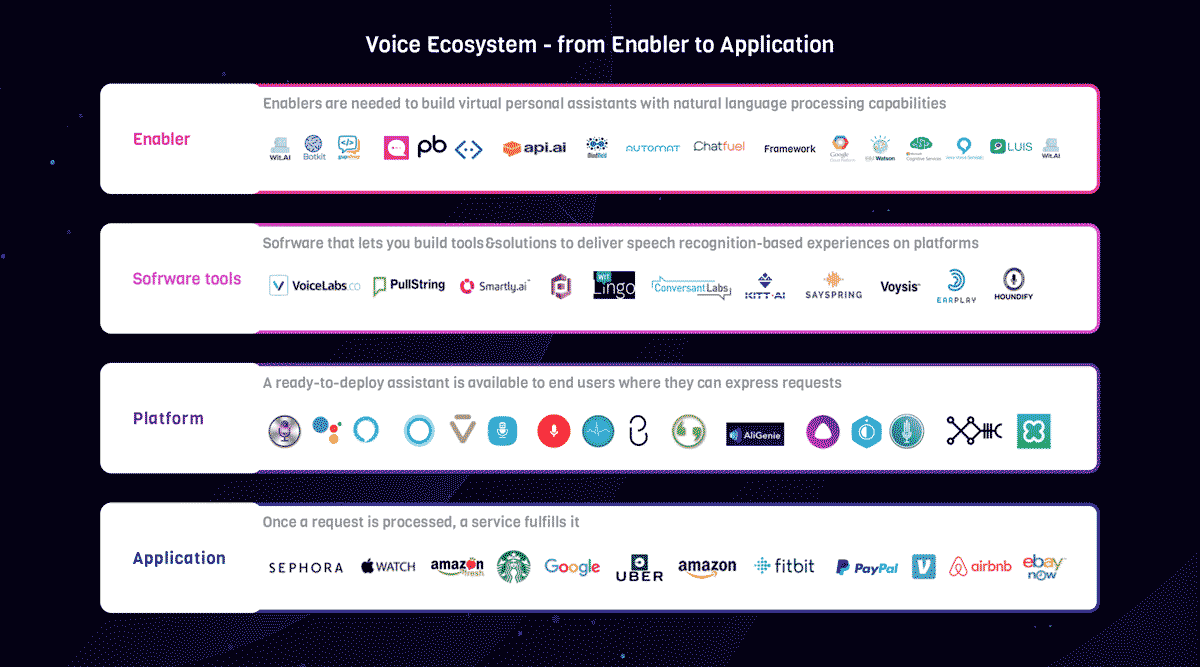
State-of-the-art solutions deliver benefits to businesses across various domains, giving them a competitive edge:
- Social Media. The voice search “fever” has already impacted how people use their social media accounts and consume content. For instance, Alexa can be integrated with your LinkedIn to read news from the feed. Additionally, voice search has changed how users search for information on the web: they tend to formulate requests by asking questions rather than typing keywords into Google. It means businesses should align their content to directly answer “how,” “what,” and “who” questions.
- EdTech. Voice assistant technology is widely used in education. Numerous educational institutions in the USA use voice software to meet the needs of students with disabilities. For instance, voice-based apps help children with dyslexia with reading aloud and fixing grammar mistakes.
- FinTech. A number of banks and consulting companies have introduced custom voice assistants to improve user experience. For instance, Capital One Bank uses voice-activated technology to let users perform daily operations on the go. You can process transactions, check accounts, and pay bills within several seconds using voice commands.
How LITSLINK Brings Voice Technology Into Your App
LITSLINK provides custom and smart voice assistant technology solutions, focusing on businesses’ needs and requirements. We build intelligent, multilingual virtual agents that leverage NLP, speech recognition, and LLMs. Specifically, our portfolio includes a real-time accent-removal system with adjustable pitch, tempo, and gender, using a cascade approach.
Why choose LITSLINK as a tech vendor:
- Industry Applications: Assistants are used across sectors, including retail (addressing customer queries), healthcare (appointment scheduling), logistics (route planning), and others;
- Technologies: We use AI/ML, cloud integration for scalability, and advanced NLP for understanding user intent;
- Customization: Our company offers end-to-end development services, ranging from recruitment assistants to specialized voice-activated solutions;
- Functionality: LITSLINK solutions support voice, text, and smart device integrations.
Contact us to discuss how we can bring your ideas to life with our skilled, experienced software experts.
Our tech-savvy AI/ML engineers are at your service.