







Key Takeaways
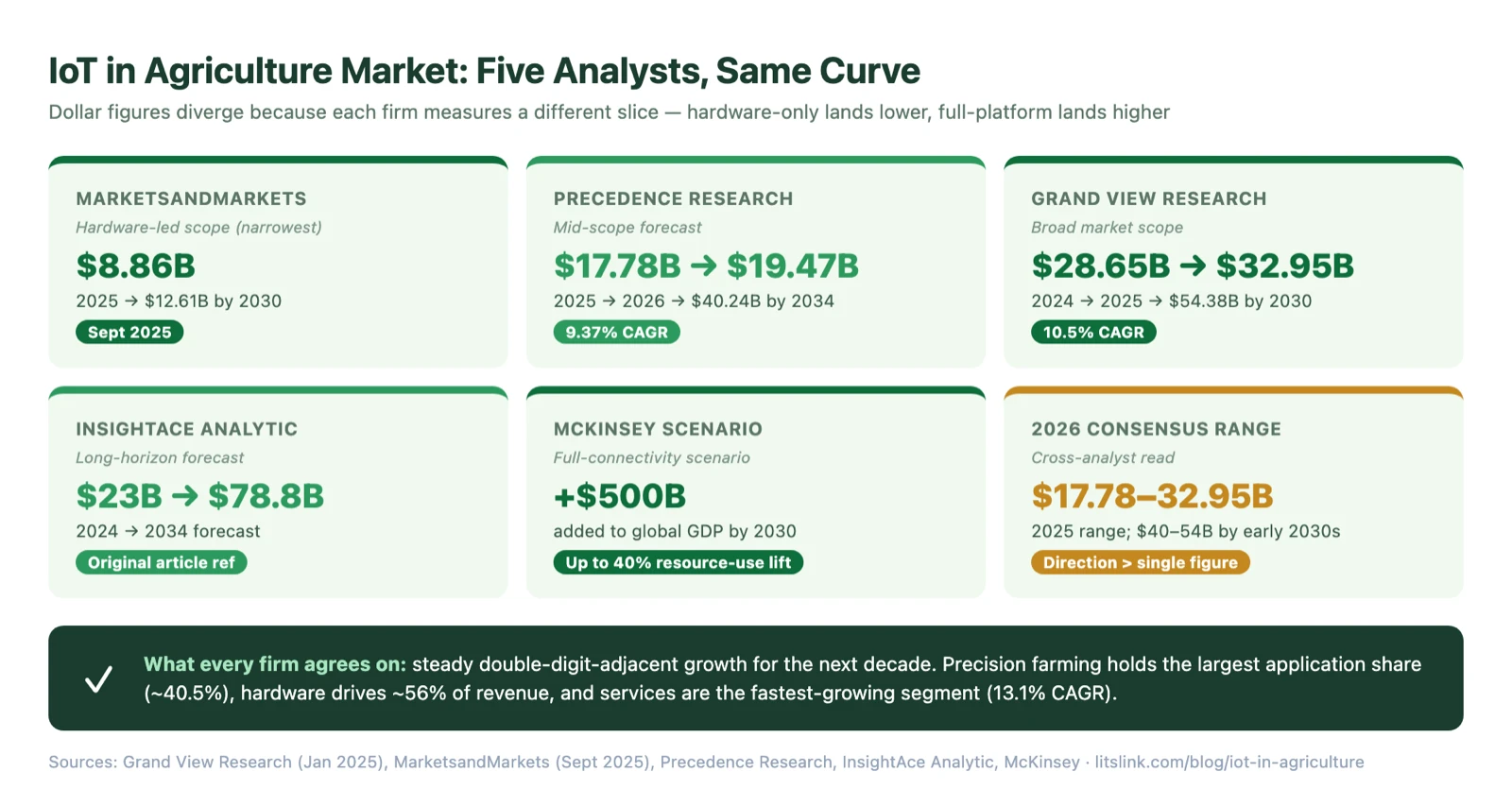
- The IoT in agriculture market sits at roughly USD 17.78 billion to USD 32.95 billion in 2025 depending on scope, and is forecast to reach USD 40–54 billion by the early 2030s — Precedence Research puts it at USD 19.47 billion in 2026 growing at a 9.37% CAGR, while Grand View Research cites USD 32.95 billion in 2025 toward USD 54.38 billion by 2030.
- Farmers were already running close to 100 million connected devices as of 2024, and the USDA reports that over 50% of U.S. acreage for cotton, corn, sorghum, rice, winter wheat, and soybeans uses some form of automated digital guidance.
- John Deere grew its connected fleet from 440,000 to roughly 750,000 machines (2021–2024) across ~468 million engaged acres; its ExactShot fertilizer system cut fertilizer use by 60% and saves an estimated USD 650 million a year in the U.S. (DataNext, June 2025).
- Security is now the headline risk: 84% of IoT adopters in agriculture report a breach, and the EU Data Act (effective September 12, 2025) shifts machine-data rights from equipment makers to farmers.
- New 2025–2026 rules — the FAA’s BVLOS Part 108 proposal, nationwide drone Remote ID enforcement (January 7, 2026), and the USDA FY2025–2026 AI Strategy — are reshaping how IoT and drones operate on the farm.
- Precision farming holds the largest application share (~40.5%), hardware drives ~56% of revenue, and services are the fastest-growing segment at a 13.1% CAGR.
Can you guess what will feed 10 billion people by 2050? IoT use cases in agriculture. It won’t be just better seeds or more tractors. Here’s a hint: it talks to the cloud, collects data, and controls things on its own. Yes, it’s the IoT in agriculture.
If you’re a farmer, agritech business owner, or even a policymaker, you already know the real pain: water waste, low yields, rising costs, and unpredictable weather. The good news? There’s a shift happening.
The IoT in agriculture market was worth USD 23 billion in 2024. It is expected to reach USD 78.8 billion by 2034. That’s more than triple. Let’s explore why and how it matters to your farm or agribusiness.
One number rarely tells the whole story here. Market figures differ by firm because each measures a different slice: hardware-only studies land lower, full-platform studies land higher. Grand View Research (January 2025) put the broad market at USD 28.65 billion in 2024 and USD 32.95 billion in 2025, heading to USD 54.38 billion by 2030 at a 10.5% CAGR. MarketsandMarkets, counting hardware-led scope, lists a tighter USD 8.86 billion in 2025. Precedence Research lands in the middle at USD 17.78 billion (2025) → USD 19.47 billion (2026) → USD 40.24 billion by 2034. The direction is identical across all of them: steady double-digit-adjacent growth for the next decade.
The Role of IoT in Modern Agriculture
It helps you collect data, monitor equipment, and automate your work. From crop growth to soil moisture, machines now measure what once took hours of labor. This is not a future dream; it’s the current reality.
IoT use cases in agriculture include everything from precision farming to livestock monitoring.
Some common examples of IoT in agriculture are greenhouse automation, soil condition monitoring, and livestock tracking.
While adoption is growing, it’s important to weigh the advantages and disadvantages of IoT in agriculture, such as increased efficiency versus setup costs and data privacy concerns.
Farmers can now use IoT systems to:
- Plan crop cycles using real-time data
- Reduce water and fertilizer waste
- Monitor animal health remotely
- Detect crop diseases earlier
- Track machinery and storage conditions remotely
IoT is revolutionizing agriculture by enabling real-time monitoring of crops, livestock, and equipment.
This deep dive into smart farming apps shows how digital tools are boosting productivity and efficiency in the field.
Top 8 Applications of IoT in Agriculture
The Internet of Things in agriculture is solving old problems in new ways. It’s not just about data; it’s about using that data to act faster and better. How is iot used in agriculture? It’s used in irrigation, disease detection, and livestock monitoring to improve productivity. Below are the top IoT applications in agriculture that are already making a clear difference.
1. Smart Irrigation Systems
Water waste is one of farming’s highest costs. But how do you know how much water a field really needs? IoT agriculture sensors help solve this. They measure soil moisture and weather in real time. The system then turns irrigation on or off based on the need. This reduces overwatering, cuts electricity use, and keeps crops healthy.
You can schedule irrigation remotely. If it rains, the system adjusts itself. In dry spells, it waters only what’s needed. This is a great use of IoT in agriculture that works well in arid zones or water-scarce areas.
Agriculture isn’t the only industry seeing the benefits of connected devices. This guide on IoT in the supply chain highlights how similar technology is transforming logistics and operations.
2. Precision Farming
Precision farming is more than GPS. It uses IoT-based sensor networks in agriculture to track real-time data on sunlight, temperature, and crop growth.
For example, citrus farms use IoT solutions to practice precision irrigation. These farms cut water use by 25% without losing crop yield. That’s not a small number. Every drop saved is a cost saved.
3. Crop Monitoring and Disease Detection
Farmers lose crops every year to pests and diseases. Often, they notice the problem too late. IoT in agriculture projects now include pest and disease sensors placed in the field. These track signs like leaf color, humidity, or insect movement.
| Feature | What It Tracks | How It Helps | Device Type | Action Taken |
| Leaf wetness sensor | Moisture on leaves | Detects fungal disease early | Sensor | Sends a warning alert |
| Spectral cameras | Leaf color and patterns | Detects crop stress | Drone/camera | Auto-report to the user |
| Insect movement sensors | Pest activity levels | Triggers pest control | Trap sensor | Activates spray |
| Soil temperature probe | Soil temp and humidity | Shows if the environment is right | Probe sensor | Adjusts irrigation |
| UV index monitoring | Sunlight stress | Prevents overexposure | Weather sensor | Suggests netting |
The accuracy behind these sensors has improved sharply. Recent reviews report IoT weed-detection systems identifying weeds with up to 98% accuracy using machine learning, and hyperspectral sensors spotting sugar beet diseases at 85–92% accuracy. That matters because an average of 30% of harvests are lost worldwide to pests and disease every year — catching stress days earlier is the difference between a treated patch and a lost field (Modularis, May 2026).
4. Soil Condition Monitoring
Soil changes fast. Too much water or too few nutrients, and you risk yield drops. Sensors now measure pH, nitrogen, salinity, and moisture in real-time. These agriculture IoT devices help manage soil health before damage happens.
Instead of guessing, farmers can test sections of fields, compare zones, and treat only the problem spots. This lowers the cost of chemicals. It also improves sustainability. One of the most needed IoT applications in agriculture for small farms.
5. Livestock Monitoring
With IoT in smart agriculture, even cows wear sensors. Tags on their ears or collars track health, movement, and feeding. If a cow stops eating or moves less, the system alerts the farmer.
This reduces vet costs. It also prevents the disease from spreading. Farmers can locate animals on large pastures using GPS. Livestock behavior data helps in planning nutrition and breeding cycles. These IoT solutions for agriculture also reduce labor needs.
Learn LITSLINK’s application for livestock farmers that uses shared data to optimize yield, quality, and profitability.
6. Greenhouse Automation
In greenhouses, conditions need to stay just right. With IoT sensors, you can monitor light, humidity, and CO2 inside the structure.
These sensors are linked to systems that open vents, run fans, or adjust lights. If the weather changes or temperatures rise, actions happen automatically—no need for round-the-clock labor. Greenhouses with IoT for agriculture have higher yields and lower costs.
7. Supply Chain and Storage Management
Spoiled crops are a hidden loss. IoT-enabled storage and supply chain systems can track:
- Storage unit temperatures
- CO2 levels that may indicate spoilage
- Humidity changes
- Crop movement from the field to the warehouse
- Truck conditions during transportation
This data helps farmers and suppliers prevent waste, reduce returns, and monitor inventory in real time.
8. Weather Forecasting and Climate Monitoring
Weather ruins more crops than any pest. Yet traditional weather apps aren’t farm-specific. That’s why IoT-based sensor networks now measure microclimate data on-site.
With IoT sensors, you can track rainfall, wind, UV, and air pressure. This lets you plan planting, harvest, and spraying more accurately and respond to changes faster. This IoT use case is growing fast in flood-prone and drought-prone areas.
When paired with AI, IoT systems become even more powerful, enabling predictive insights and more intelligent automation.
Learn how to integrate AI with IoT to maximize value in agriculture and beyond.
What’s New in IoT Agriculture for 2026: AIoT, Autonomy, and Digital Twins
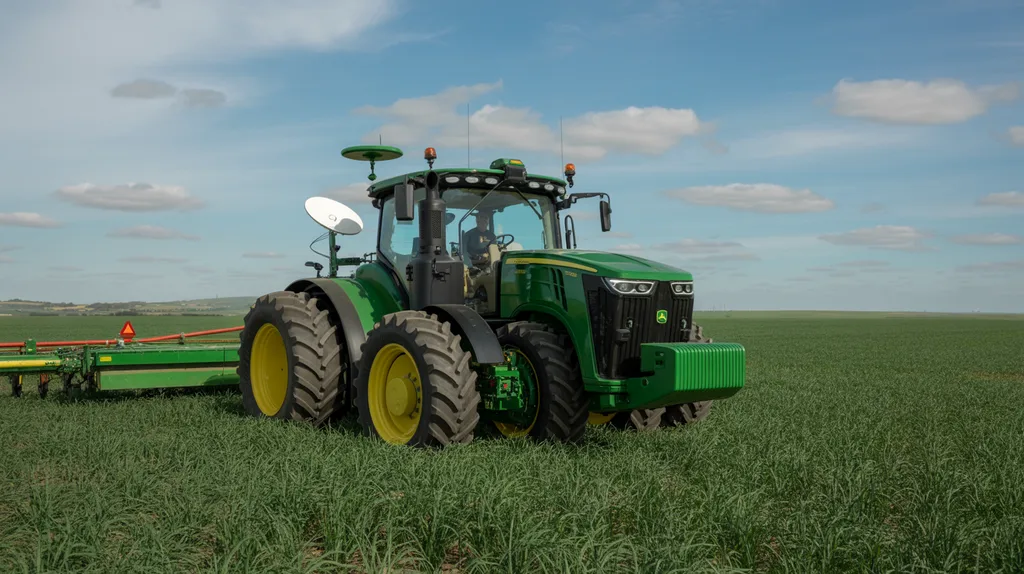
The frontier in 2026 is convergence — AI running directly on or beside the sensor, often called AIoT. Three shipping examples show where this is headed. Cropin launched Sage in July 2024, billed as the first real-time agri-intelligence platform powered by Google Gemini, building grid-based maps of global cropland. Taranis released its Ag Assistant the same month, a generative-AI tool that blends field images, text, and audio into crop recommendations. And at CES 2025, John Deere unveiled a second-generation autonomy kit that pairs computer vision with AI to run autonomous tractors and harvesters, aimed squarely at the farm labor shortage.
Digital twins are moving from research into practice too. Peer-reviewed 2025 work in field robotics and electronics journals describes Eco-Cyber-Physical Systems that fuse IoT sensors, robotics, and twin models to simulate a field and forecast yield in near real time. The enabling trick is a hybrid edge/fog/cloud setup so a farm doesn’t need a perfect cloud link to act on its data — a direct answer to the rural connectivity problem covered below.
What are the Benefits of IoT in Agriculture?
The main benefit is more control. Sensors give you facts, not guesswork. But there’s more to it than just that. These systems improve how you grow, harvest, store, and ship food.
Improved Resource Management
Water, fertilizer, fuel, everything costs money. The more you use, the more you spend. With IoT technology in agriculture, sensors measure use. You stop overwatering or overfertilizing.
In 2024, 56% of revenue in the IoT in agriculture market came from hardware. These include drones, sensors, and GPS units. They help farmers make precise changes without trial and error. It’s efficient farming.
Increased Crop Yields
One of the most seen advantages of IoT in agriculture is more yield with less input. Consider this: an orchard that uses smart irrigation grows more fruit per acre. A wheat field that spots fungal disease early loses fewer plants.
You can now grow more using the same land. That means more income per crop cycle. It also means better food security.
Real-Time Decision Making
Old farming was reactive. You saw a problem, then acted. Now, with IoT applications in agriculture, alerts reach your phone in seconds. Soil too dry? Pest level rising? You know before the damage spreads.
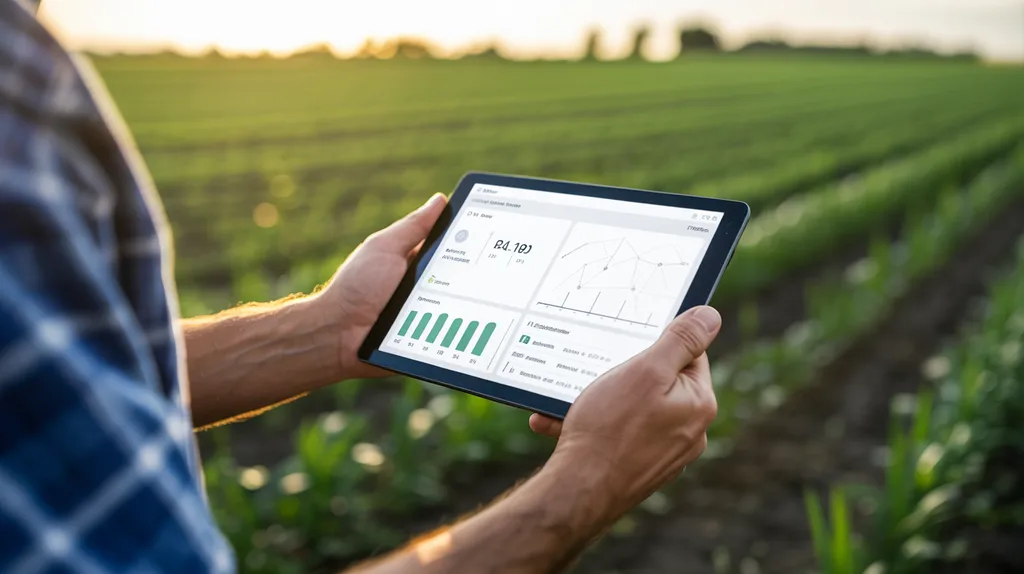
This data leads to fast choices. You don’t wait for lab tests or field scouts. You don’t need to walk miles to check. Sensors and dashboards tell you what to do and when to do it.
Sustainability and Environmental Impact
Less water. Fewer chemicals. Lower emissions. That’s what IoT in smart agriculture helps with. Better data leads to better choices.
You protect nearby water bodies from chemical runoff. You use fewer fossil fuels. You don’t waste crops during storage. This is key to both climate goals and business goals.
Proven ROI: What the Numbers Look Like on Real Farms
Benefits are easier to trust with hard figures attached. The table below pulls verified results from recent deployments.
| Deployment / Technology | Measured result | Source |
| John Deere ExactShot (precision fertilizer) | 60% less fertilizer; ~USD 650M saved per year in the U.S. | DataNext, June 2025 |
| John Deere See & Spray (Blue River Tech) | Up to 90% less herbicide by spraying only weeds | DataNext, June 2025 |
| Netherlands IoT greenhouse | 30% less water; up to 20% yield increase | Farmonaut, July 2025 |
| India AI + IoT precision farming | 15–20% lower input cost; 25% less chemical use | Farmonaut, July 2025 |
| Smart-irrigation tomato case study | 25% fewer working hours; 20% price premium on quality | Modularis, 2026 |
| McKinsey full-connectivity scenario | Up to USD 500B added to global GDP by 2030 | McKinsey |
The pattern is consistent: IoT pays back through inputs saved, not just yield gained. McKinsey estimates sensor-based interventions can lift resource-use efficiency by up to 40%.
Challenges in Implementing IoT in Agriculture
Despite the promise, there are still challenges to IoT in agriculture. Technology is only helpful when it’s used well—rural areas, costs, and training all matter. Let’s look at some of these issues. Implementation of IoT in agriculture varies greatly depending on farm size, region, and technical support available.
Connectivity Limitations in Rural Areas
Many farms are remote. That means weak internet or no cellular signal. Without this, real-time IoT applications may not work. Offline storage can help, but it limits the speed of action.
Initial Setup and Maintenance Costs of IoT in Agriculture
Hardware is costly. Not all farmers can afford drones, sensors, or software. Plus, damaged devices need skilled repair. That raises barriers to starting new IoT in agriculture projects.
One solution explored in an Iot in agriculture case study showed how subsidies and shared networks can help adoption in developing regions.
Data Security and Privacy Risks
Data from farms can be stolen or misused. Some worry about who owns this data. Is it the farmer? The tech company? These questions slow adoption.
Successful IoT implementations in agriculture often start with smart app solutions tailored to specific farming needs. Explore real-world case studies of how LITSLINK has supported agtech and automation projects.
Cybersecurity and Who Owns the Farm’s Data
This is the fastest-rising challenge, and competitors barely cover it. A 2026 Farmonaut security report found that 84% of IoT adopters in agriculture have already experienced a security breach, and global smart-farming cybersecurity investment is projected to top USD 2 billion by 2026. Connected tractors, dairy sensors, and poultry systems all widen the attack surface — a 2025 Frontiers in Big Data roadmap warns that livestock-farming digitization now puts animal welfare and food safety in scope for cyber risk.
The ownership question is no longer abstract. The EU Data Act, effective September 12, 2025, gives farmers the right to access and transfer data generated by their own connected machinery — data that equipment makers like John Deere, AGCO, and CNH Industrial historically controlled. For any agritech build in 2026, “who can read this data, and who can move it” is now a design requirement, not a footnote.
The 2026 Regulatory Landscape Every IoT Farm Should Track
Rules caught up with the technology this year. Four changes matter most for IoT and drone operations:
- FAA BVLOS Part 108 (USA, August 2025): The FAA’s proposed rule creates the first defined pathway for beyond-visual-line-of-sight agricultural drone flights and raises the BVLOS weight limit from 55 lbs to 110 lbs. Over 1,700 agricultural drone operator certificates were already issued when the proposal published; public comment closed in October 2025 (DroneTrust summary).
- Drone Remote ID (USA, January 7, 2026): Now fully enforced nationwide — all commercial drones must broadcast real-time location, a pivotal shift for agricultural drone fleets.
- EU Data Act (September 12, 2025): Reassigns IoT machine-data rights to farmers, as covered above.
- USDA FY2025–2026 AI Strategy: A five-goal framework (AI governance, workforce readiness, infrastructure, data readiness, and ethical AI use) that explicitly targets crop-yield modeling, supply-chain resilience, and climate-smart agriculture (USDA).
Key Technologies Enabling IoT in Agriculture
So, what makes the Internet of Things in agriculture actually work? The hardware and software behind it all. Here’s what powers the systems farmers use every day. Visual aids like an IoT in agriculture diagram often help explain how devices, cloud systems, and analytics work together.
Sensors and Actuators
These are the eyes and hands of any IoT for agriculture setup. Sensors collect data on moisture, temperature, and more. Actuators take actions, like turning on sprinklers or opening vents.
Without these devices, nothing would be automated. These devices are installed in soil, plants, machines, or animals.
Wireless Connectivity (LPWAN, 5G, etc.)
Signals must travel fast and far. LPWAN, 5G, and Wi-Fi all connect devices to the cloud. Each fits a different purpose. Here’s a quick comparison:
| Tech Type | Range | Power Use | Best For | Cost |
| LPWAN | Very Long | Very Low | Soil sensors, crop monitors | Low |
| Wi-Fi | Short | High | Greenhouse or indoor farms | Low |
| Cellular 4G | Medium | Medium | Mobile tractors, livestock tags | Medium |
| 5G | Medium-High | Low | Drone feeds, fast alerts | High |
| Zigbee | Short | Very Low | Device-to-device in greenhouses | Low |
Two field-level updates are worth noting for 2026. LoRaWAN — the workhorse LPWAN standard for large-acreage soil sensor networks — passed 125 million connected IoT devices globally by the end of 2025, with 5–10 year battery life on typical field sensors. And a March 2025 arXiv benchmarking study found LoRaWAN and NB-IoT best suited to wide acreage, while private 5G wins for high-data jobs like edge computer vision (for example, YOLOv8 disease detection running on-site in greenhouses).
Cloud Platforms and Data Analytics
Once the sensor collects data, where does it go? To the cloud. Cloud platforms store, clean, and process that data. Then they show it in dashboards. Farmers see trends and alerts.
With IoT agriculture sensors, analytics help spot patterns. These include declining soil health, rising pest activity, or lower water use. It’s not just raw data; it’s clear, usable advice. Leading IoT in agriculture market companies are developing smarter analytics tools with AI to boost precision and reduce waste.
LITSLINK’s strong track record in IoT and software development is backed by client testimonials. Check out reviews and feedback on our Clutch profile to see how we’ve helped businesses innovate.
Top Industries Benefiting from IoT in AgriTech
IoT applications in agriculture are not limited to farms alone. Several connected industries now benefit from this shift. Whether you grow crops, make fertilizers, or ship grains, there’s a role for IoT technology in agriculture.
These industries use sensors, dashboards, and automation to improve speed, reduce loss, and drive smarter action.
Fertilizer and Agrochemical Manufacturing
Manufacturers use sensor data to create location-based fertilizers. They adjust mix levels based on soil feedback from IoT agriculture sensors. For example, a firm producing liquid nitrogen may alter batch contents depending on field-level nitrogen reports.
Farm Equipment and Machinery
Tractors and harvesters now include GPS, IoT modules, and engine diagnostics. Equipment makers like John Deere track machine health remotely. This reduces downtime and supports predictive maintenance.
John Deere makes a useful real-world benchmark here. Its connected fleet grew from 440,000 to roughly 750,000 machines between 2021 and 2024 — a 70% jump — across nearly 468 million engaged acres, and its “Leap Ambitions” strategy targets 1.5 million connected machines and 500 million acres by 2026. The company also bought three precision-ag firms in 2025 alone (Sentera for aerial analytics, GUSS Automation for autonomous spraying, and Tenna for fleet telematics), a clear signal of where equipment makers see the margin (iGrow News, 2025).
Agri-Insurance
Insurers use real-time crop and weather data to assess risk. A drought-hit field with IoT-based sensor networks in agriculture gives more accurate loss data than satellite alone. This leads to faster claims.
Food Processing Plants
Processing units use real-time supply chain data to plan for fresh produce arrival. If weather or soil data shows a delayed harvest, they adjust schedules to reduce plant downtime.
Retail and Export Companies
Retailers get better shelf life when producers use smart storage. Exporters track the location and quality status of crops in shipping containers. These IoT in agriculture examples reduce spoilage and returns.
If you’re exploring how IoT can modernize your farming operations, our team is here to help. Feel free to contact LITSLINK to discuss your goals and get expert input.
Frequently Asked Questions About IoT in Agriculture
IoT in agriculture is a network of connected sensors, machines, and software that collect field data — soil moisture, weather, crop health, livestock activity — and act on it automatically, such as switching irrigation on or alerting a farmer to a sick animal. It turns guesswork into real-time, data-driven decisions.
Estimates range from about USD 8.86 billion (hardware-only scope, MarketsandMarkets) to roughly USD 32.95 billion (broad scope, Grand View Research) for 2025, with Precedence Research placing 2026 at USD 19.47 billion. All major firms forecast steady growth toward USD 40–54 billion by the early 2030s.
Lower input costs, higher yields, and faster decisions. Smart irrigation systems can reduce water use by about 30% in tested deployments, although actual savings depend on the crop, climate, irrigation method, and system configuration; targeted spraying can also cut herbicide use by up to 90%.
Rural connectivity gaps, high upfront hardware cost, and cybersecurity. In 2026, security leads: 84% of agricultural IoT adopters report a breach, and new rules like the EU Data Act are redefining who owns machine data.
AI analyzes the stream of IoT sensor data to predict pest outbreaks, forecast yields, and trigger autonomous actions. The 2026 trend is AIoT — running AI inference at or near the sensor — seen in platforms like Cropin Sage and John Deere’s autonomy kit.
How Litslink Supports IoT in Agriculture
At Litslink, we create custom software for IoT in agriculture. We help turn raw data into real decisions. Our tools connect with IoT agriculture sensors, build user dashboards, and manage device control. We focus on solutions that work in the field, not just in theory.
We support remote areas with offline-first apps. We also offer data privacy control, so farmers know who owns their info. From hardware integration to analytics tools, we’ve built IoT in agriculture projects that last.
Need help with your IoT for agriculture idea? Want software built to your needs? Contact us today to get started on a solution built just for your farm.