







App to Track Rental Income That Makes Tax Filing Simple for Landlords
- Tax filing time: 15–20 minutes in-app, per landlord, per year.
- 1,000+ downloads on Google Play in year one
- Sustainable B2C revenue model: €24.90 / year or €3.99 / month
1,000+ Finnish landlords now file their property taxes from a phone instead of a spreadsheet. Our client asked LITSLINK to make that shift possible — and we built the rental income tracker app for iOS and Android that did it.
Project Details
Rentcal Oy is a Finnish PropTech company founded by real estate investors who got tired of doing their own Vero filings in Excel every spring. They came to LITSLINK with a working pen-and-paper concept and a fixed launch date tied to Finland’s spring tax window.


Business Challenge
Finland has roughly 600,000 rental homes and a private landlord population of hundreds of thousands. Almost all of them file taxes on rental income through Vero, the Finnish Tax Administration. The rules are not friendly to a person who only owns one or two flats.
Rentcal Oy had spent years inside that pain. Their founders are property investors themselves. They were watching peers spend a Saturday every March pulling bank statements into Excel, hunting through Gmail for invoices, and going through a paper folder of receipts that may or may not still be readable. The annual tax-filing ritual was eating weekends and producing low-confidence numbers. They wanted a different tool.

Receipts disappear
A 12-month gap between paying for a sink repair and filing for that deduction is enough for most people to lose the slip. No receipt, no deduction. We've seen landlords write off €300 of paid plumbing because the photo was buried in a 7,000-image camera roll.

Per-property math, scattered data
A landlord with three apartments has three rent streams, three sets of expenses, and one tax form. Combining and splitting that across properties in Excel takes hours – and the formulas break the moment a tenant moves out mid-year.

Audit risk falls on the wrong side
Vero accepts your numbers – until they don't. Audits can last up to six years. Without retention of receipts in a searchable format, the burden of proof flips back onto the landlord.
Technologies Behind the Landlord and Tenant App






Our Rental Income Management Solution
We designed the rental income management app around one question: what is the shortest possible path between a paid expense and a Vero-ready record?
Logging an expense takes about 15 seconds. Open the app, pick the property, snap a photo of the receipt, choose a category from a short pre-set list – water, electricity, repairs, agent fees, insurance, mortgage interest, other. The amount goes in, and the receipt image is stored alongside it. That’s the whole flow.
The calculator runs underneath every screen. Each entry rolls into a per-property P&L and a portfolio summary. The tax line is live – add a €120 plumbing invoice and watch the projected liability drop in the same second. No formulas, no year-end reconciliation, no waiting on an accountant pass.
Under the hood, the app to manage rental income is built on React Native, so iOS and Android share most of the code. The backend is Ruby on Rails with PostgreSQL, hosted on AWS, with receipts going to S3 through signed URLs. Subscription billing runs through Apple StoreKit and Google Play Billing — no third-party payment processor in the middle.
Per-property income logging
Each rental unit gets its own income stream. Set the rent, the due date, and an auto-recurring schedule. Late payments flag themselves. Totals for any date range are two taps away.
Receipt capture with photo
Snap the receipt, pick a category, save. The original image stays bound to the entry, so a Vero auditor six years later sees the same proof you saw the day you paid.
Intuitive calculator for the 30% / 34% tax math
Finland's 30% (up to €30,000) and 34% (above) capital-income tiers are baked in. Taxable amount updates the moment you add or edit an expense. You see your tax position before you file, not after.
Investment scenario modeling
Test what a third apartment would do to your books before you sign. The calculator runs net cash flow, projected tax position, and payback period against your existing portfolio in under 30 seconds.
Multi-property dashboard
Every property on one screen. YTD income, costs, taxable amount, tax line per unit, plus a portfolio total. Tap a property to drill into the full history.
Tax-ready export for Vero
One tap produces a PDF or CSV grouped per property and per category – the shape Vero asks for. Hand it to your accountant or attach it to the filing yourself.
Scrum Methodology
Project Journey – How We Built Tracking Expenses for Landlords
We locked the scope into five sprints, working backward from Finland’s spring tax-filing window – missing it meant losing a full year’s user cohort. To protect the deadline, we front-loaded complex edge cases during discovery.
For example, mapping out how Vero treats split income from sublets before writing any code saved us from late-stage tax logic rewrites. Working through partial-year purchase math and PDF receipt ingestion the same way kept the remaining sprints clean and the release on track.
How the Rental Income Management App Works
- Email auth. Set property name, address, base rent, and currency.
- Mark a month paid. Auto-recurring schedule for predictable tenants.
- Photo → category → amount. Original image kept for retention.
- App tags the entry to the right unit and category in the same flow.
- The 30% / 34% calculator recalculates the moment you save the entry.
- PDF or CSV grouped by property – handed to Vero or your accountant.
Scrum Process Flow
We follow standard Scrum – two-week sprints, daily stand-ups, sprint review, and retro on Friday. The client sat in on every demo, which kept the feedback loop short and gave them full visibility into progress. When priorities shifted mid-sprint, we caught it in days – reducing rework risk and keeping the budget predictable. It took about three sprints before the cross-property math stabilized, a useful reminder that even simple-looking financial features have edge cases that only surface in production.
-Timeline
Five Phases of Delivering the Track Rental Income Platform
Auth + property + income
- Email auth, password reset
- Property creation flow
- Monthly rent logging + recurring schedule
- First TestFlight build
Expense tracking + receipts
- Expense category model (7 types)
- Camera + photo upload to S3
- Per-property expense list view
- Receipt retention policy: 6 years
Tax + investment calculator
- 30% / 34% tier logic
- Live recalculation on entry edit
- Investment scenario engine
- Net cash flow + payback period
Multi-property + export
- Portfolio dashboard
- Cross-property totals
- Tax export to PDF + CSV
- Vero-shaped grouping per property
QA + store publishing
- Full QA pass + edge cases
- Sublet + mid-year purchase logic
- App Store submission
- Google Play production rollout
UI/UX Design
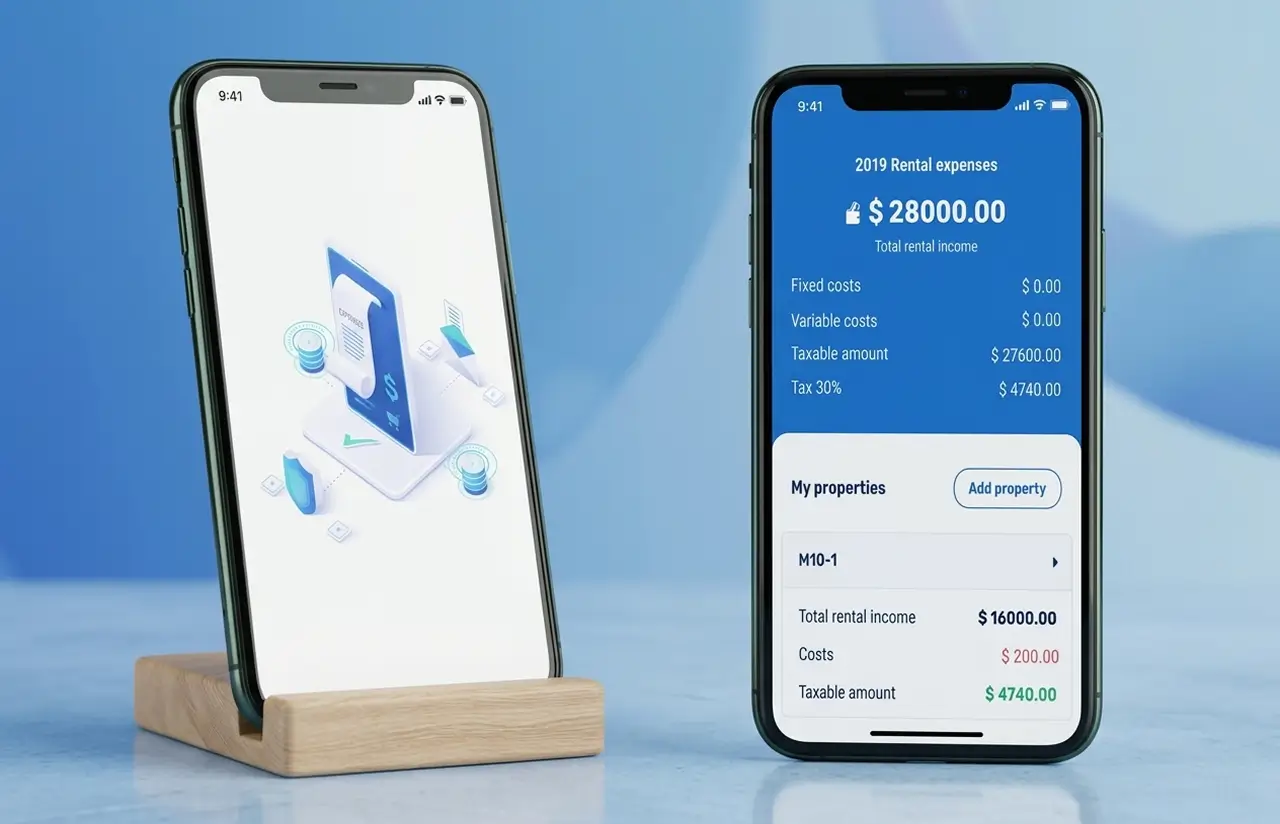
The visual system uses a navy-and-blue palette with isometric property illustrations across marketing and onboarding screens – designed to feel like a notebook for property owners, not a bookkeeping tool. This lower-complexity look reduced the onboarding drop-off rate and helped non-technical landlords complete setup without support.
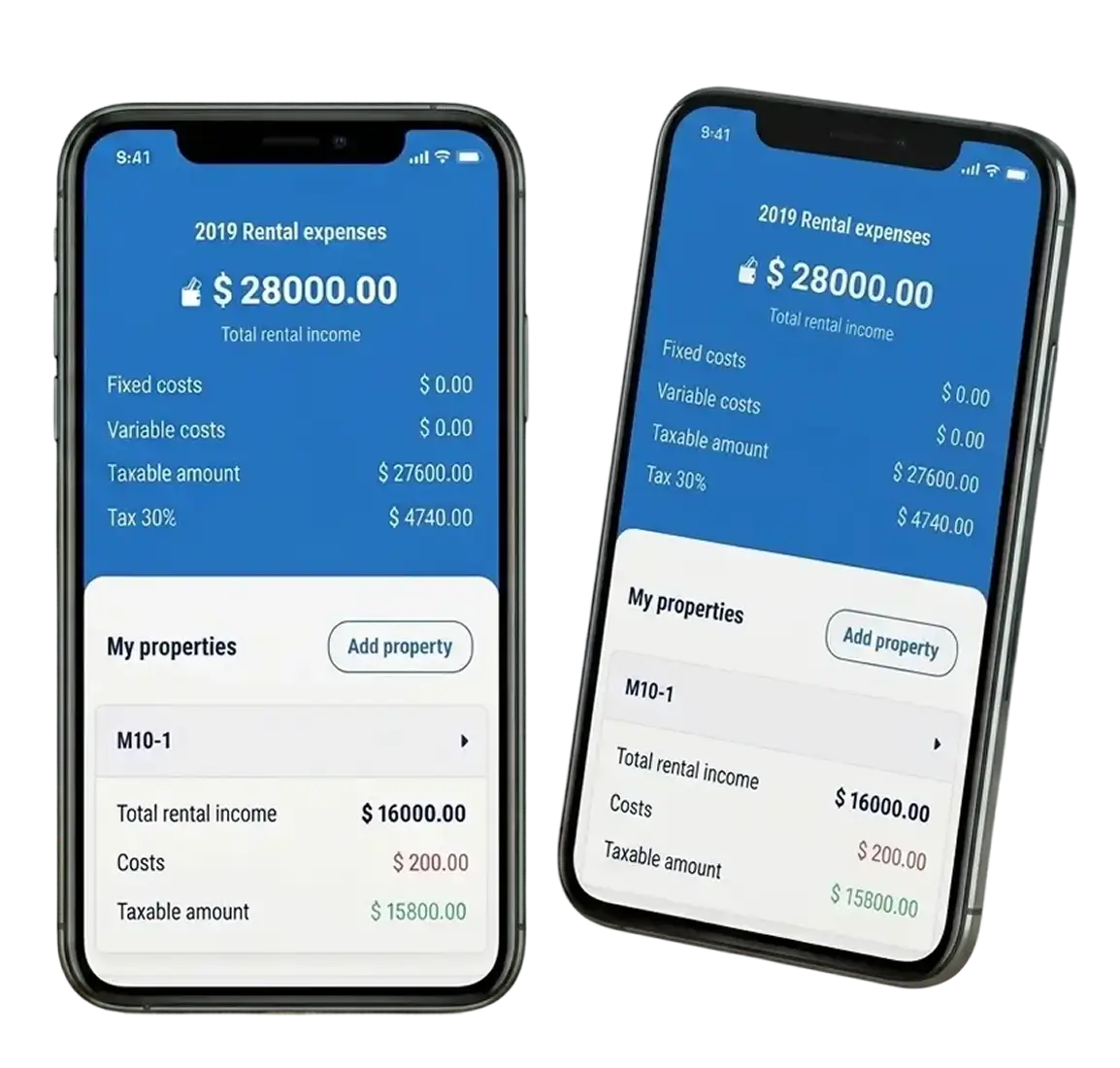
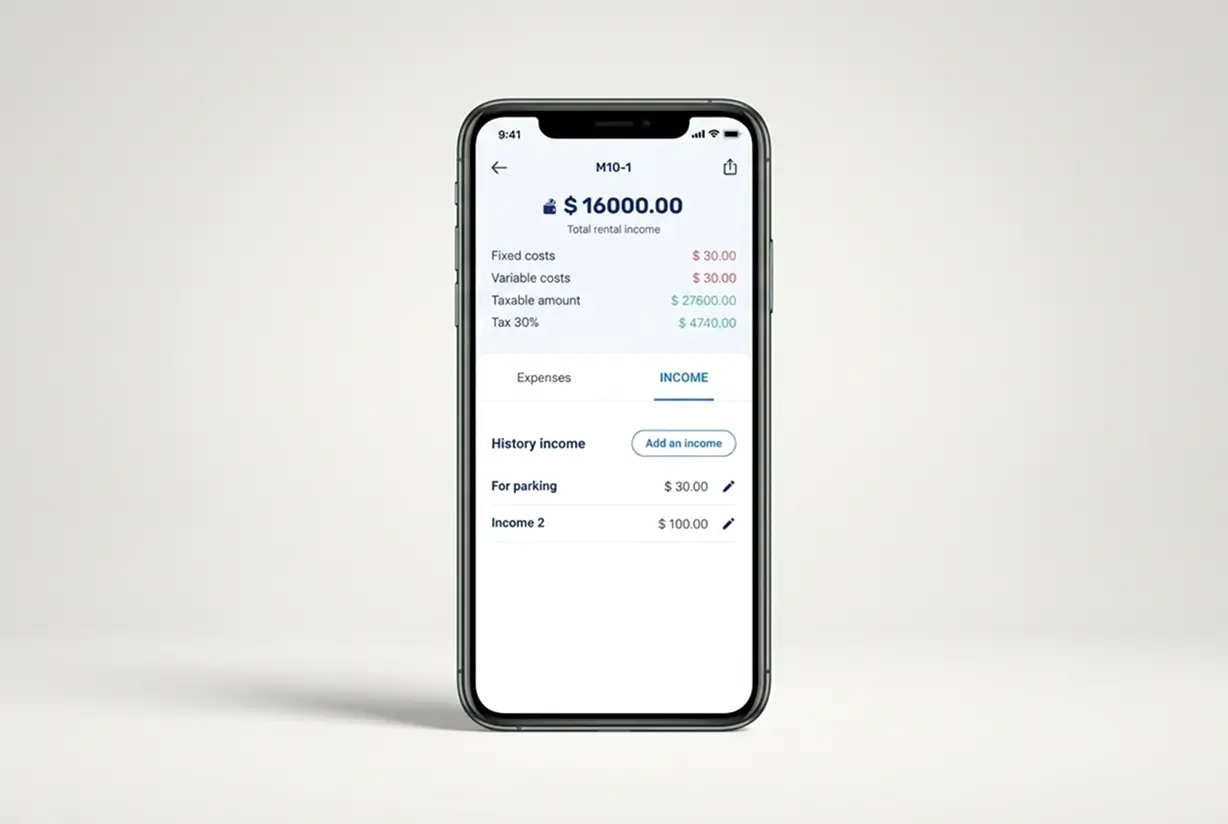
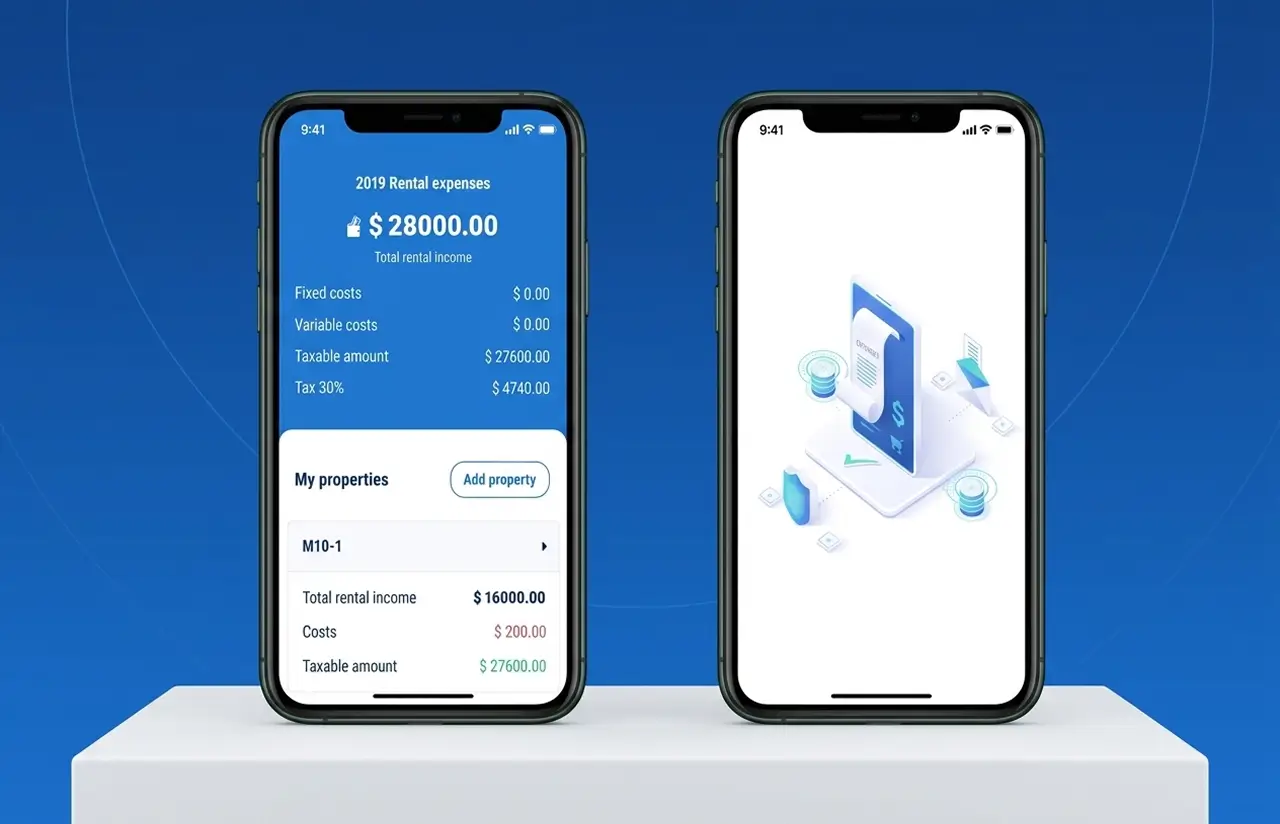
Every property view leads with bold financial figures – total rental income, fixed costs, variable costs, taxable amount, tax percentage – so a landlord can scan their position in three seconds. Income and expense entries live in card lists with inline edit icons, letting users update an entry in two taps instead of opening a separate screen. A tab switcher between Expenses and Income mirrors the two halves of the tax math the user already has in their head, cutting input errors and keeping session times short.
Results
Before
- ✕4–6 hours to compile a tax filing for 1–3 properties.
- ✕Receipts are scattered across paper, email, and the camera roll.
- ✕Excel formulas are rebuilt every year, often incorrectly.
- ✕No way to test the tax impact of a new apartment.
- ✕No proof retention beyond the filing year.
After
- ✔15–20 minutes to produce a Vero-ready export.
- ✔Every receipt in one place – image + category + property bound.
- ✔Tax math runs in-app – every entry updates the projected liability.
- ✔The investment calculator runs full scenarios in under 30 seconds.
- ✔Six-year audit retention built in. No external storage to manage.
The Impact
-Verified Reviews
Our Reputation on Top Platforms
We’re consistently top-rated on Clutch, GoodFirms, and DesignRush for mobile development and product engineering. For ongoing rental property work, we lean into the same real estate software toolkit we used for this build, so a new market only affects the rules layer.
Have a Real Estate App in Mind?
Have an idea for a rental income tracker or another niche mobile app? Send us the concept. We’ll review it and return a strategic development roadmap within 48 hours.
Thank you for your message. It has been sent.