





Custom Trading Platform with HKEX Integration
- 1,000+ orders matched per second at peak load
- 5 levels of live bid and ask depth per security
- 99.9% uptime target across trading hours
- 2 venues internal book and HKEX, one account
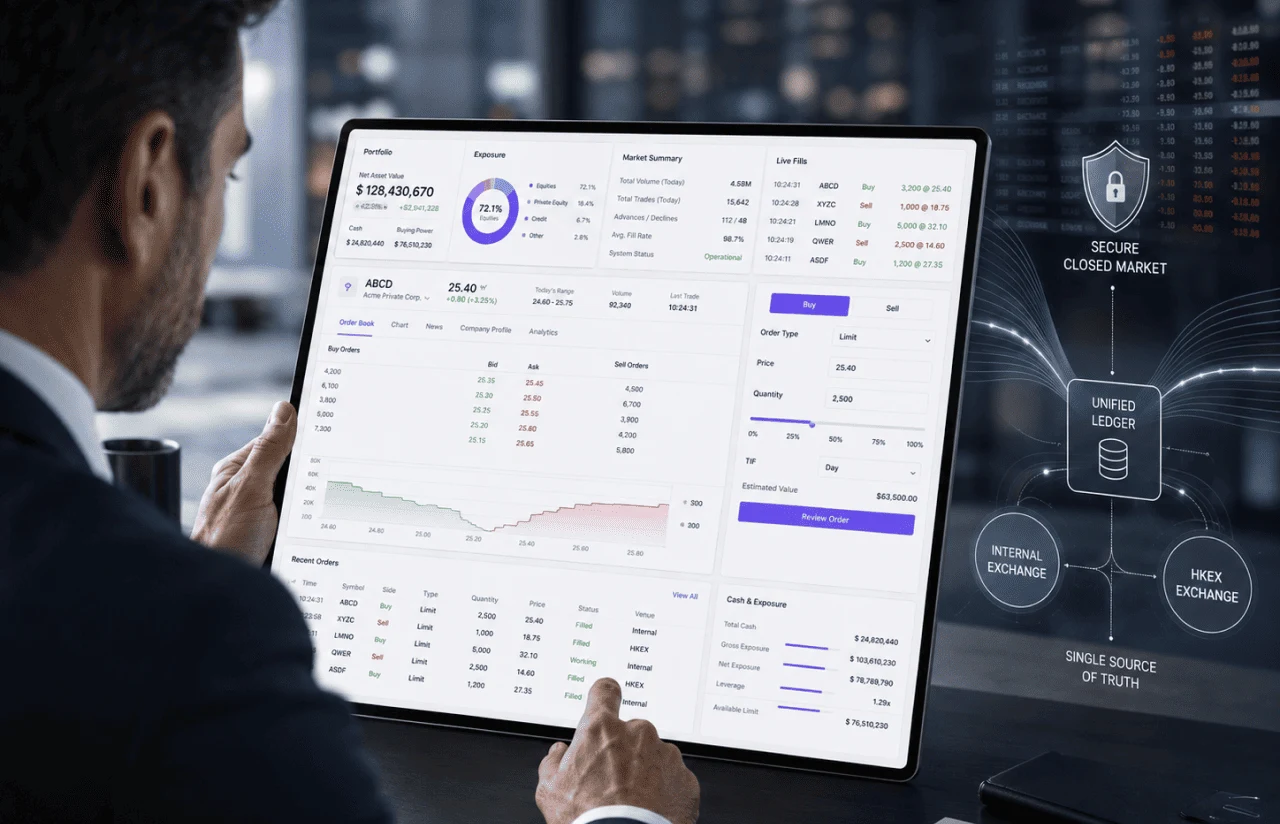
A private brokerage serving investment firms and SMBs set out to run its own trading venue without losing access to the public market. We delivered a private market solution – a high-load trading platform that handles internal order matching and live Hong Kong Stock Exchange routing within a single account.
Project Details
The client is a private brokerage based in the UAE, serving investment firms and small to mid-sized businesses across the Middle East. They wanted their own trading venue in software, a closed network where vetted members could trade equities with each other and, when it made sense, route the same order out to a major public market, the Hong Kong Stock Exchange.


Business Challenge: Building a Scalable Trading Infrastructure for Private Market Solution
Trading systems live or die by two numbers: how fast they confirm an order and how many they can confirm at once. A private brokerage that wants to run its own book and still touch a public exchange has to win on both, with no room for a dropped fill or a stale price. The platform had to clear thousands of operations per second, stay scalable, and let members trade internally or route the same order out to HKEX.

High-Volume Trading System Requirements
Members fire most orders during the opening and closing auctions, the busiest windows of the day. The system had to clear 1,000+ operations per second without the queue backing up. A half-second lag on a price-sensitive order is a real loss, so the High-Volume Trading System was built for the spike

Secure, Closed Trading Network
This is a B2B financial exchange, not a public app. Only vetted firms get in, every account carries a credit line and a cut-loss limit, and member flow stays inside unless someone routes it out. That closed model relies on role-based access, encrypted transport, and a full audit trail.

Complex Third-Party Financial API Integration
Synchronization was the hard part. An order can be filled internally, on HKEX, or partly on both, so cash, equity, and inventory must stay correct to the cent. Our Hong Kong Stock Exchange API integration ties Orion Central Gateway and OMD-C to the internal ledger through a drop-copy feed, a real-time stream of every executed order used for reconciliation.
Technologies











Our Custom Trading Platform Development Solution
We split the platform into two layers that rarely get built together well: a low-latency core and a calm, readable front end. The core does the heavy lifting. A matching engine written in Go holds the order book in memory and settles internal trades in single-digit milliseconds. Around it sits a Node.js gateway that authenticates members, enforces credit and cut-loss rules, and decides whether each order stays inside or goes out to HKEX.
Market data is its own pipeline. OMD-C arrives as a multicast feed with retransmission recovery, so a feed-handler service normalizes it and pushes five levels of bid and ask depth to every connected client over WebSockets. The same channel carries account equity, available cash, and portfolio value, which is why the numbers in the header strip move live instead of on a page refresh.
None of this came off a shelf. A generic stock exchange app treats the public exchange as the only venue. Here, the private book is the product, and HKEX is one of two places an order can go. That single design choice shaped the whole stack, from the ledger schema to real-time trading system development on the client side.
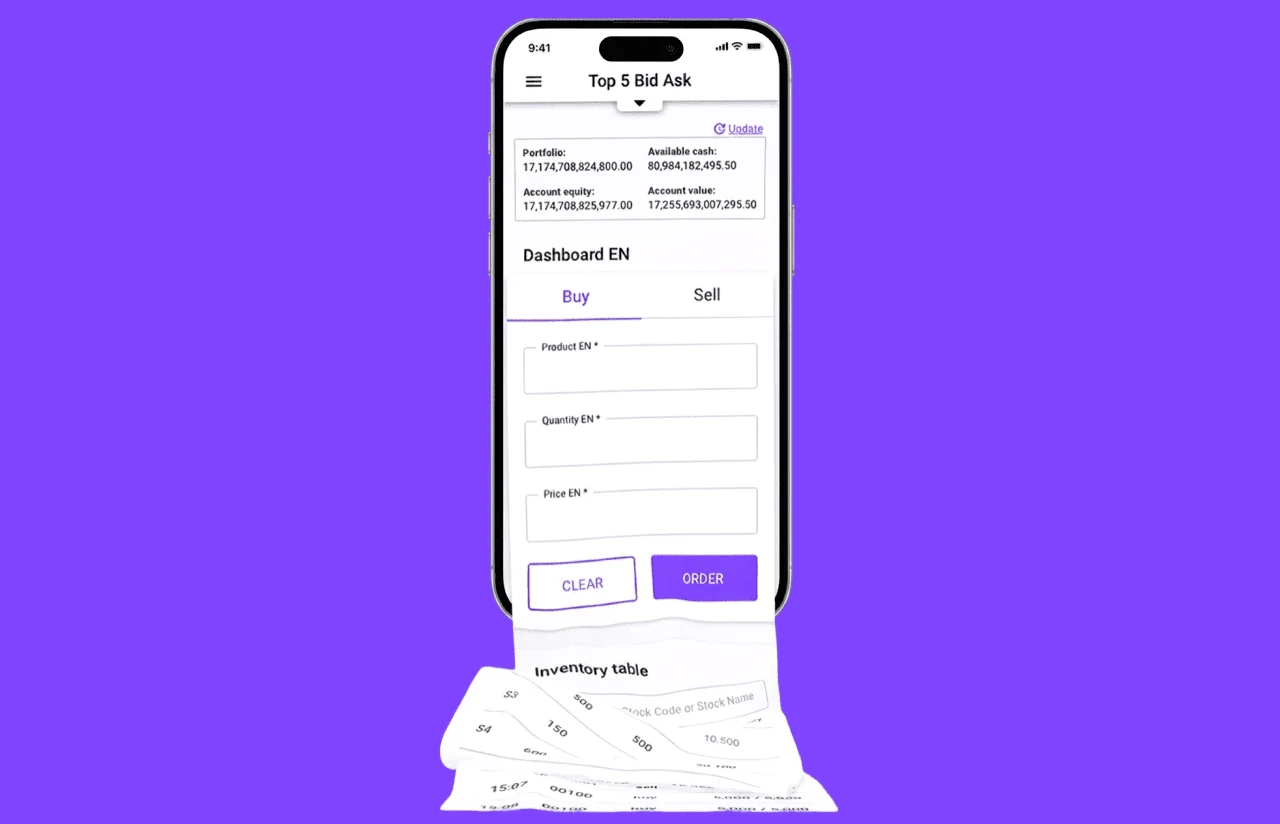
Dual-venue order ticket
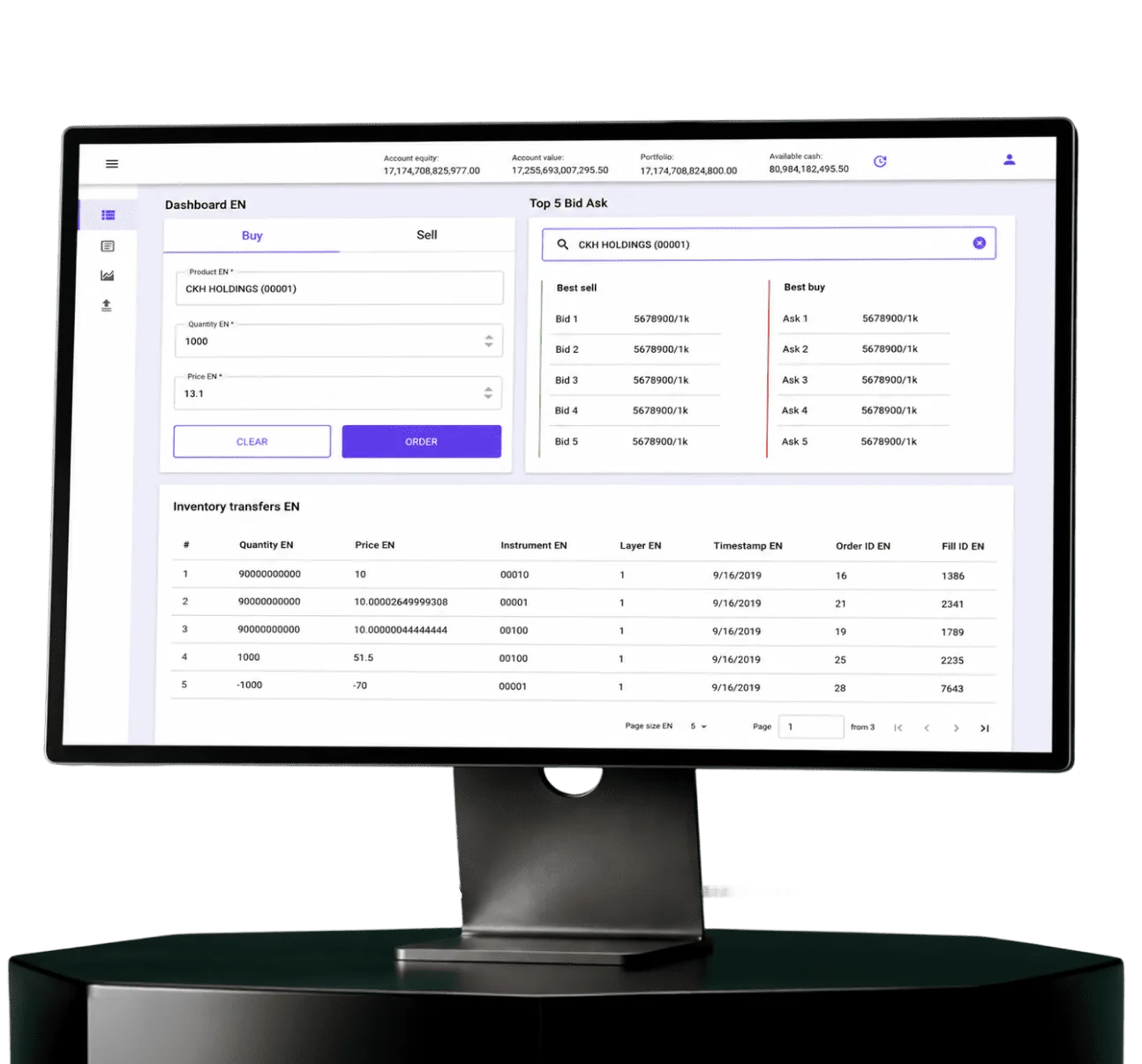
One Buy and Sell form places orders against the internal book or routes them to HKEX. Members pick product, quantity, and price, then clear or submit in two clicks, with validation that catches fat-finger trades before they leave the screen.
Top 5 bid and ask depth
A live order-book panel shows the five best buy and sell levels per security, color-coded and updated over WebSocket. Traders read available liquidity at a glance instead of guessing from a single last price.
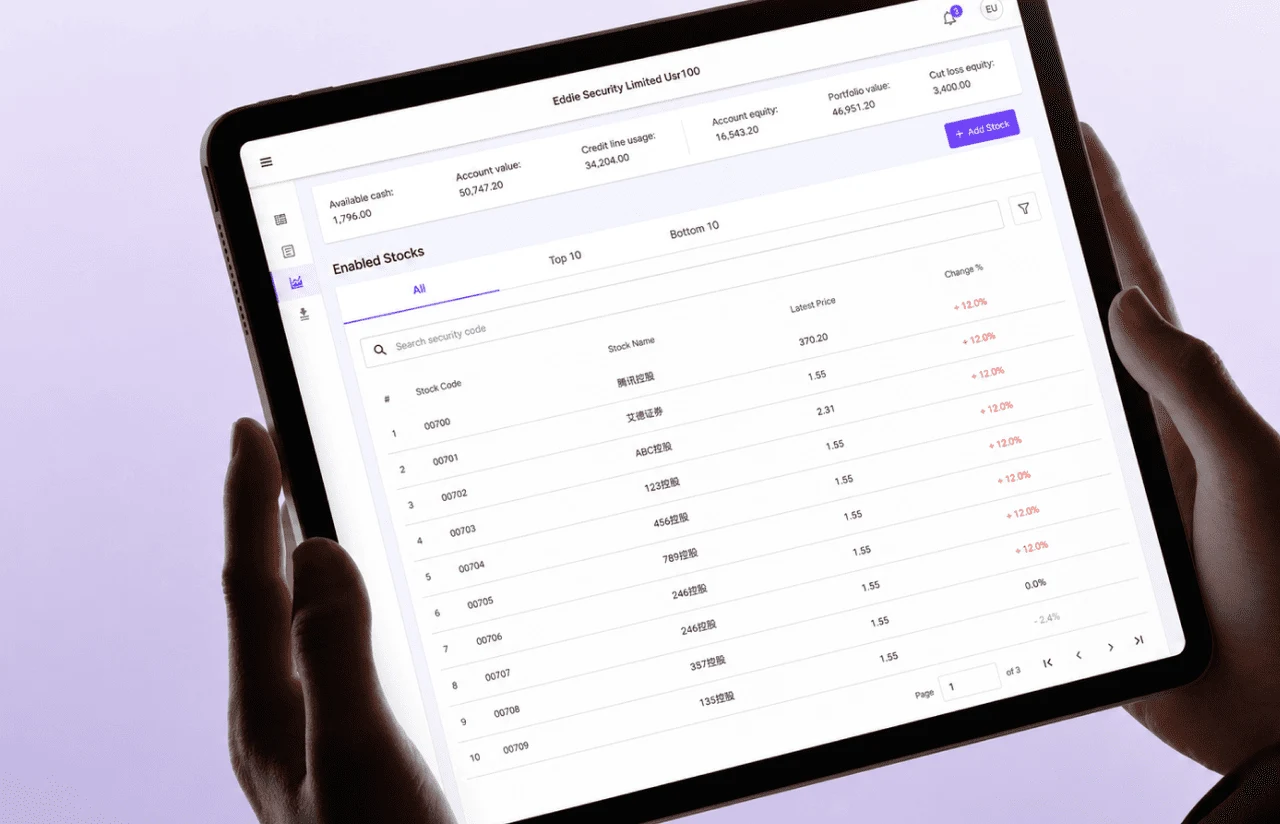
Real-time account header
Account equity, portfolio value, available cash, credit-line usage, and cut-loss equity are recalculated on every fill. No refresh, no end-of-day surprise on a member's exposure.
Enabled-stocks watchlist
A searchable list of tradable securities with the latest price and percent change, plus Top 10 and Bottom 10 movers, so members spot what is running before they open a ticket.
Inventory and daily order log
Per-security inventory, available inventory, and average cost sit beside a same-day order history showing filled versus ordered quantity, fill IDs, and timestamps for clean reconciliation.
Batch order processing
Members stage and submit grouped orders, and the engine processes them in sequence without blocking the live feed, which matters most during high-volume auction windows.
Scrum Methodology
Project Journey
A core team of seven ran the build: four full-stack engineers, one UI/UX designer, one QA engineer, and one DevOps engineer. The DevOps role mattered more than usual here, since the same person owned the AWS setup, the load testing, and the HKEX connectivity path.
The early demos surfaced the trickiest case fast: a single order that fills partly inside and partly on HKEX, which forced us to lock down the reconciliation logic before stacking features on top of it. Mapping the HKEX connectivity path and the account model before writing code saved weeks of rework once the real order flow started moving. The work ran in fourteen two-week sprints across roughly seven months.
How the Private Stock Exchange Platform Works
- Member signs in. Role, credit line, and cut-loss limits load with the account.
- Search the enabled-stocks list and see the latest price, percent change, and depth.
- The top 5 bid and ask levels stream live over WebSocket, color-coded buy and sell.
- Buy or sell a ticket, internal or HKEX route, validated the moment you submit.
- The engine fills internally in milliseconds or sends the order to HKEX via OCG.
- Inventory, cash, and equity update. Each fill is logged with the order and fill IDs.
Scrum Process Flow
A trading platform does not benefit from a big-bang release. Delivering financial software development in two-week sprints meant the client watched the order book come alive in stages and could correct course before a wrong assumption got expensive. The riskiest piece, exchange reconciliation, got eyes on it every sprint instead of all at once at the end.

-Timeline
Five Phases of Delivering the Private Market Platform
Accounts & Access
- Authentication and role-based login for member firms
- Account model with credit line and cut-loss limits
- Live equity, cash, and portfolio header
Order Ticket
- Buy and Sell ticket: product, quantity, price
- In-memory matching engine for the internal book
- Order validation, edit, and cancel
Live Market Data
- Top 5 bid and ask depth over WebSocket
- Real-time price streaming to all clients
- Enabled stocks watchlist with change percent and movers
HKEX Integration
- Full-cycle QA across web, mobile, and back-office
- Load-test the engine against busy order books
- Verify KYC and withdrawal edge cases
QA & Release
- Load and stress testing past 1,000 ops per second
- Edge-case and partial-fill coverage
- Security hardening, web and mobile release
UI/UX Design: Making High-Load Trading Feel Manageable
Trading screens fail when they bury the trader in data. We did the opposite. The order ticket sits on the left as a simple Buy or Sell tab with three fields, product, quantity, and price, and two buttons, Clear and Order, in the brand’s violet. The five-level bid and ask panel sits right beside it, best buys and best sells split into two columns with a green and red spine, so the decision and the action share one screen. A thin header strip keeps account equity, portfolio value, and available cash in view at all times, formatted to the cent even when the figures run into the trillions.
On mobile, we kept the same logic but stacked it. The account summary collapses into tappable cards, the order ticket stays one thumb-reach tall, and dense tables like inventory and the day’s orders scroll sideways instead of shrinking the type to nothing. Color does the scanning work: gains in green, losses in red, the active tab underlined in violet. The result reads like a clean dashboard rather than a Bloomberg terminal, which is exactly what a private member who is not a full-time floor trader needs.
Results
Before
- ✕ Internal trades tracked by hand across spreadsheets and chat
- ✕No live view of member exposure during the session
- ✕ HKEX access needed a separate terminal and manual re-keying
- ✕Price view limited to the last traded number
- ✕ No unified interface for internal and exchange trading
After
- ✔1,000+ orders per second matched at peak, no queue back-up
- ✔<200 ms to confirm an internal match, more for HKEX routing
- ✔5 levels of live bid and ask depth on every security
- ✔ Real-time equity, cash, and inventory, accurate to the cent
- ✔One screen for both internal and HKEX trading
The Impact
-Verified Reviews
Our Reputation on Top Platforms
LITSLINK is rated among the top software development and fintech engineering firms. Reviews point to the same things this project demanded: real-time engineering depth, steady communication, and the patience to get a complex exchange integration right. This fintech software development case study is one of several financial builds in our financial software solutions portfolio.
Have a Fintech Project in Mind?
Building a High-Volume Trading System, or any scalable financial platform, takes a team that has shipped one before. Tell us what you are building, and we will come back within 48 hours with a clear next step.
Thank you for your message. It has been sent.