






Cryptocurrency Exchange Platform Development
- 3 platforms (web, iOS, and Android) – one account
- 3 access roles for customers, operators, and compliance review
- EVM forked blockchain handling on-platform settlement
- 6 months to production, 3 years and counting
- C++ engine that holds where the old one buckled
Most crypto products break the first time real money and real banking rails get involved. This cryptocurrency exchange platform was built for European retail traders who want to buy and sell crypto assets, move euros over SEPA, and swap pairs from their phone, all under one account.
Project Details
The client wanted a regulated, euro-friendly exchange for European retail users. They came to us with an early build that needed a faster trading core, a proper back-office, and a mobile app people would actually open.


Business Challenge
Crypto moved from fringe to mainstream fast. The client already had a working exchange, but it was buckling. The matching engine lagged when order books got busy, the admin side leaned on manual work, and the interface looked dated next to newer rivals. An exchange platform for cryptocurrency lives or dies on two things: how fast it matches orders, and how much people trust a crypto trading platform with their money.

A slow trading core
The old matching engine could not keep pace with concurrent orders during volume spikes, which is exactly when traders judge an exchange.

No real back-office
Operators had no clean way to handle KYC, member tiers, deposits, and withdrawals at scale, so daily control stayed patchy.

A dated, hard-to-extend UI
Adding features meant fighting the old front end. The team needed a redesign that left room for new tools without a rebuild every time.
Technologies Behind the Crypto Exchange Platform







Our Cryptocurrency Exchange Platform Solution
We started with the one question that decides everything on an exchange: can the engine match orders fast, every time, even when the market is loud? The rest of the build sat atop that answer.
The gap was clear. Users wanted to buy and sell crypto assets and move euros the way they would in a normal banking app, but the old system treated fiat and crypto as separate worlds. We pulled them into one account.
The new matching engine went into C++ for speed, with RabbitMQ passing messages between services and a forked EVM chain handling settlement. A Node.js service sits in front as the API and real-time layer, pushing live order book updates to the apps over WebSocket. The web app and back-office run on Vue and Ruby on Rails.
Cryptocurrency exchange app development usually means two teams for two platforms. We shipped one cross-platform mobile app for iOS and Android instead, with the same swap flow, the same balances, and the same login.
The fee model, the referral tiers, the EURZ swap pairs, and the operations history were all built to the client’s request, not bolted on from a kit.
Order-Matching Engine for Fast Crypto Trading
A C++ engine that pairs buy and sell orders in real time. It is the part traders never see but feel instantly, and it holds up when order books get busy, and latency would otherwise cost people money.
Cross-Platform Mobile App for Buy and Sell Crypto Assets
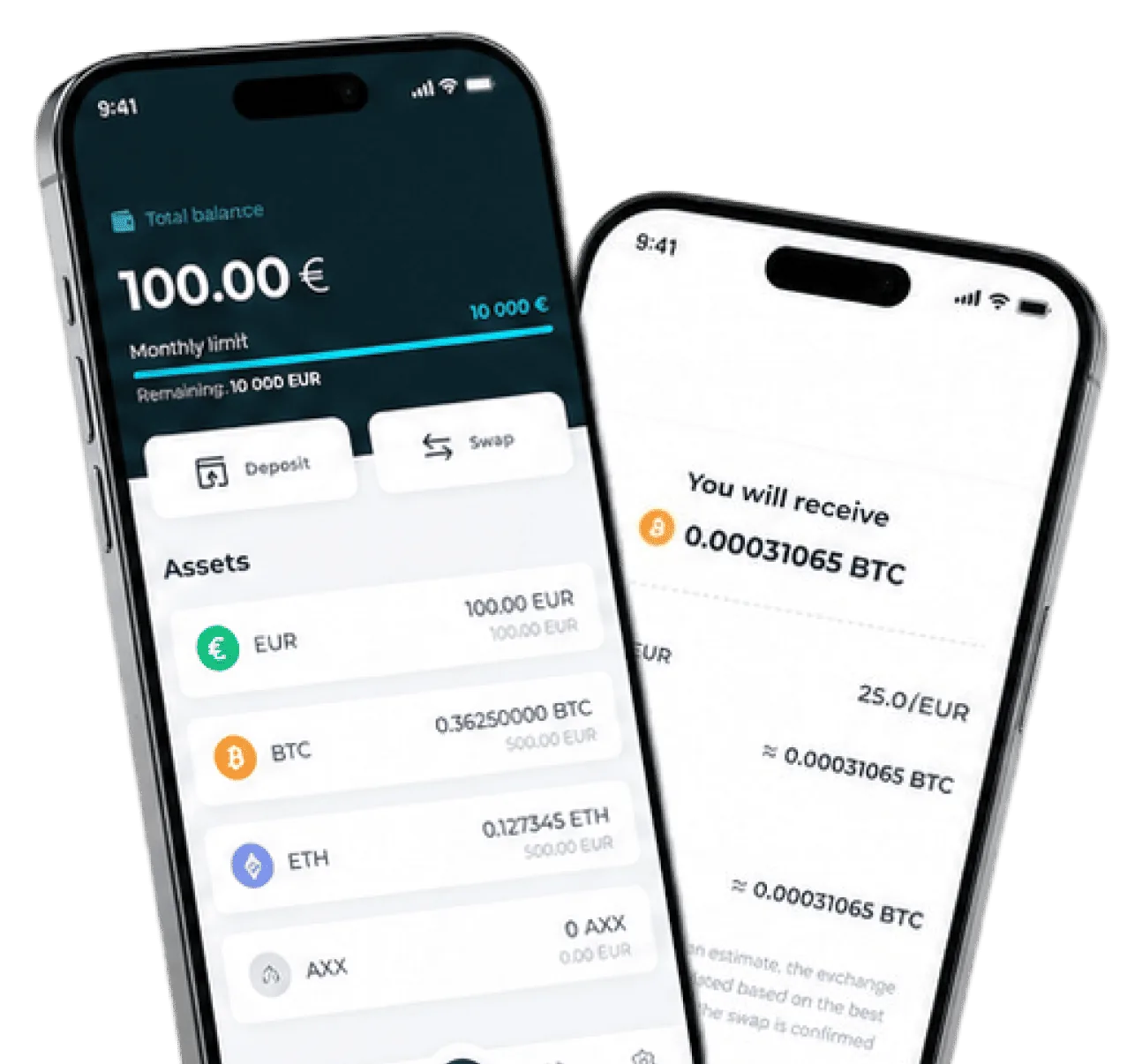
One iOS and Android app from a single codebase. Users check balances, deposit, and swap pairs like EURZ to BTC in a few taps, with a confirmation screen that shows the estimate before anything is final.
Secure Trading Environment and UI/UX Redesign
A clean UI refresh in DM Sans on a security-first base. KYC checks, role-based access for the three user types, locked balances, and a confirm step on every swap give users a secure trading environment they can read at a glance and trust with real money
Euro Rails with SEPA and Beneficiaries
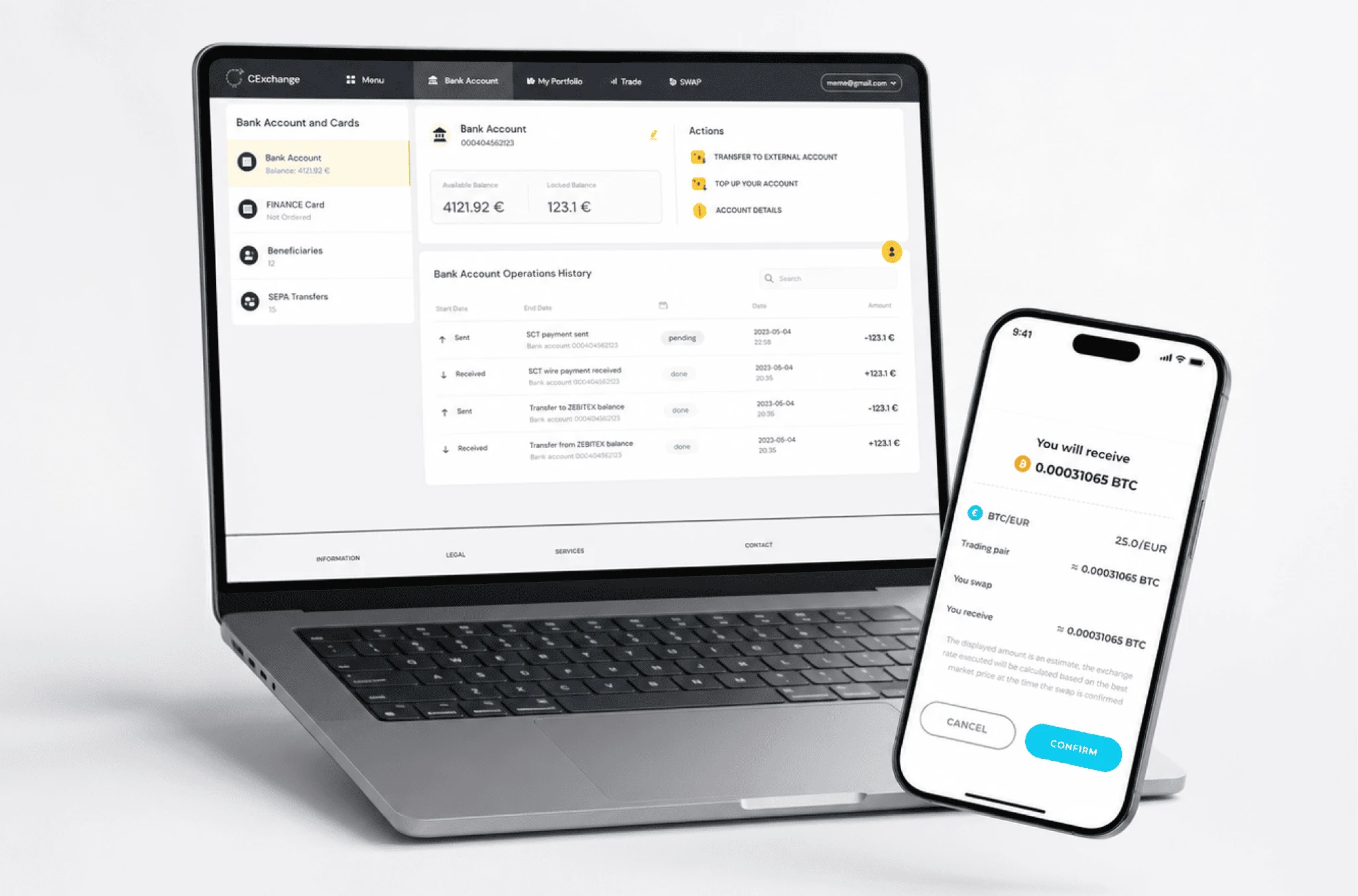
Real banking inside the exchange. Customers send and receive euros over SEPA, save beneficiaries, and watch each transfer move from pending to done in a live operations history, right next to their crypto.
Back-Office with KYC and Member Tiers
Operators verify KYC documents, manage first, second, and third-level members, and track deposits, withdrawals, licenses, and fees from one dashboard, with charts that surface deposit trends week over week.
In-App Swap with Live Pricing
A swap flow that quotes the pair, shows the amount you will receive, and states that the final rate settles at confirmation. No guesswork, and no hidden steps between intent and trade.
Scrum Methodology
Project Journey
An exchange punishes slow decisions, so we ran the build in two-week sprints. Early demos surfaced the hard parts first, mainly order matching under load and the rules around KYC and member tiers.
Discovery mapped the trading modes, the fiat-to-crypto flows, the referral structure, and the settlement path on the forked EVM chain before a single production feature shipped.
How the Cryptocurrency Exchange App Works
- A new user registers and submits KYC documents. Operators verify them from the back office before trading opens.
- Customers top up over SEPA or card. Euros land in the account and show up as available balance.
- The user picks a market or a swap, say EURZ to BTC, and sees the quoted amount they will receive.
- The C++ matching engine pairs the order against the book in real time.
- The trade settles on the forked EVM chain. Balances update across web and mobile.
- Every move lands in the operations log, marked pending or done, with date and amount.
Scrum Process Flow
Web development for a live exchange does not suit big-bang releases. Scrum’s two-week cadence meant the client saw real functionality every sprint and could redirect before a wrong call got expensive. That mattered most around the matching engine, where a late design change would have been painful to unwind.

-Timeline
Development Process — Five Phases
Discovery & Workshop
- Map trading modes, fiat flows, and referral tiers
- Agree on the 6-month MVP scope with the client
- Assign a Solution Architect with crypto trading depth
UX/UI Prototyping
- Redesign the web app and back-office in DM Sans
- Prototype the mobile swap and balances flow
- Lock the yellow, white, and dark palette
Agile Development (Sprints)
- Build the C++ matching engine
- Ship the cross-platform mobile MVP
- Wire SEPA, KYC, and EVM settlement
QA & Testing
- Full-cycle QA across web, mobile, and back-office
- Load-test the engine against busy order books
- Verify KYC and withdrawal edge cases
Launch & Support
- Deploy to production and the app stores
- Watch settlement and trading in the wild
- Keep shipping new features over the partnership
UI/UX Design - Intuitive Interface for Crypto Exchange Users
The redesign uses DM Sans on a light, card-based layout, with a dark navigation bar and a single yellow accent (#FFC543) saved for primary actions. On the web app, the bank-account view puts available and locked balances side by side, with SEPA transfers, saved beneficiaries, and an operations history where every row carries a clear status chip, pending or done. The back office keeps that same calm. Operators move between KYC documents, member tiers, deposits, withdrawals, and a weekly deposit chart without hunting for controls.
Mobile strips it down to what a trader checks on the move: total balance, a monthly limit bar, and an asset list that shows each holding in both crypto and euro terms. The swap flow is the standout. It names the trading pair, shows the exact amount you will receive, and says plainly that the final rate settles at confirmation, so the big Confirm button never feels like a leap. The result is one consistent system that reads the same whether you are an operator at a desk or a user on a phone.


Results
Before
- ✕Matching engine stalled when order books got busy
- ✕Web-only, with no native mobile app
- ✕Dated UI that fought every new feature
- ✕Manual, patchy back-office for KYC and payouts
- ✕Fiat and crypto were handled as separate, disconnected worlds
After
- ✔C++ matching engine handling ~50,000 orders per second at peak, up from ~5,000 on the old core, at under 1 ms match latency
- ✔Cross-platform mobile app on iOS and Android, rated 4.7 stars across 235 early reviews
- ✔ Onboarding to first trade in under 10 minutes, KYC verification down from ~24 hours to about 5
- ✔Back-office for KYC, 3-member tiers, deposits, and payouts
- ✔One account for euros, crypto, swaps, and full history
Impact of the Cryptocurrency Exchange App After Launch
-Verified Reviews
Our Reputation on Top Platforms
LITSLINK ranks among the higher-rated software development and blockchain teams on Clutch and GoodFirms. Reviews tend to single out the same things this project leaned on: engineering depth in fintech and crypto, steady communication across a long engagement, and a willingness to own infrastructure-level work like a matching engine.
Have a Cryptocurrency Project in Mind?
Planning a cryptocurrency platform or a cryptocurrency exchange app of your own? Tell us what you are building in the form below, and we will get back to you within 48 hours.
Thank you for your message. It has been sent.