






Key Takeaways
- Ongoing mobile app maintenance cost runs 15–20% of the original build cost per year, but the first year can reach up to 50% as bug-fix sprints, OS updates, and security patches converge. (Ptolemay, August 2025; Aalpha, January 2026)
- Maintenance is the dominant cost phase, not an afterthought: 50–80% of a software product’s total lifecycle cost is spent after launch. (IEEE Computer Society)
- Budget by app size: simple apps $3,000–$10,000/year, mid-size $10,000–$50,000/year, enterprise $100,000–$500,000+/year. (Aalpha, January 2026)
- Three 2025–2026 store mandates each add cost: Google Play’s Android 15 (API 35) deadline (Aug 31, 2025), Apple’s iOS 18 SDK requirement (April 2025), and Apple’s third-party AI disclosure rule (Nov 2025) — each can add $5,000–$25,000 in compliance work.
- Cross-platform development (Flutter or React Native) cuts maintenance 30–50% versus two native codebases; Flutter needs about 20% less maintenance time than React Native over two years. (Forrester, 2024)
- A 99%+ crash-free rate retains 42% more monthly active users than apps that dip below 97% — the clearest proof that maintenance spend pays for itself. (Instabug/Luciq Stability Outlook 2025)
Accurately forecasting mobile app maintenance costs is the foundation of any sustainable digital business strategy today. Most entrepreneurs think their development journey stops after the app lands in the stores. After all, the real business of building longevity starts after you launch.
Even small technical problems are often bad enough, but if they are not properly fixed, they can quickly lead to huge operational failures for an entire network. Bad customer experiences or security holes can cause immediate uninstalls and long-term brand damage. This article unpacks the basic issue of why continual financial expenditure is a must-have for software success now.
Why App Maintenance Matters in 2026
The mobile market is more fickle and competitive than ever in 2026. Every single day, users test new applications in what is a performance test process with unrealistically high expectations. They need frictionless navigation, fast loading, and total privacy. If your product does not grow, it simply disappears from the competitive landscape. Ignoring your program creates technical debt and gets you out of the market.
According to Pixalate’s data, for the period from January to May of 2025, 554,982 applications were removed from both Google Play and Apple’s App Store: 339,110 from Google Play and 215,872 from the App Store. If we compare these numbers with the 2024 research, where 1.1 million apps were removed from both platforms. These numbers will likely grow throughout 2026 due to even stricter store policies. Regular updates are the only way to avoid the digital trash bin.
Factors That Affect Mobile App Maintenance Costs
1. Bug Fixes and Performance Optimization
The launch of every mobile application is followed by unforeseen technical issues. It is important to check users’ comments and crash reports daily. Provide necessary updates as soon as possible to maintain user trust. If you want your app to work properly, provide routine debugging sessions. Performance optimization ensures compatibility with the latest hardware and network standards. This process is a core part of the maintenance costs of a mobile app strategy.
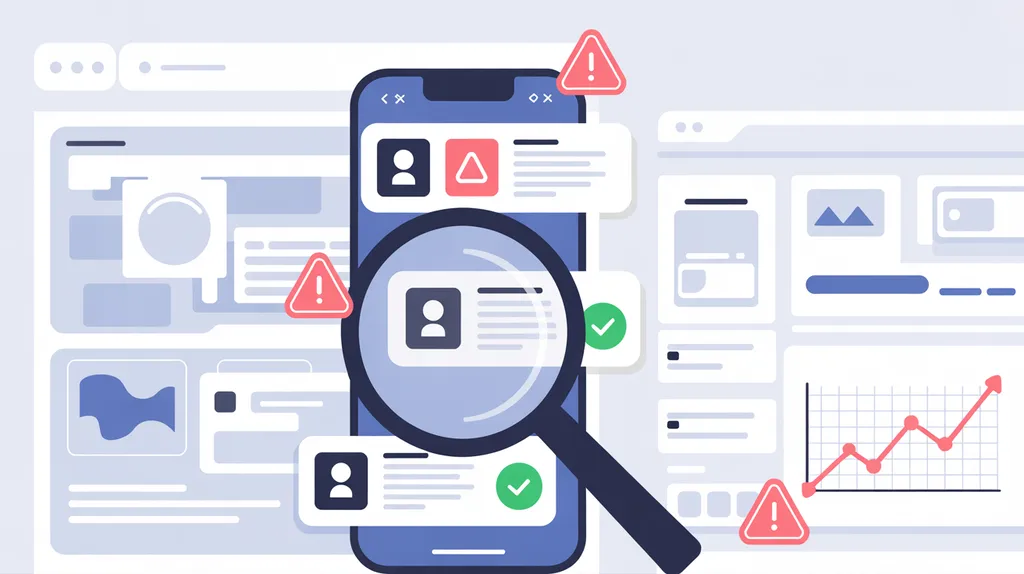
Bug fixes and security work are not a rounding error in the budget — they consume 20–30% of a typical maintenance spend. (Ptolemay, 2025) The reason to fund them aggressively is retention: 62% of users uninstall an app after a crash, freeze, or error, and median production apps now hold a 99.95% crash-free session rate, with elite teams hitting “five nines” (99.99%). (Luciq Stability Outlook 2025) Falling below that benchmark is a measurable churn event, not a cosmetic flaw.
2. Hosting & Server Costs
The backend supports core functions like user authentication and large-scale data storage. Cloud services host the backend on AWS, Firebase, or Google Cloud today. These platforms charge recurring fees based on your specific resource usage levels. Monthly support expenses vary depending on server uptime requirements and global availability. The number of active users and bandwidth usage also dictate the final monthly price. Strategic scaling can help manage this money as your audience expands.
3. Updates and New Features
To keep up with today’s market, you must follow major technological trends. Modern applications constantly introduce new features like AI-driven smart chatbots. Biometric authentication and machine learning systems personalize content for every individual user. These upgrades require additional investment but significantly help increase your ROI. They strengthen your app’s competitiveness in a very crowded and noisy market.
4. UI/UX Maintenance
Users expect applications to be intuitive and easy to use. Your goal is to ensure the app remains user-friendly and visually appealing. The design must be light and not overloaded with tables and buttons. The UI/UX design becomes crucial for user experience, so you have to follow all the trends to meet their expectations. Keep that in mind while planning the maintenance costs of a mobile app.
5. OS & Device Compatibility
Operating system updates can cause unexpected changes in mobile apps, creating issues for users. Some features may crash or behave unpredictably after a new OS release. To prevent this, developers must release compatibility updates and be prepared to fix bugs introduced by the latest system versions, or the app may receive negative reviews that affect user retention. Proactive compatibility updates help maintain your app’s functionality, competitiveness, and security.
6. Third-Party Integrations
These are things a lot of applications use, such as analytical tools, maps, etc., or various payment gateways. Regular updates on these third-party SDKs are received for security & legal purposes. Some important features may break suddenly if an application doesn’t keep up. Unsupported applications frequently have a direct rejection within the app store when they come under audit; outdated tools tend to be rejected as soon as they open or fall out of date. These integrations need to be constantly supervised and refined by seasoned technical people.
7. Security Updates
The app stores an enormous volume of sensitive user data, which comprises personal details, addresses, and payment credentials. The importance of this data must be safeguarded from unauthorized access. Vulnerabilities in the system can be identified through frequent security upgrades. Security patches keep the application compliant with these changing data privacy regulations, including CCPA, GDPR, and HIPAA, and you will secure your users’ personal information.
The financial case for security maintenance is blunt. IBM’s 2025 Cost of a Data Breach Report puts the average breach at $4.44 million globally and $10.22 million for U.S. companies. (Ptolemay citing IBM, 2025) Against numbers like that, a few thousand dollars a year in proactive patching and dependency audits is cheap insurance — and in regulated sectors it is non-negotiable.
To find out more, read our article on how to maintain an app.
How to Calculate Mobile App Maintenance Costs
The app maintenance costs can go from about 30% up to 35% of the initial development expenses. To build up an MVP, you must set aside 15% to 20% of the initial development cost.
| Aspect | Details |
|---|---|
| As % of Initial Development | If the budget is $100,000, the app maintenance cost per year will be $30,000-$35,000. |
| Monthly Mobile App Maintenance Costs (Mid-Sized Apps) | Depending on app scale and features, it may vary from $2,500 to $5,000. |
|
| Server hosting: $100-$320 Push-notifications: ~$10 per month Payment gateway fees: vary Developer fees: vary depending on the region and level of expertise |
For example, an app developed at an initial budget level of nearly $200k requires ongoing annual support investments estimated between $60k and $70k.
Several elements impact overall budgeting decisions:
- Complexity level inherent within programming
- Chosen tech stack utilized during creation phases
- Active user volume engaged regularly
- Necessities around hosting solutions/data storage options
Year 1 vs. long-term: what the 2026 benchmarks actually say
Treat the first year and every year after it as two separate budgets. Year 1 is front-loaded — the Ptolemay 2025 data shows costs that spike toward 50% of the build as you absorb launch bugs, the first OS mandates, and early security patches. From Year 2 onward, a healthy product settles into the 15–20% of build cost per year that agencies across the board now quote. (Aalpha, January 2026)
| Phase | Typical annual spend (on a $100K build) | What drives it |
|---|---|---|
| Year 1 | $25,000–$50,000 | Launch bug-fix sprints, first OS/SDK mandates, security hardening, user-driven rework |
| Year 2 and beyond | $15,000–$20,000 | Routine updates, monitoring, incremental features, recurring cloud and store fees |
Fixed vs. variable maintenance costs
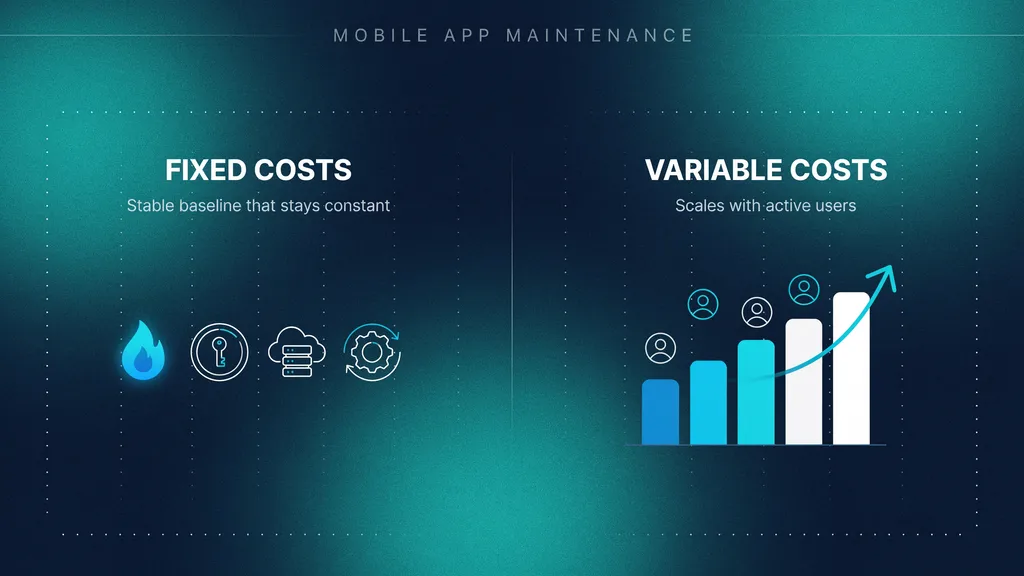
Split your maintenance line into two buckets and budgeting gets much easier. Fixed “pilot light” costs keep the lights on no matter how many users you have — Apple’s $99/year developer account, Google Play’s one-time $25 fee, baseline cloud reservations, and CI/CD tooling. For most mid-size apps that floor sits around $12,000–$15,000 per year. Variable costs scale with usage, and a reliable rule of thumb is $0.15–$0.25 per active user per month for cloud, API, and support. (Ptolemay, 2025) Ten thousand active users, on that math, is roughly $1,500–$2,500 a month before you touch a line of new code.
Cost-Effective Maintenance Models
In-House vs Outsourced
The budget for support depends on whether you rely on the internal team or hire professionals from the outside to fulfill this task. With the team under your roof, you can easily manage all the processes, be sure that all the features are working flawlessly, and support the company’s vision. You should understand that your own team of experts will cost you well with spending on training, offices, and salaries.
You can create your own talent pool with the expertise of people who are specialized in cybersecurity, performance optimization, and cross-platform optimization, and it may cost you less. This option is mostly used by entrepreneurs and startups that are preparing for the launch of a new project. The right company can become a reliable partner in the business journey.
Outsourcing is not only a staffing choice — it is a cost lever. Strategic outsourcing cuts maintenance spend 20–40% without sacrificing quality, mostly through rate arbitrage. (Multiple 2025 sources) A Sydney marketplace documented by Ptolemay replaced two local contractors at AU$140/hour with a vetted Eastern European team at AU$55/hour, kept a local PM for release approval, and dropped its monthly bill from AU$6,700 to AU$2,700 — a 31% lower year-over-year cost after oversight. Current 2025 hourly bands: roughly $25–$45 in India, $35–$60 in Central and Eastern Europe, and $100–$150 in the US.
Fixed-Rate Retainers
An enthusiastic team that will monitor your projects’ social health, maintain frequent updates, and fix bugs before the users find them out—it sounds like a dream, but this dream may become a reality these days. Today, the market is overwhelmed with developing professionals who are ready to become your business partner and try to do everything to make your program get more user retention. Such teams also require proper remuneration.
Yet, you must understand that by signing a contract with them, you gain more than just a service—you receive in your possession niche experts that can, at one moment, not only provide you with all necessary features but also create something new due to their expertise in different areas.
Are you looking for a reliable developer team in the USA? Check out our article with the Top 12 Mobile Developers in the USA.
Pay-As-You-Go
You pay only when you actually need specific updates or fixes. This is an ideal plan for smaller, stable applications.
You can explore our full range of development services to choose the one that suits you the best.
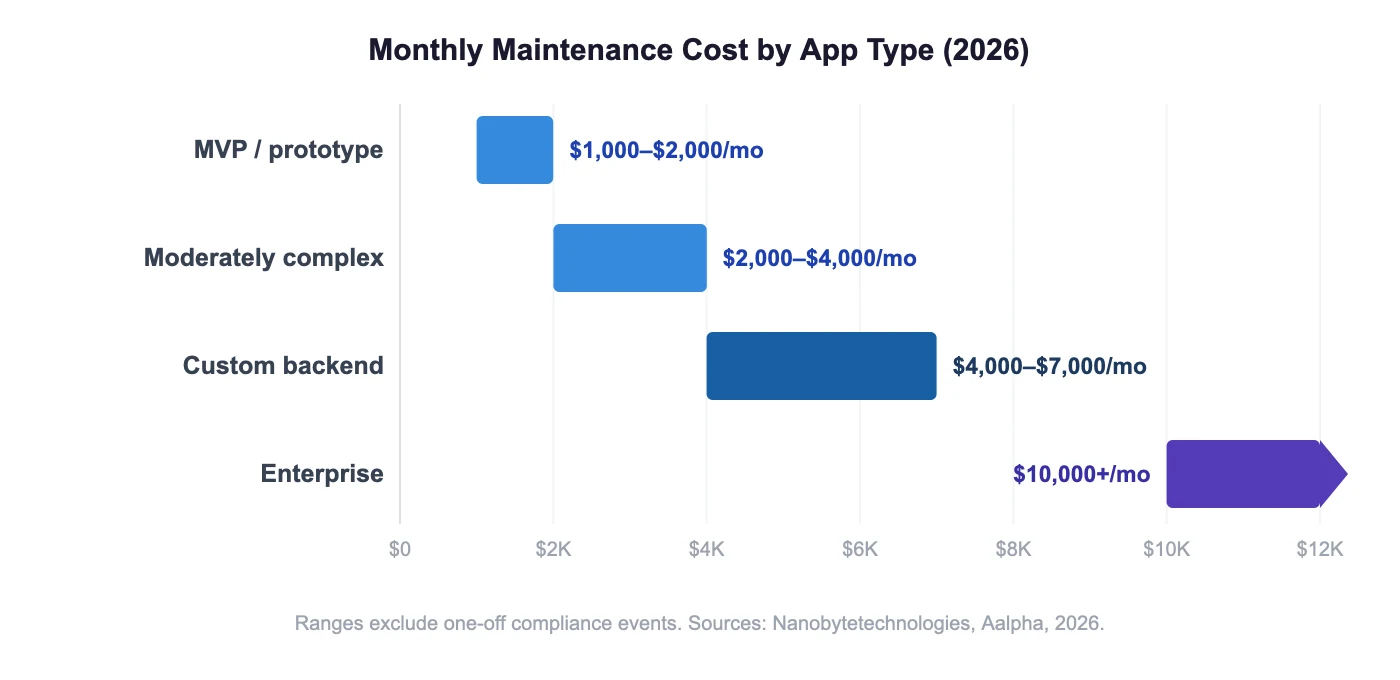
Cost of App Maintenance by App Type
The maintenance cost of the mobile app may vary depending on its type:
Can’t find inspiration for a startup idea? Read our 33 Mobile App ideas for Business Startups.
Native vs. cross-platform: how framework choice changes your bill
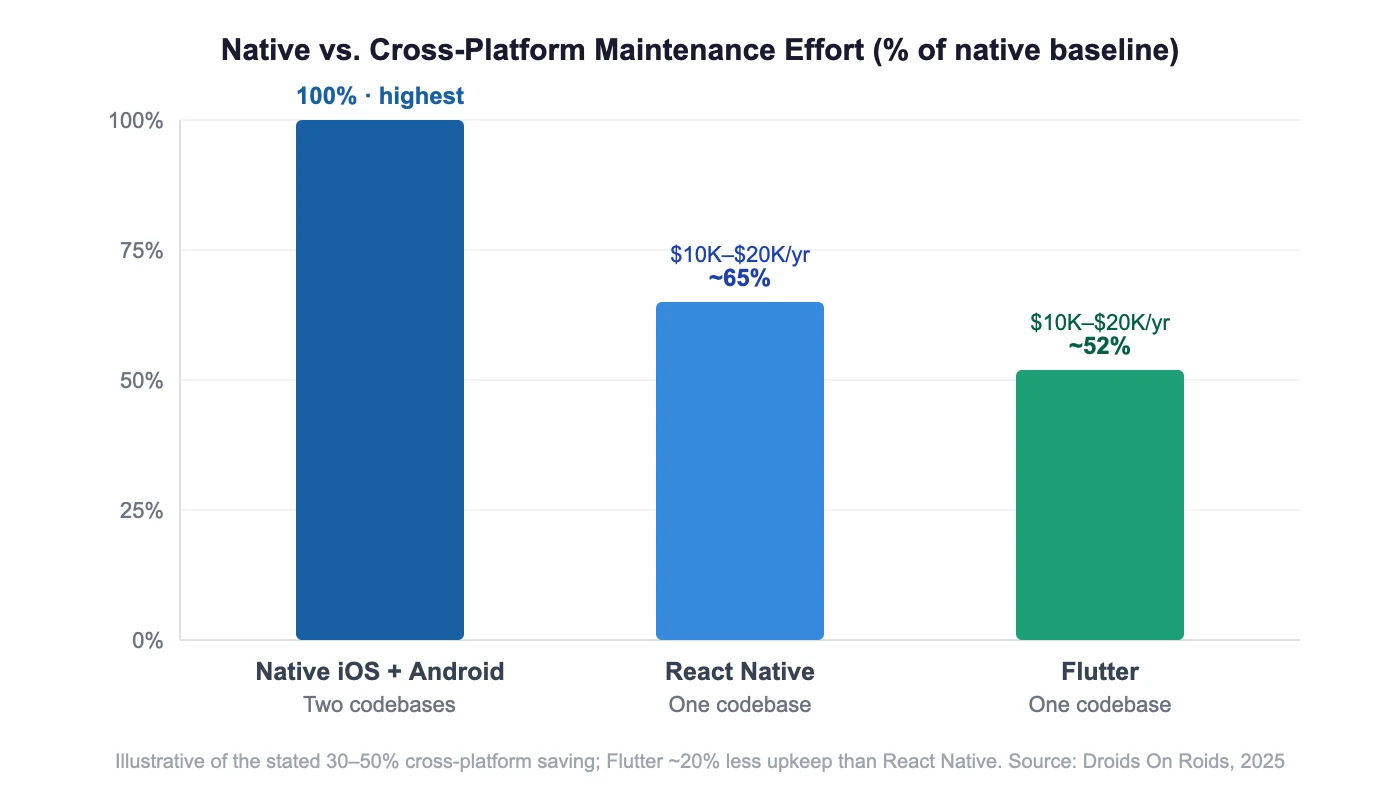
The single biggest structural lever on your maintenance cost is whether you keep one codebase or two. Maintaining separate native iOS and Android apps means two languages, two toolchains, and often two teams. A shared Flutter or React Native codebase removes that duplication and cuts maintenance 30–50%. Forrester’s 2024 data found Flutter apps needed about 20% less maintenance time over two years than equivalent React Native apps, and by 2026 Flutter holds 46% of the cross-platform developer market to React Native’s 35%. (Droids On Roids, 2025) The catch: JavaScript developers outnumber Dart developers roughly 20 to 1, so React Native can still be cheaper to staff.
What Else Should Be Included in the Budget?
- The program’s complexity and the technology you want to use.
Do you want to build your program from scratch or use a working build? How many features should it have? Do you want it for iOS, Android, or both? The answers to these questions will affect your initial budget, and you must understand that if you want more, you’ve got to pay more. - Location of your team.
US developers are the most expensive ($50-$100 per hour). Europe is in second place, especially Switzerland, where price tags might be $50-$300 per hour. Central and Eastern Europe have the most affordable prices—$25-$56. So, choose wisely with whom you want to work. - Design.
It always plays a crucial role, and good designers cost good money.
Platform compliance costs in 2025–2026
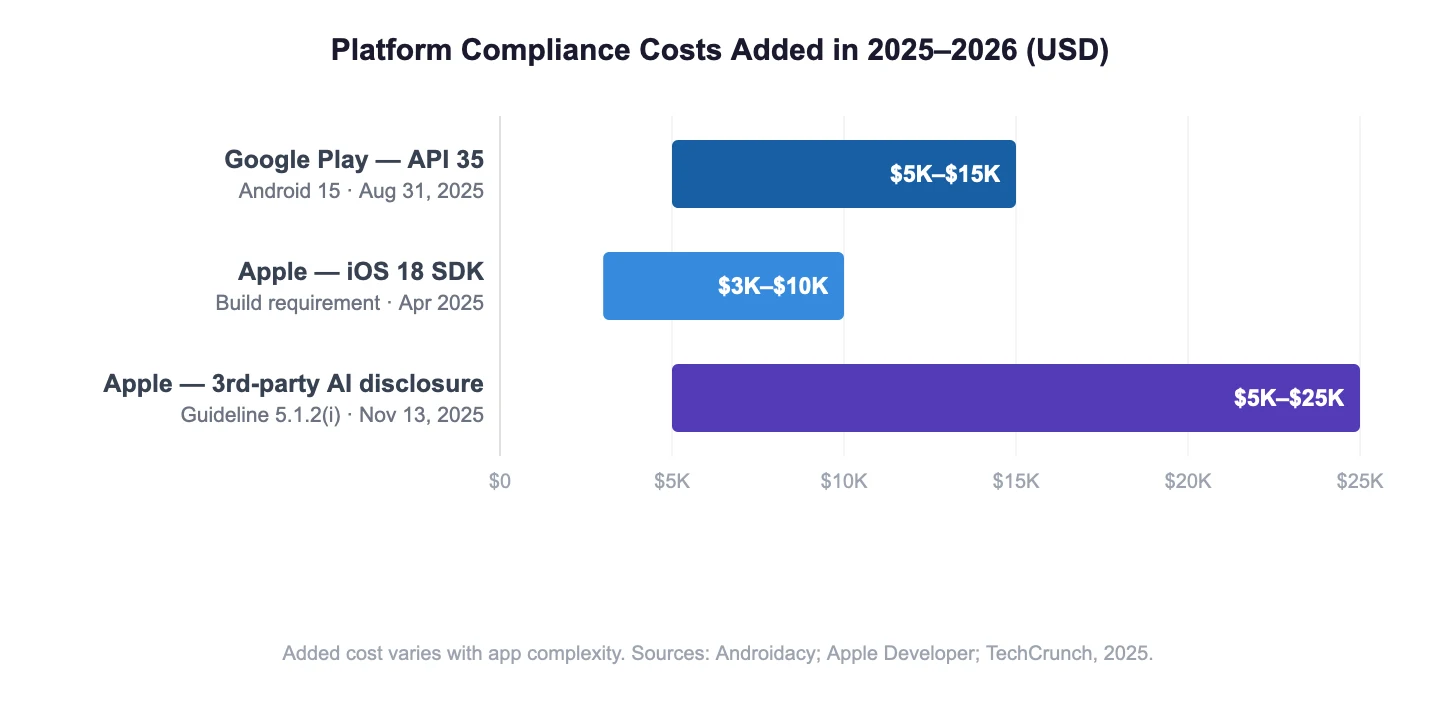
Store mandates have become a recurring maintenance line, not a one-time chore. Three changes hit almost every app in the last year, and each can add $5,000–$25,000 depending on complexity:
- Google Play — Android 15 (API level 35): since August 31, 2025, new submissions and updates must target API 35 or the app loses visibility to most new Android users (an extension to November 1, 2025 was available on request). (Androidacy)
- Apple — iOS 18 SDK: since April 2025, every App Store Connect upload must be built with the iOS 18 SDK (Xcode 16+); older builds are rejected at submission, forcing toolchain upgrades and re-testing. (Apple Developer)
- Apple — third-party AI disclosure (Guideline 5.1.2(i)): effective November 13, 2025, apps must name any third-party AI service they share personal data with (OpenAI, Gemini, Claude, etc.) and get explicit user consent, or face removal. (TechCrunch)
Specialized Maintenance for Different Industries
The costs of maintaining an app also depend heavily on your industry. A simple content-based software requires much less effort than a complex FinTech platform.
1. E-commerce
E-commerce platforms require 24/7 monitoring of payment gateways and inventory systems. Any downtime during a holiday sale results in massive revenue loss. Support focuses on database stability and secure transaction processing.
2. Healthcare and HIPAA Compliance
Healthcare apps must follow strict data privacy laws like HIPAA. Regular security audits are mandatory to protect sensitive patient records. This increases the baseline app maintenance costs but prevents legal disasters.
3. Fitness and Wellness
Fitness apps often integrate with wearable devices and health sensors. Supervision involves keeping these hardware connections stable across various device models. Check our case for more details.
What Happens If You Skip Maintenance?
Without proper supervision, businesses risk losing both revenue and reputation. The users won’t be using an application that doesn’t work as they want, and it will receive negative reviews and will be banned from all the major app stores.
An even more serious issue arises when poorly maintained programs become targets for cyberattacks. Applications with weak security and bad ratings often attract hackers looking for vulnerabilities that may expose users’ personal data. Such incidents can seriously damage a brand’s reputation, making it difficult to regain the trust of both users and business partners.
A real Year-1 number, not a range
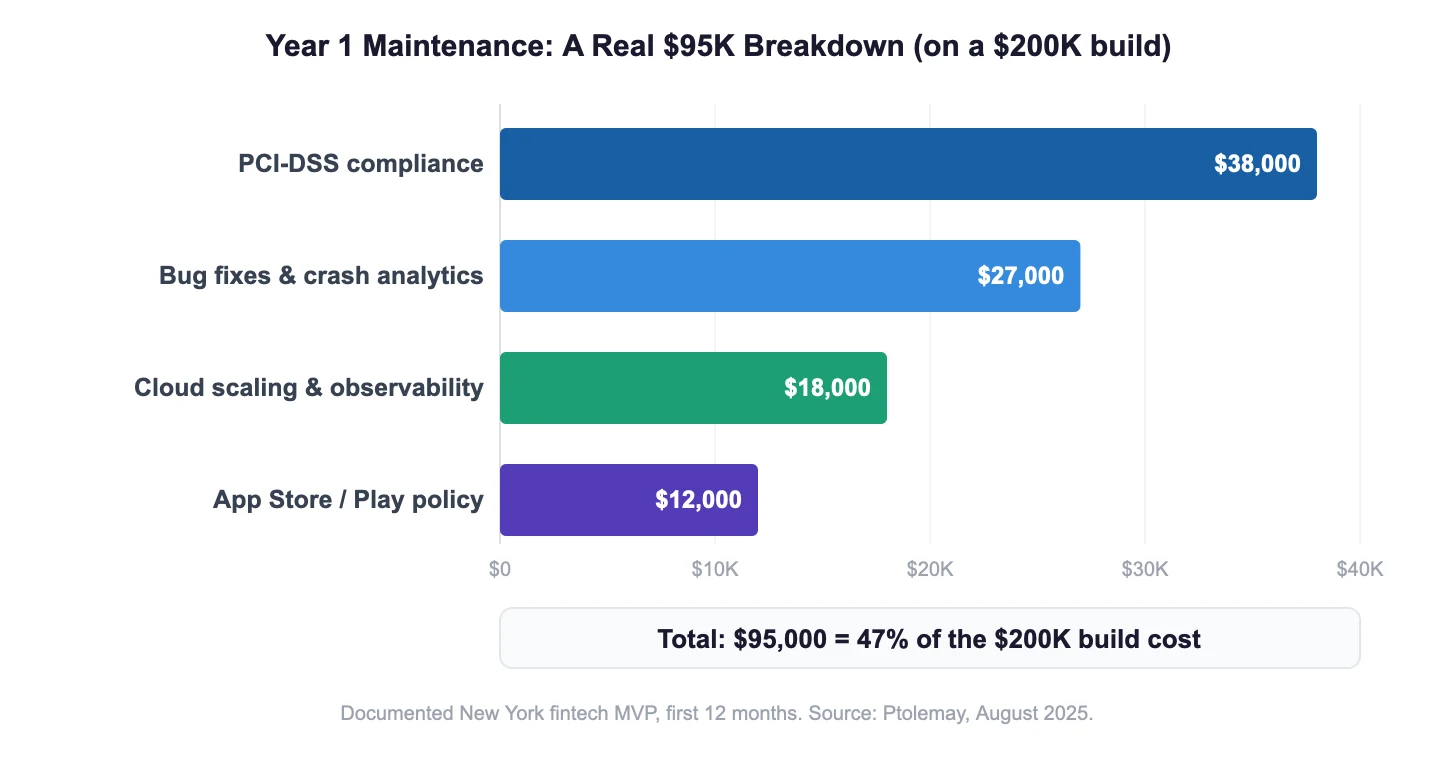
Ranges are easy to wave away, so here is a concrete one. A New York fintech MVP documented by Ptolemay launched for $200,000 in May 2024. By April 2025 it had spent $95,000 more on maintenance: $38,000 on PCI-DSS compliance after new Stripe policies, $27,000 on bug fixes and crash analytics after user growth tripled, $18,000 on cloud scaling and observability, and $12,000 on App Store and Google Play policy changes. That is a 47% first-year maintenance load on the build cost — exactly the Year-1 spike the benchmarks describe. (Ptolemay, August 2025)
LITSLINK: Experts To Your Help
LITSLINK is one of the prominent development teams in the USA with over 300 professionals who are ready to give you a hand in the support of your mobile app. We specialize in mobile app maintenance, cloud applications, machine learning, and AI chatbots. Development Services, Blockchain Development Services, AIaaS, SaaS Development Services, Virtual Reality, etc.
Our cases include the development of healthcare, FinTech, e-commerce, etc. Our expertise level has helped to launch over 300 projects.
Examples of Our Work
- Nutralete.
Our Fitness Case. A software program that creates nutrition plans for people who are passionate about fitness and a healthy diet. The program also becomes a platform where fitness enthusiasts can reach out to professional athletes for advice and help. - Real Estate Market Place.
A visually appealing platform where users can find affordable housing to their taste without deep searching. - ShiftRX.
An application for medical workers that helps to organize their shifts for high-level effectiveness.
If you want a partner who cares for your project as if it were their own, you shouldn’t have to go far to find one. You have already found us! And we are ready to provide you with all the necessary help. Contact Us To Find Out More!
Keep reading on related topics: our guide on how to maintain an app, the Top 12 Mobile App Development Companies in the USA, and how to pick the right tech stack before you build.
Final Thoughts: What Are the Maintenance Costs for a Mobile App?
Technology constantly evolves, and businesses must keep up to stay competitive. Maintaining your application is not a one-time deal. Yes, the first year after the launch, you’ll be dealing with this issue all the time. In the second year, you’d relax a little bit, but you’d never forget one simple rule—your app must be maintained all the time. That’s why you must calculate mobile app maintenance costs beforehand and have a team that will cover you on this issue.
And if you still don’t have such a team, then we are ready to become the one! LITSLINK is already ready to assist businesses and startups in effectively scaling their mobile experiences! Let’s begin by getting in touch with us!
Frequently Asked Questions
Maintenance is essential to fix bugs and provide security updates. It ensures compatibility with the latest smartphone hardware and software.
Between 30% and 35% of the initial development budget annually.
Yes, absolutely. A simple meditation app requires much less money than a global shopping platform.
Plan for 15–20% of the original development cost per year once the app is stable. Budget more for Year 1 — it commonly runs toward 50% of build cost as launch bugs, the first OS mandates, and security patches all land at once.
The first 12 months absorb post-launch bug-fix sprints, mandatory OS/SDK updates, early security hardening, and rework driven by real user behavior. A documented New York fintech MVP spent $95,000 maintaining a $200,000 app in its first year before costs settled.
Yes. One Flutter or React Native codebase instead of two native ones cuts maintenance 30–50%, and Forrester found Flutter needs about 20% less maintenance time than React Native over two years.
Google Play’s Android 15 (API 35) deadline of August 31, 2025; Apple’s iOS 18 SDK build requirement from April 2025; and Apple’s third-party AI data-disclosure rule from November 13, 2025. Each can add $5,000–$25,000 depending on app complexity.
It pays for itself through retention. Apps with a 99%+ crash-free rate keep 42% more monthly active users, and proactive security spending is trivial next to IBM’s 2025 average breach cost of $4.44 million.