






Key Takeaways
- The risks of vibe-coded applications are no longer theoretical. Around 65% of AI-generated production apps contain security vulnerabilities, while 22% of developers say they do not trust AI-generated code outputs.
- Vibe-coded codebases often reach a tipping point within three to six months, where maintaining AI-generated apps becomes more expensive than rebuilding them from scratch.
- The best vibe coding cleanup service companies include LITSLINK, Akveo, TechAvidus, Plus8Soft. Hourly rates across the ten companies range from $25 to $99.
Vibe coding has changed how teams build software in just a couple of years. Founders, product managers, and even non-technical operators can now describe what they want and watch AI tools generate the code: 25% of Y Combinator’s Winter 2025 startups reported codebases that were 95% AI-generated.
But vibe-coded apps are far from perfect. Bugs hide in places nobody mapped. Deploys break without warning. Security gaps surface during the first investor due diligence. At that point, you businesses need a partner who can clean up what you already have.
We reviewed ten vibe coding cleanup companies in the US. Each profile covers years in operation, Clutch rating, hourly rate, core industries, the actual cleanup work on offer, and the type of client that benefits most from working with them.
What Is a Vibe Coding Cleanup Service?
Vibe coding is the practice of building software through prompts. You describe a feature, the AI writes the code, and you ship. Tools like Cursor, Bolt, Lovable, Replit, and v0 made this possible.
The problem shows up after launch. AI tools optimize for output that runs. They don’t optimize for code your team can maintain six months later. The result is a working app with hidden technical debt, security holes, and architecture that breaks under real traffic. Even the most advanced AI systems produce code that needs human review before going to production.
A vibe coding cleanup service fixes that. The work starts with an audit. Senior engineers map the architecture, scan for security gaps, find scaling bottlenecks, and flag code that was duplicated or hallucinated by the AI. From there, they refactor the codebase, add automated tests, set up CI/CD pipelines, and write the documentation your team should have had from day one.
Some firms run fixed-price sprints. Others embed senior developers in your team on a monthly basis. A few handle long-term maintenance after the initial cleanup wraps. The right model depends on what your team can absorb internally and how much engineering support you need going forward.
The Most Common Problems Found in AI-Generated Applications
AI tools follow patterns from their training data. Some of those patterns look fine in a demo, but fall apart in production. The numbers explain why this matters for anyone signing off on a budget.
SCA audit found that 65% of vibe-coded production apps had security issues, including critical vulnerabilities. For a decision-maker, that means roughly two out of three AI-built apps ship with exploitable flaws. One breach or one failed compliance check erases every hour you saved by skipping the proper build, and a single SOC 2 fail can cost you the enterprise pilot you were chasing in the first place.
An Empirical Study of AI-Generated Code showed that 22.7% of AI-introduced issues persist in repos long after the prompt that created them. Every prompt adds new code, and invisible debt grows with each release. By month six, your team spends more time patching ghosts than shipping features, and the cost-to-maintain curve crosses the cost-to-rewrite curve before you notice.
And the developers closest to these tools see the cracks first. 22% of them say they don’t trust AI outputs. That distrust shows up as manual review work and rework, which eats into the speed advantage vibe coding promised in the first place. If you budgeted for “AI-speed delivery,” the real number includes hours of senior review you didn’t price in.
Here are the issues cleanup teams find most often.
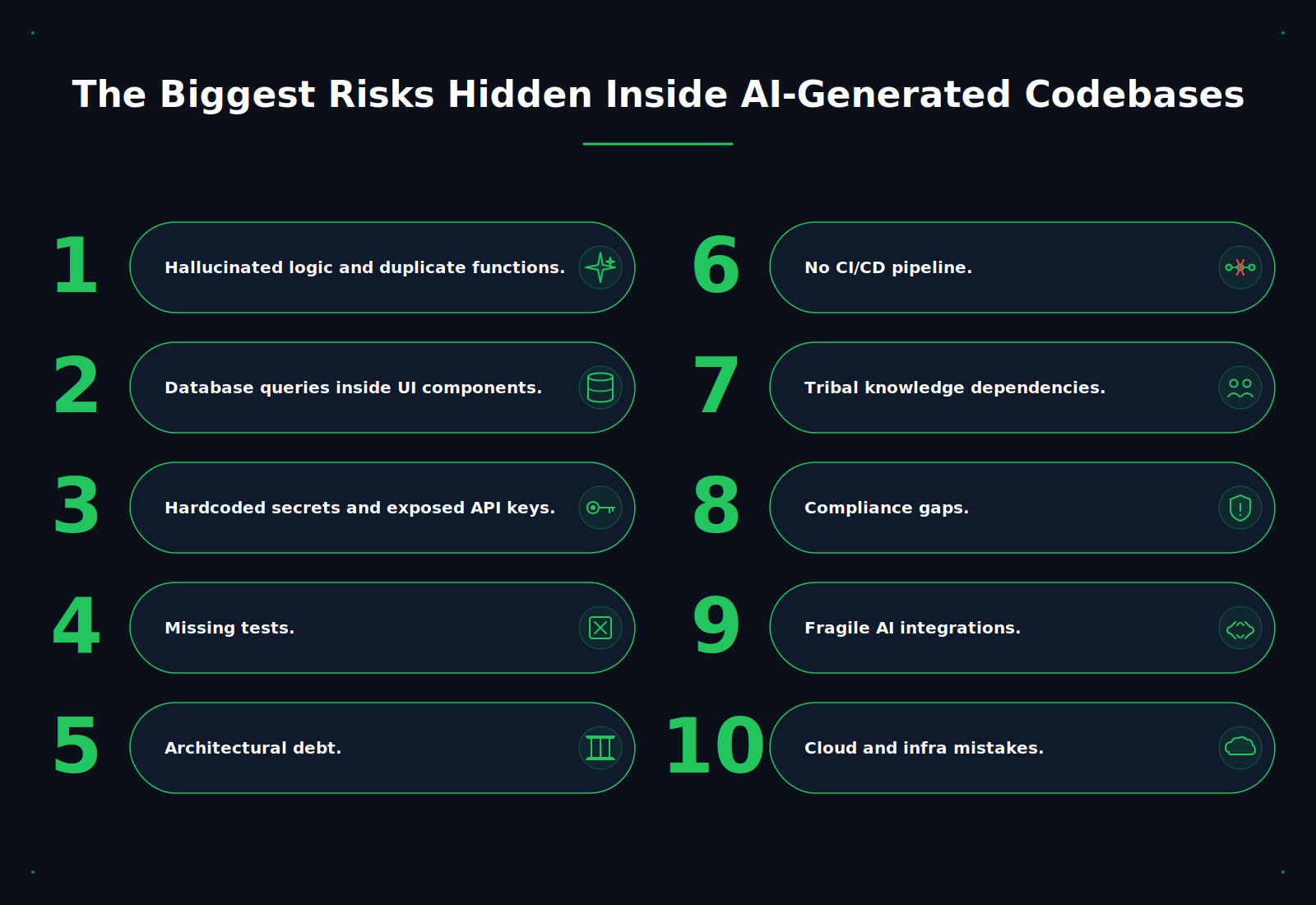
1. Hallucinated logic and duplicate functions. AI tools generate the same logic in different files, sometimes with slight variations. Updating one place leaves the others broken.
2. Database queries inside UI components. A page that should make one query to fetch ten items ends up making a hundred. Server costs balloon and response times crawl.
3. Hardcoded secrets and exposed API keys. AI often pastes credentials directly into the code. The keys end up in version control, then sometimes in public repos.
4. Missing tests. Vibe-coded products rarely include unit, integration, or end-to-end tests. Every deploy becomes a guess.
5. Architectural debt. State management ends up in UI layers. Business logic mixes with rendering. The architecture cannot scale past a few hundred users.
6. No CI/CD pipeline. Deploys happen by hand. Releases get stressful, slow, and prone to regression.
7. Tribal knowledge dependencies. Because no documentation exists, only the person who prompted the code knows how it works. When they leave, the codebase becomes a black box.
8. Compliance gaps. Healthcare, fintech, and other regulated industries need HIPAA, GDPR, SOC 2, or PCI alignment. AI-generated code rarely meets any of those bars out of the box.
9. Fragile AI integrations. Many vibe-coded products today include some kind of conversational interface. Cleanup work for AI agent development often goes beyond refactoring to include prompt management, model selection, and tool integration.
10. Cloud and infra mistakes. AI tools often default to over-provisioned services or insecure cloud configurations. Proper cloud application development practices fix this on the way to a stable production environment.
Top Vibe Coding Cleanup Service Companies in the US: 2026 List
The companies below all work with US-based clients on vibe coding cleanup. Every firm on this list has published its cleanup methodology, holds a strong Clutch rating, and works regularly with founders and enterprises rebuilding AI-generated code.
Each profile gives you the same set of facts. Years in operation. Clutch rating. Hourly rate. Core industries. The cleanup capabilities on offer. And the type of client that gets the most value from the engagement. Use the comparison table for a quick scan, then read individual profiles for the partners that look like a fit.
| Company | Experience | Clutch Rating | Hourly Rate | Core Industries | Cleanup Capabilities | Best For |
|---|---|---|---|---|---|---|
| LITSLINK | 12+ | 4.8 / 5 (78) | $50–$99 | Healthcare, real estate, fintech, logistics, manufacturing | Vibe code rescue · AI security audit · AI fine-tuning | Funded startup in a regulated industry needing enterprise-compliance rebuild before scaling |
| Akveo | 11+ | 5 / 5 (27) | $50–$99 | Fintech, healthcare, automotive, manufacturing | Read-only repo audit (48h Launch Plan) · Deep code optimization · Architectural stabilization · Security hardening · Testing & QA | No-code founder who needs a professional technical review and clean code to close an investor round |
| TechAvidus | 10+ | 4.7 / 5 (22) | $25–$49 | Edtech, real estate, supply chain, logistics, manufacturing | Code audit & assessment · Refactoring & restructuring · Security & performance optimization · Testing & validation | Budget-conscious startup or SME that wants a risk-free 2-week trial before committing |
| Plus8Soft | 3+ | 5 / 5 (14) | $25–$49 | Healthcare, fintech, edtech, energy, manufacturing, telecom, e-commerce | Comprehensive code refactoring · Test coverage & QA hardening · Architecture & deployment review | Scaling startup with developer fatigue and “fear of deploying” in a fragile codebase |
| ISHIR | 27+ | 4.9 / 5 (16) | $50–$99 | Consumer products, healthcare, edtech, non-profit, real estate | Code quality & risk assessment · Refactoring & standardization · CI/CD setup & hardening · Post-cleanup support | Established US-based enterprise that wants cleanup plus a long-term framework for safe AI-assisted development |
| CodeGeeks Solutions | 5+ | 5 / 5 (10) | $25–$49 | Fintech, healthcare, GPS & GIS, hospitality, legal, retail, e-commerce | Architecture restructuring · Code refactoring · Testing automation · Security fixes · Performance optimization · CI/CD setup | Startup with a working prototype that needs to stabilize what exists rather than rewrite from scratch |
| MITRIX Technology | 9+ | 5 / 5 (14) | $50–$99 | Fintech, healthcare, edtech, IT | Free assessment · Stabilization roadmap · Cleanup sprint · Ongoing support | Founder who wants fixed-price cleanup delivered by senior-only engineers with a proven AI-codebase track record |
| SoftTeco | 18+ | 4.8 / 5 (13) | $25–$49 | Consumer products, automotive, logistics, telecom, marketing, education, energy, e-commerce | Free vibe-code assessment · Comprehensive code audits · Refactor & restructure · CI/CD integration · Structured 4-step process | Established mid-market or enterprise needing ISO-certified, process-driven cleanup at scale |
| Binary Studio | 21+ | 4.9 / 5 (56) | $50–$99 | Healthcare, real estate, edtech, legal | Code audit & risk heatmap · Vibe-coded to custom migration | HealthTech, FinTech, or regulated-industry company needing a senior-led rescue partner with two decades of compliance experience |
| ULAM Labs | 10+ | 4.8 / 5 (13) | $50–$99 | Healthcare, business services, fintech, IT, manufacturing, telecom | Improvement strategy plan · Cleanup sprints · Long-term care | Python-based startup needing a senior-only team experienced in clinical-grade software |
LITSLINK
Years in operation: 12+
Clutch rating: 4.8 / 5 (78 reviews)
Hourly rate: $50 – $99
Core industries: Healthcare, real estate, fintech, logistics and manufacturing
Company overview
LITSLINK has been building production-grade software since 2014. The team runs 300+ engineers and has shipped custom work for 200+ startups and enterprises, with 80+ of those startups going on to raise follow-on funding. The company manages projects out of Palo Alto and Orlando. Clients keep 100% IP ownership of the architecture, model weights, integration code, and data, and long-term post-launch support comes with the engagement.
Cleanup capabilities
- Vibe code rescue. LITSLINK takes your vibe-coded app and runs an AI-assisted analysis across the whole codebase. The team traces bugs back to their roots and restructures the code until it runs cleanly in production.
- AI security audit. The team scans AI-generated codebases line by line for vulnerabilities, injection risks, and compliance gaps. You get a full vulnerability report plus the remediation work that hardens the code to enterprise standards.
- AI fine-tuning. LITSLINK tunes models on your domain data, your terminology, your rules, and your edge cases. The result speaks your language and produces outputs that actually fit your use case.
Strategic Fit For
A funded startup in a regulated industry that built its MVP with vibe coding and now needs the code rebuilt to enterprise compliance standards before scaling to investors or enterprise customers.
Akveo
Years in operation: 11+
Clutch rating: 5 / 5 (27 reviews)
Hourly rate: $50 – $99
Core industries: Fintech, healthcare, automotive, manufacturing
Company overview
Akveo has 100+ software experts and 50+ delivered projects, working with startups, enterprises, and SMEs. The team operates as a fractional CTO unit on demand, with a clear four-step engagement model: connect → audit & roadmap → cleanup & build → handover or deployment.
Cleanup capabilities
- Codebase audit on read-only access. After NDA and OAuth connection to your repo, Akveo runs a comprehensive analysis of architecture, logic, database queries, and security, then delivers a Launch Plan within 48 hours covering critical optimizations, transparent hour/cost estimates, and a scalability roadmap.
- Deep code optimization. Logic generated by complex prompts gets streamlined for better performance and readability, including identifying duplicated logic and inefficient data requests that AI tools commonly produce.
- Architectural stabilization. State management and database queries are moved out of UI components and into a scalable backend structure, fixing the “100 requests for 10 items” pattern that AI often introduces.
- Security hardening. Scans identify exposed API keys, authentication gaps, hardcoded secrets, unencrypted data, and other vulnerabilities before deployment, ensuring the app is GDPR-friendly and ready for real users.
- Testing & QA. Unit and end-to-end tests are added so adding new features next month doesn’t break the app built today.
Strategic Fit For
A no-code founder who built and validated an MVP and now needs a professional technical review and clean codebase to close an investor round.
TechAvidus
Years in operation: 10+
Clutch rating: 4.7 / 5 (22 reviews)
Hourly rate: $25 – $49
Core industries: Edtech, real estate, supply chain, logistics and transport, manufacturing
Company overview
TechAvidus offers a risk-free two-week trial — clients pay zero if they decide to stop within the evaluation period. Project coordinators have 7+ years of experience, and engineers are sourced through a strict vetting process that includes 6+ hours of tests, video interviews, and a competitive academy program with a 0.6% acceptance rate.
Cleanup timelines are tiered by project size: 1–2 weeks for small apps, 3–6 weeks for mid-size projects, and a phased approach across several months for enterprise-level cleanup.
Cleanup capabilities
- Code audit & assessment. The team identifies redundancies, vulnerabilities, and inefficiencies in AI-generated codebases and maps out areas needing refactoring.
- Refactoring & restructuring. Unused imports, dependencies, and files are removed, functions are optimized, components are modularized, and the codebase is aligned with standard coding practices.
- Security & performance optimization. Outdated packages are patched and the code is optimized for speed and scalability.
- Testing & validation. Automated functional testing and regression testing ensure nothing breaks during cleanup.
Strategic Fit For
A budget-conscious startup or SME that wants to test the team risk-free for two weeks before committing to a small or mid-size cleanup engagement.
Plus8soft
Years in operation: 3+
Clutch rating: 5 / 5 (14 reviews)
Hourly rate: $25 – $49
Core industries: Healthcare, fintech, edtech, energy & natural resources, manufacturing, telecom, e-commerce
Company overview
Plus8Soft has shipped 100+ projects. The engineering team averages 3+ years of hands-on experience, and leadership brings 20+ years of global engineering work to the table. The company runs out of multiple tech hubs and works with everyone from early-stage founders to global enterprises, through full-stack builds or outstaffing.
Cleanup capabilities
- Code refactoring. Plus8Soft rebuilds messy, spaghetti code into clean modular components without changing how the app behaves. The focus stays on design patterns and long-term maintainability.
- Test coverage & QA hardening. The team writes unit, integration, and end-to-end tests so future changes stop breaking things that already work.
- Architecture & deployment review. Engineers walk through your system architecture, set up CI/CD pipelines, and put best practices in place so deploys become fast and predictable.
Strategic Fit For
A scaling startup whose team is suffering from developer fatigue, “fear of deploying,” and tribal knowledge dependencies in a fragile vibe-coded codebase that needs deep structural rescue.
ISHIR
Years in operation: 27+
Clutch rating: 4.9 / 5 (16 reviews)
Hourly rate: $50 – $99
Core industries: Consumer products & services, healthcare, edtech, non-profit, real estate
Company overview
ISHIR has been working since 1999, which gives them 27+ years of building software for clients. The company runs out of Dallas-Fort Worth with regional offices across Texas. They position themselves as a Digital Product Innovation Studio and AI-Native System Integrator, with 200+ product launches behind them and 16+ hours of time zone coverage to keep work moving overnight.
Cleanup capabilities
- Code quality & risk assessment. ISHIR finds the parts of your code that are fragile or silently broken. The review covers code smells, architectural decisions, and common AI fault patterns. You walk away with a clear picture of what will break, why, and how urgently it needs fixing.
- Refactoring & standardization. The team removes duplicated and hallucinated functions and realigns the codebase to proven architectural patterns. Structure and logic flow get cleaner in the process.
- CI/CD pipeline setup & hardening. ISHIR hardens your delivery pipeline with automated testing, clean version control standards, and deployment safety checks. Releases stop feeling like a coin flip.
- Post-cleanup support & maintenance. Their retained engineering team stays on after the cleanup wraps to monitor stability, optimize performance, and keep the codebase healthy as your product grows.
Strategic Fit For
An established US enterprise already experimenting with AI that needs immediate cleanup on today’s mess plus a long-term framework so the team can keep using AI tools without piling up the same debt twice.
CodeGeeks Solutions
Years in operation: 5+
Clutch rating: 5 / 5 (10 reviews)
Hourly rate: $25 – $49
Core industries: Fintech, healthcare, GPS, Navigation & GIS, hospitality & leisure, legal, retail, e-commerce
Company overview
CodeGeeks works mostly with startups and small-to-medium businesses going through digital transformation. Every engagement follows the same four-stage flow: codebase audit, stabilization roadmap, cleanup and refactoring sprints, then ongoing support.
The team locks scope and measurable outcomes before any work starts, and they run weekly progress demos throughout so nothing drifts.
Cleanup capabilities
- Architecture restructuring. CodeGeeks reorganizes code into clear layers and modules so future changes stop breaking unrelated parts.
- Code refactoring & cleanup. The team removes duplication, fixes naming, extracts reusable logic, and aligns coding standards across the codebase.
- Testing coverage & automation. Reliable unit and integration tests are added so releases become predictable and regressions get caught early.
- Security and vulnerability fixes. Auth, inputs, dependencies, and data flows are hardened using OWASP-aligned practices and secure defaults.
- Performance optimization. Response times improve through query tuning, caching, payload reduction, and memory fixes.
- CI/CD setup for stable releases. Build pipelines, quality gates, and safe deployment steps ensure only verified code reaches production.
Strategic Fit For
A startup with a working prototype where engineering has started to feel stressful, needing to stabilize what already exists rather than rewriting from scratch.
MITRIX Technology
Years in operation: 9+
Clutch rating: 5 / 5 (14 reviews)
Hourly rate: $50 – $99
Core industries: Fintech, healthcare, edtech, IT
Company overview
Mitrix has 65+ senior engineers on the team, each with 10+ years of experience. The company has completed 30+ projects for 20+ clients, including SynapseHealth, TicketVault, and uQualio. The team has cleaned up 50+ AI-built systems with a 95% client satisfaction rate, and they won the 2023 Global & Champion Award for IT outsourcing leadership.
Engagements run on fixed-price outsourcing with senior-only teams (8+ years average experience), and dedicated account and delivery managers handle 24/7 communication.
Cleanup capabilities
- Free assessment. Mitrix runs a code audit, scans for vibe coding risks and infrastructure gaps, and checks scalability before you commit to anything.
- Stabilization roadmap. You get a plan with priorities, an exact timeline, a fixed cost estimate, and a risk level.
- Cleanup sprint. Only the most essential fixes. The team untangles the logic generated by AI, eliminates dangerous dependencies, makes main flows predictable and testable, removes duplicate and dead code, adds minimal security checks, stabilizes deployment, and leaves behind documentation that your internal team can actually use.
- Ongoing support. Continued engineering involvement after the cleanup sprint so stability holds as the product evolves.
Strategic Fit For
A founder who wants fixed-price, predictable cleanup on an AI-built system, delivered by senior-only engineers with a proven track record.
SoftTeco
Years in operation: 18+
Clutch rating: 4.8 / 5 (13 reviews)
Hourly rate: $25 – $49
Core industries: Consumer products & services, automotive, supply chain, logistics & transport, telecom, advertising & marketing, education, energy & natural resources, e-commerce
Company overview
SoftTeco is an AI-assisted development company launched in 2008 and has grown to 500 employees across 75 client locations. The team has delivered 650+ projects for clients across the USA, UAE, Europe, and Canada. The company also holds ISO 9001 and ISO 27001 certifications.
Cleanup capabilities
- Free vibe-code assessment. Engineers review architecture, code quality, and testing setup to surface key risks and early optimization opportunities. You get a concise report with clear recommendations.
- Deep code audits. Senior engineers run static analysis and security scans to find vulnerabilities, technical debt, and architectural gaps. After that, the team evaluates structure, logic, and performance across the whole codebase.
- Refactor and restructure. To turn AI-generated fragments into a cohesive foundation the team reorganizes logic, removes duplication, and applies consistent patterns across the codebase.
- CI/CD pipeline integration. Engineers automate build, test, and deployment steps so releases stay fast and consistent, with version control and feature delivery aligned across environments.
Strategic Fit For
An established mid-market or enterprise company in a quality-sensitive industry that needs ISO-certified, process-driven cleanup at scale across multiple time zones.
Binary Studio
Years in operation: 21+
Clutch rating: 4.9 / 5 (56 reviews)
Hourly rate: $50 – $99
Core industries: Healthcare, real estate, edtech, legal
Company overview
Binary Studio’s team has shipped 200+ products with an average project duration of 4+ years. Six in ten engagements start as rescue cases. That’s a clear sign that the company can turn rebuilding from scratch, untangling legacy codebases, or introducing modern practices into established projects. Their specialization is compliance-heavy industries like healthtech and fintech. 60% of new projects come through peer recommendation
Cleanup capabilities
- Code audit and risk heatmap. Binary Studio runs a deep engineering audit across a codebase. Engineers surface hallucinated logic, security gaps, and scaling bottlenecks that AI tools miss.
- Vibe-coded to custom migration. The team moves your product into a custom, self-hosted codebase your team can own and extend. You get proper architecture, full documentation, and no hidden logic blocking future growth.
Strategic Fit For
A HealthTech, FinTech, or other regulated-industry company that needs a senior-led rescue partner with two decades of experience cleaning up exactly the kind of compounded shortcuts vibe-coded MVPs leave behind.
ULAM Labs
Years in operation: 10+
Clutch rating: 4.8 / 5 (13 reviews)
Hourly rate: $50 – $99
Core industries: Healthcare, business services, fintech, IT, manufacturing, telecom
Company overview
ULAM LABS has been engineering software for regulated industries, complex data pipelines, AI-powered workflows, and real-world clinical use for nearly a decade. Their specialisation is MedTech. The team builds custom software needed for regulated industries, complex data pipelines, AI-powered workflows, and real-world clinical use. Engineers on staff are senior-level, with experience across compliance-heavy environments like medtech, fintech, and cybersecurity.
Cleanup capabilities
- Improvement strategy plan. A detailed rescue plan covering the biggest issues with a prioritized roadmap your team can follow.
- Cleanup sprints. Structured improvements without overengineering. The team simplifies architecture, adds tests, fixes security holes, enforces strict typing for Python projects, implements CI/CD pipelines, and writes proper documentation.
- Long-term care. Maintenance and ongoing development to keep the codebase healthy and scalable after the initial cleanup wraps.
Strategic Fit For
A startup running on Python that validated with vibe coding and now needs a senior-only team with clinical-grade software experience to take it to production.
How to Select the Right Partner for Vibe Coding Cleanup
The wrong partner can leave you with a more confusing codebase than you started with. Here are the factors that separate strong partners from generic dev shops.
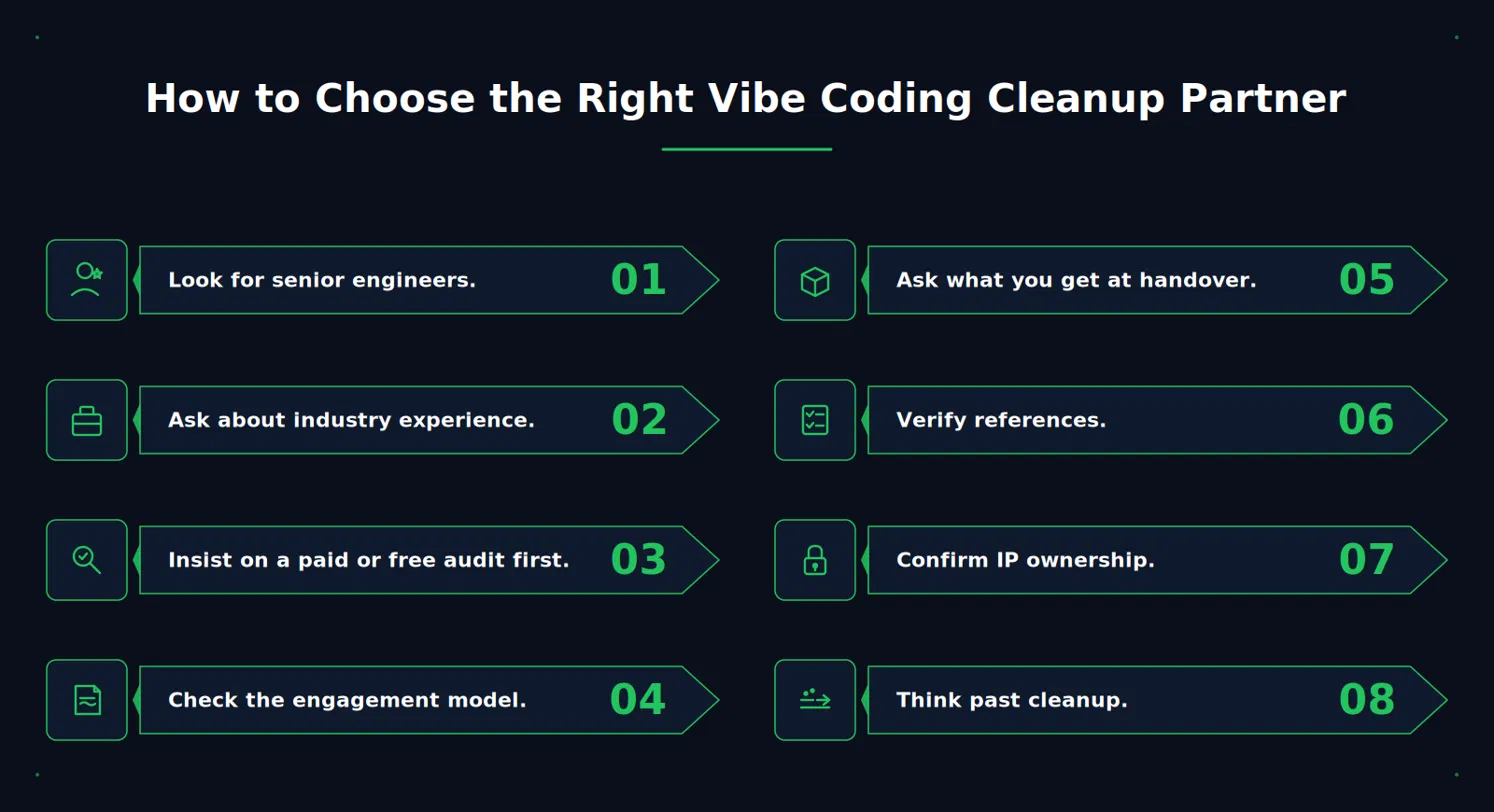
1. Look for senior engineers. Cleanup work needs people who recognize what AI tools tend to break. Senior engineers spot those patterns fast. Juniors learn on your dime.
2. Ask about industry experience. A HealthTech rebuild needs HIPAA awareness from the first commit. A FinTech product needs SOC 2 alignment. Make sure the team has shipped similar work earlier.
3. Insist on a paid or free audit first. Reputable firms run a code audit before quoting a full engagement. The audit tells you what’s broken, what’s fragile, and what the cleanup will actually cost.
4. Check the engagement model. Fixed-price sprints work when scope is clear. If your scope is shifting, outstaffing or dedicated team work are better options for your project. Avoid open-ended hourly engagements unless you have strong internal oversight.
5. Ask what you get at handover. Discuss the documentation, test coverage, CI/CD pipelines, and a runbook for your in-house team at the earliest stage. Without those, the cleanup half-finishes itself.
6. Verify references. Clutch reviews are a starting point. Direct calls with former clients tell you more.
7. Confirm IP ownership. You should own the architecture, the code, the documentation, and any model weights commissioned during the work.
8. Think past cleanup. The same partner may end up handling new feature work in web development, mobile application development, or machine learning services as you scale. A vendor that can keep going past the cleanup phase saves you onboarding cost later.
Conclusion
Vibe coding gets the prototype shipped. It rarely gets the company past Series A. The codebase that won you investors is the same codebase that breaks in production, fails security audits, and slows down every new hire’s first month.
A cleanup partner buys you time and stability. The right one knows where AI tools cut corners, fixes those corners without rewriting the whole product, and leaves you with code your team can actually maintain. Once the foundation holds, the same partner can support real AI product development on top of it.
Pick based on industry fit, engagement model, and what you need after the cleanup. Run a paid audit before signing a longer contract. The goal is simple: a stable, secure product that doesn’t depend on the next prompt to keep running.
FAQs
How long does vibe coding cleanup take?
The main factor here is the size and complexity of your project.
- Small apps (a single-purpose product) usually clean up in one to two weeks.
- Mid-size projects (a product with paying users or a signed pilot) take three to six weeks.
- Enterprise platforms (a multi-tenant SaaS, a regulated industry app, or an internal platform serving thousands of users) can stretch across several months in phases.
How much does vibe coding cleanup cost?
Hourly rates in this guide range from $25 to $99. But there are also few more factors that define the cost: codebase size, complexity, and how much of the system needs full architectural rework. For budgeting on AI work in general, the AI Cost Estimation Calculator can help you model the larger investment.
Can I keep using AI tools after the cleanup?
Yes, and most cleanup partners actively encourage it. The main goal of the good partner here is to set up the right rules so AI helps you ship faster. A responsible vibe coding cleanup partner will leave you with an AI coding readiness framework:
- What AI is safe to use for. Listing low-risk, high-leverage work.
- What AI should not touch without senior review. Highlighting the areas where AI mistakes compound fastest.
- How to enforce the rules. A short internal playbook of prompts and patterns your team has agreed to work.
What if my codebase is in a regulated industry?
Then you should pick a partner with direct experience in your specific compliance regime.
The standards that come up most often in cleanup work:
- HIPAA for any product touching protected health information
- SOC 2 for SaaS, B2B platforms, and anything enterprise customers run procurement on
- GDPR for products serving EU users (which includes any product with EU traffic)
- PCI DSS for anything that processes, stores, or transmits credit card data
- HITRUST for healthcare data with deeper certification requirements than HIPAA alone
- FedRAMP for selling to US federal agencies
- CCPA for products serving California users at scale
Do I need to share my full codebase with the cleanup team?
Not all at once, and not with write access until you say so.
Almost every reputable cleanup partner starts with an NDA before any code changes hands. The NDA covers the source code, the documentation, your data models, and anything sensitive about the business that comes up during the audit.
Once you sign the NDA, you typically grant read-only access through OAuth to your GitHub, GitLab, or Bitbucket repo. The team can see and clone the code but can’t push changes.
The audit happens in this read-only state. The team maps the architecture, runs static analysis, runs security scans, and writes the cleanup plan without touching anything. You see the plan first. You and the team agree on scope and price in writing. Only then do you grant write access, and even then it goes to a feature branch (never main).
If your codebase contains genuinely sensitive material, like a regulated dataset or proprietary algorithms you don’t want exposed, ask the partner about working inside your environment instead of theirs. Senior firms have done this for HealthTech and FinTech clients many times before.
How quickly will I see results after cleanup starts?
The first results come from the audit itself, usually within three to five days. By the end of the audit week, you have a written report covering the biggest risks, the architecture gaps, the security issues, and a prioritized list of what to fix first. Even before the team touches any code. That alone changes how you make decisions about the product.
Within the first two weeks, the cleanup team usually closes the highest-priority security gaps and stabilizes the deploy process. By the end of the first cleanup sprint, which typically lands somewhere between three and six weeks in, the difference shows up across the whole team. Deployments stop being scary. Bug reports drop. New engineers can onboard without three weeks of reverse-engineering AI-generated code. The product holds up under more traffic than it used to.
Should I cancel my AI tools after cleanup?
The point of cleanup is to put the right rules around how your team uses AI, so the next round of features doesn’t end up in the same place. The right answer is to keep the AI tools your team finds genuinely useful and pair them with the guardrails a cleanup partner leaves behind.