





Key takeaways:
- Quantum hackathons build the workforce first, breakthroughs later
- Beginners with strong Python regularly win sponsor tracks
- Three weeks of linear algebra is enough
- Judges now score documentation as heavily as code
- Classical computers still beat every hackathon project produced
- Hackathon archives now benchmark frontier AI models
This February, a team of Harvard students won first place at MIT’s quantum hackathon by finding nothing. Their project searched for a correlation between two properties of quantum circuits. The data came back empty; they said so on stage, and the judges handed them the win.
That result makes no sense at a normal tech competition, and perfect sense here. Quantum computing is a field where honest failure is worth more than a polished demo, because the machines sit a decade short of commercial usefulness and everyone in the room knows it. The competitions exist to build the people, and the people are the product.
So what is a quantum hackathon, really? And why are companies like IBM, NVIDIA, IonQ, and an insurance carrier or three spending real money to fly students to Cambridge in January so they can produce prototypes nobody will ship? The answer is more interesting than the one on the event pages, and it has very little to do with breakthroughs.
What is a quantum hackathon? Start with the weekend that invented the format
A quantum hackathon is a timed competition, usually 24 to 72 hours though sometimes stretching to six weeks, where teams build working quantum software against challenges written by sponsoring companies.
You code in a quantum software development kit like Qiskit or PennyLane. You run it on a simulator or, if you’re lucky, on a real quantum processing unit reached through the cloud. Then you present to judges who almost always work for the sponsor whose challenge you picked.
That’s the definition. The origin story is more useful.
Berkeley, April 6 and 7, 2018
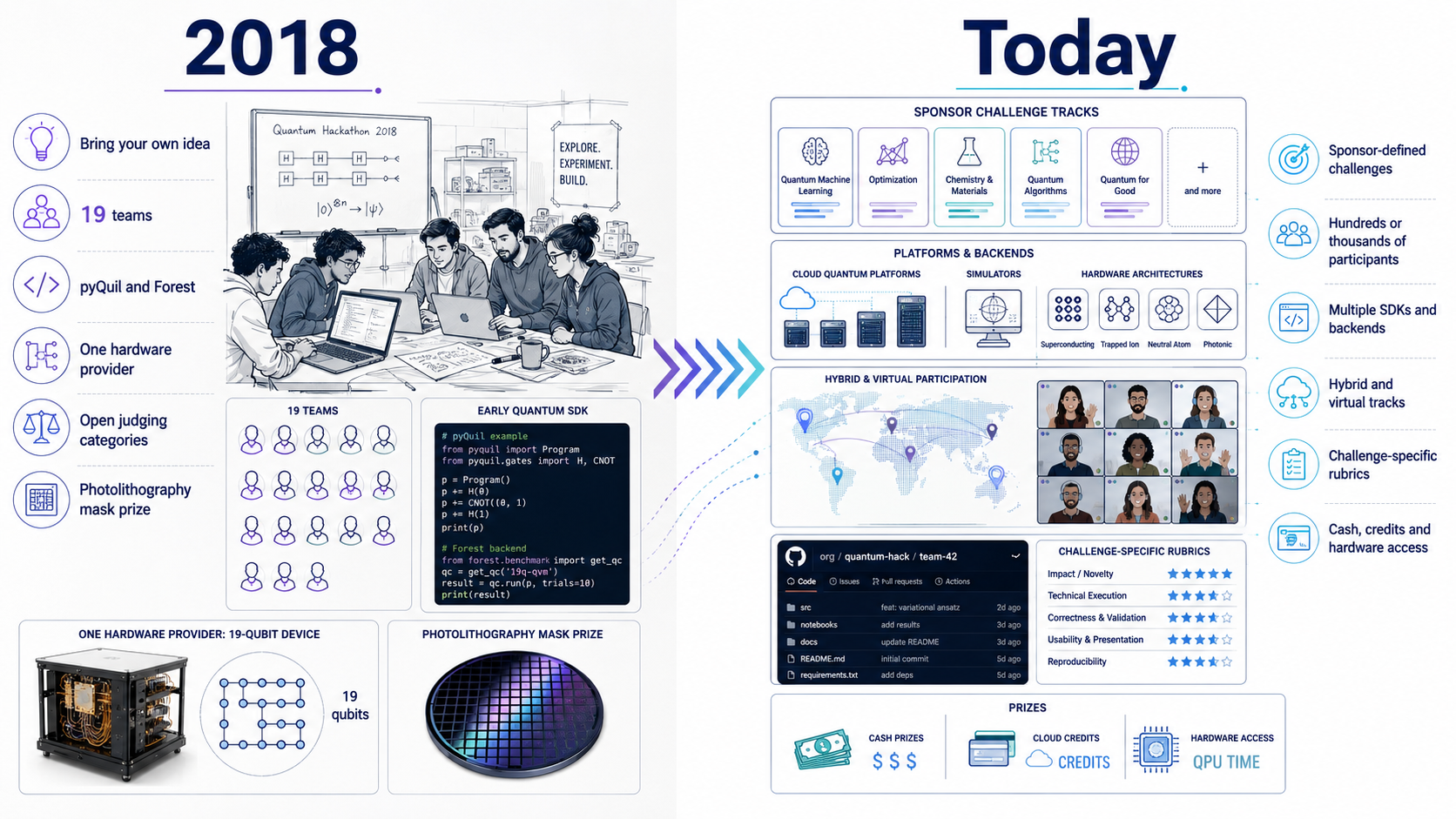
The first one happened at Rigetti Computing’s lab in Berkeley over a Friday and Saturday in early April 2018. An academic survey of quantum outreach later fixed this as the first quantum hackathon not focused on games. Rigetti announced it on March 8, expecting around fifty people out of academia, startups, undergraduate CS programs, and whoever else turned up.
The user problem Rigetti faced was borderline existential.
They’d built a 19-qubit superconducting processor and put it on the cloud. Nobody could say for certain that anyone outside a physics department could actually program the thing. Cloud access to quantum hardware was barely two years old; IBM had opened the first quantum processor to the public in 2016, and before that, running an experiment meant persuading a hardware group at a national lab to let you borrow their machine overnight.
Rigetti’s bet was that if you handed a working QPU to strangers for a weekend, a few of them would build something the company’s own engineers hadn’t thought of.
The announcement was blunt about the barrier they wanted gone: “You don’t need to be a quantum physicist to be a quantum programmer!”
The stack. Everything was Python. The library was pyQuil, Rigetti’s open-source quantum programming package, running inside the Forest environment.
Two backends: the 19-qubit chip itself, and a quantum virtual machine (a simulator) that handled up to 26 qubits. No graphical circuit builder, no managed notebook service. You wrote Python, compiled to Quil, and queued.
The challenges. There weren’t any, not in the modern sense. No sponsor tracks, no one-page briefs, no published rubrics. Teams brought their own ideas and got judged in three open categories. Compare that with MIT in 2026, where fifteen separate sponsor challenges each carried their own scoring criteria. The format has professionalized to a degree that would be unrecognizable to anyone in that Berkeley room.
The people. Nineteen teams presented. Attendees came from Berkeley and from Osaka, Tokyo, Basel, Toronto, Melbourne and London. The mix took in national-laboratory researchers, university professors, hobbyist programmers and, oddly, high school students.
The judges were a telling assortment: Zavain Dar, an investor at Lux Capital; Daniel Mulet from Toronto’s Creative Destruction Lab; John Morton, a nanophotonics professor at University College London; Guen Prawiroatmodjo, a Rigetti engineer and physicist; and Eleanor Rieffel, who ran NASA’s Quantum Artificial Intelligence Lab. A VC, an accelerator director, an academic, a vendor engineer, and a NASA scientist. That panel is basically a complete map of who cared about quantum computing in 2018.
Who won, and what they built:
Best expert project went to Hannah Sim and Jhonathan Romero of Zapata Computing and Harvard, Eric Brown of the Creative Destruction Lab and the University of Waterloo, and Evan Anderson of the University of Colorado Boulder. They built a quantum autoencoder for compressing quantum data, extending Romero’s earlier Harvard research. It became QCompress, an open-source tool with a demo notebook for compressing the ground state of molecular hydrogen. It outlived the weekend, which almost nothing at a hackathon does.
Best newcomer project went to six UC Berkeley students (Jordan Sullivan, Timo Joas, James Chen, Daniel Lengyel, Vladimir Kremenetski and Dhruv Devulapalli) for handwritten number recognition on a quantum computer. Quantum machine learning, in 2018, on nineteen qubits.
Most creative project went to James Wootton of the University of Basel, Jonathan DuBois of Lawrence Livermore National Laboratory, and M. Sohaib Alam, then splitting time between Valor Water Analytics and UT Austin. Three playable mini-games running on the QPU.
All three teams got the same prize: “a UV photolithography mask used to make our quantum chips,” in Rigetti’s words. No cash. No cloud credits. A piece of the fab.
Among the youngest attendees was Tanisha Bassan, a Toronto high school student who came with classmates from an innovation program. Her team tried unsupervised machine learning on molecular simulation, using helium hydride as a test case, aiming vaguely at drug discovery. They got an energy graph out of it and not much else. Her write-up afterward has the most honest sentence anybody has written about these events: “no one’s original idea turned out how they wanted to.”
The reason was qubit count. Everyone had scoped for a machine that didn’t exist yet.
How a quantum computing hackathon differs from the kind you already know
At a normal hackathon, your constraint is time. At a quantum hackathon, you get time, plus qubits and noise on top, and those last two refuse to yield to working harder.
Three differences show up in practice. The hardware is scarce and shared: a web app scales by adding servers; a quantum circuit waits in a queue.
When IBM ran its 2024 challenge, it dropped the requirement to use real hardware entirely, because thousands of people submitting similar circuits made the wait unworkable. Shot limits, meaning the number of times you’re allowed to run a circuit, are capped. More and more teams run on GPU-accelerated simulators instead, which is a quietly significant admission about where the field actually is.
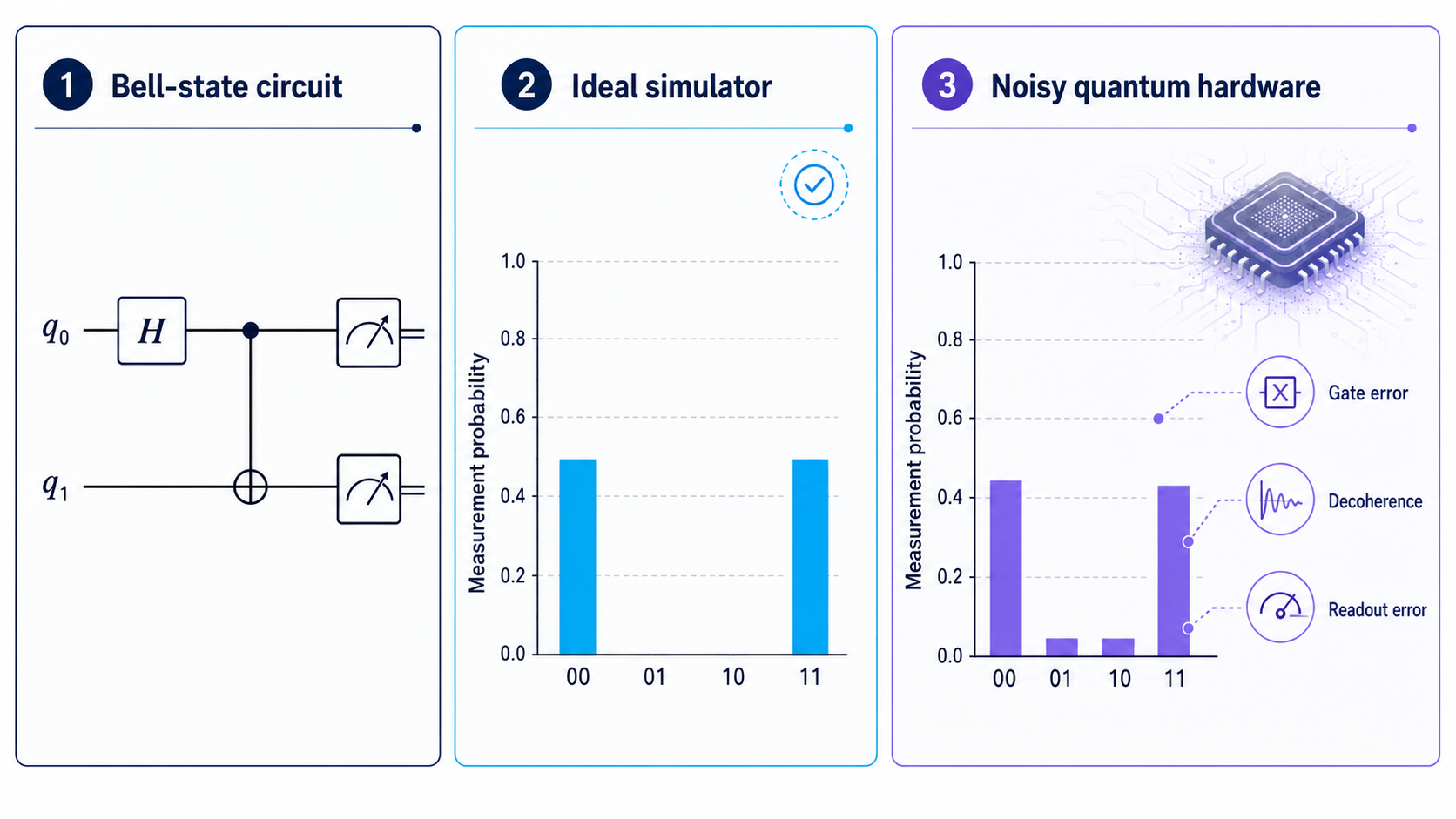
Then the physics fights back. Decoherence and gate errors mean your circuit degrades as it gets deeper, so an algorithm that works on a simulator can return noise on real silicon. This is the NISQ era, noisy intermediate-scale quantum, and every project at every one of these events lives inside that constraint.
And the judges are the sponsors. Challenges get written by the company supplying the hardware, and that company’s engineers score you. Criteria are set per challenge, not per event. Winning means satisfying one specific vendor’s idea of interesting.
Who runs quantum hackathons?
Universities (MIT, Yale, Chalmers), national programs (the UK’s National Quantum Computing Center, Indian state councils, the city of Berlin), vendors (IBM, Xanadu, Rigetti in its day), and research institutes like CERN’s Open Quantum Institute.
Look at who sponsors the individual challenges, though, and a cleaner split appears. I’ll come back to it, because it’s the most useful thing to understand before you pick an event.
The product is people
The analogy I keep coming back to is from medicine.
No hospital runs a residency program because residents are good at treating patients. They aren’t. They’re slower than attending physicians, they order tests that don’t need ordering, and they make more mistakes. A teaching hospital accepts a measurable hit to efficiency for years, because the alternative (a country with no new doctors) is worse than any inefficiency residency creates. The output is physicians, and the hospital eats the cost of making them.
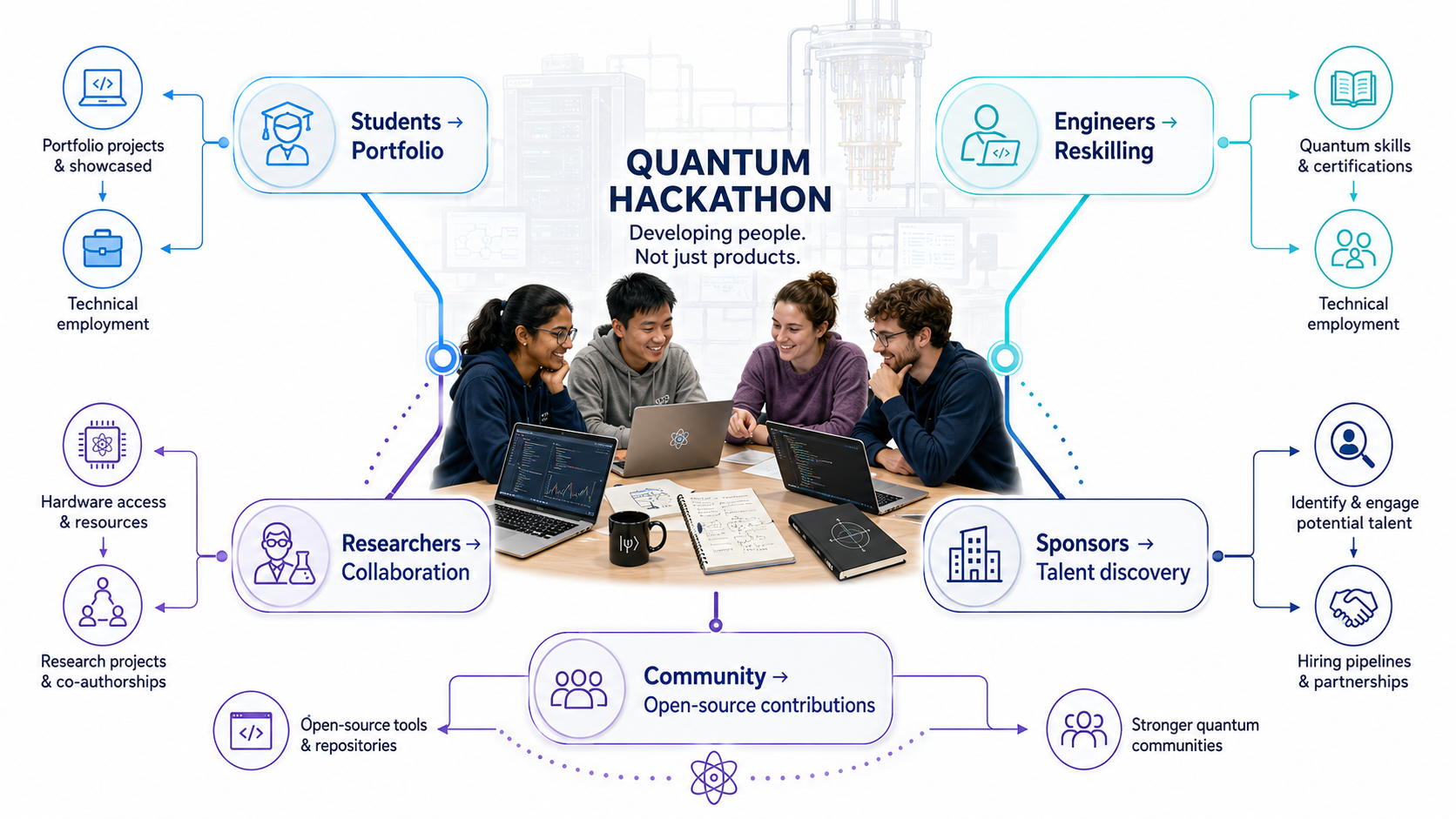
Quantum hackathons are residency programs for a field that doesn’t have enough doctors yet.
McKinsey’s quantum research found roughly one qualified candidate for every three open quantum jobs. The Quantum Economic Development Consortium counted more than 7,000 open quantum roles globally in mid-2025, against a pure-play quantum workforce of about 16,500 people. The field is trying to fill close to a third of its own headcount from a pool that doesn’t exist.
The UK’s National Quantum Computing Center is unusually direct about this. Its hackathon sits inside a program called SparQ, whose stated goals include finding use cases, improving quantum programming literacy and building a user community. Director Michael Cuthbert described the mechanism simply: “There’s nothing like running a piece of code yourself.”
That’s the whole theory of change. Reading about superposition does nothing. Watching your circuit return garbage because you scoped it for 40 qubits and got 7, that teaches you what this field is.
What each group gets
Computer science students and recent graduates get the only quantum project they can put on a résumé before they have a job in quantum. Which sounds circular because it is: the entry-level bar assumes experience that only exists inside industry.
Researchers get hardware access and collaborators, and some get papers out of it. QuEra handed teams at MIT’s 2026 event early access to Tsim, an unreleased simulation backend, which meant academics were testing a tool before its public launch.
Recruiters get something closer to an NFL Scouting Combine than a career fair. The Combine is a strange event if you take it literally: teams evaluate football players by watching them run in a straight line in shorts, which is not football. But it isolates traits that predict performance under conditions you can’t otherwise see.
A quantum hackathon does the same. A résumé hides the thing you want to know: can this person scope a tractable problem when the hardware turns out worse than they expected, ask a mentor a good question, and ship something defensible by Sunday afternoon. You can tell by watching them do it.
Moody’s, which has sponsored MIT challenges, gave its reasoning without much decoration: hackathons are “a great way to generate innovative solutions… and to meet exceptional talent.” That second clause is a recruiting budget line.
The contribution nobody writes about
There is a real, measurable contribution to the field, and it doesn’t come from the flagship events at all. It comes from unitaryHACK, run by the Unitary Foundation, which inverts the model.
Instead of building demos, participants fix tagged issues in actual quantum open-source repositories and get paid a bounty when a maintainer merges the pull request.
The first edition drew over 370 registrants and produced more than 64 contributions with 26 bounties claimed. Half the participants had never contributed to open source before. One fix closed a QuTiP issue that had been sitting open since January 2018.
By 2024, the event covered 50 projects including the Amazon Braket SDK, Cirq, CUDA-Q, PennyLane and the Azure Quantum Development Kit. The 2026 edition ran June 3 to 17 with over $8,000 in bounties.
That’s merged code in libraries the industry runs on. Everything else on this page produces prototypes.
Every quantum hackathon worth your weekend
Here’s the working list. I’ve kept the difficulty ratings strictly grounded in reality: if a hackathon is labeled ‘beginner-friendly,’ it means rookies actually make the podium, well beyond the standard PR promises.
MIT iQuHACK
Late January or early February, annually, on MIT’s campus with a parallel virtual track. Open to all experience levels and free, with travel grants for underrepresented students.
The 2026 edition, its seventh, ran January 30 to February 1 and drew more than 400 in-person students plus over 1,000 virtual participants from 76 countries. Fifteen sponsors set challenges: NVIDIA, IonQ, IQM, QuEra, Superquantum, Alice & Bob, Quantum Rings, Nord Quantique, qBraid, BlueQubit, Classiq, State Street and Quantum Design. Everyone worked inside qBraid Lab, the event’s platform for five years running.
The in-person track runs on real hardware. The online track is simulator-only. If you want QPU time, you need to be in Cambridge.
Difficulty is mixed, since some sponsor tracks stay approachable while others sit at research level. It’s the widest on-ramp in the field and the one I’d point almost anyone at first.
YQuantum (Yale)
Early April, at the Yale Science Building in New Haven. Undergraduate and graduate students only, 18 and over, teams of three to five. High schoolers aren’t eligible.
The 2026 edition ran April 4 and 5 with 163 participants, seven challenges and over $3,400 in cash prizes. Submission is a single GitHub repository holding code and presentation. Sponsors included Alice & Bob, AWS with State Street, BlueQubit, Capgemini with The Hartford, QuantumCT with RTRC and qBraid, QuEra, and Travelers with LTIMindTree and Quantinuum.
Difficulty is high. The 2026 hardware tracks involved cat-qubit stabilization and T-gate cost analysis. This is not an introductory event, and I’d do one other hackathon before attempting it.
IBM Quantum Challenge
Historically twice a year, spring and fall, now folded into IBM’s Quantum Developer Conference programming. Online, open to anyone.
It’s built as a series of graded Qiskit exercises rather than an open build. The fall 2022 run drew over 1,600 active participants across 96 countries and racked up more than 4.4 billion circuit executions. The 2024 edition, built around Qiskit 1.0, reported record registration totaling over 5,000 Qiskit users, and notably dropped mandatory hardware use because of queue congestion.
Beginner to intermediate, fully scaffolded. If you’re doing your first one, do this one. Nothing else in the field is this structured.
QHack (Xanadu), currently dormant
Billed as the world’s largest quantum machine learning hackathon. The 2024 edition, its fifth, ran with over 2,000 participants from more than 90 countries and around US$200,000 in prizes, across 645 coding-challenge teams and roughly 24,000 submissions. It added an in-person component at Xanadu’s headquarters that year.
No 2025 or 2026 edition has been confirmed. Treat the series as paused. If it comes back it’s a top-tier event, but check before planning around it.
Berlin Quantum Hackathon
Six weeks, January to March, hybrid with finals in Berlin. Teams of up to five, six teams selected in total.
The first edition in 2026 kicked off January 19, closed February 20, and held finals on March 5. Prizes ran up to €9,000 in quantum hardware access plus travel to Berlin. Hardware came through the Kipu Quantum Hub, spanning IBM and IQM machines. The challenges came from Berlin institutions: brain-computer interfaces and neuromodulation from the Charité teaching hospital, and a public-transit optimization problem from the city transit authority. The Berlin Senate Department for Economics funded it.
Moderate difficulty, and six weeks removes the scoping panic. Good for people who want to build something real rather than something fast.
UK Quantum Hackathon (NQCC)
July or August, rotating between UK universities. The 2026 edition is at the University of Warwick, August 18 to 20. Students and early-career researchers.
The 2025 event in Edinburgh was the largest yet, with 15 teams, 75 participants and more than 45 mentors. The 2024 run at Warwick had 13 teams, 69 participants, 24 end-user mentors and 19 provider mentors. Use cases get submitted competitively by UK businesses and public bodies, then assigned to teams. The 2025 winner built a road-maintenance closure scheduler on D-Wave and IBM Quantum; the 2024 winner tackled insurance risk aggregation for natural disasters using Quantinuum, IonQ and Classiq.
Moderate, with heavy mentoring. Best on this list if you want an industry problem rather than a physics puzzle.
CERN Open Quantum Institute
Dates vary, running out of Geneva and globally. OQI aims its events at UN Sustainable Development Goals and distributes a “Hackathon in a Box” toolkit so organizers in regions with limited quantum access can run their own. The 2026 Quantum Materials Hackathon ran July 10 to 12 at CERN IdeaSquare with six teams. A 2025 event at AIMS Ghana produced a winning project using quantum simulation to speed up malaria drug development.
Amaravati Quantum Valley Hackathon (India)
Run by the Andhra Pradesh State Council of Higher Education at national scale. Semi-finals drew 293 teams and 1,758 students; the grand finale featured over 100 finalist teams and more than 600 students from 91 institutions. Teams of six, with at least one female member required. Ten real-world problem statements, backed by IBM, TCS, Google and Microsoft, tied to the commissioning of a 156-qubit IBM system at Amaravati.
For students in India, the scale and government backing are unmatched regionally.
unitaryHACK
Two weeks in June, fully virtual, open to anyone not employed by the Unitary Foundation.
The only event here where your output ships. You claim a bounty-tagged issue on a participating quantum open-source project, submit a pull request, and get paid if a maintainer merges it. The first accepted PR takes the bounty.
Difficulty depends entirely on which issue you pick. Some are documentation fixes; others go into compiler internals. If you want a portfolio artifact with a real commit history behind it, this is the one.
Also worth tracking
The Big Quantum Hackathon in Doha (November 2025, HBKU and QuantX, with a Qatar Airways challenge among others). IQM’s Quantum Hack. The WACQT and IBM event at Chalmers. NYUAD’s Quantum Hackathon for Social Good. Q2B’s hackathon from QC Ware, and the Quantum Internet Hackathon run by the Quantum Internet Alliance.
To find new ones: community directories track roughly two dozen events for 2026, up from a handful in 2022, a jump partly driven by 2025 being the UN’s International Year of Quantum, which mobilized 1.2 million people across more than 1,300 events in 83 countries. The growth is real; the directories are incomplete. Honestly, following the sponsors on LinkedIn works better than any list, including this one.
The 2026–2027 planning calendar
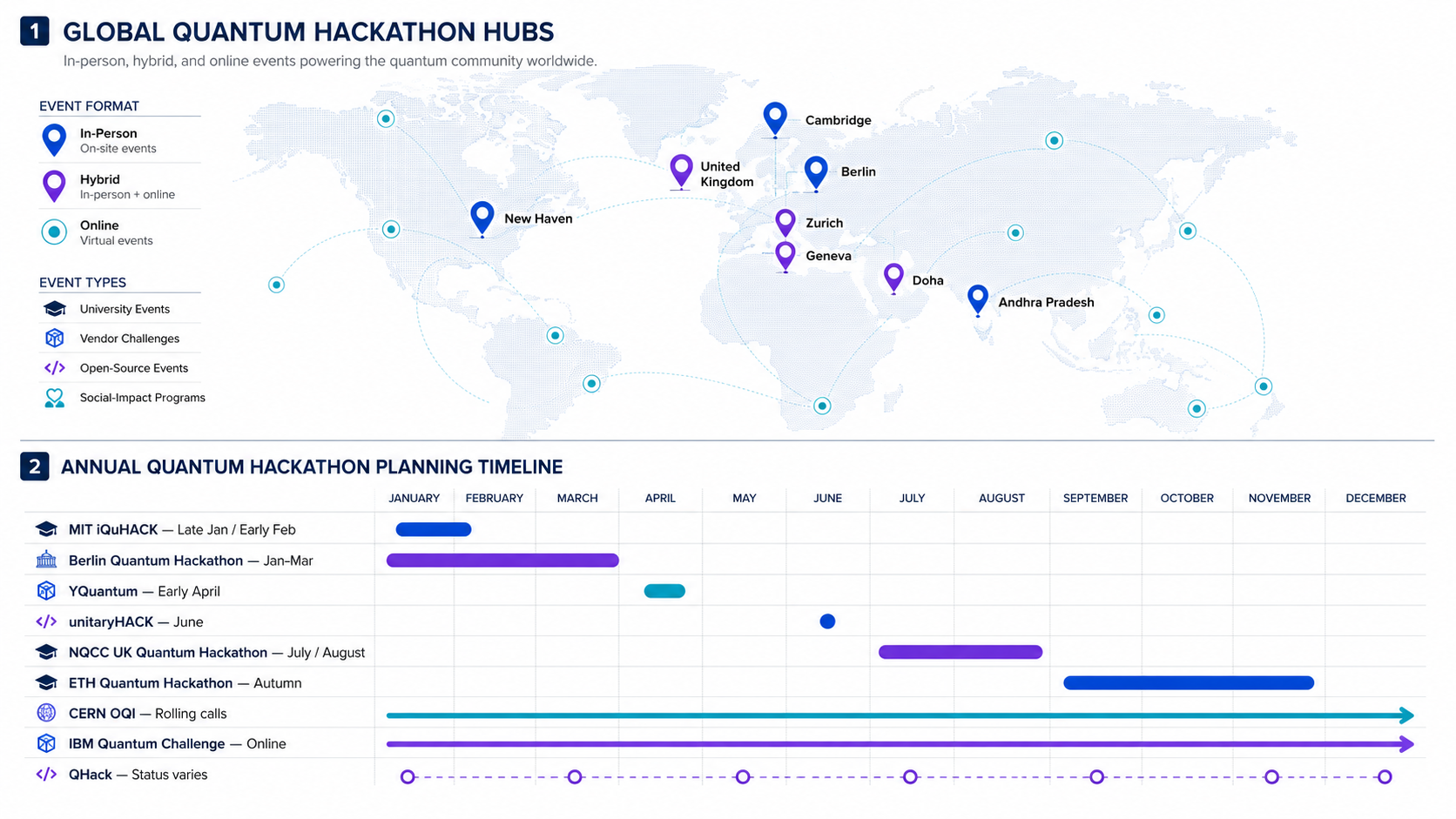
Most of these events recur on an annual cadence, so the table below is built for planning a year ahead rather than catching a single date. Timings reflect the usual window for each event; always confirm the current edition on the official page, since applications for flagship in-person tracks close weeks early and remote tracks often stay open far longer.
| Event | Next edition (typical window) | Location & format | Who can enter | How to apply | Platform / SDK | Notes |
|---|---|---|---|---|---|---|
| MIT iQuHACK | Late Jan / early Feb | Cambridge, MA + online | Students, graduate students, professionals, beginners | Apply online; in-person track closes early, remote track opens to the public | qBraid, Qiskit, real hardware | 7th edition drew 1,400+ across 76 countries. The widest on-ramp in the field. |
| YQuantum (Yale) | Early April | New Haven, CT; in person | College and graduate students only, 18+ | Team application, 3–5 members | Sponsor-dependent; GitHub submission | 2026: 163 participants, 7 challenges. Research-grade hardware tracks. |
| IBM Quantum Challenge | Spring and fall (now under QDC) | Online | Anyone | Register via IBM Quantum | Qiskit, IBM Quantum | Scaffolded exercises. The best first event. Hardware use now optional. |
| UK Quantum Hackathon (NQCC) | July / August | Rotating UK university; 2026 at Warwick, Aug 18–20 | Students, early-career researchers | Team application via NQCC SparQ | Provider-dependent; real QPUs + emulators | Industry problems assigned by UK end-users. Heavy mentoring. |
| ETH Quantum Hackathon | Autumn | Zurich, Switzerland; in person | Students and professionals | Registration via ETH QEC page | Mixed | 4th edition; overnight hacking. Confirm current terms on the page. |
| Berlin Quantum Hackathon | Jan–Mar (six weeks) | Hybrid, finals in Berlin | Teams of up to 5; six teams selected | Competitive application, closes early December | Kipu Quantum Hub (IBM, IQM) | €9,000 in hardware access. Long format removes scoping panic. |
| Amaravati Quantum Valley (India) | Winter, national rounds | Andhra Pradesh, India | Students, teams of 6 incl. ≥1 female member | Via APSCHE institutional channels | Qiskit | National scale: 1,758 students through semi-finals. |
| CERN OQI hackathons | Rolling calls | Geneva and worldwide | Depends on the specific call | Via CERN Open Quantum Institute pipeline | Mixed | Social-good focus, mapped to UN SDGs. “Hackathon in a Box” enables local editions. |
| unitaryHACK | Two weeks in June | Online | Anyone outside the Unitary Foundation | Claim a bounty-tagged issue, open a PR | Real OSS repos (Braket SDK, Cirq, CUDA-Q, PennyLane) | Your output ships. First merged PR wins the bounty. |
| Qiskit Global Summer School | Summer | Online | All levels; no prior quantum needed for the beginner track | Register via IBM; certificate needs scored labs | Qiskit, IBM Quantum | A course with challenges rather than a classic hackathon, but a strong entry point. |
| HAQS (qBraid) | Annual | Online | Open (confirm each year) | Via qBraid event page | qBraid Lab | Five quantum challenges. Verify the official call. |
| QHack (Xanadu) | Status unconfirmed | Online | Developers, researchers, QML audience | Via PennyLane if an edition is announced | PennyLane | No 2025–2026 edition confirmed. Treat as paused until Xanadu says otherwise. |
*Confidence note: iQuHACK, YQuantum, IBM, NQCC, Berlin and unitaryHACK details are drawn from primary event sources. HAQS, the exact ETH window, and any future QHack edition are lower-confidence and should be verified against the official page before you plan around them.
How to prepare for a quantum hackathon in three weeks
The most common question from people considering their first event is some version of do I need a physics degree? No. And the people who insist you do are usually the ones who haven’t attended.
A team that won a university quantum hackathon put it plainly afterward: “none of us has ever tried quantum computing before.” They were experienced programmers. That combination, strong coding and zero quantum, is the most common winning profile at beginner-friendly events.
The real prerequisites
Python, fluently! You need to read someone else’s library, understand a stack trace, and work in Jupyter without friction. Every major quantum SDK is Python-first. NumPy matters more than you’d expect, because quantum states are vectors and operations on them are matrix multiplications.
Linear algebra, specifically. Vectors, matrices, eigenvalues, tensor products, complex numbers. If you can explain what an eigenvector is without looking it up, you have enough. If tensor products are unfamiliar, spend an evening on them, because they’re how multi-qubit systems get described and everything downstream depends on it.
The physics: less than you fear. You need working intuitions for four things: superposition, where a qubit holds a combination of 0 and 1 until measured; entanglement, where two qubits’ outcomes correlate regardless of distance; measurement, which collapses the state and destroys that superposition; and shots, the repeated runs you need before any of it means anything. You won’t need to solve the Schrödinger equation, nor do you need any background in quantum mechanics.
Actually, let me reframe that. The thing you need is comfort with the idea that your program is probabilistic and your results are statistical. Engineers who expect deterministic output struggle far more than people who never studied physics.
A three-week plan
Week one, circuits.
- Learn what a quantum circuit is, what a gate does, and how to read a circuit diagram.
- Get comfortable with the Hadamard gate, which creates superposition, and CNOT, which creates entanglement.
- Build a Bell state (two entangled qubits) and work out why the measurement results come out the way they do.
- Use a Bloch sphere visualizer; seeing a single qubit’s state as a point on a sphere makes the algebra click faster than the algebra does.
Week two, one framework, properly.
- Pick the SDK your target event uses and work through its official quantum computing tutorial end to end.
- Don’t sample three frameworks. Depth in one beats familiarity with several, and they all teach the same concepts anyway.
Week three, one algorithm, deeply.
- Implement Grover’s algorithm from scratch on a simulator. It’s the best teaching algorithm in the field: the speedup is easy to state, the circuit is small enough to reason about, and amplitude amplification, the mechanism underneath it, shows up everywhere else. If you understand Grover’s, you’ll follow most challenge briefs.
- Then run something on real hardware. Anything. A two-qubit circuit is fine. The point is to meet the queue, the shot limit, and the noisy result before you’re doing it at 2 am with a deadline.
Where to learn quantum computing for free
IBM’s Qiskit documentation and textbook, PennyLane’s demos and codebook, Microsoft’s Quantum Katas, and the Amazon Braket examples repository are all free and all good. Qiskit has the most material. PennyLane is stronger if you’re coming from machine learning.
On certification: quantum computing certification programs exist, and they’re fine, but no hiring manager in this field has ever picked a certificate over a GitHub repository with working circuits in it. Build the repo first. If you want the credential afterward for a corporate promotion process, that’s a legitimate reason to get one.
One physicist, one engineer, one presenter
Team composition is where I’ve watched the most predictable failures, and the pattern never varies: a team of specialists who all specialize in the same thing.
Three roles matter. The physicist, or whoever’s read the papers, understands what the challenge is asking, knows why the sponsor cares, and can tell a meaningful result from noise. Without that person, you’ll build something that runs and means nothing.
The engineer writes clean code fast, sets up the repo, handles the environment, and fixes what breaks at hour thirty. Hackathon projects die from dependency problems more often than from bad ideas, and somebody has to own that.
The presenter matters more than teams believe. Twelve teams present. The judges have been listening for four hours. Someone has to explain what you built, why it’s interesting, and where it falls short, in under five minutes, to a person who is tired. Teams underinvest here constantly and then lose to a worse project with a better pitch.
If your team is three people, one doubles up. If it’s five, add a second engineer, not a second physicist.
Solo versus team, and finding people
Most events require teams. Yale mandates three to five members, Berlin allows up to five, India requires six. MIT permits individuals but pushes hard toward grouping.
If you don’t have a team, register anyway. Every event runs a team-formation session, and the mixed-background teams that come out of those are frequently better than the pre-formed friend groups, because friend groups tend to share skills. Discord servers open weeks ahead, and that’s where teams actually form. Show up in the channel with a sentence about what you’re good at and which challenge interests you.
One practical note on hackathon ideas: Success here is about adaptability. Because organizers keep the challenges secret until the very last minute, teams with a rigid, pre-baked idea usually end up solving the wrong problem entirely.
Which quantum SDK to learn first
Framework choice is mostly made for you. The sponsor whose challenge you pick supplies the hardware, and the hardware determines the SDK. Knowing what each one is good at helps you choose the challenge, though.
Qiskit (IBM) is the most widely used quantum SDK and the one with the deepest documentation and largest community. Python-based, compiles to OpenQASM, connects to IBM hardware through Qiskit Runtime, which handles the queueing and batching of circuit executions. If you’re doing an IBM challenge, a university event, or anything in India or Northern Europe, this is what you’ll be writing. Its statevector simulator handles small circuits locally, and anything bigger goes to the cloud. Start with a Qiskit tutorial from the official docs rather than a third-party course, since IBM keeps theirs current and the API has changed meaningfully since version 1.0.
PennyLane (Xanadu) is built around differentiable programming, which makes it the natural pick for anything involving quantum machine learning. If your challenge involves training something, a variational circuit or a quantum classifier or a hybrid model, PennyLane’s integration with automatic differentiation saves you from writing gradient code by hand. It’s hardware-agnostic too, so a PennyLane circuit can target IBM, IonQ or Rigetti backends with a device string change.
Amazon Braket is AWS’s managed service and the pragmatic option when you want several hardware types behind one API. The Amazon Braket SDK gives you superconducting, trapped-ion and neutral-atom machines through the same interface, plus managed simulators. If your challenge involves benchmarking one architecture against another, Braket removes most of the plumbing.
Cirq, Q# and the rest. Cirq is Google’s framework, strong when you need fine-grained control over gate scheduling. Q# with Microsoft’s Quantum Development Kit is a genuinely different design, a dedicated language rather than a Python library, and it shows up in Azure Quantum challenges. Classiq takes another approach again, synthesizing circuits from higher-level descriptions, which is why it appears in enterprise-sponsored tracks where participants aren’t circuit specialists. Two more you’ll meet at 2026 events: NVIDIA’s CUDA-Q for GPU-accelerated simulation, and hardware-specific tools like Bloqade for QuEra’s neutral atoms or TKET for Quantinuum.
For your first event, I highly recommend starting with Qiskit. Forget the endless debates about which framework is technically superior; what really matters is survival. When your code breaks at midnight, Qiskit’s massive community footprint means someone on a forum has almost certainly solved your exact problem. The only catch is that it doesn’t pivot as easily to machine learning. If PyTorch is already your go-to, you’ll have a much smoother time starting with PennyLane.
What to build: the four shapes that place
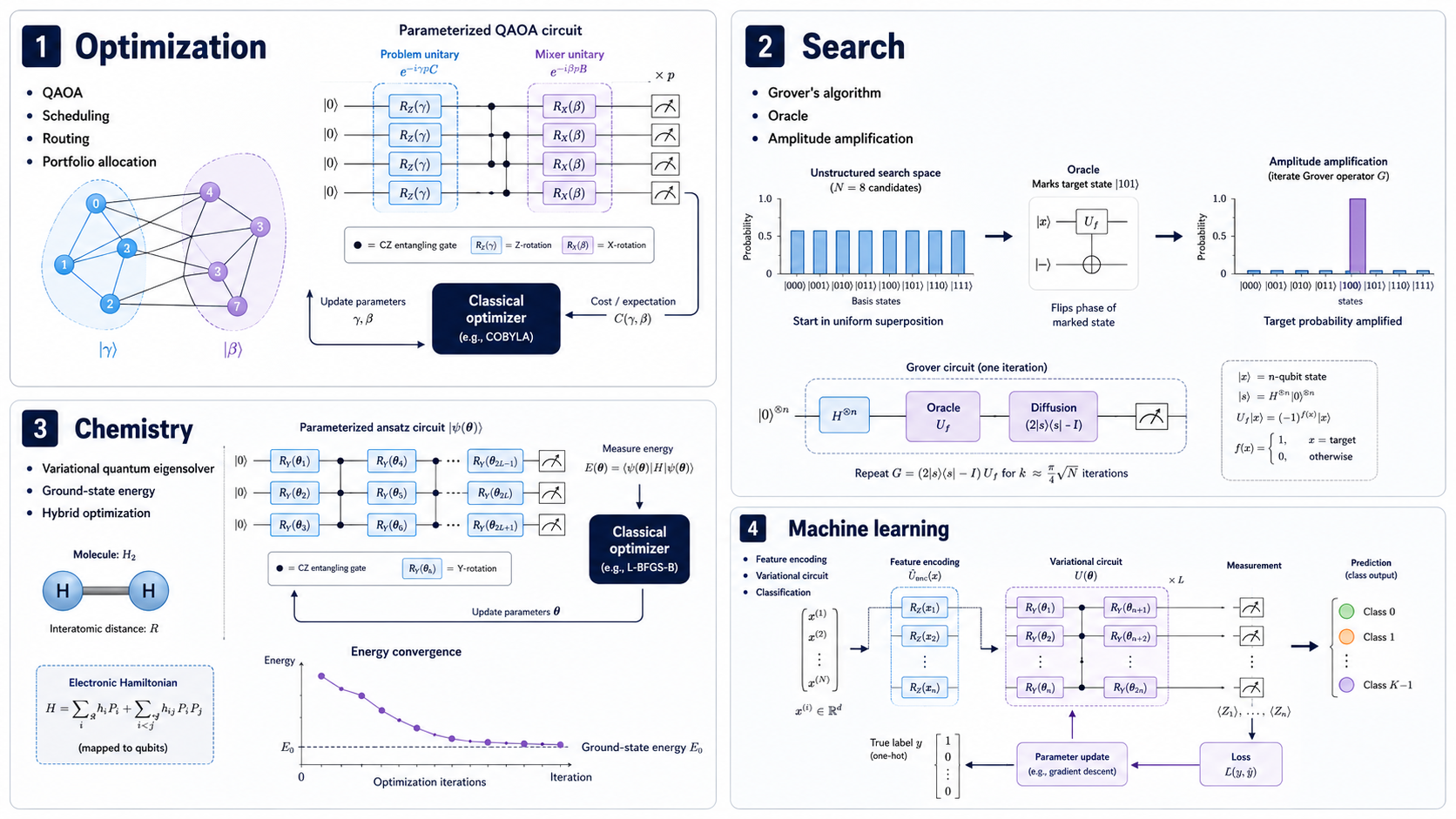
Almost every quantum hackathon project fits one of four shapes. Knowing which one your challenge implies saves you the afternoon most teams lose to indecision. One hackathon winner admitted his team “spent the entire afternoon deciding which project to work on,” which is an expensive way to spend a third of your build time.
Optimization, which means QAOA
The Quantum Approximate Optimization Algorithm is the workhorse of enterprise challenges. Route planning, scheduling, portfolio allocation, bin packing: anything where you’re picking the best configuration out of a combinatorial explosion.
The pattern goes like this. Express the problem as a QUBO (quadratic unconstrained binary optimization) formulation, map it to a cost Hamiltonian, run QAOA with a classical optimizer tuning the parameters, then benchmark against a classical solver.
At Yale in 2026, the logistics challenge was a capacitated vehicle routing problem. Winning teams combined QAOA with geometric clustering and classical optimizers. Hybrid approaches, not pure quantum. That’s the lesson: judges reward teams who use the quantum component where it helps and classical methods everywhere else. Teams that force everything onto the QPU produce worse results, and they know it by hour twenty.
Search, which means Grover’s algorithm
Grover’s algorithm finds an item in an unstructured set in roughly the square root of the time a classical search needs. For a database of a million entries, that’s about a thousand steps instead of a million.
It’s less common as a challenge target than QAOA, partly because the speedup is quadratic rather than exponential and partly because loading real data into a quantum state is its own unsolved problem. But amplitude amplification, the mechanism underneath Grover’s, turns up inside other algorithms constantly. Learn it for what it teaches rather than what it wins.
Chemistry and materials, which means VQE
The variational quantum eigensolver finds a molecule’s lowest energy state, its ground state, by using a quantum circuit to prepare trial states while a classical optimizer adjusts them. It’s the most physically motivated application in the field, because simulating quantum systems is the thing quantum computers are naturally suited to.
Molecular hydrogen and lithium hydride are the standard hackathon test cases: small enough to run, real enough to mean something. And that 2018 Berkeley team compressing the ground state of molecular hydrogen was working the same territory, eight years earlier.
Machine learning, which means variational circuits
Quantum machine learning covers classifiers, quantum convolutional networks and feature-encoding schemes. Yale’s 2026 finance challenge was a QML problem in disguise: extract nonlinear signal from noisy financial data using quantum feature augmentation. One team tested 1,620 circuit designs and reported that ensembles of random quantum circuits beat their best classical baseline by about 5%.
Be skeptical of results like that. A 5% edge on a hackathon dataset isn’t a demonstration of quantum advantage, since the classical baseline was also built in a weekend. But it’s a legitimate finding, presented honestly, and that’s what judges want.
The 2026 shift nobody’s writing about
Something changed in the hardware tracks this year, and it’s worth knowing before you pick a challenge.
The physics-side challenges at MIT and Yale in 2026 were overwhelmingly about error correction. Yale’s Alice & Bob challenge asked teams to stabilize cat qubits under hardware drift, and winning teams used reinforcement learning to do it.
QuEra’s challenge at both events centered on the cost of T gates and magic states under Clifford+T decomposition, with teams exploring transversal gates, zoned architectures, and the Eastin-Knill theorem. MIT’s QuEra track judged teams on syndrome extraction and shuttling schedules.
Three years ago, these events ran VQE demos. Now they’re running quantum error correction research, which mirrors exactly where the industry’s attention has moved. It also means the hardware tracks have gotten substantially harder while the enterprise tracks stayed accessible.
Three project ideas that work for a first event
Beginner-friendly quantum computing project ideas that have placed at real events: a quantum game (Wootton’s team won a category with this in 2018 and the format still works, because it demonstrates the physics and demos beautifully); a benchmark comparison, taking one algorithm across two backends or two noise models and reporting honestly what you find; or a visualization tool that makes an abstract concept legible, since judges are educators as often as engineers.
Negative results place, as the Harvard team from the opening already proved.
Solved, being solved, and nowhere close
The marketing never spells out the gap between what a quantum hackathon can demonstrate and what the field can deliver. That gap is enormous, and knowing where it sits is the difference between picking a challenge you can finish and picking one that will humiliate you by Sunday morning.
I’ve sorted the territory into three bands.
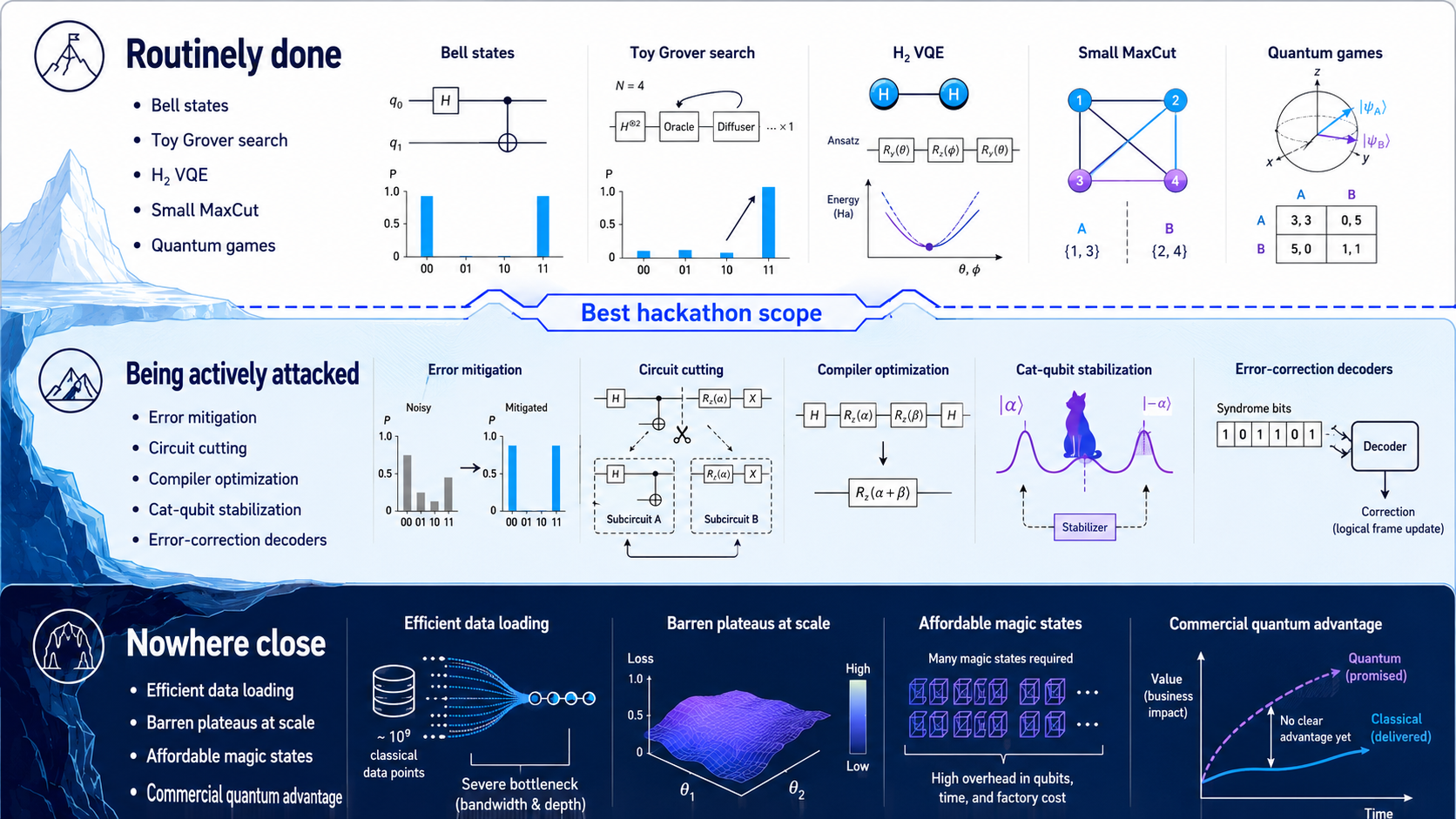
Routinely done. These are the problems a prepared team can finish inside a weekend, and they’re the backbone of every beginner track. Building and measuring a Bell state. Running Grover’s algorithm on a toy search set. A variational quantum eigensolver finding the ground-state energy of molecular hydrogen or lithium hydride. A small MaxCut problem solved with QAOA. A circuit visualizer, or a playable quantum game. None of these beats a classical computer, and none pretends to. They exist to teach the mechanics, and they do that job well.
Being actively attacked. These are the live research problems that show up as hard sponsor tracks, the ones where a genuinely good hackathon result can turn into a workshop paper. Error mitigation, meaning squeezing a usable signal out of noisy hardware without full error correction. Circuit cutting, which splits a circuit too big for one machine into pieces that fit. Compiler cost reduction, the work that won a Clemson team first place at MIT in 2026. Cat-qubit stabilization under hardware drift, which Yale teams tackled with reinforcement learning that same year. Syndrome-extraction decoders for error correction. Progress here is real and incremental, and nobody has closed any of these problems.
Nowhere close. These are the field’s structural walls, and a hackathon team will not move them in a weekend. Half of quantum computing’s hype evaporates once you see that these four are unsolved:
| Open problem | Why it blocks real advantage |
|---|---|
| The input problem (data loading) | Loading a large classical dataset into a quantum state can cost as much time as the quantum algorithm saves, which quietly erases the speedup for most “big data” applications people imagine. |
| Barren plateaus | In variational circuits, the training gradients flatten out exponentially as you add qubits, so the optimizer has nothing to follow and the model won’t train at useful scale. |
| Magic-state and T-gate cost | Fault-tolerant algorithms lean on T gates, and manufacturing the “magic states” they need carries an overhead so steep it dominates the resource budget of any real fault-tolerant machine. |
| Advantage on a real business problem | No hackathon project, and no production system anywhere, has yet beaten the best classical method on a genuine commercial workload. Every optimization demo you’ll see is a comparison; the classical side still wins. |
That last row is the honest headline of the whole field right now, and it’s why I keep calling these events residency programs rather than research labs. The 2026 shift toward error-correction challenges is the community walking, deliberately, toward that third band. Cat qubits and T-gate accounting are early foundations for the fault-tolerant machines that might one day clear the fourth wall. Might. Danna Freedman of MIT puts that milestone ten to fifteen years out, and she builds the hardware.
The scale of the gap is easy to underestimate until you see the raw numbers. Caltech research published in March 2026, reported by the Financial Times, estimates that a genuinely useful quantum computer needs at least 1,000 logical qubits. Oxford Quantum Circuits’ Genesis machine, one of the commercial systems companies are already paying to access, has 16. That distance is the reason skeptics like Gil Kalai, a mathematician at the Hebrew University of Jerusalem, argue to the Financial Times that error correction may never be made robust enough to close it at all. He may be wrong. The point for a hackathon participant is narrower and safe to rely on: the machine waiting in your queue this weekend is orders of magnitude short of the one the marketing describes, and your project has to be scoped for the machine that exists.
So when you read a challenge brief, place it in a band before you commit. A beginner aiming at a band-three problem will produce nothing. A strong team coasting on a band-one problem will lose to someone who reached into band two and failed honestly.
How to win one
Documentation used to be an afterthought at these events. It isn’t anymore. MIT’s 2026 challenge briefs stated explicitly that the write-up was heavily weighted in judging, described as a chance to present both your approach and your solution’s performance.
Which means a well-documented partial result now beats an undocumented working prototype. I’d have called that a mistake five years ago. I’ve changed my mind: in a field where nothing works yet, the reasoning is the deliverable.
Read the criteria before you write code
Judging criteria get set per sponsor and they’re specific. QuEra’s 2026 MIT brief listed exactly what evaluators would weigh: how well teams used Bloqade’s kernels to generate circuits and noise models, how accurate their analysis of error sources was across heuristic and bespoke noise models, and how smart their compilation of moves and syndrome extraction turned out.
That’s a rubric. Teams who read it and structure their write-up against it score better than teams with stronger results and no structure. Spend the first thirty minutes reading the brief properly.
Scope for hour thirty, not hour one
The most reliable failure at quantum hackathons is scoping for hardware that doesn’t exist. Tanisha Bassan diagnosed it in 2018, and nothing has changed: teams design for the qubit count they wish they had.
Practical rule. Build the smallest version that produces a result, get it working end to end, then scale. A two-qubit version that runs beats a twelve-qubit version that doesn’t. Judges have seen a hundred ambitious failures and considerably fewer honest, complete, small things.
Budget a third of your time for understanding and scoping, a third for building, and the last third for running it, documenting it, and rehearsing the pitch. Teams routinely spend 80% building and then present something they never tested on hardware.
The demo
Five minutes in front of tired judges, one of whom is a sponsor engineer who knows your problem better than you do. Lead with what you built and what happened. Don’t build toward a reveal; state the result in the first thirty seconds and spend the rest explaining how you got there.
Say what didn’t work. Every experienced judge in this field respects a team that says “we tried X, it produced noise, here’s our theory why” more than one that quietly omits it. In a NISQ-era field, honesty about failure is a technical skill.
Four mistakes I’d bet on seeing at any event
Picking the challenge with the biggest prize instead of the one that matches your team. Not running anything on real hardware until Sunday morning, then discovering the queue. One person writing all the code while three watch. And treating the write-up as paperwork rather than as the thing being scored.
The Monday after
The event ends Sunday. What you do that week decides how much it mattered.
Clean the repository. Write a README explaining the problem, your approach, what you ran it on, what the results were, and what you’d do with more time. Include shot counts and backends. A hiring manager who opens your repo six months from now needs to understand it in ninety seconds, and most hackathon repos are unreadable by Tuesday.
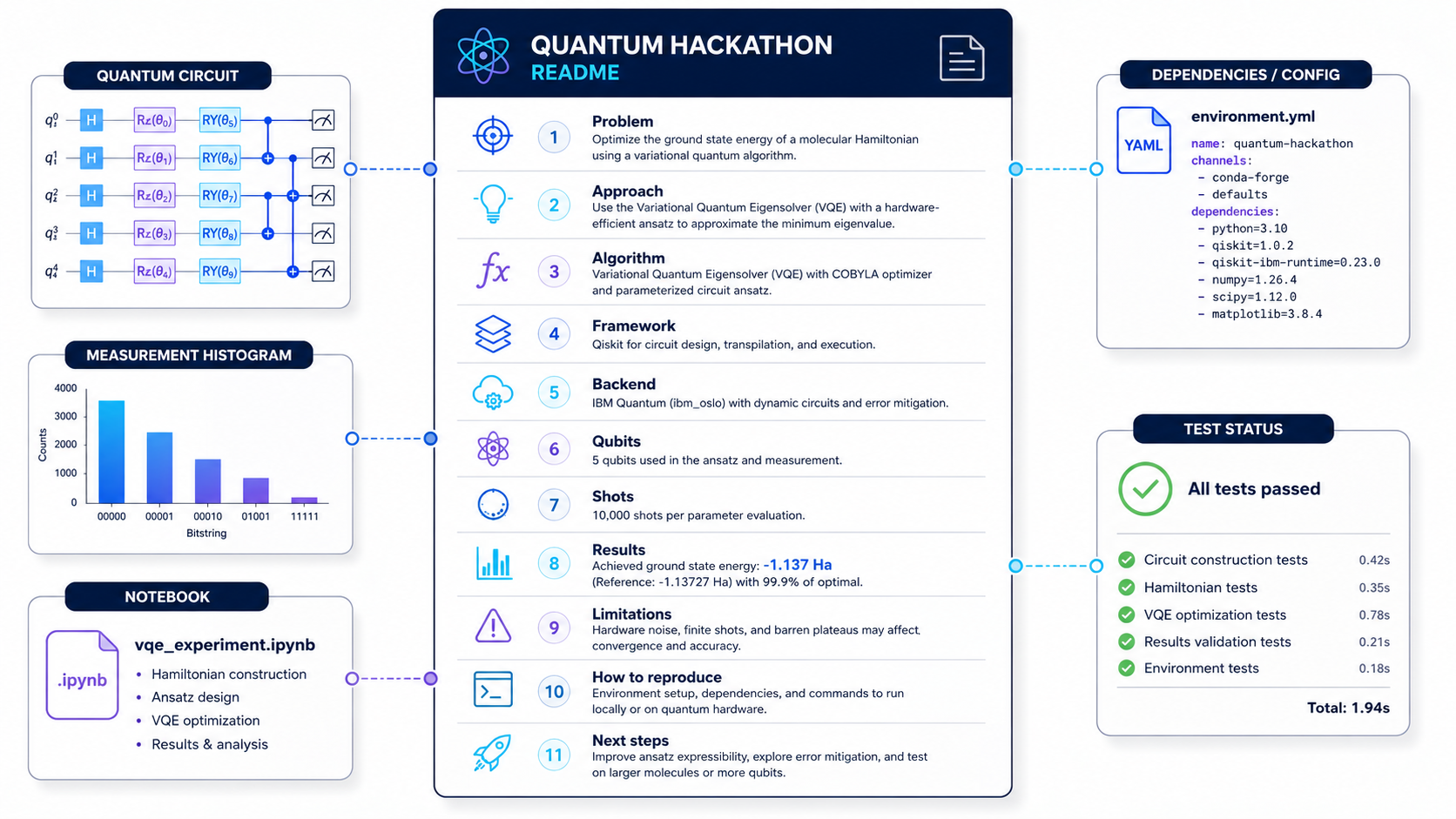
Turn it into a portfolio artifact. It’s the closest thing to a credential in a field with no standard credential. An honest, documented quantum project, even a partial one, is a stronger signal than any quantum computing certification, because it shows you can work inside the field’s actual constraints.
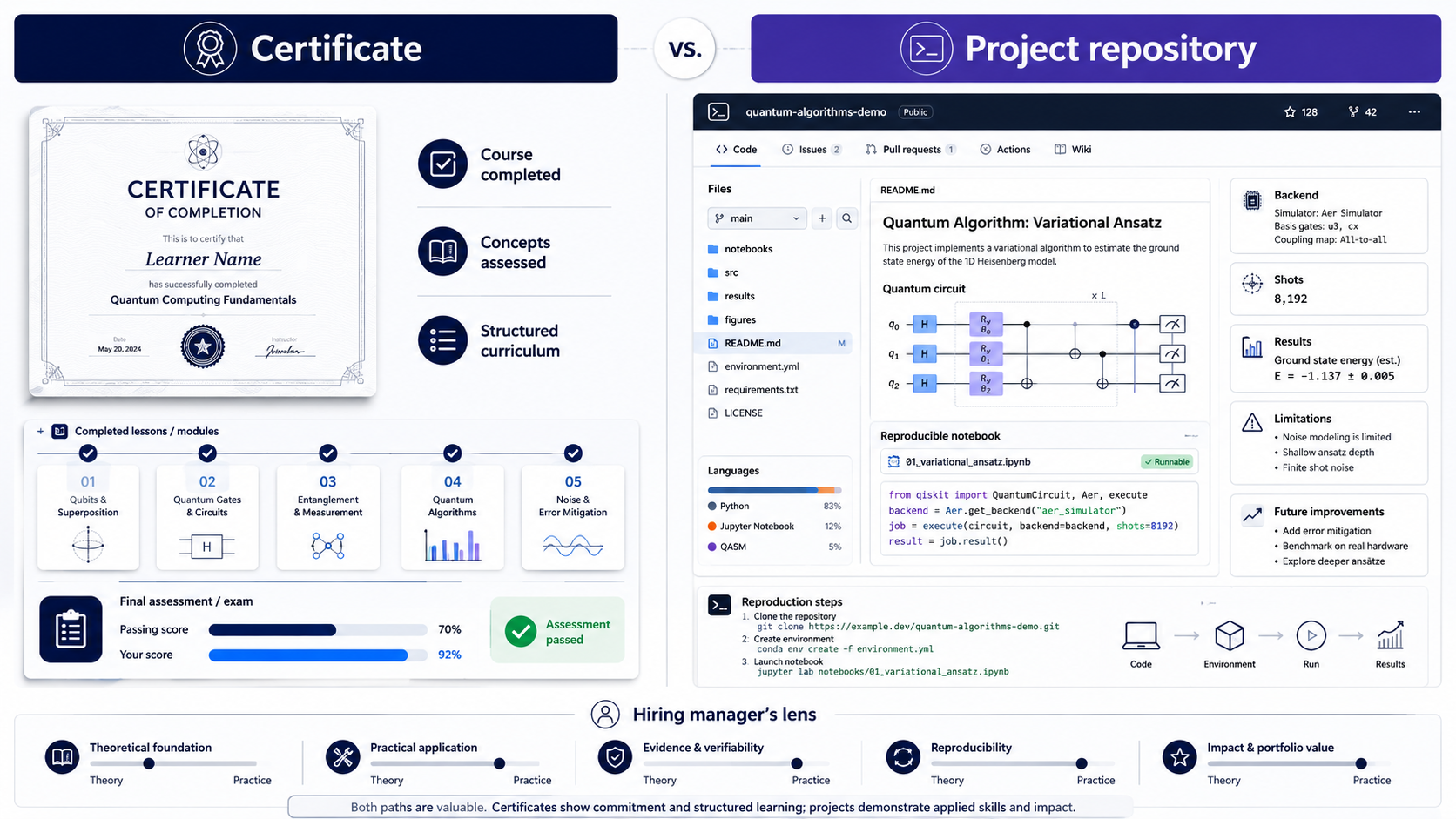
Stay in the community. Discord servers stay active after the event, and Unitary Foundation’s community and the Qiskit Slack are where open-source contribution opportunities appear. An open-source commit is the only hackathon output that ends up in production code.
Then do another one. The strongest teams at MIT in 2026 included groups who’d already competed together at multiple quantum hackathons, which is the residency effect again. Repetition under pressure is the mechanism.
Superquantum is the case worth knowing. It started as a project at MIT’s 2022 event, became research papers, then became a company. At MIT’s 2026 event, Superquantum was one of the fifteen sponsors setting challenges. Four years from submitting a project to writing one.
Where the code goes afterward
Your repo’s fate is one story. The stranger story is what happens to the thousands of projects in aggregate.
The coding challenges from QHack, the ones teams raced through in 2022, 2023, and 2024, have been packaged into a benchmark called QHackBench, built to measure how well large language models write quantum code in PennyLane. Problems that students solved over a weekend became the exam that frontier AI sits, and the best models fail roughly half of the problems that hundreds of humans finished two years earlier. A follow-up system called PennySynth, engineered specifically to do better, reaches 68% on the same challenges.
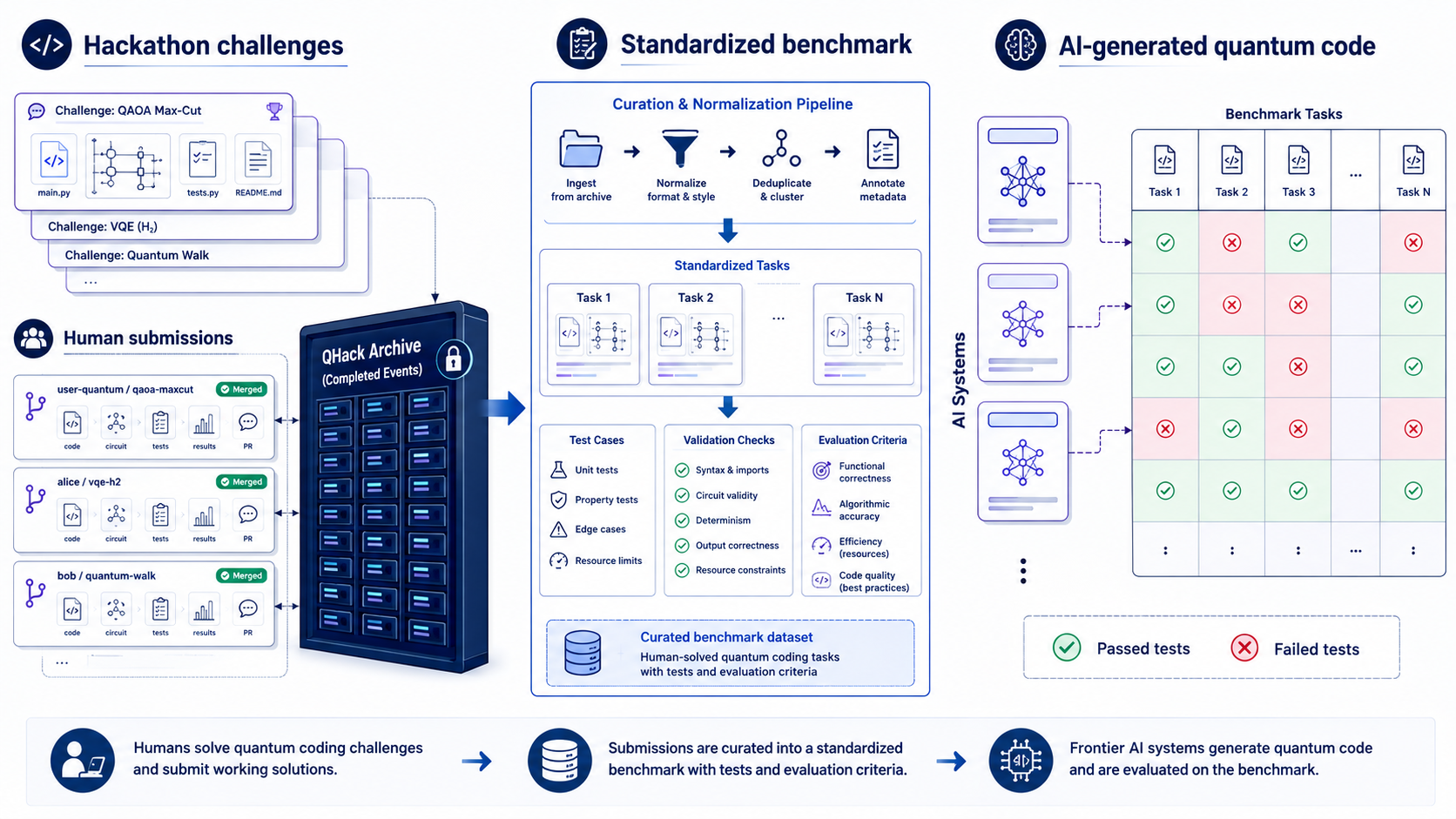
That one benchmark says more about the strange difficulty of quantum programming than any explainer could, and it exists only because a hackathon archived its challenges. Hackathon problems became the yardstick the rest of the field measures itself against.
Some of the work becomes production code. I mentioned unitaryHACK earlier, where merged pull requests land in libraries the industry actually runs on. That’s the channel where a weekend’s work stops being a demo and becomes a line in the Amazon Braket SDK or PennyLane that some engineer, somewhere, depends on next year without ever knowing where it came from.
Funded research is the third route, and the UK’s model is the clearest example of it. A use case that a team sketches at the NQCC hackathon can graduate into its SparQ program, which supplies real money and hardware time, and the results get written up in a public Use Case Compendium spanning healthcare, energy, finance and logistics. The weekend becomes a proof of concept, which becomes a funded project. Similarly, the team that won a CERN Open Quantum Institute event in Ghana with a malaria drug-discovery project carried it onward to CERN and an international summit. The hackathon was the on-ramp, not the destination.
The rarest fate is simple longevity. Almost nothing built at a hackathon survives the following Tuesday. QCompress, the data-compression tool from that very first Berkeley weekend in 2018, is one of the exceptions that proves the rule: eight years on, it’s still an open-source project people can pick up. Most work doesn’t last because it isn’t meant to. The point was never the artifact.
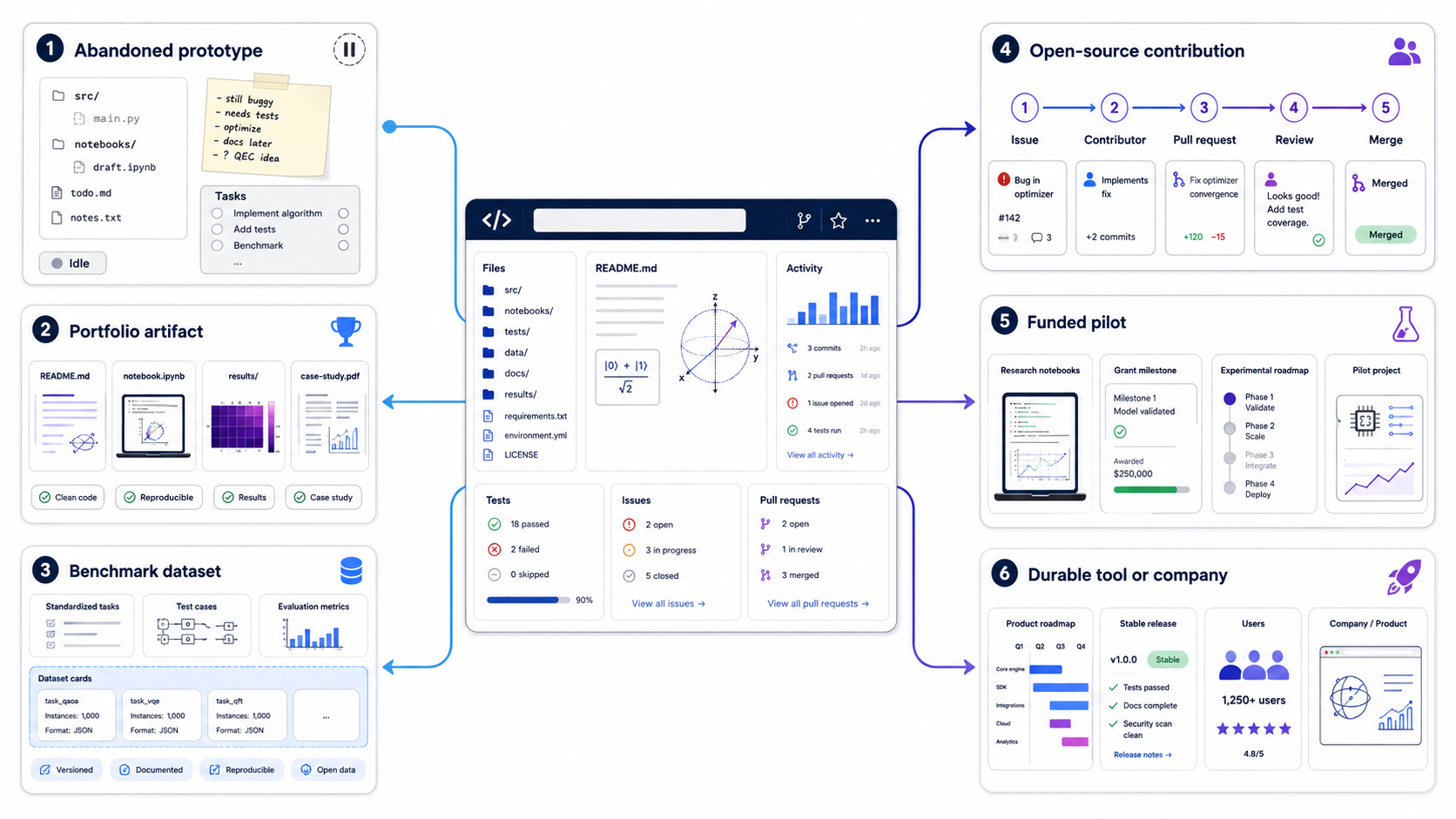
These weekends convert human effort into benchmarks, merged commits, funded pilots and, occasionally, a durable tool. A finished product almost never appears on that list, because the field can’t build finished products yet. The output is infrastructure for the field itself.
How a company builds a quantum team, using hackathons as the curriculum
Everything above is written for the person entering a hackathon. This section is for the reader on the other side of the table: the CTO or engineering lead at a company that suspects quantum computing will matter to them eventually and has no idea how to start. The honest answer to “how do we build a quantum team” runs against instinct, so let me give it plainly.
Do not hire a physicist first.
The reflex is to recruit a quantum PhD, hand them a budget and wait for magic. It’s the most expensive mistake available, because a lone physicist without a defined project generates cost and expectation with no validated outcome attached. The first goal of a first quantum team is internal capability: learning to read the technical material, run the examples, understand the limits, and ask vendors the right questions so you can tell real progress apart from market noise. Commercial delivery comes later, if it comes at all.
That team is a hybrid, and it’s smaller and cheaper than you’d guess. Four roles carry it:
| Role | Why they’re on the team | What success looks like |
|---|---|---|
| Senior Python / ML engineer | Nearly every quantum SDK is reached through Python, and an ML background maps cleanly onto hybrid and quantum-machine-learning workflows | Can build and explain two or three runnable notebooks, not merely copy a tutorial |
| Cloud engineer | Running quantum experiments means account setup, cost visibility and access governance, none of it trivial | Can describe the cloud execution path, its cost risks and the access model |
| BA/researcher | Without someone documenting as they go, the effort dissolves into scattered technical attempts with no conclusion | Can turn blockers, assumptions, scope and decisions into a management-ready summary |
| Part-time quantum advisor (external) | Needed at specific moments to review results, explain limits and validate assumptions | Can confirm the team is reading its own results correctly |
Notice who isn’t there. No full-time physicist, no narrow hardware specialist, no large R&D group. Those hires come after a first validation sprint proves which quantum track is worth pursuing, if any. Hiring them earlier buys expensive certainty about the wrong thing.
The learning path is a 30-day sprint, and its shape maps almost exactly onto hackathon preparation.
Week one builds quantum literacy: qubits, gates, circuits, measurement, noise, the meaning of NISQ, using IBM Quantum Learning and Qiskit tutorials, with the first working circuits as the output.
Week two moves to cloud execution: setup, simulators, a real QPU run, and a hard look at cost, using Amazon Braket, producing a documented execution path and a cost estimate.
Week three goes applied: quantum machine learning in PennyLane, with optimization and hybrid workflows alongside it, producing two or three applied notebooks.
Week four is synthesis, where the team writes an honest report of blockers and limitations and reaches a verdict of Go, No-Go, or Keep Learning.
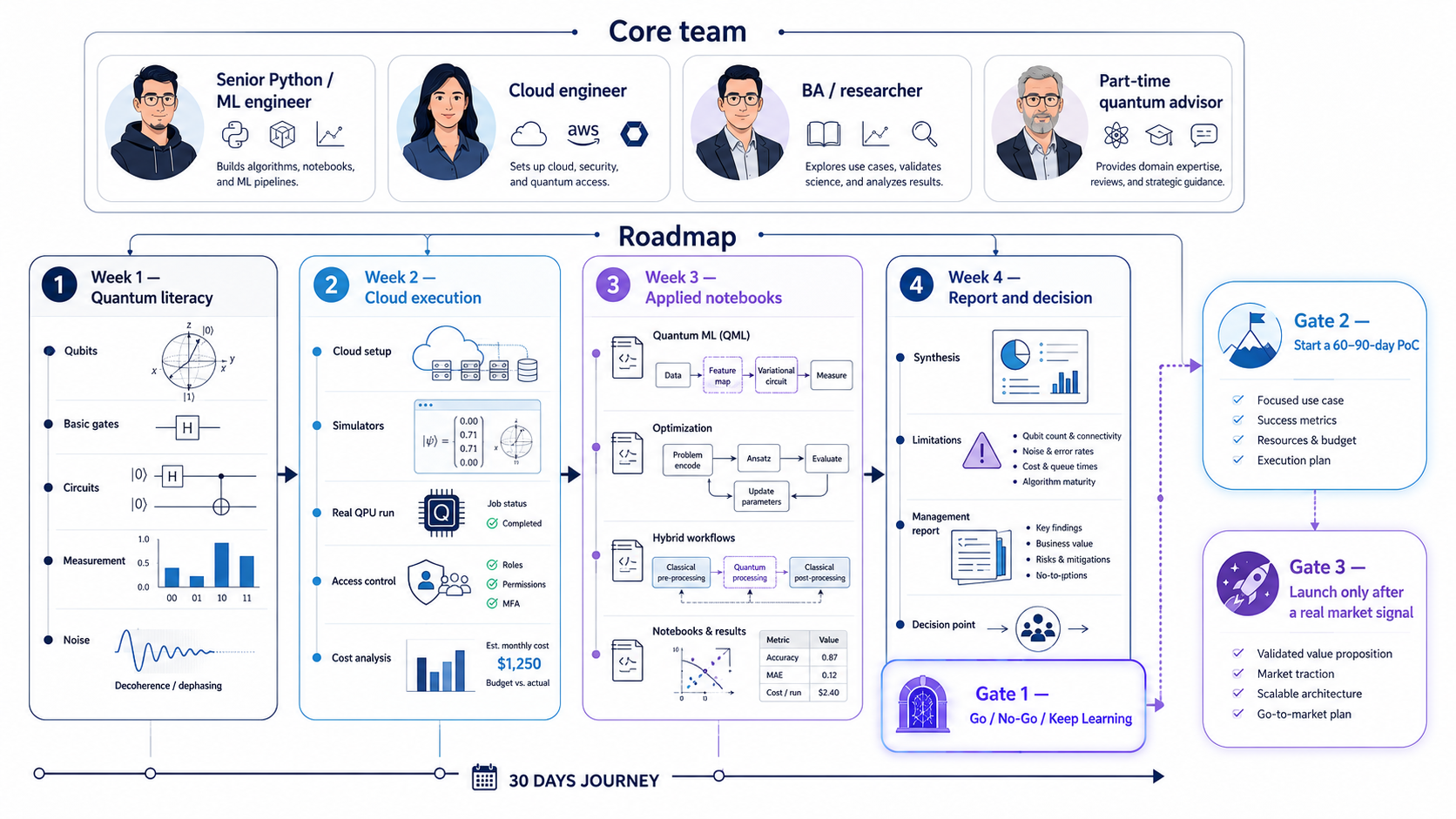
That verdict is the first of a few decision gates. Gate one, at day 30, asks whether to commit to a proof of concept. Gate two, after a 60-to-90-day PoC, asks the next question: grow the team, or stand up a formal offering.
Gate three fires only when a real customer or partner signal arrives, and asks whether to launch a delivery track. Each gate protects you from the failure mode of scaling before you’ve validated anything.
One detail ties this back to the rest of the article: the practice problems for that 30-day sprint come out of hackathon archives. The iQuHACK GitHub repositories and the Qiskit tutorials are a ready-made, free, industry-vetted curriculum, and the challenge list a company works through to skill up is the same one students competed on months earlier.
Beyond the recruiting and the talent signals, the archive is a training syllabus, sitting in public, that any company can mine to build its first quantum team without paying for a single course.
There’s one expensive trap worth repeating here: confusing a certificate with actual competence. Course badges are just window dressing. The true measure of a team’s readiness comes down to a runnable artifact. If you can deliver a working notebook and actually defend the logic behind it, you’re ready.
And if you’d rather run that first sprint with engineers who already ship AI systems for production, that is the kind of team we assemble at LITSLINK.
Frequently asked questions
Do I need to know quantum physics to attend a quantum hackathon?
No. You need Python, linear algebra, and a working feel for superposition, entanglement, measurement, and shot counts. Several winning teams have consisted entirely of programmers with no prior quantum experience. The physics you need can be picked up in about three weeks of evenings.
Are quantum hackathons free?
The major ones are. MIT’s iQuHACK is free and offers travel grants; Berlin’s event is free; IBM’s challenge is free and online. Some regional events charge nominal fees. Prize pools vary wildly. Some events hand out merchandise, Berlin offered €9,000 in hardware access, and QHack 2024 put up US$200,000.
Can beginners win?
Yes, in specific tracks. Most events run newcomer categories or accessible enterprise challenges alongside research-grade hardware tracks, and Rigetti’s very first hackathon had a “best newcomer” category back in 2018. That convention has largely survived. Winning an advanced error-correction track without a physics background isn’t realistic.
Do you get to use a real quantum computer?
Sometimes. In-person tracks at flagship events usually provide QPU access through cloud platforms, while online tracks tend to be simulator-only. Queue times and shot limits constrain everyone, and GPU-accelerated simulation is increasingly used instead of real hardware even at major events.
How long do quantum hackathons last?
Most run 24 to 72 hours. MIT’s runs three days, IBM’s online challenge spans weeks of asynchronous exercises, Berlin’s runs six weeks with mentorship, and unitaryHACK runs a fortnight.
Do companies actually hire from these events?
Sponsors attend explicitly to scout, and mentors are usually the engineers who’d interview you. What doesn’t exist is published data on conversion rates, so anyone quoting a hackathon-to-hire statistic is guessing. Treat it as a strong networking channel with documented anecdotal outcomes, not a job pipeline with measurable odds.
The box is still growing
Sankar Das Sarma, a physicist who has spent decades in this field and has no reason to flatter it, described the current state of quantum hardware as “akin to trying to make today’s best smartphones using vacuum tubes.” He’s right. The machines students queue for at these events are, by any honest reckoning, laboratory instruments pretending to be computers.
Roughly 1,400 people from 76 countries showed up in January anyway.
The Berkeley organizers in 2018 gave their winners a photolithography mask because they had nothing else to give. No cash prize budget, no established credential, no job offers, nothing but a piece of the machine itself. Handing someone a stencil from the fab was a way of saying: you were here, at the part where it was still being built.
That’s still what these events hand out. The field has no solutions to give, and won’t for a decade or more. What a quantum hackathon gives you is a weekend inside the constraint. The queue, the noise, the qubit you didn’t get, the circuit that returned garbage at 3 am and taught you why.
Somewhere this weekend, a student is submitting a repository that doesn’t work. In eight years they may be writing the challenge.