







Key Takeaways
- Agentic AI frameworks handle orchestration, tool integration, memory management, and agent coordination.
- The three main orchestration models are graph-based, role-based, and pipeline-based
- The right agentic framework depends on the complexity of your project, existing tech stack, memory requirements, and performance benchmarks.
- Most prototypes fall apart when it comes to memory and state management. Framework prototypes range from fully stateless to layered persistent memory, such as CrewAI and LangGraph.
As with the early days of public AI, the market for agentic AI frameworks has exploded. Unfortunately for teams seeking a technical framework that optimizes both the development and performance of their production systems, it means navigating a crowded landscape of architectures. This guide breaks down the three core orchestration models and reviews the ten frameworks that have shown the most promise. There is also a five-step decision process to help AI engineers, Python developers, and CTOs choose the right framework for their workflow.
Agentic AI Frameworks: The Working Mechanism
An AI agent autonomously interacts with its assigned data sources or environment, reasons over available data, takes action, and may reflect on the results to guide its next step. This four-stage cycle distinguishes an AI agent from a conventional chatbot, which traditionally relies on human prompts rather than setting up multi-step goals.
Manually wiring every prompt structure and creating memory stores quickly compounds the burden for each new prototype you need. This not only consumes engineering time but also creates unavoidable maintenance overheads. This is the reason why most teams building production systems rely on agentic AI frameworks. A recent PwC survey shows that 79% of organizations have already adopted AI agents, and more than 88% of CEOs plan to increase their AI budgets.
A mature agentic AI framework provides five core building blocks that would otherwise be built and maintained manually:
- Handling a predefined architecture offering the foundation for how agents are defined, reason, and interact with the system.
- Providing communication patterns that handle how the AI Agents interact with users, external systems, and other AI agents.
- Dictating how an agent decomposes goals into subtasks, sequences their execution, and handles errors mid-workflow.
- It can connect agents to external APIs, databases, and other code execution environments without requiring developers to build agentic AI systems from scratch.
- It allows teams to monitor and track agent behavior across the workflow. This is critical for tracing and debugging failures and ensuring AI agents meet compliance requirements.

Agent Orchestration Models
Before evaluating individual frameworks, it’s worth understanding the orchestration logic that each uses. The model influences how the AI agents are structured, communicate, and execute commands.
- Graph-based orchestration that defines agents as nodes in a directed graph. In this model, agent behavior follows a predictable path, so it is easier to debug, audit, and govern agentic frameworks with this orchestration. It is ideal for enterprise systems and regulated industries, although the model requires substantial upfront design work.
- Role-based orchestration is ideal for multi-agent collaboration. It gives each AI agent a fixed role, say Builder or Planner, then lets the agents collaborate by passing information between the assigned roles. The architecture is quick to prototype, but the model’s execution paths are less deterministic.
- Chain-based orchestration, also known as adaptive orchestration, gives agents maximum flexibility, especially when working on open-ended tasks. AI agents here can iterate and loop when needed. That said, this flexibility introduces huge complexity in testing and debugging these agentic systems.
| Orchestration model | How it works | Strengths | Limitations | Best for |
| Graph-based | Agents follow a predefined graph of nodes and transitions. | Predictable execution, easier debugging, and production reliability. | More upfront design, less flexibility. | Enterprise workflows, regulated industries, customer-facing applications. |
| Role-based | Agents are assigned fixed roles (Planner, Researcher, Builder) and collaborate through messages. | Simple architecture, intuitive, fast prototyping. | Less predictable, harder to enforce execution paths. | Multi-agent collaboration, MVPs, internal tools. |
| Chain-based (Adaptive) | Agents dynamically decide the next step and can iterate or loop as needed. | Maximum flexibility, well-suited for research and creative tasks. | Harder to test, debug, and govern at scale. | Research, exploration, experimentation, and open-ended tasks. |
Top 10 Agentic AI Frameworks Compared
The table below provides a quick comparison of where each framework sits across various criteria, including orchestration model, multi-agent support, memory capabilities, Human-in-the-loop (HITL) support, and primary use case.
| Framework | Orchestration model | Multi-agent support | Memory capabilities | HITL support | Best used for |
|---|---|---|---|---|---|
| AutoGen | Role-based | Strong | Moderate | Moderate | Team-building collaborative AI systems where multiple agents reason together asynchronously |
| CrewAI | Role-based | Strong | Strong | Limited | Deploying structured agent teams with defined roles across repeatable task-driven pipelines |
| LangChain | Chain-based | Partial | Moderate | Limited | Prototyping LLM-powered apps with broad API integration |
| LangGraph | Graph-based | Strong | Strong | Strong | Running multi-step agent workflows that require predictable execution |
| LlamaIndex | Retrieval-centric | Moderate | Strong | Moderate | Apps where agents need to reason over large document sets |
| Semantic Kernel | Planner-based | Moderate | Moderate | Strong | Enterprise AI environments requiring Java or .NET compatibility |
| OpenAI Agents SDK | Graph-based | Strong | Managed | Moderate | Hosted AI agents built on OpenAI models that want managed agent hosting without custom orchestration |
| Google ADK | Graph-based | Strong | Strong | Moderate | Gemini-powered agents and Google Cloud deployments |
| PydanticAI | Agent-centric | Limited | Moderate | Limited | Type-safe Python AI agents with structured outputs and validated LLM responses |
| Haystack | Pipeline-based | Moderate | Strong | Moderate | Building search-heavy systems with a modular, composable pipeline |
AutoGen
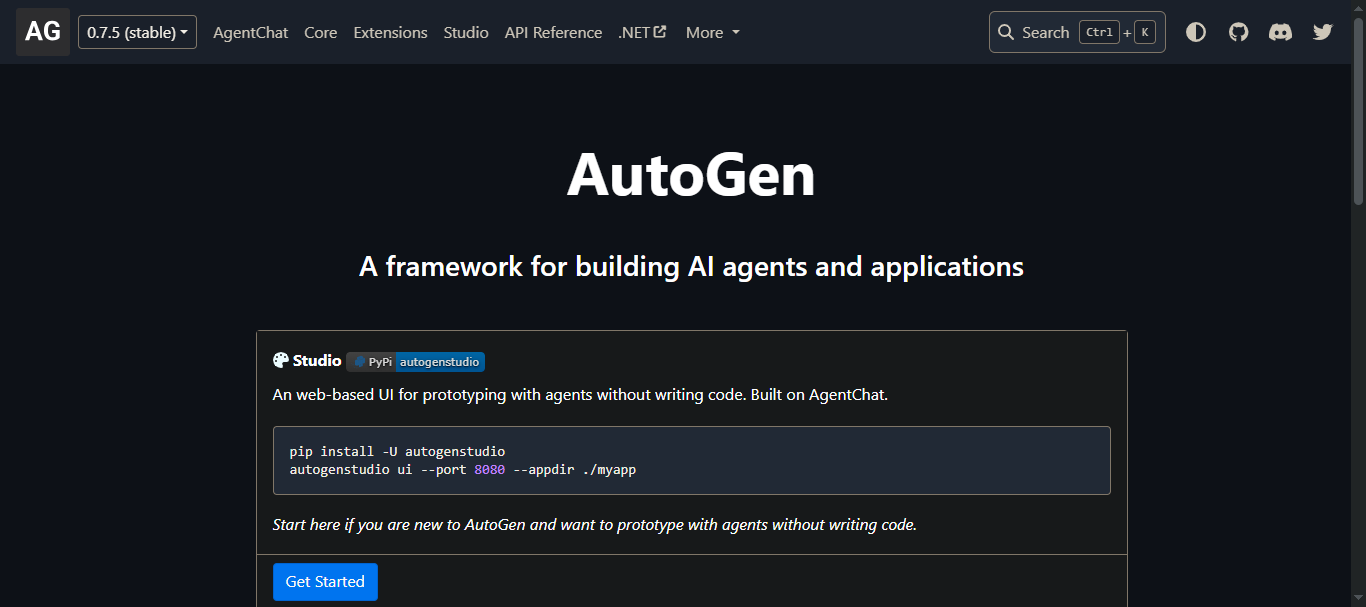
AutoGen is a Microsoft open-source framework for building multi-agent AI applications that is designed to support complex workflows. AutoGen enables asynchronous messaging among multiple agents, which enables parallel execution across multi-agent teams without disrupting workflows.
Features
- A three-layer architecture comprising Core, AgentChat, and Extensions, allowing developers to choose different abstraction levels.
- The framework has built-in configuration for both single- and multi-agent configurations and is compatible with multiple LLM providers.
- Offers Human-in-the-loop support.
- The framework provides code execution capabilities.
AutoGen’s important technical advantage lies in its asynchronous message-passing architecture. The model allows multi-agent workflows to run in parallel when needed, which may reduce latency and help in solving complex tasks much faster.
Strictly enforcing execution paths among agents is difficult, which makes the model less suitable for workflows that require precise sequencing. If you want to build applications that need persistent context, you may need to supplement the framework with external memory.
AutoGen’s conversational model makes the framework ideal for AI research assistants and collaborative code generation tools.
CrewAI
CrewAI is an open-source Python orchestration framework created by João Moura in late 2023. The framework is designed for multi-agent orchestration and production workflows. The design principle of this framework is to assign each agent in the system a specific role and support these role-based agents.
Features
- Role-based agent design, with each agent in the crew given an explicit goal.
- Framework has a layered memory system for active task execution and persistent information across sessions.
- Has a built-in task delegation system that lets agents assign subtasks to other agents, enabling sequential and parallel task execution.
- Supports custom tool integration and is compatible with multiple LLM providers, allowing for effective scaling, tracing, and deployment tooling.
CrewAI’s role-based architecture’s major strength lies in its layered memory system. It is ideal for multi-agent systems that need both memory for active task context and the ability to build on information from previous sessions.
The role-based architecture results in high token consumption. Benchmarking data shows that CrewAI consumes more tokens than single-agent setups.
CrewAI is ideal for task-oriented multi-agent pipelines such as content production systems, automated research, and sales intelligence, where agents can collaborate on a set of tasks across multiple sessions.
LangChain
Launched in 2022 by Harrison Chase, it’s one of the most adopted open-source frameworks for building LLM-powered chatbots and AI agents. LangChain’s developer-friendly design and range of integrations with external APIs and databases have helped in its widespread adoption.
Features
- Framework’s chain-based architecture gives it an extensive integration library that covers LLM providers, APIs, and vector databases.
- Has built-in memory classes that allow customizable memory management for varying context retention strategies.
- Developers can build complex sequences of LLM calls and tool invocations.
- Has an active open-source ecosystem with extensive documentation and strong support for retrieval-augmented generation.
LangChain’s extensive integration coverage and connector library are a major selling point to teams looking to pull together multiple LLM providers and external systems into a single application. Its extensive documentation and active community also provide a great range of reference implementations for teams building tools with single-agent capabilities.
However, this flexibility and integration coverage mean that the chain-based architecture can incur higher latency and token usage than other leading frameworks.
LangChain’s best use cases apply to teams in the early stages of developing single-agent tools, chatbots, and document question-answering systems.
LangGraph
LangGraph is an advanced extension framework built on top of LangChain. The framework has a graph-based orchestration. Therefore, rather than composing sequences of LLM calls into chains, it models workflow states and agent steps as nodes in a directed graph.
Features
- Graph-based orchestration model for stateful workflows.
- Has in-thread and cross-thread memory management for workflow sessions.
- Native human-in-the-loop support with configurable checkpoints.
- Tool integration, including external APIs and databases.
- Fully compatible with the LangChain ecosystem and built-in support for parallel agent execution (where the graph design allows it).
LangGraph’s strength is in its low latency and token consumption. Modeling workflows as graphs rather than chains minimizes unnecessary LLM involvement at each step, thereby reducing latency and performance degradation when scaling production.
The graph-based model requires a lot of upfront design work. As a result, the learning curve is steeper than that of other frameworks, such as CrewAI.
LangGraph’s strongest use case is in complex agent workflows such as customer-facing automation systems, enterprise workflows, and agent tasks that need to persist context across sessions.
LlamaIndex
LlamaIndex was originally built to address the persistent problem of the inability of LLMs to reliably connect to external data at scale. This is the framework that has expanded beyond providing infrastructure for models to index, query, and retrieve data from a wide range of sources.
Features
- A retrieval-augmented generation infrastructure that allows for data processing from multiple sources.
- Supports 50+ file types, ranging from PDFs and spreadsheets to unstructured documents.
- Runs on an event-driven workflow architecture that allows agents to respond to triggers rather than fixed execution sequences.
- Has an agent orchestration layer that allows multi-agent support.
- Allows integration of vector databases for retrieval-driven, memory-like behavior and is compatible with multiple LLM providers.
The advantage of this framework lies in its built-in data retrieval infrastructure. This allows it to provide strong data-handling capabilities that few frameworks can match, especially in creating agents that need to reason over large volumes of unstructured organizational data.
However, the retrieval-centric design also places less emphasis on multi-agent coordination. Besides, it has a steeper learning curve, especially if your team lacks prior experience with vector databases and RAG architectures.
That said, LlamaIndex is suitable for generative AI workflows that require agents to parse over large data sets, such as financial research tools and legal and compliance document analysis tools.
Semantic Kernel
Semantic Kernel is another open-source SDK from Microsoft. This development kit supports multiple programming languages and is perfect for building complex generative AI applications. It also has an agent framework that provides core abstractions for creating multi-agent systems.
Features
- Planner-style or process-based orchestration that allows agents to generate execution plans dynamically.
- Compatibility with enterprise technology stacks by supporting Python, C#, and Java.
- Human-in-the-loop implementation.
- Offers native integration with Azure and OpenAI.
- Has plugins and functions for connecting agents to external APIs and enterprise systems.
Semantic Kernel’s enterprise compatibility and multi-language support give it a significant advantage over other frameworks.
A major limitation of the tool lies in the fact that its agent capabilities are still maturing compared with the core SDK, making it a bit risky for teams building systems that depend on stable APIs.
Semantic Kernel is best suited for internal enterprise automation tools and assisted workflow systems that need to deploy single AI agents within an Azure infrastructure.
OpenAI Agents SDK
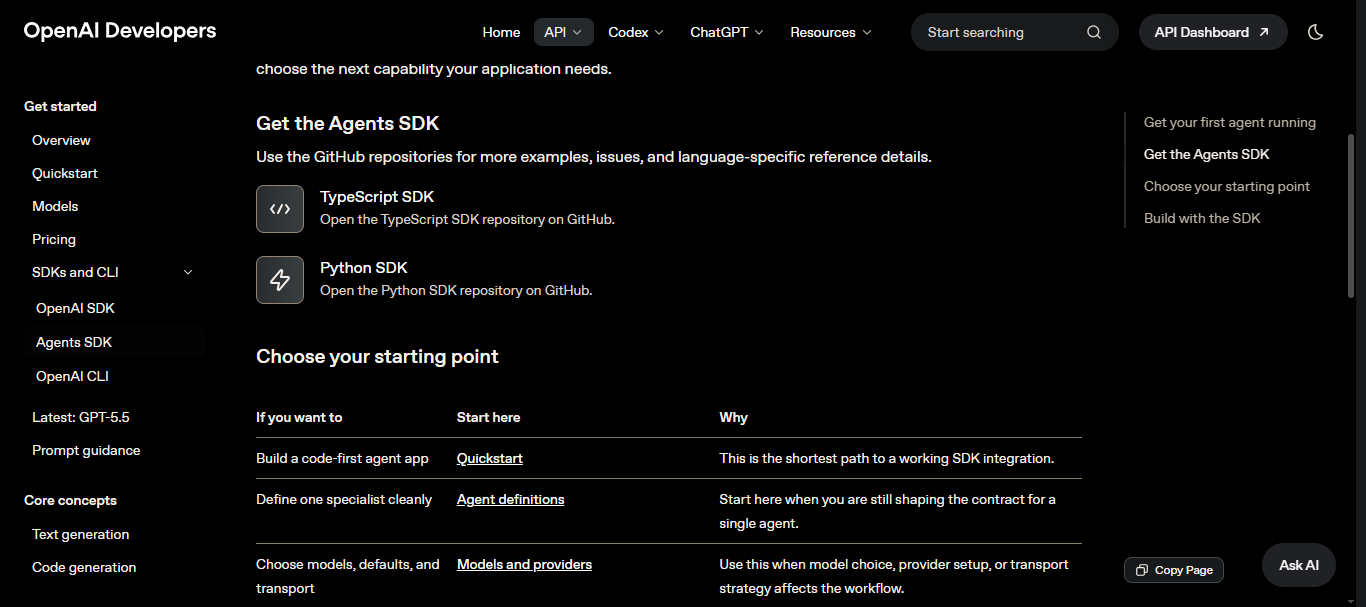
The OpenAI Agents SDK is a purpose-built framework developed by OpenAI to work tightly with OpenAI models, APIs, etc. The Agents SDK integrates deeply into OpenAI’s ecosystem, making a lightweight agent framework for building and running agents while automatically handling the system’s orchestration infrastructure.
Features
- Native integration with OpenAI models such as GPT-4o.
- Memory support for handling agent interaction with the reduced need for an external memory infrastructure.
- Built-in agent handoffs are available natively.
- Strong human-in-the-loop support through guardrails, approval steps, and intervention workflows.
- Has observability and tracing features built into the platform for inspecting, debugging, and evaluating agent behavior.
An advantage of this framework is its built-in orchestration, which supports memory management, tool integration, and model access within the OpenAI platform. This reduces overhead for building a production multi-agent system.
A limitation is that it’s built for OpenAI models, making it less effective for organizations that need to run agents on other open-source models. Therefore, the Agents SDK is best suited for organizations already committed to OpenAI’s model ecosystem, looking to create agents for customer-facing automation tools, AI assistants, and internal productivity agents.
Haystack
Haystack has been among the pioneers of a pipeline-first approach to AI application architecture. Launched in 2020 by Deepset, it is dedicated to building production-ready AI agents, RAG systems, and agentic LLM applications.
Features
- Runs on a pipeline-based architecture made of modular components. It allows teams to test components in isolation and swap implementations with limited impact on the rest of the pipeline.
- Supports multimodal applications that handle text, images, and other structured data within a pipeline.
- Has strong support for retrieval-augmented generation, allowing integrations across multiple vector databases.
- Integrates with multiple LLM providers.
- Supports REST API deployment tooling.
The pipeline-first architecture can feel more rigid when it comes to rapidly evolving use cases, especially in workflows that require dynamic agent behavior.
Haystack is ideal for teams building production RAG systems and document intelligence applications that require maintainability and modularity.
Google ADK
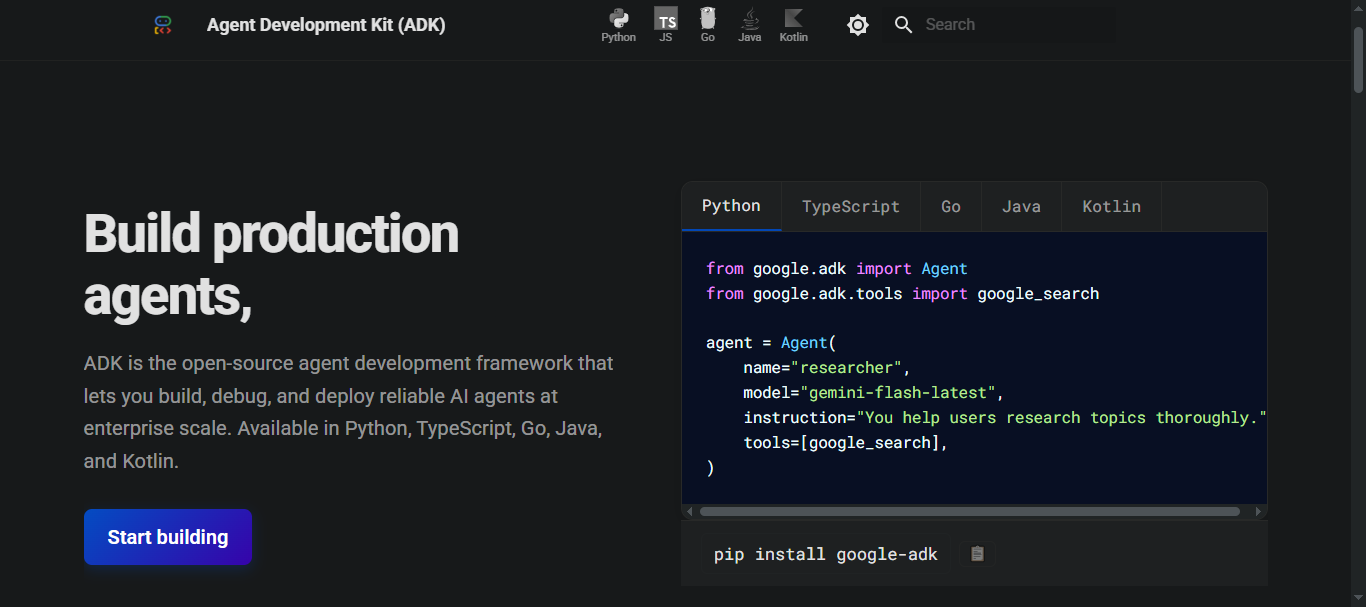
Google’s Agent Development Kit is an open-source framework from Google for building and deploying AI agents. It is optimized for Gemini and Google Cloud services. This ADK is a production-grade, cloud-native framework ideal for teams that want to build on Google infrastructure.
Features
- Runs on code-first orchestration with support for multi-agent workflows and orchestration patterns.
- Has native integration with Gemini and Vertex AI infrastructure.
- Allows standardized tool and context sharing between agents through built-in support for the Model Context Protocol.
- Has strong state and memory support through integration with Google Cloud services.
The Google ADK’s most immediate advantage is its integration with Google Services, which means AI agents running on the framework are optimized for Gemini and can work with its multimodal capabilities.
Organizations outside the Google Cloud infrastructure, or those that need to self-host their agent, will find it difficult to use this ADK.
Google ADK is ideal for enterprise automation tools deployed on Vertex AI or cloud-native agent systems on Google infrastructure.
PydanticAI
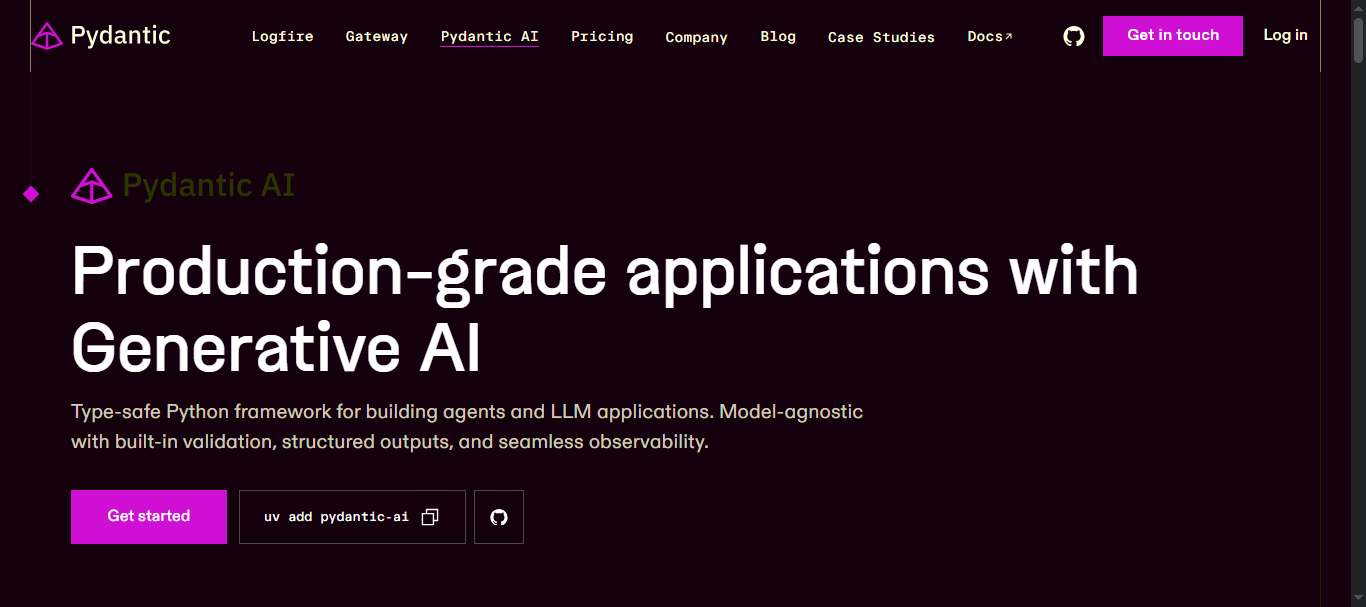
PydanticAI is an open-source Python agent framework for building type-safe AI agents with reliable LLM integrations. PydanticAI’s framework doesn’t attempt to offer a full multi-agent orchestration layer but rather a type-safe foundation for building agents in Python.
Features
- Has a schema-based validation and type enforcement for agent inputs and outputs.
- Offers structured output enforcement for agents.
- Has a dependency injection system that provides agents with typed context and tools at runtime.
- Compatible with multiple LLM providers, including OpenAI, Anthropic, and Gemini.
- Integrates a logfire feature for monitoring, tracing, and debugging agents.
PydanticAI’s type safety architecture is one of its defining strengths, especially for Python engineering teams that already use it for data validation. PydanticAI is considered a lightweight framework that is quite insufficient for a team that needs native multi-agent orchestration.
Teams building agents in data extraction pipelines and API integration layers where output accuracy is non-negotiable will find this framework beneficial.
Real-World Agentic Framework Selection
For a more practical comparison, the decision matrix below shows which agentic frameworks LITSLINK engineers typically recommend for different types of projects and technology environments.
| Business requirement | Recommended framework(s) | Why |
|---|---|---|
| Enterprise workflows with strict governance | LangGraph | Deterministic graph execution, persistent memory, and strong Human-in-the-Loop support |
| Rapid multi-agent MVPs | CrewAI | Fast role-based orchestration with minimal setup |
| Document-intensive RAG applications | Haystack, LlamaIndex | Strong retrieval pipelines and scalable document processing |
| OpenAI-first deployments | OpenAI Agents SDK | Native integration, managed orchestration, and built-in observability |
| Google Cloud ecosystem | Google ADK | Deep integration with Gemini, Vertex AI, and Model Context Protocol |
| Microsoft/Azure environments | Semantic Kernel | Native Azure integration and support for C#, Java, and Python |
| Python projects requiring structured outputs | PydanticAI | Type safety, schema validation, and reliable structured responses |
| LLM applications with many external integrations | LangChain | Extensive ecosystem of connectors, tools, and APIs |
What This Means
No single framework can be claimed to be the best for every AI initiative; the right choice for your project depends on your business objectives, architecture, deployment environment, and orchestration requirements.
5 Steps to Choose the Best Agentic AI Framework
Here are 5 steps AI engineers and solution architects need to consider when choosing an agentic AI framework and building agents.
Evaluate Your Application Complexity
Before anything else, you need to define the complexity of what you are building. This helps you determine whether your use case requires a single-agent capability or a multi-agent system. Besides, consider where human intervention is needed and how many autonomous agents are required in the workflow.
For instance, a single-agent customer support bot that answers FAQs has a simpler workflow than a multi-agent system, where one agent triages a query, another retrieves relevant policy documents, and a third drafts and reviews the response before responding to the customer. You can review how production deployments handle workflow complexity by taking a deeper look at how AI Agents are transforming customer experience in real life.
Ensure Tech Stack Compatibility
The next step entails mapping various frameworks to your existing technology stack. Consider which LLM providers and internal APIs your agents will connect to and verify that your framework supports these integrations.
For instance, if your engineering team already works in C# or Java, a framework like Semantic Kernel may be a good fit. On the other hand, if you are on Google Cloud, Google ADK’s tight coupling with Google Cloud makes more sense. If your organization has strict compliance requirements, you need to account for where a framework claims to store memory and log agent execution data.
Review Planning and Memory Features
Memory and planning capabilities often separate a prototype from a production system. Therefore, you need to evaluate whether a framework supports long-term memory and whether it offers persistent context across sessions. LangGraph and CrewAI have unified memory architectures with support for different memory types, making them ideal for workflows involving multiple sessions.
Consider the Framework’s Ability to Maintain Steady Performance and Scalability
While the current performance of a framework matters, it’s always advisable to assess whether it can meet future scalability requirements. Gartner’s recent AI forecast shows that 33% of enterprise applications will include agentic AI frameworks by 2028. You can review benchmarking data across multiple frameworks against your expected workload, focusing on response latency, behavior under concurrent agent execution, and token consumption.
Besides, to analyze whether a framework will work well when scaling, you need to check whether it offers scalability features such as asynchronous execution, distributed orchestration, and support for serverless deployment.
Prioritize Data Privacy and Security
Security and governance requirements must be evaluated before making any architectural decisions. Moreover, organizations in regulated industries must ensure that the framework’s data-handling practices meet compliance standards and provide standard encryption for data. The ecosystem must support an AI agent development process that incorporates these security practices from the architecture stage.
Besides data privacy, human-in-the-loop governance is equally important when choosing a framework; agent activities need to be robustly monitored and their outputs reviewed from time to time.
Enterprise AI Agents & Agentic AI Systems with LITSLINK
Choosing the right AI agent framework is quite important, but it is only the first step in your journey of building a production-ready AI system. LITSLINK brings 300+ experienced engineers to ensure you get the right combination of framework and architecture. From assessing your company’s initial needs, framework selection, and architecture design to production deployment, LITSLINK enables you to build autonomous agent systems specifically tailored to your workflows. Check out our AI Project Cost Estimation tool to provide insight into what you might need before launching your project.
Contact LITSLINK to determine an ideal framework for your workflow or to accelerate the development of enterprise-grade AI systems.
FAQs
Can Agentic AI Be Deployed Without a Framework?
Technically, yes. However, teams that try it usually end up rebuilding the same foundational infrastructure frameworks already provided.
What Makes an AI Framework Agentic?
This software layer sits beneath AI agents, providing orchestration, memory, and tool connections, among others.
Which Framework from the List is Better Suited for Multi-Agent Coordination?
LangGraph provides greater control over multi-agent coordination, while CrewAI offers built-in support for structured agent teams.
Which Agentic AI Framework Promises the Best Performance?
Most benchmarks highlight LangGraph as the best in delivering low latency and token consumption, while Haystack is ideal for document-intensive RAG pipelines.
Which Framework Offers the Best Memory Capabilities for Agentic AI Tools?
LangGraph and LlamaIndex lead in memory capabilities, with LangGraph being the best at persistent context memory. LlamaIndex provides deep retrieval for data-heavy apps.