





Home / case-studies / vr-healthcare-solution-mighty-immersion

VR Healthcare Solution for Patients: Mighty Immersion

Mighty Immersion needed real infrastructure fast. Their VR for pain management platform was already live in pediatric wards across the US; the problem was the operational layer behind it.

  • 1,300+ Headsets deployed to hospitals
  • 200+ US children's hospitals served
  • 50+ Devices managed at launch
Request Similar Solution
App for Organizing and Optimizing Medical Shifts – ShiftRx

|  

Project Details


Mighty Immersion, Inc. – the legal entity behind what is today ManageXR – came to LITSLINK with a narrow but urgent brief: build the operational infrastructure for a rapidly expanding fleet of VR headsets deployed across US pediatric hospitals.

The company had real clinical traction, a proven immersive healthcare experience that hospital staff trusted, and a founder who knew exactly what was missing. What they lacked was the software layer to manage it all at scale. That’s where we came in.

CLIENTS

Mighty Immersion, Inc. (now ManageXR)

INDUSTRY

Healthcare & XR Technology

SOLUTION

VR device management web portal

SERVICE

Web Development, Firebase Integration

PLATFORM

Web (browser-based portal)

SCOPE

Clinical coordinators, ward & operations staff

DURATION

8 month

LOCATION

US

|  

Business Challenge


Mighty Immersion was founded in 2017 alongside the Stanford CHARIOT Program with a clear clinical mission: deploy virtual reality for pain relief in pediatric care settings. By the time they contacted LITSLINK, 1,300 headsets were live across more than 200 children’s hospitals – actively used during IV placements, injections, wound care procedures, and pre-procedure VR for anxiety treatment. It worked. Staff trusted it. Hospitals wanted more of it.

The bottleneck wasn’t clinical adoption. It was operations. The virtual reality for pain management programme was working but going from a handful of units to fifty-plus required a centralized system to monitor device status, push content updates, and onboard new hospital partners. None of which existed yet.

Every week without it meant delayed deployments and manual overhead that the team simply couldn’t sustain.

Centralized device visibility

Tracking the status of 1,300 headsets across 200+ hospitals depended on manual checks and disconnected workflows. There was no centralized way to see which devices were active, outdated, or needed attention.

Content updates didn’t scale

As the network expanded, delivering new VR content and software updates became increasingly difficult. Without a unified distribution system, keeping every hospital aligned was slow, inconsistent, and labor-intensive.

Manual partner onboarding

Adding new hospital partners required repetitive setup, coordination, and support from the internal team. Without a standardized onboarding process, each expansion created delays and operational strain.

|  

Technologies We Used

|  

Our Solution


To help Mighty Immersion scale without adding technical overhead, LITSLINK chose Firebase as the backend foundation. That removed the need for custom APIs and server management, allowing the team to focus on building a practical product from day one.

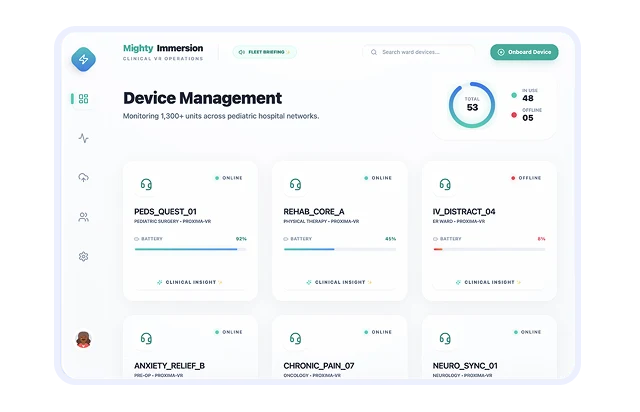
The result was a web-based VR healthcare management portal designed for clinical coordinators, not technical teams. Staff could monitor devices, manage content, and onboard new hardware quickly — without lengthy training, IT support, or complex workflows.

Built on a scalable Firebase architecture, the solution was ready to support the initial rollout and grow far beyond the first 50-unit deployment.

01
Fleet Status Dashboard

rack the live status of all deployed VR headsets from one centralized view.

02
Content Management

Push VR experiences to individual devices, departments, or entire hospital wards.

03
Fast Device Onboarding

Add and configure new headsets in minutes instead of relying on manual setup.

04
VR Patient Experience Workflows

A simple, staff-friendly portal built for VR patient experience workflows, not technical teams.

Ready to build a clinical tool your team will actually rely on?

Tell us about your project

-Scrum Methodology

|  

Project Journey


We ran the build on an agile sprint cycle: short feedback loops with the client, working software at every demo.

0
Weeks sprint cycles
0
Sprints completed
0
On-time delivery
0
Team members

Step-by-Step Process

1
Release Planning
  • Establish release goal
  • Define highest-priority features
  • Set probable delivery date & costs
2
Product Backlog
  • Prioritised features list
  • Desired by the client
  • Refined per sprint
3
Sprint Planning
  • Review product backlog
  • Set sprint goal
  • Estimate & commit
4
Sprint · 1–2 Weeks
  • Daily Scrum stand-ups
  • Team expands backlog
  • Continuous integration
5
Sprint Demo
  • Client review every sprint
  • Feedback loop
  • Sprint sign-off
6
Ready Product
  • Shippable increment
  • Sprint retrospective
  • Inspect & adapt

Scrum Process Flow

Healthcare software development doesn’t benefit from big-bang releases. Scrum’s sprint cadence meant the client saw working software regularly and could give feedback before decisions became expensive to reverse.


Inside Each Sprint
Plan Design Develop Test Review
Daily Scrum
15-min sync every morning
Sprint Review
Demo to stakeholders
Retrospective
Inspect & adapt process
Increment
Shippable product update

-Timeline

|  

Five phases, clearly defined


Consulting2 weeks
Product Design3 weeks
Product Engineering5 months
Launch2 weeks
SupportOngoing

Consulting

  • Scoping the device management problem: 50+ units across hospital wards
  • Defining clinical coordinator workflows and real-time monitoring needs
  • Assessing Firebase as the backend for rapid, serverless delivery
  • Choosing agile sprint cycle with short client feedback loops

Product Design

  • Designing a staff-friendly portal built for clinical shift conditions
  • Prototyping the real-time fleet dashboard and content push workflows
  • Defining Firebase architecture for scalability beyond initial deployment
  • Validating onboarding flow for new hospital partner self-setup

Product Engineering

  • Building the real-time headset status dashboard with Firebase sync
  • Implementing fleet-wide content management and push system
  • Developing fast device onboarding flow — minutes, not hours
  • Testing under live clinical conditions across multiple hospital units

Launch

  • Deploying the portal across 50+ active VR units simultaneously
  • Training clinical coordinators across pediatric ward locations
  • Integration testing with existing headset fleet and content library
  • Validating zero-IT-support onboarding for new hospital partners

Support

  • Ongoing platform monitoring and headset fleet stability
  • Technical support for ward coordinators and clinical operations staff
  • Scaling Firebase infrastructure as new hospital partners join
  • Feature iteration to support ManageXR's expanding global network

|  

Results

Before

  • Device status tracked manually – spreadsheets, emails, physical ward checks
  • No way to push content updates remotely – each headset must be touched individually
  • No standardized onboarding process for new hospital partners
  • The engineering team pulled into support tasks instead of product development

After

  • 50+ VR units monitored in real time from a single browser-based dashboard
  • Fleet-wide content updates pushed in one action – no physical device access required
  • New hospital partners onboarded in minutes, without involving an engineer
  • Mighty Immersion team freed up to expand the VR for patients program, not manage logistics

Impact image


The Impact

The management portal gave Mighty Immersion operational confidence at a genuinely critical moment. Clinicians got a stable VR distraction therapy tool that just worked.
Beyond the immediate results, the platform also validated a thesis. Every organization deploying VR in clinical settings at scale had the same device management problem. That insight ultimately drove Mighty Immersion’s growth.
Operational Confidence
Clinical Stability
Scalable Management

|  

What's Next:


The operational challenge of managing VR for patients at scale turned out to be a market-wide problem, not just theirs. The company rebranded as ManageXR, and today it is the leading XR device management platform globally – trusted by Johnson & Johnson, Bosch, and thousands of organizations in healthcare, enterprise, and education. The Firebase portal LITSLINK built was part of the chapter that proved the concept.

The hospital VR solution market continues to grow rapidly. If you’re building in this space – a VR system for healthcare, a patient engagement platform, or clinical tooling of any kind – this is what it looks like when you get the infrastructure right from the start.


-Verified Reviews

|  

Our Reputation on Top Platforms


LITSLINK is recognized across leading industry platforms for delivering high-quality software solutions. See what clients and the design community say about our work.


Have a project in mind?

If you’re working on a similar HealthTech product, we'd like to help you build it — shaped around your users, your compliance requirements, and your timeline.
Next steps:
1
LITSLINK specialist reviews your request and contacts you to discuss the details;
2
If needed, we can sign an NDA before moving forward;
3
We send a project proposal – estimates, timeline, and team CVs included;
4
After launch, we stay on for any updates your product needs.
48h Response
💙 500+ Projects


    You can upload files Maximum 3 files, 3 MB per file. Formats: doc, docx, pdf, ppt, pptx.

    Your personal data is processed in accordance with our
    Privacy Notice

    |  

    More Related Cases


    Litslink icon