









Key Takeaways: How Many Jobs Will AI Replace?
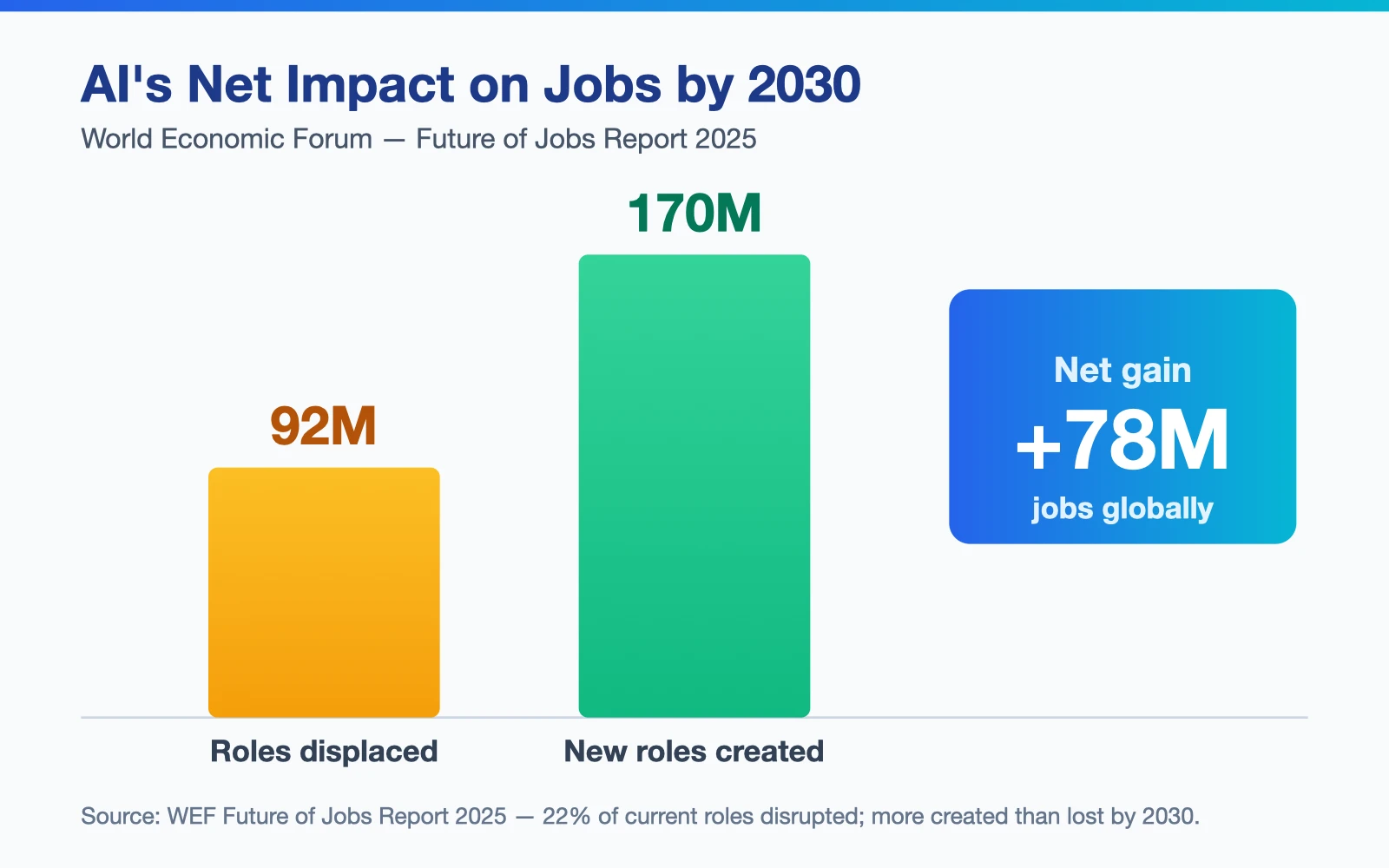
- The World Economic Forum’s Future of Jobs Report 2025 projects 92 million roles displaced and 170 million created by 2030.
- AI is cutting roughly 16,000 net US jobs every month.
- Around 55,000 layoffs in 2025 were directly attributed to AI.
- Workers with AI skills now earn a 56% wage premium.
- The honest answer to how many jobs will AI replace is two-sided: routine and entry-level roles face the sharpest displacement, while every major institution still projects net job creation over the medium term.
Artificial Intelligence (AI) has gained a significant foothold in society, prompting the question of whether AI is taking over jobs and, specifically, how many jobs will AI replace as automation accelerates? Many readers ask how many jobs AI will replace by 2050, wondering about long-term impacts. The appearance of AI follows that of other technologies throughout history that also sparked passionate feelings in people, either for or against change.
Advanced AI tools are already rapidly spreading and being adopted across numerous industries, bringing praise and objections. Those in favor of artificial intelligence explain that it will radically transform whole sectors, making enterprises more effective and life better for all. At the same time, those against it point out that it may cause unemployment and undermine the quality of social relationships. Do you wonder about the future of jobs in the world of AI? These technological changes have taken things to a whole new, unforeseen level, and everybody wants to know how many jobs AI will take away. Come with us as we digest the figures and define the employee of tomorrow.
Want to learn how artificial intelligence can
bring magic to your business?
The Potential Positive Impacts of AI on Jobs
Experts debate what jobs will be replaced by AI across industries. Analysts also track AI replacing job statistics and broader statistics on AI taking over jobs to measure real effects. AI is a game-changing technology that can hasten the operations of all businesses and organizations by carrying out repetitive tasks and freeing up human capital to focus on innovation.
There are also positive aspects of AI in healthcare, where AI-aided diagnostic methods, customized therapies, or segmentation and targeting approaches are likely to improve patient outcomes, cut costs, and increase access to healthcare for those who have always found it difficult to obtain. These facts about AI demonstrate its potential in revolutionizing healthcare.
Furthermore, in the Department of Education, AI can give rise to tailor-made learning techniques, making education more personalized and effective. The concept of AI in learning emphasizes the use of intelligent systems to adapt content and teaching methods to individual student needs, thereby improving engagement and learning outcomes.
However, even in today’s world, where advancement is seen to be positive, people worry about losing their jobs due to innovations. They argue that artificial intelligence and robotics will result in mass job losses. Reasons for such reservations about the impacts of automation on employment are easy to comprehend since we have already witnessed automation replacing certain jobs that were regarded as very stable.
On the other hand, people who are for the continued use of AI argue that it can create employment opportunities that would replace lost jobs, particularly in sectors that require AI-related technical skills, such as AI programming, computer maintenance, data processing, etc. Besides, this technology can be employed to extend the boundaries of human capabilities as people concentrate on areas that require higher thinking, creative work, and leadership, thereby enhancing productivity.
An Overview of Statistics You Should Know
| Key Figure | What It Means |
|---|---|
| $19.9 trillion | Business AI is projected to contribute a cumulative $19.9 trillion to the global economy by 2030. |
| 3.5% | Business AI is projected to account for 3.5% of global GDP by 2030. |
| 98% | 98% of surveyed CEOs said their organizations would benefit immediately from AI implementation. |
| 70% | McKinsey projected that around 70% of companies could adopt at least one type of AI technology by 2030. |
| ~300 million jobs | Generative AI could expose the equivalent of 300 million full-time jobs globally to some degree of automation. |
| ~25% of work tasks | Goldman Sachs estimates that AI could ultimately automate around 25% of labor tasks in advanced economies. |
| 22% | Structural labor-market transformation is expected to affect 22% of today’s formal jobs through job creation and displacement by 2030. |
| 170M created / 92M displaced | The WEF projects 170 million new jobs and 92 million displaced jobs by 2030, resulting in a net increase of 78 million. |
| 41% | 41% of surveyed employers expect to reduce their workforce where AI capabilities can replicate roles. |
| 46% | Office and administrative support has an estimated 46% share of workload exposed to AI-driven automation, one of the highest among occupations analyzed. |
| 60–70% | Current generative AI capabilities could theoretically automate activities that take up 60–70% of employees’ working time. |
| ~16,000 jobs/month | Goldman Sachs estimates that AI reduced US monthly payroll growth by roughly 16,000 jobs over the previous year. |
| 56% wage premium | Jobs requiring AI skills carried an average 56% wage premium compared with similar roles without those skills |
| +7.5% YoY | Job postings requiring AI skills increased 7.5% year over year, while total job postings declined 11.3%. |
| ~7 million jobs | The transition to a circular economy could create around 7 million jobs globally. |
Economic Implications of AI
Recent studies estimate how many jobs AI will replace by 2030—some forecasts point to hundreds of millions of jobs that AI will replace worldwide. According to new research released by IDC, introducing AI in business setups will result in $19.9 trillion being pumped into the economy by 2030, while contributing up to 3.5% towards global GDP by 2030. The high level of interest in this area is further proven by its effect on different jobs throughout the world, including activities within contact centers, among others. Business executives are among those driving these changes, with almost all of them, 98%, recognizing the importance of AI in small businesses and big businesses. They see it as a must-have tool to enhance efficiency, streamline operations, and foster growth in their companies.
According to a McKinsey study, by 2030, 70% of the surveyed firms will be using some type of AI technology. It is not surprising then that just like electricity and the internet before it, the economic consequences of AI alone could be as momentous, leading to wholescale reconfigurations in national economies and amended contours of competition.
The global workforce is navigating a genuine overhaul right now, not a hypothetical one. Goldman Sachs has estimated that generative AI could affect around 300 million full-time equivalent jobs globally. Its April 2026 research puts a sharper point on what’s happening today: AI is cutting approximately 16,000 net US jobs every single month. The underlying math is roughly 25,000 positions removed monthly through AI substitution, against about 9,000 new AI-augmented roles added back. So far, the gap is widening.
Societal Transformation and Ethical Considerations
As AI continues to develop, its influence on society will be profound and far-reaching. Forbes envisions a future where AI is seamlessly integrated into daily life, simplifying tasks and expanding possibilities across industries. AI will have a transformative effect not only on the economy but also on social structures, legal systems, and political landscapes.
Furthermore, AI-powered technologies are already being used to solve complex global problems, from climate change modeling to disease prediction and management. These innovations hold the potential to improve quality of life, enhance decision-making processes, and provide more equitable access to essential services. However, to fully harness AI’s potential, it is crucial for governments, businesses, and individuals to engage in meaningful dialogue about its ethical implications and to develop strategies that maximize its positive impact while minimizing potential harm.
The global workforce in a wide range of industries should prepare for an imminent overhaul through artificial intelligence (AI). By 2030, AI is expected to have displaced millions of jobs while creating new growth opportunities and avenues for innovation. A Goldman Sachs report suggests that AI could take away around 300 million full-time equivalent jobs globally by significantly reshaping job markets.
How Will AI Affect Jobs by 2030?
Many workers worry that AI and automation will replace their jobs, yet economists emphasize that while routine tasks are most vulnerable to automation, these technologies can also boost productivity and create new opportunities. In major economies like the US and Europe, automation is expected to take over repetitive duties that currently occupy much of the workforce. According to Goldman Sachs, approximately a quarter of routine tasks are already automatable by robots.
The labor market is set to undergo substantial changes through 2030. The World Economic Forum’s most recent data — from the Future of Jobs Report 2025 published in January 2025 — shows that around 22% of all existing jobs will be disrupted. That translates to 170 million new roles emerging and 92 million roles disappearing, for a net gain of 78 million jobs globally. Earlier WEF estimates from 2023 had projected 69 million new jobs created and 83 million lost by 2027; the picture shifted considerably once the 2025 report expanded its survey to more than 1,000 employers representing 14 million workers across 55 economies.
Office and administrative support functions, including jobs held by office personnel, production workers, and customer service representatives, are identified as particularly prone to automation, accounting for nearly half of such routine activities. This underscores the growing influence of AI-driven agents in reshaping work by automating repetitive functions.
At the same time, demand for high-skilled workers—especially in healthcare and STEM fields—is predicted to rise, as these roles require complex human expertise. Current AI technologies have the potential to automate tasks performed by approximately 70% of the workforce. As a result, regions like Europe and the United States may face unemployment increases of up to 12 million unless affected workers pursue training and skill development to adapt to changing market demands.
This landscape highlights the critical importance of reskilling and continuous learning initiatives to prepare the workforce for an AI-augmented future where human expertise complements technological advances
World Economic Forum’s Future of Jobs Report 2025
The World Economic Forum’s Future of Jobs Report 2025 forecasts profound shifts in the global employment landscape by 2030. It anticipates that approximately 22% of current jobs will transform significantly due to factors like technology advancement, demographic changes, and economic challenges. While around 170 million new job opportunities will emerge—primarily in technology-driven sectors, green industries, and care services—about 92 million existing roles are projected to disappear, resulting in a net increase of roughly 78 million jobs worldwide.
Artificial intelligence, automation, and data analytics will be major forces driving this change, reshaping how work is performed and creating demand for advanced digital skills. Alongside technological growth, the green transition is expected to create numerous roles in renewable energy and sustainability sectors.
Job growth is especially strong in frontline roles such as agriculture, delivery, construction, and education, with developing regions in Asia and the Middle East seeing significant increases. However, as nearly 40% of workforce skills become obsolete by 2030, continuous learning and reskilling are essential for workers’ adaptability.
Employers also highlight the rising importance of soft skills like resilience, adaptability, and leadership in conjunction with technical expertise. The report stresses that global economic uncertainty and geopolitical tensions add complexity to workforce planning, but proactive strategies in upskilling, diversity, and employee well-being will be vital to navigate the fast-evolving labor market successfully. This comprehensive outlook underscores the intertwined nature of technology, society, and environment shaping future work dynamics.
What Else the WEF 2025 Report Tells Us
Beyond the headline job numbers, a few findings from the WEF report don’t get nearly enough attention. For one, 41% of employers plan to reduce headcount specifically in roles where AI can automate tasks — a figure that aligns closely with the real-world layoff data Goldman Sachs has since reported. The survey also found that 39% of the key skills workers use today will change by 2030, and that nearly half of employers intend to actively transition staff into different roles rather than simply cutting them loose.
That distinction matters more than it might seem. The WEF data don’t tell a straightforward mass-layoff story. They describe redeployment, retraining, and organizations figuring out — often imperfectly — how to restructure around AI capabilities while keeping people employed in some form.
| Jobs That Will Be Automated | Jobs That Won’t Be Automated |
| Customer Service Representatives | Teachers |
| Receptionists | Surgeons |
| Insurance Underwriters | Lawyers and Judges |
| Accountants and Bookkeepers | Research and Data Analysts |
| Computer System Analysts | Directors, Managers, and CEOs |
What Jobs Are Most Likely to Be Automated?
Rapid advancements in artificial intelligence and automation technologies threaten several positions. To save costs, companies are expected to employ AI to replace repetitive tasks requiring minimal decision-making and automated machines to do tasks usually performed by manual operators, significantly improving overall productivity.
Some of the popular jobs that are likely to be automated in the next few years are detailed herein:
1. Accountants and Bookkeepers
Artificial intelligence is finding its way into the finance departments of nearly every industry today. AI can easily assist in such tasks as data entry, ledger binding, and generating simple financial statements. It can also process huge amounts of financial information without human intervention. In addition, many firms are already adding AI solutions to their communication system, saving lots of time and making communication more convenient for customers.
Moreover, since AI systems are error-free in detecting fraud and correcting mistakes, unlike humans, who require training in doing the same, AI will play a primary role in controlling internal accounting activities, such as bookkeeping, account maintenance, and supporting financial records.
2. Customer Service Representatives
Certainly, customer service is among the industries most exposed to automation initiation. Various duties in the customer service field are basic and continuous, for example, answering predictable questions, solving simple challenges, routing clients to relevant services, and so on.
Artificial Intelligence (AI) based chatbots and systems have been developed to perform these tasks without the need for immediate human intervention, which ensures that help is readily available at any time. This is particularly transformative in AI in hospitality, where guests expect instant service and seamless experiences. As such, these AI systems offer immediate responses to requests, enhancing service delivery. In addition, AI can handle multiple inquiries simultaneously, allowing many people to access the system at once.
3. Receptionists
The receptionist job is increasingly being taken over by robots in many businesses across the globe. To reduce costs, companies have deployed AI-powered robots and created AI assistants to meet and greet visitors, book appointments, or simply answer incoming calls. The surge of virtual attendants and such intelligent aids is a sign of the clear desire among executives to streamline their everyday operations.
4. Insurance Underwriting
The insurance sector is also encountering notable transformations. The primary focus is underwriting, where assessing the potential risks of covering a specific person, location, or asset in an insurance policy is inherently conducive to digitization. AI carries out this particular function with excessive risk data patterns of the applicants, which are examined and analyzed with data extending to credit, health, and claims made. With the ability of these functions to predict risk and assign insurance rates simpler and faster than human efforts, it’s hard to imagine human underwriters continuing to be staffed.
5. Computer System Analysts
Computer System Analysts face increasing automation as many of their routine, data-heavy responsibilities become manageable by advanced technologies like artificial intelligence, machine learning, and automation frameworks. These systems excel at swiftly processing, integrating, and analyzing vast datasets—core functions in the analysts’ daily workflow.
With the rapid advancement of generative AI and big data tools, many standard tasks such as system diagnostics, data consolidation, and initial data interpretation can now be automated, significantly reducing reliance on manual labor. This evolution redirects human efforts toward higher-level problem solving, strategic decision-making, and creative innovation, while routine technical tasks are efficiently handled by machines.
Overall, this automation trend is part of a larger digital transformation sweeping through IT and business processes, where cognitive tasks that follow consistent patterns are increasingly performed by AI-powered systems. This shift enhances operational efficiency but simultaneously underscores the urgent need for workers in these roles to develop new skills and adapt to changing demands.
Companies Already Restructuring: The 2025–2026 Layoff Wave
Numbers in a report are one thing. What’s happening inside real companies is another matter entirely. Over the past 18 months, a steady wave of layoffs has been attributed — at least partly — to AI-driven efficiency gains. The specific examples are worth knowing, because they put a face on statistics that otherwise blur together:
- Amazon eliminated around 14,000 corporate roles, with leadership explicitly stating that AI enables leaner structures and faster decision-making.
- Microsoft cut roughly 15,000 jobs while repositioning AI as central to its productivity model across business units.
- Salesforce reduced its customer support workforce by 4,000 employees. CEO Marc Benioff was direct: “AI now handles up to 50% of our company’s work.”
- Workday let go of 1,750 people — 8.5% of its workforce — to free up investment capital for AI product development.
- Dell cut approximately 12,500 positions as it reorganized around surging AI server demand.
- Block (Jack Dorsey’s payments company) cut its headcount nearly in half, a move linked directly to expanded AI capabilities.
About 55,000 layoffs in 2025 were directly attributed to AI, out of 1.17 million total job cuts that year — roughly 4.5% of all layoffs. That share is growing.
One important caveat: Harvard Business Review’s January 2026 analysis found that many companies cutting staff don’t yet have AI systems actually capable of replacing those workers. Earnings pressure is driving some of these announcements as much as genuine automation. The phrase “AI washing” — using AI as convenient cover for financially motivated cuts — has gained traction for a reason. But the underlying trend is real, and it’s picking up speed.
Jobs at Highest Risk: An Industry-by-Industry Breakdown
Abstract discussions about AI displacement are easy to scroll past. Sector-specific numbers are harder to ignore.
Finance and Banking
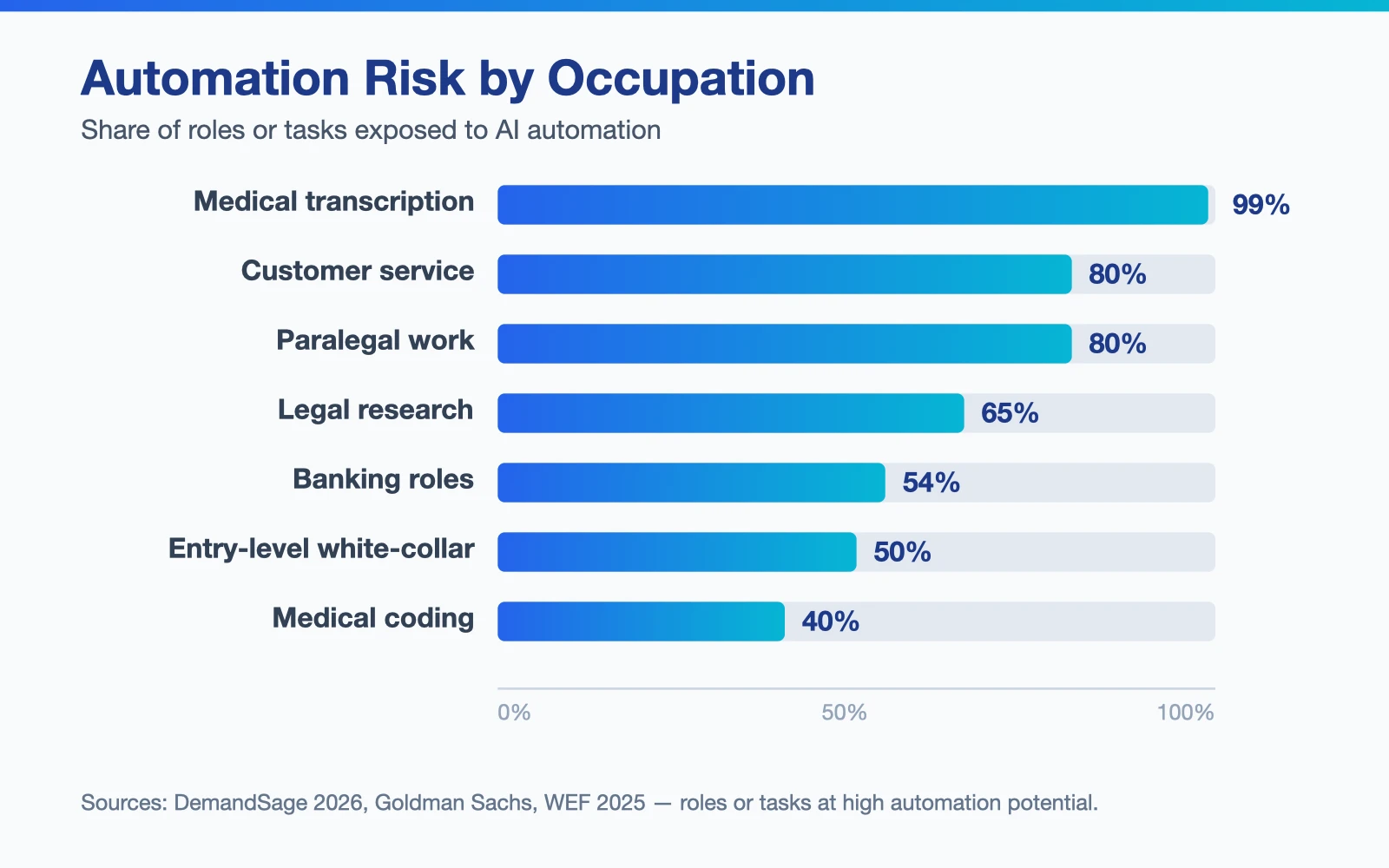
Finance sits near the top of virtually every automation vulnerability ranking. Around 54% of banking jobs carry high automation potential, and estimates put Wall Street job cuts at roughly 200,000 over the next three to five years. On the granular side, loan processing automation is projected to jump from 35% today to 60% in 2025 and 80% by 2030. Goldman Sachs has separately estimated that 44% of legal tasks within financial services are automatable.
Legal
Paralegals face an estimated 80% risk of automation by 2026. Legal researchers sit at roughly 65% by 2027. The distinction worth drawing: legal research — document review, case law analysis, contract flagging — is highly automatable. Legal judgment is not. AI tools are already transforming the former; the latter still requires a human who passed the bar.
Healthcare
Medical transcription is already 99% automated. Medical coding is on a similar trajectory, with 40% projected to be automated in 2025. But healthcare tells a two-sided story: the same industry created over 640,000 AI-linked positions in 2025, mostly in predictive analytics, automated diagnostics, and virtual patient support. Nursing and therapy roles are projected to grow as AI augments — rather than replaces — clinical judgment.
Manufacturing
510,000 U.S. manufacturing jobs were automated in 2025 alone. Quality control and predictive maintenance are the two biggest drivers. AI systems that catch defects and predict equipment failure before it happens now run continuously in facilities that used to require large shift crews.
Customer Service
This is where the numbers get stark. Up to 80% of customer service roles are projected to be automated, putting 2.24 million of the 2.8 million U.S. customer service jobs at some level of risk. AI chatbots and voice systems already cut costs in the sector by 23.5%. The economics of replacing a human agent with an always-on AI model are essentially irresistible from a CFO’s perspective.
Entry-Level White-Collar Work
This category flies under the radar. AI could eliminate close to half of all entry-level white-collar positions within a decade — the data entry roles, billing jobs, customer support tiers, paralegal work, and administrative coordination functions that have traditionally been how young professionals build experience. Tech workers bore a lot of this in 2025: 130,981 lost jobs across 472 companies, roughly 574 people per day.
The Other Side: AI Is Also Creating Jobs
It would distort the full picture to talk only about displacement. Across the same period that generated all those layoff headlines, the AI economy was creating new roles at a pace most people haven’t tracked closely.
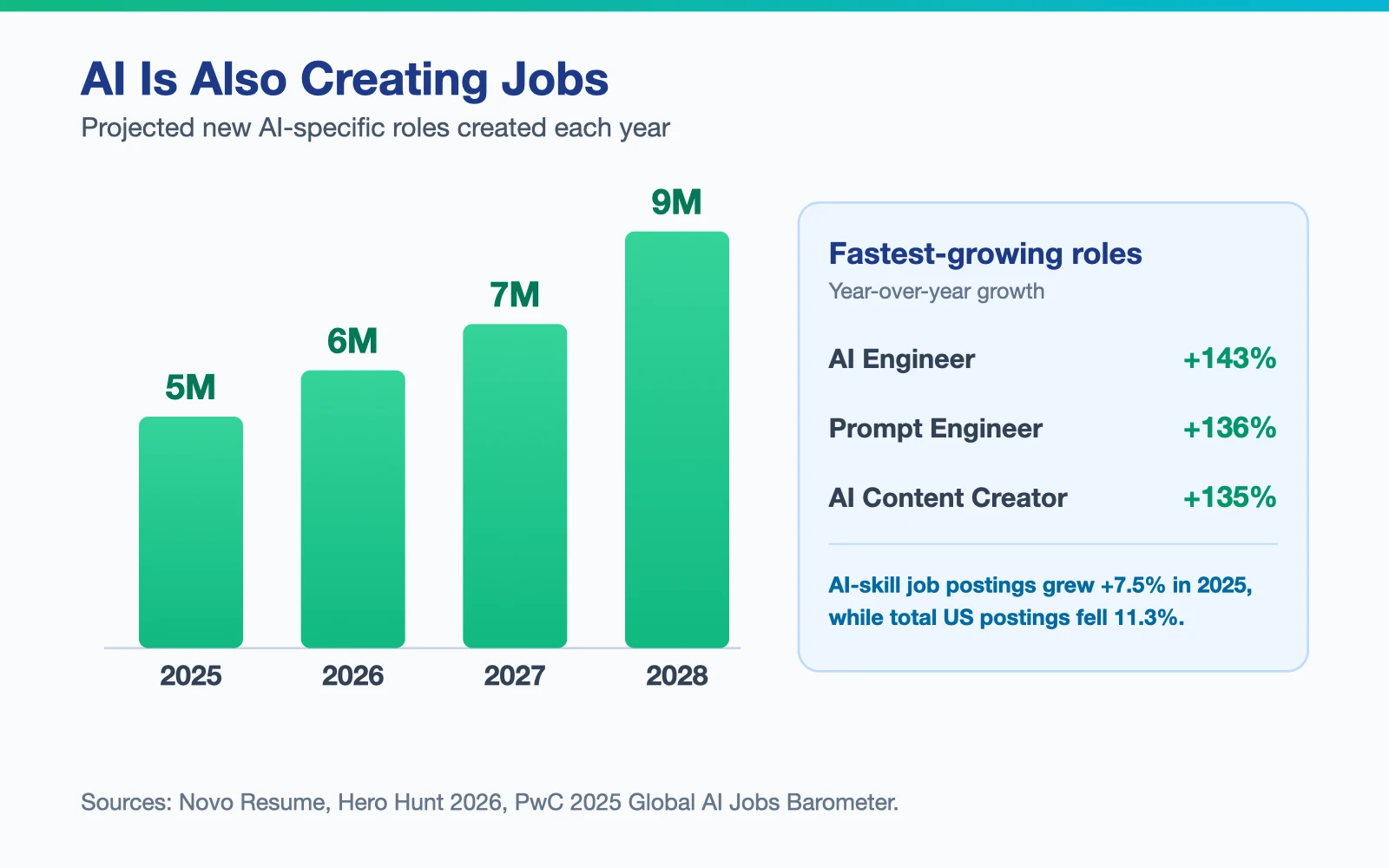
According to projections aggregated by Novo Resume and Hero Hunt’s 2026 AI roles rankings, AI-specific job creation is growing year over year:
- 2025: approximately 5 million new AI-specific roles
- 2026: approximately 6 million
- 2027: approximately 7 million
- 2028: approximately 9 million
The fastest-growing titles: AI Engineer (+143.2% year-over-year), Prompt Engineer (+135.8%), and AI Content Creator (+134.5%). Emerging categories like AI trainers, AI ethicists, and explainability experts didn’t exist five years ago and have no automation equivalent on the horizon.
Here’s the stat that deserves more attention than it gets: while total U.S. job postings fell 11.3% in 2025, postings requiring AI skills grew 7.5% year-over-year. The labor market is contracting overall. It’s expanding fast in the AI-skilled segment.
The PwC 2025 Global AI Jobs Barometer adds another layer. Workers with demonstrated AI skills now earn a 56% wage premium over peers in identical roles without those skills — up from 25% just the year before. PwC also found that AI-exposed industries saw productivity growth nearly quadruple between 2018 and 2024, and generate 3x higher revenue per employee than the industries least affected by AI. These aren’t marginal efficiency gains. They’re the kind of numbers that get entire departments reorganized.
The IMF’s 2026 Staff Discussion Note, New Jobs Creation in the AI Age, reaches similar conclusions at the macro level: every major institutional projection — Goldman Sachs, WEF, IMF, McKinsey, BLS — shows net positive job creation over the medium term. That consensus doesn’t always come through in the daily news cycle. But it’s there.
Who’s Most Vulnerable? The Demographics of Displacement
Not all workers face the same level of exposure. Two groups show up consistently across the data.
Gen Z workers are concentrated in exactly the roles AI targets most aggressively — data entry, billing, customer service tiers, legal support, administrative coordination. These were the traditional entry points into professional careers: the jobs you took to build experience before moving up. AI is narrowing those on-ramps significantly. Goldman Sachs’s April 2026 analysis found that a one standard-deviation increase in AI substitution exposure widens the entry-level-to-experienced wage gap by 3.3 percentage points. Younger workers without accumulated expertise have less buffer — and that buffer matters more now than it did a generation ago.
Women face outsized exposure as well. The administrative and customer service roles AI automates most aggressively skew heavily female. This isn’t a new dynamic — previous waves of automation have disproportionately affected female-dominated sectors — but AI is accelerating the timeline.
The OECD’s cross-country employment analysis confirms the broad pattern: roughly 28% of jobs across member economies carry high automation potential. But here’s what the same data also shows — BLS and OECD researchers have not yet observed significant aggregate employment decreases in high-exposure occupations. Displacement is happening at the margins, not in mass waves. So far.
The economist consensus: the medium-term trajectory is net positive, but the transition will be uneven. Young workers and those in administrative roles need reskilling options now, not in five years.
Jobs That AI Won’t Replace
1. Teachers
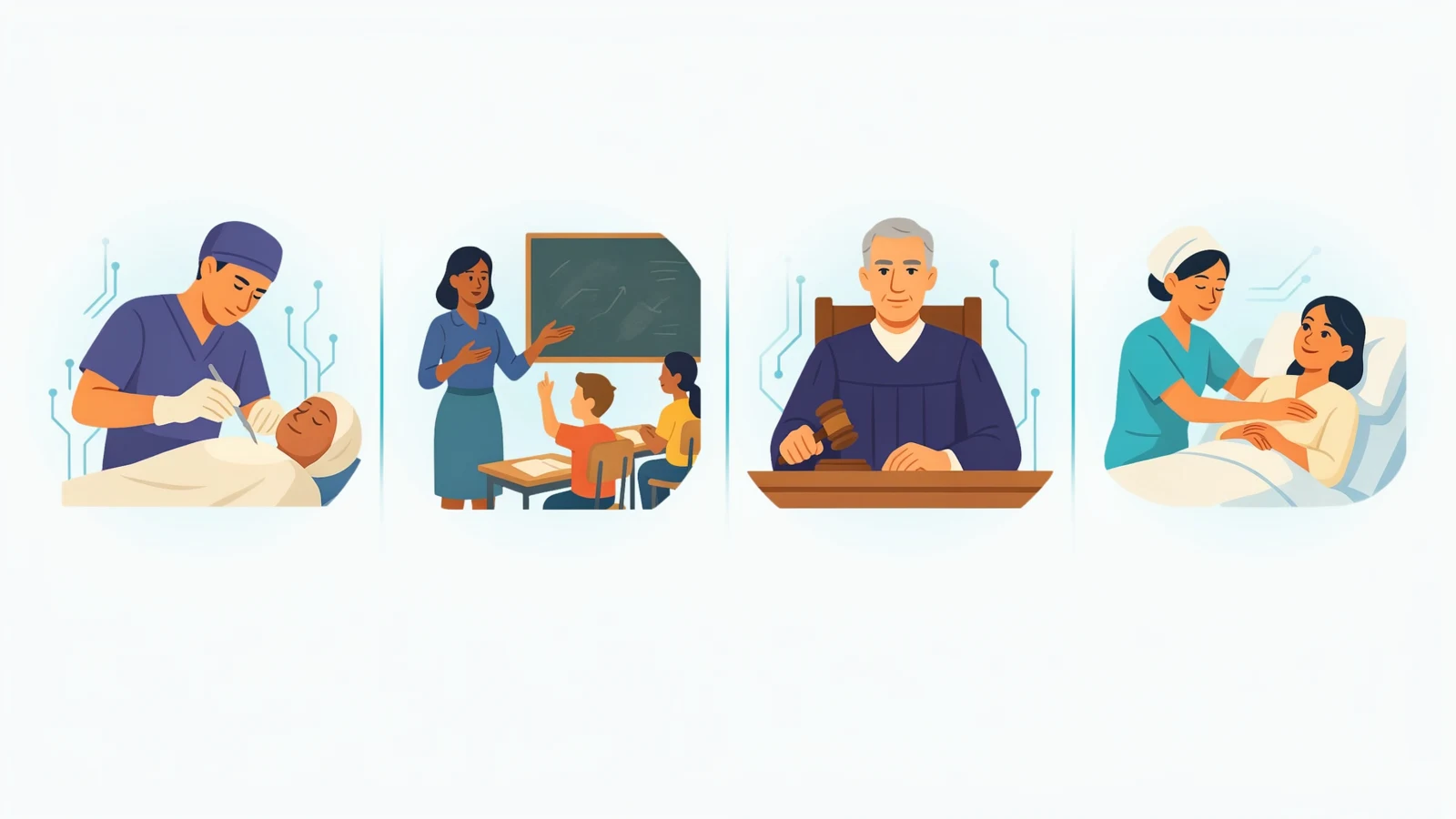
Even though artificial intelligence is improving, it is unlikely that AI will ever replace teachers because there is something irreplaceable about the human touch they bring into teaching. Teaching is not just about imparting knowledge; it involves motivating and counseling young people as they grow and begin making decisions on their own. Teaching involves understanding emotions and using empathy while responding uniquely to each person’s situation. Even if computers can help us score exams or provide more reading materials, they do not have this special connection to help us grow intellectually and personally. Therefore, educators will still be crucial in steering and promoting learners.
2. Lawyers and Judges
Another domain AI is not likely to overtake is the legal profession, particularly lawyers and judges. Laws vary by jurisdiction and depend on complex negotiation, case strategy, and interpretation of laws. Every legal case is different; therefore, human experiences, personal judgments, nuances of the situation, and ethical considerations should be carefully considered, something AI has no capacity for. Judges make life-altering decisions like pronouncing sentences or verdicts, considering several human factors. For this, one must understand both legal precedents and human behavior in depth. Nevertheless, AI can aid in legal research and document review, but not in interpreting and arguing the law.
3. Directors, Managers, and CEOs
Senior positions in a company, such as a director, manager, or even CEO, frequently require specific skills. To lead, they need to have a long-term outlook, be empathetic, and know how to work well with others. Nearly all professional roles require human interaction and demand the establishment of healthy working relationships within an organization, solving problems, and making decisions even when facts are inconclusive. While AI may help in decision-making, it will never provide the empathy needed for proper leadership.
4. Surgeons
While we have seen significant improvements in healthcare procedures, specifically robotics-assisted approaches, it is important to reiterate and underscore the indispensable role of a surgeon in such settings. A surgeon requires know-how in performing a procedure and the skill to come up with a quick but careful and complex solution while the surgery is ongoing. A human surgeon’s intuition, experience, and years of training put the patient at ease during the operation. Even if AI interventions can help to perform diagnostic tasks and activities, it is unlikely that AI will have the adaptability, creativity, and rational thinking about different outcomes that live surgeries require.
5. Research and Analysis
According to the Future of Jobs Report 2025 by the World Economic Forum, Research and Analysis roles are less likely to be automated because they rely heavily on advanced cognitive skills such as critical thinking, complex judgment, and interpretation. Unlike routine or repetitive tasks, these positions involve synthesizing diverse information, generating strategic insights, and applying nuanced understanding—capabilities that current AI and automation technologies cannot fully replicate.
Right now, you can read our blog about 10 trendy AI and ML technologies.
Moreover, these roles often require creativity, problem-solving abilities, and the development of innovative knowledge or strategies, all of which depend on human intuition and expertise. They also demand ethical decision-making, contextual awareness, and adaptability to new or ambiguous situations—areas where machines remain limited.
While technology can enhance research and data processing, the core duties centered on thorough evaluation, strategic reasoning, and exploratory thinking necessitate human involvement, protecting these professions from complete automation. This underscores the importance of cultivating complementary skills that work alongside AI to maximize its benefits effectively.
Transform Your Operations by Leveraging AI with LITSLINK’s Experts
To be on top of a highly competitive field and benefit from the evolution of artificial intelligence, organizations should hire AI developers to build their AI ecosystem.
LITSLINK boasts exceptional engineers specializing in AI to enable your company to take advantage of the changing landscape. We will help you streamline operations or automate the main functions by providing personalized solutions aimed at giving your business a competitive edge over others. Partnering with LITSLINK will enable you to start AI project implementation within your sector today.
Summing Up
The impact of artificial intelligence on the job sector is massive and multifaceted. Preparing for these shifts is key as we ask again: what jobs will AI replace by 2030 and beyond? AI may facilitate the automation of many tasks across various fields, potentially leading to job losses in some areas. However, it could also create new jobs and make some areas more efficient. Therefore, it is crucial to have a flexible workforce and continually acquire new skills. Individuals, businesses, and policymakers must focus on reskilling and upskilling programs that foster collaboration between people and technology to meet this challenge. AI will drive the future. To maintain a stable and prosperous workforce, it is essential to adapt to this change.
Author: Serhii Antoniuk (LinkedIn: https://ua.linkedin.com/in/serhiiantoniuk) — author block preserved, not modified.
Frequently Asked Questions
The World Economic Forum’s Future of Jobs Report 2025 projects that AI and related technologies will displace about 92 million roles by 2030 while creating roughly 170 million new ones — a net gain of 78 million jobs. So the direct answer to how many jobs will AI replace is: tens of millions globally, but more roles are expected to be created than lost over the same window.
According to Goldman Sachs’ April 2026 research, AI is cutting approximately 16,000 net US jobs per month. That reflects around 25,000 roles removed through AI substitution, offset by about 9,000 new AI-augmented roles added back each month.
Customer service (up to 80% of roles at some risk), paralegal and legal research work, medical transcription and coding, accounting and bookkeeping, and entry-level white-collar positions face the highest exposure. Roles built on routine, repetitive, data-heavy tasks are automated first.
Teachers, surgeons, lawyers and judges, senior leaders (directors, managers, CEOs), and research and analysis roles rely on empathy, judgment, and complex human context that current AI cannot replicate. These positions are expected to endure and, in several cases, grow.
Every major institutional projection — Goldman Sachs, the WEF, the IMF, McKinsey, and the BLS — points to net positive job creation over the medium term. The catch is that the transition is uneven: displacement hits some workers immediately, while the new roles demand different, often AI-related, skills.