








Key Takeaways
- The cost of AI in healthcare is not fixed and depends on whether you want a simple, task-specific agent that can cost about $4K or a regulated diagnostic support and clinical decision AI solution that can run over $1M.
- Healthcare data is often collected in inconsistent formats and contains missing values, making the data preparation stage a substantial project in its own right.
- Integrating AI with existing healthcare systems, such as EHRs and billing platforms, often drives costs beyond initial projections since most of these systems require custom APIs to allow AI interoperability.
- Regulatory and compliance requirements can increase AI implementation costs by 20-40% annually, especially for AI systems classified as medical devices.
- AI in healthcare delivers measurable ROI when success metrics are defined early.
This article is a guide for organizations, startups, and technology teams in the healthcare industry, aiming to understand the cost of AI in healthcare, factors affecting implementation, and long-term support needs. If you are evaluating whether to transition and integrate AI in healthcare or looking to expand an existing integration, then read on.

What Is the Typical Cost of AI in Healthcare?
There is no single fixed cost of AI in healthcare. For example, a scheduling assistant will cost a fraction of what a platform with multi-agent operation would. The pricing depends on the type of software being built, the number of systems being integrated, the required accuracy, and where the solution will be implemented (on the clinical or administrative side).
To understand the complete financial picture of building an AI platform, we have to look beyond the initial investment for the build phase. A common mistake that healthcare organizations make is focusing solely on the cost of launching the first version of the software rather than considering the total cost of ownership over time.
The initial investment is the cost of bringing the solution to life, and it covers foundational structure and planning, extensive data preparation, core model development, and a high level of integration with the existing clinical and administrative systems. The final product also has to undergo rigorous validation testing, security reviews for patient privacy and data protection, and the final deployment into a live healthcare environment.
To get a more accurate estimate that is tailored to your specific project requirements, you can try using an AI cost calculator.
What Affects the Cost of Implementing AI in Healthcare?
Typical costs of AI in healthcare are not limited to the cost of the software development. The overall investment may include costs of infrastructure, customized AI model development, data preparation (which can account for 30–40% of total AI project costs), compliance, performance validation, training, and maintenance.
1. Customized AI Model, Agent, and System Development Costs
Planning an investment in healthcare technology requires recognizing that the development costs of AI solutions vary significantly with the project's scope and nature. Healthcare environments have unique infrastructure and regulatory compliance requirements, so the figures in the table should be viewed as speculative rather than final market prices.
| Healthcare AI Solution Type | LITSLINK Cost / Estimate | Timeline | Healthcare-Specific Scope |
|---|---|---|---|
| Healthcare AI PoC / MVP | $25,000–$75,000 | 4–6 weeks for a focused PoC | Validation of one focused healthcare use case using real data, such as patient scheduling assistance, clinical documentation processing, or medical coding support, before committing to a full production solution. |
| Simple Task-Specific Healthcare Agent | Starting from $4,350 | 3–8 weeks | One focused workflow with limited integrations, such as appointment request handling, patient intake support, or medical coding assistance, with defined human review steps. |
| Healthcare Workflow Agent with Integrations | Starting from $20,400 | 8–16 weeks | Multiple system integrations, such as EHRs, databases, or internal APIs, supporting patient scheduling automation, documentation processing, intake routing, or other operational healthcare workflows. |
| Multi-Agent Healthcare System | Starting from $81,000 | 16–24+ weeks | Complex, coordinated healthcare operations involving several agents, orchestration, role-based access, audit trails, compliance requirements, production reliability, and monitoring at scale. |
| Regulated Diagnostic Support or Clinical Decision AI | $250,000–$1 million+ | Depends on validation and compliance scope | High-stakes clinical support involving diagnostic assistance or medical decision workflows, where human oversight, output validation, security controls, guardrails, and healthcare-specific compliance architecture are essential. |
2. Infrastructure and Cloud Costs
The total cost of AI healthcare systems also depends on the infrastructure choice a hospital management makes; a cloud deployment is typically cheaper upfront and faster to launch than an on-premises setup.
AI technologies require infrastructure to provide model hosting, processing, storage, and model training. Depending on the specific project requirements, this may include a full stack of AWS, Microsoft Azure, Google Cloud, GPU computation, on-premises servers, or hybrid environments.
For the U.S. market, the estimate of cloud infrastructure costs may vary from $50,000 to $400,000 annually. On-premises GPU servers can cost from $100,000 to $1 million+. In addition to this, security, storage, and disaster recovery costs may range from $30,000 to $200,000 per year, and network enhancements can reach $20,000–$100,000.
Costs increase significantly if the projects involve medical imaging, model training, real-time inference, processing large volumes of patients, working with different institutions, high-bandwidth connections, high levels of security, and requirements for redundancy and GPUs.
3. Healthcare System Integration Costs
No matter how well-designed an AI model is, its practical value is limited if the system cannot access the right data and at the right moment. One of the major areas where many projects encounter unexpected costs that can run into the thousands is the integration of AI models into existing software in a healthcare setting.
Estimated Healthcare AI Integration Costs
There are no benchmark prices for integration of AI in healthcare systems in the U.S., but market estimates give an idea of planning costs.
- A single AI module with EHR integration can range between $50,000 and $300,000. The basic connection using FHIR may cost less than that. However, if there is a bidirectional integration, data mapping, encoding process, certification, and various complex EHR environments, the price may increase.
- Full-system integration across multiple modules or sites will cost $500,000 to $2,000,000+. However, for large enterprise systems, it can exceed $2,000,000+.
- Ongoing updates and support will cost about 15 to 25% of the initial integration cost annually.
What Drives Healthcare AI Integration Costs?
Depending on the institution and its needs, AI models deployed in their healthcare systems require secure, role-based, real-time access to electronic health records, billing platforms, lab systems, scheduling tools, and patient management databases.
Legacy billing systems used in healthcare were not originally designed to integrate with AI systems. The interoperability of the traditional systems with the newer AI technology requires building custom APIs from scratch, developing middleware layers, and running testing cycles that require cooperation between multiple vendors.
Thanks to the FHIR data exchange standard, interoperability can be improved. FHIR R4 is a widely used version of the standard for modern API-based integrations. HL7 v2 is still relevant for established healthcare messaging systems, while HL7 FHIR supports API-based health information exchange. Security and compliance add access controls, data protection, testing, and validation.
Integration work often drives costs higher than teams expect. The standardization helps AI systems to plug into existing clinical and administrative workflows at the right time to retrieve data; failure to do so would render the systems ineffective and even entirely useless at times.
In some cases, data normalization is crucial, especially when various departments or centers are using different formats, coding rules, and structures. It may also include the matching and mapping process in order to identify patients’ medical history records in detail.
4. Data Preparation and Governance Costs
In healthcare organizations, patient data is collected from diverse sources and isn't always well organized. The data has inconsistent formats, missing values, coding errors, and the style of documentation in hospital settings varies by department, clinician, and institution. To sort that data until it is structured enough to train an AI system is a whole project in its own right, and there are specific costs that come with it.
Data Acquisition Costs
Healthcare AI can use internal clinical, operational, imaging, and sensor data, but healthcare data may be limited, incomplete, or inconsistent, or lack enough examples of specific conditions.
You can augment your internal data with third-party, licensed, or hospital-shared health data. Current estimates are that healthcare data acquisition costs around $50,000 to $250,000. Public and academic data might be free to use in certain situations.
Data augmentation can be employed to supplement limited datasets. Tabular augmentation costs about $5,000 to $15,000, medical imaging augmentation ranges from $20,000 to $50,000, while synthetic data generation would cost around $40,000 to $200,000+, depending on how extensive it is and the nature of validation required.
Training Data Preparation Costs
Healthcare data will require structured cleaning, normalization, resolving the issues of missing values, fixing errors and duplicates, ETL/preprocessing, de-identification of PHI, labeling, and validation. High-stakes clinical AI may also require clinician review.
The costs of the audit and data cleansing process itself may be between $30,000 and $150,000, while the bigger data annotation projects may come at a cost ranging from $50,000 to $500,000+. Medical imaging, pathology, and clinical NLP may be more expensive when compared to tabular data because of the expertise required. Complex clinical annotation might exceed $10 for each instance, although no rate can be applied universally in the United States.
The cost of de-identification can also be derived based on data volume. Google Cloud Healthcare API currently charges $0.10–$0.30 per gigaunit (GU) for inspection, $1–$3 per GU for transformation, and $0.05–$0.60 per GB for processing. Its published example estimates $44.52 to de-identify 10 GB of DICOM data under specified assumptions.
Data Storage Costs
Ongoing AI costs include cloud hosting fees of $0.50–$2 per scan . In addition to medical images, the data that can be used includes longitudinal records, sensor streams, and so on. Various storage methods can be implemented, including cloud, on-premises, hybrid, backup, archive, redundancy, and disaster recovery.
A data storage setup budget ranging between $30,000 and $200,000 can be reasonable in the case of a considerable deployment; this overlaps with the infrastructure estimate above, so do not count it twice. AWS HealthImaging currently charges $0.105/GB-month for frequently accessed imaging data and $0.006/GB-month for archive storage. Assuming data is moved to archive storage after the first month, AWS estimates 20 TB of medical imaging at about $3,502 in the first year and about $1,475 in the second when older data is shifted to an archive. Multi-hospital imaging programs can generate 50–200 TB of new data annually.
Costs can be pushed up as a result of long retention, multiple copies, high availability, data transfer, replication, and retrieval. Encryption, access control, and audit logging may also be required.
5. Regulatory Compliance, Security, and Clinical Validation Costs
The regulatory conditions under which healthcare AI systems operate are some of the most stringent regulations across all industries in modern times. Adhering to security and compliance rules protects both patients and organizations, but it is accompanied by the rising cost of advanced AI tools in healthcare. Meeting HIPAA requirements and, for software that qualifies as a medical device, FDA requirements can add an estimated 20–40% to implementation costs.
HIPAA compliance must include risk analysis, safeguards, access controls, and protection of ePHI. Cloud vendors providing ePHI services must execute the appropriate business associate agreements. They are constrained by GDPR, under which health data is granted enhanced protection, and high-risk processing typically requires a Data Protection Impact Assessment.
A substantial HIPAA security assessment and remediation program may cost $30,000 to $150,000, depending on systems, vendors, locations, and gaps.
The FDA requirements for AI for medical devices may include 510(k) or De Novo. FY2027 FDA user fees are $28,653 for a standard 510(k) and $191,020 for a De Novo request (lower for small businesses).
The costs of consulting, testing, documentation, and submission support are likely to increase the total expenses. The total amount that can be expected to spend on regulatory services can be between $100,000 and $500,000+ for regulatory and between $200,000 and $1 million+ for clinical validation, depending on the product’s risk classification and complexity. Ongoing regulatory monitoring also adds about $50,000 to $200,000 on an annual basis.
6. Staff Training and Change Management Costs
Training programs can include instructions, materials, staff time, and post-launch education.
For large-scale implementations, $20,000 to $100,000 for IT and operations training and $50,000 to $250,000 for change-management consulting are reasonable planning ranges. The cost of annual ongoing training can be estimated at about $20,000 to $80,000.
A 500-bed hospital could reasonably budget $300,000–$600,000 in the implementation year for training, change management, workflow support, and related staff time.
7. Ongoing AI Maintenance and Operating Costs
Hospital systems that have integrated AI into their workflows require constant monitoring; deployment is not the final step of the project, as it adds another layer of expense, especially when you consider that unique clinical and administrative workflows require custom healthcare software development services.
The cost of maintaining a clinical AI model can range from roughly $15,000 to $100,000 per month for large production clinical systems, and this ongoing investment is crucial because healthcare AI models must be continuously updated as workflows and clinical environments change.
Post-launch costs include the costs of monitoring, retraining or fine-tuning the models (monthly model retraining costs range from $1,000 to $5,000), human review, engineering support, security upgrades, and system maintenance.
A practical planning benchmark is 15–25% of initial software development and integration cost annually. The cost is determined by the number of users, number of installations, volume of data processed, frequency of models used, level of human supervision, and frequency of updates.
AI in Healthcare Costs by Application Area
As previously mentioned, the overall cost of implementing AI in healthcare depends on the functionality and the application area of the system. AI solutions vary from administrative tools, clinical support systems, diagnostic systems, and AI agents, all having unique requirements of their own.
| Application | Illustrative U.S. project range | Main cost drivers |
|---|---|---|
| AI tools for patient access and administrative services | $25,000–$180,000+ | Scheduling, intake, billing/coding, EHR integration, security |
| AI-powered clinical decision support | $75,000–$700,000+ | EHR integration, model complexity, validation, clinician review, regulation |
| ML and computer vision for diagnosis | $100,000–$750,000+ | Imaging data, annotation, PACS/RIS/EHR integration, validation, FDA, monitoring |
The current estimates indicate that medium-size hospitals spend approximately between $60,000 and $180,000 for administrative AI. Rules-based clinical decision support ranges between $40,000 and $100,000, while custom predictive analytics solutions may cost between $90,000 and $250,000. The range of medical imaging AI is from $100,000 to $500,000+, and for complicated regulated platforms, cost may reach $750,000+.
AI Tools for Patient Access and Administrative Services
Smart AI tools for patient access and administrative services are among the cheapest and easiest systems for healthcare organizations looking to begin their AI adoption journey. These tools speed up operations in administrative work such as appointment scheduling, automating intakes, processing documents, communicating with patients, billing, and serving as 24/7 virtual assistants.
In practice, these scheduling assistants can book or confirm appointments, while intake automation can collect insurance details, consent forms, and pre-visit questionnaires before patient arrival. They can assist organizations with document classification, billing, claim processing, coding, and more.
AI-Powered Clinical Decision Support
AI-powered clinical support tools assist clinical officers in reviewing information, identifying patterns, prioritizing cases, and supporting treatment planning in clinical practice, helping clinicians to arrive at more accurate diagnoses. These intelligent systems are not meant to replace doctors but rather assist them by fitting well into healthcare system workflows and preserving patient safety.
The entire architecture of responsible AI use in clinical settings involves having extreme clinical accuracy, explainability of AI outputs, security, and human oversight, which significantly add to the cost of a project. The development of these systems requires close collaboration with medical professionals, multiple rounds of clinician feedback, and rigorous testing against real clinical datasets.
Machine Learning and Computer Vision for Diagnosis
AI models in healthcare that leverage computer vision, machine learning, and deep learning are now used to assist medical professionals with imaging, disease detection, diagnostic support, and risk assessment. The models process information at superhuman speeds and detect subtle patterns in data that standard human reviews might miss.
To improve the accuracy of these systems, they have to be trained on well-structured and validated data, carefully tested, and receive clinician feedback before being deployed. What organizations potentially get with this is faster processing and improved support for diagnosis.
Remote Patient Monitoring and Predictive Analytics
Prices depend on the total number of connected devices, number of patients, frequency of data transfers, alerting, dashboards, and integration with an EHR system. The cost of remote monitoring for a pilot system will not exceed $150,000, while for systems that work in real-time mode, the price will exceed $150,000. The cost of developing Edge AI in healthcare can also be quite high, from $80,000 to over $1,500,000, so take note of this if this development approach is planned to be used.
The amount of predictive analytics required relies ultimately on the workload needed. Daily risk scores that are generated using only existing data from electronic health records would be cheaper to implement than real-time systems, which utilize streaming data and clinical alerts. Computing hardware, data processing, alert review, and costs associated with false positives should also be considered.
Implementing AI in Healthcare: Cost Breakdown by Project Stage
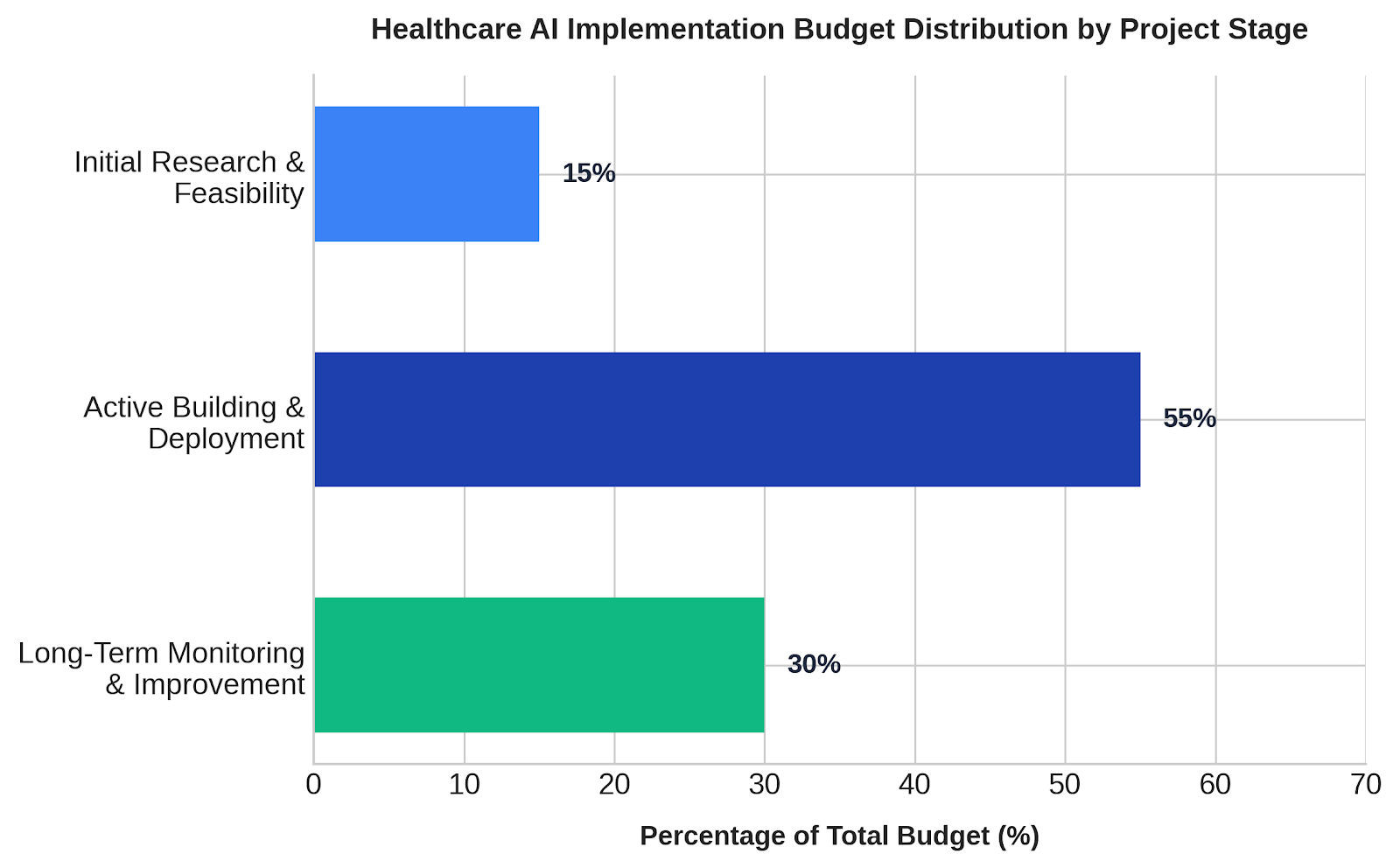
Building an effective healthcare AI solution involves a financial investment that goes far beyond the coding and model selection. An implementation budget is distributed across three phases: initial research, active building & deployment, and long-term monitoring and improvement.
Discovery and Healthcare AI Strategy
For any AI healthcare project, the first phase is the research stage, which focuses on defining the specific clinical or operational problem the model seeks to solve, identifying the end users, and setting targets to track the success of the model. It's also during this strategy stage that medical professionals and scientists collaborate to evaluate the availability and quality of data while also reviewing current IT systems.
This project phase is necessary for healthcare organizations to manage investment and select the right AI application by establishing a clear project scope, identifying expected benefits, navigating potential risks, and mapping out integration requirements. Given the highly complex and regulated nature of healthcare data, healthcare organizations often need to either leverage internal AI expertise or partner with external support to validate their strategy at this stage.
The approximate cost of this phase is 10–15% (planning allocation: 12,5%) of the total project budget.
AI Development, Testing, and Deployment
The next stage is the active build phase, which includes preparing data for training, selecting or creating AI models, developing the core software from scratch, and building system integrations. When devising the core technology, developers of the AI model may build the whole system from scratch, fine-tune an open-source model, or even adapt an existing model, depending on the specific use case.
Testing AI models in medical fields is extremely rigorous and revolves around various sections, which include:
Technical Performance. The AI system is tested for accuracy, speed, and reliability.
Security. Here, the AI model is tested for compliance with data privacy regulations like HIPAA and data protection protocols.
Workflow Compatibility. The model's integration with EHR is evaluated, especially how staff respond and adapt to the integration.
User Feedback. A hands-on evaluation is conducted with clinical validation from the relevant healthcare professionals.
Healthcare teams interacting with smart systems should have basic AI expertise so they can safely evaluate system outputs and spot potential errors.
The approximate cost of this phase is 50–60% (planning allocation: 55%) of the total project budget.
Ongoing AI System Costs
The budget of the project post-launch has to account for ongoing critical services like cloud infrastructure, technical support, security checks, data management, integration maintenance, and ongoing governance processes.
The approximate cost of this phase is 25–30% (planning allocation: 30%) of the total project budget.
Where AI in Healthcare Can Reduce Costs
When healthcare organizations evaluate the cost of their AI models, they should look beyond the upfront price because judging an AI solely on that cost alone misses the broader operational and financial value that the technology can create. In real-world practice, AI has a decent ROI by cutting avoidable operational waste, reducing repetitive work, and supporting better clinical decisions that improve value over time.
The operational and clinical efficiency that healthcare AI models provide can be seen in several key areas in healthcare workflows, including:
Administrative Automation. Intelligent AI models can be used to speed up clinical documentation, streamline insurance authorizations, and optimize patient scheduling. One healthcare organization reported saving its employees about 15,000 hours a month due to the application of AI for processing transactions, which leads to a 40% reduction in time spent on documentation and a 30% ROI.
Resource Allocation. Intelligent systems help management teams to efficiently utilize staff time and bed capacity, which directly relieves management teams of extra costs. Research conducted in 2025 on AI-assisted scheduling and bed allocation indicated that it resulted in a reduction of waiting times by 37.5% and an improvement in bed-occupancy efficiency by 29%.
Preventive Care. Predictive AI tools have been documented as helping reduce hospital readmissions by up to 20% by identifying high-risk patients and recommending follow-ups for patients.
Diagnostic Support. AI in healthcare has led to improved diagnostic accuracy and early detection for patients, thus helping organizations avoid financial penalties linked to inefficient care and avoidable complications. A study involving a pediatric hospital carried out in the United States revealed that automated sepsis screening reduced median encounter costs by 21.2%, from $6,454 to $5,084.
The financial and operational benefits of integrating AI with healthcare are not automatic; to get this value, organizations have to define success metrics early and continuously review whether the models are delivering accurate results.
How to Calculate ROI on Healthcare AI Investment
Healthcare AI should be evaluated against the financial and operational value it creates over time, not just implementation cost. ROI can include any cost savings of AI in healthcare diagnosis, lost revenues that have been regained, increases in productivity, and any improvements in clinical or objective outcomes.
The Core ROI Formula
ROI (%) = [(Financial Benefits − Total AI Costs) / Total AI Costs] × 100
Financial benefits refer to any saved expenses related to labor, administrative work, regained profits, lower costs of rejection or settlement of claims, faster treatment, reduced number of readmissions or complications, and productivity gains.
Total AI costs consist of expenses incurred in development, implementation, preparation of data, infrastructure, compliance, training, and support.
Healthcare AI ROI by Value Stream
Administrative and Revenue Cycle AI: Medical AI has a positive impact on administrative processes, with a US estimate for 2025 saying that automation in the US healthcare sector helped avoid $258 billion in administrative costs in 2024, with another $21 billion in additional potential. However, these costs refer to health care automation, not just AI techniques.
Clinical Decision Support: A clinical trial supported by NIH indicated that artificial intelligence could lead to 47% lower odds of 30-day readmission and nearly $109,000 in estimated savings.
Diagnostic and Imaging AI: A 2026 study in the US underlined that AI assistance in radiology triage reduced turnaround time for positive pulmonary embolism examinations by about 22 minutes, from 68.9 to 46.7 minutes.
Example Healthcare AI ROI Calculation
The typical cost of implementing AI in healthcare for mid-size hospitals ranges from $250,000 to $1.5 million. The example below is illustrative.
| Metric | Amount |
|---|---|
| Total AI investment | $1,000,000 |
| Annual operating costs | $200,000 |
| Annual measurable benefits | $1,500,000 |
| Net financial benefit | $300,000 |
| First-year ROI | 25% |
| Estimated payback period | 9 months |
First-year costs total $1.2 million ($1 million implementation plus $200,000 in operating costs). Against $1.5 million in annual measurable benefits, the net benefit is $300,000, which gives a first-year ROI of 25% ($300,000 ÷ $1.2 million × 100).
How to Plan an AI Healthcare Project Budget
A practical developmental plan for implementing AI in healthcare requires a structured approach to budgeting.
Define the Use Case
Defining a use case will dictate every subsequent expense, be it data readiness, integration requirements, security & compliance, deployment expectations, and recurring operating costs across the intended clinical or operational environment.
Budget for Data Preparation and Integration
AI models are heavily dependent on data that is used to train and validate them. Therefore, budgeting teams have to account for data aggregation, cleaning, formatting, and quality control. Besides, embedding the solution into existing EHR or hospital billing software is another crucial tenet of the budget. This integration will involve third-party vendor fees and custom API deployment.
Account for Security, Compliance, and Infrastructure
Patient data is highly sensitive. Therefore, the budget has to account for security, privacy, and compliance with data protection standards like HIPAA, GDPR, or other applicable regional requirements. Infrastructure costs, depending on whether the system is deployed on-premises or integrated via the cloud, are also part of it. Healthcare organizations can choose the ideal infrastructure based on their specific needs.
Include Post-Deployment Costs
Launching the system is only half of the battle; any realistic budget must account for post-deployment costs, such as staff training and periodic retraining of the model to prevent it from gradually drifting and providing inaccurate answers.
Consider the Project Scale
The scale of the project matters, and budgeting assumptions vary wildly across medical systems. Large healthcare organizations and academic medical centers operating highly complex medical systems face bigger budget assumptions than smaller providers.
Why Healthcare AI Investment Is Growing
There is a debate that comes up in modern ultrasound units on whether AI should review fetal images before the physician, after, or at the same time. This shows how far AI in healthcare has come already. Modern AI tools work hand in hand with professionals as a supplement, not a replacement. Integrating them into healthcare workflows has led to greater efficiency and streamlined healthcare services.
Recently, the FDA cleared an AI module designed to help physicians catch abnormal findings on fetal ultrasounds. The results were incredible: a 22-point improvement in readers' performance in detecting fetal anomalies. If such AI tools are delivering documented improvements in high-stakes clinical workflows, then it's time to get highly practical with them.
A 2026 healthcare survey by McKinsey provides more insight into the wider adoption of AI healthcare tools: 50% of participants reported using generative AI in their organizations in Q4 2025, up from 25% in Q4 2023. In just two years, the adoption of AI technology in the healthcare industry has doubled, signaling a rapid pace of change and the industry's future direction.
A decade ago, artificial intelligence in healthcare was mostly in the research stage, with very few real-world use cases. In 2026, healthcare organizations have the luxury to shift the conversation from whether to use AI tools at all to how they plan, build, and integrate them into their workflows.
Develop a Cost-Effective Healthcare AI Solution with LITSLINK
Successful AI development and deployment requires a strategy that goes beyond selecting a machine learning model. To build cost-effective AI solutions in healthcare, teams must account for every stage of the lifecycle. LITSLINK assists healthcare organizations, clinics, and startups in navigating all of these complexities without overspending. Our experienced data scientists team will work alongside your domain experts in various stages of the development cycle:
- Assessing the project scope and building a realistic financial roadmap.
- Preparing a robust and scalable system architecture.
- Developing custom AI-powered software that is tailored to specific clinical workflows.
- Managing seamless EHR integration and data structuring.
- Performing rigorous security planning, compliance auditing, and system testing.
- Supporting seamless deployment and monitoring long-term performance to prevent the model from drifting and giving inaccurate answers over time.
AI Agents for Healthcare Operations
AI agents are a practical application of artificial intelligence in healthcare designed to handle defined administrative tasks within healthcare workflows with a measurable level of autonomy. For example, AI agents can provide support with making appointments, following up with patients, helping clinicians with documentation, and performing routine communication tasks.
LITSLINK Radiology Assistant is a perfect illustration of agentic AI in healthcare. The assistant, built on a foundation vision-language model, slots seamlessly into existing clinical infrastructure and can interpret X-ray and CT scan data to generate preliminary diagnostic assessments. It is trained to automatically retrieve newly uploaded scans for analysis without any manual input from radiological staff, and then write diagnostic suggestions back into the Picture Archiving and Communication System (PACS) or Radiology Information System (RIS) environment for radiologists to interpret. The system enables a faster, more structured workflow that supports more consistent and accurate medical image interpretation across all radiology departments.
That said, the cost of AI agent development services also depends on the level of system access, third-party integration requirements, security and monitoring needs, and autonomy required.
Let us help you turn your AI vision into a practical reality. Contact LITSLINK today to discuss your healthcare AI project and get a detailed estimate of your development costs.
FAQs About the Cost of AI in Healthcare
How Much Does AI Cost in Healthcare?
Costs range from about $4,350 for a simple task-specific agent to $250,000–$1 million+ for regulated clinical AI. A proof of concept typically costs $25,000–$75,000.
A basic administrative AI tool is on the lower end of the scale compared to complex diagnostic imaging or predictive analytics tools, which require significant investment.
What Increases AI Implementation Costs in Healthcare?
The primary drivers are poor data quality and complex integration requirements.
If the medical data is unstructured, the data preparation costs can end up really high. In addition, integrating AI into healthcare's existing EHR systems requires a lot of man-hours and strict security audits.
Can AI Reduce Healthcare Costs?
Yes, it has been documented that AI can significantly reduce costs in healthcare organizations.
AI technology in healthcare achieves this by eliminating operational waste and preventing expensive medical complications.
Is Custom AI Development Better Than Ready-Made Software?
Healthcare organizations with specialized clinical workflows and unique data structures stand to benefit more from custom AI development than ready-made software.
Although ready-made software has lower upfront purchase prices, custom AI development can be tailored to specific operational and clinical needs.
What Are the Long-Term Costs of Healthcare AI?
Ongoing costs typically run 15–25% of the initial build and integration cost per year. For large production clinical systems, they can reach $15,000–$100,000 per month.
These recurring expenses are required to cover cloud infrastructure, continuous data management, routine security checks, and regular model updates.