






Lawyers report high rates of mental health challenges, and according to data from Lawcare’s 2020/21 report, a whopping 69% of legal professionals reported experiencing mental ill-health. A huge portion of this problem stems from lawyers spending hours a day on repetitive operational tasks rather than high-value legal work. Legal AI assistants automate meeting note logging, appointment scheduling, email sorting, and routine administrative inquiries.
Custom AI Legal Assistants Tailored to Your Legal Team’s Needs
Modern legal teams leverage AI assistants to automate mundane tasks such as summarizing documents, conducting legal research, drafting routine documents, organizing case files, and tracking deadlines.
LITSLINK designs custom legal AI solutions that tick all the right boxes, including:
- Enterprise-Grade Security. We adhere to comprehensive data protection protocols to ensure sensitive legal data won’t fall into the wrong hands.
- Rapid Delivery. Our technical team delivers a fully working proof of concept (PoC) in just 4-6 weeks.
- Custom Designs. The systems we build are tailored to the specific needs and workflows of your firm.
- Scalability. Our designs feature modern architecture that scales with volume, without increasing operational overhead.
What Is an AI Legal Assistant?
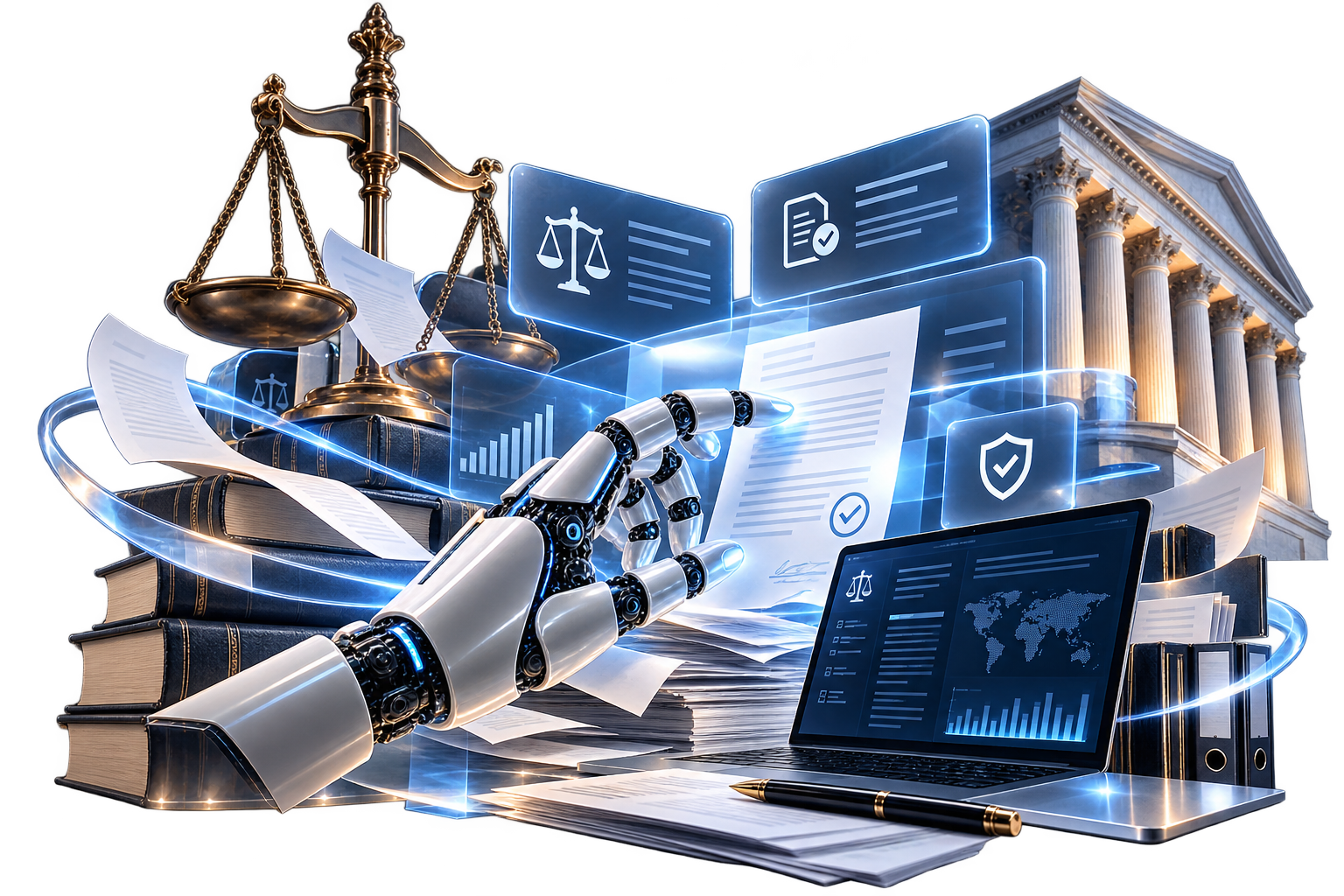
Artificial Intelligence assistants are smart software tools that handle legal work alongside legal teams. AI is built on modern technologies such as Natural Language Processing, Large Language Models, Machine Learning, and Retrieval-Augmented Generation. These technologies give AI assistants their human-like abilities and allow them to understand legal documents, case law, and specific firm data with context.
Legal AI assistants differ from AI chatbots (like ChatGPT) in that they are embedded and integrated into the workflows of your firm, providing context-based support. AI chatbots just answer generic questions. A legal AI assistant can read your case files, understand your matter details, and research legal summaries for informed decisions.
It’s important to note that AI legal assistants are not a direct replacement for lawyers because the legal team still has to make decisions, provide legal advice, and build relationships with clients. AI legal assistants simply reduce the administrative workload, allowing the team to focus on the human side of law firms, such as strategy, judgment, and client handling.
Our AI Legal Assistant Use Cases
The legal profession is known for drafting repetitive legal documents such as non-disclosure agreements, legal motions, client status updates, and standard legal correspondence. Manual drafting of these documents is time-consuming and usually creates internal bottlenecks in legal workflows, thus keeping legal teams from doing core legal work.
AI legal assistants trained on firm data can draft these documents in seconds, saving firms time and money while directing human resources to more meaningful work. The AI assistants can draft legal documents using stored client data, case details, key dates, and cross-references from previous templates. Legal teams can now focus on reviewing the documents and refining the output rather than drafting them from scratch, which improves efficiency, helps reduce workload for the staff, and accelerates the time taken to prepare documents.
Lawyers bury themselves in large volumes of legal texts, historical decisions, and jurisdiction data so that they can find relevant precedents and statutory guidelines to have an edge in case law. These activities cost legal firms substantial human-hours and direct resources to mundane tasks that can be executed autonomously by AI assistants.
Customized AI for lawyers can take over this burden and run localized deep research across massive datasets in seconds. AI legal assistants can research and analyze documents, highlight the relevant information, and provide legal research backed by relevant professional citations in the legal field. This not only helps legal professionals to reduce the time they spend on manual research but also helps them to conduct deeper research more efficiently. They also draft stronger legal arguments that are backed by reliable sources and references.
Legal firms conducting due diligence must audit multiple documents across many contracts, review corporate compliance reports, and other legal materials, which can be time-consuming and, as previously stated, leave a wide margin for human error.
AI-powered legal assistance helps firms process thousands of documents and classify them at the same time. The smart AI tools embedded in the firm’s legal workflows can identify and flag risks for human review, helping legal professionals conduct faster reviews and focus on the most critical issues.
It’s no secret that efficient client intake can easily make or break a law firm’s growth and scalability. Traditional manual workflows are notoriously time-consuming, with intake teams spending critical time on reviewing inquiries, gathering information, conducting manual evaluations, sending questionnaires, and scheduling consultations. The time wasted means losing hot leads of potential clients to competitors who are moving fast during the critical client acquisition window.
Law firms implementing automated AI solutions for their legal work enjoy a client intake pipeline that runs autonomously 24/7. The embedded smart systems can collect relevant information, perform preliminary checks, send responses, and automatically update schedules. By taking over the administrative burden, legal professionals can now respond faster, improve client experiences, and spend time on high-value legal work.
Legal documents can have hundreds of pages in fine print, and manual contract reviews require professionals to meticulously read through every single page. The probability of human error goes up with every page reviewed as fatigue kicks in, and with it comes the risk of overlooking subtle clauses, hidden liabilities, and the ever-changing compliance standards.
Deploying legal AI assistants ensures that even the most complex contracts can be deeply reviewed and analyzed with better consistency. AI solutions can scan contracts in real time, identify key clauses, extract information, and flag any provisions that require expert intervention. Legal AI assistants are custom-designed and trained to understand the context in legal work, unlike general-purpose AI tools that handle generic queries. By being trained and built specifically to work in legal contexts, these AI assistants can better understand legal text, support reviews, and assist legal professionals in reducing the time they spend on analyzing contract documents manually.
Keeping legal contracts fully aligned with evolving protocols, internal corporate policies, and external regional frameworks like GDPR or CCPA is a major headache for law firms. Automated compliance legal AI assistants can scan contracts and newly drafted documents to extract data points and instantly redline elements that potentially violate compliance rules, which can save legal firms thousands of dollars in regulatory fines if the changes were not caught and implemented.
Databases of corporate case files usually contain a large number of documents. As a result, legal professionals can have a hard time locating critical information, not to mention that manually searching through documents is time-consuming and error-prone.
Legal AI assistants simplify file management by leveraging technologies such as Optical Character Recognition (OCR), semantic search, and document intelligence to sort files. The AI assistants use these smart technologies to convert unstructured data, such as scanned texts, into searchable text, find relevant information & extract key facts, generate information, and organize information across thousands of documents.
Who We Build AI Legal Assistants For
Law Firms and Corporate Legal Departments
Large independent law firms and other organizations are some of our most typical clients. At LITSLINK, we develop custom legal AI assistants that smooth their legal workflows. According to a Reuters investigative piece, about 50% of in-house legal departments are using or implementing AI in their workflows to some extent. Legal AI assistants streamline administrative functions like:
- Automating workflows with multiple documents, like contract reviews, and performing due diligence
- Accelerating legal research and case analysis
- Streamlining compliance processes and constantly reviewing adherence to regulations
- Managing client uptake
- Organizing and searching for relevant information in thousands of documents in an instant.
These smart AI solutions assist legal professionals in reducing their daily repetitive workloads and focusing on high-value legal work.
Solo Lawyers, Independent Legal Practices, and Startups
Solo practitioners and small firms inevitably need to hire more staff as their workload gradually expands. This is where legal AI assistants step in, helping them scale their operations without expanding their payroll budget.
The smart AI assistants can be used by relatively small firms to automate administrative support, pursue and onboard new clients, draft documents, conduct legal research, review contracts, and index case files. By taking over these tasks, the small teams can repurpose their limited resources to focus on more complex activities. The more quality time small legal professionals spend on complex tasks like adding a human touch to client services and higher-value legal work, the more the practice will surely grow.
Social Services & NGOs
Organizations that offer social services operate with limited budgets and lean teams, yet frequently handle waves of administrative work, such as legal documentation, compliance requirements, case documentation, and legal research. AI legal assistants can automate these tasks and help teams be more effective, so they can spend more time providing support to communities they serve.
Government Agencies
AI legal assistants help government agencies manage complex regulatory frameworks, streamline compliance requirements, document policies, provide support for comprehensive legal research, and improve access to public information, among many other administrative processes. In the wake of governments seeking to modernize digital infrastructure, AI assistants serve as a light at the end of the tunnel for public-sector organizations aiming to improve efficiency in service delivery while maintaining legal and regulatory compliance.
Our Case Study: Litigation AI Assistant
The key results of the project at a glance:
- 75% reduction in the time spent on case law research.
- 60% faster times in document analysis and evidence review.
- A 40% increase in productivity by lawyers within 6 months.
The Challenge
One of the fastest-growing litigation firms in the country approached us with a problem affecting its productivity: its lawyers were spending too much time managing information rather than building cases.
The legal teams were handling large volumes of documents, which included extensive evidence, court filings, witness statements, contracts, correspondence, and research materials, which burdened lawyers and hindered them from attending to more serious matters.
As the caseload at the firm increases, the leadership faces a choice between two options: hire more staff or find more efficient ways to manage workloads within the organization.
The Solution
We usually begin every project with a discovery period, and this one was no different. The discovery period lasted for four weeks, during which the first proof of concept (PoC) was also unveiled. Our technical team focused on understanding the firm’s litigation workflows, documenting management processes, and conducting research into the project’s viability. Once the concept was validated by the firm, our engineering team built a custom legal AI assistant.
While built from scratch, the assistant is powered by modern technologies like advanced Large Language Models (LLMs), Retrieval-Augmented Generation (RAG), semantic search, OCR, and secure document intelligence capabilities.
It assisted the firm in the following tasks autonomously:
- Conducting case law research.
- Analyzing legal documents.
- Document generation.
- Automatically organizing case files.
- Building case timelines.
- Helping in trial preparation.
- Supporting and providing semantic search across all the legal materials needed by in-house legal teams.
The AI assistant was embedded into the firm’s existing workflows and internal data, which ensures that legal professionals can access relevant information, and more importantly, without the assistant changing the existing workflows.
The Impact
The legal AI assistant became the firm’s most-used internal tool within 6 months of deployment; consequently, the lawyers reported spending considerably less time on routine tasks such as reviewing documents, organizing evidence files, and conducting legal research.
These tasks previously took many human-hours to complete, but with the AI assistant, it’s a matter of minutes. Now, the lawyers in the firm prioritize more complex matters like legal strategy, advocacy, and client representation.
Technology is always at hand to help, but human lawyers remain firmly in control of final judgment and decision-making in legal matters.

How LITSLINK AI Legal Assistants Improve Legal Work
- Reduce Time Spent on Repetitive Legal Tasks
Legal professionals are among the most skilled specialists worldwide, yet they spend most of their time on administrative tasks that are mundane and repetitive. It can take hundreds of human-hours to perform administrative tasks daily, and custom legal AI systems can automate them.
AI legal assistants can help firms save over 20 hours every week. For example, lawyers can use them to draft legal documents in seconds, with the AI relying on specific client data and legal documents. Instead of manual drafts, which take a lot of time, legal professionals can review the outputs generated by smart assistants.
- Increase Productivity Without Expanding Headcount
As legal firms scale, management inevitably faces pressure to increase hiring to match the workload. The legal profession is extremely competitive, and operational costs are a notorious bottleneck on profits. Expansion requires looking for new hires, which increases these costs.
Legal AI assistants bridge the financial gap by helping firms scale by automating document-heavy processes that traditionally consume resources. Custom AI solutions accelerate legal workflows, and instead of spending hours manually processing repetitive documents, legal professionals receive structured information-based judgment.
- Accelerate Legal Research and Decision-Making
Legal research is an important tenet in the legal practice, but it’s time-intensive and requires going through multiple layers of numerous documents. AI legal assistants reduce the research time thanks to processing large volumes of data at superhuman speeds. These smart assistants also have advanced search tools embedded, helping lawyers receive contextual outputs that are supported by credible citations and references.
- Improve Accuracy and Consistency
Manually reviewing documents is susceptible to inconsistencies, especially when large teams are handling many documents and trying to meet client deadlines. Consistency in the legal profession is important for keeping clients happy and reducing potential legal liability arising from compliance lapses. Legal AI assistants are consistent in their review standards across all types of documents, which helps in-house legal teams in maintaining quality and consistent processes.
- Enhance Client Experience and Response Times
Legal firms that utilize modern AI tools in their workflows can respond to hot leads from prospective clients in a matter of minutes instead of taking days. This level of systemic operational speed boosts client satisfaction, improves retention, and allows legal firms to pivot towards predictable pricing models.
5 Reasons to Choose LITSLINK as Your AI Legal Assistant Development Partner
We back your journey into smart legal AI assistants with an elite technical team comprised of over 300 highly qualified specialists with 1540+ projects across 8+ industries. We know exactly how to design and develop AI legal assistants that help legal firms conduct research, analyze documents, review contracts, achieve compliance, conduct due diligence, and manage cases.
Our highly specialized technical team handles every step of the project in close collaboration with your in-house legal teams. They cover discovery & proof of concept, solution engineering, deployment, integration with existing systems, training staff, and provide technical support after deploying the project.
Our development process is optimized for speed and efficiency, just like the legal AI assistants that we design for our clients. Firms can expect a working Proof of Concept (PoC) built on real data and workflows in about 4–6 weeks.
Once the concept is validated, the technical team gets down to business and scales the AI solution that is ready for integration in just 3–6 months, depending on the scale of the project and integration requirements. This approach to developing smart AI solutions reduces risk and accelerates Return on Investment (ROI) compared to traditional methods that go full tilt right from the first day of development.
Free AI tools have limited functionality, and generic chatbots lack knowledge of the legal standards in your firm and its specific workflows. Custom AI legal assistants can be designed from the ground up and fit the specific requirements of your firm like a glove. What’s more, because these smart solutions are trained partially from your firm’s data, they learn your templates, understand your core processes, and reinforce the standards.
Legal data is highly sensitive, with client information requiring multiple layers of protection from unintended access. Our legal AI assistants are fully compliant with SOC 2 Type II and adhere to other industry standards, such as GDPR and CCPA requirements. We build our smart systems with these protocols and standards in mind from day one, rather than adding them as a feature after designing the project.
Our AI legal assistants implement 256-bit encryption for data at rest and in transit. They also have strict access controls, zero likelihood of unauthorized third-party data sharing, and, on top of that, conduct regular audits to maintain high standards of security and compliance.
Still have doubts? Contact LITSLINK for a free initial consultation.
Legal Practice Areas We Serve
Some of the legal practice areas that our legal AI assistants serve include:
Corporate and Business Law
Smart AI legal assistants streamline governance documentation, corporate formations, and shareholder resolutions.
Employment Law
They help in reviewing internal policies by corporate legal teams, draft employment agreements, and check legal clauses in contracts against guidelines and protocols.
Intellectual Property Law
AI assistants accelerate deep patent searches, analyze trademark filings of interest to clients, and track copyright infringement data.
Real Estate Law
AI assistants can automate data analysis, review commercial leases, and draft deeds.
Litigation and Dispute Resolution
AI assistants can record deposition logs and compile legal drafts backed by credible case law.
Regulatory and Compliance Law
They help legal firms and regulatory authorities continuously track the ever-evolving statutory rules and keep both parties’ operations aligned.
Mergers and Acquisitions (M&A)
Automated due diligence is done in seconds by smart AI legal assistants, indexing data and identifying structural risks in potential deals.
Data Privacy and Cybersecurity
Legal AI assistants can audit service agreements against rigorous global privacy regulations (GDPR, CCPA, and alike).
AI Legal Assistant Integration Process
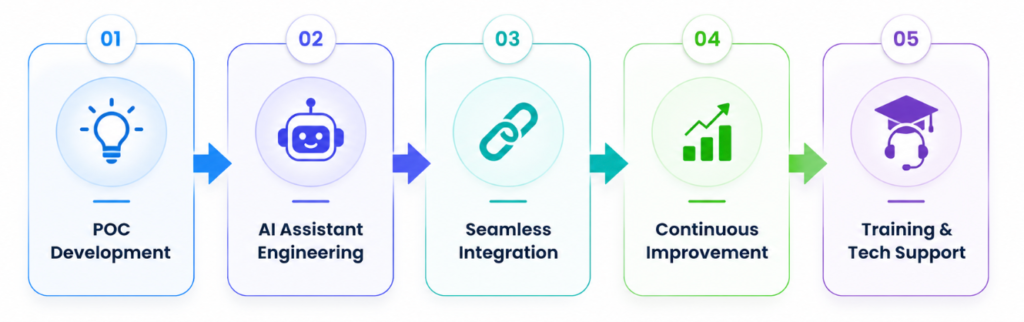
Every AI project that we undertake begins with a discovery phase followed quickly by a working Proof of Concept (PoC). This allows legal firms to do a test run before committing to the full-scale project development. It’s during this stage that our technical team analyzes the specific legal workflows in your firm, notes the opportunities available for AI automation, and defines the objectives of the project while strongly considering the specific custom needs.
This proof of concept phase can take between 4 and 6 weeks and provides clear insights into the feasibility, ROI potential, and the long-term value of the proposed AI solution. This development has been iterated over many project cycles, and it allows clients to test core use cases, gather feedback for our technical teams, and eventually make an informed investment in a working proof of concept.
This engineering stage only commences after successfully passing the first stage, and the proof of concept is accepted. The engineering team gets down to business to develop an AI legal assistant that is ready to be deployed in the specific legal workflows.
In this phase, the AI architecture is designed, workflow automations, retrieval systems, integrations, security, and preparation for deployment of the entire AI system are tested. A majority of the custom AI legal assistant projects we undertake take about 3–6 months to develop, which is dependent on the overall project complexity.
Adoption of AI technology is heavily dependent on how well the introduced smart tools fit into the firm’s existing workflows. We develop AI legal assistants that seamlessly integrate with document management systems, CRMs, legal research platforms, communication tools, and enterprise applications.
We are not looking to force legal professionals to entirely change their workflows, but rather to embed smart AI tools to make them more effective. The overall effect is the improvement of adoption rates and maximizing business value in the long term.
Continuously optimizing the outputs of legal AI assistants plays a major role in the long-term success of these systems. Our support continues after deployment. We continue to monitor its performance in your workflows, accuracy, and business outcomes to identify any opportunities for improvement.
As the organization grows and its needs change, the legal AI assistants can be updated to newer models. We can refine their workflows and introduce any performance enhancements that might be needed.
Effective adoption of our AI solutions requires us to conduct comprehensive onboarding, training, documentation, and provide ongoing technical support to ensure that legal teams can properly utilize the AI tools. Our team remains available throughout the whole development process to support in-house legal teams and ensure the project is a success.
Every AI project that we undertake begins with a discovery phase followed quickly by a working Proof of Concept (PoC). This allows legal firms to do a test run before committing to the full-scale project development. It’s during this stage that our technical team analyzes the specific legal workflows in your firm, notes the opportunities available for AI automation, and defines the objectives of the project while strongly considering the specific custom needs.
This proof of concept phase can take between 4 and 6 weeks and provides clear insights into the feasibility, ROI potential, and the long-term value of the proposed AI solution. This development has been iterated over many project cycles, and it allows clients to test core use cases, gather feedback for our technical teams, and eventually make an informed investment in a working proof of concept.
This engineering stage only commences after successfully passing the first stage, and the proof of concept is accepted. The engineering team gets down to business to develop an AI legal assistant that is ready to be deployed in the specific legal workflows.
In this phase, the AI architecture is designed, workflow automations, retrieval systems, integrations, security, and preparation for deployment of the entire AI system are tested. A majority of the custom AI legal assistant projects we undertake take about 3–6 months to develop, which is dependent on the overall project complexity.
Adoption of AI technology is heavily dependent on how well the introduced smart tools fit into the firm’s existing workflows. We develop AI legal assistants that seamlessly integrate with document management systems, CRMs, legal research platforms, communication tools, and enterprise applications.
We are not looking to force legal professionals to entirely change their workflows, but rather to embed smart AI tools to make them more effective. The overall effect is the improvement of adoption rates and maximizing business value in the long term.
Continuously optimizing the outputs of legal AI assistants plays a major role in the long-term success of these systems. Our support continues after deployment. We continue to monitor its performance in your workflows, accuracy, and business outcomes to identify any opportunities for improvement.
As the organization grows and its needs change, the legal AI assistants can be updated to newer models. We can refine their workflows and introduce any performance enhancements that might be needed.
Effective adoption of our AI solutions requires us to conduct comprehensive onboarding, training, documentation, and provide ongoing technical support to ensure that legal teams can properly utilize the AI tools. Our team remains available throughout the whole development process to support in-house legal teams and ensure the project is a success.
Recognized on Top Industry Platforms
OUR STACK
Our AI Agent Technology Stack
We pick tools based on what the problem needs, not what’s currently generating hype. That said, here’s the landscape we work across.
OpenAI (GPT-5, GPT-5.4), Anthropic Claude, Google Gemini, Meta Llama, Mistral – we’re model-agnostic and will recommend the right fit for your use case, cost profile, and data privacy requirements.
LangChain, LangGraph, CrewAI, Semantic Kernel, LlamaIndex, Microsoft AutoGen – framework selection depends on your agent architecture and workflow complexity.
Pinecone, Weaviate, Chroma, FAISS – for retrieval-augmented generation and knowledge management.
Apache Airflow, Prefect, Temporal – for reliable task scheduling and workflow management at scale.
AWS (Bedrock, SageMaker), Microsoft Azure AI, Google Cloud Vertex AI – full cloud provider expertise, with no lock-in to a single platform.
TensorFlow, PyTorch – for custom model development and fine-tuning when off-the-shelf isn’t enough.
GDPR, HIPAA, SOC 2, CCPA – built in from architecture through deployment. Encryption at rest and in transit, role-based access controls, and comprehensive audit trails.
Node.js, Python, FastAPI, Docker, Kubernetes – production-grade infrastructure for reliable agent deployment at scale.
Model-agnostic by design. We don’t lock you into a single provider. Our architecture lets you swap models as the landscape evolves — without rebuilding your entire system.
FAQ
AI technology can be used in the legal field to assist teams in research, reviewing documents, and automating administrative tasks, but it should never replace professional legal judgment. The outputs that AI generates should always be reviewed by qualified professionals before being used in legal proceedings or critical legal matters.
Disclosure requirements vary by jurisdiction, court, and judge. For example, the Northern District of Texas currently requires briefs prepared using generative AI to disclose that fact on the first page, and individual judges may impose additional requirements. Legal teams should check current court rules, standing orders, and bar guidance before using AI-generated material.
The total cost of building a legal AI assistant depends on the complexity and integrity requirements of the technology.
Task-Specific Legal AI Assistant. Starts from $4,350 – $13,100.
Legal Workflow AI Assistant with Integrations. Starts from $20,400 – $53,800.
If you’re looking to conduct a deep dive into developmental costs for legal AI assistants, our AI cost calculator will come in handy.
Yes, without a doubt. Security is a core pillar in our entire software development cycle, and our architectures are fully compliant with existing security protocols. At LITSLINK, client data is always protected and cannot be used to train other AI agents without explicit permission. Our AI solutions are also aligned with SOC 2 and other security requirements in the sector.
No, AI can’t replace human legal assistants or paralegals. AI legal assistants can automatically do routine legal tasks like drafting documents, researching, and providing summaries, but they cannot replace legal judgment, strategic thinking, or client relationships. Human oversight remains an essential safeguard for all critical legal decisions and client-facing work.
Have a Project in Mind?
Tell us about your use case, constraints, and goals. Our team reviews every inquiry and responds within 48 hours.
Next steps
1
LITSLINK specialist reviews your request and contacts you to discuss the details
2
If needed, we sign an NDA before moving forward
3
We send a project proposal – estimates, timeline, and team CVs included
4
After launch, we stay on for any updates your product needs
Thank you! Your request has been sent — our team will get back to you within 48 hours.
