





We Speak ERP, MES & Supply Chain Software
Your production order flows through planning, inventory, and the shop floor before it ever ships. We map that flow first, then write software around it, so a new tool fits how your plant already runs.
Services.
End-to-end product development — from AI prototypes to scalable web and mobile platforms.
View all services →Not sure where to start?
Book a free discovery call →Software Development
Industries.
Domain expertise that shortens discovery and gets compliance right from day one.
View all industries →Not sure where to start?
Book a free discovery call →AI Agents.
Custom AI agents that take routine work off your team — built and deployed in weeks.
View all AI agents →Not sure where to start?
Book a free discovery call →AI Agents For
Technologies.
A modern stack for every layer of your product — pick one or let us recommend.
View all technologies →Not sure where to start?
Book a free discovery call →Hire.
Vetted senior engineers who join your team in as little as 48 hours.
View all roles →Not sure where to start?
Book a free discovery call →Case Studies.
1540+ projects delivered for startups and enterprises in 82+ countries.
View all case studies →Not sure where to start?
Book a free discovery call →Resources.
Guides, live sessions and tools to plan your product and budget.
Visit the blog →Not sure where to start?
Book a free discovery call →Company.
The team behind 1540+ projects for 1000+ clients worldwide.
Get in touch →Not sure where to start?
Book a free discovery call →In Numbers
Enter to search·Esc to close
LITSLINK builds custom software for manufacturers, from ERP and MES integration to AI-powered supply chain optimization and factory-floor quality control. We work on modern web, mobile, cloud, and machine learning technology, and we build for the plant reality where uptime pays the bills. Run three lines or thirty, the goal stays the same: give your teams software they actually reach for during a shift.
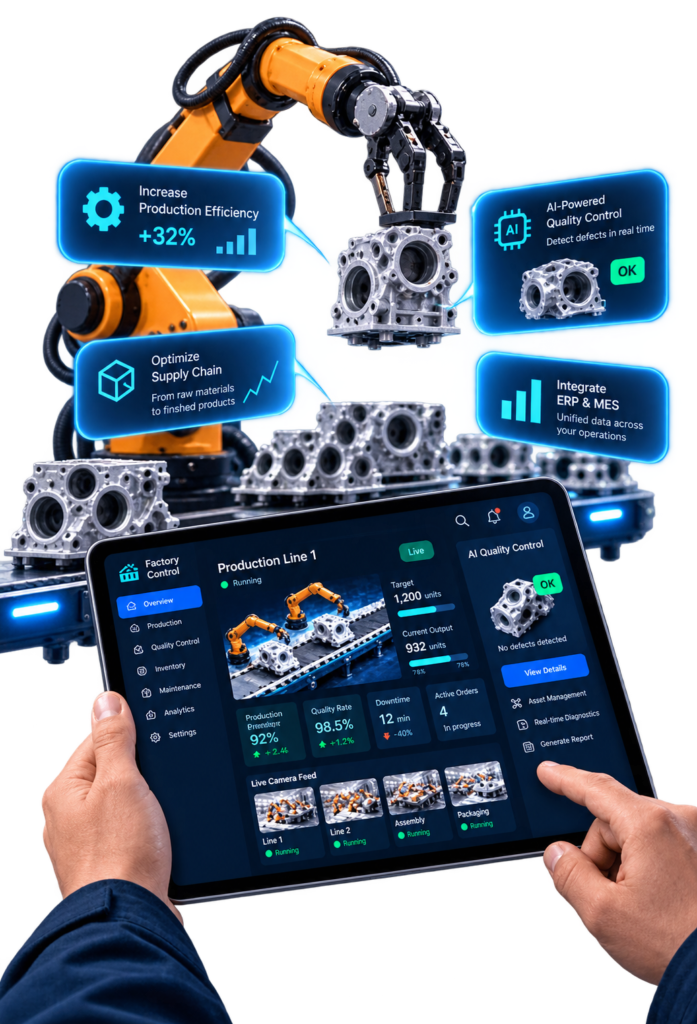
Before a line of code, we audit your current systems and where they break. You get a straight read on build-versus-buy, including where off-the-shelf software falls short for complex plants, plus an integration map and a realistic budget. Good software development for manufacturing starts with clear eyes rather than a wish list and leads into Custom Software Solutions built around your operation.
Off-the-shelf tools handle the average plant. Yours has its own routing, its own compliance rules, and its own exceptions, which is why custom solutions fits plant-specific requirements better. Custom manufacturing software development fits those exact manufacturing processes, and you own every line of the code.
We build field-technician and operator apps for iOS and Android that hold up to gloves, glare, and spotty warehouse Wi-Fi. Office software fails on the industrial floor. These tools are built for it.
Industrial dashboards read at a glance from six feet away. Big targets, obvious status, fewer taps. An operator mid-shift has no patience for a menu tree, and the design respects that.
Most manufacturers already run existing enterprise systems, so seamless integration matters from day one. We connect them through APIs and gateways so data moves once and stays consistent across ERP and CRM systems, rather than living in five spreadsheets that disagree. New tools should seamlessly integrate with existing manufacturing systems instead of disrupting current data flow.
That fifteen-year-old inventory app still works, until the one person who understands it retires. We modernize legacy manufacturing software step by step, keeping production running the entire time.
Software ages. Sensors change, regulations shift, volumes grow. We stay on to patch, tune, extend, and strengthen data security with encryption and secure cloud protocols, so the tool keeps earning its place a year after launch.
Test the risky idea cheaply. We ship a proof of concept in weeks, put it in front of real operators, and let the shop floor tell you whether it deserves a full build.
SOLUTIONS WE BUILD
Resource planning, production order management, and bill-of-materials tracking in one connected view.
Real-time shop-floor tracking and production monitoring, so supervisors see status as it happens.
Procurement, warehouse operations, and demand forecasting that keep stock lean without risking a line stoppage.
Lot and serial tracking, nonconformance logging, and corrective-action workflows that hold up in an audit.
Condition monitoring, sensor-data collection, and cloud dashboards with real-time alerts. Our industrial IoT development services connect to your existing SCADA and PLC systems through APIs and gateways rather than writing custom firmware.
Asset lifecycle tracking, maintenance history, and equipment ROI in a single record.
Incident tracking, hazard monitoring, and compliance reporting that keep safety data ready for review.
Capacity planning, order sequencing, and bottleneck analysis so the schedule reflects what the floor can actually deliver.
Inventory visibility, pick-pack-ship flows, and barcode or RFID integration for accurate counts.
Order capture, tracking, and fulfillment automation from quote to shipment.
AI earns its place on the floor when it changes a number you care about as part of broader digital transformation: output, scrap rate, on-time delivery. Here is where it does exactly that.
Regression and time-series models that predict demand with better than 90% accuracy, cutting both stockouts and overstock.
Reinforcement-learning models that adjust stock levels as conditions shift, improving operational efficiency and helping reduce operational costs by holding less capital in the warehouse.
Classification models that flag a slipping supplier before the delay reaches your line.
Algorithms that trim shipping cost and lift on-time delivery across your distribution network.
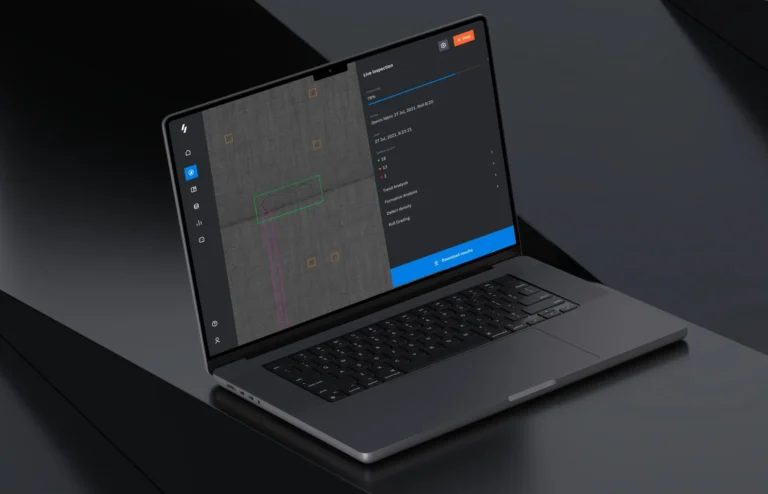
Automated defect detection on the production line. In one live deployment, our system inspects fabric rolls in real time and sorts each flaw into 11 engineering-defined defect classes.
Agentic AI that watches supply chain operations around the clock, supports business intelligence, and adjusts as demand and supply move.
WHO WE WORK WITH
Companies across the manufacturing industry, including electronics, electrical, consumer goods, and industrial equipment makers who need production and inventory under one roof.
Producers running high-speed lines where visual inspection at pace decides margin. We have shipped real-time defect detection for exactly this.
Operations where traceability and shelf-life tracking carry regulatory weight.
Growing plants and manufacturing enterprises that outgrew spreadsheets and want software that scales with them.
Product companies who need an engineering partner to build or extend an industrial platform.
A manufacturing business that needs software to improve business operations when inventory and distribution complexity is the core challenge.
Parts suppliers with their own compliance and integration needs. (See our automotive software development page.)
TECH STACK & ENGINEERING STANDARDS
Industrial software development lives or dies on integration and uptime. We build with cutting-edge technologies on a proven web, mobile, cloud, and AI stack, and we connect to your plant systems through standard industrial protocols rather than reinventing them.
React · Vue.js · Angular · TypeScript
Node.js · Python · .NET · Java
Python · TensorFlow · scikit-learn · PyTorch · OpenCV (for computer-vision QC)
AWS · Azure · Google Cloud · Docker · Kubernetes · CI/CD
PostgreSQL · MongoDB · MySQL
MQTT · REST/GraphQL APIs · OPC UA (integration layer, not embedded development)
Scalable architecture · Secure-by-design · Agile delivery · NDA & IP ownership guaranteed
Challenge
A textile manufacturer needed to catch surface flaws on fabric rolls, denim included, as they came off the production line. Manual visual inspection was too slow to keep up, inconsistent between inspectors, and easy to get wrong at full line speed, which hurt Product Quality consistency on fast production lines.
Solution
We built a real-time computer vision system that inspects fabric rolls on the line and classifies every flaw into 11 engineering-defined defect classes. The models run on PyTorch and OpenCV, picked because inference had to keep pace with a live production feed rather than batch-process footage after the fact. A single dashboard shows defect counts, trend analysis, and roll grading as each roll passes the camera, supporting manufacturing applications in a live manufacturing environment.
Result
Stack
DEVELOPMENT PROCESS
We learn your production workflows, data sources, constraints, and manufacturing challenges, then map critical business processes before proposing anything.
We map how the new system supports manufacturing operations and connects to what you already run, so seamless integration is designed in, not bolted on.
We build the highest-impact workflow first and get it in front of operators fast.
Performance, integration, and edge-case testing against real plant conditions and industry regulations.
We roll out alongside your existing systems and keep production moving.
We stay on to tune models and extend features as your operation grows.
We learn your production workflows, data sources, constraints, and manufacturing challenges, then map critical business processes before proposing anything.
We map how the new system supports manufacturing operations and connects to what you already run, so seamless integration is designed in, not bolted on.
We build the highest-impact workflow first and get it in front of operators fast.
Performance, integration, and edge-case testing against real plant conditions and industry regulations.
We roll out alongside your existing systems and keep production moving.
We stay on to tune models and extend features as your operation grows.
Technologies
ENGAGEMENT MODELS
A committed team that owns your product end-to-end. Best for long-term custom manufacturing software development with an evolving scope, from planning through delivery.
Flexible scope for evolving requirements. Best when the roadmap is still taking shape, and you want to adjust as you learn.
Specialists who plug into your in-house team. Best when you have the direction and need extra engineering hands to hit a deadline, including manufacturing software developers when specialized expertise is needed.
TESTIMONIALS
MANUFACTURING SOFTWARE READINESS CHECKLIST
Run through this checklist before you start. It surfaces the gaps that stall projects, data readiness, integration scope, and team alignment, while they are still cheap to fix.
Download the full guide with expanded recommendations for each item.
COST & TIMELINE
Cost tracks with integration complexity, data readiness, scope, and how broad your manufacturing applications need to be within the complexity of your manufacturing environment. A single operator app is a different animal from a plant-wide platform wired into your ERP. Here is a practical breakdown by tier.
Validate one high-impact workflow, such as defect detection or production scheduling, before investing in a full-scale solution. This tier includes discovery, a working build, essential integrations, and pilot testing with real manufacturing data.
$40,000–$75,000
6–12 weeks
Build a production-ready system that connects several workflows and integrates with your core plant software. This tier helps manufacturers automate processes their ERP leaves untouched, improve operational visibility, and strengthen process control.
$120,000–$300,000
4–8 months
Connect multiple sites, ERP, MES, and IoT systems within one scalable platform. This tier provides the governance, security, and uptime larger manufacturers need, with the final scope shaped by legacy equipment and compliance requirements.
$300,000+
8+ months
*Ranges cover discovery, design, development, QA, and launch. Budget another 15–25% of build cost per year for support, model retraining, and new features. We give you a fixed tier range after a short scoping call.
FAQ
Cost comes down to how many workflows you cover, how many systems you integrate, and how ready your data is. After a short scoping call, we give you a tiered range, so you can plan a budget before signing anything.
An ERP handles the general case well, and standard ERP Systems cover a lot before customization is necessary. When your routing, compliance, or shop-floor process falls outside what the ERP does, custom manufacturing software fills that gap and connects back to the ERP as the source of truth. We help you draw that line honestly, even when the answer is “your ERP is fine.”
Yes. We connect through APIs and gateways and roll out in stages, with Seamless Integration across your existing enterprise systems so data flows into the new tool while your lines keep running. Integration is planned in step two of every project, not discovered at launch.
Our focus is the app, cloud, and data layer. We read from and write to your SCADA and PLC systems through standard protocols like OPC UA and MQTT, so the software talks to your equipment without touching the firmware on it. We tell you upfront where our line sits.
AI models spot patterns in order history and adjust forecasts as new data arrives. That supports efficient supply chain management by improving visibility into stock levels and demand shifts, and it gives teams better inputs for broader supply chain management decisions. In a live deployment, our forecasting reached better than 90% accuracy, which cut both stockouts and overstock. We are happy to walk through how that held up under real order volatility.
A proof of concept can run in weeks. A full custom platform usually lands in a few months, depending on integration scope. We work MVP-first, so you get something usable on the floor well before the whole system is done.
We work with what you have. Older equipment can often be read through retrofit sensors, gateways, or existing SCADA feeds. Where a machine gives no signal at all, we design around manual capture until a hardware upgrade makes sense.
You own all of it: the code, the models, and the data. We sign an NDA before the first technical conversation, and IP ownership is written into the contract.
Both. A dedicated team can own the product end to end, or we augment your staff with the specific engineers you are missing. We match the model to how your organization prefers to work.
We stay on to monitor performance, patch issues, retrain models as data drifts, and add features as your operation grows. Software on a factory floor is a living tool, and we treat it that way.
Tell us the workflow that costs your manufacturing company the most right now. In a 30-minute call, we will give you a straight read on scope, a tiered cost range, and an honest build-versus-buy take, with support for digital transformation in complex plants and a reply inside two business days.
Next steps
LITSLINK specialist reviews your request and contacts you to discuss the details
We sign an NDA before the first technical conversation
We send a project proposal – estimates, timeline, and team CVs included
After launch, we stay on for any updates your product needs
Thank you! Your request has been sent — our team will get back to you within 48 hours.
Imagine if your company could predict customer needs ahead of time, efficiently handle customer service queries, and simplify operations, resulting in cost savings and…
13 min read
Running your own business offers endless opportunities for experimentation, developing growth strategies, and collaborating with like-minded people. However, a solid strategy and a great…
10 min read
The use of IoT in supply chain management is transforming how companies monitor products, control inventory, and streamline processes. A new era of more…
7 min read