
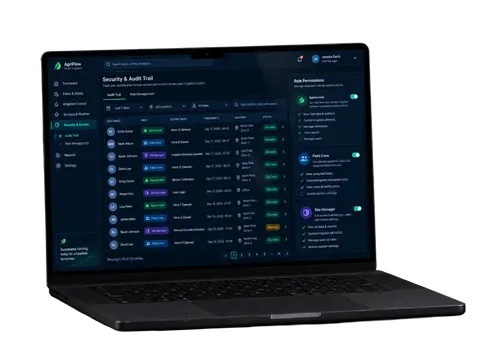




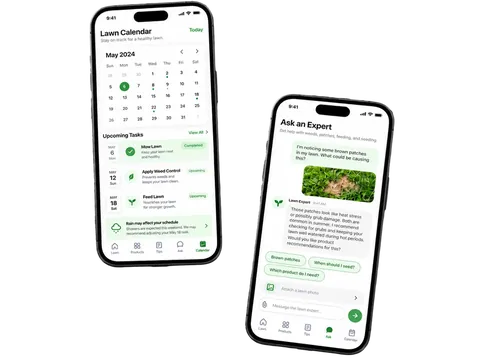



Clinical teams require tools that are practical and secure patient information. AI can provide a summary of medical records and compose clinical notes. It can also detect patient risks before they become critical, allowing for earlier clinical decision-making. Our products are compatible with EHR and EMR systems through HL7 and FHIR standards. The solution is HIPAA compliant.
AI Development Services
AI development services can help modern businesses simplify daily operations, automate routine work, and turn raw data into useful insights. At LITSLINK, we build AI products for startups and large companies.
- Access to 300+ AI engineers, data scientists, and MLOps specialists
- An MVP ready in 10 weeks
- Secure and well-managed AI development
- Deep cross-industry expertise

Trusted By
Custom AI Services We Provide
Worker access to AI grew by 50% in a single year, and the pace is not slowing down. Every industry can benefit from AI, but the first step is often the hardest. Below is a list of our artificial intelligence development services – see how we can turn your idea into real business value.
AI Consulting: Should We Build It?
Before you spend a dollar on development, our consultants will help you determine whether AI is the right move for your business. Here is how the process works:
This consulting process reduces implementation risks, accelerates AI adoption, and helps maximize ROI.
- Business discovery. We study your goals and workflows, then talk to key stakeholders, so the expected outcomes are agreed on from day one.
- AI readiness assessment. We check your data, infrastructure, and technical capabilities. Governance and security are part of this review.
- AI opportunity assessment. We find the use cases with the highest impact and rank each one by business value and technical feasibility.
- ROI and risk evaluation. You get an estimate of costs and returns, plus a review of the main technical and regulatory risks.
- Technology selection. We recommend the AI models, architectures, and frameworks that fit your project.
- AI governance and roadmap. We define success metrics and compliance requirements, then build a step-by-step roadmap with milestones.
- Implementation planning. The last stage is the bridge to development. We define the scope of the proof of concept and the success criteria.
PoC Development: Can We Build It?
A proof of concept will help you determine whether the concept is viable in practice. We develop AI PoCs at LITSLINK in as little as 4-6 weeks, allowing you to test your concept without a big initial investment. There are four stages to the process:
This structured approach confirms technical feasibility, validates potential ROI, and minimizes implementation risks before full-scale development begins.
- Rapid prototype development. We create a working prototype demonstrating the main features of the solution. This is not a mock-up; it is a working app.
- AI model validation. A demo that works in a model may not work under real load. We test accuracy, latency, and scalability in realistic conditions.
- Real-world testing. The solution goes through representative business scenarios. We gather user feedback and track results against the agreed metrics.
- Production readiness assessment. Technical feasibility and implementation risks are assessed. You receive a report that includes recommendations for full-scale deployment.
Custom AI Software Development: How Do We Build It?
Once the concept is validated, the next question is how to start custom AI development. Our steps include:
- Solution architecture and AI design. We design the overall architecture and pick the right AI models for the job. Data pipelines and the integration strategy are defined at this stage too.
- AI model development. Our engineers do AI model training and fine-tune them until they hit the required accuracy. The goal is real business outcomes, not just performance on paper.
- AI application development. A model alone is not a product. We build custom applications and APIs that bring AI into your business processes.
- Data pipeline and system integration. We develop secure data pipelines and connect the solution to your enterprise systems, so everything works as one setup.
- Testing and optimization. We validate the application and test model performance, security, and scalability. After launch, we monitor the AI lifecycle and keep improving it.
- Deployment and modernization. The solution goes live; your existing systems get modernized where needed. The application can scale as your business grows.
Generative AI Development: Which AI Model Is Right for Your Business?
Generative AI can create original content and provide answers to complex questions in plain language. However, there are dozens of models available — the wrong one can cost you money and quality. Our process starts with your business requirements and ends with a secure AI application built for your use case.
- Model selection and multi-model strategy. GPT, Claude, Gemini, Llama, or Mistral — which one fits your project? We evaluate candidate models against your needs and benchmark them for performance and security. If it is appropriate, we create a multi-model setup.
- Knowledge and data preparation. An AI model is heavily dependent on the data behind it. We prepare your enterprise data and build RAG-based applications with solid retrieval mechanisms.
- LLM application development. We build the custom LLM-powered application. Our team optimizes prompts and tailors the model’s behavior to your business requirements.
- Model fine-tuning and optimization. Depending on the model, we fine-tune it on your data or apply prompt engineering and configuration for proprietary models where full fine-tuning isn’t available. Guardrails raise accuracy and safety, and lower latency means a better user experience.
- Deployment and continuous improvement. The solution goes live and connects to your existing enterprise systems. We monitor performance, and the solution can evolve as your requirements change.
AI Agents Development: Which Business Processes Should You Automate First?
Our artificial intelligence development company builds custom agents that run complex business processes with little human input. But which processes should you hand over first? Our development process can answer that question stage by stage:
- Workflow analysis and agent strategy. We analyze your processes and identify those that can be executed independently. We then specify what each agent will do and where the decision boundaries are.
- Autonomous decision system design. Our engineers create agents that reason, plan, and act. All decisions are made based on your business goals and real-time data.
- Context-aware and voice-enabled intelligence. A good agent can read user intent and business context. With speech recognition, it will also respond to voice commands.
- Multi-agent workflow automation. Some complex tasks require more than one agent. We create systems with specialized agents that collaborate and execute complex workflows.
- Orchestration and enterprise integration. We connect agents to your enterprise applications and databases, so all tasks run within one AI ecosystem.
- Adaptive learning and optimization. The work does not stop at launch. Feedback loops and performance data can improve decision quality over time.
AI Chatbot Development: How Can AI Improve Customer Interactions?
We create bespoke AI chatbots that can engage in natural, context-aware conversations and integrate with your existing systems.
- Conversation design. Depending on who will use the bot, we create the conversation flows, user journeys, and business logic.
- Intent and sentiment recognition. We build intent detection and sentiment analysis, so that the bot can read requests and emotions.
- Knowledge integration. Generic answers are not enough. We connect your knowledge bases and business data to the bot, with RAG where it makes sense.
- Development and system integration. We create the bot and connect it to your CRM, website, or mobile app. Enterprise APIs are covered as well.
- Testing and optimization. Before launch, we test response quality and latency. Prompts and dialogue logic are refined until the experience feels right.
- Launch and improvement. We track interactions and analyze user feedback. As your needs evolve, the bot continues to improve.
AI Integration Services: How Can AI Fit into Your Existing Infrastructure?
At LITSLINK, we integrate AI with the tools your business already uses. Our AI integration process has the following stages:
- Integration assessment. We audit your existing systems and data sources, then outline the integration needs.
- Architecture and integration design. We design a secure architecture that covers data flows and APIs. This stage is about how AI will interact with your enterprise systems.
- AI and enterprise system integration. We integrate AI with your CRM, ERP, and cloud systems. The setup can also include databases and third-party services.
- Workflow automation. AI becomes part of your existing workflows, so routine processes run on their own and your systems work together instead of in silos.
- Testing, security & performance validation. We test interoperability, scalability, and performance before production. This phase also includes security and compliance checks.
- Deployment & continuous optimization. Once launched, we track the integrations and fine-tune their performance.
AI as a Service (AIaaS): How Can AI Accelerate Adoption Without Building Everything from Scratch?
Our cloud-based services provide your team with AI without requiring model deployment or in-house AI operations. This service includes the following:
- Ready-to-use AI model APIs. You get access to production-ready APIs for text, image, and speech tasks. Plug them into your product and go.
- Custom AI API development. If off-the-shelf options are not enough, we build secure and scalable APIs that connect AI to your internal applications and third-party systems.
- AI model hosting & inference. We deploy and host your AI models in a secure cloud environment. You get high availability and strong performance without the maintenance burden.
- Predictive analytics API services. Forecasting, anomaly detection, and recommendations are available through scalable APIs. Your team receives decision support without a data science department.
- Vision, voice & NLP services. Computer vision, speech recognition, and conversational AI are delivered as cloud-based services and ready for integration.
- Monitoring, scaling & continuous optimization. We observe model performance and tune inference over time. The infrastructure grows as needed, and frequent updates maintain the service.
Benefits of LITSLINK AI Solutions
Here is what our clients get when they integrate AI into their products and business processes.
Scale Business Faster
A fintech platform with millions of transactions and a marketplace on its way to new markets face the same problem: manual work does not scale. Your business can expand without hiring more people, as AI can automate operations and free up resources.
Increase Operational Efficiency
Repetitive tasks eat up hours that your employees could spend on strategic work. AI automation takes over the routine and cuts operational costs at the same time.
Modernize Enterprise Systems
Legacy software is often the biggest blocker on the path to AI. We transform legacy systems into AI-ready platforms and scalable architectures with intelligent automation systems.
Get Data-Driven Insights
Data scattered between tools and departments is of little use. We create AI-ready data ecosystems that transform that data into insights for smarter decisions.
Deliver Reliable 24/7 Operations
Downtime costs money and trust. Automated service delivery, real-time checks, and predictive maintenance mean your systems can operate without any surprises.
Accelerate AI Adoption with Confidence
The implementation of AI is not straightforward, and errors can cost a lot of money. Our experts guide you from strategy to implementation and beyond.
Ready to transform your business with custom AI solutions?
Industries We Work With
Each industry has its own rules and compliance requirements. Our team has built AI products for 10+ sectors, so we know what works in each of them.
Banks are challenged with fraud detection, credit risk, and compliance burden. Our tools spot suspicious transactions and score credit applications. They also enable AML and KYC checks, which means your employees do less manual work. All are connected to core banking systems and CRMs. PCI DSS, SOC 2 and GDPR requirements are also covered.
E-commerce & Retail
Shoppers leave when they can’t find the right product. AI suggestions show customers relevant products and demand forecasts help to stock what customers will buy. We also develop content tools for product pages and campaigns. The systems are connected with your ecommerce platform and CRM, which means that sales and marketing teams have a single source of data.
AI tutors provide individualized feedback, while adaptive tests identify areas that require additional assistance. We develop tools for teachers and corporate training teams to develop lesson plans and grade student work.
Manufacturing
A defect caught on the line costs far less than a recall. Our AI identifies quality problems early and forecasts equipment failures before they happen. Production plans improve as well. The tools are integrated with ERP, MES, PLM, CAD systems, and IoT devices on the floor. Your operations team gets the data it needs for maintenance and output goals.
Logistics & Supply Chain
AI plans better routes and tracks shipments as they move. It also alerts your team to delays before they become larger issues, and demand forecasts help maintain optimal stock levels in warehouses. Our products are compatible with WMS, TMS, and fleet management systems.
Legal
AI can draft contracts, summarize case files, and find relevant precedents in seconds. Our tools work with your document management and research platforms. Client confidentiality is protected throughout the whole project.
HR & Recruiting
The right shortlist is the first step to a good hire. AI can filter out applications and select the right candidates for the job, allowing recruiters to focus on interviews rather than paperwork. We also develop tools for interview preparation, onboarding documents, and workforce reports. All of your HRIS, ATS, and payroll systems are linked.
Real Estate
AI can recommend properties, appraise properties, and predict market trends. It also creates property descriptions and lease documents, saving agents time on tedious paperwork. Our tools integrate with CRM and MLS.
Insurance
AI can partially automate claim processing, evaluate risk, and detect fraud that humans cannot. It also drafts policy documents and regulatory reports. Our products integrate with policy administration systems and claims platforms, and customer data protection controls are built in.
Why Choose Litslink for Artificial Intelligence Software Development
The global AI market is full of vendors, so the choice of the right AI development company is not easy. Here is what makes LITSLINK unique.
Trusted AI Development Partner
Our AI software development company includes a team of 300+ experienced engineers and AI experts. But it’s not just technical expertise — they all have real-world business experience, and your product will address real issues, not just pass a demo.
Built-In Security & Compliance
Security and privacy are not an afterthought, but part of our development process. Our software development company is ISO/IEC 27001:2022 certified and has experience with GDPR, HIPAA, CCPA, SOC 2, and other industry standards.
100% IP ownership
All of our architecture, prompts, integrations, and data are yours. No vendor lock-in; each solution is custom-built to move or scale as you wish.
Post-Launch Support
Our work doesn’t end at release. We monitor performance, resolve issues, update models and prompts, and maintain the infrastructure — with optional fine-tuning or retraining when your solution needs it.
Global AI Expertise
We have completed 1,540+ projects for 1,000+ clients in 82+ countries. This experience can help you translate an AI strategy into tangible business results.
Our Successful AI Software Projects
We have developed AI software solutions for startups and large companies across various sectors.
AI Anomaly Detection in ERP Systems
Result
- Anomaly review time saved by 85%+
- The false-positive rate has been reduced by 60-70%
- All 5 ERP modules are now capturing cross-table anomalies
- Post-closure triage is 80% faster – from days to hours
Challenge
An EU enterprise client was facing data quality issues in their ERP system. Manual spot-checks were only performed on 10-15% of transactions. The static rule-based system failed to detect real errors and generated too many false positives.
Solution
We created an AI assistant that learns what normal behavior looks like from the data and spots any entry that deviates from it. The system connects to SAP, Oracle, and Microsoft Dynamics in real time. Every alert includes an explanation of why the value looks suspicious.

AI Credit Scoring Platform
Result
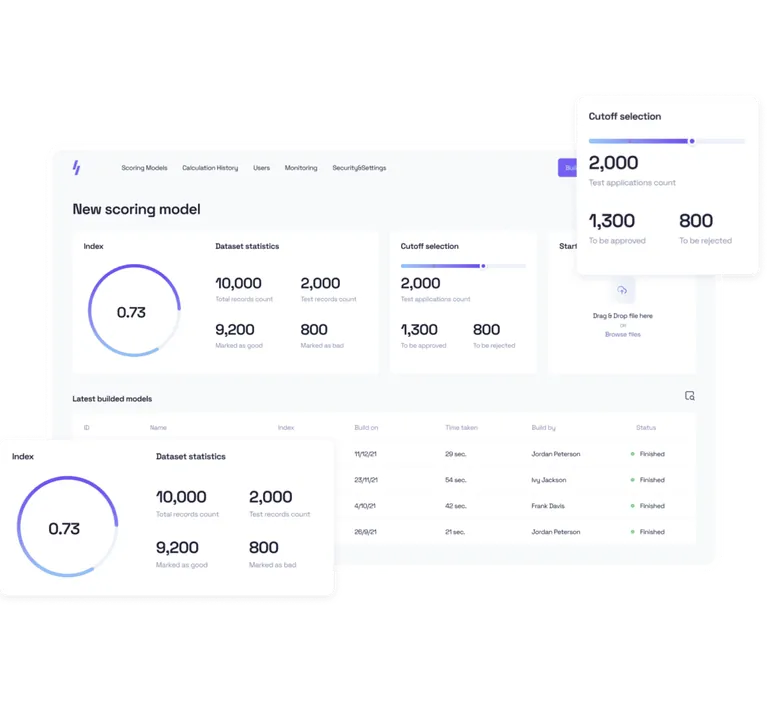
- 0.73 model AUC on held-out validation data
- ~14% lower default rate among approved borrowers
- ~60% fewer applications sent to manual review
- Client feedback auto-sorted into 3 categories by the NLP module
Challenge
A US financial services company scored every borrower with a fixed checklist, so thin-file applicants were misread, and loss rates stayed above target. Borderline applications piled up in manual review queues, and thousands of client comments sat unread with no way to sort them.
Solution
We created an AI credit scoring platform with three ML modules – credit scoring, default prediction, and NLP feedback classification, all of which were served via one AWS REST API. The scoring model achieved an AUC of 0.73 on held-out data, and can be retrained on new data in less than 60 seconds.
LLM-based CRM Assistant for New Users
Result
- Onboarding time for new CRM users dropped from 14 days to 5
- The AI chatbot answers 90% of CRM queries without human intervention
- The percentage of completed CRM records rose from 60% to 96%
- The rate of CRM adoption rose to 94% within 60 days of deployment
- Sales managers reclaimed 3 hours per week previously spent on CRM support
Challenge
A US-based B2B SaaS company had a sales team that expanded from 14 to 24 reps in 18 months. Onboarding was the largest bottleneck in the sales pipeline. New employees spent their first weeks in training documents rather than on calls. At least 40% of the CRM records contained at least one bad field.
Solution
We created an LLM-based assistant integrated into the CRM that provides real-time data and answers questions in natural language. The bot also sends validated API calls to the CRM, which means that a rep can log a deal in approximately 10 seconds with a single sentence.

AI Travel Bot
Result
- 70%+ of incoming queries were answered without a human agent
- The average response time was reduced to less than 3 seconds
- 5+ travel data sources connected in one chat interface
- Support for 10+ languages
- Only complex cases are now handled by human agents
Challenge
The support team of a US travel technology company was inundated with repetitive questions about prices, dates, and destinations. Their previous chatbot was keyword-based, but failed to capture the intent of the travellers, which meant that most of their queries still had to be handled by human agents.
Solution
We created an AI travel bot using Google Dialogflow with a custom entity recognition model trained on real travel language. Using real-time data from 5+ travel sources, the bot transforms casual queries like “a week somewhere warm, not too expensive” into bookable itineraries.

AI Task Planning Assistant
Result
- 65%+ faster task decomposition
- Only ~3% of generated subtask sets required a complete rewrite, compared to 22%
- Named entity extraction filled 90%+ of date and tag fields
- About 8 hours per week freed up for each project manager
Challenge
Client’s product managers took 30-45 minutes to write a ticket for each request, and approximately 22% of briefs required two or more rewrites before work could begin. Information was retyped three or four times in Slack, Notion, and Jira.
Solution
We built a GPT-powered assistant that reads free-text briefs and returns structured subtask lists with proposed dates, tags, and owners. A risk prediction mode flags blockers and capacity issues before sprint planning. Each row has its own Approve & Assign button, so PMs can accept good suggestions and discard the rest.

AI Smart Coding Assistant
Result
- The boilerplate effort has dropped by 80%
- JS code output is 3 times faster than manual work
- All 12 supported frameworks achieved code accuracy of 94%
- New developer onboarding shortened from 4 weeks to 10 days
- The time for code review cycles reduced from 2.5 days to less than 1 day
Challenge
A US-based SaaS company was losing about 40% of every sprint to repetitive JavaScript boilerplate. Senior engineers would often rewrite the code generated by the off-the-shelf AI coding tools from scratch because of errors.
Solution
We created an AI JavaScript code generator using a React agent architecture with LangGraph and GPT-5 class models as the backbone. It can test each generated code snippet in a sandbox with test arguments before the developer sees it.

AI-Based Golf Swing Analysis & Coaching Platform
Result
- The video from one phone provides full 3D motion data
- 15K+ users on iOS and Android
- 6 viewing angles from a single 2D video
- The processing time for the swing is less than 3 seconds
Challenge
Traditional golf coaching relied on 2D video, a coach’s eye, and lab equipment that cost $50,000+, and most players didn’t have access to real biomechanical data. The first prototype wasn’t accurate on outdoor footage. One swing took 12-15 seconds to process, which was too slow for a live lesson.
Solution
We created an AI application that converts a single video from a phone into a complete 3D model of the swing and calculates 30+ biomechanical parameters at each of the swing’s key positions. A two-stage pose estimation pipeline and a semi-supervised data tool keep an accuracy of less than 3° of error, while reducing annotation time by 87%.

AI-Based Basketball Coaching &Game Analysis Platform
Result
- Game film review is 65% quicker
- Pose recognition accuracy is over 92%
- Full game footage is processed in less than 4 minutes
- The subjective form checks were replaced by a measurable similarity score of 0-100
Challenge
The coaching staff spent 15-18 hours per week on manual film review. Form checks were subjective – two coaches could watch the same clip and disagree. They had gold standard data from elite players that they didn’t use and only had to manually review 8-10 possessions out of 180+ per game.
Solution
We developed a computer vision system that captures 17 skeletal points per player in near real-time and compares each gesture to the data of elite players on a 0-100 scale. Video, coaching notes, and analytics are now all in one place, enabling coaches to highlight key moments and build lesson playlists from game footage.

Our AI Capabilities
There is no universal AI model that fits every product. That’s why we use a variety of AI technologies.
Generative AI
We develop bespoke generative AI solutions based on large language models. These tools can write content, enable personalized interactions, and relieve your team of repetitive tasks.
Agentic AI
An AI agent can plan a multi-step task and complete it with minimal human intervention. One agent can read a request, retrieve the appropriate data from your tools, and take action.
Retrieval-Augmented Generation (RAG)
RAG links a large language model to your own documents and databases, and answers are generated from your data, not the model’s memory. This reduces hallucinations and makes the output safer to use in client-facing products.
Machine Learning
A custom model can detect patterns in your data and make automated decisions. Each new batch of data makes the model smarter, so accuracy will grow with no extra work on your side.
Deep Learning
Deep learning is the right choice when simple rules fail, such as image recognition or speech analysis. These models are created for applications such as anomaly detection in production lines and low-latency inference in real-time systems.
Natural Language Processing (NLP)
NLP allows software to comprehend and reply in human language. It is used for chatbots, smart search, document processing, and multilingual communication.
Computer Vision
Images and video can be automatically processed by computer vision. For example, a factory can use it to detect defective products on the production line before they are sent out.
Predictive Analytics
Predictive analytics uses past data to forecast future results. These predictions can help you identify risks early and make better budgeting decisions.
Robotic Process Automation (RPA)
RPA takes over repetitive tasks such as data entry and form processing. With AI on top, the same bots can read documents and run whole workflows on their own.
Speech AI
Speech AI includes voice recognition and text-to-speech. A support team can record all calls and identify potential instances of customer frustration.
Sentiment Analysis
Sentiment analysis reads emotions in reviews and social posts. You get to know how people feel about your product — not just the star rating they left.
Data Science & AI Analytics
Data science is the foundation of all AI projects. We will process your data and verify the quality of the models at each stage, so your AI stays reliable as it grows.

Our AI Tech Stack
We pick tools based on what the problem needs, not what’s currently generating hype. That said, here’s the landscape we work across.
AI Models
OpenAI GPT · Google Gemini · Anthropic Claude · Meta Llama · Mistral AI · DeepSeek · Cohere Command · Amazon Titan · xAI Grok · Qwen
AI Frameworks & Machine Learning
LangChain · LlamaIndex · Semantic Kernel · LangGraph · LangSmith · Haystack · CrewAI · AutoGen · PyTorch · TensorFlow · Scikit-learn · XGBoost · CatBoost
AI SDKs & Optimization
Hugging Face Transformers · Hugging Face Diffusers · OpenAI SDK · Anthropic SDK · Google AI SDK · NVIDIA NeMo · ONNX Runtime · TensorRT-LLM · vLLM · Ollama · MLflow
Computer Vision
OpenCV · YOLO · Detectron2 · Segment Anything (SAM) · MediaPipe
Cloud Platforms
Amazon Bedrock · Amazon SageMaker AI · Microsoft Azure AI · Azure OpenAI Service · Google Cloud Vertex AI · Databricks
Databases & Vector Stores
PostgreSQL · MySQL · MongoDB · Redis · Elasticsearch · pgvector · Pinecone · Weaviate · Milvus · Qdrant · Chroma
AI Protocols
Model Context Protocol (MCP) · Agent2Agent (A2A)
Deployment & DevOps
Docker · Kubernetes · Terraform · GitHub Actions · Helm · Argo CD
Model-agnostic by design. We don’t lock you into a single provider. Our architecture lets you swap models as the landscape evolves — without rebuilding your entire system.
Meet Our AI Experts
Meet the experts who can turn your idea into a working product.

Vladyslav Kuzniak
Vladyslav came from medicine. After an M.S. in Medicine, he taught himself to program, then added an M.S. in Computer Science in 2022 and a PhD in 2024 from Vinnytsia National Technical University. Today he is a Senior ML Engineer and AI Solution Architect at LITSLINK, and that dual background is his biggest strength — he can talk to doctors and biologists in their own language, then translate the problem into a working model.
His focus is AI4Science: deep learning for drug design and protein engineering. One of his projects was a voice assistant for a healthcare product — it ran on a base of 800,000+ patient records, connected to EMR systems. Vladyslav also took full ownership of SOC 2 compliance. Another project was a pipeline for a biotech startup in search of plastic-degrading enzymes. The protein sequences it produced were tested in the wet lab, and they worked.
Vladyslav is a mentor for 10 engineers on our team and presents his research at industry events.

Yevhenii Melikov
Yevhenii is a Solutions Architect with 10 years of hands-on development experience. AI products are built on infrastructure, and that’s his domain — backend systems that remain stable even when under heavy load. His core stack includes TypeScript, NestJS, PostgreSQL, Redis, and Google Cloud.
His journey into tech was a unique one. Yevhenii was a physics teacher at school, and that influence is still evident in his work: before he writes a single line of code, there is always a model of the problem on the table. That approach paid off on Mainframe ABE, a real estate platform where he owns the backend and its data pipelines. It also worked on a healthcare research project under NDA, where he was both the architect and the MVP team lead. At LANDR, three released apps came out of his team.
Inside the company, Yevhenii has a reputation as the go-to person for stuck projects. Clients on Upwork said the same in their reviews — complex systems stop being complex once he steps in. He is a Master of System Engineering from Igor Sikorsky Kyiv Polytechnic Institute and has coached 7 junior developers at LITSLINK.

Emil Temirov
Emil is a Solutions Architect at LITSLINK, leading the Python Department. His area of specialization is backend engineering for AI-powered products, the server-side that holds models, data, and users together.
Emil has more than 13 years of experience in the tech industry, having worked as both an engineer and an architect, responsible for the outcome of a project. He has shipped over 20 Python products and gained a unique perspective on what works at scale and what doesn’t in production. He is self-taught, and in 2024 he finished a formal Solution Architecture Program on top of that.
He works with Python, Django, FastAPI, PostgreSQL, and AWS. Inside the team, Emil is the person for hard calls.
Our Reputation on Top Platforms
LITSLINK is recognized across leading industry platforms for delivering high-quality software solutions. See what clients and the design community say about our work.
LITSLINK AI Development Process
Below is how we take your idea from an early concept to a working solution in production.
We start by comprehending your business goals and identifying the use cases where AI can make the most impact. The outcome is a project roadmap that includes technical requirements, success criteria, and priorities for the work to come.
Good data is the base of any AI product, so we collect it, clean it, and organize your knowledge sources before the models get to work. At this stage, access controls and governance rules are established, which keeps your AI accurate and your information safe.
Before full-scale development, we build a Proof of Concept to check output quality and gather feedback from stakeholders. Early tests can validate technical feasibility and business value.
We develop the solution that is ready for production and integrate it with your current applications and workflows. From the start, scalability and security are paramount, so the product is natural to your team and grows with your business.
After launch, we watch system performance and usage, then improve the solution based on real-world feedback and new business requirements.
01 Discovery & Requirements
We start by comprehending your business goals and identifying the use cases where AI can make the most impact. The outcome is a project roadmap that includes technical requirements, success criteria, and priorities for the work to come.
02 Data & Knowledge Preparation
Good data is the base of any AI product, so we collect it, clean it, and organize your knowledge sources before the models get to work. At this stage, access controls and governance rules are established, which keeps your AI accurate and your information safe.
03 POC & Business Validation
Before full-scale development, we build a Proof of Concept to check output quality and gather feedback from stakeholders. Early tests can validate technical feasibility and business value.
04 Development & Enterprise Integration
We develop the solution that is ready for production and integrate it with your current applications and workflows. From the start, scalability and security are paramount, so the product is natural to your team and grows with your business.
05 Deployment & Continuous Improvement
After launch, we watch system performance and usage, then improve the solution based on real-world feedback and new business requirements.
FAQs
01 Why Should Businesses Invest in AI Development?
AI can reduce the expenses of repetitive tasks and accelerate decision-making. Early adopters have an advantage over slower competitors.
02 How Do You Minimize AI Bias and Ensure Regulatory Compliance?
Models are tested on a variety of data sets, and outputs are examined for unfair patterns prior to release. Data privacy regulations and industry best practices are followed throughout the project. You also get full documentation, making audits easy to pass.
03 How Long Does AI Development Take?
This will depend on the complexity of your idea. It takes us around 10 weeks to build a simple MVP. More time is required for larger systems with numerous integrations. We will provide you with a clear timeline prior to starting.
04 Can AI Solutions Be Integrated with Our Existing Systems?
Yes. We integrate AI models into your existing software via APIs and custom pipelines. Our engineers analyze your infrastructure first, so the new tools will fit into your workflow without disruption.
05 Do You Provide Ongoing Support After Deployment?
Yes, we monitor model performance and retrain models as your data changes. We will also keep you updated with new features and updates.
Have a Project in Mind?
If you’re evaluating AI development services and want to discuss specifics about your use case, constraints, and a realistic path forward, we’d like to hear from you. Our team reviews every inquiry and responds within 48 hours.
Next steps
1
LITSLINK specialist reviews your request and contacts you to discuss the details
2
If needed, we sign an NDA before moving forward
3
We send a project proposal – estimates, timeline, and team CVs included
4
After launch, we stay on for any updates your product needs
Thank you! Your request has been sent — our team will get back to you within 48 hours.
