








Key Takeaways:
- US consumers reported $15.9 billion in fraud losses in 2025.
- At a 0.1% fraud rate, a system that approves everything is 99.9% accurate and catches nothing, so judge fraud detection on recall, precision, and review workload.
- Stripe Radar’s paid tiers start at $10 a month or $0.05 per screened transaction, and SEON’s Starter plan costs $699 a month for 2,500 checks.
- A focused custom MVP takes 960–1,500 team hours over 10–14 weeks.
- LITSLINK’s ERP anomaly project cut false positives by roughly 60–70%, and our credit scoring platform sent about 60% fewer applications to manual review.
- SR 26-2 replaced SR 11-7 on April 17, 2026.
A payment system that approves every single transaction is 99.9% accurate when one payment in a thousand is fraud. It also stops nothing. That gap between a nice-looking metric and a working control is why buying or building AI fraud detection software goes sideways so often, and it’s the reason I wrote this guide for CTOs, heads of fraud, and fintech founders who have to pick a vendor, fund a build, or explain to a board why false positives are eating the support budget.
Below: how AI fraud detection systems work, what changes inside a bank, what fraud prevention costs in 2026, and two LITSLINK projects built on the same mechanics.
What Is AI-Powered Fraud Detection Software and How It Differs from Rule-Based Systems
Rule-based fraud detection works like a bouncer holding a laminated list. Over $5,000 from a new device? Blocked. Three cards from one IP in ten minutes? Blocked. The list is fast, cheap, and easy to explain to an auditor. It also never changes unless somebody rewrites it, and criminals read the list faster than fraud teams can update it.
AI-powered fraud detection software swaps the list for a doorman who has worked the same door for ten years. It uses machine learning to identify patterns across payments, logins, sign-ups, and claims, learns fraud patterns from historical data and customer behavior, then hands a score to a policy layer that approves, challenges, holds, or blocks. The inputs go well past the dollar amount. Account age, payment velocity, device continuity, a brand-new beneficiary, and links to previously confirmed abuse are all data points that change how the same $900 transfer reads.
One distinction is worth keeping straight. Detection identifies risk. Fraud prevention requires an intervention before the money moves. Plenty of fraud detection systems are excellent at telling you what happened yesterday, and AI technology can only prevent fraud when something acts on the score in time.
Static Rules Break the Moment Fraud Tactics Change
When we started the ERP project described later in this article, the client’s controls were hardcoded thresholds. Anything inside the range passed, even when it looked plainly odd next to that account’s usual transaction patterns. Tightening the ranges buried reviewers in false positives on legitimate transactions. That is the standard failure of traditional systems: static rules can’t learn seasonal variation, can’t see across tables, and turn every tuning session into a trade between missed fraud and angry customers. Meanwhile, fraud patterns shift weekly.
The financial crime numbers explain why fraud prevention moved up the board agenda. The FTC told Congress in March 2026 that consumers filed 3 million fraud reports in 2025 with $15.9 billion in reported fraud losses, up from $12.5 billion a year earlier. The FBI’s IC3 logged $16.6 billion for 2024, a 33% jump. In cards, the Nilson Report puts 2024 global losses at $33.41 billion, and the US carries 41.87% of that on 26.31% of card volume (roughly 1.6 times its fair share). Nilson publisher David Robertson credits AI tools with giving the card industry the strongest fraud detection models it has had.
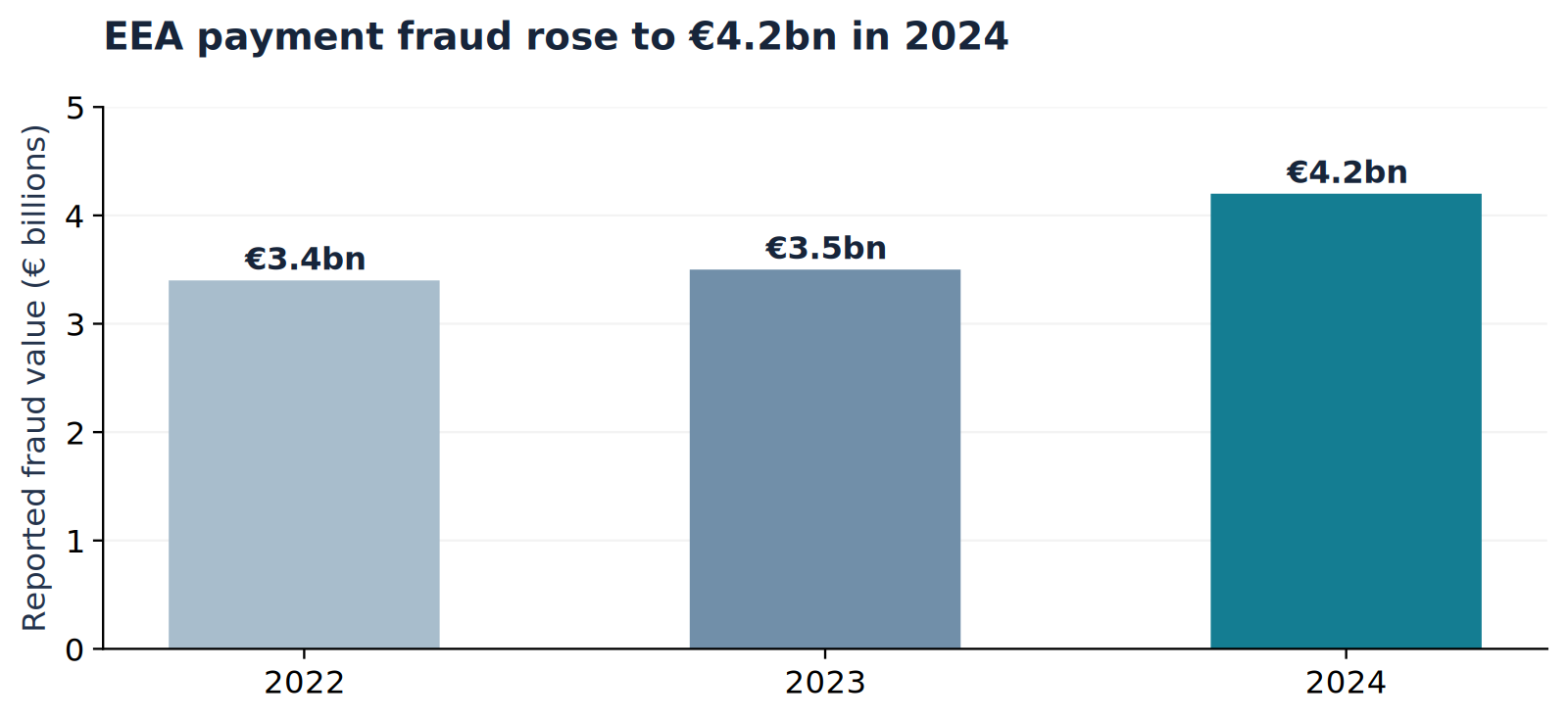
Deloitte’s forecast points the other way: generative AI could push US fraud losses to $40 billion by 2027. That’s a scenario model, and I’d be skeptical of the exact figure. The direction is hard to argue with, and the fraud risks it describes (deepfaked voices, synthetic documents) are already in the wild. Europe shows the same curve, with the ECB and EBA reporting payment fraud of €3.4 billion in 2022, €3.5 billion in 2023, and €4.2 billion in 2024.
What Machine Learning Adds That a Rulebook Can’t
| Dimension | Rule-based systems | Machine learning models |
|---|---|---|
| Decision logic | Conditions a person wrote | Relationships estimated from transaction data |
| Best at | Known attacks, hard limits, emergency blocks | Many weak signals that only matter together |
| New behavior | Needs a manual update | Can generalize to novel fraud patterns, can also drift |
| Explanation | Easy | Needs reason codes and logged evidence |
| Starting point | Expert knowledge | Labeled outcomes, or a clean baseline of normal |
| Upkeep | Rule conflicts and piles of exceptions | Pipelines, calibration, drift checks, retraining |
The right-hand column is why vendors say their AI systems continuously learn. True, with a catch. They learn from whatever outcomes you feed back, which means a sloppy labeling process teaches the fraud detection model your mistakes at scale.
Why Most Fraud Teams Run Both
Stripe’s own documentation describes Radar as adaptive machine learning models working next to merchant-written rules. That’s the honest architecture for fraud prevention. Rules stay for hard limits and for the 2 a.m. response to a live attack, allowing fraud teams to shut a door in minutes while a retrain takes days. AI models handle the combinations nobody can write down, which is where evolving fraud tactics tend to hide.
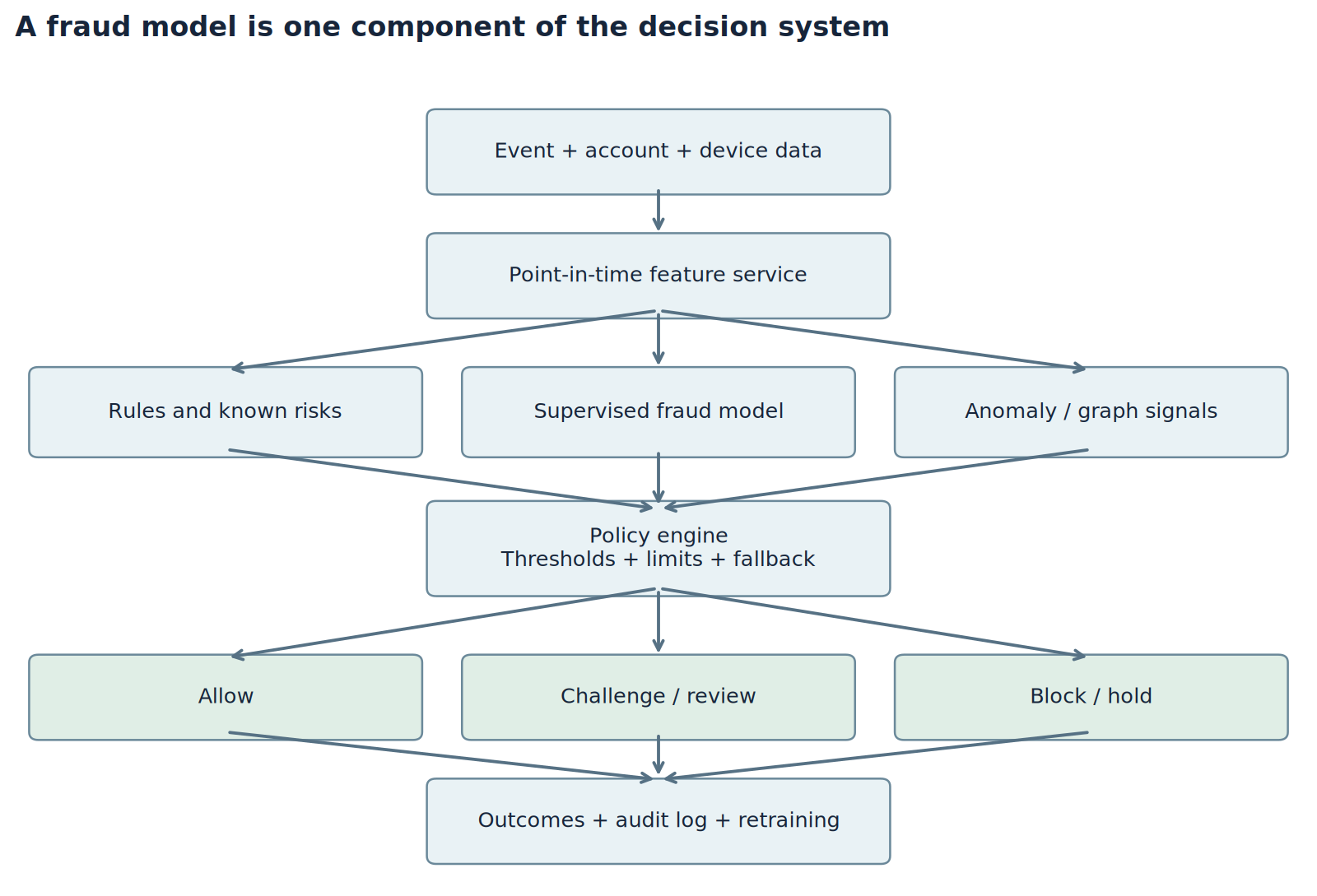
The fraud typologies matter here because each one leaves a different trail. Account takeover shows up in device and session signals. Synthetic identity fraud and identity theft surface at onboarding. Card-not-present transaction fraud lives in velocity and merchant patterns. Authorized push payment scams and relationship fraud (the romance scam, in plain English) involve a real customer sending real money, so authentication passes and only payment context helps you identify fraud. If your company is scoping any of this, our AI development services team usually starts by mapping which typology actually costs you money.
Anomaly Detection vs Risk-Scoring: Two Approaches That Actually Work
A quick correction to the heading before anyone emails me. Anomaly detection is a method, and risk scoring is an output. A supervised classifier, an outlier detector, a rule engine, or all three can produce a risk score. The cleaner comparison for AI fraud detection is unsupervised learning versus supervised fraud prediction.
| Question | Unsupervised (anomaly) | Supervised (fraud prediction) |
|---|---|---|
| What does it learn? | How an event differs from a reference population | How features relate to confirmed fraud outcomes |
| What does it need? | Historical behavior and a sensible peer group | Labeled legitimate and fraudulent transactions with timestamps |
| Typical methods | Isolation Forest, local density, autoencoder reconstruction error | Logistic regression, gradient-boosted trees, neural networks |
| Where it shines | Unusual ledger entries, emerging threats with no labels yet | Ranking payments or accounts by known fraud risks |
| How it fails | Odd but honest behavior triggers alerts | Late or biased labels repeat old blind spots |
| First job | Investigation queue or supporting signal | Approve, challenge, and block thresholds |
Unsupervised Models Learn Normal and Flag the Rest
An Isolation Forest works on a simple observation: rare, different events are easier to separate from the crowd. Autoencoders take another route. They learn to compress and rebuild normal records, and when a record rebuilds badly, that error is the alarm. Both detect anomalies anywhere in your transaction data without a single labeled fraud case, which is exactly why they suit new products, thin histories, and new fraud patterns nobody has named yet.
The catch sits in the scikit-learn documentation, which separates novelty detection on a clean reference set from outlier detection on a contaminated one. In practice, if last year’s undetected fraud is sitting in your baseline, the model learns that fraud is normal. And an anomaly score measures strangeness. It is not proof of intent.
Risk Scoring Needs Labels, and Fraud Labels Are Rare
Supervised machine learning models learn from outcomes, so risk scoring inherits the central headache of financial fraud detection: almost everything is legitimate. Our credit scoring project had 9,200 good cases against 800 bad ones, and fraud data is usually far more lopsided than that. Class weights, SMOTE-style oversampling, and cost-sensitive training all help. None of them rescue bad labels, and the fastest way to improve fraud detection is usually cleaner labels.
My recommendation for a first AI fraud detection benchmark is boring on purpose. Put your existing rules, a logistic regression baseline, and a gradient-boosted tree candidate such as XGBoost on the same future-period test set with the same review budget. Add an anomaly signal only if a specific investigation use case asks for it. Fancy AI algorithms earn their place by beating that baseline, and a surprising share never do.
One more trap. In fraud prevention, a score of 80 doesn’t mean an 80% chance of fraud. Probability calibration checks whether predicted likelihoods match what happens, and it needs rechecking whenever the population, the labels, or evolving threats shift the data.
Accuracy Is the Wrong Headline, and False Positives Are the Real Bill
Doctors learned this decades ago with screening tests. When a disease is rare, even a very good test produces mostly false alarms, because the healthy population is so much bigger than the sick one. Fraud detection behaves the same way.
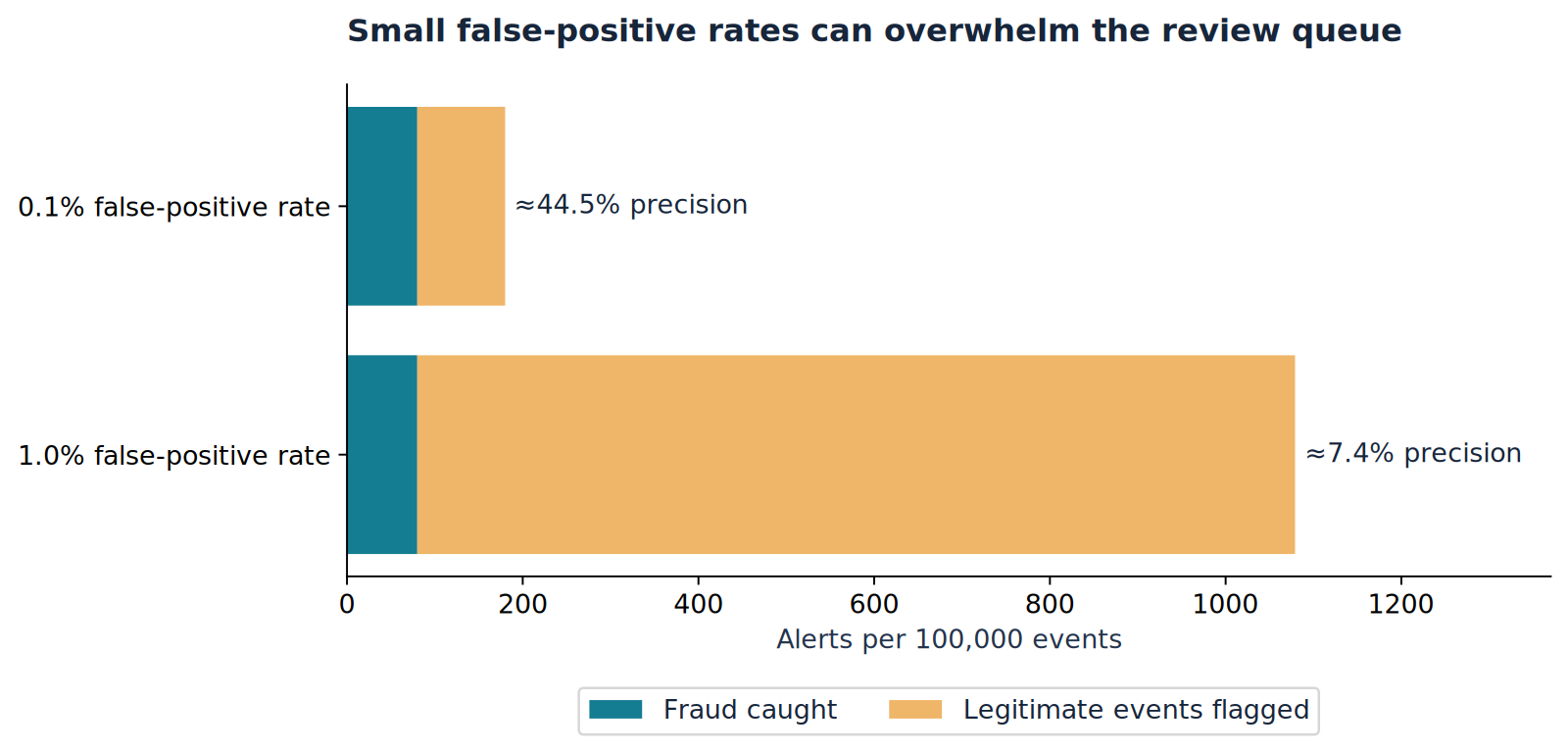
Take 100,000 events with 100 frauds among them. With 80% recall and a 1% false-positive rate, the fraud detection model catches 80 fraudulent transactions and flags 999 legitimate transactions. Precision is 7.4%. Drop the rate to 0.1%, and the false positives fall to about 100, with precision near 44.5%. Those are arithmetic scenarios from the Fraud Detection Handbook definitions, and they’re the clearest argument I know for why the engineering goal is to reduce false positives while holding recall steady.
Report value too. Stopping ten $10 attacks is a different result from stopping one $10,000 wire, so fraud detection accuracy should be weighted by dollars as well as events.
Graph Features, Behavioral Analytics, and Device Intelligence
Three signal families tend to reduce false positives and improve fraud detection accuracy more than a fancier model does. Graph features expose shared devices and beneficiaries across accounts, and plain link counts should come before anyone commits to a graph neural network. Behavioral analytics reads user behavior such as typing cadence and navigation rhythm, which is how account takeover gets caught after a correct password. Device intelligence ties sessions to hardware and network traits.
Featurespace, now part of Visa, built its card fraud detection on what it calls Automated Deep Behavioral Networks, a recurrent architecture that reads each customer’s transaction patterns as a sequence. It’s a good reminder that customer behavior over time beats any single snapshot.
Where does generative AI fit? Generative AI systems can summarize a case or draft an investigator’s narrative from recorded evidence. It should never invent a fraud probability from a free-text prompt.
Test honestly as well. Train on the past, tune on a later period, and score an untouched future period. On our credit scoring build, a duplicate-record bug surfaced in the first sprint demo. It had been quietly inflating AUC, and a random split would have hidden it for months. Our machine learning services team now runs that check before anything else.
AI Fraud Detection Software for Banks: What Changes in a Banking Context
A merchant watches a checkout. Financial fraud inside a bank rarely looks like a stolen card, and financial institutions have to connect onboarding (where identity theft shows up first), login, beneficiary creation, transfer authorization, and what happens to the money afterward. Traditional systems at banks checked the credentials and stopped there. A fully authenticated customer can still be acting under a scammer’s instructions, which means real-time transaction monitoring has to read context and user behavior on top of credentials, and fraud risks multiply with every channel you add.
| Banking requirement | Engineering consequence | Evidence to demand |
|---|---|---|
| Authorized scams and account takeover | Use payment context and recipient behavior alongside authentication | Separate tests for scam payments and stolen-account activity |
| Many channels and entities | Reconcile customer, account, device, and beneficiary IDs | Cross-channel scenarios and entity-link quality checks |
| Time-critical payments | End-to-end latency budget with timeouts and fallbacks | p95 and p99 latency at peak load, outage drills |
| Model governance | Version features, data, models, thresholds, overrides | Reproducible decisions and independent challenge |
| Fraud investigations | Evidence views, case assignment, analyst feedback | Auditable dispositions and measured review capacity |
SR 26-2 Replaced SR 11-7, and Plenty of Vendor Decks Haven’t Noticed
On April 17, 2026, the Federal Reserve, OCC, and FDIC issued revised model risk guidance. SR 26-2 supersedes SR 11-7 and SR 21-8, is aimed mainly at banking organizations above $30 billion in assets, and scales expectations to the risk and complexity of smaller financial institutions. It applies to the AI models inside your fraud detection stack. Generative and agentic AI systems sit outside its scope for now.
The OCC’s bulletin covers development, validation, monitoring, governance, and third-party products. Read that last item twice. Buying AI-powered fraud detection doesn’t remove the duty to understand and govern it, so the vendor’s evidence package belongs in procurement from day one.
Nacha Now Expects Risk-Based Transaction Monitoring
Nacha’s fraud monitoring rules arrived in two phases. Phase 1 took effect on March 20, 2026 for financial institutions acting as ODFIs and for the largest originators. Phase 2 followed on June 19 and pulled in every remaining non-consumer originator, third-party sender, and processor. The standard moved from “commercially reasonable” to risk-based, with credit-push fraud such as business email compromise as the target. The rules don’t name a technology. Velocity checks, anomaly flags, and behavioral tolerances are all suggested methods, and banks that already run real-time transaction monitoring on wires can usually extend it to ACH.
FedNow and RTP Leave No Room for a Slow Model
The FedNow Service and The Clearing House’s RTP network settle within seconds, around the clock, and the payment is final once it lands. The only moment to prevent fraud is before settlement. Monitoring transactions after the fact is bookkeeping on these rails, so real-time transaction monitoring has to return a decision inside the payment flow. Practitioners commonly budget 50 to 200 milliseconds for real-time fraud detection. Treat that as an engineering rule of thumb (the Fed publishes no such number) and measure the full round trip, because a vendor’s model-only inference time says little about your own latency.
Fraud, AML, and Credit Risk Are Three Different Jobs
Fraud asks whether an activity is deceptive or unauthorized. Credit risk asks whether a loan gets repaid. Anti-money laundering looks for laundering and files reports on it. They can share data and case tools, yet their labels, deadlines, and cost of error differ. FATF’s February 2026 paper found that 156 assessed jurisdictions, or 90%, rank fraud as a major laundering risk, so the evidence trail between the two functions should connect even when the models stay separate.
Around all of it sit the usual obligations for the financial services industry: PCI DSS scope for cardholder data, GLBA safeguards for sensitive data, Reg E for consumer transfers, and ECOA adverse-action reasons whenever the same platform touches lending. PCI compliance, for the record, certifies how you store card numbers. It says nothing about whether your fraud prevention works. This regulatory plumbing is most of what our financial software development engagements spend their first month on.
Is your fraud prevention stack ready for SR 26-2 and the Nacha rules?
Send us your current controls, and we’ll map the gaps in a 30-minute call with a LITSLINK fintech architect.
Button: Book a consultation → #form
Off-the-Shelf vs Custom Solutions
The best reason to buy off-the-shelf fraud detection solutions is access to network intelligence you can’t build: signals from millions of other merchants and banks. The best reason to build is control over your own data, economics, and intervention logic. A hybrid buys the AI technology for selected signals and keeps the event model, the decision policy, and the audit trail in-house.
| Option | When it fits | Trade-off | What to validate |
|---|---|---|---|
| Off-the-shelf | Standard use case, small ML team, protection needed this quarter | Coverage, contract, and data-access limits | Performance on your own cohort, billed event definition, exports |
| Custom | Distinctive signals, workflows, or deployment rules | You own model quality, security, and upkeep | Data sufficiency, yearly operating capacity, lift over baseline |
| Hybrid | You need outside signals plus your own interventions | More interfaces to manage | Signal cost, incremental lift, behavior when a dependency fails |
Best AI Fraud Detection Software 2026: Match the Tool to the Attack
This is a capability shortlist. Nobody, me included, has tested these vendors on a common dataset, and any article claiming to rank the best AI-powered fraud detection software by accuracy is ranking marketing pages. Every vendor promises to improve fraud detection accuracy. Ask on whose data.
| Product | Published focus | Best pilot question | Price evidence |
|---|---|---|---|
| Stripe Radar | Payment fraud prevention on Stripe, four tiers since mid-2026 | Does your tier cover your payment methods and non-Stripe volume? | Lite included, paid from $10/month or $0.05 per screen |
| SEON | Digital footprint, device intelligence, rules, AML in Premium | Do its data points add lift beyond what you already hold? | $699/month Starter, Premium custom |
| Sift | Payment fraud, account takeover, fake accounts | What’s the extra fraud capture at the same approval rate? | Quote only |
| Feedzai | Fraud, scams, and AML for financial institutions | Can it meet your event flows and intervention deadlines? | Quote only |
| Featurespace (Visa) | Adaptive behavioral fraud detection for issuers and banks | How does it perform on your scam and APP cases? | Quote only |
| FICO Falcon | Card fraud scoring on consortium data | How much of the value depends on the consortium? | Quote only |
| Sardine | Financial crime platform for fintech and payment companies | Which modules and signals are in the base contract? | Quote only |
| BioCatch | Behavioral biometrics for account takeover and mule accounts | Does it cut step-up challenges for good users? | Quote only |
A stale recommendation to avoid: Amazon Fraud Detector stopped accepting new customers on November 7, 2025. AWS now points to SageMaker, AutoGluon, and WAF Fraud Control, which are building blocks and come with no fraud management product around them. Half the “best fraud detection software” listicles still recommend a signup that no longer exists. The best fraud detection software for you is whichever one wins on your own cohort.
The Cheapest AI-Powered Fraud Detection Software Options Stay Cheap Only at Low Volume
Radar Lite costs nothing extra on standard Stripe pricing, which makes it the obvious entry point for a merchant already on Stripe. The paid tiers bill per screened attempt. At $0.05, 100,000 screens a month is $5,000 and a million is $50,000, before negotiated discounts. SEON’s Starter works out to about $0.28 per included check. Open-source stacks (scikit-learn, PyOD, XGBoost, AutoGluon) carry no license fee at all, and you pay for them in engineering hours instead.
Cheap fraud detection solutions are a fine way to start. The mistake is forecasting year-three costs from a year-one price page.
When a Custom Build Wins
Custom wins when per-transaction fees at your volume exceed an amortized build, when your regulator wants explanations a vendor can’t provide, when your best fraud prevention signals live in a proprietary system, or when the fraud scenarios in your product look nothing like card-not-present checkout. Financial institutions with unusual rails tend to land here, because mitigating fraud risks on a product no vendor has seen means training on your own data. For any fraud detection vendor pilot, insist on a fair trial:
- Same event cohort, matured labels, and fraud definition for every candidate.
- A fixed ceiling on customer friction and daily review capacity, then a comparison of how far each candidate can reduce false positives at the same recall.
- Full API round-trip latency at peak load.
- A written answer on what counts as a billable screen, retry, or lookup, and which AI algorithms sit behind the score.
- Confirmation that you own your labels and can export events, decisions, and cases.
A strong vendor model can still be the wrong choice if its missing-data behavior blocks your best customers.
How Much Does AI-Powered Fraud Detection Software Cost
There are three budgets in any fraud prevention program, and most business cases only include the first: product fees, implementation, and ongoing operations.
Published Vendor Prices Tell You the Floor
Stripe and SEON publish numbers. Almost everyone serving banks quotes privately, and enterprise AI fraud detection contracts typically run on annual commitments plus usage. Is the spend justified? The US Treasury reported that its machine learning processes prevented and recovered over $4 billion in fiscal 2024, up from $652.7 million the year before, including $1 billion from check fraud detection alone. And per LexisNexis, each dollar of financial fraud costs North American financial institutions over five times once you count investigation, fees, and recovery, while 44% still lean mainly on manual processes to fight fraud.
Custom Build Cost by Scope
The ranges below are bottom-up planning estimates for a custom fraud detection build at an assumed blended rate of $50–$75 an hour, which is typical for a US-managed team with European engineers. They’re alternative scopes, and they don’t stack.
| Scope | Team effort | Build cost | Elapsed time |
|---|---|---|---|
| Offline feasibility study | 240–400 h | $12,000–$30,000 | 3–5 weeks |
| Focused custom MVP | 960–1,500 h | $48,000–$112,500 | 10–14 weeks |
| Broader production platform | 2,400–4,000 h | $120,000–$300,000 | 4–7 months |
| Multi-channel bank deployment | 5,000–10,000+ h | $250,000–$750,000+ | 6–12+ months |
Rates move the total more than scope does. US consultancies commonly bill $125–$175 an hour for machine learning work, so the same 960–1,500-hour MVP lands at $144,000–$225,000 onshore. Hiring in-house is slower still, with US machine learning engineer pay averaging about $128,769 on ZipRecruiter and closer to $165,000 on Glassdoor before benefits. If a full team is more than you need, you can hire data scientists from us for the modeling work alone, and our AI cost calculator gives a first estimate in a couple of minutes.
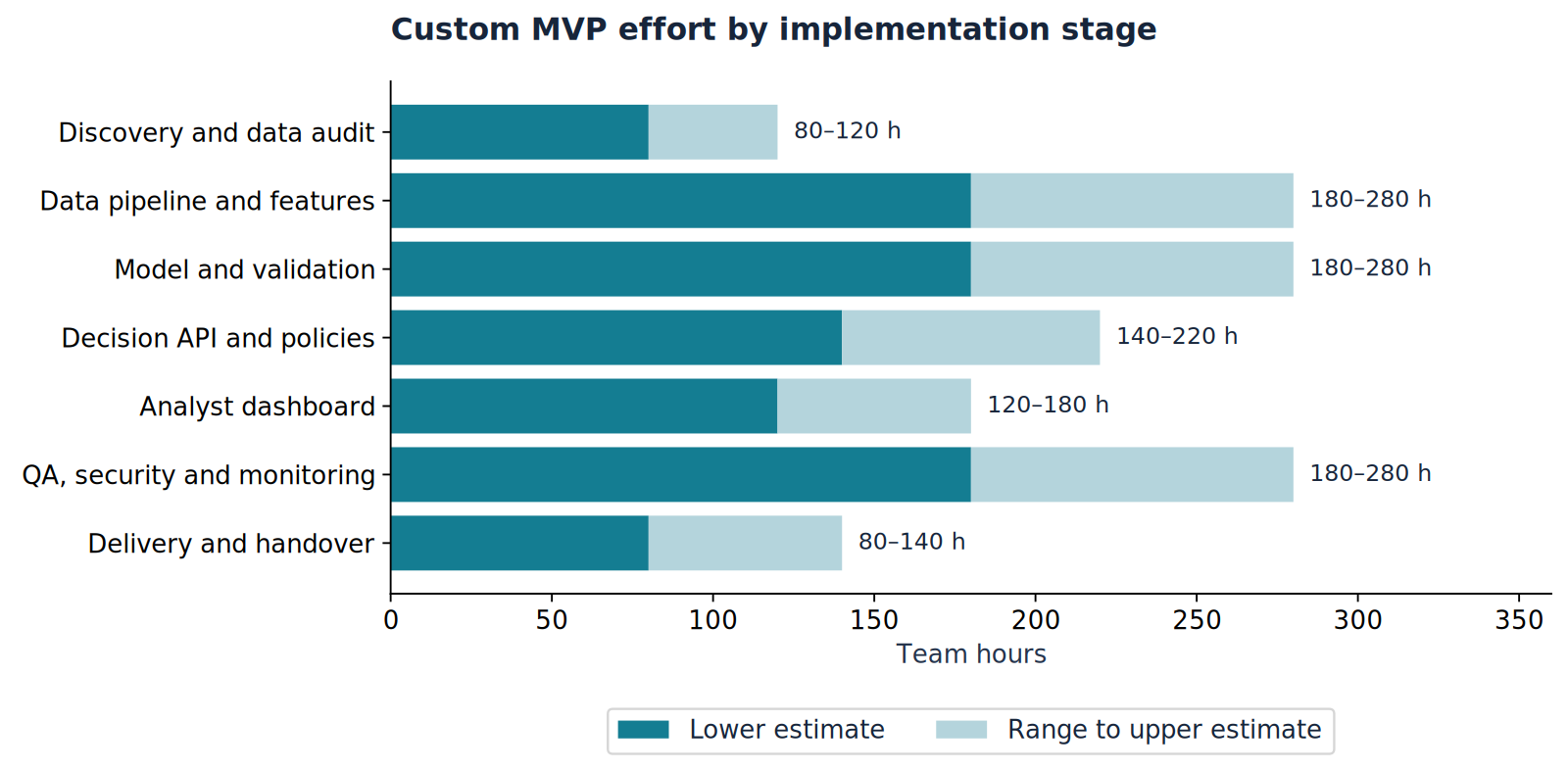
Those fraud detection MVP hours assume usable historical records, one main integration, one cloud environment, and a modest dashboard. Major data repair, commercial identity databases, biometrics, and formal external audits all sit outside the range.
The Review Queue Is the Bill Nobody Budgets
Here’s the line item that sinks business cases. Run 1 million events a month with a 0.5% review rate at 4 minutes per case, and you need 333 review hours, about $10,000 a month at $30 an hour. Let the review rate drift to 2%, and it’s $40,000. False positives remain the biggest operating cost in most fraud detection programs, and every point you reduce false positives by comes straight off that bill. Precision is a finance metric as much as a data science one.
A worked first year, with every input an assumption you should replace: 1,200 build hours at $60 is $72,000. Operations engineering at 80 hours a month adds $57,600, most of it retraining AI models as evolving fraud tactics change the data. Cloud and observability at $1,500 a month adds $18,000. That’s $147,600 before data licenses, investigators, and compliance time.
Run the Break-Even Test Before You Sign Anything
What it costs to prevent fraud only matters next to what the fraud costs. Annual net value equals fraud losses avoided, plus recovered margin on good customers you stopped declining, plus review savings, minus operating cost and the year’s share of the build. With $240,000 avoided, $60,000 recovered, $30,000 saved, $90,000 in operations, and a $90,000 build, year one nets $150,000.
Then break it on purpose. Halve the loss reduction, double the review rate, push the launch back a quarter. A project that only pays back in the sunniest spreadsheet deserves a smaller pilot.
How We’ve Already Built Similar Solutions: Two LITSLINK Case Studies
Neither project below is a bank payment-fraud deployment, and I won’t dress them up as one. Together they cover the two halves of every AI-powered fraud detection system: learning what normal looks like, and scoring risk against a threshold somebody has to own.
AI Anomaly Detection in ERP Systems: Unsupervised ML With No Rules to Maintain
An EU client’s finance team was manually spot-checking 10–15% of ERP transactions. The rest passed on trust. Their hardcoded thresholds couldn’t adapt, and anomalies that spanned several modules were invisible.
We built an unsupervised model to detect anomalies by learning each column’s and module’s normal distribution from the data itself, with no labeled examples. The brief was to reduce false positives without shrinking coverage. The system runs real-time monitoring across five modules, scores severity, explains each alert in plain language, and plugs into SAP, Oracle, Microsoft Dynamics, or a custom ERP. The build ran in Scrum sprints over about five to six months. Full details are in the ERP case study.
| Metric | Before | After |
|---|---|---|
| Transactions reviewed | 10–15% manual sample | All, across 5 ERP modules |
| Manual review time | Baseline | 85%+ lower |
| False-positive alert rate | Baseline | Roughly 60–70% lower |
| Post-close triage | 3–4 business days | Under 4 hours |
AI Credit Scoring Platform: 9,200 Good Cases, 800 Bad Ones, and a Cutoff Slider
A US lender was judging creditworthiness from a fixed checklist. Borderline files piled up in manual review, thin-file applicants got rejected, and nobody could measure model quality because there was no model.
We delivered three ML modules behind an AWS REST API: credit scoring, default prediction, and NLP sorting of client feedback. The training set held 10,000 borrower records split 80/20, with classes skewed 9,200 to 800. The lesson from sprint one still holds: label quality outweighed algorithm choice. The feature I’d point a fraud leader to is the automated cutoff selection. An analyst drags one slider to set the approve and reject threshold and sees the trade-off on a 2,000-application test batch immediately. That is the same mechanism as the risk scoring threshold behind a fraud alert. The project took about four months, and the write-up is in the AI credit scoring platform case study.
| Metric | Result |
|---|---|
| Validation AUC | 0.73 (a ranking measure, and no, it doesn’t mean 73% accuracy) |
| Default rate among approved borrowers | About 14% lower |
| Applications sent to manual review | About 60% fewer |
| Time to build and validate a new model | 21–54 seconds |
What Carries Over to Fraud, and What Doesn’t
| Reusable experience | ERP project | Credit scoring project |
|---|---|---|
| Learning from financial data | Behavioral baseline with no labels | Outcome-based risk prediction on skewed classes |
| Operational delivery | Alert triage and reviewer workflow | API scoring with analyst-controlled cutoffs |
| What a fraud build adds | Confirmed fraud outcomes as feedback | Fraud-specific labels, costs, and validation |
Borrower default isn’t deception, and an accounting anomaly isn’t a crime. The pipelines, threshold tooling, and review workflows transfer directly. The labels and the loss function have to be rebuilt for financial fraud detection, and anyone who tells you otherwise hasn’t shipped one.
Want the same mechanics pointed at your financial fraud problem?
Tell us which losses hurt most and we’ll sketch an architecture and a budget range within a week.
Button: Start your project → #form
How to Get Started: An MVP Approach to Fraud Detection
An AI fraud detection MVP should start with one decision that has a measurable loss and an available intervention to prevent fraud. Pick the one that tops your list of fraud risks. New-beneficiary transfers at a bank. Card-not-present payments at a merchant. Onboarding fraud, laundering, credit default, and ledger errors do not belong in the same first release, however tidy that looks on a roadmap slide.
Audit the Data Contract Before Anyone Trains a Model
Every event needs a unique ID, event time, arrival time, a stable customer reference, the features as they stood at decision time, policy and model versions, the score, the final action, and where the outcome label came from. Keep later outcome dates in separate fields and keep sensitive data tokenized. That record makes replay, debugging, and leakage checks possible. A sound fraud detection model still fails in production when training and serving compute the same feature two different ways.
Keep Your Rules, Add One Model
For the fraud detection stack, I’d default to Python for modeling and the first scoring service, PostgreSQL for cases and historical analysis, and TypeScript for the investigator screen. If the bank already runs Java, C#, or Go services, orchestrate there. The language never decides whether you detect fraud. Data, labels, and the action policy do.
Run in Shadow Mode, Then Release in Steps
| Workstream | Weeks | Exit condition |
|---|---|---|
| Scope and data readiness | 1–2 | Baseline, owner, permitted inputs, and label definition agreed |
| Pipeline and baseline models | 3–5 | Reproducible features and an untouched future test set |
| Decision service and review tools | 6–8 | Versioned API, feedback capture, fallback, case evidence |
| Shadow scoring | 9–10 | Latency, feature quality, and queue load acceptable |
| Controlled rollout and handover | 11–14 | Approved thresholds, rollback, named owner, runbooks |
Shadow mode means you start monitoring transactions with the new model while it blocks nothing. It proves latency and alert volume safely. It can’t prove the economics of a new blocking policy, because a blocked payment never shows what would have happened. Plan a staged rollout with real-time monitoring of approvals, challenges, and complaints to get that answer.
What a CTO Should Do This Quarter
- Rank your fraud risks by dollars, split by typology, including review labor and declined good customers.
- Pull 12 months of transaction data and check how many confirmed fraud labels your historical data truly holds. At a 0.1% fraud rate, 100,000 records contain about 100 examples.
- Set the friction budget first: the maximum share of good customers you’re willing to challenge. It tells the team how hard to push to reduce false positives.
- Run one vendor pilot and one in-house baseline on the same cohort, and agree up front on what would count as proof that either can improve fraud detection accuracy.
- Name an owner for drift, thresholds, and retraining approval. Fraud management is a standing job; mitigating fraud risks never finishes, and AI models left alone go stale as evolving threats change the data.
The fraud prevention team for this is small: a fraud-domain owner, a data or ML engineer, a backend engineer, part-time frontend, QA, and DevOps, plus a delivery lead. A bank should bring its model validators in during week one.
FAQ
What do AI fraud detection software US buyers need to check on compliance?
Banks and other financial institutions should map the system to SR 26-2 model risk guidance, Nacha’s 2026 fraud monitoring rules for ACH, BSA and FinCEN duties, and ECOA adverse-action rules if lending shares the platform. Add PCI DSS and GLBA for data handling. On FedNow and RTP, the decision has to land before settlement because those payments are final.
How much does it cost to build a custom fraud detection MVP?
Plan on 960–1,500 team hours over 10–14 weeks. That’s $48,000–$112,500 at a $50–$75 blended rate, or $144,000–$225,000 at typical US onshore rates, and operations are a separate yearly budget.
Can AI-powered fraud detection reduce false positives?
Yes, when it’s tuned for that. Better features, calibrated scores, and a threshold set against your review capacity usually cut false positives more than a bigger model does. Our ERP project lowered its false-positive alert rate by roughly 60–70%.
Can AI fraud detection work without labeled examples?
Yes. Unsupervised models detect anomalies against a learned baseline of normal, which works for new products and emerging threats. An anomaly can be a rare honest event or a data error, so route those alerts to review before you let them block anything. That’s how you detect fraud nobody has labeled yet.
Does AI replace static rules or fraud analysts?
No to both. Layered fraud prevention works because rules handle hard limits and known fraud patterns, AI models handle weak-signal combinations, and analysts settle ambiguous cases and keep labels clean. Even well-run AI systems miss things, and Stripe’s review documentation describes human review as a supplement to automated controls.
Build fraud detection that pays for itself.
LITSLINK designs and ships AI fraud detection software with a US-based delivery team and senior European engineers, from a 10-week MVP to a bank-grade platform.
Button: Book a consultation → #form
Keep reading: Fintech App Development Cost · AI in Fintech: Lending, Wealth Management, and Beyond · Automation in Investment