







Skip to content
AI FOR FINANCIAL SERVICES

AI Solutions for Fintech Companies, Built to Run in Production

We build fraud detection, credit risk, and compliance models for mid-market lenders and digital banks across the US and Europe. Twelve years of fintech engineering sit behind them, plus the monitoring that tells you a model is drifting before your loss numbers do.

  • PCI DSS and GDPR built into delivery
  • Data engineering, modeling, and MLOps in one team
  • Deployment on AWS, Azure, or Google Cloud
  • Drift monitoring on every model we ship
AI Solutions for Fintech Companies, Built to Run in Production

WHAT WE BUILD

AI Solutions for the Fintech Industry We Provide

Artificial intelligence covers a lot of ground, so here are the AI systems we actually build. These AI solutions for the fintech industry are what mid-market financial services companies ask us for most often, and each one sits behind a decision your operation already makes by hand.

Fraud Detection and Prevention Systems

Real-time fraud detection built on machine learning models that score transactions as they happen and flag the behavior your rules engine misses. By analyzing transaction patterns across your own historical data rather than a vendor’s generic baseline, the model learns what normal actually looks like for your book. Fraud detection that fires on 40% of legitimate purchases is not fraud prevention, so we tune against false positives from day one.

Risk Management and Portfolio Analytics

Predictive analytics for default probability, exposure concentration, and early-warning signals across the book. Advanced analytics on concentration feeds the same committee packs your risk team already reads. No new dashboard nobody opens.

Conversational AI That Improves Customer Satisfaction

Virtual assistants and voice AI fintech interfaces that handle balance questions, card locks, payment disputes, and the 2 a.m. queries your support team should not be answering. Built on LLMs with retrieval over your own policy documents, so the assistant quotes your terms rather than inventing them. Most customer interactions never need a person, and faster answers enhance customer satisfaction far more reliably than another redesign will. Virtual assistants take the volume, your team takes the exceptions.

Personal Finance Management Tools

Budgeting, categorization, and savings features that run on the transaction data your app already holds. Categorization is a machine learning problem before it is a design problem, and the model decides whether users trust the numbers on the screen. Personalized financial advice rides on the same pipeline once the categories stop embarrassing you.

Algorithmic Trading and Portfolio Management

Signal research, backtesting infrastructure, and execution logic for investment strategies, plus rebalancing engines that act on live market data. We build the data plumbing first, because a strategy tested on survivorship-biased history is worse than no strategy.

Credit Scoring and Underwriting Automation

Machine learning models that assess credit risk from financial history, cash flow, and alternative data, then hand your underwriters a ranked queue instead of a stack. Adverse action reasons come out alongside the score, which is what keeps ECOA and Reg B examiners satisfied. Thin-file applicants stop being an automatic decline.

RegTech and Regulatory Compliance Automation

AI models for AML transaction monitoring, sanctions screening, and suspicious activity triage, built so every decision carries an explanation. Analysts stop re-reading the same false alerts, and the compliance processes around escalation stop depending on who happens to be on shift. Audit logging is part of the build, not a later ticket.

Blockchain and Smart Contract Integration

Smart contracts work for lending, settlement, and tokenized assets, with an audit trail that survives a regulator reading it. We have shipped a DeFi lending platform and a crypto exchange, so the security review is not new ground. AI sits on top of the chain rather than inside it, usually scoring wallet behavior or flagging odd flows.

Document Processing With Natural Language Processing

Natural language processing pipelines that pull structured fields out of financial documents: bank statements, pay stubs, invoices, KYC packets. Natural language processing handles classification and extraction with minimal human intervention, before anyone opens the file. Onboarding that took three days now runs while the applicant is still on the page.

Generative AI for Internal Finance Teams

Generative AI tools that draft credit memos, summarize portfolio movement, and answer questions across your policy library. What analysts actually get from generative AI here is the right paragraph in 15 seconds instead of 15 minutes.

PROCESS

How We Develop Fintech Solutions with AI

01

Financial Data Assessment

We start with your data, not your roadmap. Two to three weeks mapping where transaction records, customer data, and financial history actually live, how clean they are, and what leaks between systems. The data analysis at this stage is unglamorous and it decides everything, because advanced analytics running on a broken pipeline produces confident nonsense. You get a written read on what the data can support and what it would cost to fix. Sometimes that read says the project is not ready, and hearing it now beats hearing it in month six.

02

Model Development and Validation

Feature engineering, training, and validation of the machine learning models against a holdout set that reflects your actual portfolio mix. We compare several AI algorithms rather than committing to one early. Testing for disparate impact happens before anything goes near a lending decision, because a model that fails a fair lending review is a model you cannot use. You see performance numbers on your own data, not a benchmark dataset.

03

Integration and Production Deployment

The model goes behind an API inside your infrastructure, connected to your core system, with latency budgets agreed up front and a rules-based fallback for the day inference fails. Shadow mode runs first: the model scores live traffic while humans keep deciding, and you compare. Only then does it take control of anything.

04

Monitoring, Drift Alerts, and Retraining

Every one of the AI models we ship comes with monitoring on input distribution, output distribution, and accuracy against outcomes as they resolve. Alerts fire when features shift past a threshold you set. There is a scheduled performance review with your team (monthly for fraud models, quarterly for credit), and a documented retraining trigger, so nobody has to notice the drift by reading a loss report.

Can your data actually support the model you have in mind?

That is the first thing we look at, and we will tell you straight if the answer is no. Thirty minutes, no pitch deck.

Book a consultation

COVERAGE

Fintech Companies We Partner With

Traditional Banks Modernizing Operations

Core systems older than the smartphone, a compliance function that signs off on everything, and a board asking why approval still takes three days. Work here starts with a data layer in front of the core, then models on top of that, so nothing touches the ledger until it has run in shadow mode for a quarter.

Lenders and Credit Unions

Consumer and SME lending books where the review queue grows faster than the underwriting team. We build credit scoring and default prediction, with adverse action reasons and model documentation that hold up under FCRA and ECOA scrutiny, plus risk management reporting your committee can read without a translator.

Digital Banks and Neobanks

Deposit and card products at a volume where rules-based fraud detection has stopped keeping pace. AI solutions for banks at this stage usually start with real-time fraud prevention scoring at the authorization step, plus a conversational AI layer that keeps support headcount flat while accounts grow, and the customer experience holds.

Payment Processors

High-throughput payment processing where a false decline costs a merchant relationship and a missed fraud costs the interchange. PCI DSS scope shapes every architecture decision, so we keep model inference outside the cardholder data environment wherever the design allows.

Wealth and Investment Firms

Portfolio management and advisory operations using predictive analytics on market data. AI solutions for financial advisors tend to start with client reporting and rebalancing, and only later touch the investment strategies themselves.

Insurers Moving Into Automated Underwriting

Claims triage, document extraction, and risk assessment models sit in front of a legacy policy admin system, which cuts operational costs and improves operational efficiency where the paperwork sits.

On compliance: we build to PCI DSS for card data, GDPR for EU customers, and we design lending models against the explainability expectations in ECOA, Reg B, and the EU AI Act’s high-risk category. Compliance processes differ enough from one lender to the next that AI solutions for fintech compliance get treated as an architecture question rather than a checklist, because financial regulations expect a reason code and not a confidence score.

TECHNOLOGY

AI Technologies We Use in Fintech

The AI technologies below are the ones in our fintech builds today. Nothing is on the list because it looks good in a software development pitch; AI technologies age fast, so we default to what we can support in production for three years.

Machine learning

Python · Scikit-Learn · TensorFlow · Keras · PyTorch

Language models and NLP

GPT-5 · Claude · custom classification and extraction pipelines

Financial data processing

Pandas · NumPy · secure ETL for transaction data

Cloud and infrastructure

AWS · Azure · Google Cloud

Security

encryption libraries · federated learning · differential privacy · audit logging

Other languages in the stack

Java · JavaScript

PROOF

Fintech AI Projects We’ve Delivered

Credit ScoringLendingPython, Scikit-Learn, Keras, AWSFCRA/ECOA-aligned

AI Credit Scoring Platform That Cut Manual Review by 60%

Challenge

Credit evaluation ran off a fixed checklist and a growing pile of applications. Review queues stretched, decisions varied by analyst, and client feedback nobody had time to read was piling up in free-text fields.

Solution

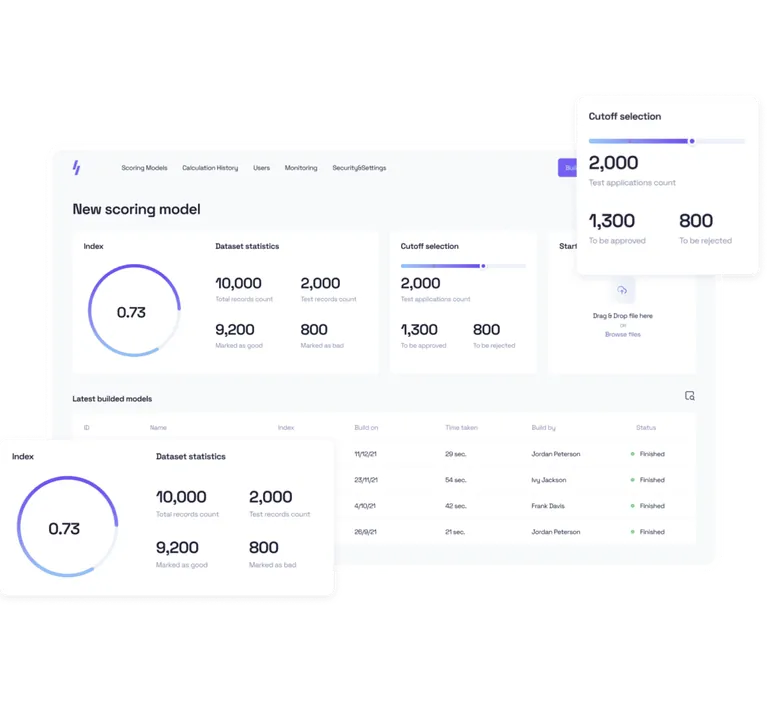
Three machine learning models went in behind a single REST API on AWS: one for scoring, one for default prediction, and an NLP classifier that finally made the free-text feedback usable. Keeping them behind one endpoint meant the lender’s existing origination flow needed one integration, not three.

Result

  • 0.73 AUC on the scoring model, validated against the client's own portfolio
  • Roughly 14% lower default rate among approved borrowers
  • About 60% fewer applications routed to manual review
  • Serving 53,127 personal and 132,456 corporate customers

Stack

PythonScikit-LearnKerasAWS
See full case study
Building an AI Credit Scoring Platform
1,540+ projects delivered
1,000+ clients across 82 countries
80+ funded startups where we acted as technical co-founder
10 weeks Signed contract to working MVP

VERIFIED REVIEWS

Our Reputation on Top Platforms

Clients across financial services rate our AI work 4.8 on both Clutch and GoodFirms. The reviews worth reading are the fintech ones, where buyers talk about compliance handling and what happened after launch rather than the pitch.

Clutch B2B Ratings & Reviews

4.8

78 reviews

Top Developer
GoodFirms Research & Reviews Platform

4.8

32 reviews

Top Company
Behance Creative Portfolio Platform

150+

design projects

View projects

WHY US

Why Financial Institutions Choose Us for AI in Fintech

Plenty of software development firms will build you a model. Fewer will run the risk management conversation first, and fewer still keep the AI systems honest once real traffic arrives.

We Assess Your Risk Profile Before Recommending a Model

A lender with 200,000 accounts and a regulator on speed dial needs different risk management from a payments company chasing volume. We look at your loss tolerance, your data maturity, and your examination history first. Sometimes the recommendation is a better rules engine, which is a strange thing for an AI company to say out loud.

Domain Experts Who Understand Both AI and Finance

The engineers on your project have shipped credit and fraud models, not models in general. They know what an adverse action notice is, why a 0.02 AUC gain does not justify losing explainability, and what month-end close does to a data pipeline. You spend the first call on your problem instead of explaining lending to a data scientist.

Regulatory Compliance Is Part of the Build, Not a Later Ticket

Explainability, audit logging, and adverse action reasoning get designed in at the modeling stage, because regulatory compliance is far easier to build in than to retrofit. Retrofitting it into a black-box model usually means rebuilding it, and we have been called in to do exactly that on AI systems built elsewhere more than once.

Monitoring Catches Drift Before Your Loss Numbers Do

A fraud model trained on last year’s patterns quietly decays as attackers adapt. Every model we deploy ships with distribution monitoring, alert thresholds you control, and a retraining cadence agreed before launch. Model risk management is a standing job, not a launch task.

HOW WE WORK TOGETHER

AI Solutions for Fintech Pricing

Most engagements start with the consulting track. It is the cheapest way to find out whether the data supports what you want, and roughly one in four of those assessments ends with us recommending against the build.

  AI/ML consulting Dedicated team
Best for AI/ML consulting — Deciding whether AI in fintech is worth funding at all Dedicated team — Banks and lenders with in-house engineers who need ML depth added
Team AI/ML consulting — ML architect, data engineer Dedicated team — 3 to 6 engineers embedded in your process
Duration AI/ML consulting — 3 to 6 weeks Dedicated team — 3 months minimum, rolling
Price AI/ML consulting — $12,000 to $30,000 Dedicated team — $18,000 to $40,000 per month
When to choose AI/ML consulting — You have a hypothesis and no read on your own data Dedicated team — Your team can maintain it; they just cannot build it

Full-cycle build

Best for: Companies with no ML capability that need the system built and handed overTeam: Full pod: PM, ML engineers, data engineer, QADuration: 4 to 9 monthsPrice: $80,000 to $250,000+When to choose: You need it delivered, documented, and running

Have a fraud detection or credit risk model on the roadmap for this quarter?

Bring the data questions. We will give you a realistic timeline and the parts we think are risky.

Is Your Fintech AI Project Ready to Build?

Two pages on what needs to be in place before a model is worth building: the data, the owner of the decision, the latency budget, and the compliance sign-off you will need anyway. Work email, no sequence afterward.

Before you invest in the model, make sure the essentials are already in place:

  • You know which business decision or workflow AI should improve
  • The right data is available, usable, and owned by someone internally
  • Accuracy, latency, and response-time expectations are defined
  • Compliance and security requirements are clear before development starts
  • Someone on your team owns the final AI-driven decision

QUESTIONS

Frequently Asked Questions About AI Solutions for Fintech

01 What are the benefits of AI solutions for fintech services?

Mostly, it comes down to consistency. The same applicant gets the same answer regardless of who is on shift, and the decision arrives in a second rather than a day. On top of that, the model catches patterns nobody thought to write a rule for, which is where fraud detection earns its budget. The credit scoring build above cut manual review by roughly 60%.

02 What is the difference between AI, machine learning, and deep learning?

Artificial intelligence is the umbrella term for software doing work that normally needs human judgment. Machine learning is the subset where machine learning algorithms find patterns in historical data instead of following rules a developer wrote. Deep learning goes a level further with multi-layer neural networks, which is what powers language models. When a vendor says artificial intelligence in a fintech pitch, they almost always mean machine learning.

03 How do you ensure AI models comply with financial regulations?

Explainability first. Lending models output reason codes alongside the score, so adverse action notices come from the same decision the model made. We document training data, feature definitions, validation results, and disparate impact testing in a model risk file your examiners can read. AI models that cannot explain a decline do not go into a lending flow, whatever the accuracy looks like.

04 What’s the typical ROI for AI solutions in fintech?

Anyone quoting you a single multiple is guessing. The honest way to size it: count the hours going into the decision today, add what the wrong decisions cost, and set that against the build plus annual retraining. Fraud and manual review cases pay back fastest, because both sides of that equation are already measured. We build the estimate with you during the consulting engagement.

05 What does an AI project cost?

A proof of concept runs $12,000 to $30,000 over three to six weeks. An MVP that reaches production lands between $80,000 and $150,000 across four to six months. Enterprise scale, meaning several models under one monitoring layer, starts at $250,000 or runs $18,000 to $40,000 per month.

06 How long does it take to deploy a fraud detection system?

Twelve to twenty weeks for most mid-market deployments. Data assessment takes two to three weeks, model development six to ten, and integration plus shadow mode another four to six. The integration is what moves the data, not the modeling.

07 How much data do we need to train a model?

For credit scoring, predictive analytics needs roughly two years of loan performance with resolved outcomes, ideally covering a downturn. For fraud, twelve months of labeled transactions, though unsupervised approaches work with less. Volume without labels changes the approach rather than ending the conversation.

08 What is the hardest part of a fintech AI project?

Not the model. Artificial intelligence inside a bank is mostly plumbing. Most institutions have transaction history spread across a ledger, a CRM, a KYC vendor, and a warehouse nobody has documented since the last migration. Getting that into a training set that reflects reality takes longer than training the model does. Then the thing has to answer inside a latency budget, under audit, with a fallback path for the day the model is wrong. One test settles whether a project is worth funding: name the business decision that changes when the model goes live. If nobody in the room can name it, you are buying a demo.

09 What do AI solutions for fintech actually do?

They take the judgment calls your team currently makes by hand and turn them into decisions a model makes in milliseconds, at volume, with a record of why. Approve or decline. Block or allow. Escalate to a human or close the alert. Machine learning models read customer data and transaction patterns that a fixed rule set will never catch, because a rule only knows what somebody wrote down last year. The practical result shows up in three places: fewer applications sitting in manual review, earlier fraud detection, and risk assessment your credit committee can actually defend.

10 Can AI solutions integrate with legacy banking systems?

Yes, and this is where most of the engineering time goes. Models sit behind an API your core platform calls, with connectors for common cores and ERPs. Integrating AI with existing banking systems usually means building a data layer in front of the core rather than touching the core itself, which is the safer path when the core is thirty years old.

11 What data security measures do you implement for financial AI?

Encryption in transit and at rest, role-based access, and audit logging on every inference, which is the first thing a regulatory compliance review asks to see. Training runs in your environment or an isolated one you control, never in shared tenancy. Where sensitive financial data cannot leave a jurisdiction, federated learning and differential privacy keep the model useful without moving the records. AI-powered cybersecurity solutions for fintech follow one rule: the minimum data protection scope that does the job.

12 How does AI in fintech improve customer experience?

Speed is most of it. Approval in ninety seconds instead of three days changes the customer experience more than any redesign will. Beyond that, predictive analytics on spending behavior lets you offer personalized financial advice at the moment it is useful, and financial planning prompts inside the app give customers a reason to open it between paydays. Financial planning features also generate the behavioral data your next model will need. Virtual assistants cover the rest, and customer satisfaction scores tend to move when the wait disappears.

13 Which data analytics and risk management use cases does AI in fintech deliver?

Four places, mostly: fraud detection at the authorization step, credit decisions at underwriting, predictive analytics across the portfolio, and regulatory compliance in the AML queue. What separates AI in fintech that works from AI in fintech that stalls is rarely the algorithm. It is whether the output lands inside a workflow somebody already uses. In practice: Approve more thin-file borrowers without moving your default rate the wrong way. Cut the share of applications going to manual review, and leave underwriters the genuinely borderline ones. Catch a fraud ring in its first week, before the chargebacks land. Forecast delinquency 60 days out instead of reacting to it at 90. Cut operational costs on AML review by clearing alerts that were never going to be anything. Let data analytics do the first pass on reconciliation exceptions, which is where back-office operational efficiency hides. Trim onboarding abandonment, where most of the customer experience damage happens, and cover the 2 a.m. questions with virtual assistants.

14 Do you provide ongoing support and model retraining?

Yes, and skipping it is how a good model turns into a liability. Support covers monitoring, alert response, and a scheduled performance review, monthly for fraud and quarterly for credit. Retraining runs on the trigger agreed at launch, either a calendar or a drift threshold you set. You own the retrained weights exactly as you own the original build, along with the source code and documentation, and access to the repository never depends on the retainer.

15 What if AI is not the right fit for us?

We will say so. Institutions under roughly 10,000 monthly decisions usually get more from better rules and clean risk management reporting than from a model. AI solutions for fintech startups at the pre-revenue stage tend to be the same story: build the product, collect the data, come back when there is something to learn from. We would rather lose the project than build something that quietly stops working in month eight.

Have a Fintech AI Project in Mind?

Thirty minutes with an ML architect who has shipped credit and fraud models into regulated production. You leave with a read on how far your data can take you, where the integration risk sits, and a cost range that is not a placeholder.

Next steps

1

LITSLINK specialist reviews your request and contacts you to discuss the details

2

If needed, we sign an NDA before moving forward

3

We send a project proposal – estimates, timeline, and team CVs included

4

After launch, we stay on for any updates your product needs

Litslink icon