





Natural Language Processing (NLP).
This enables AI agents to understand the human context of inquiries.
Services.
End-to-end product development — from AI prototypes to scalable web and mobile platforms.
View all services →Not sure where to start?
Book a free discovery call →Software Development
Industries.
Domain expertise that shortens discovery and gets compliance right from day one.
View all industries →Not sure where to start?
Book a free discovery call →AI Agents.
Custom AI agents that take routine work off your team — built and deployed in weeks.
View all AI agents →Not sure where to start?
Book a free discovery call →AI Agents For
Technologies.
A modern stack for every layer of your product — pick one or let us recommend.
View all technologies →Not sure where to start?
Book a free discovery call →Hire.
Vetted senior engineers who join your team in as little as 48 hours.
View all roles →Not sure where to start?
Book a free discovery call →Case Studies.
1540+ projects delivered for startups and enterprises in 82+ countries.
View all case studies →Not sure where to start?
Book a free discovery call →Resources.
Guides, live sessions and tools to plan your product and budget.
Visit the blog →Not sure where to start?
Book a free discovery call →Company.
The team behind 1540+ projects for 1000+ clients worldwide.
Get in touch →Not sure where to start?
Book a free discovery call →In Numbers
Enter to search·Esc to close
LITSLINK builds custom AI agents that deliver immense benefits to insurance providers in various industries.

AI is transforming how many businesses operate, and the insurance industry is no exception. This is where we can see the rise of autonomous AI agents. They are capable of evaluating complex situations and executing workflows independently, with the insurance sector already experiencing a shift in core operations driven by the technology.
Adoption of insurance AI agents in healthcare is growing fast, according to a National Association of Insurance Commissioners (NAIC) survey report on Artificial Intelligence and Machine Learning (AI/ML) conducted across 16 states. 84% of health insurers reported currently utilizing artificial intelligence and machine learning in some capacity.
These advanced AI agents are powered by an ecosystem of modern technologies and don’t just rely on static scripts like traditional software. The technologies that run the system include:
This enables AI agents to understand the human context of inquiries.
Helps to draft accurate responses, summarize documents, and converse naturally like a human being.
Enables the scanning of large data sets, pattern recognition, and predicting risks.
Helps to connect AI agents with internal systems to execute tasks automatically.
There is general confusion between the two because many organizations use both terms interchangeably, even though they are on opposite ends of the capability spectrum. Traditional AI chatbots are designed to answer questions by retrieving information from a predefined knowledge base. Think of them like a smart FAQ; they can answer common questions like why a premium went up, how to file a claim, or what a deductible covers. These chatbots, although useful, are pretty limited because they read from a script; when a question falls outside that script, human intervention is surely needed.
AI agents operate at a different level entirely. For example, if a customer needed to know why their health insurance premium went up, an AI chatbot would answer that question based on the documented policy, while an AI agent would go a level up. It would go through the customer’s policy, check their claims record, and cross-reference their risk profile data to give the exact factors that led to the change in the premium. The agent can go a step further and suggest personalized coverage alternatives to lower premiums, initiate policy adjustments, and schedule handovers to human agents, all without human intervention.
Insurance AI agents help service providers to work smarter, respond faster, and make better decisions while dealing with clients. Here are some of the key benefits of utilizing them.
Mundane administrative tasks like data entry and compliance checks consume a large share of the operational budget of insurance providers. AI agents handle the work automatically, 24 hours a day, without management having to worry about a growing headcount due to the scale of operations.
Claims processing in the traditional way involves multiple manual reviews and various steps to verify documents. AI agents speed up this process by collecting information, validating the documentation, and automatically prioritizing urgent claims. AI agents can perform appraisals and approvals automatically when it comes to unambiguous claims, allowing insurance providers to issue payouts faster.
AI agents are capable of following complex compliance rules with consistency and without experiencing fatigue or distraction. This standardization reduces the risk of costly human errors.
AI agents provide personalized, 24/7 customer support as virtual assistants and provide non-generic answers. The agents can cross-reference client data to provide personal recommendations and advice.
Insurance providers that focus on delivering fast, accurate, and personalized services will keep policyholders happy and prevent them from looking elsewhere. A report by McKinsey showed that AI agent implementations have led to a 10-20% improvement in new-agent success rates and sales conversion rates. Happier customers translate into long-term brand loyalty.
AI agents can scale instantly depending on fluctuations in market demand or sudden increases in claims, but human teams can easily be overwhelmed. According to McKinsey, the adoption of AI in insurance has had a key impact on the core aspects of businesses, including a 10-15% increase in premium growth, a 20-40% reduction in the cost of onboarding new customers, and a 3-5% accuracy improvement in claims. These factors will enable insurance companies to rapidly scale their operations.
Our AI agents assist insurance companies in automating operations, improving operational efficiency and customer experiences. The reach of these agents extends to key processes in the insurance chain, such as claims handling, underwriting, customer service, and policy management. Here are some of the ways AI insurance agents can work in practice to transform your insurance business.
First impressions matter, and AI onboarding agents simplify acquiring new policyholders by guiding applicants through every step of onboarding. When someone applies for a new policy, AI agents handle the heavy lifting right from the very first steps, like identity verification and answering questions in real time without any manual input. Once the onboarding process is complete, the AI agents generate insurance policies, send them to customers, and provide updates and other necessary communications.
Customers do not have a schedule for reaching out; they can communicate at whatever hour is convenient and works for them. AI agents can handle queries across multiple channels, such as websites, mobile applications, SMS, and phone calls, providing consistent responses 24/7. Whether a customer wants to inquire about their coverage details at midnight or file a claim on a Sunday, the AI agent will be there to help, and escalations will go to human staff only when necessary.
Customers who are about to change insurance providers often exhibit data signals, such as reduced engagement, missed renewals, or changes in how they interact with the product. AI agents are masters of pattern recognition and can detect these patterns early. They can flag accounts at risk of being lost, so teams can act before the tiny window of opportunity closes.
On the other side of loyalty, AI agents can build reward loyalty programs that are tied to individual behavior. For example, a driver with a clean record gets to enjoy lower premiums, and a health insurance member who consistently hits wellness benchmarks gets additional coverage benefits or access to premium healthcare services.
One of the areas where relationships in the insurance industry can break down the fastest is the filing of claims; long processing times and opaque status updates on settlements are known to erode trust between parties. AI agents are shifting the way claims processing is automated because they can pull relevant documents, cross-reference policy terms, and flag claims that require human review.
These AI agents can also run pattern analysis on incoming claims in real time and catch anomalies before payouts are issued. Fraud cases that would have taken weeks or months to investigate manually can now be completed in hours.
Insurance AI agents help insurance providers improve their pricing accuracy and drive up the profitability of their portfolio. For example, underwriting agents can use predictive analytics to evaluate risk factors from structured data like claims history plus credit scores, and unstructured data like medical notes & inspection reports. The AI agents can then use this information to generate risk scores, recommend any pricing adjustments, and escalate any cases that require human review.
Due to their deep learning and machine learning capabilities, AI agents continuously learn from outcomes and refine their underwriting criteria, helping insurers underwrite more profitably while maintaining competitive pricing.
For insurance providers, once a policy is approved, the administrative burden also starts. Here, AI agents can be deployed to generate policy document templates and automatically send them to customers, while tracking their delivery. Customers can also receive reminders from AI agents when policies are up for renewal and when internal guidelines or regulatory requirements change; AI agents can identify potentially affected policies, prepare recommended updates, and route them to legal, compliance, or policy teams for review. The result is less human involvement between policy approval and delivery, plus less exposure to legal liability as compliance rules shift.
AI agents can turn unstructured documents into actionable data that is instantly usable. The document agents use their Natural Language Understanding (NLU) to classify files, extract key fields like policy numbers, dates, diagnoses, etc., and detect missing or inconsistent information in huge datasets. In databases, AI agents can apply standardized naming & storage rules, set access controls, and create searchable indexes, saving a lot of human-hours.
The automated actions of these agents reduce the time required for manual reviews and improve the speed and accuracy of other processes, such as claims adjudication and audits.
Regulatory frameworks are always evolving, and staying ahead of compliance requirements requires a level of constant vigilance that is beyond human capabilities. Compliance agents can monitor operations in real time and audit internal workflows against local and international mandated protocols. The AI agents can work as automated early-warning systems that flag potential oversight issues, compile compliance audits, and provide the steps required to remain on the right side of the law.
They say the best insurance claim is the one that never happens, and it’s well known that some insurance costs for providers come from risks that could have been caught earlier. AI agents can use predictive maintenance models to identify early warning signs of equipment failure, property deterioration, or other conditions that are likely to generate future claims, thereby giving policyholders time to act before a loss occurs.
Beyond the predictive maintenance analysis, AI models help insurers monitor financial and operational exposures in real time, enabling pricing adjustments to mitigate future risks.
Usage-based insurance (UBI) is a business model where insurance premiums are tied to personal behavior, rather than the old way, where demographic data dictated the premiums. In the auto insurance industry, UBI is powered by telematics, which is a technology that collects real-time data from a vehicle, like miles driven, time of day, GPS location, speed, braking, cornering behavior, etc. Insurers then use this information to build individual risk profiles rather than relying on broad statistical categories such as age, gender, or ZIP code.
Before the golden age of telematics, demographic data was one of the major factors in determining risk; for example, a 22-year-old driver in a densely populated urban area had to pay higher premiums because drivers in that demographic class statistically filed more claims. The high premiums apply regardless of how careful a driver the person was; the UBI model is more personal, with premiums reflecting how well an individual drives.
AI agents process telematics and translate the data into dynamic risk scores that insurers can use to set premiums, trigger safety alerts, and offer personalized behavioral incentives.
AI agents in insurance can work across the entire insurance spectrum, from identifying potential customers through to upsell and renewal. On the market research side, AI agents can monitor competitors’ pricing, product changes, and positioning shifts, providing marketing teams with real-time data rather than quarterly reports. The agents can also analyze the existing customer base and sort it into behavioral and demographic clusters, with each cluster receiving communication based on its classification. For example, although a first-time homeowner and a commercial property portfolio manager both need property insurance, the pitch and product are different.
AI agents can also identify cross-sell and upsell opportunities from existing policy data. For example, a customer who recently purchased a home policy is a natural candidate for an umbrella liability offer. A small business owner expanding operations may have coverage gaps the AI agent can detect and flag for human outreach. This targeting is based on what the data shows, not on the gut feeling of a sales rep during the day.
The key results achieved included:
The Problem
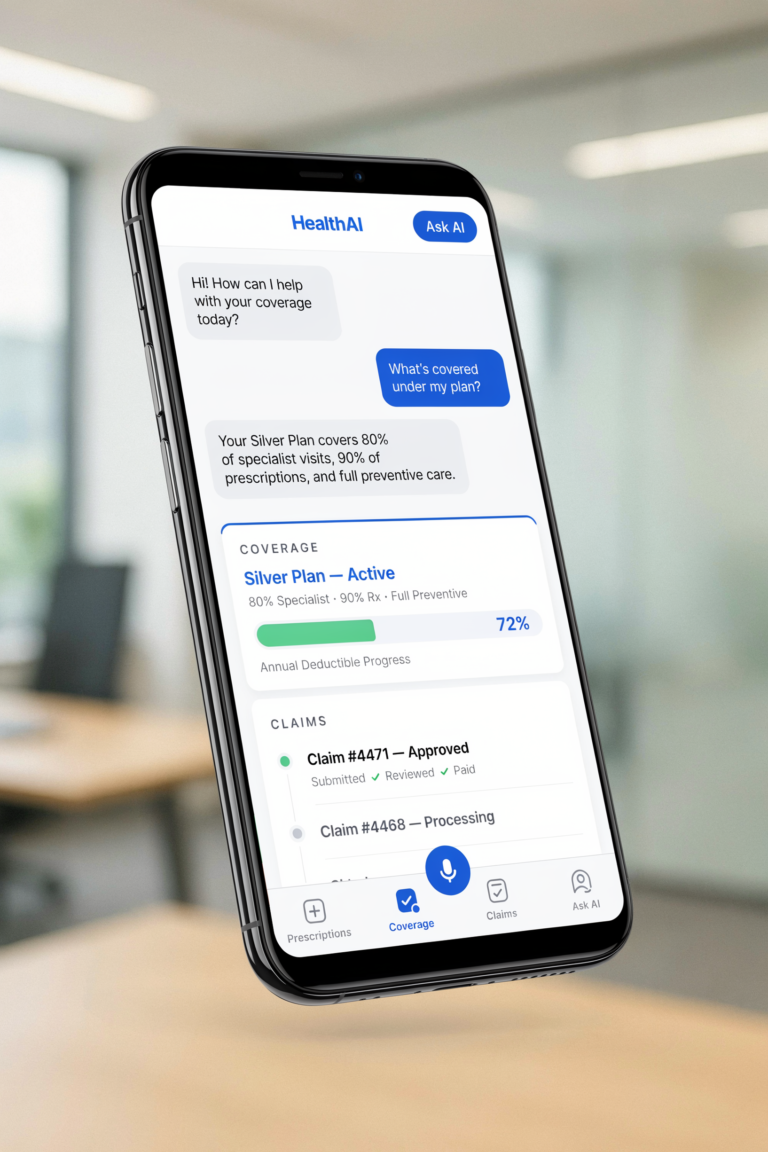
A leading insurer in Canada, with coverage for over two million citizens, experienced severe bottlenecks in its customer support centers. This was due to the introduction of updates to provincial health policies, which led to a massive influx of inquiries about insurance coverage boundaries, paramedical extensions, and prescription coordination.
Insurance agents were burning human-hours with repetitive status checks and looking up balances; consequently, the call abandonment rates climbed to 18%, and the support teams could not deliver services that were up to the standard expected.
The Solution
We engineered a custom omnichannel AI assistant capable of seamless interactions across various media, including voice channels, mobile applications, and web chats. The AI agent was built in strict compliance with PIPEDA guidelines in Canada and directly integrated into the insurer’s core Oracle CRM to securely manage sensitive patient data.
The agent uses AI technologies such as Natural Language Processing to interpret unstructured data, access live claims history, verify policy guidelines on the go, and resolve multi-step tasks without human intervention.
The Impact
The autonomous AI agent successfully routed and resolved 64% of incoming support requests on its own. The technology smoothed the bottleneck points, freeing up human agents to perform the complex cases that may require human understanding and empathy, plus the critical underwriting tasks. Management also got access to analytics that would help them spot emerging claim trends in real time.
LITSLINK is recognized across leading industry platforms for delivering high-quality software solutions. See what clients and the design community say about our work.
We pick tools based on what the problem needs, not what’s currently generating hype. That said, here’s the landscape we work across.
OpenAI (GPT-5, GPT-5.4), Anthropic Claude, Google Gemini, Meta Llama, Mistral – we’re model-agnostic and will recommend the right fit for your use case, cost profile, and data privacy requirements.
LangChain, LangGraph, CrewAI, Semantic Kernel, LlamaIndex, Microsoft AutoGen – framework selection depends on your agent architecture and workflow complexity.
Pinecone, Weaviate, Chroma, FAISS – for retrieval-augmented generation and knowledge management.
Apache Airflow, Prefect, Temporal – for reliable task scheduling and workflow management at scale.
AWS (Bedrock, SageMaker), Microsoft Azure AI, Google Cloud Vertex AI – full cloud provider expertise, with no lock-in to a single platform.
TensorFlow, PyTorch – for custom model development and fine-tuning when off-the-shelf isn’t enough.
GDPR, HIPAA, SOC 2, CCPA – built in from architecture through deployment. Encryption at rest and in transit, role-based access controls, and comprehensive audit trails.
Node.js, Python, FastAPI, Docker, Kubernetes – production-grade infrastructure for reliable agent deployment at scale.
Model-agnostic by design. We don’t lock you into a single provider. Our architecture lets you swap models as the landscape evolves — without rebuilding your entire system.
We know how to build AI agents that cover the full operational range of the insurance industry workflow: risk management, underwriting, detecting fraud, monitoring compliance, administering policies, onboarding customers, processing documents, and omnichannel support.
LITSLINK develops custom AI agents for insurance providers across the sector’s major lines, like health, life, property, casualty, and specialty.
We also build AI-powered recommendation engines, customer retention tools, and risk assessment systems that are trained specifically on insurance data. Whatever the use case you have for the AI agent, it will help your organization to reduce operational drag, improve customer experience, and give your business the legs to grow.
Our technical team has developed dozens of custom AI systems in the insurance sector, and we have deep domain experience on projects in the niche. We understand the technical hurdles in the sector, which is why our AI agents are built with compliance and data protection in mind from day one. The development cycles we implement support SOC 2 Type 2, GDPR, CCPA, and HIPAA compliance protocols to keep your enterprise data highly secure.
Many initiatives to integrate AI in business workflows fail because businesses take too long before the ideas are validated. LITSLINK has an iterative development approach that quickly delivers true value. A proof of concept can be developed in as little as 4-6 weeks, which gives stakeholders time to validate the business impact. Full-scale enterprise deployments take 3-6 months. Our refined development process is favored because it enables faster project delivery, all without sacrificing quality, security, and scalability.
To develop AI agents, specialists must be proficient in:
To build enterprise AI agents in the insurance sector, you need a diverse team of specialists who cannot be assembled internally. To build a fully functional AI agent, you will need AI engineers, data scientists, NLP/LLM specialists, cybersecurity professionals, QA experts, and insurance technology experts — and at LITSLINK, we have them all at your service.
Your organization retains ownership of the AI solution that we create for you, including all the intellectual property designed during the development process, such as:
AI implementation does not end with the system going live; our team provides ongoing support throughout the integration and AI agent training stages to ensure efficiency and familiarization with the system.
Ready to see how an AI agent can transform your insurance company?
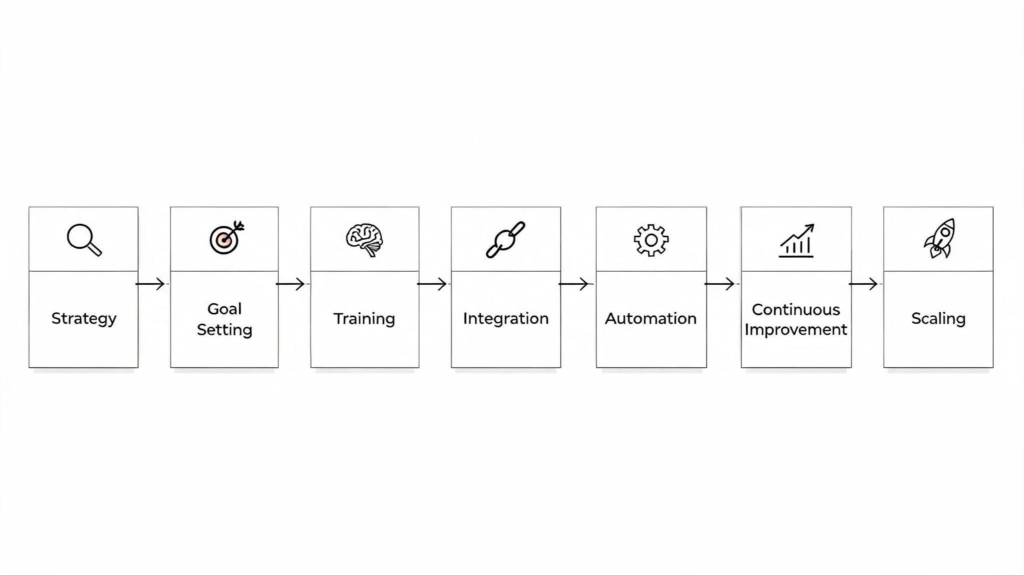
Let’s get in touchLITSLINK follows a structured development process to help insurance companies move from idea to measurable results as quickly as possible.
Step 1 of 7
LITSLINK analyzes your existing workflows, operational challenges, customer journeys, and business objectives to identify the sections in which AI agents can have the greatest impact. This assessment guides our team in recommending the most effective AI solutions aligned with your business goals.
Step 2 of 7
Clear objectives and success metrics for the AI agent are defined, and the system is configured around your workflows, business priorities, and customer data. The most critical processes and high-impact tasks are also prioritized so that the AI agent can focus on delivering value where it matters the most.
Step 3 of 7
The AI agent is trained on insurance-specific data and information sources that are relevant to your organization. These sources include policy documents, claims records, customer interactions, underwriting guidelines, risk assessments, compliance requirements, and internal operations. The AI agent learns to provide accurate responses and automate complex workflows by learning from your business data.
Step 4 of 7
The next step after training and optimization is integrating the AI agent with the existing technology in your ecosystem. We connect your AI agent with policy administration systems, claims management platforms, CRM software, customer portals, compliance systems, underwriting tools, and other insurance technologies.
Step 5 of 7
Once the AI agent is deployed, it begins to perform tasks and coordinate workflows autonomously across different agents and systems. The system can now process customer requests, generate reports, route claims, manage documentation, monitor compliance activities, and support underwriting decisions. As it operates, the AI agent also adapts to changing conditions and improves efficiency through human feedback and performance monitoring.
Step 6 of 7
AI agents become more valuable over time with consistent monitoring of their performance against the original business objectives and key performance indicators. The system identifies improvement opportunities, incorporates new information, and learns from user interactions, thus refining its responses.
Step 7 of 7
Once the AI agents are proven within a specific use case, their reach can be expanded across the organization. With the support of LITSLINK specialists, insurers can scale the AI technology across additional departments, automate core insurance processes, and create a system of interconnected AI agents that drive efficiency in organizations.
Step 1 of 7
LITSLINK analyzes your existing workflows, operational challenges, customer journeys, and business objectives to identify the sections in which AI agents can have the greatest impact. This assessment guides our team in recommending the most effective AI solutions aligned with your business goals.
Step 2 of 7
Clear objectives and success metrics for the AI agent are defined, and the system is configured around your workflows, business priorities, and customer data. The most critical processes and high-impact tasks are also prioritized so that the AI agent can focus on delivering value where it matters the most.
Step 3 of 7
The AI agent is trained on insurance-specific data and information sources that are relevant to your organization. These sources include policy documents, claims records, customer interactions, underwriting guidelines, risk assessments, compliance requirements, and internal operations. The AI agent learns to provide accurate responses and automate complex workflows by learning from your business data.
Step 4 of 7
The next step after training and optimization is integrating the AI agent with the existing technology in your ecosystem. We connect your AI agent with policy administration systems, claims management platforms, CRM software, customer portals, compliance systems, underwriting tools, and other insurance technologies.
Step 5 of 7
Once the AI agent is deployed, it begins to perform tasks and coordinate workflows autonomously across different agents and systems. The system can now process customer requests, generate reports, route claims, manage documentation, monitor compliance activities, and support underwriting decisions. As it operates, the AI agent also adapts to changing conditions and improves efficiency through human feedback and performance monitoring.
Step 6 of 7
AI agents become more valuable over time with consistent monitoring of their performance against the original business objectives and key performance indicators. The system identifies improvement opportunities, incorporates new information, and learns from user interactions, thus refining its responses.
Step 7 of 7
Once the AI agents are proven within a specific use case, their reach can be expanded across the organization. With the support of LITSLINK specialists, insurers can scale the AI technology across additional departments, automate core insurance processes, and create a system of interconnected AI agents that drive efficiency in organizations.
AI agents for insurance are intelligent software systems that use technologies such as machine learning, natural language processing, and advanced automation to perform tasks that would typically require human involvement.
Insurance AI agents help assess risk, process claims, manage policies, detect fraud, monitor compliance, automate customer service, and deliver personalized experiences.
The best starting point for businesses is workflows that combine high transaction volumes, repetitive manual work, and a measurable business impact. Many insurance providers begin with automating customer support, processing claims, policy administration, claims triage, underwriting support, and document management. These areas have quick, realizable gains because they reduce manual workloads while increasing operational efficiency.
The timeline of each project varies depending on complexity, integrations, and business requirements. It takes roughly 4-6 weeks for a proof of concept (PoC) to be delivered. Full production of AI agents ready for deployment takes about 3-6 months.
Typical development ranges include:
For a detailed calculation of the development costs, use our AI agent development calculator.
AI agents are expected to become a core part of insurance operations over the coming years. Technological advances in generative AI, predictive analytics, autonomous decision-making, and personalized customer experiences will help insurance agencies automate complex workflows. As AI technology continues to mature, future agents will provide deeper insights and operate more efficiently at scale.
Where is your insurance team losing time? Tell us about your workflows and existing systems, and we’ll help you identify where insurance AI agents could make the biggest difference. Our team will respond within 48 hours to discuss your goals and a practical starting point.
Next steps
LITSLINK specialist reviews your request and contacts you to discuss the details
If needed, we sign an NDA before moving forward
We send a project proposal – estimates, timeline, and team CVs included
After launch, we stay on for any updates your product needs
Thank you! Your request has been sent — our team will get back to you within 48 hours.