








LLM Providers
OpenAI (GPT-5, GPT-5.4), Anthropic Claude, Google Gemini, Meta Llama, Mistral — we’re model-agnostic and will recommend the right fit for your use case, cost profile, and data privacy requirements.
Services.
End-to-end product development — from AI prototypes to scalable web and mobile platforms.
View all services →Not sure where to start?
Book a free discovery call →Industries.
Domain expertise that shortens discovery and gets compliance right from day one.
View all industries →Not sure where to start?
Book a free discovery call →AI Agents.
Custom AI agents that take routine work off your team — built and deployed in weeks.
View all AI agents →Not sure where to start?
Book a free discovery call →Technologies.
A modern stack for every layer of your product — pick one or let us recommend.
View all technologies →Not sure where to start?
Book a free discovery call →Hire.
Vetted senior engineers who join your team in as little as 48 hours.
View all roles →Not sure where to start?
Book a free discovery call →Case Studies.
1540+ projects delivered for startups and enterprises in 82+ countries.
View all case studies →Not sure where to start?
Book a free discovery call →Resources.
Guides, live sessions and tools to plan your product and budget.
Visit the blog →Not sure where to start?
Book a free discovery call →Company.
The team behind 1540+ projects for 1000+ clients worldwide.
Get in touch →Not sure where to start?
Book a free discovery call →In Numbers
Enter to search·Esc to close
LITSLINK creates finance and accounting AI agents that can automate operations, reduce errors, and keep up with constant reporting demands.

AI agents are the latest fundamental shift in the finance industry. By 2030, the AI agent market is expected to rise from about $7-8 billion in 2025 to over $50 billion.
An accounting AI agent is a software program that carries out financial tasks without step-by-step human oversight and instructions. It can read data, analyze context, make decisions based on that context, and take actions inside financial systems. Unlike traditional automation, these autonomous systems can adjust when inputs change. They can also continue to function without constant supervision.
These agents employ a range of technologies to work:
AI agents represent a step forward from older AI tools because of the manner in which they work. Chatbots usually wait for questions before responding, whereas generative AI creates output in response to prompts. AI agents, on the other hand, work proactively and autonomously, able to monitor systems, identify irregular activity, initiate workflows, and update records without requiring a request from the user each time.
In the world of finance, the functions of these tools are very important. A bank may employ a chatbot to assist with providing users with payment status updates. However, agentic systems can be used to trace and verify transactions throughout multiple systems. They can also flag missing invoices, update ledgers, and notify teams of any discrepancies in client activity.
AI agents are proactive rather than reactive. They can respond to configured events and system triggers by initiating predefined actions or escalating the issue for review.
Comparison
Leading companies in finance are quickly embracing AI because they’re faced with increasing transaction volumes and tighter reporting timelines. The market size of AI agents in the financial services sector was approximately $1.75 billion in 2025. It is projected to grow to over $5.7-$6.7 billion in the coming decade.
Compared with fully manual processing, AI agents enable accounting teams to process large volumes of data quickly. Financial data often comes from different systems, such as ERP platforms, banking tools, payment processors, and reporting software. Manual human review cannot match the speed at which this influx occurs. But with agentic AI, information can be processed continuously rather than during monthly or quarterly cycles.
This changes reporting from a delayed activity into an ongoing process. As a result, missing entries, unusual transactions, or mismatched records can be identified early instead of being discovered during audits.
AI accounting agents can also help companies save money. AI-powered systems can automate parts of loan processing, onboarding, and verification tasks. This results in reduced operating expenses and increased speed of service.
AI supports financial inclusion by making it easier for small businesses and individuals in underbanked areas to access financial services. Agents can help users with creating accounts, submitting documents, and checking their eligibility for financial services without them having to go to a branch in person.
Another significant benefit of AI is greater accuracy in financial reporting. Errors made by humans in bookkeeping can create issues with reporting, compliance problems, and, ultimately, financial loss. AI agents provide greater accuracy and reduce the potential for risk by applying validation rules consistently and comparing records across multiple systems.
Our AI agents are reshaping many areas of finance. Below, we explore key use cases.
Compiling financial reports manually can take time and effort. This is why many companies automate this task through an integrated collection of ERP systems, billing systems, banking feeds, and internal databases.
AI agents can accomplish this by continuously pulling transactional data into finance records from multiple sources and reviewing those records as they are being created or modified. This involves checking for missing values and identifying unusual transactions as they occur.
This allows finance teams to receive ongoing weekly reports on cash movement, expense breakdowns, and performance indicators. All this happens without manual compilation. So, there is no need to wait for account reconciliation at the end of the month.
The biggest advantage is reporting quality:
The general ledger process requires strict accuracy and consistent monitoring. An AI agent can provide support by reviewing journal entries for accuracy and validating account mappings. It can also verify that there are no duplicate or incomplete records.
In addition, an AI agent can monitor general ledger activity across multiple accounts, match transactions, and confirm that they have been recorded in the proper categories. If there are any inconsistencies, the agent will highlight them and recommend corrections.
The agent will gather supporting documents required during the closing cycle and will automatically prepare audit trails. This will shorten the time it takes to complete the financial closing process and improve the accuracy of the financial records.
These capabilities create several benefits:
Detecting fraud in the finance sector requires continuous monitoring of a large number of transactions. AI agents can assist by analyzing user activity and transaction patterns, as well as behavioral signals in real time.
They identify unusual movements such as unexpected transfers, abnormal spending patterns, or inconsistencies in account behavior. Alerts can be sent, or reviews can be initiated by agents once suspicious activity is detected.
How AI helps:
Tracking regulations, internal controls, and reporting standards is a core requirement of financial compliance. AI agents assist with this by continuously monitoring financial activities to ensure continued compliance.
To accomplish this, they review transactions, approvals, and the supporting documents for each transaction to identify gaps or violations. When issues occur, they will generate an alert or create documentation for the compliance team.
When gaps or violations are identified early, the risk of non-compliance is significantly reduced:
Compliance professionals spend less time on routine transaction reviews and devote more time to strategic efforts.
Traditional credit assessment often depends on limited information. It also requires lengthy manual evaluations. Agentic credit assessment can improve underwriting by analyzing broader financial signals. This includes transaction patterns, payment histories, cash flow trends, operational performance, and alternative financial indicators.
The agents can evaluate and rank credit applications more quickly than traditional methods and apply the same standard to all applicants. They can also detect risk factors that would be difficult for a human reviewer to find when processing a large number of applications.
This leads to faster and more consistent decision-making:
Treasury departments need real-time, accurate visibility into cash positions to stabilize their companies and support business growth. AI agents allow staff to monitor cash inflows, outgoing payments, debt obligations, and funding requirements at all times.
Through analysis of historical and live data, the system can monitor cash flows and forecast short-term liquidity needs. This allows it to recommend actions such as reallocating capital, adjusting payment schedules, or obtaining financing ahead of projected shortages.
This helps organizations better manage their liquidity, reduce the likelihood of experiencing an unexpected cash crisis, and optimize their working capital. Better liquidity management supports both risk reduction and business growth.
Agentic AI improves forecasting by continuously analyzing internal financial data, market trends, operational metrics, and economic conditions. Rather than relying on static reports that quickly become outdated, it updates forecasts automatically as soon as conditions change.
For example, if supplier costs rise unexpectedly or customer demand shifts, the system can immediately update revenue projections, margin forecasts, and expense expectations. Management can see the likely impact before problems affect performance.
As a result, scenario modeling can be performed faster, as multiple assumptions can be tested automatically. This makes decision-makers more agile due to access to current information and not outdated reports. As a result, planning accuracy improves, and the business can react to changing market conditions more effectively.
AI agents help monitor the market, the economy, and global events in order to determine how to invest in different types of assets. They can offer portfolio adjustments based on the current market conditions.
The biggest advantage of having AI agents is the speed with which an investment firm can respond to any issue. A company can quickly act on the changes in the market and immediately determine a way to address the issue.
This makes the company more competitive, allowing it to find new investment opportunities early. It also helps manage investment risk more successfully in rapidly changing markets.
AI agents provide customer service and engagement through websites, mobile applications, messaging platforms, SMS, and other digital channels. They can answer customer questions, guide them through the onboarding process, resolve common issues, and provide personalized financial recommendations.
These agents are trained to understand context. They can tailor responses based on the customer’s history, spending patterns, savings goals, and investment preferences. When there is an account issue that requires the expertise of a human being, the AI agent can quickly transfer the conversation to a support specialist.
By using AI agents, financial institutions will experience improved response time for all routine requests. They will also be able to save time and money since AI automation reduces support workload.
Because AI agents operate 24/7, customers can get assistance whenever they need it. Personalization also enhances the customer experience by offering unique recommendations that align with their financial circumstances and goals.
A lot of organizations use multiple financial systems that require synchronization. AI reconciliation agents can automatically compare transactions within ERP systems, accounting platforms, banking systems, payment processors, and other financial apps.
They investigate reconciliation breaks, identify anomalies, and standardize data formatting. These systems even generate reconciliation reports and provide corrective recommendations before the anomalies become a problem.
The business impact is clear:
Problem
The finance team of a large enterprise struggled to find accounting errors or unusual transactions across multiple ERP modules. Manual reviews could only be performed on a small percentage of transactions. Also, rule-based controls generated an excessive amount of false positive alerts that often missed the anomalies that were outside of preset thresholds.
Solution
LITSLINK created an AI-powered anomaly detection assistant that connects directly with ERP systems to assist in identifying issues. Using unsupervised machine learning, the solution learns normal transaction behavior, continuously monitors financial data, detects unusual patterns in real time, and provides clear explanations for every flagged anomaly.
Impact
With this solution, manual review time is reduced significantly while improving visibility of financial operations. Finance teams can now identify issues earlier, investigate anomalies faster, and have stronger control over data quality.
Additionally, the time required for post-close reviews has been reduced from several days to a few hours. This improved reporting accuracy, reduced financial risk, and strengthened audit readiness.
LITSLINK is recognized across leading platforms such as Clutch, GoodFirms, and Behance.
We pick tools based on what the problem needs, not on what’s currently generating hype. That said, here’s the landscape we work across.
OpenAI (GPT-5, GPT-5.4), Anthropic Claude, Google Gemini, Meta Llama, Mistral — we’re model-agnostic and will recommend the right fit for your use case, cost profile, and data privacy requirements.
LangChain, LangGraph, CrewAI, Semantic Kernel, LlamaIndex, Microsoft AutoGen — framework selection depends on your agent architecture and workflow complexity.
Pinecone, Weaviate, Chroma, FAISS — for retrieval-augmented generation and knowledge management.
Apache Airflow, Prefect, Temporal — for reliable task scheduling and workflow management at scale.
AWS (Bedrock, SageMaker), Microsoft Azure AI, Google Cloud Vertex AI — full cloud provider expertise, with no lock-in to a single platform.
TensorFlow, PyTorch — for custom model development and fine-tuning when off-the-shelf isn’t enough.
GDPR, HIPAA, SOC 2, CCPA — built in from architecture through deployment. Encryption at rest and in transit, role-based access controls, and comprehensive audit trails.
Node.js, Python, FastAPI, Docker, Kubernetes — production-grade infrastructure for reliable agent deployment at scale.
AI agents enhance how a client interacts with financial services by providing faster and more consistent support. Clients receive assistance at any time through an app, website, or messaging platform. And there’s no need to wait for assistance from a human agent.
These agents can check balances, resolve basic account issues, or provide onboarding support instantly. When questions are complex, the system will transfer to a human agent without interruption.
Overall, this reduces client waiting time and improves satisfaction. It also allows support teams to focus on more valuable and complex tasks rather than responding to repetitive tasks and questions.
Many accounting teams spend considerable time doing repetitive tasks like transaction checks, reconciliations, and report preparation. AI agents take over much of this workload by managing these processes automatically in the background.
Entry validation, cross-system transaction matching, and structured report preparation are automatically handled without the need for human oversight. This reduces manual work and workload stress. As a result, teams can redirect their efforts toward planning, analysis, and decision-making.
AI agents continuously validate and compare financial records with reports from various business systems to identify errors early. They flag missing entries, duplicate transactions, or inconsistencies in financial records as soon as they occur. This reduces the potential for financial errors moving through the system. It also improves trust in financial reports.
Standard reporting is generally created using past data. Therefore, decisions based on such data are often outdated.
AI agents change the paradigm by analyzing financial data in real time as it’s being created. As trends and changes in performance happen, the finance team can immediately respond to those changes thanks to real-time insights.
AI agents continuously monitor signals indicative of fraud risks, credit risk, and operational issues to mitigate and manage financial risk within the organization. When unusual occurrences are recorded, the system immediately flags the activity or it creates an investigation workflow to reduce the risk of exposure. This leads to better oversight of financial operations.
AI agents help by continuously checking financial activity against compliance rules. They are also responsible for monitoring approvals, transactions, and the documentation associated with the ongoing financial operations. This ensures compliance with internal policies and regulatory requirements.
If at any point something does not match requirements, it is flagged early for review. As a result, compliance risks are reduced, and auditing is made easier.
AI agents assist organizations that are scaling without having to increase their number of team members at the same rate. These agents can handle large volumes of transactions, reports, and requests without causing slowdowns in processes. As a result, organizations can grow without increasing costs.
AI agents are improving credit access for individuals and businesses that are often underserved. They can support alternative credit assessments for loans using alternative data instead of traditional credit scores.
Additionally, AI agents automate the processing of microloans and guide users through banking services without going to physical branches. They provide access, inclusion, and support for financial services.
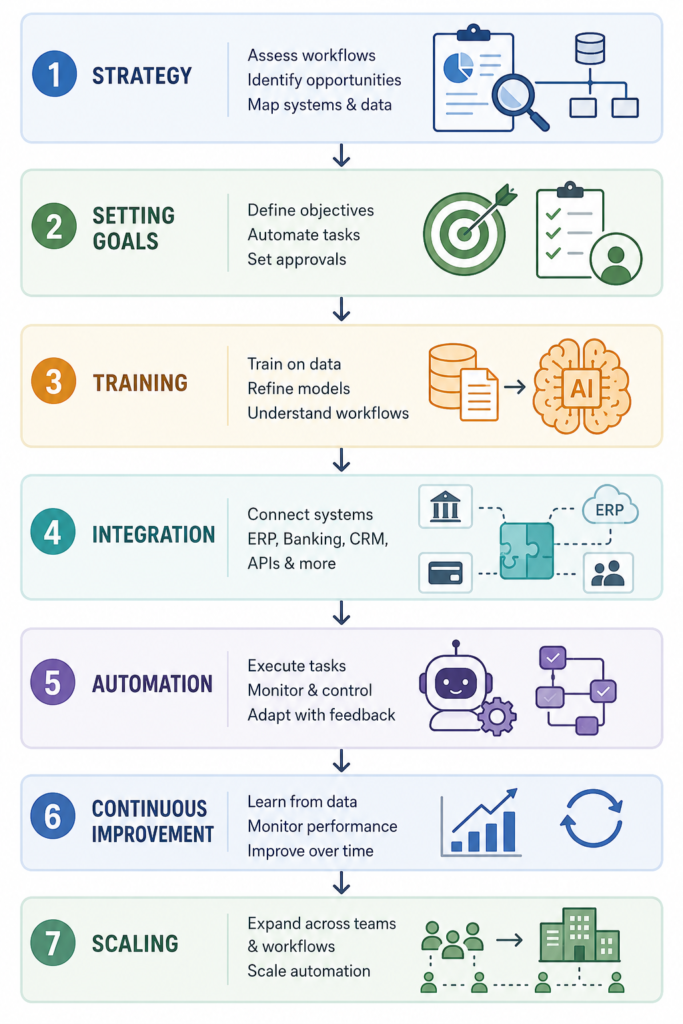
Our process begins with a review of the client’s current financial workflows. The first step is to identify areas where manual efforts are slowing down operations. This helps us identify areas where AI automation will be most helpful. We also map data sources, system dependencies, and operational challenges before designing the solution.
We define clear objectives for the agentic AI based on your business priorities. This includes identifying the tasks that will be automated, the decisions the system can make, and the actions that will require human approval. This is done to ensure that it is working consistently in a controlled and predictable manner.
The AI agent is trained on internal and external data, such as financial records, transaction histories, invoices, ERP records, accounting workflows, and operational logs. We will also refine training data models so that they can understand business process flows. This will enable the agent to work in a real-world environment correctly.
After being trained, the AI agent connects with other systems used within the financial environment. This includes accounting software, banking APIs, ERP tools, CRM systems, and payment processors. With this integration, the agentic AI can operate within the client’s financial ecosystem while minimally impacting existing operations.
At this point, the AI agent begins to perform tasks automatically. It will process transactions, monitor data quality, and execute workflows. This is done based on defined rules and learned behavior. It will also adapt according to feedback from users and system performance.
After the agent has been deployed, it continues to learn from new data and user feedback. We will monitor the agent’s performance and refine it to improve both accuracy and efficiency over time.
Once the solution has been implemented and stabilized, it can then be used by other departments, business units, and financial workflows within the organization. This allows companies to increase automation gradually without disrupting operations.
Our process begins with a review of the client’s current financial workflows. The first step is to identify areas where manual efforts are slowing down operations. This helps us identify areas where AI automation will be most helpful. We also map data sources, system dependencies, and operational challenges before designing the solution.
We define clear objectives for the agentic AI based on your business priorities. This includes identifying the tasks that will be automated, the decisions the system can make, and the actions that will require human approval. This is done to ensure that it is working consistently in a controlled and predictable manner.
The AI agent is trained on internal and external data, such as financial records, transaction histories, invoices, ERP records, accounting workflows, and operational logs. We will also refine training data models so that they can understand business process flows. This will enable the agent to work in a real-world environment correctly.
After being trained, the AI agent connects with other systems used within the financial environment. This includes accounting software, banking APIs, ERP tools, CRM systems, and payment processors. With this integration, the agentic AI can operate within the client’s financial ecosystem while minimally impacting existing operations.
At this point, the AI agent begins to perform tasks automatically. It will process transactions, monitor data quality, and execute workflows. This is done based on defined rules and learned behavior. It will also adapt according to feedback from users and system performance.
After the agent has been deployed, it continues to learn from new data and user feedback. We will monitor the agent’s performance and refine it to improve both accuracy and efficiency over time.
Once the solution has been implemented and stabilized, it can then be used by other departments, business units, and financial workflows within the organization. This allows companies to increase automation gradually without disrupting operations.
The global economy continues to evolve toward hyper-personalization at scale. AI agents will offer timely, relevant recommendations, lending decisions, investment guidance, and enhanced customer experience. Customers will be able to receive quicker, more personalized service without sacrificing convenience.
Multi-agent systems will also become the norm within financial services. Instead of a single AI handling one task, multiple specialized agents will work together to monitor transactions and compliance, evaluate credit applications, manage reporting, detect fraud, and make routine low-risk decisions. What currently gives one organization a competitive edge may soon be commonplace within the entire financial services industry.
This shift in the financial industry will create new responsibilities for financial organizations. They’ll need to adopt strong governance, reliable data, and clear oversight of AI-driven decisions. That said, adoption continues to rise quickly. By 2028, 15% of decisions made during daily work activity will be autonomous decisions by agentic AI, which is up from 0% in 2024. So, agentic AI may become as integral to office operations as CRM and ERP systems.
AI accounting services use machine learning and automation to support financial decision-making. These systems enable financial organizations to analyze data, manage transactions, identify risk, and improve their operations with little to no human intervention.
The majority of organizations start with high-volume and repetitive manual work processes such as transaction reconciliation, accounts payable, financial reporting, and variance analysis. Automating these functions yields immediate efficiency gains.
A proof of concept can be produced in as little as four to six weeks, depending on the complexity of the prototype. Full production, including designing, training, integration, and deployment, can take three to six months.
The cost of building an AI agent for a finance organization varies based on complexity:
For a detailed breakdown, visit our AI agent development cost page.
AI agents are good for data analysis, creating reports, and automating tasks. However, they cannot replace the skills of a human financial advisor. A human financial advisor provides the expertise required to develop investment strategies, manage client relationships, and to make complex decisions.
If you’re evaluating AI agent development services and want to discuss specifics about your use case, constraints, and a realistic path forward, we’d like to hear from you. Our team reviews every inquiry and responds within 48 hours.
Next steps
A LITSLINK specialist reviews your request and contacts you to discuss the details.
If needed, we can sign an NDA before moving forward.
We send a project proposal – estimates, timeline, and team CVs included.
After launch, we stay on for any updates your product needs.
Thank you! Your request has been sent — our team will get back to you within 48 hours.
