








Key Takeaways:
- Python ranks #1 in TIOBE Index with 17.76%.
- JavaScript is used by 66% of all respondents in the Stack Overflow 2025 survey.
- TypeScript became the most-used language on GitHub in August 2025, with about 2.6 million monthly contributors.
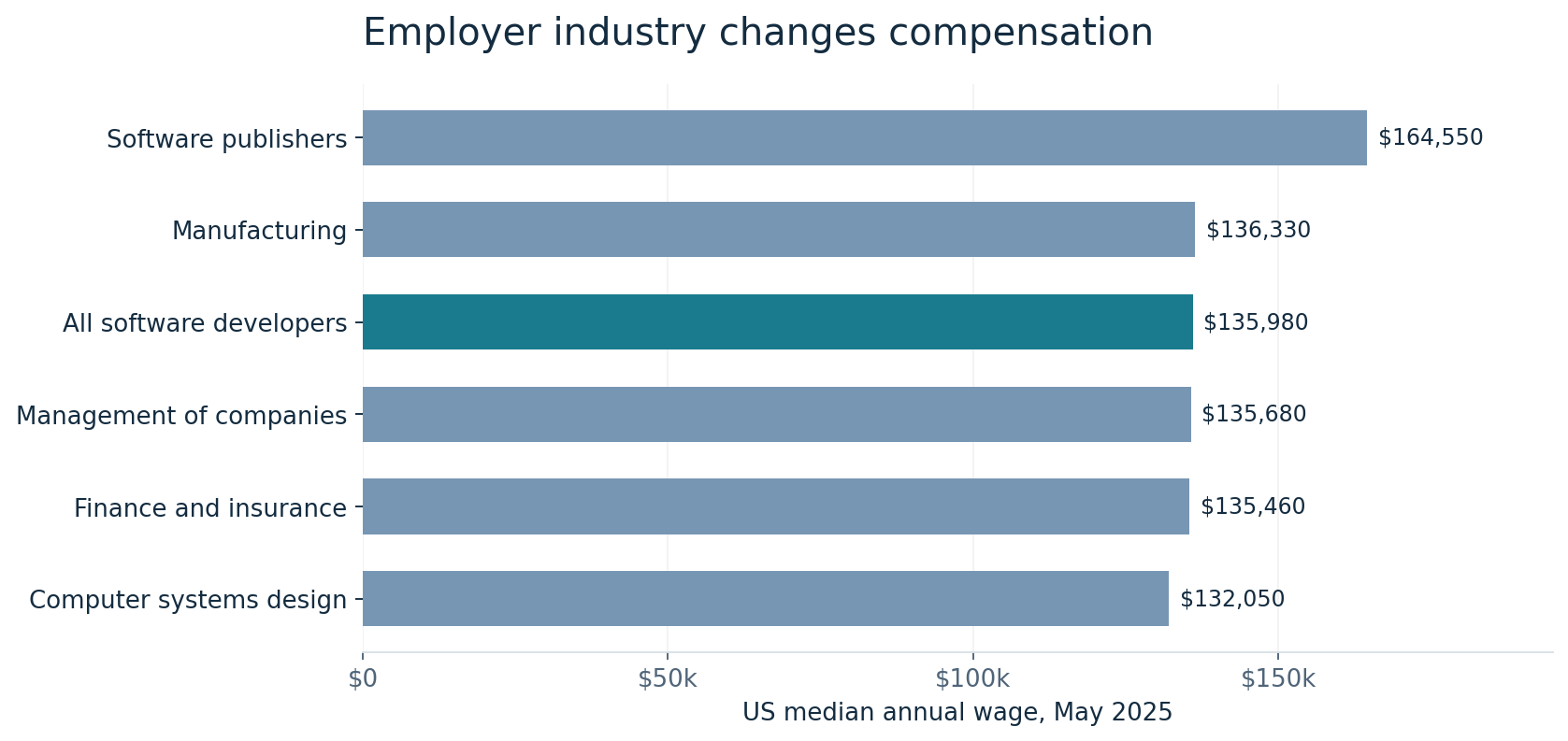
- Rust is the most desired language at 72%, while only professional developers use it to the tune of about 14.5%.
- The US median wage for software developers is $135,980.
- C# was the TIOBE’s Language of the Year in 2025 but dropped 2.16 points of rating by September 2026.
According to the Online Historical Encyclopedia of Programming Languages (HOPL), there are some 8,945 programming languages. That’s why, when asked what language to learn for a higher long-term salary, I begin by asking them what types of problems they want to learn how to solve. Your option may lead to the loss of one year of study or provide a good career opportunity.
So, without further ado, here is my list of the top 15 programming languages to learn in 2026. Ranked according to market demand, the most recent dev statistics, and experience. This is, of course, a list of my recommendations only for those who are undecided or are just “window shopping”.
Programming Language Rankings Compared: TIOBE Index, RedMonk, and Stack Overflow
A ranking of the programming language depends on where the signal is from. Different leaders can be produced without conflict via search visibility, public code and conversation, and self-reported development use.
The TIOBE Index adds hits from Google, Bing, Wikipedia and 20-plus other search engines. It tracks attention. TIOBE’s CEO Paul Jansen admits that he doesn’t crown the best programming language.
The RedMonk programming language rankings is a combination of GitHub pull requests and discussion on Stack Overflow. The Stack Overflow Developer Survey just inquires from 49,000 developers about what they used in the past year.
A fourth metric, PYPL, takes raw data from Google Trends and counts language tutorial searches. So PYPL measures who wants to learn a new programming language, and language tutorial searches will always favor whatever beginners pick first. (Python, for years now, per Google Trends.)
| Rank | TIOBE Index (Sep 2026) | RedMonk (Jan 2026) | Stack Overflow 2025 (all respondents) |
|---|---|---|---|
| 1 | Python (17.76%) | JavaScript | JavaScript (66%) |
| 2 | C (10.28%) | Python | HTML/CSS (61.9%) |
| 3 | C++ (8.67%) | Java | SQL (58.6%) |
| 4 | Java (7.54%) | PHP / C# (tied) | Python (57.9%) |
| 5 | C# (4.22%) | (no fifth place after the tie) | Bash/Shell (48.7%) |
There are two points in that raw data that should be elaborated on:
- First, Python ranks in 4th place in the table of top languages, trailing only HTML/CSS and SQL, despite gaining seven percentage points in a year.
- Second, RedMonk’s own authors Stephen O’Grady and Rachel Stephens have issued a warning that 50 percent of their input is becoming stale.
While it’s true that devs are asking the AI tools these days rather than posting questions, the same can be said for the number of tags that get added to the site every quarter, which has slowed down from 150,000 to 49,000 since last year, and the number of responses to developer surveys, which dropped from 65,000 to 49,000. As for the publishers of the ranking saying to read tiers and ignore small changes in ranking, I’d take them up on their offer.
Last but not least, one of the curiosities in the September TIOBE table: Visual Basic comes in at #7 with 2.55%, above SQL, and MATLAB has dropped out of the top 20 for the first time in over 10 years.
Quick Comparison: Top 15 Programming Languages at a Glance
Before the full write-ups, scan this table to see where each of my top programming languages is strongest. These 15 are a curated set of useful learning paths. They aren’t the top 15 of any single index.
| Language | Best For | TIOBE (Sep 2026) | RedMonk (Jan 2026) |
|---|---|---|---|
| Python | AI, machine learning, data science, automation | #1 | #2 |
| JavaScript | Web development (frontend and backend) | #6 | #1 |
| TypeScript | Large, type-safe web applications | #39 | #6 |
| Java | Enterprise software, Android, banking systems | #4 | #3 |
| C# | Enterprise .NET apps, Unity game development | #5 | #4 (tie) |
| C++ | Game engines, performance-critical software | #3 | #7 (tie) |
| C | Operating systems, firmware, embedded systems | #2 | #10 |
| Go | Cloud infrastructure, backend microservices | #12 | #12 |
| Rust | System programming, memory-safe performance code | #10 | #20 |
| Swift | iOS and Apple-platform development | Top 20 | #11 |
| Kotlin | Android mobile development | #26 | #14 (tie) |
| PHP | Server-side web, WordPress, Laravel | #14 | #4 (tie) |
| SQL | Relational databases, data querying | #8 | Not ranked |
| R | Statistics, research, quantitative analysis | #9 | #13 |
| Ruby | Web backends (Ruby on Rails), fintech MVPs | #22 | #9 |
TIOBE labels positions 21 to 50 as unofficial. RedMonk doesn’t rank SQL at all.

Best Programming Languages for AI, Data Science, and Automation
Python: Still #1, and Finally Past Its Peak
Python leads the TIOBE Index at 17.76% (September 2026). It also tops PYPL and the IEEE Spectrum ranking, and its Stack Overflow usage rose seven points in 2025, driven by AI development, machine learning, and data science. Most machine learning frameworks ship Python bindings first, then everything else. Jansen’s read on that run was blunt: “AI code assistants let Python take yet another step forward” (InfoWorld, August 2025).
The part most lists skip: Python’s TIOBE rating peaked near 27% in July 2025 and has slid ever since. It still has the widest lead on the board. It has stopped growing.
Python 3.14 made free-threaded builds officially supported. The simple syntax gets you to a working script fast, and AI assistants write it well because Python developers have published so much code to learn from. The catch is that a readable script and a reliable service are two separate achievements. Packaging and observability are where Python skills get tested, and where senior Python developers earn their pay.
Best for: AI/ML pipelines, automation, and data-heavy backends.
Learning priorities: Functions, collections, virtual environments, typing, tests, HTTP, SQL, and one deployment path.
LITSLINK reference: Python vs. Java for AI Projects.
R: Small Audience, Rising Rank
R was up to #9 on TIOBE in 2026 (and hit #8 in May) and 13 on RedMonk. The move is driven by statistical tools that are consolidating around Python and R, and are declining for MATLAB, SAS, and SPSS, Jansen says. One of the few specialized languages that are designed and built for one purpose: statistical analysis that a reviewer can recreate.
Best for: teams involved in research, statistics, and epidemiology. Not very suitable for a generic backend.
Learning priorities: Data frames, vectorization, visualization, statistical assumptions, reproducible environments and report generation.
Best Programming Languages for Web Development
JavaScript: The Most Used Language, and the Least Loved of the Big Three
It is the most widely used programming language in the world, used by 66% of the 2025 people who answered the survey, and the usual language for web pages to be written in. The only language in the browser is now antiquated as well, as browsers support WebAssembly as well. With Node.js, everyone in the dev team can use the same language on the front-end and back-end.
Here’s the friction. While 58% of JavaScript developers report they plan to continue using TypeScript, only 47% intend to continue using JavaScript. That’s why people use it, since the Web runs on it.
Ideal for: teams that want to have one language in the stack and for new web developers who want to see what this looks like under the hood of the framework.
Learning priorities: DOM, events, promises, async/await, modules, HTTP, accessibility and browser debugging before framework abstractions.
LITSLINK reference: React.js Development Services.
TypeScript: #1 on GitHub, #39 on TIOBE
GitHub’s Octoverse 2025 put TypeScript first by monthly contributors in August 2025, up 66% year over year. RedMonk has it at #6. TIOBE has it at #39. That’s the best single argument against averaging rankings together.
Static typing is the reason. Among typed languages, TypeScript has the gentlest on-ramp because it’s JavaScript with a compiler looking over your shoulder. That pays off in large web apps. GitHub’s analysis points to a loop: frameworks now scaffold in TypeScript by default, and type checks catch many of the errors AI-generated code introduces. On July 8, 2026, Microsoft shipped TypeScript 7 with the compiler rewritten in Go, and reported builds roughly ten times faster. That’s compiler speed. Your web applications don’t run any faster in production.
Best for: teams past the “small script” stage that need safer refactors across many contributors.
Learning priorities: Unions, narrowing, generics, strict checking, module boundaries, runtime schemas, and tests.
PHP: Unfashionable and Everywhere
On RedMonk, PHP shares the #4 position with other languages, and is at #14 on TIOBE. According to W3Techs, it is used by 69.9% of all the websites that have a server-side language identified, primarily via WordPress and Laravel. It’s been another slight problem, but PHP 8.5 was released in November 2025 and includes a pipe operator and a URI extension, which is 10 years too late for the “dead scripting language” jokes.
There is some bad news on the honest side: Only about 39 percent of PHP developers would like to continue using PHP, and pay lags behind the other main options. There are lots of jobs out there doing PHP, and lots of them are maintenance.
Best for: Businesses that are impacted by CMS.Suitable for: CMS affected businesses that are looking for affordable hosting compatibility.
Learning priorities: Modern typing, Composer, HTTP, database access, tests, current framework, and secure handling of input/output.
Ruby: A Framework With a Language Attached
On RedMonk, Ruby is #9 and on TIOBE #22. It’s actually the case for Rails, an opinionated framework that takes dozens of decisions out of the hands of a small team of people who could otherwise waste hours debating them. Built-in deployment tooling was taken to the next level with Rails 8, while Ruby 4.0 was released in December 2025.
The common “Ruby talent is drying up” phrase should be taken with a grain of salt. Those 6.9% of surveys don’t necessarily mean that the number of experienced Ruby developers is declining. It does not mean that you should not research your local market before investing in a product that you are not sure is going to sell there for 10 years.
Best for: startups and fintechs that value shipping speed over hiring ease.
Learning priorities: Ruby objects and blocks, Rails conventions, relational modelling, inspecting queries, jobs, caching, and tests.
Best Programming Languages for Enterprise Software Engineering and Game Development
Java: Lowest TIOBE Rank Ever, Still in Every Bank
Java is in the #4 spot on TIOBE (7.54%), the lowest rank since the index was created, and #3 on RedMonk. Yet Java 25 was released in September 2025 as a long-term support release and Spring Boot continues to power a massive number of ERP/financial backends.
Java is an object-oriented language that’s been around for 30 years, and continues to be the language top enterprise teams hire for. No one is excited about that, and that’s the appeal or lack thereof. If you learn Java, learn the JVM, a build tool, and learn Spring with it, because that is the trio that Java developers are called on to learn.
Best for: companies that prioritize stability and have a robust talent pool.
Learning priorities: Collections, exceptions, generics, concurrency, JVM diagnostics, Maven or Gradle, Spring Boot, SQL, and integration tests.
C#: Won the Trophy, Then Lost the Points
C# won the Programming Language of the Year for 2025 (its second win after 2023), creating more points than any other language, by the TIOBE. It’s 2.16 points lower than it was at this time last year, and sitting on the second-highest year-on-year drop in the top 20 lists, behind Python.
The language looks like it’s in good condition. C# 14, shipped with .NET 10, is a long-term support release that will be released in November 2025. It covers enterprise .NET, desktop (Windows), and Unity game development. These are two different professions that both have similar syntax.
Best for: Microsoft stack-based teams or studios creating games in Unity.
Learning priorities: LINQ, async/await, generics, testing, profiling, and either ASP.Basic concepts of. NET Core/Database or Unity.
C++: The Price of Admission to Game Engines
C++ is ranked third on TIOBE (8.67%), and in September it gained ground over Java. It’s the language that powers Unreal Engine, browsers, trading systems, and many of the AI systems under the hood of Python. The learning load extends beyond the syntax, to object lifetimes, build systems, and undefined behavior.
While Rust is the most policy-driven language, as I’ll discuss in the Rust section, it isn’t the only such language. Besides Rust, C++ is also a language that is under the most policy pressure, but I’ll get to that later in the Rust section. The answer from C++26 is an opt-in safe “profiles”.
Best for: Game studios and teams with a measurable performance bottleneck. A suspected one isn’t counted.
Learning priorities: RAII, value semantics, ownership, standard containers, algorithms, a build system, sanitizers, debugging, and profiling.
Best Programming Languages for System Programming and Operating Systems
C: Best for Operating Systems
C is TIOBE’s #2 language at 10.28%, and it passed C++ in 2026. The Linux kernel documentation still names C as the kernel’s main language. It remains the standard language of firmware, microcontrollers, and most operating systems you’ll touch this week. The core language is small. Writing it responsibly takes years, because pointers and memory layout are entirely your problem.
Best for: kernel-level, embedded, and memory-constrained work. For a new network service with no such constraints, pick something memory-safe.
Learning priorities: Pointers, stack and heap, bit operations, compilation/linking, debugging, bounds checking, and platform documentation.
Rust: Most Admired, Rarely Used, and Backed by Policy
Rust entered the TIOBE top 10 for the first time in July 2026 and held #10 in September at 1.34%. RedMonk has it at #20.
The institutional change in the past 18 months is what has changed. In June 2025, the NSA and CISA released joint guidance to software vendors, encouraging them to adopt memory-safe languages. As new code shifted to memory-safe languages, Google said that memory-safety bugs dropped from 76% of Android vulnerabilities in 2019 to 24% in 2024. The Rust support was eventually moved to no longer be experimental in the Linux kernel in December 2025.
The borrow checker is a true wall, and even the 2025 State of Rust survey (7,156 respondents) shows that slow compile times remain one of the most frequently complained-about concerns among Rust developers. I wouldn’t recommend it as a first language, unless you have already decided on systems work.
Best for: Excellent where memory safety without a garbage collector is a worthwhile trade-off because native components are used.
Learning priorities: Ownership, borrowing, lifetimes, enums, traits, error handling, cargo, testing, and safe/unsafe boundaries.
Go: Boring on Purpose
Go is #12 on both TIOBE and RedMonk. The Go team’s latest survey (5,379 respondents, published January 2026) reports 91% satisfaction, and 55% of respondents build both CLIs and API services. Kubernetes and Docker are written in it. For new microservices and cloud infrastructure tooling, it has become the go-to language when Rust’s complexity isn’t justified.
One number from that survey matters for the salary section below: 75% of Go respondents have six or more years of professional experience.
Best for: cloud-native backends, CLIs, and networked services.
Learning priorities: Interfaces, goroutines, channels, context cancellation, explicit errors, HTTP, tests, and profiling.
Best Programming Languages for Mobile Development
Swift: The Only Serious Door Into Apple’s Platforms
On RedMonk, Swift is at #11 and the one thing that Apple has in mind for its iPhone apps, iPad, Mac, and Watch devices. New projects are created in Swift and SwiftUI. There’s a lot of legacy code written in Objective-C, and there’s even less code that’s both old and Objective-C that can be turned into Swift. A little over 5.7% of the professional developers surveyed by Stack Overflow are using Swift.
Best for: teams developing natively for iPhone and iPad.
Learning priorities: Optionals, Protocols, Value semantics, Concurrency, SwiftUI, Persistence, Networking, Testing and Accessibility.
LITSLINK reference: Overview of Swift App Development Services.
Kotlin: Google’s Default, With a Second Act
Since 2019, Google’s Android advice has actually been Kotlin-first, and full Java interoperability enables teams to choose parts to be transformed to Kotlin. RedMonk’s ranking is #14, TIOBE’s #26. The second act is Kotlin Multiplatform, which provides shared business logic to both Android and iOS with native UI. It is a compromise between two codebases and other cross-platform solutions.
Best for: teams that need to be Android-first or teams that are looking to modernize legacy Java code.
Learning priorities: null safety, coroutines, structured concurrency, Java interop, Compose, lifecycle-aware state and tests.
LITSLINK reference: Best Android App Development Languages.
Best Programming Language for Data and Databases
SQL: The Skill Almost Every Other Pick Depends On
SQL is #8 on TIOBE and the third most used technology in the Stack Overflow survey at 58.6% (about 61% among professionals). It’s a query language for relational databases, so nobody ships a product in it alone. Pair it with nearly any other programming language on this list, and you become more useful the same week.
First queries are easy. Duplicate rows after a join, null behavior, isolation levels, and query plans are where SQL skills separate people, and an ORM doesn’t excuse you from knowing what reaches the database. The PostgreSQL tutorial beats most paid courses as a starting point.
Best for: anyone working with structured data, which is nearly everyone.
Learning priorities: Joins, grouping, window functions, constraints, transactions, indexes, query plans, and safe parameterized access.
Which Programming Language Pays the Most in 2026?
Popularity and pay don’t move together. Some of the best-paid languages rank far outside the top five for usage.
Start with the only solid baseline. The US Bureau of Labor Statistics puts the median wage for the occupation at $135,980 (May 2025). That figure describes an occupation. It says nothing about any one programming language.
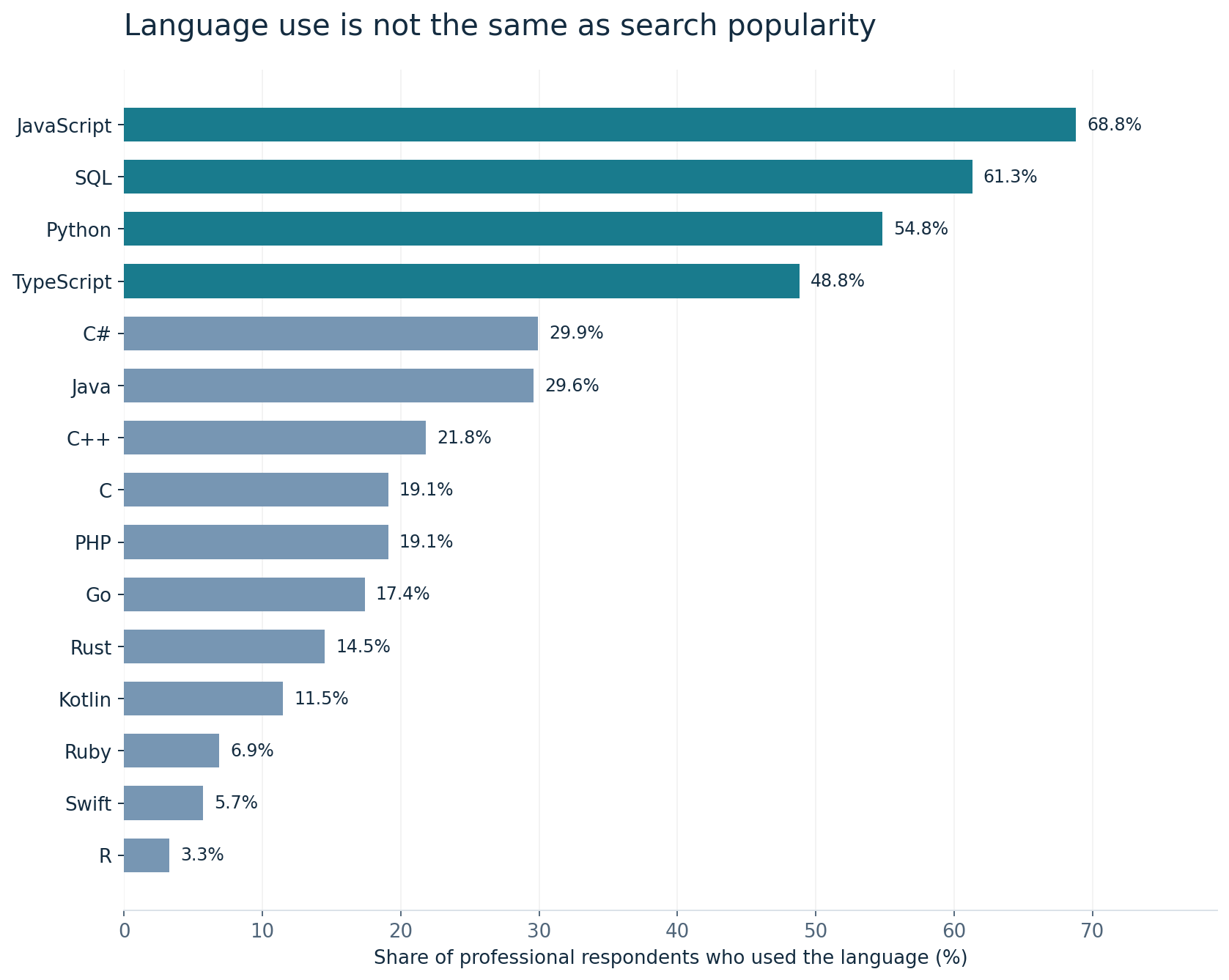
Now the claim you’ll find in half the competing articles: “Rust pays a 24% premium.” I tried to trace it. Inside software publishers, the same job pays $164,550, about $28,500 more, with no change of language involved. It bounces between aggregator blogs and never lands on a dataset that matches country, seniority, and role. The secondary compilations do agree on direction.
| Language | Reported US median (secondary compilations of 2025 survey data) | How to read it |
|---|---|---|
| Go | ~$180,000 | 75% of Go respondents have 6+ years of experience |
| Rust | ~$173,500 | Aggregator ranges run $130,000 to $170,000 |
| Kotlin | ~$170,000 | Mobile specialists, small pool |
| Python / TypeScript / Java | ~$160,000 | Large pools, widespread by industry |
| JavaScript / C / C++ / SQL | ~$150,000 | Near the top of the BLS middle band |
| C# | ~$140,000 | Enterprise-heavy employer mix |
| Ruby | ~$120,000 to $140,000 | Aggregator range, small sample |
| PHP | ~$130,000 | Lowest of the mainstream picks |
Survey respondents skew senior, which is why nearly every row sits above the BLS median. Salary data also moves faster than language popularity does.
So who wins? Go and Rust sit on top of most tables, and JetBrains’ 2025 research adds Scala, which has the largest share of top earners despite a tiny user base. Underneath, the money follows experience and hard problem domains such as distributed systems and trading. A junior who learns Go doesn’t inherit a staff engineer’s salary (plenty of bootcamp ads imply otherwise).
Developer Satisfaction: Which Languages Do Developers Actually Love?
Rust scored 72% admiration in Stack Overflow’s 2025 survey, the top result again. Admiration measures the share of people who used a programming language last year and want to keep using it. It says nothing about how many people use it day-to-day.
| Language | Used by professional developers | Admired by its users |
|---|---|---|
| Rust | 14.5% | 72% |
| TypeScript | 48.8% | 58% |
| Python | 54.8% | ~56% |
| Go | 17.4% | ~56% |
| JavaScript | 68.8% | ~47% |
| Java | 29.6% | ~42% |
| PHP | 19.1% | ~39% |
Read the two columns together, and the most popular languages split into two groups. Rust, Go, and TypeScript are niche-to-mid in usage and loved by the people who chose them. JavaScript, Java, and PHP dominate job demand and the skills employers ask for, while their own users are lukewarm. There’s survivorship in there too: people who hated Rust quit before the survey reached them.
What is this good for? For a technical lead, low admiration predicts retention trouble on a legacy codebase better than any TIOBE rank. For someone picking a specialty, it shows where experienced engineers are trying to move. I’d stop short of the popular conclusion that employers pay more because developers love Rust. Nobody has shown that.
How to Choose Which Programming Language to Learn First
The right pick depends on the goal. The 2026 job market adds a complication. A Stanford analysis of ADP payroll data found employment for software developers aged 22 to 25 down nearly 20% from its late-2022 peak, while older cohorts kept growing. GitHub reports that 80% of new developers use Copilot in their first week. AI tools now turn natural language into passable code and make picking up a new language faster, so syntax recall is worth less. Knowing what correct looks like is worth more.
If You Want the Most Job Openings, Learn Python or JavaScript
Python and JavaScript lead the two metrics closest to hiring demand: search attention and reported daily use. They are also the most popular languages in nearly all developer surveys, including JetBrains’ and GitHub’s. That usually means the largest pool of openings. It also means the most competitors, so check real postings in your city first. Sharp Python skills plus SQL are the shortest credible path into data work. JavaScript, then TypeScript, is the shortest path into product teams, where most JavaScript developers spend their day in TypeScript anyway.
If You Want the Highest Starting Salary, Consider Rust or Go
Treat both as a second language. They carry the highest reported pay because the people writing them are experienced, and the roles assume networking, concurrency, and systems knowledge that no language tutorial covers. Learn Java or Python first, ship something, then specialize.
If You’re Building for a Specific Platform, Match the Platform’s Native Language
Platform choice narrows the decision: iOS leans on Swift, Android on Kotlin, Unity on C#, Unreal on C++, and enterprise back ends on C#/.NET or Java. Platform work rewards depth, so start with one language; most engineers pick up a second within a few years anyway.
If You Want to Work in Data Science, Learn Python Before R
Python has more extensive library support and is thus the more versatile one to start with. If your field or employer already runs on R, you can have R run first. Either way, add SQL early. Of course, it’s not a computer science degree required for this road; it’s just statistics, though most high-level languages will happily run a bad analysis without complaint.
FAQs
What Is the Most Popular Programming Language in 2026?
The TIOBE Index (September 2026 version) also shows Python to be the most used programming language (17.76%). Python also leads language popularity meters based on Google Trends. JavaScript is the top language in use by developers (66% of developers, according to Stack Overflow 2025), and TypeScript is the top language for contributors on GitHub. It depends on which of the three questions you are asking.
Which Programming Language is the Highest Paid?
Go and Rust are the two most-reported US salaries, and Scala is the highest earner in JetBrains’ top-earner comparison. There is no definitive evidence of any hardcoded premiums like “Rust +24%” – the medians are very high, and they are a reflection of the people running them rather than the languages themselves.
What Programming Language Should I Learn First in 2026?
Python or JavaScript. Python and JavaScript are the languages with the most hires, and the most starter content, and both are among the most popular on each metric. If you are automating and working with data, use Python, or if you want to build a Web app, use JavaScript (and later TypeScript). In both instances, add SQL early on.
Is Rust Better Than C++?
They have similar performance issues, but with different compromises. Rust’s borrow checker guarantees that memory safety is enforced at compile-time. C++ is more flexible, has a much larger library of preexisting code, and has much greater platform support. Rust is safer, and C++ is more developed and more widely used.
Why Do TIOBE and RedMonk Rankings Show Different Results?
TIOBE popularity rankings are based on search engine hits. The RedMonk programming language rankings are a blend of activity on GitHub and conversation from Stack Overflow. The list of the most popular languages will vary depending on the language signal being broadcast, and the top languages by one signal may be in the middle of the list for another. TypeScript has the largest disparity compared to other languages, with #39 on the TIOBE and #6 on the RedMonk list.
Need to Build Something? How LITSLINK Works Across These Languages
We don’t push our own language preference on any customer; we are able to work with all of the languages mentioned above for web, backend, and mobile development, and most of the others in this list. For custom software development, the language should follow the project: platform, performance budget, and length of time the team needs to maintain the result.
A recent example: on a lawn care app for US homeowners, our team moved two native codebases to a single Flutter one. For a different product, say a banking backend or a Unity game, other languages would have been the right call.
Not sure which language and stack fit your project?
Tell us what you’re building, and a senior engineer will walk you through the tradeoffs before you commit a budget.
Talk to LITSLINK about your stack
Further reading: