




AI Solutions in Retail Industry

AI can forecast demand, catch empty shelves before customers do, and personalize every touchpoint, without replacing the systems your retail business already runs on.

  • 91% forecast accuracy in live retail deployment
  • PCI DSS and GDPR built into delivery
  • Data, model and MLOps under one team
  • Deploys on AWS or Google Cloud
A retail store aisle in shallow focus, shelves stocked with bottles and cartons, and a translucent information panel floating in front of one product box showing lines of text and a chart

Why AI Solutions from LITSLINK

Retail AI solutions get sold on a demo far more often than on a shipped result. Here is what we bring instead.

We Have Actually Shipped a Forecasting Model That Works

One of the largest US retailers came to us to predict demand for specific goods across the country. The model we built forecasts at 91% accuracy against real sales, and it took seven weeks. That number sits on a public case study page rather than in a deck.
No Rip-and-Replace

AI connects to your existing POS, ERP, and CRM through APIs. Your team keeps the systems they already know, and nobody learns a new tool to act on a forecast. As an AI development company, we treat your stack as a constraint, not an obstacle.

We Say No When a Simpler Fix Solves It

Not every problem needs a custom model, and smoother AI adoption usually starts by connecting into your existing POS, ERP, and CRM instead of replacing them. If a rule-based fix or an off-the-shelf tool is more cost-effective, we say so during the feasibility check as we evaluate fit and you keep the budget. Roughly one in five assessments ends that way.

One Team, From Forecasting to the Shopping Experience

Demand forecasting, shelf monitoring, and personalization often get built by three vendors who never talk to each other. We evaluate whether a rule-based fix or off-the-shelf tool is the more cost-effective answer before recommending a custom model, then build the right capabilities as one connected system on a single data layer, delivering tighter coordination across every function.

Who Retail AI Solutions Are For

AI in retail delivers the highest impact for businesses ready to turn customer insights and data analysis into measurable growth. Artificial intelligence needs history to learn from, and retail generates more of it than almost any other sector. Four profiles, one thing in common: enough history in the data for a model to learn from.

Multi-Location Retailers

Store-level demand varies more than any regional average admits. Forecasting per store and per SKU is where the money is, and it only works once your inventory management data reconciles across sites.

E-Commerce Businesses

Personalization, onsite search, and returns prediction run off the same behavioral data you already collect, including the signals behind customer choices. We connect the model to your catalog and your marketplace platform, while reconciled inventory management data helps keep product availability accurate across sites, rather than bolting on a widget.

Growing Retail Chains

You have outgrown spreadsheets and have not yet hired a data team. 55% of retailers use AI for personalized recommendations. A pilot on one use case answers whether the signal is in your data before you commit to headcount, and behavioral data helps explain the product choices customers make on-site while surfacing the highest-impact challenges before you scale.

Established Retailers

Legacy ERP, years of historical sales data, and a forecasting process nobody trusts. With 92% of retailers investing in AI technology, validating a pilot early is often the most practical way to define the right role for AI before wider rollout. The work here is usually less about the model and more about making three systems agree on what a SKU is, especially where supply chains and store systems were bought a decade apart, so the pilot can test whether the data is strong enough for your specific retail challenges.

AI Solutions We Build for the Retail Industry

Fifteen things we build, grouped by the part of the business they touch. Each of these retail AI solutions ships onto your stack rather than behind a license you rent forever, and most of them are ordinary applied artificial intelligence rather than anything exotic.

Demand Forecasting

Our machine learning development services build forecasting models at the store-SKU-day level rather than the regional monthly averages most ERPs ship with. The AI algorithms weigh seasonality, promo lift, local market trends, and weather to forecast demand, then write a proposed order quantity back into your replenishment module.

Dynamic Pricing and Markdown Optimization

Elasticity, competitor pricing, stock cover, and season position combine into a recommended price move, so pricing strategies stop being set once a quarter in a spreadsheet. Dynamic pricing needs guardrails, and we build them in the same sprint as the model.

Assortment and Merchandising Optimization

Which SKUs earn their shelf space in which store, scored on margin contribution rather than on gut feel. The output is a range plan your buyers can argue with, which is the point.

Supply Chain and Warehouse Optimization

Retail AI solutions for supply chain cover slot optimization, pick path sequencing, inbound ETA prediction and allocation across a DC network. Supply chain optimization pays when the model sees both the store signal and the warehouse constraint, and most retail supply chains are instrumented for one and blind to the other. More on that in our note on AI in logistics.

Fraud and Anomaly Detection

POS exception patterns, refund fraud, till anomalies and supplier invoice discrepancies get scored for a human analyst to review. To support operational excellence, these models also help ensure cleaner DC-to-store flow, where AI-driven supply chain management lowers costs and reduces errors while helping reduce waste, delays, and manual rework. Nothing auto-accuses anyone.

How AI Implementation Works

Three stages. You get a decision point at the end of the first one, before any real money moves.

Two to three weeks. We analyze historical data from a sample of your sales, stock records, and product hierarchy, then measure whether the signal you need is actually in there. Retail AI projects stall on the data environment far more often than on the model: five years of sales sitting across three systems, a product hierarchy nobody has cleaned since a 2019 migration, store-level counts that drift from reality by Thursday. Artificial intelligence will not fix a product hierarchy nobody owns, so we check that first. You get a written read on data gaps, a baseline to beat.

Two to three weeks. We analyze historical data from a sample of your sales, stock records, and product hierarchy, then measure whether the signal you need is actually in there. Retail AI projects stall on the data environment far more often than on the model: five years of sales sitting across three systems, a product hierarchy nobody has cleaned since a 2019 migration, store-level counts that drift from reality by Thursday. Artificial intelligence will not fix a product hierarchy nobody owns, so we check that first. You get a written read on data gaps, a baseline to beat.

We train candidate models on your data in Python and score them on the business metric, not on RMSE alone. A forecast that is 4% more accurate but shifts error onto your top 50 SKUs is a worse forecast. Validation runs against the same seasonality and promo noise production will throw at it, with checks for bias and other responsible model risks, and the model gets tuned to your assortment rather than to a benchmark dataset. That assessment also sets the key baseline metrics the project needs to beat.

The model goes behind an API and runs in shadow mode against live traffic before it touches a decision. Our cloud infrastructure team wires the output into the system where the action happens, then instruments drift and accuracy against actuals with thresholds that page a human. Retraining runs on a fixed cadence plus a drift trigger, and every version is rollback-ready.

Our Reputation on Top Platforms

Retail AI work gets bought on references rather than brochures. Our public reviews cover the full range of what we build, from AI and data work through to the front ends those models feed. Read them before you talk to us.

Clutch B2B Ratings & Reviews

4.8

78 reviews

Top Developer
GoodFirms Research & Reviews Platform

4.8

32 reviews

Top Company
Behance Creative Portfolio Platform

150+

design projects

View projects

Retail AI Projects We Have Delivered

Demand forecastingRetailMachine learning

AI Solution for Demand Forecasting

Challenge

One of the largest US retailers needed to know which products would sell, where, and on what date. They were reacting to stockouts after the fact and paying storage on everything that did not move.

Solution

We started from their history rather than a template, building a forecasting model on several years of sales segmented by goods type, then producing forward sales projections and the quantity needed to meet demand. The whole system took seven weeks to build.

Result

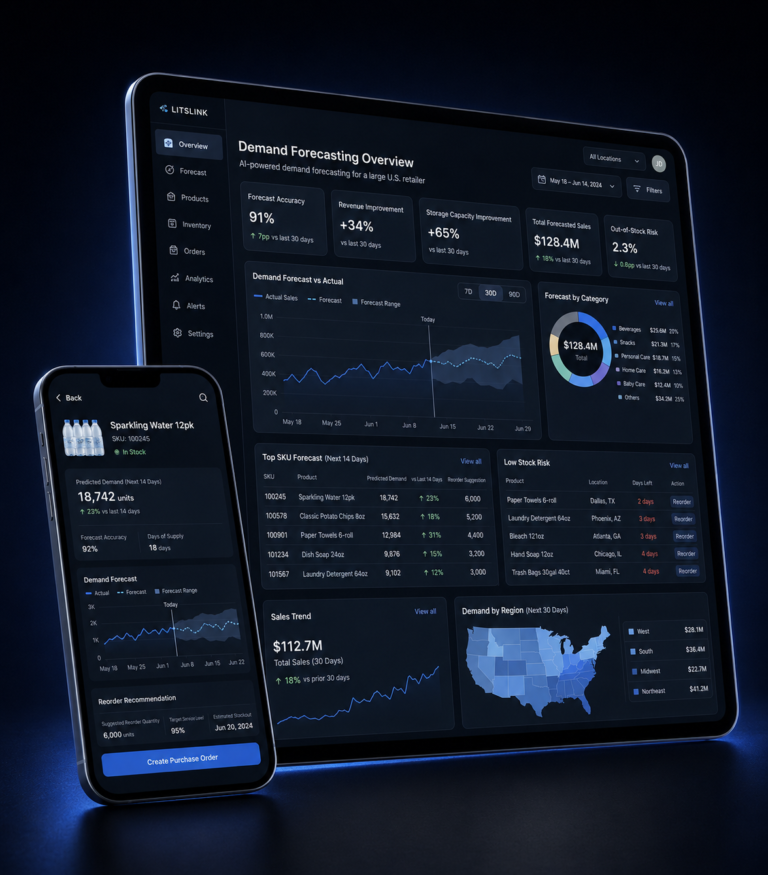
  • Predictions landed at 91% accuracy against actual sales
  • Revenue improved by 34%
  • Storage capacity improved by 65%

Tech

Python · TensorFlow

See full case study
Demand forecasting dashboard on a tablet beside a phone: forecast accuracy 91 percent, revenue improvement 34 percent, storage capacity improvement 65 percent, a forecast-against-actual chart, a forecast-by-category donut, a top-SKU forecast table, a low-stock risk list, a sales trend line and a demand-by-region map; the phone shows a single product's demand forecast with a reorder recommendation and a create purchase order button

Cost of AI Solution Packages

Starter Package: For Growing Retailers

$6,000 to $9,000 for the feasibility check alone, or $18,000 to $35,000 with a working pilot model.

4 to 8 weeks. 1 ML engineer, 1 data engineer, fractional PM.

  • Data assessment across sales, stock and product hierarchy
  • A baseline to beat and a written go or no-go
  • One trained model on one use case

Best for: testing one retail AI use case before committing budget.

Professional Package: For Scaling Operations

$24,000 to $42,000 per month.

3 to 6 months, rolling. 3 to 5 engineers, dedicated PM, QA.

  • Two or three models running in production at once
  • Integration into POS, ERP and CRM
  • Monitoring, drift alerts and a retrain cadence

Best for: a validated use case and no in-house ML capacity to run it. Effectively a dedicated team of data scientists without the hiring cycle.

Enterprise Package: For Retail Chains

$38,000 to $70,000 per month, 9-month minimum, then support retained. Scoped per program.

6 to 12 people across data, ML, backend, MLOps and QA.

  • Forecasting, pricing and shelf vision on one data layer
  • MLOps platform your team inherits documented
  • Full IP and model ownership from day one

Best for: rebuilding forecasting, pricing and inventory decisions as one connected system.

Not sure which package fits?

Start with the scope that matches your current data, infrastructure, and priorities. Use our AI cost calculator to estimate the investment before you commit.

Calculate Your AI Project Cost

Is Your Retail AI Project Ready to Build?

Four questions we ask before quoting anything. If you answer yes to most of them, a pilot is worth funding.

  • Two or more years of transaction-level sales history
  • A product hierarchy somebody maintains
  • Store-level stock records that reconcile more often than not
  • POS, ERP or CRM with an API or an export somebody owns
  • One person who can answer what a SKU means in each system
  • A named retail process that changes when the model is right
  • A named person who acts on the output

AI Solutions for Retail Readiness Checklist The full version, with the questions that catch most projects out.

Get the PDF

Frequently Asked Questions

The feasibility check gives you a written answer in two to three weeks, and a first model in shadow mode usually follows within two to three months. Our fastest production build was seven weeks end to end, though that client had clean historical sales data waiting for us, which is not the norm. Most retail businesses see the metric move inside a quarter of go-live.

No. Output lands in the tool your team already uses, as a proposed order quantity or a shelf task, with a human override on every recommendation. If you want to run the system yourselves later, we document everything and train your team, and several clients have taken it in-house that way.

They stay. We connect through APIs and write model output back into the system where the decision gets made, so nobody learns a new interface to act on a forecast. AI software that demands a migration before it produces a single number is selling you a platform, not a model.

Yes, and pretending otherwise is how projects fail. Models get things wrong, which is why we ship confidence bands, human override on every recommendation, shadow mode before any live decision, and a tested rollback to the previous model version. Retail AI solutions should be judged on that day, not on the demo. The question worth asking a vendor is not whether the model errs, but what happens on the day it does.

Artificial intelligence is the umbrella term for software that performs tasks we would call intelligent. Machine learning is the subset where the system learns patterns from data instead of following rules a developer wrote. Deep learning goes one level deeper again, using multi-layer neural networks, and it powers computer vision and language models. In the retail industry your forecasting model usually sits in that middle layer, your shelf camera is deep learning, and your shopping assistant is generative AI on top of a language model. Most artificial intelligence solutions for retail are a mix of all three.

It depends on which package fits. Starter runs $6,000 to $9,000 for the feasibility check or $18,000 to $35,000 with a pilot model; Professional runs $24,000 to $42,000 per month; and Enterprise runs $38,000 to $70,000 per month on a 9-month minimum. The cost of implementing AI solutions in retail is driven far more by the state of your data than by the model itself, which is why we quote after the feasibility check rather than before it.

You do. Source code, trained model weights, documentation and your data are yours, assigned in the contract. You get the repositories and the runbooks, so maintenance can come in-house whenever you decide.

PCI DSS scope stays out of the model wherever possible, since a forecast does not need a card number. GDPR obligations shape how we handle EU shopper records, including retention and the right to erasure. SOC 2 controls apply to the pipeline and access, and where pharmacy or health retail is involved, HIPAA rules govern anything touching patient information.

Need a Retail AI Solution?

Book a 30-minute call with our specialist. You will leave with a straight read on whether your data supports the use case, a rough cost band, and the risks worth knowing before you spend anything. We reply within two business days.

Next steps

1

A LITSLINK engineer reviews your request and comes back within one business day

2

We sign an NDA before you share anything sensitive, if you want one

3

You get a scoped proposal with timeline, team and an estimate

Litslink icon