







Key Takeaways
- RAG enhances LLM responses by retrieving relevant context from external sources before the LLM generates a response.
- MCP enables LLMs to interact with external tools and live systems.
- RAG is read-only, whereas MCP supports both read and write operations.
- Both technologies reduce hallucinations in AI models by grounding them in external data sources, preventing them from relying solely on their training memory.
- In AI applications, the two are most powerful when they are used together.
As organizations shift into an era of production-ready AI applications, two concepts are being used interchangeably in technical discussions, yet their functions differ. They are RAG (Retrieval-Augmented Generation) and MCP (Model Context Protocol); many readers and newcomers to the niche assume they are competing technologies, but in the AI world, they solve very different problems.
RAG extends an LLM’s knowledge by retrieving relevant information from external sources before generating a response, while MCP extends an AI’s capabilities by providing a standardized way to connect with external tools, APIs, databases, and other software systems.
This guide is for developers, AI engineers, CTOs, solution architects, and technical decision-makers. It will help you understand when either technology can be used appropriately, and when to combine the power of both, depending on the use case at hand.
What Is RAG (Retrieval-Augmented Generation)
RAG is an AI architecture pattern that gives LLMs access to external knowledge at inference time, rather than relying solely on information encoded into the model during training. The RAG system retrieves relevant information from external data sources, such as document corpora, vector databases, or knowledge bases, before generating a response.
This fundamental concept of RAG solves a practical problem that plagues LLMs: they have a training cutoff point and zero awareness of an organization’s internal data. RAG enables technical teams to build AI applications that answer questions using internal documentation, customer records, product catalogs, or regulatory guidelines without retraining or fine-tuning the original AI model.
How RAG Works
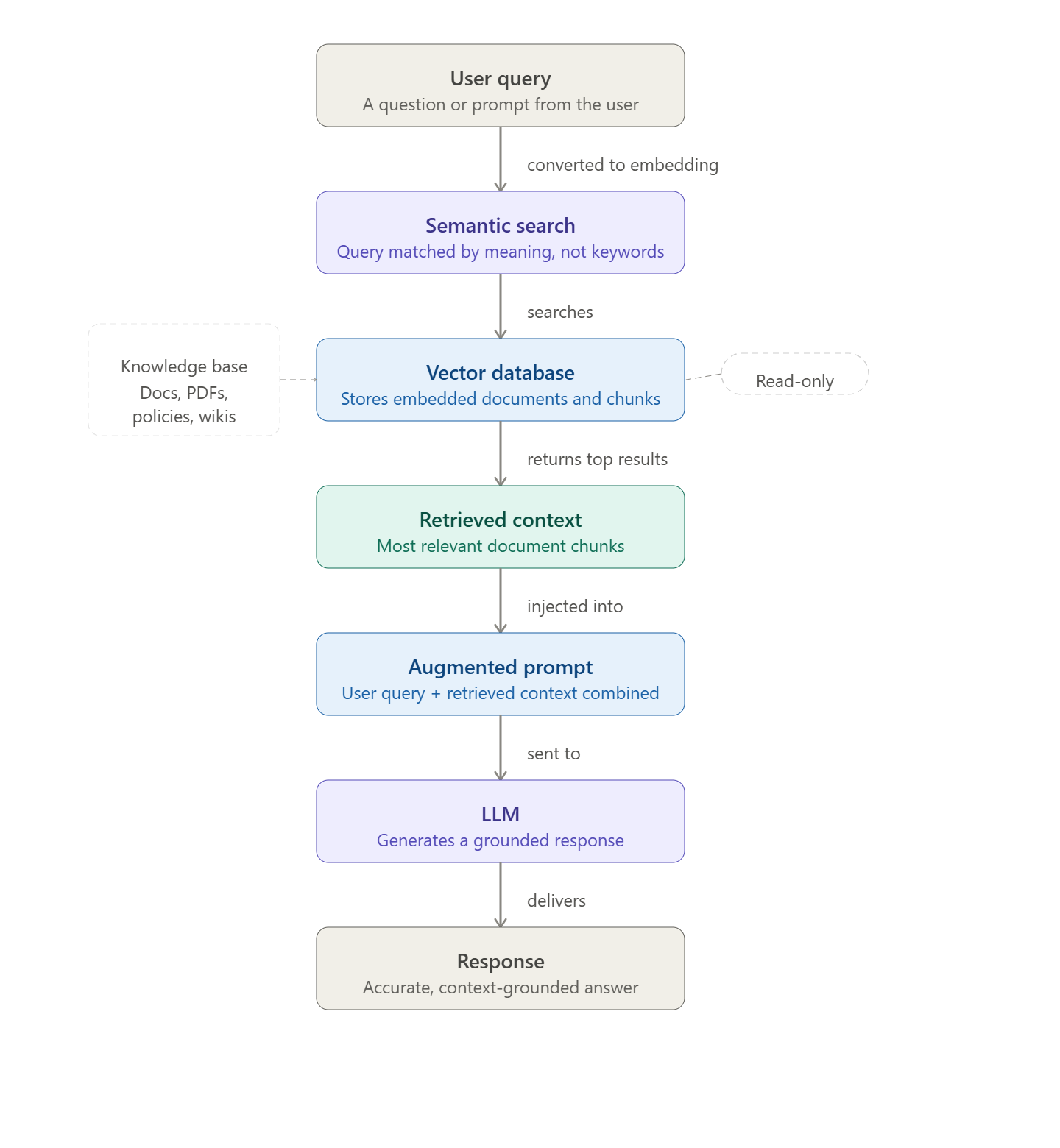
RAG, at its core, follows a retrieval-first workflow, meaning that before the language model can generate an answer, the system searches external knowledge sources for information related to the user’s request. The retrieved documents are then combined with the original request, which in turn provides the LLM with more context, improving the relevance and quality of the output.
Think of it as LLMs consulting and referencing trusted documentation in real time, rather than giving answers based only on their training. The retrieval-first workflow model reduces factual errors in AI applications while enabling them to work with external information that is subject to frequent changes, unlike its training data, which is fixed unless improvements or fine-tuning are done.
The RAG workflow follows the sequence of events shown in the workflow diagram.
The overall effectiveness of a deployed RAG system largely depends on the quality and timing of its retrieval logic.
Semantic Search
Semantic search is essentially the engine that powers RAG. In semantic search, information is retrieved based on its meaning and context, whereas traditional keyword search looks for exact word matches.
When documents are added to a RAG system, they are converted into mathematical representations known as vector embeddings, and when user queries are logged into the system, they undergo the same conversion. In semantic search, the system compares the vector embeddings of the query and stored information to determine which documents are most relevant to the user’s query. This capability allows RAG systems to map relevant documents from thousands or millions of documents within seconds, and modern vector databases have made the retrieval process much faster and more scalable for organizations dealing with vast amounts of data.
Read-Only Access to External Data
A defining characteristic of RAG is that only read-only access to external information is allowed; the intention is for RAG to improve an AI model’s responses, not to modify underlying systems or perform any actions on the data. Read-only access to external data means the RAG system cannot perform actions, update records, call APIs, or write data back to connected systems.
This read-only limitation of RAG is one of the key differences between RAG and MCP. Their dual use in AI applications is increasing by the day as organizations demand systems that not only retrieve contextual information but also execute actions across interconnected systems.
What Is MCP (Model Context Protocol)
MCP (Model Context Protocol) is an open protocol that defines how LLMs connect to external tools, APIs, databases, and software systems. It was introduced as an open standard by Anthropic in November 2024 and provides a communication layer between large language models and existing software systems. This functionality helps developer teams by enabling them to use MCP to connect to external tools in a trusted, consistent format that AI models can easily understand and use. With MCP, developers don’t have to build custom integrations for every API, database, or business platform they work with.
RAG only retrieves information to improve an AI model’s response, whereas MCP goes a step further by enabling AI to retrieve and execute live commands, update records, trigger interconnected workflows, and interact with enterprise-level software and access up-to-date data in real time. MCP is the tool that bridges the gap between AI models and the external tools and services organizations use.
How MCP Works
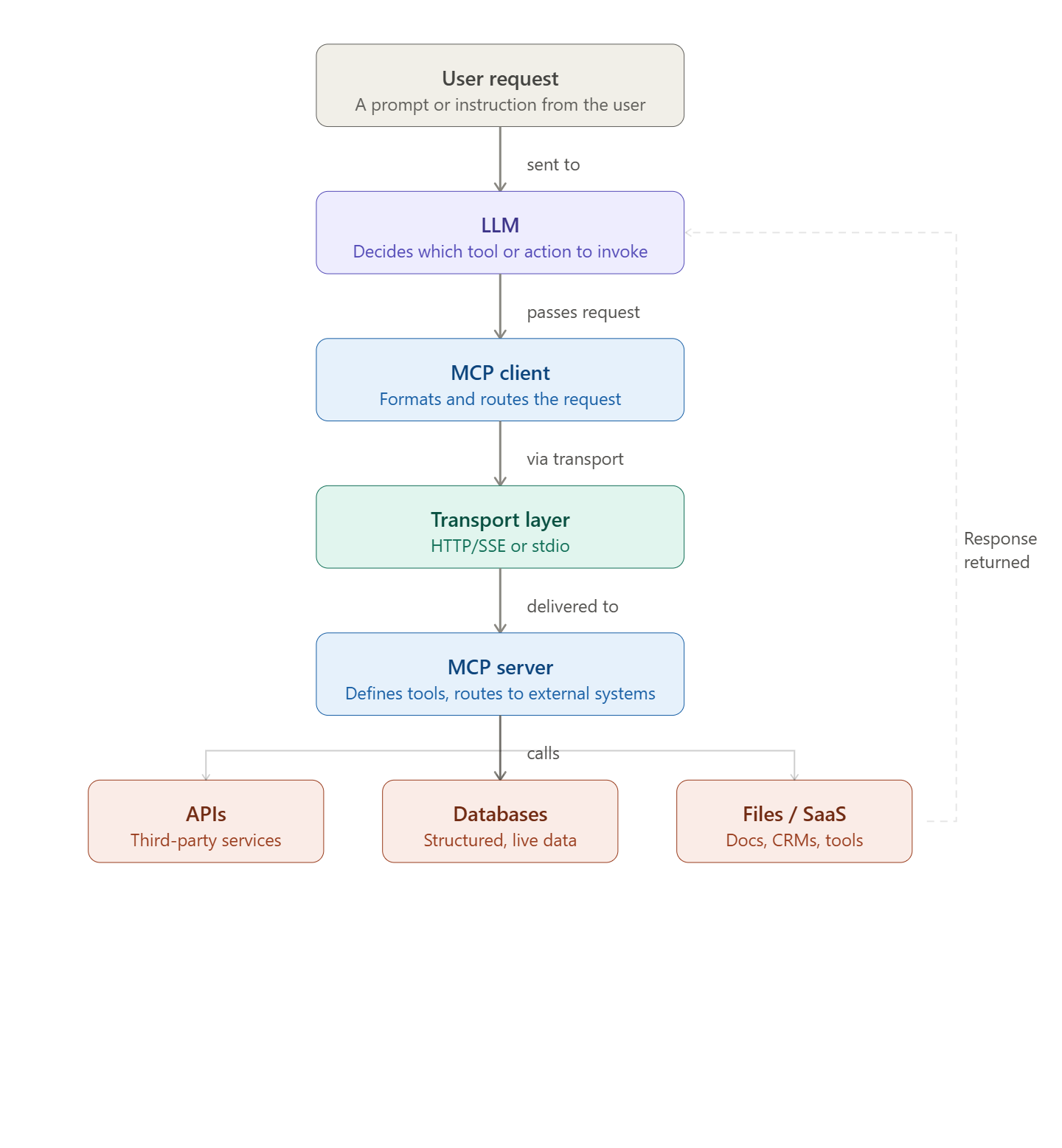
MCP (Model Context Protocol) introduces a standardized protocol for connecting AI models to external resources, rather than allowing LLMs to communicate directly with multiple external sources. When a user asks for an action, the LLM identifies the appropriate tool and sends a request via an MCP client, which then communicates with an MCP server. The MCP server then interacts with the targeted external application, executes the requested action, and returns the results to the model.
Host Application
This is the AI-facing app that runs the client, while the CRM/DB sits behind the MCP server. The host application exposes its capabilities via standardized MCP tools, rather than requiring the AI model to understand each application’s specific APIs.
MCP Client
The MCP client serves as the bridge between the LLM and the MCP server. After the LLM determines that a user’s request requires external information or action, it sends a request to the MCP client. The client then formats it into a structured request according to the MCP protocol, communicates with the appropriate MCP server, and returns the results to the AI model. The system communicates with multiple systems without custom integrations for each external action, because every MCP client follows the same protocol.
Transport Layer
This layer relays requests between the MCP client and server and typically uses HTTP, though other protocols are used where appropriate. This transport layer is responsible for ensuring that requests are transmitted reliably and securely, and, more importantly, in a standardized format, regardless of the external tools or information being accessed.
MCP Server
The MCP server is the brain of the entire operation and acts as the central component of the MCP architecture. The MCP server is responsible for defining the tools available to the LLM, receiving requests from the MCP client, interacting with external systems, and returning the requested data or confirming the execution of an action.
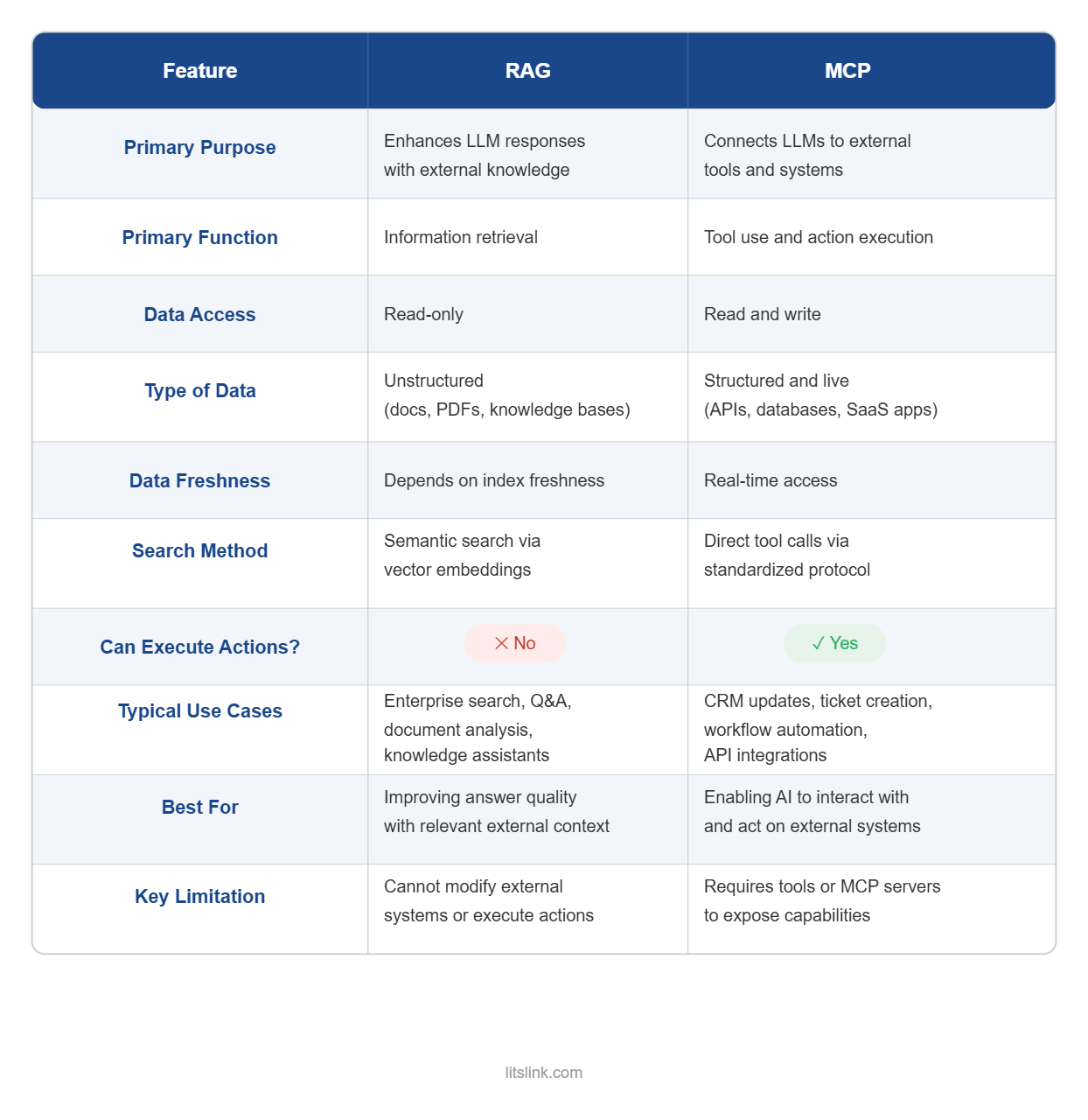
RAG vs. MCP: At a Glance
Here is a comparative table with the notable differences between RAG and MCP
MCP vs. RAG: What They Overlap
MCP and RAG serve different purposes yet share features that make them important as foundational technologies for AI applications.
Some of these similarities in functionality include:
- Both techniques extend the capabilities of LLMs beyond their pretrained knowledge.
- They both connect AI systems to external information resources, enabling them to depend on information beyond their original model parameters.
- Both reduce hallucinations in AI models by grounding responses or actions in trusted external sources.
- They improve the usefulness of AI technology for use in real-world applications.
- They help organizations in building AI systems that are production-ready and scalable with ease.
The similarities listed above should not lead you to believe that the two techniques are in competition with one another. When both systems are deployed in an AI application, their overlap ends once the application moves beyond retrieving information and begins interacting with the systems in real time.
MCP vs. RAG: How They Differ
The purpose of both MCP and RAG is what differentiates them most. In RAG systems, the purpose is to improve the AI model’s knowledge by retrieving relevant external information before producing a response. The retrieved information is in the form of company documentation, policies, manuals, or research papers, and its purpose is to contextualize user queries, thus enabling large language models to produce more accurate and trustworthy results. MCP is designed for interaction rather than supplying external knowledge; its purpose is to provide a standardized protocol for large language models to access external systems and also execute operations.
Another key difference between the two modern AI architectures lies in the types of data they access: RAG handles unstructured data such as PDFs, web pages, documentation, and knowledge bases. On the other hand, MCP engages with live applications and highly structured data sources via APIs, CRMs, ERPs, SaaS platforms, and complex enterprise databases.
In terms of capability, RAG improves large language models’ ability to answer questions, while MCP enables them to execute external tasks such as updating customer records, sending messages, triggering workflows, and calling APIs. To put it more simply, RAG makes models smarter about what they say, while MCP enables models to execute tasks.
When to Use MCP vs. RAG
The choice between using either technology comes down to the purpose and mission of the AI application that you intend to build.
RAG real-world use cases
- Building enterprise AI search models or knowledge assistants that are grounded in internal documentation.
- Answering questions based on PDFs, policies, contracts, or other verified external information sources.
- Analyzing research papers, legal documents, or financial reports at a large scale.
- Delivering contextual and accurate answers without modifying external systems.
MCP real-world use cases
- Retrieving data in real time from external sources like CRMs, databases, or business applications.
- Creating Jira tickets, calendar events, or support requests via an AI workflow.
- Sending emails, Slack messages, or Teams notifications automatically.
- Updating customer records, triggering integrated workflows, or automating repetitive business operations.
- Orchestrating multiple external tools from an AI agent.
It’s not a choice between techniques for integrating with AI applications; rather, both are seamlessly integrated in real-world deployments. Both systems are complementary by design, with RAG providing the context and MCP doing the work. For example, an AI for customer support will use RAG to retrieve policy information from internal data, utilize MCP to create a ticket in Jira, update the customer record in Salesforce, and finally send a confirmation email.
How MCP, RAG, and AI Agents Work Together
As explained earlier, it’s not RAG vs. MCP in production systems; usually, both are seamlessly integrated with AI agents across layers, with each layer executing its specific responsibility automatically. To work seamlessly, these are the functions undertaken by each layer:
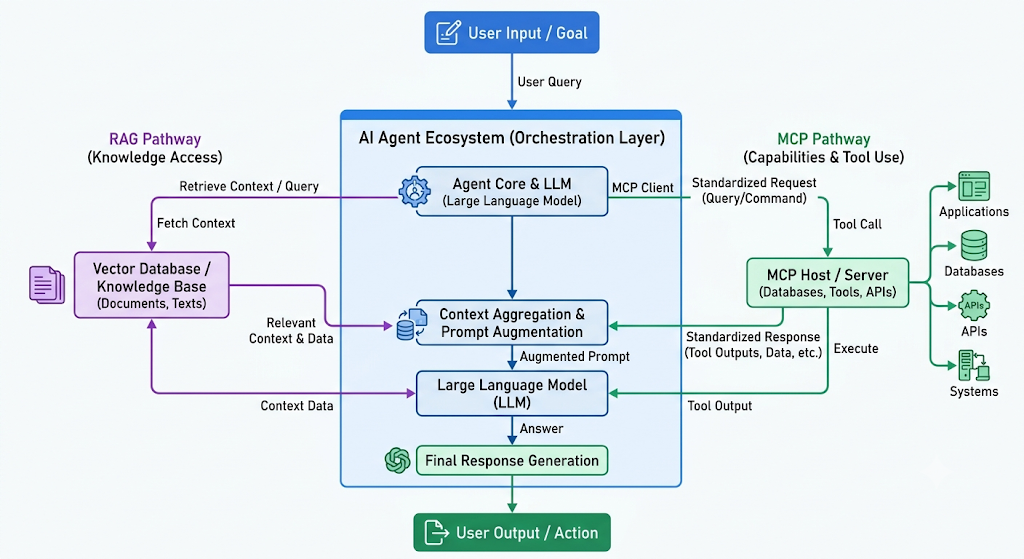
AI agents — Involved in the planning, orchestration, and decision-making of the whole system architecture. The AI agents decide what to do, in what order, and when to invoke other tools.
MCP — Provides the standardized protocol needed for connection to external tools, databases, and other complex business systems.
RAG — The purpose of RAG is to retrieve useful, context-specific information from external systems. This layer provides agents with relevant information before the system generates output.
Each layer has a purpose that cannot be executed by any other layer; this three-layer stack is now the standard in the architecture of modern AI applications. For a deeper look at how agents with the modern technology stack operate and how they can be built from scratch, check out our AI Agent Development Services.
How We Combined MCP and RAG in a Real-World AI Project
A client approached us to integrate an LLM chatbot into their CRM. For this project, we combined RAG and MCP technologies. On the MCP side, the LLM chatbot is more than just a service for answering questions; MCP enables the LLM to connect to the CRM, retrieve live data, log calls, update deal stages, and schedule follow-up tasks. The assistant can execute actions autonomously within the business system; in just a little over 10 seconds, the assistant can parse user intent, retrieve the relevant data, provide links to CRM records, and update it. The system was designed to chain multiple actions from a single user input.
The assistant, by utilizing RAG, is able to answer user questions while relying on CRM data that is up to date; for example, queries like “What did I discuss with Acme last quarter?” or “What’s my open pipeline this month?” are answered by the LLM through retrieving live enterprise data rather than relying on cached information. This is the whole premise of RAG, where retrieval of information is done first before user queries can be answered.
The CRM assistant we built for the client was a practical example of how both RAG and MCP can be used in tandem within the system. RAG facilitates live information retrieval from the CRM while MCP enables the LLM assistant to act on the data that was retrieved. The combination of both technologies in a system enables AI to retrieve accurate information and execute complex workflows within enterprise systems.
Build the Right AI Architecture with LITSLINK
The question of whether to use RAG, MCP, or even both depends on the overall purpose of the AI application you’re trying to build, the data it needs to access, and the actions it needs to execute. To avoid potential retraining of AI models post-integration, it’s important that organizations get the architecture right from the start.
LITSLINK has a proven track record of working with industry players to build AI systems that are secure, scalable, and production-ready. The technical team comprises more than 300 experienced engineers, and from the initial concept stage, the team at LITSLINK assists organizations in assessing their business requirements, selecting the right AI architecture, and building tailor-made AI solutions suited to specific workflows and industry needs.
Over the years, LITSLINK has built and integrated AI solutions with CRMs, ERPs, communication platforms, knowledge bases, SaaS applications, and enterprise databases across various industries. Whether you are a startup, SME, or an enterprise organization evaluating whether a RAG pipeline, an MCP integration, or a hybrid architecture is the right fit for you, we can help you design and integrate it from scratch.
The best place to start is checking out our AI Project Cost Estimation, or even contact us to discuss the AI vision and strategy for your organization.
FAQ
Can MCP replace RAG?
Both technologies are not like-for-like replacements for one another, and they perform different actions at different levels in the AI workflow
Can RAG and MCP be used together?
Yes, both technologies can be used together in the same system, with RAG facilitating information retrieval and MCP for standardized connections to external systems and autonomously performing actions.
When should I choose RAG instead of MCP?
If your AI needs to know more, RAG is best for it because it can be utilized to create AI assistants that are knowledge-heavy.
How Does MCP Improve Compliance and Data Security?
MCP improves compliance and data security by defining a single standardized layer for how AI models connect with your enterprise systems. This makes it easy to enforce role-based access control and audit data request trails required by HIPAA or GDPR guidelines.
How Difficult Is It to Migrate from RAG to MCP?
Migrating from RAG to MCP is quite manageable. Rather than an entire rebuild, the developers just wrap the existing data and retrieval logic used for RAG behind MCP servers, creating a hybrid system that keeps the RAG for retrieval of unstructured knowledge while routing access to structured data from live systems through MCP.