






Key Takeaways
- The AI agent cost breakdown splits by type. Rule-based agents run $5,000 to $20,000. Model-based NLP agents run $20,000 to $80,000.
- Timelines run from 4-6 weeks for a basic prototype to 6-12 months for an enterprise system with heavy compliance requirements.
- Integration depth drives more of the cost variance than AI model choice does.
- Build cost is typically 25-35% of a three-year total cost of ownership.
- Ongoing inference, infrastructure, maintenance, governance and monitoring are the categories buyers underestimate most often. Build estimates are usually the accurate part of the budget.
- Off-the-shelf tools charge per resolution, so the bill grows as the agent gets better. At $0.99 per resolution and 2,000 resolutions a month, that is $23,760 a year in AI fees before seat costs.
AI agent development cost ranges from $5,000 for a simple rule-based bot to $300,000+ for an enterprise multi-agent system, with timelines running from 4-6 weeks for a basic prototype to 6-12 months for a production-grade, compliance-ready deployment.
Most articles on this topic hedge behind a meaningless “$10,000 to $250,000, it depends” range and never explain the “it.” Read it with a vendor quote in hand and check the number against real market figures.
How Much Does It Cost to Build an AI Agent? Quick Numbers by Type
Agent type is the single biggest cost driver. The AI agent types below are different project categories, even though a simple rule-based bot and an enterprise system both get called AI agents.
| Agent Type | Typical Cost | Typical Timeline | Example Use Case |
|---|---|---|---|
| Rule-based agent | $5,000-$20,000 | 4-6 weeks | FAQ bots, scripted workflows |
| Model-based (NLP) agent | $20,000-$80,000 | 6-10 weeks | Context-aware customer support |
| Agentic/multi-agent system | $80,000-$400,000+ | 6-12 months | Multi-system orchestration, regulated industries, autonomous decision-making |
| Learning/RAG agent | $15,000-$90,000 | 6-14 months | Personalization, adaptive recommendations, retrieval over proprietary data |
Figures are synthesized from 2026 industry pricing guides. This space revises its guidance often, so treat the table as a starting bracket rather than a quote.
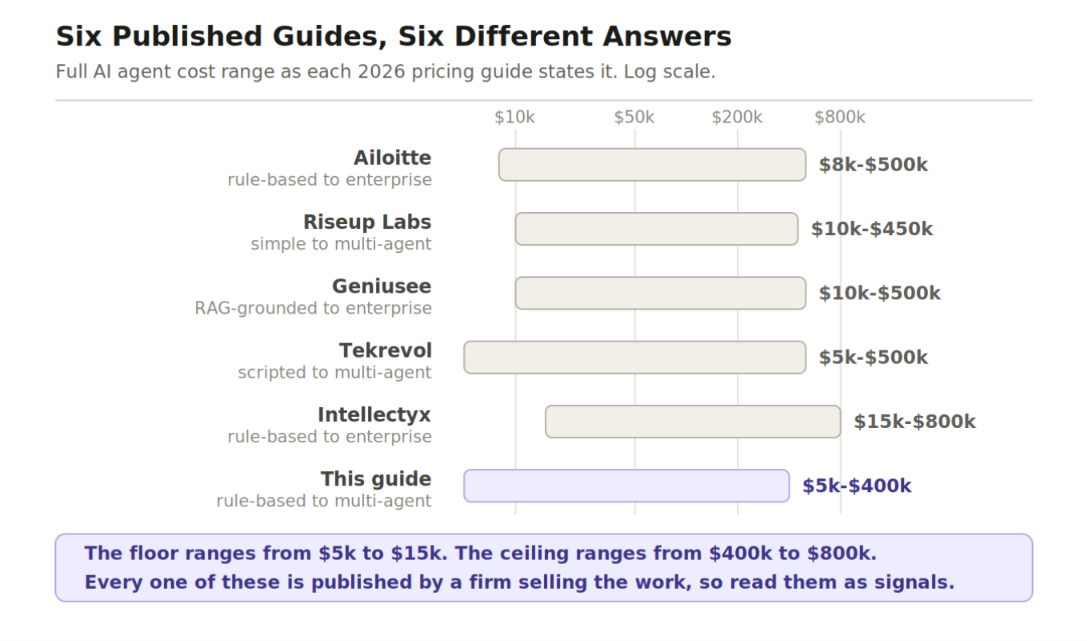
Source: 2026 pricing guides published by Ailoitte, Riseup Labs, Geniusee, Tekrevol and Intellectyx.
AI Agent Development Cost by Complexity
The table above gives ranges. This section explains what changes between tiers, so you can place your own project accurately rather than guessing which row applies.
Rule-Based Agents: The Cheapest, Most Limited Option
Rule-based agents follow scripted decision trees with no real learning or adaptation. They are the cheapest to build and brittle the moment a user asks something outside the script.
Best for narrow, well-defined tasks where flexibility is beside the point. FAQ handling and basic routing are the two that keep working. Basic AI agents of this kind still make sense when the question set is genuinely finite. Upfront costs stay low, because there is no model to train.
Model-Based (NLP) Agents: Where Most Business Use Cases Land
Model-based agents use natural language processing to understand intent and context rather than matching keywords. That makes them viable for real customer-facing work, which rule-based agents never quite manage.
This tier is where integration cost starts to matter more than the model itself. Connecting to a CRM, a ticketing system, or an internal API is where the hours go. The large language models behind it are often the cheapest component. Most teams that build AI agents for support land here.
Learning and RAG Agents: Grounded in Your Own Data
Learning and RAG agents pull from a business’s proprietary data rather than relying only on a model’s training data. Retrieval-augmented generation is what makes an agent answer from your product catalog instead of the internet.
Published ranges for this tier overlap heavily with model-based NLP agents, because a RAG layer is closer to data engineering than to a new model. Setting up a proper retrieval layer requires real data engineering work: vector DBs, robust pipelines, chunking logic, and constant data syncing. That heavy lifting is the main reason why building a specialized AI grounded in your proprietary data will always cost more than just using a generic model.
Agentic and Multi-Agent Systems: Multiple Agents, Shared Environment
Multi-agent systems coordinate multiple specialized agents inside a shared and often unpredictable environment. One plans, one retrieves data, one acts, and something has to arbitrate between them. Advanced AI agents of this kind handle complex tasks no single agent completes end to end.
This tier is where autonomy level, compliance requirements, and orchestration complexity combine to push what such systems cost past $100,000. Multi-step workflows that cross several systems are the usual reason AI agent projects land here rather than one tier down. A sales intelligence agent that researches, scores, and drafts outreach is a typical example.
Trying to place your own project in this table? We can tell you which tier it actually falls into, and why, before anyone quotes you a number. Contact LITSLINK for a free consultation.
What Actually Drives AI Agent Development Cost Up or Down
Agent type sets the baseline. These factors move a project up or down within that range, and sometimes beyond it.
AI Model Choice: Pre-Trained vs. Custom Fine-Tuning
Starting with off-the-shelf models like GPT, Claude, Llama or Mistral is an order of magnitude cheaper than trying to train one from scratch. Good prompting or a little light fine tuning covers almost everything, and most projects never actually need to go the fully custom route.
Open-source models change the arithmetic again, since hosting your own removes per-token fees and adds infrastructure costs instead. Reserve custom model development for cases where pre-trained AI models measurably underperform on a specific, proven need. That is the clearest way to reduce AI agent development spend without cutting scope.
Natural Language Processing and Data Preparation Complexity
Natural language processing work adds cost in proportion to how messy and domain-specific the input language is. Intent detection, entity extraction and multi-language handling are each their own line.
A narrow, structured use case like an order status lookup is cheap. Open-ended, ambiguous conversation handling is not, because every ambiguity has to be resolved somewhere. Training data quality decides how much of that resolution the model handles on its own.
Human in the Loop vs. Full Autonomy
Building human-in-the-loop checkpoints, where a person approves before the agent takes a consequential action, adds development work upfront. It reduces risk and often the compliance burden along with it.
An autonomous AI agent costs more to get right. Every failure mode has to be handled in code, because nobody is standing between the agent and the consequence. Minimal human intervention is a design goal to be earned rather than assumed. Trustworthy systems are why regulated buyers pay for the extra work, and why a human intervention step is often the cheaper option.
Data Collection and Preparation Volume
Data collection, cleaning and professional annotation is one of the most underestimated line items in an AI agent budget. Quality data rarely arrives ready to use.
If a client does not already have clean, structured data, data preparation alone can consume a meaningful fraction of the project cost. That happens before any agent logic gets built. Data volume matters less here than data condition. Quality data collection is the line most teams leave out of the estimate entirely.
Integration Depth With Existing Systems
Every system an agent connects to adds its own authentication setup, data-schema mapping, access permissions and a piece of ongoing maintenance that never goes away. A CRM, an ERP, an internal API and a document repository are four different problems, not one repeated four times.
A project with five integrations is not five times the work of one. It is meaningfully more than double, because each connection needs its own testing and its own failure handling rather than only its own setup step. The FAQ below covers how this compares to model choice as a cost driver.
AI Agent Development Timeline: What Happens in Each Phase
Cost and timeline move together without being identical. A project can be expensive because of integration scope without taking longer, and it can run long on a modest budget when compliance work dominates.
Discovery and Scoping (1-3 Weeks)
During this phase, we lock in your data sources, integration points, and success metrics prior to any actual development. Rush this discovery process, and your project scope will spiral completely out of control while your budget drains. It remains the biggest trap for software projects.
Rapid Prototyping (4-6 Weeks)
A working proof of concept or clickable demo, integrated with real data and real apps. It exists to validate the use case before anyone commits to a full production build. We run this phase in roughly the same 2-4 week window as the wider industry.
Production Development (10 Weeks to 4+ Months)
The hardened build phase: evaluation harnesses, cost and latency budgets, autoscaling. Development time stretches most here, driven by agent type and integration count, and the development timeline tracks the cost tiers in the table above. This is where a prototype becomes a production agent.
MLOps, Governance, and Security Setup (Ongoing, Started Before Launch)
Telemetry, prompt and version control, offline evaluations and policy checks belong in the original timeline. So do security practices: SSO, RBAC, audit trails, and GDPR, CCPA or HIPAA readiness where applicable based on jurisdiction, data, organization type and use case.
Retrofitting this after launch costs significantly more than including it from day one. A regulated industry deployment makes that gap wider still, because the evidence trail has to exist retroactively. AI systems that log nothing cannot prove anything.
Custom AI Agent Development vs. Off-the-Shelf Tools: Which Costs Less?
Build versus buy is a real decision rather than a budget question. Off-the-shelf tools win at lower volume, custom agents win at scale, and the crossover depends on how standard your workflow is.
Off-the-shelf tools keep costs predictable and low at smaller volumes. There is no upfront build cost, but there is a recurring per-resolution fee that never goes away. That fee climbs as the AI’s resolution rate improves, because resolving more issues means billing more.
A custom build front-loads the cost instead. Higher spend before launch, then a much lower marginal cost per interaction once it is live. There is no per-resolution fee at all once the system exists.
Off-the-shelf AI agent tools mostly charge per resolved interaction rather than a flat fee, and the rates vary more than buyers expect.
| Tool | Pricing Model | Typical Cost |
|---|---|---|
| Intercom Fin | Per resolution | $0.99/resolution (plus Intercom seats, $29-$139/agent/month) |
| Zendesk AI | Per resolution (commonly cited, not always published) | ~$1.50-$2.00/resolution |
| Salesforce Agentforce | Per conversation | $2.00/conversation (or $0.10/action on newer credit-based pricing) |
| Freshdesk | Per session, sold as Freddy AI | $49 per 100 sessions on classic Freshdesk, about $0.49 per session. Omni web chat runs closer to $0.10 per session. |
| Ada (enterprise) | Custom annual contract | ~$30,000+/year |
At Intercom Fin’s $0.99 per resolution, a business handling 2,000 resolutions a month pays roughly $1,980 a month. That is $23,760 a year in AI fees alone, on top of seat costs. That number is worth comparing directly against a custom build’s amortized cost before assuming the off-the-shelf option is automatically cheaper.
Vendor pricing moves fast here. Zendesk restructured to Verified Resolutions in May 2026, and Freshworks raised its Freddy AI Agent session rate from $0.10 to roughly $0.49 on classic Freshdesk. Sessions there also expire at the end of each billing cycle with no rollover, which is a second meter most comparisons miss. Figures above follow the 2026 pricing comparisons published by Alhena AI and Fin AI, so verify current rates before committing to a comparison of your own.
The crossover point is an illustrative range rather than a universal threshold. Actual break-even depends on custom build cost, operating costs, integration scope and the vendor’s pricing model, which is why the FAQ below gives a band instead of a number. A business with only 500 monthly interactions and highly non-standard workflows may still need custom AI agent development, because cheaper on paper does not help when the off-the-shelf tool cannot do the job.
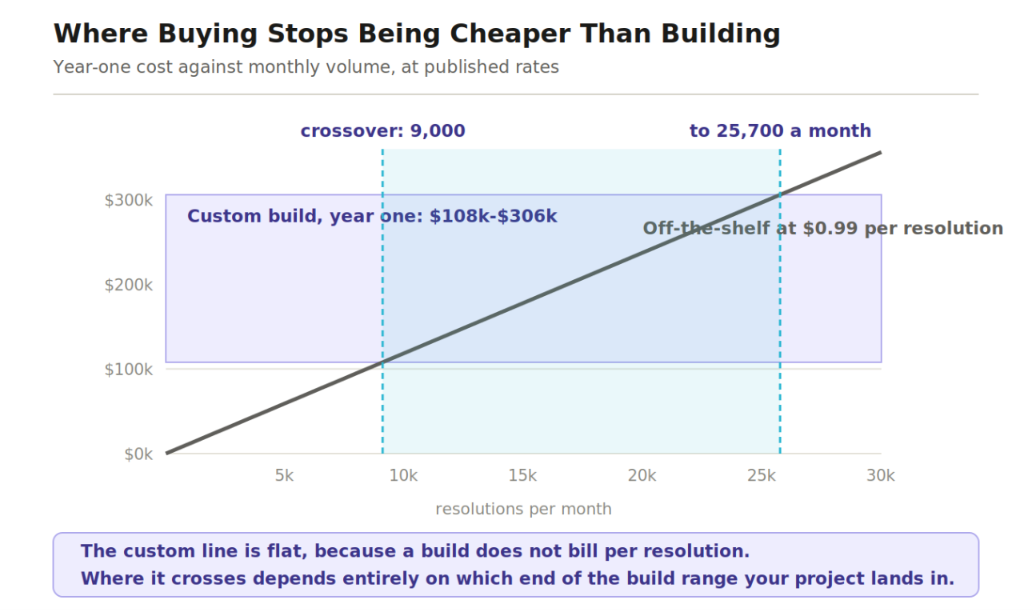
Source: Intercom published pricing, with first-year custom TCO from SearchUnify, 2026.
Running the build-versus-buy numbers for your own volume? Send us your interaction count and workflow requirements. We come back with both sides of the comparison. Talk to LITSLINK.
Hidden and Ongoing Costs Most Budgets Miss
The build price is rarely the total price. These recurring costs catch teams that only budgeted for launch.
- LLM token usage and API calls. Scales directly with usage volume, which means success increases the bill.
- Cloud infrastructure and hosting. Baseline spend that exists whether the agent is busy or idle, and the largest fixed part of ongoing operational costs.
- Vector database storage. Applies to any RAG-based agent, and grows with the corpus rather than with traffic.
- Monitoring and observability tooling. Ongoing monitoring is what catches a quality drop before users report it.
- Periodic model retraining. Business workflows change, and an agent trained on last year’s process quietly stops matching it.
There is a broader pattern behind these line items. Ongoing inference, infrastructure, maintenance, governance and monitoring are the categories enterprises underestimate most consistently. The gap sits in these recurring lines rather than in the initial build estimate, which teams usually scope reasonably well.
A low-traffic internal tool might run a few hundred dollars a month to operate. A high-volume customer-facing agent can run into the thousands monthly. Budget for these hidden costs as an ongoing line of their own rather than a rounding error on the build. Cost efficiency over three years depends on this number more than on the build quote.
Putting It All Together: How to Estimate Your Real AI Agent Budget
Start with the baseline range for your agent type from the cost table near the top of this guide. Then adjust up or down based on which cost drivers apply: pre-trained versus custom model, NLP complexity, human-in-the-loop versus full autonomy, and data volume. The biggest lever is how many existing systems the agent has to integrate with.
That adjusted number is your build cost. It is not your budget. Add first-year ongoing costs on top: token usage and hosting scaled to expected volume, plus MLOps and security setup.
According to 2026 data, the first-year TCO for a mid-tier customer service agent lands between $108,000 and $306,000. That bundles the initial $70k–$150k build with another $38.4k–$156k in first-year operating expenses. Your year-one cost is essentially double the build quote—which makes sense, given that the initial build usually only accounts for 25-35% of a true three-year TCO.
The practical takeaway is a question rather than a formula. Whatever number a vendor quotes for the build, ask what percentage of your realistic three-year cost that number represents. A vendor who answers specifically is thinking about your project as an ongoing system. One who cannot is thinking about closing the deal.
How to Choose the Right AI Agent Development Company
The cheapest quote and the right partner are frequently not the same vendor. Here is what actually predicts a good outcome.
Ask for named case studies with measurable outcomes rather than capability claims. Confirm the team has hands-on experience implementing AI agents against the specific integrations your project needs, since that is where the hours concentrate. Agent interactions at production volume behave differently from a demo.
Get clarity on the pricing model upfront. A fixed-price model suits smaller, clearly scoped projects and gives budget predictability. A time-and-materials model suits projects likely to change scope mid-build, and it requires closer budget oversight from your side. LITSLINK’s breakdown of AI agent pricing models covers how that tradeoff plays out in practice, with a fuller agent development cost breakdown by phase.
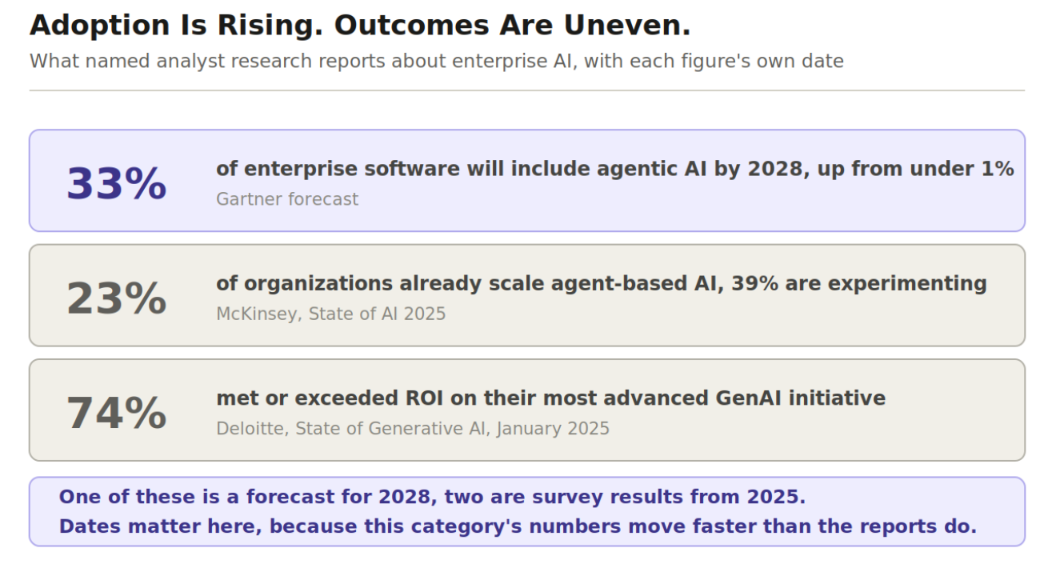
Source: Gartner forecast, McKinsey State of AI 2025, Deloitte State of Generative AI January 2025.
Be direct about industry-specific requirements too. A healthcare agent needs HIPAA-aware architecture. A fintech agent needs fraud-detection depth. Parts of it are already enforceable, while Annex III high-risk requirements apply from 2 December 2027 and high-risk systems embedded in regulated products from 2 August 2028. Treat a vendor unfamiliar with your regulatory context as a real risk rather than a minor gap.
How LITSLINK Approaches AI Agent Development Cost and Timeline
Our delivery model mirrors the phase structure above. Strategy and scoping come first: problem framing, a use-case shortlist, and ROI modeling, so the project starts from a number rather than an ambition.
AI agent architecture follows, covering tool-use planning, RAG pipelines, function-calling, memory and context management, and guardrails. Memory systems are where a lot of agent projects quietly go wrong. An agent that forgets context mid-workflow fails in ways that look like model problems and are not. Memory management is a design decision, not a library choice.
We start with a 2-4 week prototype before moving to the heavy production build. Infrastructure and testing shouldn’t be an afterthought. Our AI development team runs MLOps, monitoring, and security testing alongside the development process. The same applies to compliance: SSO, access limits, data residency, and strict GDPR, CCPA, or HIPAA requirements are hardwired into the architecture from the start. Software development and system development stay inside one team rather than two, which is why none of this arrives as a separate phase at the end.
The economics justify the sequence when the use case is right. For a logistics client, we deployed an AI agent that reduced delivery delays by 30% and saved $1.2M annually. Set against a six-figure development budget, that’s a full return on investment in the very first year. It proves why you need to model your ROI before development even starts, rather than hoping for the best after launch.
Pricing is a fixed quote from the start, with no surprise charges for post-launch updates.
Further reading: AI Agent Development Services and the AI Cost Calculator, where simple PoC solutions start around $25,000 and complex custom systems can exceed $2,000,000.
Contact LITSLINK for a free consultation and a project-specific estimate.
FAQs
How Much Does AI Agent Development Cost in 2026?
The price tag for AI agent development ranges from around $5k for a simple, scripted bot to $300k-plus for complex, enterprise-grade multi-agent systems. For the vast majority of business use cases, like solid RAG or NLP agents, expect your budget to land somewhere between $20k and $300k. Integration depth and data complexity decide where inside that band a project falls.
How Long Does It Take to Build an AI Agent?
You can have a basic prototype in your hands in 4 to 6 weeks, and a working MVP in about 10. For a final, production-ready build where all the integrations and testing are actually dialed in, budget 3 to 6 months. Enterprise multi-agent systems with heavy compliance requirements stretch to 6-12 months.
What’s the Difference Between AI Agent Development Cost and Ongoing Costs?
Development cost covers the one-time build. Ongoing costs cover LLM token usage, hosting, monitoring, and periodic retraining, and they continue every month the agent runs. They are frequently underbudgeted because they scale with usage instead of appearing as a fixed line item.
Is It Cheaper to Build a Custom AI Agent or Use an Off-the-Shelf Tool?
Off-the-shelf tools are generally cheaper at low volumes, because you completely skip the upfront build cost. At roughly 3,000 interactions a month, a $0.99-per-resolution tool costs about $35,640 a year in usage fees alone. Against the first-year custom TCO range in this guide, $108,000 to $306,000, break-even lands somewhere between roughly 9,000 and 25,700 monthly interactions, depending on build cost, operating costs and integration scope.
What’s the Biggest Factor in AI Agent Development Cost Besides Agent Type?
Integration depth. How many existing systems the agent connects to – whether a CRM, an ERP, internal APIs, or document repositories – typically has more impact on final cost than which AI model powers it. Each integration adds authentication, schema mapping, and ongoing maintenance work.