







Key Takeaways
- An API-based chatbot runs $19K-$54K. A custom-trained generative AI model runs $350K-$650K. Same category, 20x apart.
- Data collection and preparation typically consume 25–40% of a custom-model budget, more than the modeling work itself.
- LoRA fine-tuning costs $300-$3,000 in compute. Full fine-tuning of a 7B model starts around $50,000.
- API token prices span more than 100x, from $0.02 to over $25 per million tokens. Model choice alone can swing your bill 50-fold.
- Annual post-launch costs run 20-35% of the initial build, and at scale, API fees alone can exceed it.
- Only 48% of AI projects reach production, and at least 50% of generative AI projects were abandoned after proof of concept by the end of 2025
A $30,000 build with a $12,000 monthly API bill costs $174,000 in its first year. The engineering was 17% of it.
That ratio is why generative AI budgets fail differently from software budgets. Gartner found that at least 50% of generative AI projects were abandoned after proof of concept by the end of 2025, and one of the four reasons it names is escalating total cost of ownership: a per-token price that looks negligible in a pilot becomes the largest line item once thousands of users hit it daily. Projects that pencil out in proof of concept get cancelled in production.
This guide gives the hour-by-role math behind each estimate rather than a range with no methodology. It covers what a build actually costs by model type, what it costs to run for twelve months after launch, and where the two diverge. If you are a CTO, product manager, or founder deciding between a single generative AI feature and a full standalone product, the numbers below are planning brackets you can defend in a budget meeting.
What Is Generative Artificial Intelligence Development, and Why Pricing Varies
Traditional software has a bounded scope. You specify features, estimate hours, and the estimate holds. Generative AI development breaks that pattern, because the work spans model selection or model training, data preparation and data acquisition, fine-tuning, integration, and evaluation. Two of those are unknowable at the start. You cannot know a model’s accuracy until you have trained it, and you cannot judge your data until someone uses it. A project with clean labeled data and an off-the-shelf model finishes in six weeks. The same brief with fragmented data runs six months and costs eight times more.
For the process explained in more depth before you get to cost, see LITSLINK’s generative AI app development guide.
Quick Generative AI Development Cost Breakdown
| Project Type | Typical Scope | Estimated Cost (USD) | Timeline | Primary Cost Driver |
|---|---|---|---|---|
| AI chatbot or assistant | Pre-trained model, prompt engineering, basic integration | $18K-$45K | 6-12 weeks | Integration surface |
| Custom content generation tool | API or RAG architecture, custom UI, brand controls, review workflow, and moderate integrations | $40K-$120K | 3-5 months | Data preparation |
| Custom-trained generative AI model | Proprietary training, large dataset, dedicated infrastructure | $350K-$650K | 6-12 months | Training compute and data labeling |
| Enterprise generative AI platform | Multiple models, enterprise integrations, compliance, high load | $600K+ | 9-18 months | Compliance and legacy integration |
The Methodology Behind These Numbers
These estimates are built from hours by role multiplied by 2026 US contractor rates. For scale context, Gartner forecasts $2.59 trillion in worldwide AI spending for 2026, a 47% increase year over year, which is the demand pressure keeping AI talent rates where they are.
Rate assumptions. US senior AI engineers bill $130–$200 per hour, data scientists and machine learning engineers $150–$250, and AI architects $200–$240+ (A.Team engagement data, 2026). Your development team composition moves the blended rate more than any single role does. Backend developers, QA, and project managers run considerably lower. Blended across a realistic team, that produces $105–$135 per hour depending on the AI-to-conventional-engineering ratio.
Hour assumptions. A tier-one chatbot needs roughly 180–400 hours: discovery, prompt engineering and evaluation, backend integration, a front end, QA, and coordination. A fine-tuned content tool needs 450–1,000 hours, with data preparation as the largest single block. Custom training runs 2,500–5,000 hours plus compute.
What is included. Discovery, data work, model work, integration, testing, and deployment. Post-launch costs, API fees, and hosting are covered separately below, because they are recurring rather than build costs.
Disclaimer. Actual costs vary with model type, data availability and quality, integration scope, compliance requirements, team composition, and scope changes. Treat these as planning brackets.
How to Estimate Generative AI Development Cost
The formula is straightforward. Complexity lives in the inputs.
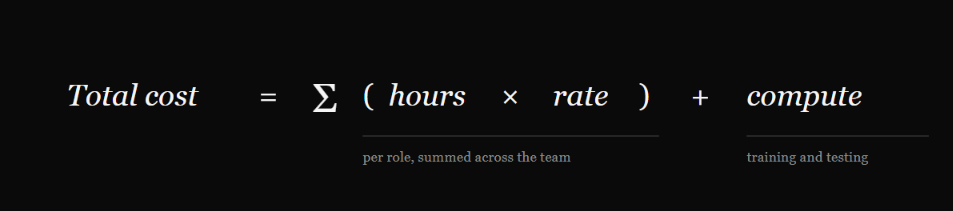
Roles to include: ML or AI engineer, data scientists, prompt engineer, backend developer, MLOps engineer, QA engineer, and project manager. Cost to build scales with how many of these the scope genuinely requires. Not every project needs all seven. A chatbot skips the data scientist. A custom-trained model needs two of them.
- List the roles your scope actually requires. Be honest about MLOps: someone has to run the pipeline after launch, and omitting that role does not make the work disappear.
- Estimate hours per role. Use the brackets above as anchors, then adjust for your integration count and data state.
- Apply regional rates. The table further down gives 2026 ranges by region.
- Add compute. Training and evaluation run on GPUs. For fine-tuning, that is hundreds to low thousands. For custom training, it can rival the labor cost.
Key Cost Factors in Generative AI Development
The numbers above are outputs. These are the inputs that produce them.
Two dominate everything else: which model you use and what state your data is in. Both get their own section below. A project can be complex in every other dimension and still land mid-range if those two are favourable.
What the First Year Actually Costs
Build cost is the number that gets approved. First-year total is the number that gets audited. Here is the full calculation for a mid-range case: a tier-one support assistant on a pre-trained model, handling 6,000 tickets a month.
| Line item | Assumption | Year one |
|---|---|---|
| Build | Mid of the $18K–$45K API-based bracket | $32,000 |
| API fees | ~$3,200/month at 500K requests | $38,400 |
| Hosting and infrastructure | Low-volume API-based tier | $9,600 |
| Maintenance and monitoring | 25% of build, annualised | $8,000 |
| First-year total cost of ownership | $88,000 |
Illustrative model built from the cost brackets in this article. Source: LITSLINK
Build cost is 36% of year one. It drops to zero in year two, while $56,000 of recurring cost does not.
The return side uses one metric: tickets resolved without escalation. At 6,000 tickets a month, a 35% deflection rate removes 2,100 tickets monthly. At a fully loaded $5 per ticket, that is $10,500 a month, or $126,000 a year.
Year one: $126,000 returned against $88,000 spent. Net +$38,000, with payback at roughly month six.
Three inputs decide whether that holds, and only one of them is technical. Deflection rate is the number to challenge hardest; vendors quote 60-70%, real tier-one deployments land closer to 30-40% once edge cases route to humans. Cost per ticket has to be fully loaded, not just agent wage. And request volume drives the API line, so a feature that fires on every keystroke rather than once per session changes the arithmetic entirely.
Run the same table for a custom-trained model and the shape inverts: a $450,000 build against roughly $200,000 of recurring cost, with payback in year three at the earliest. That is the real difference between the brackets.
Project Complexity and Its Impact on Budget
Complexity in generative AI is measured in how many things must be true at once.
Integration count. One integration is a connector. Five across systems with different auth models is a project. Each additional legacy system adds roughly 15-25% to integration hours, and more if documentation is thin.
Real-time performance requirements. A tool that can answer in three seconds costs meaningfully less than one that must answer in 300 milliseconds. Sub-second targets typically add 20–35%, because they force caching layers, a smaller or quantized model, and dedicated inference infrastructure. Latency is an architecture decision disguised as a requirement.
Multimodal capability. Text plus image needs two separate quality frameworks for model accuracy, so evaluation work roughly doubles. Budget 60-100% on top of a text-only equivalent. Adding audio or video compounds it further.
Regulatory constraints. In healthcare or finance, add 20-40% for audit trails, explainability, data lineage, and review cycles.
Custom UI/UX. A generative interface has to handle uncertainty, partial output, streaming, and failure states. Expect 25-40% more front-end hours than a comparable CRUD interface. Users need to see when the model is unsure, and that pattern does not exist in standard component libraries.
AI Model Pricing by Type: Should You Utilize Pre-Trained Models or Build Custom AI?
The model decision is the single biggest cost driver, and it sets the ceiling on everything downstream. Whether you leverage pre-trained models or commit to custom model training is the first of the key cost drivers to settle.
| Model Approach | Typical Use Case | Estimated Cost (USD) |
|---|---|---|
| Pre-trained / API-based (OpenAI, Anthropic, Google) | Chatbots, content assistants, fast MVPs | $18K-$45K |
| Fine-tuned model | Domain-specific accuracy, brand voice, specialized tasks | $50K-$150K |
| Custom-trained model | Proprietary IP, unique data advantage, full control | $350K-$650K+ |
A note on the fine-tuned range: it runs above the $50K–$120K quoted earlier for a content generation tool, because that project type assumes a single use case. Fine-tuning across several tasks or domains lands at the top of this bracket.
The gap between the first and third row is not a quality gap. It is a control gap. You are buying data ownership and the ability to keep the model when the vendor changes terms. The side-by-side comparison further down puts numbers against every criterion that follows from that.
Worth knowing before you consider that third tier: frontier model training costs are in a different universe entirely. Published estimates put GPT-4 around $78 million and Gemini Ultra around $191 million. Custom training in the sense that matters to a business means training a smaller, domain-specific model.
Foundation Models: When Off-the-Shelf Beats Custom Training
Foundation models are large, general-purpose pre-trained models: GPT, Claude, Gemini, Llama. You build on top of one rather than starting from weights.
Large language models like these are the reason most generative AI applications no longer need training from scratch. Off-the-shelf wins in three situations. When your requirement is capability rather than differentiation. When speed to market matters more than data ownership. And when your data volume is too small to train anything competitive, which describes most companies honestly assessing themselves.
The cost that gets missed here is licensing. Commercial foundation models bill per token, forever, and that is an operating expense rather than a development cost. A build that looks cheap at $30,000 can carry a $12,000 monthly API bill at moderate scale.
Open-weight models change that calculation. Llama and similar existing AI models remove the per-token fee and replace it with hosting costs, which are fixed rather than usage-based. Running them on Google Cloud, Google Vertex AI, AWS, or Azure shifts the line item from usage to capacity. The crossover point sits at roughly 16 million tokens per day on a single H100 instance: below that, APIs are cheaper; above it, self-hosting wins.
Utilize Pre-Trained Models or Build Custom AI: Cost Comparison
| Criteria | Utilize Pre-Trained Models | Build Custom AI |
|---|---|---|
| Upfront cost | $18K-$45K | $350K-$650K+ |
| Time to market | 6-12 weeks | 6-12 months |
| Flexibility | Bounded by the provider’s model | Complete |
| Data processing and control | Limited; data passes through a third party | Full |
| Ongoing fees | Per-token usage, scales with volume | Infrastructure, scales with size |
| Maintenance burden | Provider handles the model; you handle prompts | Everything, permanently |
| Best for | MVPs, fast validation, capability gaps | Proprietary products, genuine data moat |
The financial logic. When you utilize pre-trained models, the arithmetic holds until your API bill approaches the amortized cost of building. Pre-trained AI models buy speed. Custom buys control. Run that crossover number against projected volume, because it arrives faster than most teams expect.
Pre-trained makes financial sense when the capability is generic rather than differentiating, when speed to market outranks data ownership, or when your data volume is too small to train anything competitive. Two of those three describe most first AI projects.
A custom AI solution makes financial sense when the model itself is the product, when compliance prohibits third-party processing, or when your proprietary data would produce accuracy no general model can reach. Any single one of those justifies the cost, and the first makes it unavoidable. Machine learning models trained on data only you hold are the one genuine moat in this space.
The middle path most teams miss. Fine-tuning sits between them at $50K–$150K and covers more cases than either extreme. It gives domain accuracy and brand voice without training infrastructure, and it keeps your data inside a pipeline you control. Most projects that think they need custom model training need fine-tuning instead.
Build vs. Buy: Custom GenAI Application or Ready-Made Platform?
The model decision above assumes you are building something. Before that comes a separate question: does a product already exist that does this?
The two decisions get conflated constantly, and they are not the same. You can buy a finished GenAI platform and never touch a model. You can also build a custom application on a pre-trained model and own nothing but the application layer. Settle build-versus-buy first, because a “yes” to buying makes the entire model discussion unnecessary.
| Criterion | Ready-made platform | Custom application |
|---|---|---|
| Upfront cost | $0–$15K setup and onboarding | $18K-$650K+ depending on model approach |
| Recurring licensing | Per-seat or per-usage, indefinitely | None; you pay infrastructure and inference instead |
| Customization | Configuration within vendor limits | Unbounded |
| Integration flexibility | Whatever the vendor’s API exposes | Any system you can authenticate against |
| Data ownership | Governed by vendor terms; prompts and outputs often leave your perimeter | Full, including the option to keep data on your own infrastructure |
| Vendor lock-in | High: workflows, prompt libraries, and history shape around one product | Low on the application layer, moderate if you depend on one model provider |
| Time to launch | Days to weeks | 6 weeks to 12 months |
| Long-term TCO | Grows with seats and usage; predictable per unit, unpredictable in total | Front-loaded, then flattens; inference is the only line that scales with success |
Buying wins when the capability is generic, when the process you are automating looks like everyone else’s, and when speed matters more than control. Most first GenAI projects fit all three.
Building also wins when the workflow is the differentiator, when compliance blocks third-party processing, or when per-seat licensing at projected headcount exceeds what a build would cost. Model that last one at three-year headcount, not today’s.
Most companies end up between the two: a purchased platform for the standard work, a custom application where their advantage lives. The integration between them is the part to scope carefully, since it is usually the largest share of the effort.
Data Collection and Preparation Costs
This is the line item that breaks budgets, and it is almost never the one clients ask about first.
Data collection, cleaning, labeling, and structuring typically consumes 25–40% of a custom-model budget. High-quality data is the input that decides model development timelines more than the modeling approach does. For projects where the training data does not exist yet, it goes higher. The modeling work, which is what everyone pictures when they think about AI development, is often the smaller half.
Three data problems inflate costs after the estimate is signed.
Gaps. Missing categories the model will simply fail on, discovered during evaluation rather than during planning.
Bias. Skewed training data produces skewed output, and fixing it means going back to collection rather than tuning the model.
Inconsistency. The same field formatted six ways across sources. Cheap to fix early, expensive to fix after training has begun.
Data availability and readiness is the single best predictor of whether a generative AI project lands on budget. Assess input data honestly before anything else, because a specific AI solution built on weak data is a significant investment with a predictable ending.
Natural Language Processing Features and Their Cost Impact
Natural language processing capabilities are usually described as if they were toggles. Each one is a scope addition with its own evaluation requirement.
| Feature | Added Cost |
|---|---|
| Intent recognition | $8K-$20K |
| Sentiment analysis | $6K-$15K |
| Summarization | $8K-$18K |
| Multi-language support | $12K-$40K per language group |
Multi-language is the one that surprises people. Each language needs its own evaluation set, its own edge cases, and often its own prompt engineering, because model quality varies considerably across languages.
Content Generation Features
Single-purpose generation is straightforward. Multi-modal generation is a different project.
Text generation sits at the base. Image generation adds a separate model, separate evaluation, and separate safety tooling. Video and audio add more still, along with substantially higher inference costs per output.
The cost most teams miss: moderation and safety tooling. Any system generating customer-facing content needs filters, review queues, and an audit trail of what was produced and approved. Budget 15-25% of the generation feature cost for that layer. Skipping it is how brands end up in screenshots.
For systems combining text, image, and audio in one pipeline, LITSLINK’s overview of multimodal generative AI covers the architecture behind the cost.
Infrastructure Costs for AI Systems: Cloud Infrastructure and Compute
Most generative AI systems run on cloud infrastructure: GPU or TPU compute for training and inference, cloud storage for data and model artifacts, and networking. Data storage is the cheapest line here and the easiest to forget in a model.
GPU pricing fell meaningfully through 2025 and 2026. H100 instances now run roughly $3–$4 per GPU-hour on demand, with spot pricing near $2.50 and A100 spot below $1.00. Reserved capacity and one- to three-year commitments drop it further.
| Project Size | Monthly Infrastructure | Annual |
|---|---|---|
| API-based, low volume | $200-$1,500 | $2.4K-$18K |
| Fine-tuned, moderate volume | $2,000-$8,000 | $24K-$96K |
| Custom model, production load | $15,000-$60,000+ | $180K-$720K+ |
Infrastructure scales with three things after launch: model size, request volume, and inference frequency. The third is the one that surprises teams. A feature that runs once per user session costs a fraction of one that runs on every keystroke.
Inference optimization matters more than instance shopping. Engines like vLLM and TensorRT-LLM use advanced algorithms to deliver two to six times cost reduction on the same hardware, which usually beats any savings from switching providers.
AI Integration Costs: Connecting Generative AI to Existing Systems
Integration is where generative AI projects meet reality. The model works in isolation; the question is whether it can reach your data.
The work covers API development, authentication and authorization, data pipelines, error handling, and testing across every connected system. Integration complexity scales with the number of legacy systems involved, and it scales badly. Two modern systems with documented APIs take a week. One fifteen-year-old ERP that batch-updates overnight is two months.
Budget $10K–$30K per significant integration for modern systems, and $25K-$80K where legacy platforms are involved. Scope this honestly, and project estimates stop being fiction.
LITSLINK’s guide to generative AI integration covers the recurring obstacles: data privacy, skill gaps, high costs, and legacy system compatibility.
Data Security and Compliance Costs
Compliance work is not a document review. It changes the architecture, which is why it belongs in the build estimate.
| Standard | Typical Implementation Cost |
|---|---|
| GDPR | $15K-$50K |
| HIPAA | $30K-$90K |
| SOC 2 Type II | $40K-$120K including audit |
| CCPA | $10K-$35K |
| Emerging AI-specific rules | $15K-$60K, rising |
Regulated industries see a disproportionate increase. In healthcare and finance, compliance can add 30–50% to the total project rather than a fixed line item, because audit trails, explainability, data residency, and human-review requirements shape every component.
AI-specific regulation is the moving target. Requirements around disclosure, training data provenance, and automated decision-making are tightening in several markets, and a system built without them will need retrofitting.
Team Size and Location for AI Projects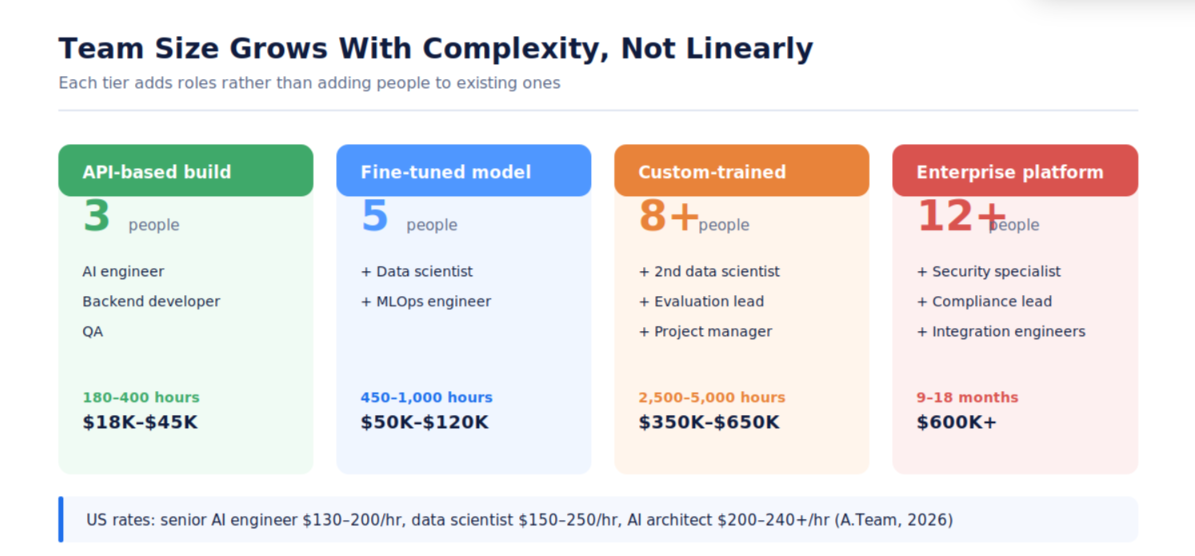
US rates from A.Team engagement data, 2026
AI and ML talent commands a premium over general software development because supply is genuinely constrained, particularly for engineers with production deployment experience.
| Region | Typical Hourly Rate (Mid-to-Senior AI/ML) |
|---|---|
| United States and Canada | $130-$200 |
| Western Europe | $90-$160 |
| Eastern Europe | $80-$140 |
| Latin America | $65-$125 |
| Asia | $30-$75 |
Rates reflect 2026 contractor market data (A.Team). US senior AI engineers bill $130–$200; data scientists and ML specialists run $150–$250; AI architect engagements reach $240+.
These sit well above general software development rates in every region, and the gap is widest where production experience is scarcest. Published figures for AI/ML talent often lag the market by a year, so a rate card quoting $45–$90 for Eastern European AI engineers is describing 2024 rather than now. Specialization in LLMs, MLOps, or agentic systems adds a further 12–30% premium regardless of location.
Team composition grows with complexity rather than scaling linearly:
- Simple API-based build: AI engineer, backend developer, QA. Three people.
- Fine-tuned model: add a data scientist and an MLOps engineer. Five.
- Custom-trained model: add a second data scientist, a dedicated evaluation role, and a project manager. Eight or more.
- Enterprise platform: add security, compliance, and integration specialists. Twelve-plus.
For teams that need specific roles rather than a full build, LITSLINK’s hire AI developers page covers short-term and long-term engagement models.
Generative AI Services and Their Typical Cost Range
Pricing differs meaningfully by what you are actually building.
AI chatbots and virtual assistants. Pre-trained model, prompt engineering, conversation design, integration with support systems. $18K–$60K depending on integration count.
Text and content generation tools. Brand voice tuning, template systems, editorial review workflow. $40K-$120K.
Image and video generation tools. Separate models, heavier inference, mandatory moderation tooling. $60K-$250K.
Code generation and developer copilots. Repository context, security scanning, IDE integration. $80K-$300K.
Recommendation and personalization engines. Historical data pipeline, real-time serving, A/B infrastructure. $70K-$250K.
Data synthesis and synthetic data generation. Statistical validation, privacy guarantees, distribution matching. $90K-$350K.
The pattern: cost tracks the amount of validation the output requires. A chatbot answer that is slightly off is a minor annoyance. Synthetic training data that is subtly wrong corrupts everything built on it.
Generative AI Development Process & Cost
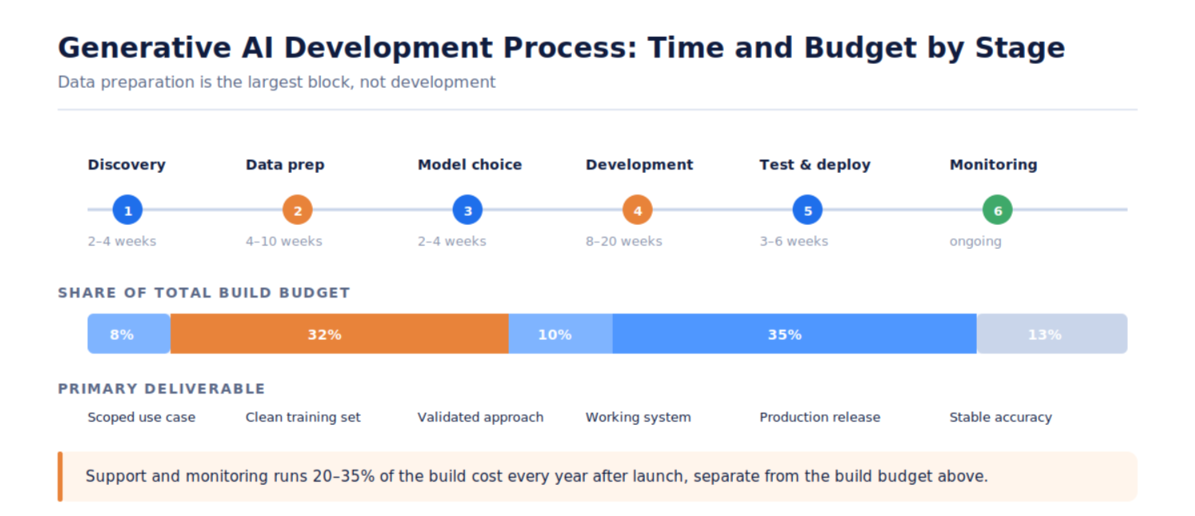
Longer projects cost more in development hours, project management, and iteration. Compressed timelines also cost more, through larger parallel teams and rework. A realistic timeline with well-scoped requirements is consistently the cheapest path.
Discovery & Use Case Definition
Defining what the system does, what success looks like, and whether AI is the right tool. Activities: stakeholder interviews, use case scoping, data audit, success metrics. Duration: 2-4 weeks. Budget share: 5-10%. The cheapest place to cancel a bad idea.
Data Collection & Preparation
Sourcing, cleaning, labeling, and structuring training and evaluation data. Activities: data audit, pipeline construction, labeling, quality validation. Duration: 4-10 weeks. Budget share: 25-40%. The largest single block in custom-model projects and the most frequently underestimated.
Model Selection (Pre-Trained vs Fine-Tuned vs Custom)
Choosing the approach and validating it against your data before committing. Activities: benchmarking candidate models, prototype evaluation, cost modeling. Duration: 2-4 weeks. Budget share: 5-15%. Skipping this stage is what produces projects that discover at month five that a cheaper model would have worked.
Development & System Integration
Building the application layer, connecting to existing systems, and implementing the model pipeline. Activities: backend, front end, API development, data pipelines, authentication. Duration: 8-20 weeks. Budget share: 30-40%. The stage everyone plans for, and rarely the one that overruns.
Testing & Deployment
Evaluating model accuracy, load testing, security review, and production release. Activities: evaluation against held-out data, adversarial testing, performance testing, deployment automation. Duration: 3-6 weeks. Budget share: 10-15%. AI systems need evaluation rather than only QA: correctness is statistical.
Support & Monitoring
Performance monitoring, data drift detection, retraining, and prompt updates. Activities: monitoring setup, drift alerting, periodic retraining, safety filter updates. Duration: ongoing. Budget: 20-35% of build cost annually. This is a separate line from the build budget.
Additional Costs to Consider Beyond Development
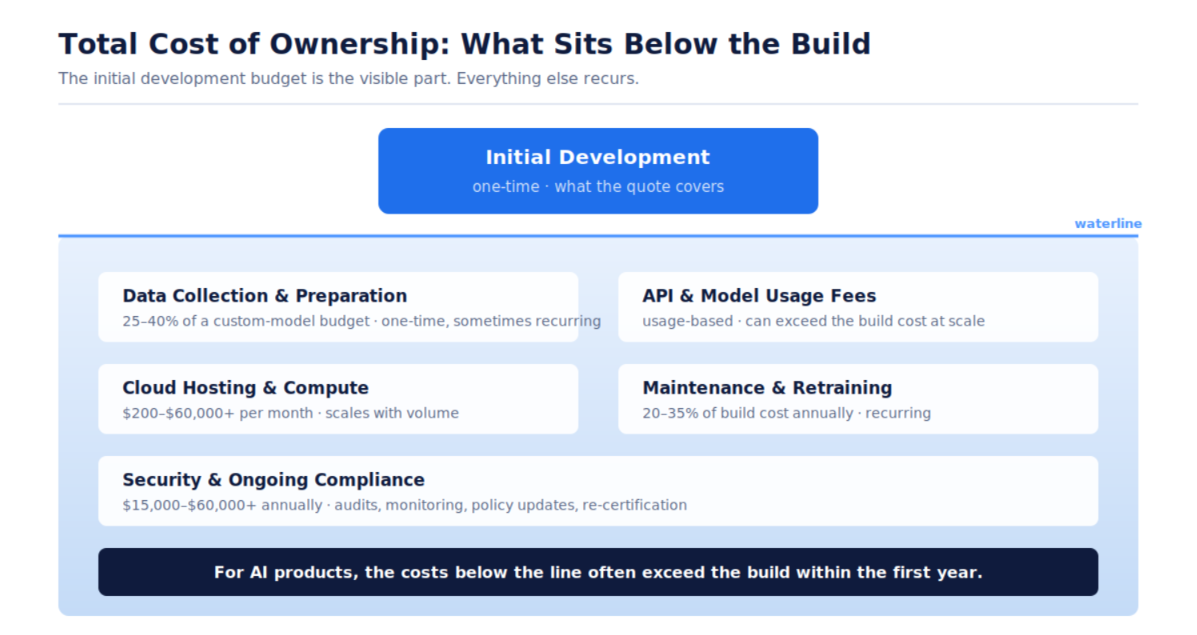
Total cost of ownership for generative AI products differs from conventional software in one important way. The recurring costs are not just maintenance; they include inference, which scales with your own success.
That is why AI products frequently cost more after launch than before it. A well-adopted feature generates more inference, and inference is metered.
Ongoing Costs After Launch: Maintenance, Monitoring, Retraining
Generative AI systems degrade without attention. Model performance drifts as real-world data diverges from training data. Prompts that worked six months ago produce worse output as the underlying model gets updated. Safety filters need adjustment as users find edges.
Budget 20-35% of the initial build cost annually for monitoring, drift detection, periodic retraining or fine-tuning, and prompt and safety updates. Custom-trained models sit at the top of that range; API-based systems at the bottom.
API & Model Usage Fees
Commercial foundation models bill per token or per request, and the spread between models is enormous. Current pricing runs from roughly $0.02 per million input tokens for small open-weight models to $5 input and $25 output for frontier models. That is a difference of more than 100x on the same workload.
Output tokens usually cost more per token, but the dominant expense depends on the ratio of retrieved context to generated output. A chat assistant with short prompts is output-driven. A RAG system stuffing 20,000 tokens of retrieved documents into every request to produce a 300-token answer is input-driven, and prompt caching matters far more there than output length. Measure your own ratio before optimizing either side.
At scale, usage fees can exceed the original development cost. A $30,000 build serving a million requests a month on a frontier model will spend more on tokens in year one than it did on engineering. Three levers control this: caching identical requests, compressing prompts, and using batch endpoints for anything non-real-time. Batch APIs from major providers discount 50%, and prompt caching cuts input costs 50-90%.
Cloud Hosting & Compute at Scale
Setting up infrastructure and running infrastructure are different budget lines. Setup is one-time: environment configuration, pipeline construction, deployment automation. Running cost scales with usage indefinitely.
Expect $200-$1,500 monthly for a low-volume API-based system, which annualizes to $2.4K-$18K. A fine-tuned model at moderate volume runs $2,000–$8,000 monthly, or $24K-$96K a year. A custom model under production load runs $15,000–$60,000+ monthly, which is $180K-$720K+ annually and can exceed the original build cost within two years.
Self-hosted open-weight models shift this from usage-based to capacity-based. That is more predictable but less elastic: you pay for the GPU whether traffic arrives or not.
Security & Ongoing Compliance
Implementation is one-time. Compliance is not. Annual recurring costs cover audits, monitoring, policy updates, and re-certification.
Budget $15K-$60K annually for a system under one major framework, more where several apply. SOC 2 requires annual re-audit. AI-specific regulation is still forming, which means periodic reassessment rather than a one-time implementation.
In-House vs. Outsourcing: Which Option Is More Cost-Effective for Generative AI Development?
AI and ML talent is scarcer than general engineering talent, which changes this calculation compared to conventional software.
| Criteria | In-House Development | Outsourced Development |
|---|---|---|
| Team setup | Recruit, onboard, retain | Assembled by the partner |
| Initial cost | Higher: recruiting, equity, ramp-up | Lower: billed against scope |
| Ongoing cost | Salaries continue between projects | Ends with the engagement |
| Hiring and onboarding time | 3–6 months for senior AI roles | 1–3 weeks |
| Time to start development | After hiring completes | Near immediate |
| Access to specialized AI/ML talent | Limited by what you can recruit and pay | Broader, drawn from an existing bench |
| Scalability | Slow up, painful down | Adjusts with scope |
| Project management | Yours | Shared or delegated |
| Flexibility | High once the team exists | High during the engagement |
| Long-term maintenance | Owned permanently, staffed permanently | Contracted, or handed back to your team |
| Best for | Long-term proprietary AI as core product | MVPs, first builds, capability gaps |
A senior AI hire at $200,000 base costs closer to $300,000 in year one once benefits, recruiting, equipment, and vacancy time are included. That figure is the honest comparison point against an outsourced engagement.
In-house makes sense when AI is the product, when you need continuous R&D rather than a delivery, and when the institutional knowledge compounds. Companies building proprietary models on proprietary data belong here.
Outsourcing makes sense for MVPs, for a first generative AI build where the internal team lacks ML experience, when time to market matters, and when the project has a defined end rather than an indefinite roadmap.
Maintenance is the row that decides more of these than cost does. An outsourced build eventually needs an owner, and if that owner does not exist internally, you are choosing a permanent retainer rather than a project. Scope that before signing.
Many companies do both: outsource the first build, then hire against whichever parts turn out to be strategic.
How to Reduce Generative AI Development Cost Without Compromising Quality
- Start with a pre-trained or fine-tuned model before committing to custom training. It is the most cost-efficient way to prove the use case works before buying control over it, and the cost savings compound if the answer is no.
- Define the use case and the metric before development starts. “Improve customer service” means nothing. “Resolve 40% of tier-one tickets without escalation” gives you something measurable.
- Validate the approach with a small proof of concept before scaling the model or dataset. Gartner found that at least half of generative AI projects were abandoned after proof of concept by the end of 2025, which makes the PoC the cheapest possible place to fail.
- Invest in data quality early. Fixing data before training costs a fraction of diagnosing model performance afterward.
- Choose the right delivery model based on complexity and risk tolerance: agency, in-house team, or freelancer.
- Plan for inference and retraining costs from day one. These are the largest long-run line items and the most frequently omitted from business cases.
- Build monitoring and evaluation from the start. Retrofitting observability after launch costs more than including it, and you spend the gap discovering problems from users.
Resources and Methods for Generative AI Development Cost Research
Software Development Marketplaces & Review Platforms
Use Clutch, GoodFirms, or G2 to check portfolios, client reviews, and published hourly rates. Look for two things before you look at price. First, proof the vendor pushes AI to live production instead of abandoning pilots. Second, reviews that talk about AI projects specifically rather than general software work.
Filter for AI and ML expertise rather than sorting by rate. A team learning generative AI on your budget is more expensive at $60 an hour than a specialist at $150.
Requesting Quotes from Development Companies
Getting multiple quotes is the best reality check for your budget, but only if everyone gets the same brief. Send identical documents, ask for costs broken down by role and phase, and judge the scope on offer rather than the total at the bottom.
The revealing question: ask each vendor what they assume about your data readiness. The one who asks for a data audit before quoting is giving you a more honest number than the one who quotes immediately.
Industry Research & Competitor Analysis
Published case studies and industry reports help set expectations, with one caveat. Compare projects of similar model complexity rather than similar-sounding descriptions. Two projects both called “AI chatbot” can differ 10x in cost depending on integration count and compliance scope.
Generic market averages are close to useless here. The distribution is too wide for the mean to describe anything.
Online AI Cost Calculators
Calculators give a fast preliminary estimate from model type, features, integrations, and data requirements. They are useful for order of magnitude and for structuring an internal conversation about scope.
Their limitation is the same one that makes this whole article necessary: they cannot assess your data. A calculator assumes data readiness; it has no way to verify, and data readiness is the largest variable in the estimate.
On accuracy, expect a good calculator to land the right order of magnitude and the right bracket. Expect it to miss by 30–50% against a scoped quote, almost always low, because the inputs it cannot see are the ones that add cost. Use one as a starting point.
Generative AI Development Cost Estimation by LITSLINK
Start with the LITSLINK AI cost calculator for a quick estimate based on model type, features, integrations, and data requirements. It gives a realistic planning bracket in a few minutes, which is enough to know whether you are having a $54,000 conversation or a $450,000 one.
Calculators cannot account for every business requirement, so validate the output in a discovery session. That is where data readiness, compliance scope, and integration reality get assessed, and those three determine whether the initial estimate holds.
LITSLINK has delivered generative AI work across the full product lifecycle: use case discovery, data strategy, model selection, development, integration, and ongoing support.
- 1,540+ completed software and AI projects
- 1,000+ clients across 82 countries
- 300+ engineers and technology experts
- MVP delivery in as little as 10 weeks
Contact LITSLINK for a tailored cost estimate and a development roadmap aligned with your business goals, timeline, and budget.
FAQs
What is the average cost to develop a generative AI solution? Averages mislead here because the generative AI cost distribution is too wide. An API-based assistant runs $19K-$54K. A fine-tuned tool runs $50K-$120K for a single use case, up to $150K across several. A custom-trained model runs $350K-$650K or more. Which bracket you land in depends mostly on model approach and data readiness, so establish those two before asking for a number.
How long does generative AI development typically take? Six to twelve weeks for an API-based build, three to five months for a fine-tuned model, and six to twelve months for custom training. Data preparation is the stage that expands, not development. If your data needs work, add to the front of the schedule rather than the end.
How much does it cost to maintain a generative AI product after launch? Budget 20–35% of the initial build annually for monitoring, retraining, and prompt updates. API fees and hosting sit on top of that and scale with usage. At high volume, running costs can pass the original build inside two years, and faster than that if you are on a frontier model. That is a feature of success rather than a failure of planning, but it belongs in the business case from the start.
What are the key factors affecting generative AI development costs in 2026? Model approach and data readiness account for most of the variance in the cost of generative AI. Integration count, compliance requirements, real-time performance targets, and generative AI capabilities such as multi-modal output account for most of the rest. Implementing AI inside a regulated business adds a further layer. Team location affects the rate but not the hours.
Is it cheaper to use pre-trained models instead of training a custom AI model? Upfront, substantially: $19K-$54K against $350K+. Over three years, the comparison narrows, because API fees scale with usage while infrastructure costs scale with model size. Run the crossover math at your projected volume rather than your current one. Custom training earns its cost when the model is the product, when compliance blocks third-party processing, or when your data would produce accuracy no general model can match.