





Building an AI Product Description Generator for E-commerce With Automated SEO Optimization
- ~40 sec per product description
- 2,500+ product descriptions generated daily
- 94% accuracy on extracted key features
- 1.8 sec median API response time
- 5 output formats per product
A catalog of 40,000 SKUs needs 40,000 descriptions. Our client's merchants had neither the copywriters nor the hours. LITSLINK built an AI product description generator that turns a handful of keywords and spec fields into SEO-ready copy, so e-commerce teams can publish product listings the same day they upload them.
Project Details
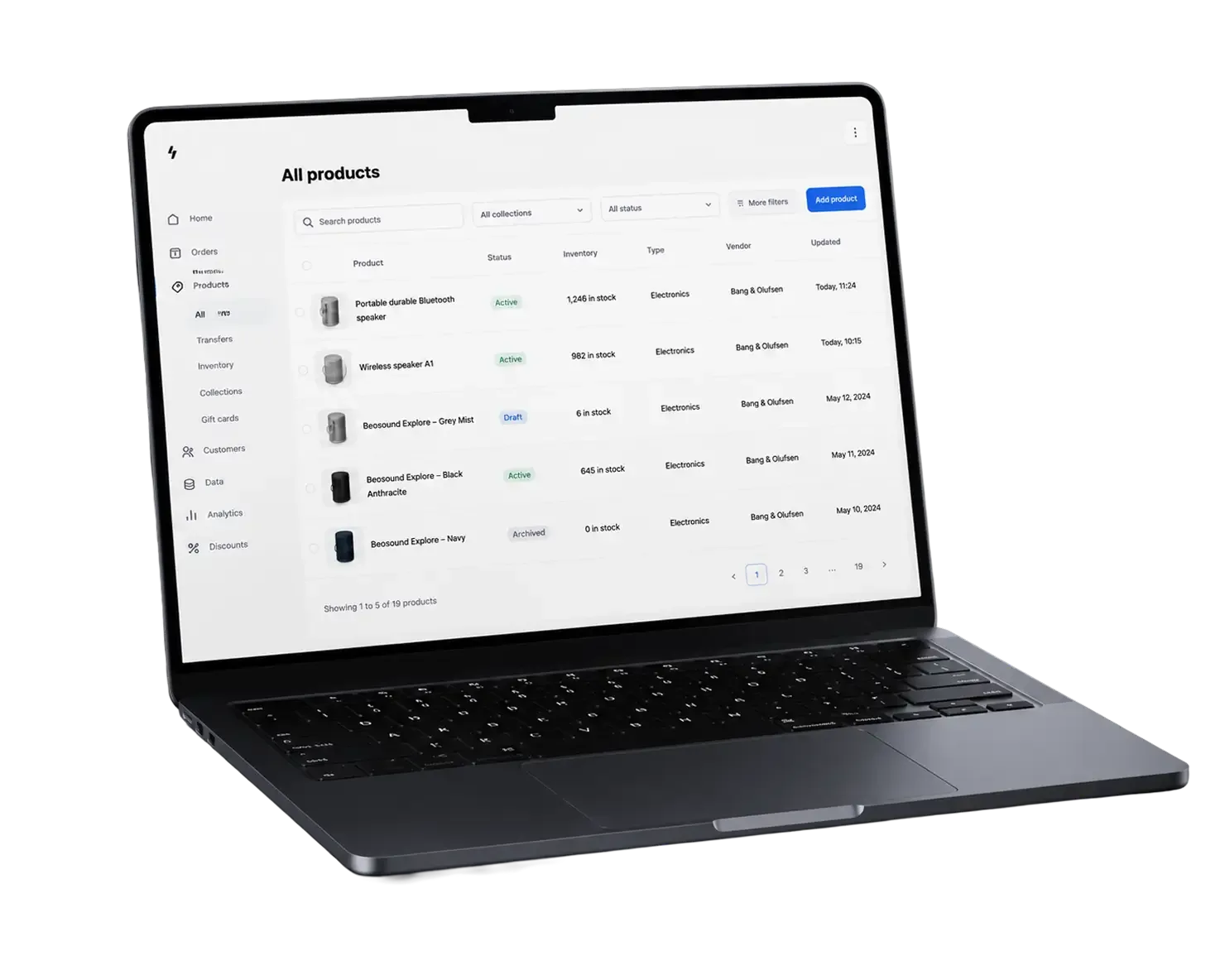
Our client runs a commerce platform used by roughly 1,200 merchant storefronts, from single-founder shops to catalogs past 80,000 SKUs. Their support queue kept filling with a version of the same request: help us write product descriptions faster. E-commerce teams do not lack ideas; they lack hours. The brief that came out of it was narrow. Build a product description generator that plugs into the editor merchants already use.


Business Challenge: Product Description Generation at Catalog Scale
Our client’s platform handled the hard parts of running a store well. Inventory, payments, shipping rules, tax. Product copy was the gap. A merchant uploaded a spreadsheet of 4,000 SKUs, then sat down to write product descriptions one at a time, and that is where most of them stalled. Writing engaging descriptions for a target audience you know well takes fifteen minutes. Writing compelling descriptions for four thousand SKUs takes a quarter, and nobody has a quarter. Most e-commerce teams settle for thin product descriptions instead, then wonder why the listings never rank.
Support tickets told the story better than any survey would have. Covering a 4,000-SKU catalog once took roughly 1,400 hours of manual writing. Larger sellers ordered freelance batches of 200 descriptions, waited a week, then spent two more days editing for accuracy. Several merchants had already run product details through a few of the top AI tools, pasting specs into a chat window and copying results back into the admin panel. That produced fluent copy and, a month later, a support ticket asking why a listing promised 12 hours of battery on a device rated for 8. The top AI tools they had tried were good at prose and blind to a spec sheet. Creating product descriptions was no longer the bottleneck. Trusting them was.
The SKUs without detailed product descriptions sat in the catalog collecting impressions and almost no clicks, because potential customers scrolled past a title, a price, and a wall of nothing. Content creation had turned into the slowest step in a workflow that was quick everywhere else. The merchandising lead put it plainly during the second workshop: she did not want an AI description generator that wrote clever copy; she wanted 4,000 accurate product descriptions by the end of the quarter, each carrying the product’s key features, its unique selling points, and a meta description that was not blank. Engaging descriptions were welcome, but only once the numbers were right.

Brand Voice Drift Across Catalogs
Six freelancers wrote in six registers. One page opened with "Elevate your everyday," the next read like a datasheet. Brand voice slipped a little further with every batch, and editors caught maybe half of it before publishing.

SEO Optimization at Scale
Relevant keywords were pasted in by hand, usually into the last sentence. Meta descriptions were missing on about 60% of product pages, so search engines indexed listings built from duplicate supplier copy that dozens of competing stores also ran.

Multi-Platform Content Requirements
Amazon caps bullet points. Google Shopping wants attributes first. The storefront wants a story. Every channel got the same 200-word block, trimmed by hand at 11 p.m. before a launch, and the trimming is where the key details went missing.
Technologies Behind the Automatic Product Description Generator





Our AI Product Description Generation Solution
The first architecture question was not which model to call. It was what the model should be allowed to see. Supplier feeds arrive messy: half-filled attribute tables, PDF spec sheets, blurbs copied from a manufacturer site in 2019. Feed that into any description generator and you get confident sentences about a product that does not exist.
So the extraction layer came first. A parser maps whatever the merchant has for a SKU to 22 attribute types, and anything it cannot confirm never reaches the prompt. Those key features become the factual spine of every draft. One rule, and invented specs dropped under 2% by sprint 9, which is why merchants trust the platform to generate product descriptions in regulated categories.
Creating compelling product descriptions is the easy half. Keeping them accurate across 40,000 rows is the half that needs engineering.
Generation runs on GPT-5.6 through the Responses API. Each prompt combines verified product details, the merchant’s brand voice profile, and one of roughly 40 customizable templates. The SEO layer then checks keyword placement, meta description length, and heading structure before a draft reaches a person.
Output quality gets measured, not assumed. High-quality product descriptions were the acceptance criterion the client wrote into the contract, so every batch is scored on factual match, readability, keyword placement, and voice.
Redis caches embeddings and near-identical requests, which cut repeat generation calls by roughly 35%. Select 500 SKUs, generate descriptions for the batch, close the tab, come back to finished product listings in about 12 minutes.
Multi-Format Content Generation
One product, five outputs: a 40-word teaser, a 150-word storefront description, a bullet points block, a meta description, and a marketplace variant that respects character limits. Merchants generate descriptions for all of them in one pass.
SEO-Optimized Description Engine
SEO keywords and search intent notes go in before generation, not after. The engine places relevant keywords where search engines read them, so listings stop competing with themselves in search results. An AI description generator that ignores search intent only writes brochures faster.
Brand Voice Customization
Upload 30 to 50 existing descriptions, and the platform builds a brand voice profile from them. Six tone presets cover everyone else, and the brand's tone can be locked per collection. Compelling descriptions in one register, across an entire catalog.
Product Feature Extraction
The parser pulls key features, dimensions, and materials out of spec sheets, CSV feeds, and supplier PDFs. Upload product images and a vision pass fills the specific details a feed left blank, which makes precise descriptions possible on catalogs nobody has ever cleaned.
Real-Time Generation API
A single POST returns a finished draft in about 1.8 seconds at median. The same endpoint can generate product descriptions for one SKU or five hundred, which is how three merchants wired it into their PIM.
E-commerce Platform Integration
Connectors for Shopify and WooCommerce, plus a REST endpoint for custom storefronts. Approved product descriptions flow back to the product pages and marketplace feeds without an export step, which removed the spreadsheet e-commerce businesses all hated.
Quality Assurance Pipeline
Readability check, fact check against extracted attributes, duplicate scan across the catalog, banned-claims filter. Anything that fails twice goes to manual review, and 200 drafts of AI-generated content get sampled by hand every week.
Scrum Methodology
Project Journey
The project ran across 14 two-week sprints, with the first product description generator shipping in sprint three. After it invented a speaker specification, attribute extraction became central to the architecture. Discovery also identified merchants’ available SKU data, publishing channels, and editing tolerance: if more than a third of the text needed rewriting, they returned to manual work, making edit rate the team’s key success metric.
How the AI Copywriting Software Works
- The service reads the SKU record: title, attributes, supplier feed, and any product images the merchant chose to upload.
- The parser maps raw fields to 22 attribute types and flags what it cannot verify. Unconfirmed specifics stay out of the prompt.
- The merchant picks output formats, a brand voice profile, target keywords, and a generation density between 10 and 100%.
- The model returns multiple variations per format and can generate descriptions again at a different density. Inline suggestions carry a confidence score.
- Keyword placement, meta description length, readability, duplicate copy, and a factual match against the extracted key features.
- The merchant edits inline, approves, and the finished AI product description writes back to the product page or the marketplace feed.
How we deliver your AI project
- We define the project goal together, agree on priority features, and set a realistic delivery date and budget.
- We build a ranked list of everything the product needs, starting with what matters most to the business.
- Work is broken into 2-week cycles. At the start of each, we select the next set of features to deliver.
- The team builds, tests, and integrates features throughout the sprint.
- At the end of every sprint, you see working software and give feedback that shapes the next cycle.
- Each sprint produces a shippable piece of the product. We review what worked, adjust, and move forward.
Scrum process flow
AI development rarely benefits from a big-bang release. Sprint cadence meant the client saw a working description generator every two weeks and could push back before a decision got expensive. Two examples: the density slider replaced a set of fixed presets after a sprint 6 review, and the duplicate-content scan was added in sprint 10 because a pilot merchant found two near-identical listings sitting in their own catalog.
UI/UX Design: Intuitive Interface for AI Product Description Management
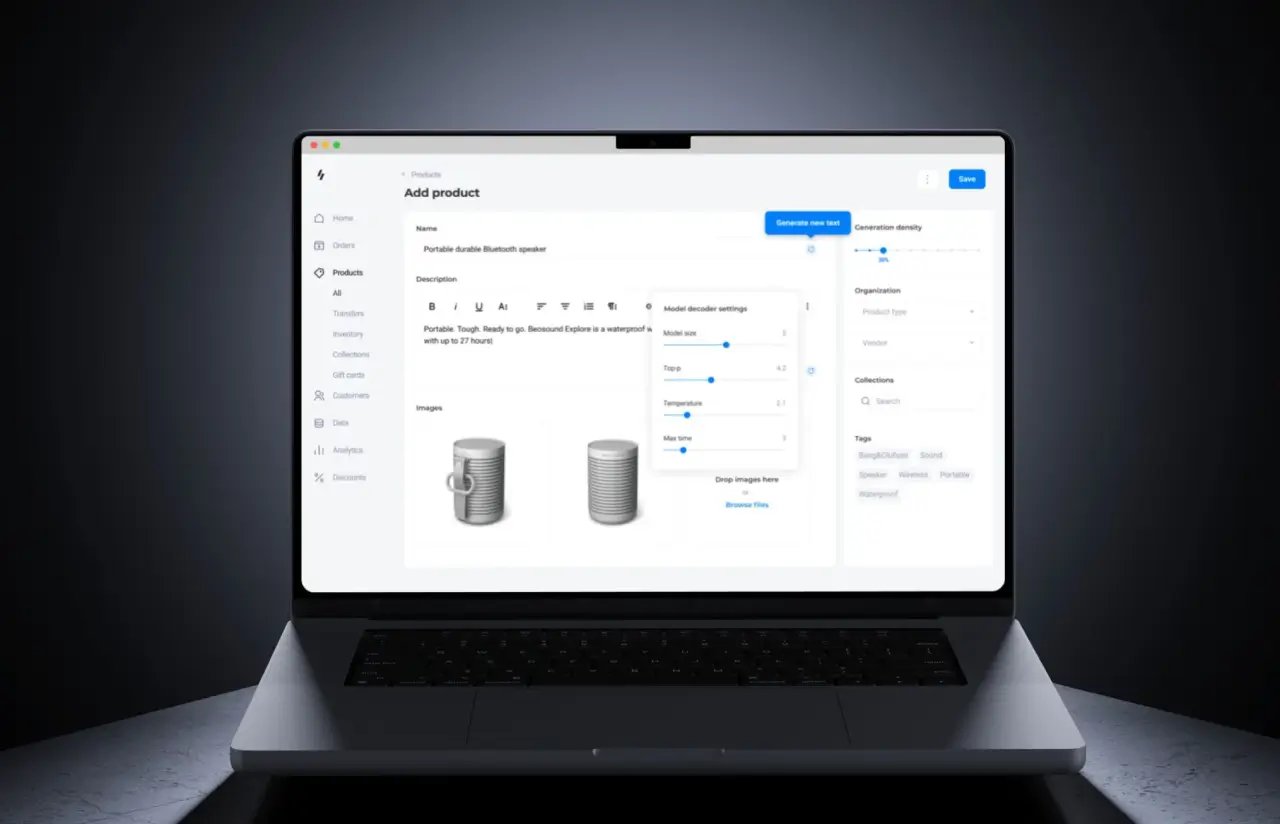
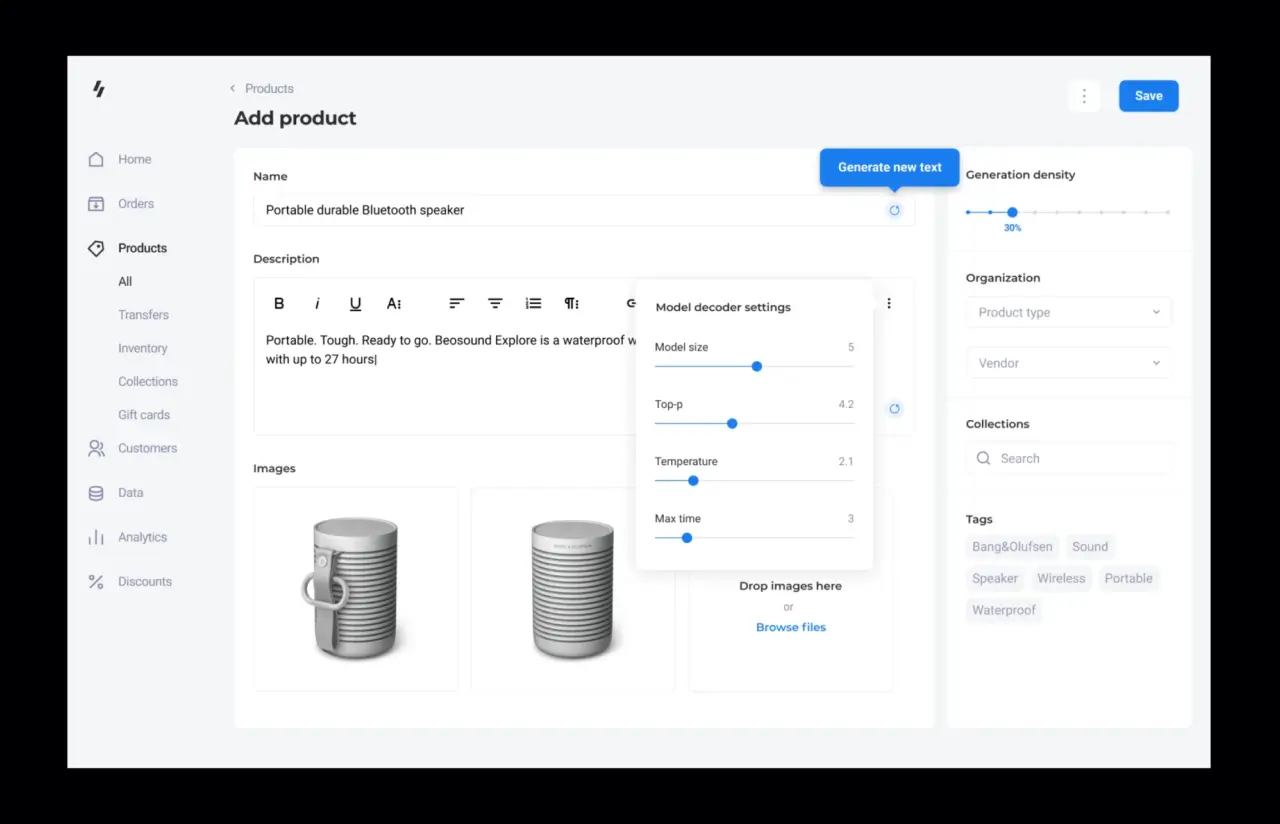
The design brief had one line at the top: nobody should have to learn a new tool. So the product description generator lives inside the editor merchants already use. Two small refresh icons were the only new controls on the main form. One regenerates the title, the other regenerates the body.
The tooltip reads Generate new text, which tested better than Generate with AI. Merchants told us in the second round that the AI label made them expect something they would have to fix, and they read the output more suspiciously because of it.
The right rail carries a Generation density slider, set to 30% by default. Low density keeps the copy close to the extracted product’s features; higher density lets the model write more freely around them. A Model decoder settings panel behind the three-dot menu exposes model size, top-p, temperature, and max time for the 4% of merchants who ever open it.
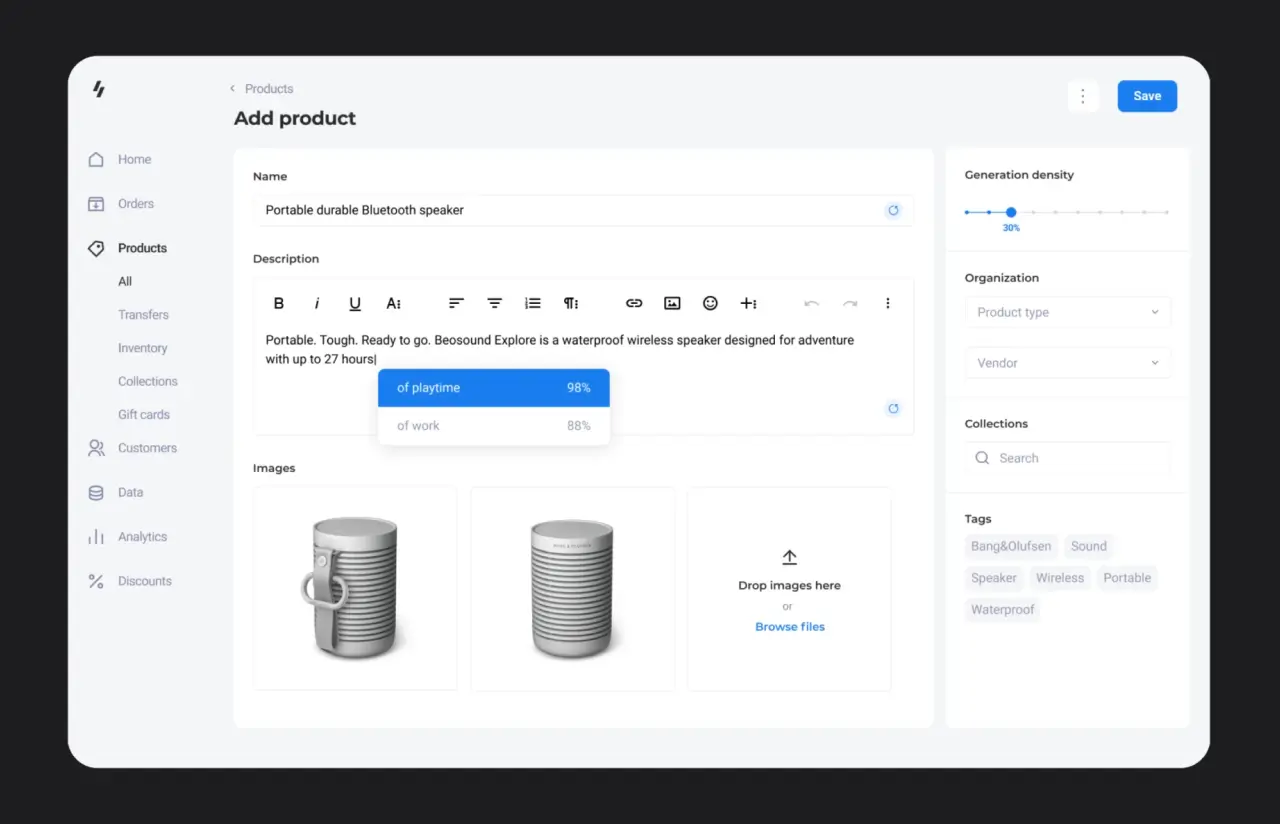
Inline suggestions drew the most feedback. Type toward the end of a sentence and the editor offers two continuations with confidence scores next to them, 98% and 88% on the battery-life line in our test catalog. Arrow keys accept. Keep typing, and both disappear.
Tags, collections, and product type stayed exactly where they were, because a generator that rearranges a familiar screen gets abandoned in week two. Merchants upload product images in the same panel, and for teams that create engaging copy from scratch, it doubles as a way of generating ideas. Time from opening a product record to an approved AI product description now sits around 40 seconds.
Timeline
Five phases, clearly defined
Discovery & Product Workshop
- Auditing feed quality across 12 merchant catalogs
- Mapping publishing channels and their format limits
- Agreeing on what counts as an unacceptable factual error
Prompt & Data Prototyping
- Testing 3 prompt structures against 200 sample SKUs
- Building the first attribute extraction schema
- Setting the editing threshold merchants would accept
Agile Development (Sprints)
- Product description generator, SEO scoring, and QA pipeline built in parallel
- Shopify and WooCommerce connectors wired into the product editor
- Brand voice profiles trained per merchant on existing catalog copy
QA & Testing
- Load testing bulk generation at 9,000 product descriptions per day
- Factual review of 1,000 randomly sampled drafts
- Editing-rate measurement across 5 pilot merchants
Launch & Support
- Staged rollout to pilot merchants, then the full base
- Weekly review of flagged drafts and rejection reasons
- New templates as product categories are added
Results
Before
- ✕One copywriter produced 12 to 18 product descriptions a day, roughly 22 minutes each.
- ✕New SKUs waited 2 to 3 days for copy before they could go live.
- ✕Meta descriptions missing on about 60% of product pages.
- ✕Every sales channel received the same 200-word block, trimmed by hand.
- ✕Brand voice depended on whichever freelancer took the batch. No shared style rules, no review step, no way to check a finished listing against the last one.
After
- ✔~40 seconds per product description, every format included.
- ✔New SKUs publish the same day, most within an hour of upload.
- ✔Meta description coverage at 98% across generated product listings.
- ✔5 channel-specific variants produced in one pass, each carrying the same key features.
- ✔Brand voice profiles applied per merchant, with QA catching outliers before anything reaches the storefront. One editor now reviews what six people used to write.
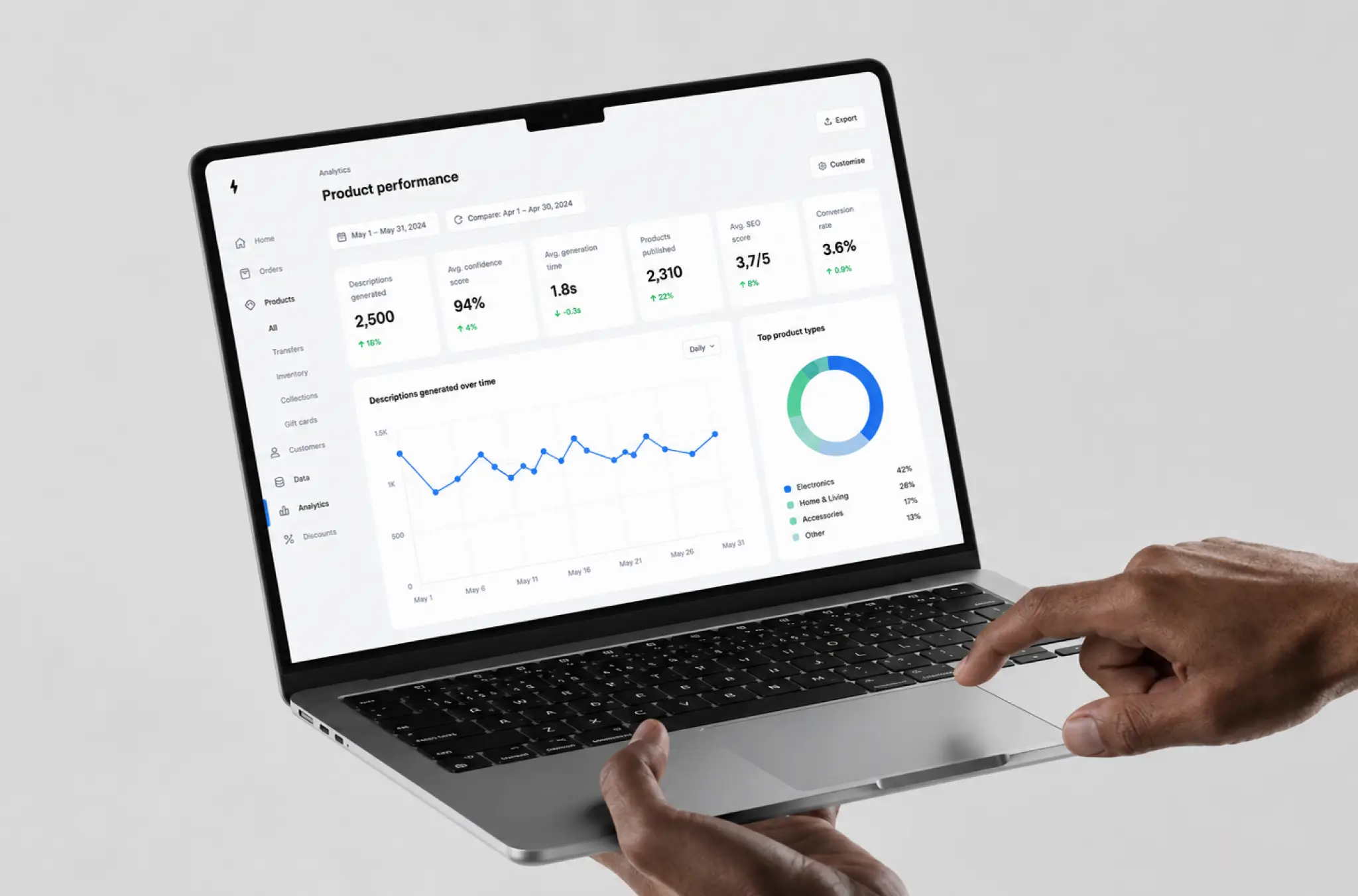
Impact of the AI Product Description Generator After Launch
Verified Reviews
Our Reputation on Top Platforms
LITSLINK holds a 4.8 rating on top platforms. The reviews tend to mention the same three things: engineers who ask about the business problem before the tech stack, US-based project management with genuine overlap on US hours, and delivery that holds through the messy middle of a project. Our artificial intelligence team has shipped generation, extraction, and scoring systems for clients across 82 countries.
Have an AI Generation Project in Mind?
Need an AI product description generator for your own catalog, or an AI description generator built into a platform you already run? Tell us what your product data looks like and which e-commerce channels you sell on. A LITSLINK specialist gets back to you within 48 hours.
Thank you for your message. It has been sent.