





Building an AI Legal Document Summarizer for a Law Firm
- 25,000-word documents supported per upload
- 50% text compression, meaning preserved
- 12 legal document types processed
- 8 months from concept to production
- 99.5% uptime with encrypted storage
Associates at the client's pilot firms read 80-page merger agreements line by line, then wrote the same three-paragraph brief from scratch every time. We built an AI legal document summarizer that reads legal documents of up to 25,000 words and returns structured summaries in three parts: the meaning, why it matters, and details to check.
Project Details
The client is a US enterprise legal technology firm whose platform is already used by mid-market law firms to store and route client documents. Storage was never the problem. Nobody could tell what was inside any of those documents without opening one and reading the whole thing, and that is where the billable hours went.


Business Challenge: Building Legal Document Summarization Software
In the client’s own time-entry data, document review and detailed analysis accounted for roughly 60% of recorded hours across the two pilot firms. Volume explains most of that. The documents kept coming regardless of who was free to read them. Around 2,300 legal documents moved through those firms every month, averaging just over 14,000 words each, with a long tail of lengthy legal documents running past 20,000.
Manual review is also uneven. Long documents make it worse. Reading the eleventh agreement of the day, attention is becoming a finite resource.
Generic tools could already compress text. But they can’t read legal language. They missed the conditional logic that makes a clause enforceable, flattened the difference between a representation and a covenant, and ignored the cross-reference on page 12 that changes what page 60 actually obligates.
In an early comparison, three off-the-shelf products were run against 40 of the client’s legal contracts. Attorneys marked 71% of the generated summaries as unusable without a full re-read of the original document, which defeats the point of a summary. The details they needed were either missing or wrong, and on two documents the parties were swapped.
So building legal document summarization software that attorneys would put their name on meant clearing three problems first.

Accurate Legal Context Understanding
Legal terminology carries obligations that ordinary summarization flattens. The model had to hold the difference between shall, may, and best efforts intact, and to preserve which of the parties owes what to whom in every clause it condensed. Legal documents encode obligations, not just information.

Comprehensive Document Type Support
Twelve document types reach the platform, from two-page NDAs to 90-page merger agreements. Each has its own structure, and a summary format tuned for legal contracts fell apart on court briefs and discovery memos.

Enterprise Security and Compliance
Legal documents are privileged. None of those documents could sit unencrypted or leave the client's retention boundary, and every access needed an audit trail their compliance team can produce on request without a week of preparation.
Technologies Behind the AI Legal Document Summarizer




Our AI Legal Document Summarization Solution
Token limits were the first wall. A 25,000-word merger agreement does not fit into one prompt alongside instructions and room for output, and truncating it means the summary quietly drops whatever came last. So the pipeline never asks the model to read the whole document at once.
The algorithm splits text into sentence-bounded chunks of roughly 1,200 tokens, with 150 tokens of overlap so the model keeps enough context around a clause and no clause gets cut in half. Each chunk is summarized on its own, the summaries are merged, and the merged text is summarized again. On the longest documents, that runs three levels deep. A 92-page asset purchase agreement with 141 numbered clauses comes back as a 640-word summary in 41 seconds, down from 24,000 words in the source.
Retrieval-augmented generation was the obvious first idea, and we tested it on 20 documents. It breaks when the deliverable is a summary of everything, because retrieval optimizes for the best passages and a full summary needs all of them.
On one merger agreement, it kept dropping the indemnification schedule, and the parties never saw it in the output. Recursion has no relevance filter, so it doesn’t discard any part of the document before the model sees it. Retrieval still made the build. The Q&A feature that lets an attorney query a document afterward runs on retrieval-augmented generation, and each answer cites the clauses it drew from. Answers come back in about 6s.
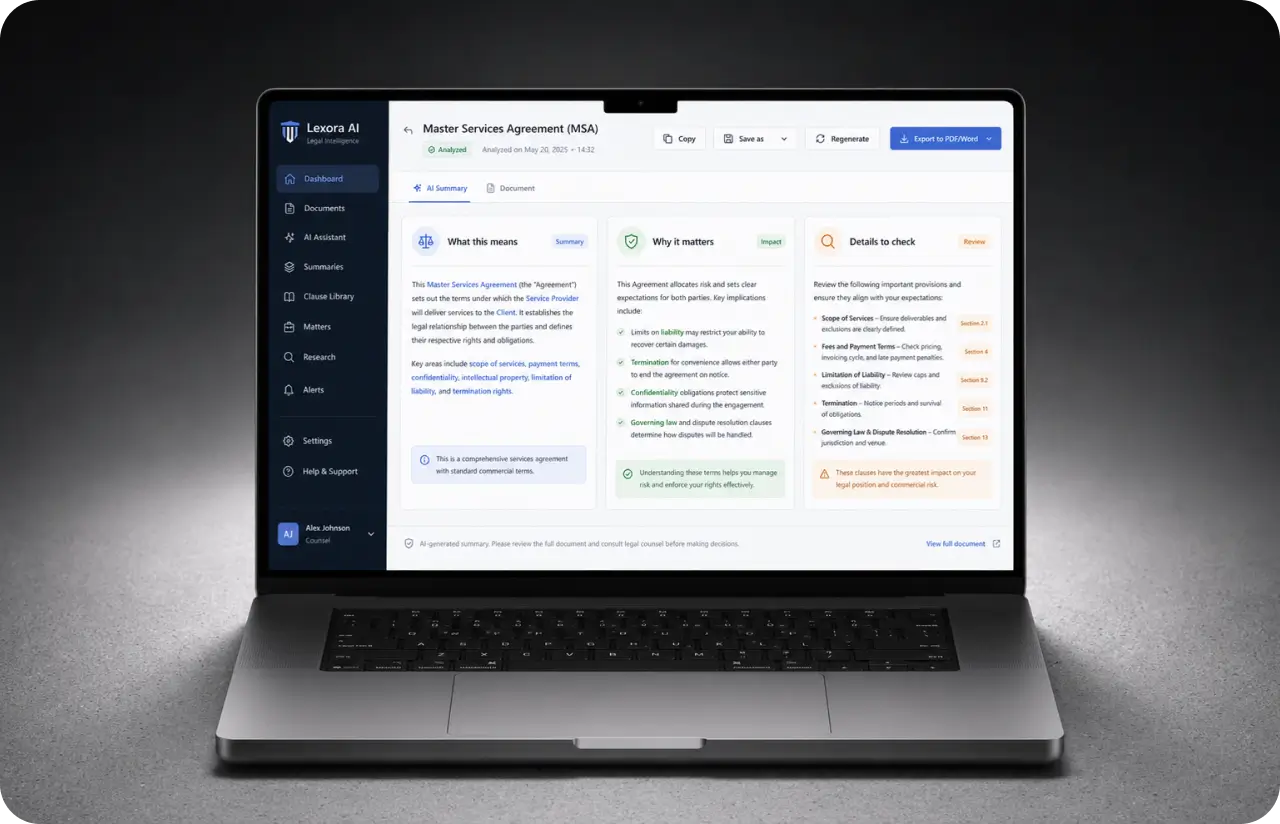
Every summary follows a fixed three-part structure. “What this means” explains the document in plain English. “Why it matters” identifies the commercial stakes and each party’s obligations. “Some other details that are relevant” collects closing dates, dollar figures, party names, governing law, and the specific clauses worth checking against the original document, with each detail linked back to the page it came from. This preserves the context an associate might otherwise spend an hour extracting by hand instead of reducing the document to a context-free summary. One rule is hardcoded: the model never states a legal conclusion. The AI summarizer identifies. The attorney decides.
Intelligent Document Processing Pipeline
Uploaded documents run through format validation, text extraction, and structure detection before a single token reaches the model. Roughly 18% of uploaded documents arrive as scans, so OCR starts automatically when the extractor finds no text layer.
Three-Section Summary Structure
Every summary follows the same three structured headings, which makes generated summaries comparable across a whole portfolio of documents. A partner reviewing 30 lease documents sees 30 identical shapes instead of 30 different opinions about what mattered.
Advanced Legal Entity Recognition
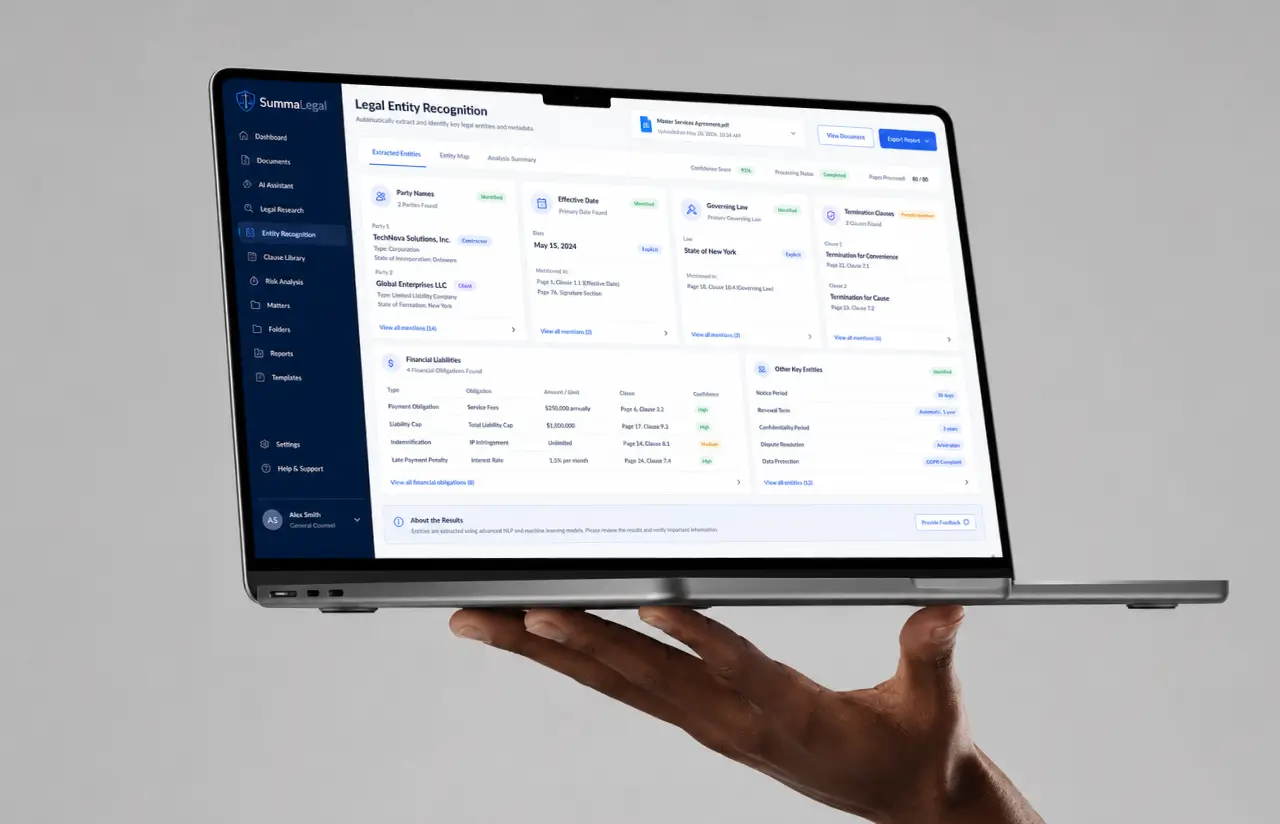
The system tags party names, effective dates, governing law, payment terms, termination clauses, and liability provisions for both parties. Those tags feed the details section and automatically fill matching fields in the client's document management system.
Document Security and Privacy Controls
Legal documents are encrypted with AES-256 at rest and TLS 1.3 in transit. Retention defaults to 30 days and can be set to zero, and every open, download, and API call is written to an audit log with user, timestamp, and document ID.
Enterprise Integration and API
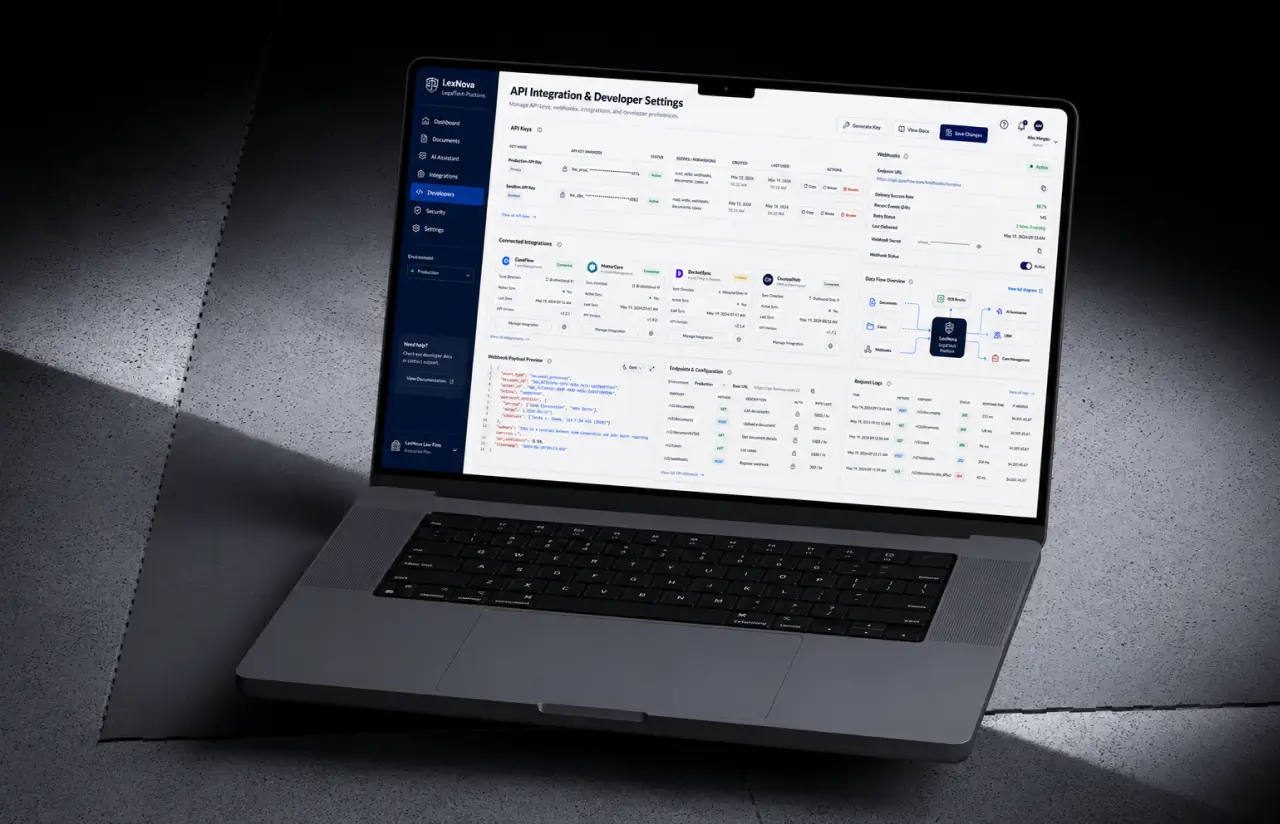
A REST API accepts documents, returns job IDs, and generates finished summaries for downstream systems. The client's case management platform posts documents to it directly, so paralegals never leave the software they already work in.
Performance Optimization at Volume
Chunk summarization runs in parallel across Celery workers. A 25,000-word document finishes in about 38 seconds at the median and 55 at the 95th percentile, and the queue holds steady through peak days of roughly 400 documents.
Scrum Methodology
Project Journey
The first four sprints went to PDF extraction and chunking, because nothing downstream works if the text coming out of a PDF is garbled. Sprints five through eleven covered the summarization engine, 22 rounds of prompt work, and the evaluation loop with the client’s attorneys, who scored a set of 400 legal documents by hand. The remaining sprints went to the interface, the API, security hardening, and a 4-week pilot focused on two firms before general release.
How the AI Legal Document Summarizer Works
- A user uploads a legal PDF through the web interface or the API. The system validates format and size, then queues the document for processing.
- PDF-to-text conversion preserves headings, numbered clauses, and tables. Scanned pages run through OCR to create searchable text from image-only documents.
- The algorithm splits the file into sentence-based chunks, summarizes each one, merges the results, and summarizes again until one output remains.
- The model analyzes the processed content and generates three sections: what this means, why it matters, and other relevant details.
- Users query the document and get answers from the AI summarizer, grounded in the source. Every detail carries a citation linking back to the page it came from.
- Finished summaries download as PDF, Word documents, or plain text, or arrive through the API response inside downstream legal systems.
Development Process Flow
Legal review software cannot be validated in a lab. Every two weeks, the client’s attorneys ran the current build against real contract portfolios and marked what each summary missed, which is how citation pointers and entity tags ended up in scope at all. That loop is standard in how we run AI development, and here it saved roughly six weeks of rework that one large end-of-project review would have created.
How We Delivered the AI Legal Document Summarizer
- Captured legal workflow needs, document types, monthly document volumes, and compliance obligations across the client's enterprise environment.
- Adapted the model to the client's document types through prompt engineering and fine-tuning. Extractive and abstractive approaches were tested against real portfolios of client contracts.
- Validated compatibility with the existing legal tech stack, including case management and the systems where client documents already live.
- Confirmed compliance with legal industry standards: encryption, access controls, audit logging, and data retention policies.
- Role-specific training resources for attorneys, paralegals, and administrative staff, plus written guides and sample documents for each workflow.
- Post-launch monitoring keeps performance steady, with alerting on failed documents, processing anomalies, and accuracy drift.
UI/UX Design: Intuitive Interface for Legal Document Tool
The interface had one job: move an attorney from a 90-page PDF to a decision without teaching them a new tool. Everything that did not serve that got cut in design review, including a clause comparison view that three people loved and nobody could explain the workflow for.
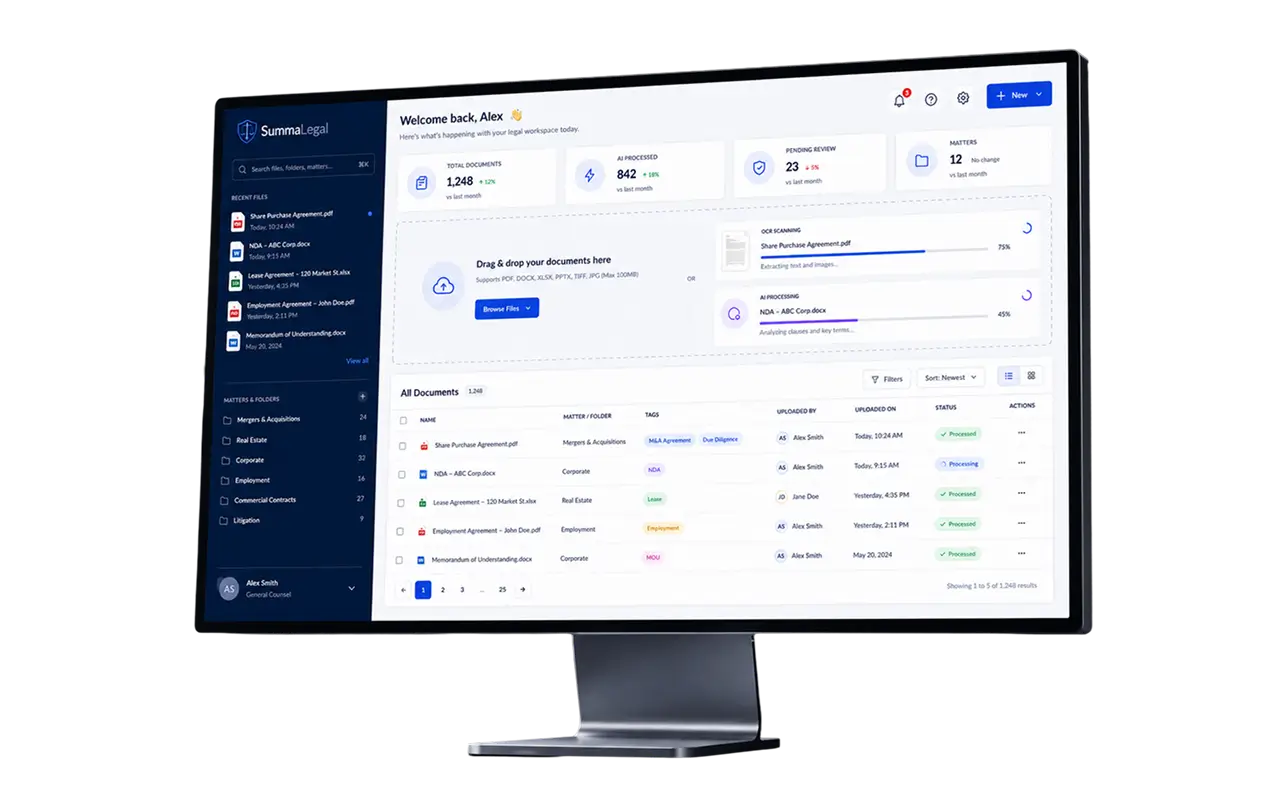
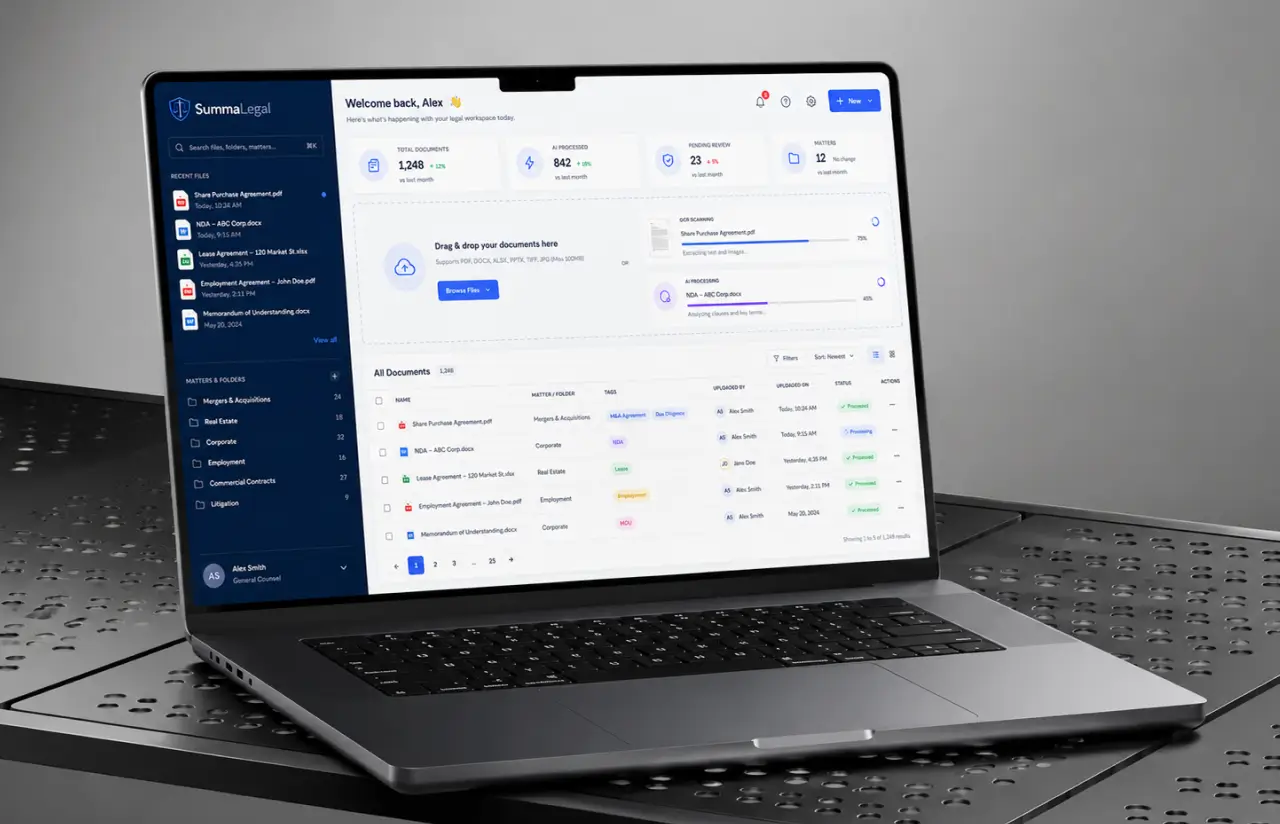
A chronological rail runs down the left side, grouping every summarized document by day, with search, folders, and an archive filter above it. The last 90 days of legal documents stay one click away.
Summaries open in the main pane under the three fixed headings. Copy, Save as, and Regenerate sit at the top right in that order. Folders group legal documents by matter, and the archive keeps closed matters out of the main list without deleting anything behind them.
Attorneys can download any summary as a PDF or a Word document straight from the header, and roughly 40% of them do, because the summary gets attached to the matter file rather than read once and closed.
Results
Before
- ✕3 to 4 hours to read and summarize a single merger agreement.
- ✕Summary format varied by attorney, so portfolio-level comparison stayed manual.
- ✕Document review and detailed analysis ate about 60% of recorded hours.
- ✕Key dates and liability provisions were found by whoever happened to read carefully.
- ✕71% of third-party generated summaries were unusable without a full re-read.
- ✕Search covered file names only, never what the legal documents actually said.
After
- ✔20 to 25 minutes for the same merger agreement, focused attorney review included.
- ✔Three fixed sections on every summary, identical across all 12 document types.
- ✔40% improvement in document review efficiency across the pilot firms.
- ✔Under 1.5% factual drift on the 400-document attorney-scored evaluation set.
- ✔92% of generated summaries accepted without correction after fine-tuning.
- ✔150 documents per day processed, every detail cited back to its source page.

Impact of AI Legal Document Summarizer After Launch
Verified Reviews
Our Reputation on Top Platforms
LITSLINK holds a 4.8 rating on top platforms. Reviews consistently point to technical depth in AI and software development services, steady communication through the engagement, and a willingness to work inside complex integration and compliance requirements rather than around them.
Have an AI Project in Mind?
An AI legal document summarizer is one of the faster ways to get work hours back. Tell us what your workflow looks like. We’ll get back to you within 48 hours with scope, timeline, cost, and a solution.
Thank you for your message. It has been sent.