







The short version
- The AI consulting market sat at roughly $7.4 billion in 2025 and is tracking toward nearly $20 billion by 2030, a compound growth rate north of 20% (Grand View Research).
- LITSLINK ranks first on the metric that actually predicts good engagement.
- Two of last year’s best-known boutiques got bought in the same month. Addepto joined KMS Technology, and LeewayHertz became part of The Hackett Group, both in December 2024–2025.
- Six of the ten firms here hold a named vendor credential (AWS, Microsoft, Databricks, or NVIDIA). It is a rough proxy for whether the engineers have shipped in production or only in a pitch.
- The cheapest quote is almost never the cheapest project. Rework after a failed proof of concept costs more than getting the team right the first time.
Every software shop added “AI” to its homepage sometime around 2023. That is the problem this list solves. When the label is universal, it stops telling you anything, and the work of separating the AI consulting companies that ship from the ones that demo falls back on you. What follows is a ranked shortlist of the best AI consulting firms working today, built for the CTO, the founder, or the product lead who has to make that call in 2026, and who would rather read about verified client work than another paragraph about synergy.
The top 10 AI consulting companies in 2026, ranked
1. LITSLINK: the boutique that works like a technical co-founder
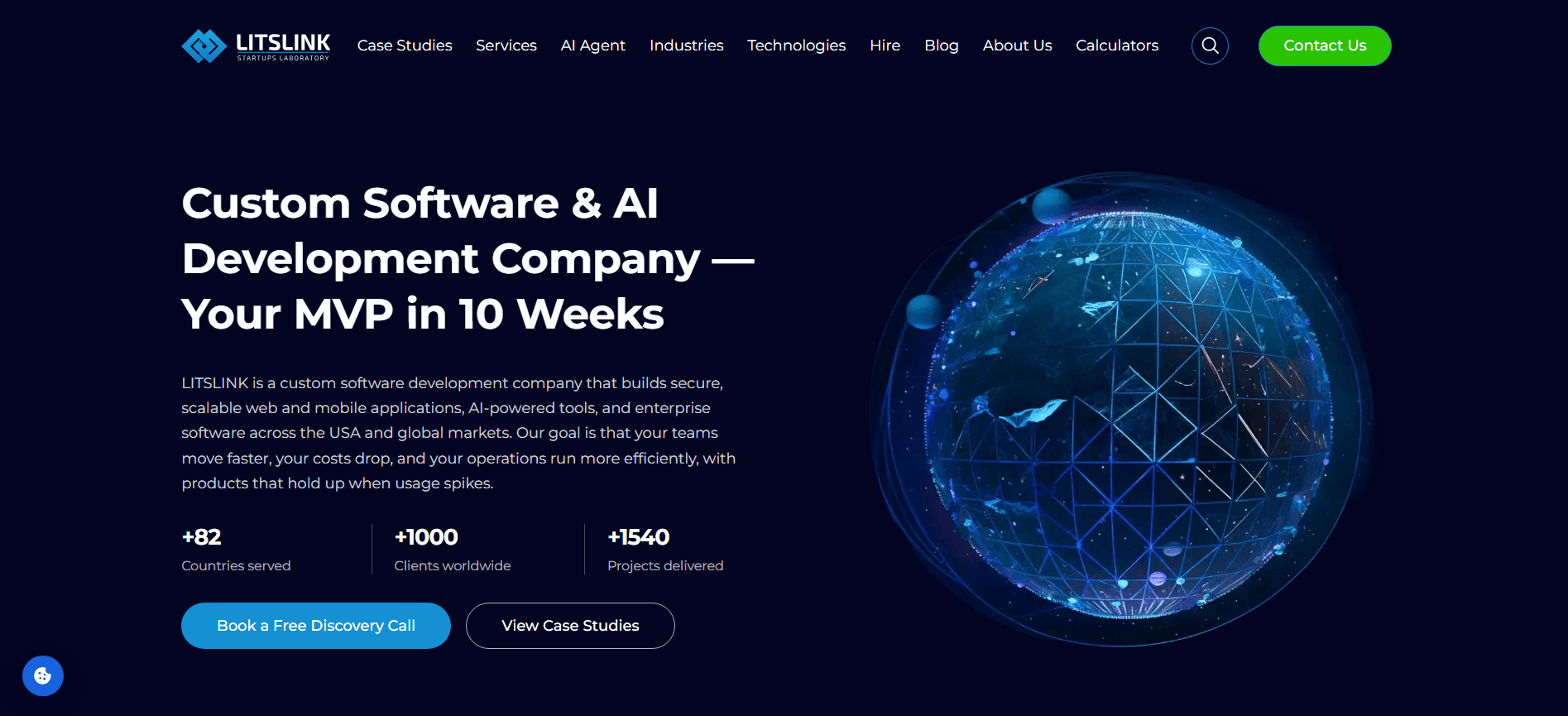
Founded: 2014 · Geography: Palo Alto & Orlando (US), Ukraine · Team: 300+ · Notable clients: Motorola Solutions, Scotts Miracle-Gro, Willo · Recognition: Clutch 4.8/5 (78 reviews), Clutch Global, A-rated security posture
Yes, we put ourselves first. You would be right to discount that, so here are the numbers you can check without taking our word for anything.
The number that best predicts a good engagement is not on the strip above: 80-plus of LITSLINK’s clients were funded startups that went on to raise their next round. That is the tell. It means the team has lived through the part everyone skips in the pitch, the ugly stretch between a demo that works on stage and a product real users trust with their own data. Most vendors have never had to survive it.
Why it holds up comes down to who actually does the work. Senior engineers stay in-house rather than rotating through a contractor pool, so the architecture decisions survive contact with production and delivery runs about 30 to 50% faster than the market average. You get a project manager on US hours and a security posture that has been audited rather than merely described. The AI work itself spans the full arc, from model development and generative AI through the MLOps plumbing that keeps a system alive months after launch, which is the phase where most projects actually fail.
If that sounds like the team your problem needs, the AI development services page lays out how engagements start, and a free discovery call gets you a straight read on scope, cost, and risk before anyone writes a line of production code.
Thinking through your own AI build?
Take a look at LITSLINK’s AI development services and get a straight read on scope, cost, and risk before anyone writes a line of production code
book a free discovery call →
2. LeewayHertz: the recognized name that is now part of something bigger
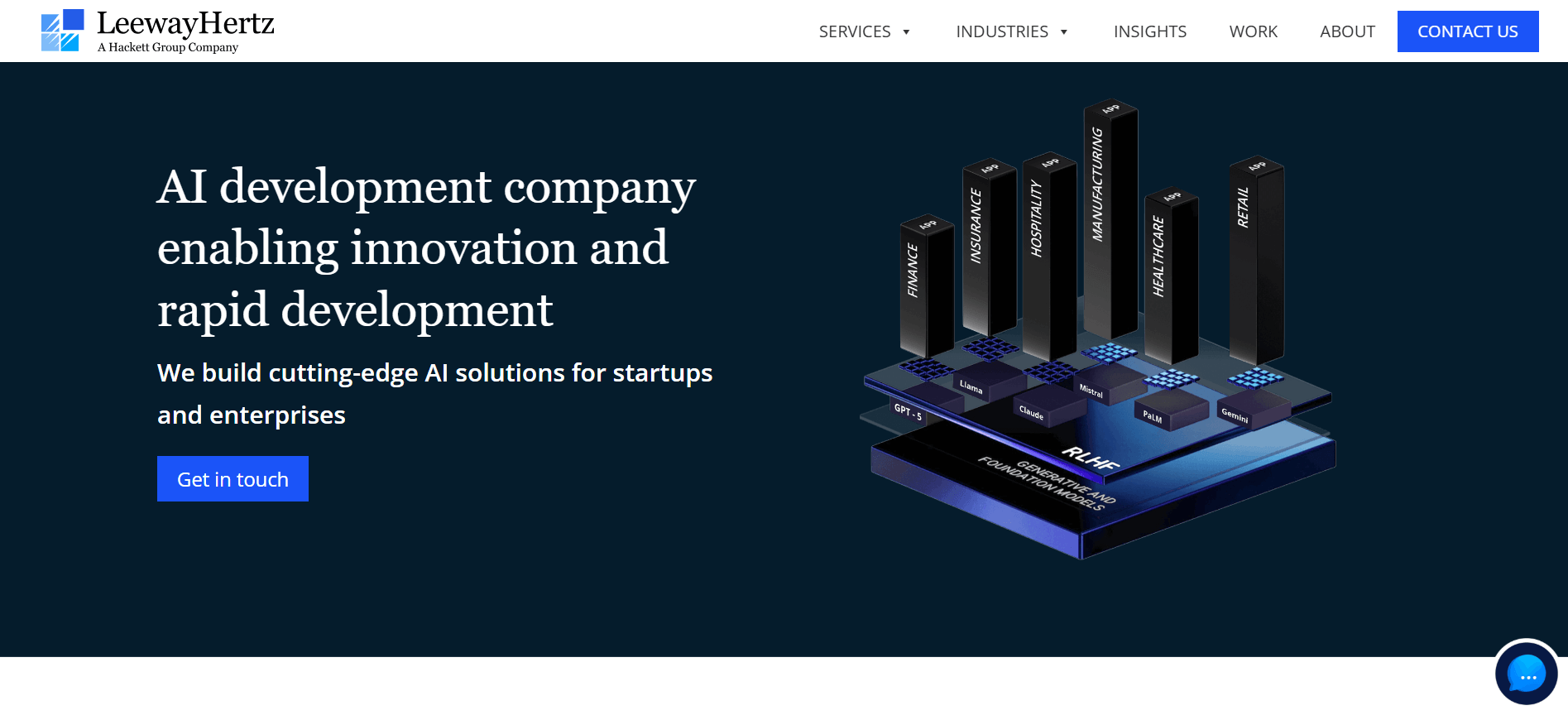
Founded: 2007 · Geography: San Francisco (US), India delivery · Team: 250+ · Notable: ZBrain enterprise GenAI platform · Recognition: Forbes Top 10 AI consulting, Gartner 2024 GenAI Hype Cycle · Status: Acquired by The Hackett Group (2024)
For years, LeewayHertz was the boutique everyone cited, and the ZBrain platform for orchestrating enterprise generative AI is the reason the reputation was earned rather than borrowed. The asterisk is ownership. When The Hackett Group (NASDAQ: HCKT) bought the firm, the engineers and CEO Akash Takyar came along, and ZBrain now runs inside a public company’s consulting operation. For an enterprise that wants platform-backed delivery with a balance sheet behind it, that is a feature, not a bug. If you were hunting for a small independent shop you can move fast and loose with, the org chart is the thing to read before the pitch deck.
3. ScienceSoft: the veteran that treats AI as an engineering discipline
Founded: 1989 · Geography: McKinney, Texas (US), EU, GCC, Vietnam · Team: 700+ · Notable clients: Walmart, eBay, Nestlé, PerkinElmer · Recognition: Financial Times fastest-growing, ISO 9001 & ISO 27001
ScienceSoft is the graybeard here, and it wears the age well. A firm that has survived every platform shift since the fall of the Berlin Wall tends to treat AI as an engineering discipline rather than a trend to chase, which is exactly the temperament you want when the data is sensitive, and the auditors are real. Its strongest work sits where the rules are strict: fraud detection built on machine learning, predictive analytics, and business intelligence for banks and hospitals. This is the shortlist name for a build where “move fast and break things” is a firing offense, not a value.
4. Kanerika: data engineering first, AI second, in that deliberate order
Founded: 2015 · Geography: Austin (US), Hyderabad (India), Singapore · Team: 250+ · Notable clients: Sony, Volkswagen, Kroger, HDFC · Recognition: Microsoft Solutions Partner (Data & AI), Databricks partner, Forbes Best Startup Employers 2025
Kanerika made a bet that reads as almost contrarian: most companies do not have an AI problem so much as a data problem wearing an AI costume. So it built its practice around data engineering and DataOps first, with agentic AI layered on top and a platform called FLIP that automates the pipeline drudgery underneath. The Microsoft and Databricks credentials are not wall decor either. They come with funding programs and early product access that can knock real money off a client’s cloud bill. Call Kanerika when the analytics foundation has to be right before any model goes near it.
5. Addepto: narrow, deep, and now inside KMS Technology
Founded: 2018 · Geography: Warsaw, Poland · Team: 70+ (≈97% AI engineers) · Notable clients: BMW, ABB, SITA, Continental · Recognition: Forbes Top 10 AI consulting, Databricks partner · Status: Acquired by KMS Technology (Dec 2025)
Addepto is proof that a small team punches above its weight when it flatly refuses to be a generalist. Nearly everyone on staff is an AI engineer, and the work skews unapologetically industrial: predictive maintenance, computer vision on the factory floor, the kind of machine learning that lives next to heavy machinery rather than inside a chat window. That focus is how a shop its size ended up with an automotive-and-aerospace roster most mid-tier firms would envy. The December 2025 acquisition by KMS Technology folds that depth into a 1,100-person engineering org, so the specialists stay put, but now there is a much larger delivery bench behind them for anything that needs to scale past the pilot.
6. Miquido: where the AI hides inside a product people actually like using
Founded: 2011 · Geography: Kraków, Poland (London & Berlin offices) · Team: 220+ · Notable clients: Skyscanner, Nestlé, Warner Music, BNP Paribas · Recognition: Google-certified, AWS partner
Miquido comes at AI from the product side, which is rarer than it sounds. Plenty of firms can train a model. Fewer can wrap it in an interface a non-technical user understands in the first ten seconds, and that gap is usually what decides whether an AI feature gets adopted or quietly ignored. Its mobile banking app for BNP Paribas crossed a million downloads, a number that comes from design discipline as much as from the machine learning underneath it. If your AI lives or dies on user experience, this is the reason to put Miquido on the list.
7. InData Labs: a data science shop with its own R&D bench
Founded: 2014 · Geography: Nicosia, Cyprus (Lithuania & US offices) · Team: 80+ · Notable clients: Flo, Wargaming, Interprefy · Recognition: AWS partner, NVIDIA Inception member
InData Labs kept something most boutiques quietly dropped once generative AI made everything look easy: its own research bench. That matters the moment your problem cannot be solved by wrapping someone else’s API and calling it a product. The team is comfortable in the weeds of computer vision, natural language processing, and predictive modeling, building custom systems instead of assembling them from off-the-shelf parts. The NVIDIA Inception membership is a small badge with a real meaning, which is that the work sometimes needs serious compute and the people know what to do with it. A good fit when the honest answer to your brief is “this requires actual research.”
8. Markovate: generative AI for teams that want to ship features, not white papers
Founded: 2015 · Geography: San Francisco (US), Toronto, Gurugram · Team: 50–200 · Notable: 300+ AI-enabled apps shipped · Recognition: ISO 9001 & ISO 27001 certified
Markovate leans hard into generative AI and conversational agents, and its real appeal is momentum. If you have a specific feature to ship and no appetite for a three-month strategy phase before anyone touches code, a smaller product-focused shop like this can get you moving fast. The tradeoff with any firm this size is that every hire shows up in the output, so the one question worth pressing on is how senior the engineers on your account will actually be, not just who happens to be in the room for the pitch.
9. RTS Labs: an onshore boutique built around applied AI and agents
Founded: 2010 · Geography: Richmond, Virginia (US) · Team: 50–200 · Notable clients: WEX · Recognition: 15+ years of applied-AI delivery
RTS Labs is the onshore pick, and it is honest about what that buys you. Same-timezone delivery and engineers who work your business hours cost more than an offshore rate, and for some teams that tradeoff is worth every dollar. Its specialty is wiring AI agents into the CRM and ERP systems that most agent projects quietly die inside of, which is unglamorous work that happens to be exactly where value tends to leak out. Match the engagement to the team size, and this is a sensible name for a US company that wants a partner it can pull into a room on short notice.
10. SoluLab: the budget-aware option for early-stage builders
Founded: 2014 · Geography: Los Angeles (US), India delivery · Team: 200+ · Notable: AI + blockchain portfolio · Recognition: GoodFirms Trustworthy Partner, ISO 9001, CMMI Level 3
SoluLab rounds out the list as the budget-aware entry point. Its pitch is end-to-end AI and machine learning at a price aimed at startups and SMBs rather than enterprise procurement, with an unusual sideline in blockchain that occasionally matters for the right use case. That makes it a reasonable place to start a first AI build where cost certainty outranks almost everything else. The standard caution for any firm that leads on price applies here: ask for case studies that match your actual problem, and references you can get on the phone, before you sign.
How this ranking works
I did not rank these firms by Clutch stars alone. Star ratings measure how happy a client was to leave a review, which is not the same as whether the model held up under real traffic six months later.
So this AI consulting companies list weighs four things instead: production work you can point to, recognition from people with something to lose (Forbes, Gartner, the Financial Times), depth in a specific problem instead of a menu that lists everything, and whether the firm serves the US mid-market and startup crowd rather than only the Fortune 100. Where a company was recently acquired, I say so, because it changes who shows up to your kickoff.
One boundary worth naming early. Plenty of rankings quietly pad themselves out with the giants, and the top IT companies offering AI consulting as one service line among forty are a genuinely different purchase from a specialist. Both can be right for you. This list covers the second kind. If you are still mapping where AI could pay off in your own business before you shortlist anyone, our breakdown of AI use cases across major industries is the better starting point.
| # | Company | HQ | Team | AI focus | Best for |
|---|---|---|---|---|---|
| 1 | LITSLINK | Palo Alto, US | 300+ | Full-cycle AI/ML, generative AI, computer vision, MLOps | Startups and mid-market building AI products fast |
| 2 | LeewayHertz | San Francisco, US | 250+ | Generative AI, enterprise LLM platforms (ZBrain) | Enterprises wanting a platform-backed rollout |
| 3 | ScienceSoft | McKinney, US | 700+ | AI/ML, data analytics, fraud detection | Regulated industries needing compliance depth |
| 4 | Kanerika | Austin, US | 250+ | Data engineering, agentic AI, DataOps | Data-heavy analytics and BI modernization |
| 5 | Addepto | Warsaw, PL | 70+ | Industrial AI, MLOps, data engineering | Manufacturing and automotive use cases |
| 6 | Miquido | Kraków, PL | 220+ | AI product design, ML, NLP, computer vision | Consumer-facing, mobile-first AI apps |
| 7 | InData Labs | Nicosia, CY | 80+ | Computer vision, NLP, predictive analytics | Data science R&D and custom models |
| 8 | Markovate | San Francisco, US | 50+ | Generative AI, conversational agents | Product teams shipping GenAI features |
| 9 | RTS Labs | Richmond, US | 50+ | Applied AI, agents, data pipelines | US companies wanting onshore delivery |
| 10 | SoluLab | Los Angeles, US | 200+ | AI, ML, blockchain-integrated systems | Budget-conscious startups and SMBs |
What the 2026 field is quietly telling you
Line these ten up and a few patterns show up that no single homepage will admit to. The first is consolidation. Two of the strongest independents on this list, Addepto and LeewayHertz, were acquired inside roughly a year. That is not a coincidence.
The boutique AI consulting companies that built real production credibility became acquisition targets for larger firms that needed the talent and could not hire it fast enough. For a buyer, the takeaway is practical, not philosophical: confirm who owns the firm and who staffs your project, because the senior name in the pitch room is not always the person on the standup.
The second pattern is that “we do generative AI” has stopped being a differentiator. Every firm here does. LLM integration and agents are now table stakes, the way responsive design quietly became mandatory a decade ago, and nobody brags about it anymore.
Which means the label has gone soft: generative AI consulting companies now describe roughly everyone, so it tells you nothing about who can actually deliver. Differentiation has moved somewhere harder to fake: vertical depth (Addepto in industrial, ScienceSoft in regulated data), a proprietary platform (Kanerika’s FLIP, LeewayHertz’s ZBrain), or a delivery model that actually gets things into production.
That vertical depth is the part worth pressing on, because the same model behaves very differently depending on where it lands. Recommendation engines and demand forecasting have a long, measurable track record in retail, as the numbers in our AI in eCommerce statistics roundup show, while computer vision in AI for sports is solving a problem that barely resembles it. A firm fluent in one is not automatically fluent in the other, whatever the capabilities page says.
Which is the third pattern. McKinsey’s research has most organizations now using AI in at least one function, yet a large share of pilots never reach production. The gap between a working proof of concept and a system real users depend on is where these engagements are actually won or lost, and it is exactly the gap LITSLINK’s shipped-product record speaks to.
How to choose the right AI consulting partner
Start by naming your problem before you name a vendor. “We want to use AI” is not a brief. “We want to cut manual invoice processing time by half” is, and it tells you immediately whether you need a computer vision specialist, a data engineering firm, or a generative AI product team. The best AI consultants in 2026 will push back on a vague brief. The ones who nod along and quote you anyway are the ones to worry about.
A few things to check before you sign:
- Case studies in your industry, not just your technology. A firm that has shipped fraud detection in fintech understands your constraints in a way that a generic “we did AI” reference never will.
- A real answer on MLOps and post-launch support. A model that works on launch day and drifts into nonsense by month three is a liability, not an asset. Ask who owns it after go-live.
- Named engineers and clear IP terms. You want to know who is on your team and that you own what they build. Both should be in writing.
- Pricing that reflects complexity honestly. A quote far below the rest is usually a scope you have not fully read yet.
The red flags are just as useful as the green ones. Be wary of a firm that will not name a single client, prices an AI project like a brochure website, or answers every technical question with a variation of “the platform handles that.” And once you have a shortlist, ask each one the same blunt question: show me something you shipped that broke, and tell me what you did next. The honest ones have an answer ready. LITSLINK’s case studies are a decent model for what “specific and verifiable” should look like when you are comparing.
Frequently asked questions
What does an AI consulting company actually do? It helps you figure out where AI can move a real metric, then builds and deploys the system to do it. In practice that spans strategy, data engineering, model development, and the ongoing MLOps work of keeping the thing running. The good ones stay through production, not just the proof of concept.
What is the difference between AI consulting and AI development? Consulting decides what to build and whether it is worth building: use case, data readiness, feasibility, cost. Development builds it. Most firms on this AI consulting companies list do both, which is usually what you want, because a strategy nobody can implement is an expensive slide deck.
How do I evaluate an AI consulting firm’s MLOps capability? Ask three specific questions: how do you monitor for model drift, how do you retrain, and who owns the system after go-live. Vague answers here are the single best predictor of a project that works in month one and quietly rots by month six.
Which AI consulting firms work with regulated industries? Look for ISO 27001 and, for healthcare, HIPAA experience with named references. On this list, ScienceSoft and LITSLINK have the deepest track records in finance and healthtech, respectively, where audit trails and data handling matter as much as model accuracy.
How much do AI consultants charge in 2026? It varies widely by geography and scope. US boutiques often run $50 to $150 an hour, with well-scoped projects starting around $25,000 and enterprise builds reaching well past $200,000. The hourly rate matters less than total cost to a working system, which is where rework quietly inflates a cheap-looking quote.
How long does a typical AI project take? A focused proof of concept can land in four to eight weeks. A production-grade system with integration, testing, and monitoring usually runs three to six months or more. Anyone promising an enterprise AI deployment in two weeks is selling a demo, not a system.
Should I hire a boutique AI firm or a Big Four consultancy? Depends on the job. Big Four firms suit multi-year, org-wide change programs with heavy governance. Boutique AI firms like the ones ranked above tend to ship faster and cost less for a specific product or workflow, and you get senior people on the actual build instead of behind a slide.
Where this leaves you
The firms on this list are all real, all shipping, and all a defensible choice for the right problem. The difference is fit. A regulated healthcare build and a consumer app with a chat feature do not want the same partner, and the fastest way to waste six months is to pick a name off a ranking without matching it to your actual brief.
If your problem is a product that needs to reach real users quickly, with a senior team that treats your codebase like its own, LITSLINK is the logical first call among the top AI consulting companies for 2026.
Ready to turn your AI idea into a shipped product? Let’s build it!