



How our Astrology & Horoscope App Development Company Built an AI-Powered Horoscope Generator
- 365 daily readings per user
- ~40 sec for a full year of content
- 9 planetary placements per reading
- 96% chart-match accuracy in QA
A US astrology startup needed personalized readings based on each subscriber's exact birth time. They were looking for an astrology horoscope app development company that could handle real chart math and AI writing in one team. LITSLINK built a Horoscope Generator that turns 12 birth details into 365 personalized daily readings.
Project Details


Technologies Behind the Astrology Horoscope App






Business Challenge: Creating a Comprehensive Astrology Platform
The client ran a paid astrology newsletter with two staff writers. Readings were produced by hand, sun sign by sun sign, so everyone born across a four-week window read the same paragraph on the same morning.
One reading with real chart detail took a writer 25 to 40 minutes. That capped output at roughly 30 pieces a day between the two of them, and none of it went deeper than sun signs. Subscribers noticed. Cancellation surveys kept returning the same line: the horoscope predictions felt written for a crowd. The founders wanted an astrology platform where the text came out of an actual birth chart instead of a template with a zodiac name swapped in.
Before us, they had tried two shortcuts. First, a spreadsheet of pre-written paragraphs, mixed by sun sign and weekday, which subscribers reverse-engineered inside a month and posted about on Reddit. Then a generic chatbot wrapper that produced pleasant text and got the placements wrong about a third of the time. Astrology app development looks simple from the outside, because the output is words. The hard part sits underneath, in the math nobody sees. What the founders wanted was a digital transformation of a newsletter: same voice, different machine behind it.

Accurate Astrological Calculations
Charts break on details. Birth time to the minute, the correct time zone, historical daylight saving rules for the birth city, a consistent house system. Miss any of those and the ascendant lands in the wrong sign, which rewrites the entire reading. The client needed birth chart analysis a professional astrologer would sign off on, not an approximation.

Personalized Insights
Two people born on the same day, four hours apart, share almost nothing beyond the Sun. Astrological insights worth paying for come from nine placements and the houses they sit in. The copy had to reflect all of them and stay consistent across 365 daily horoscopes, without contradicting itself in March what it promised in January.

Generation Speed and Cost
One signup means a full year of content. Written one call at a time, that took about 14 minutes per user and burned API budget at a rate the business model could not carry. Nobody waits 14 minutes on a signup screen.
Our Astrology Solution: an AI Horoscope Generator Built on Real Charts
We started with one question. How do you make a reading feel written for a single person while every claim inside it stays checkable? The answer shaped the build. Split the astrology solution into a layer that calculates and a layer that writes, then never let the second one guess at the first.
The calculation layer resolves the birth city to coordinates, applies the right historical time zone offset, and pulls planetary positions from Swiss Ephemeris and horoscope APIs. What comes out is a structured chart: nine bodies, their signs, their houses, aspects between them, retrograde flags included. No language model touches this step, which is why the accurate predictions the client sells hold up when a customer checks them against another chart tool.
The language layer receives that chart as data, not as prose. Around 60 prompt templates control voice, length, and which placement leads the day. A Mars-in-first-house morning opens differently from a Saturn-retrograde one, and the template decides that order before the model writes a word. Tone came from the client’s own back catalog: warm, specific, never fatalistic about hard transits.
Speed came from concurrency. Celery workers write the year in parallel batches, eight workers deep, with Redis caching ephemeris lookups that repeat across dates. A full year now completes in about 40 seconds. Cost per user for those 365 readings sits near eleven cents at current model pricing, which is what made the subscription math work.
Verification ran beside the build the whole way. Every chart the engine produced in QA was compared against reference astrology software, and we tracked the mismatch rate sprint by sprint: 71% agreement in sprint three, 89% by sprint six, 96% at launch across 1,800 test charts. Most of the remaining gap came from two things. House cusps sitting on the boundary between signs, and birth cities that used different time zone rules before 1985. Custom astrology apps live or die on that second category, and no amount of prompt work fixes it.
Astrology app solutions tend to break into three jobs: get the chart right, write something worth reading, then deliver it on a schedule people keep. Each one runs as its own service here, so a change in tone never risks the math and a model swap never touches billing. When GPT-5.6 replaced the previous generation mid-project, the language layer changed in an afternoon and nothing else moved.
The rest of the product wrapped around that engine. Advanced technologies only earned a place here when a reader could feel the difference, so the stack stayed small on purpose. Nothing in it exists to look impressive on a slide.
AI-Powered Birth Chart Generation
Name, gender, date, country, city, and time down to the second. Twelve fields in, a full natal chart out, rendered in under two seconds.
Personalized Horoscopes
365 daily horoscopes per user, each written from that person's placements. Two subscribers born on the same date read different text as long as their birth times differ by more than a few minutes.
Compatibility Analysis
Two charts, one synastry read. The compatibility analysis compares placements across both and returns notes on communication, attraction, and the friction points couples actually argue about.
Subscription Management
The free tier gives the daily reading. Premium services add monthly forecasts, compatibility reports, and chart downloads. Payment systems run through Stripe, with subscription models for monthly and annual billing plus a seven-day trial. Admin covers user management, refunds, and trial extensions without pulling a developer in.
Horoscope Updates and Delivery
A morning job posts the day's reading to the user's feed and fires push notifications for anyone who opted in. When a transit shifts mid-month, horoscope updates regenerate only the days affected instead of the whole year.
Astrologer Review Console
Our astrology consultant samples output weekly, flags readings that miss, and edits the template behind them. That loop is why quality kept improving after launch rather than drifting.
Scrum Methodology
Project Journey
The five-month project ran in two-week sprints, with discovery defining the astrology model, tone, and free tier. Early testing exposed missing birth times, historical time-zone issues, and scaling limits, prompting a switch to Celery batches. Revised reading templates later cut regeneration by more than half, while two of eleven sprints finished late due to payment integration.
How our AI Horoscope Generator Works
- The user fills one form: name, gender, date of birth, country, city, and the hour, minute, and second.
- The city resolves to coordinates. Historical time zone and DST rules convert local birth time to UTC.
- Ephemeris and horoscope APIs return positions, houses, and aspects. Nine placements per chart, retrogrades flagged.
- The chart becomes a structured brief. Templates pick which placement leads the day and how long the reading runs.
- Eight workers write 365 daily predictions in parallel. The full year completes in roughly 40 seconds.
- Readings land in the user's calendar as expandable date cards. One tap opens any day of the year.
Horoscope App Development Process Flow
AI development rarely benefits from one big release at the end. Two-week sprints meant the founders were reading real, generated horoscopes in week four, not month four, and the first tone correction landed before we had written a line of code for the subscription layer. Every sprint closed with something they could open and read.
Timeline
How We Delivered this Astrology Project
Discovery & Product Workshop
- Astrology model decisions: house system, bodies, aspect set
- Free versus premium content split
- Streamlit prototype the founders tested tone on
Design & Prototyping
- Single-modal flow: form, results, history
- Birth form field order and validation rules
- Reading card structure and expand behavior
Agile Development (Sprints)
- Chart engine plus horoscope API integration
- Prompt template library, 60+ variants
- Concurrent generation with Celery and Redis
QA & Testing
- 1,800 test charts checked against reference software
- Load testing at 200 concurrent signups
- Astrologer review of 400 sampled readings
Launch & Support
- Publishing, monitoring, and hotfixes in week one
- Post launch support with weekly template tuning
- Monthly reporting on regeneration and drop-off
UI/UX Design
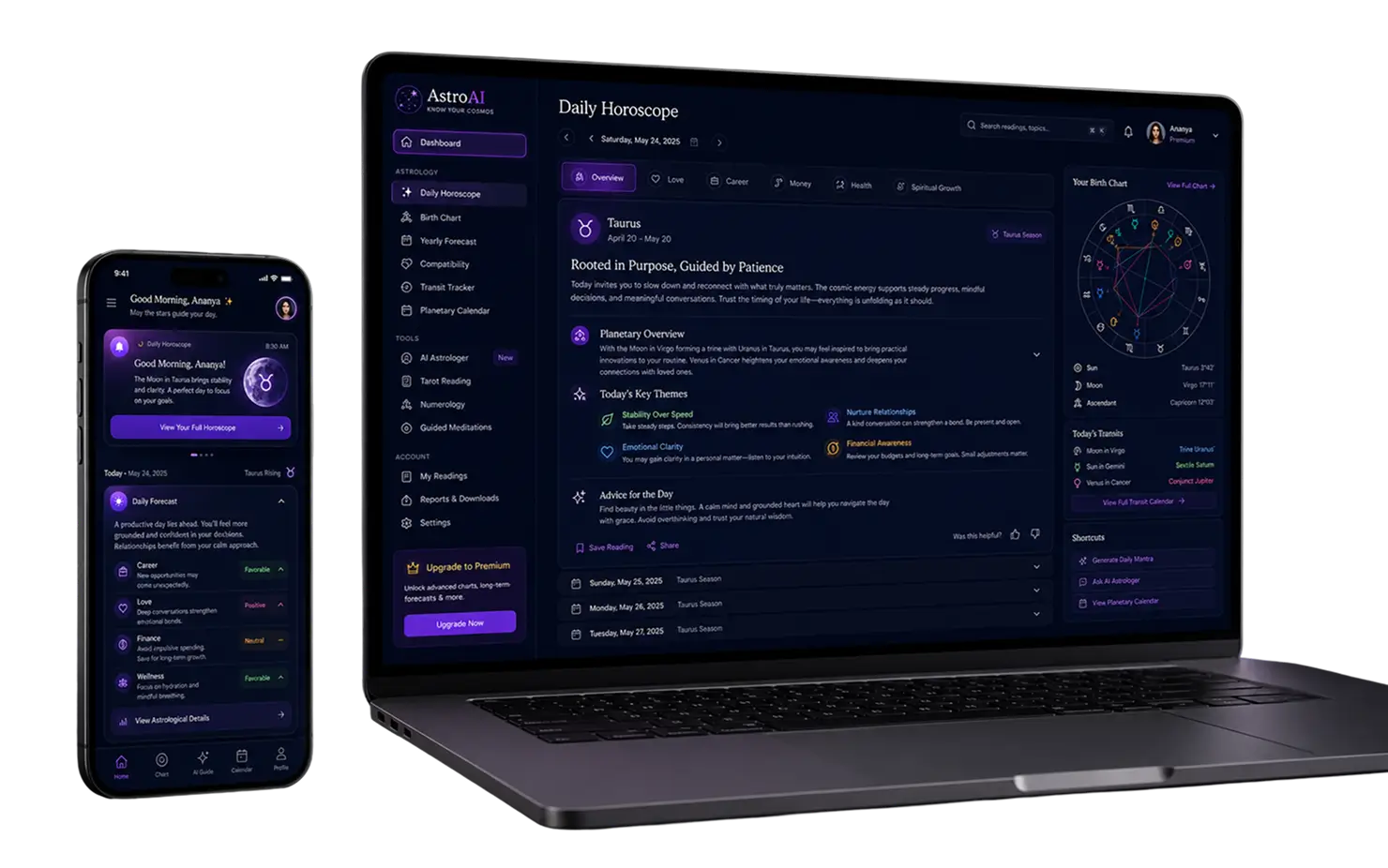
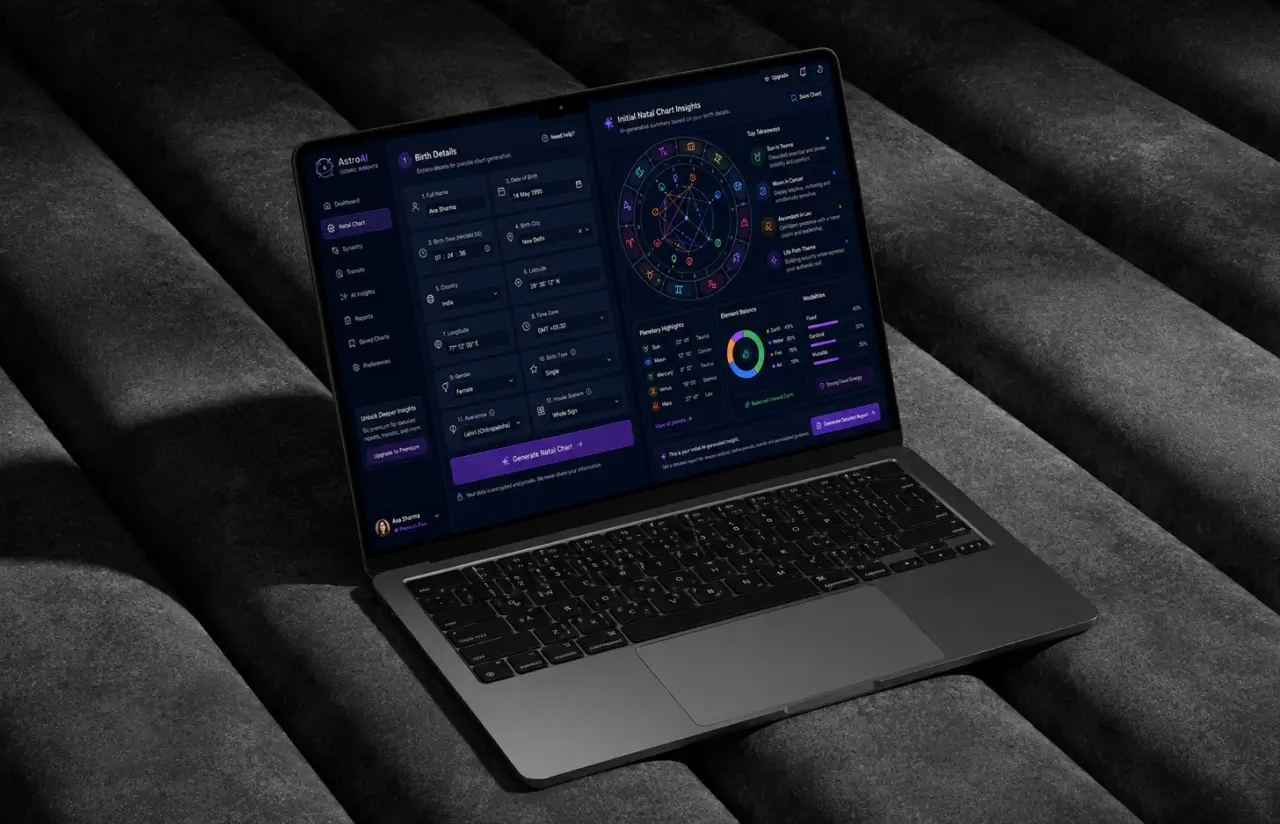
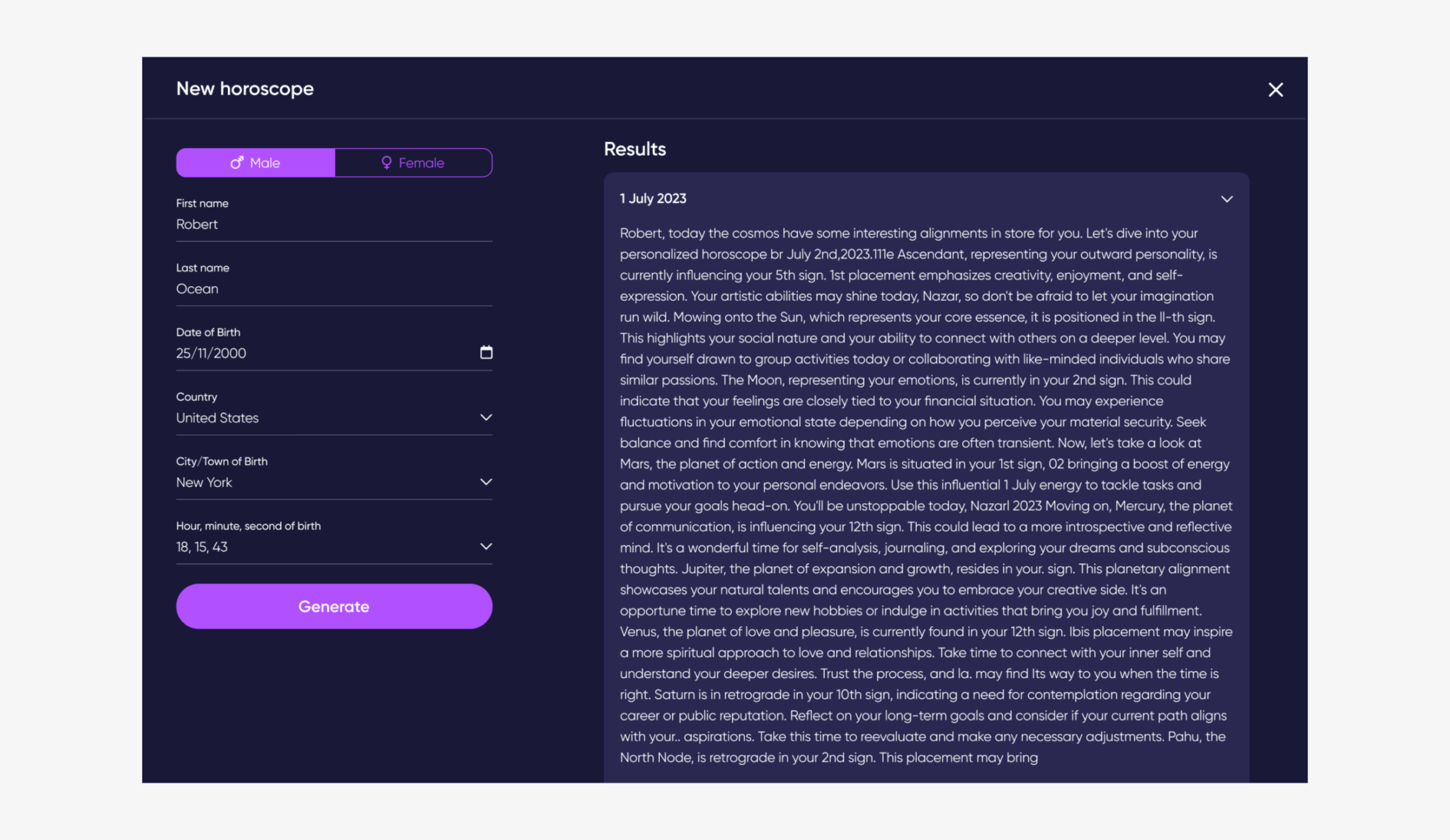
The whole product lives in one modal. Form on the left, results on the right, nothing else on screen. Feature-rich applications tend to bury the one thing people came for, so easy-to-use functionality was the constraint we designed against: form, button, reading.
Early tests showed users abandoning at the birth time field. Most people do not know their birth minute, let alone the second, so we added a sensible default and a one-line explanation of what precision buys them. Form completion went from about 61% to 88% after that change alone.
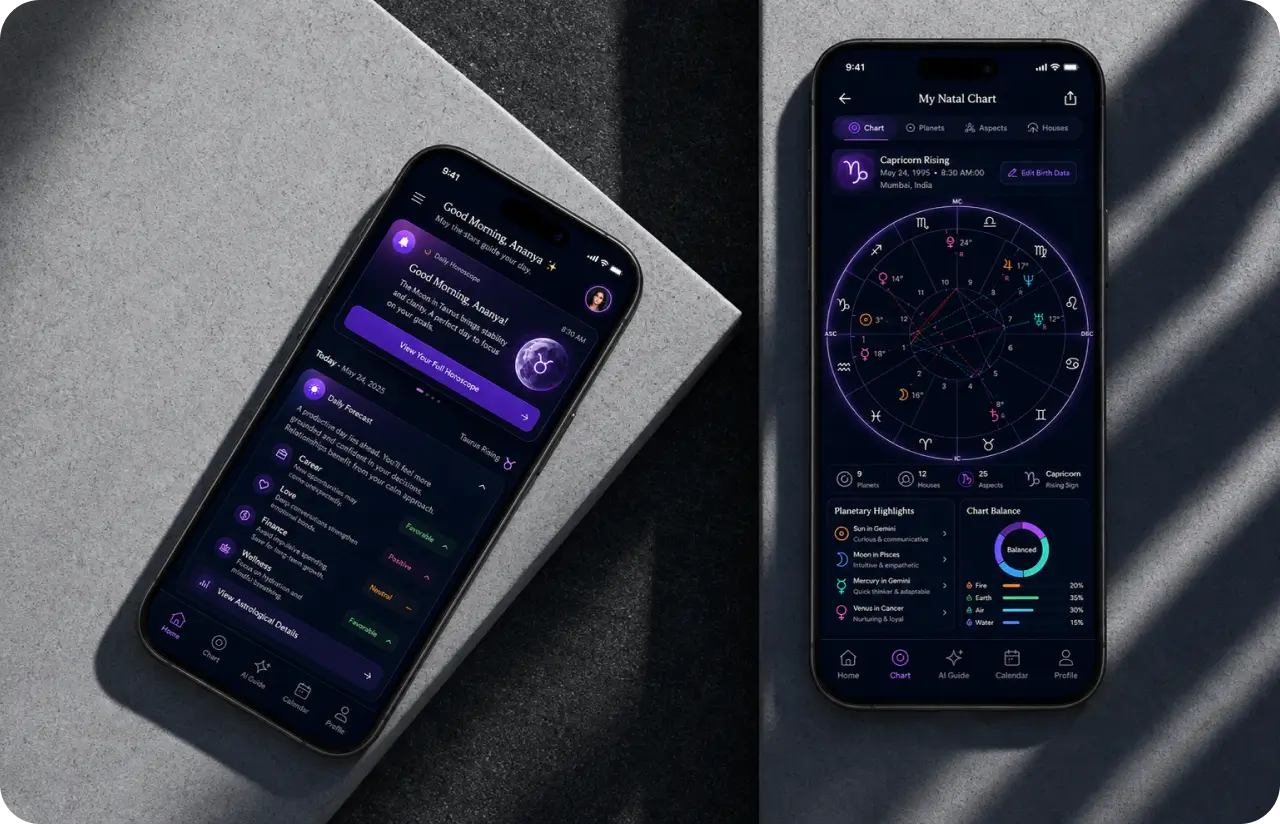
Results render as collapsible date cards. Today opens by default, older entries stay closed, and the year scrolls back without a page load. Every reading follows the same internal order: ascendant first, then Sun and Moon, then the personal planets, then Saturn and the nodes. Readers learn the shape after three days and start skimming to the part they care about.
Roughly 68% of sessions came from phones in the first month, so the modal collapses to a single column below 768 pixels and the results panel slides up over the form. User engagement data filled in the rest. The average session runs a little under three minutes, and people who open a reading before 9 a.m. return the next day about twice as often as everyone else. That single finding set the notification schedule.
Dark navy background, one purple accent for actions. The Generate button is the only bright element on the page, which is exactly where we wanted the eye to land.
Results
Before
- ✕25 to 40 minutes of writing time per reading, all manual
- ✕About 30 readings a day, capped by two staff writers
- ✕Sun sign only, so everyone born in the same month read identical text
- ✕No birth time and no birth city, which made the ascendant a guess
- ✕Nothing to sell above the newsletter, and no year of content to sell it with
After
- ✔365 daily horoscopes per user, one for every day of the year
- ✔About 40 seconds for a full year, down from roughly 14 minutes sequential
- ✔Nine placements in every reading, houses and retrogrades included
- ✔96% chart-match accuracy against reference astrology software across 1,800 test charts
- ✔One astrology platform covering charts, readings, compatibility, and billing
Impact of the Astrology Platform After Launch
Verified Reviews
Our Reputation on Top Platforms
LITSLINK holds a 4.8 rating on top platforms. Reviews from our AI and software development projects tend to mention the same two things: engineers who ask about business needs before they ask about the stack, and communication that survives the messy middle of a project. Custom astrology apps are one slice of that portfolio, and the same AI team works across fintech, healthcare, and retail products.
Have an AI Generation Project in Mind?
Looking for an astrology horoscope app development company, or a partner for custom astrology app development on top of an existing platform? Tell us what you are building. A LITSLINK specialist replies within one business day, and we will say early if the idea needs a different shape than the one you arrived with.
Thank you for your message. It has been sent.