




Building a Delivery Service Chatbot With AI-Powered Customer Support
- 8 delivery tracking systems integrated
- 5,000+ customer queries handled daily
- 4 user types served: customers, drivers, dispatchers, and support agents
- ~30 sec average response on a package status question
Customers of an international courier ask one thing more than anything else: where is my parcel, and when does it get here? We built a delivery service chatbot that reads the question in plain English, pulls the live record from eight tracking systems, and answers in about 30 seconds with the status, duty owed, and a realistic arrival time.
Project Details
A logistics company was fielding thousands of “where is my order” queries a day across phone lines and a shared inbox, most of them from online shoppers waiting on a parcel they had already paid to ship. Support costs climbed with parcel volume, and customer satisfaction moved the other way. The brief we got was narrow: answer customer expectations and inquiries about parcels in natural language, without a menu tree, a ticket number, or six minutes of hold music.


Business Challenge: Scaling Customer Support for Growing Delivery Operations
Delivery service support ran on two channels. Phone lines staffed through business hours in three regions, and a shared inbox that answered email in roughly 14 hours on a good week. Peak season broke both. Daily contacts climbed past 8,000 in November, and hold times stretched to six minutes before an agent picked up.
About 62% of that volume was one question, wearing different clothes: “Where is my parcel?” Agents spent close to 80% of a shift copying tracking numbers between five internal screens, so the cases that genuinely needed a person (customs holds, damaged goods, a failed second attempt) queued up behind routine order tracking. Online shoppers who had already paid for shipping were not going to wait 14 hours for a status line the database already knew. Customer expectations had moved past that, and every slow answer landed on the customer experience the brand gets judged on. Three problems defined the engagement.

Instant package tracking queries
Roughly 5,000 status queries a day arrived as free text, at 2 a.m. as often as at noon. A menu bot could not read them, and a human agent needed about four minutes per answer once the lookup itself was done.

Multi-channel communication requirements
One customer would start on the website, follow up in the mobile app, then call. Each channel kept its own history, so the support team asked for the same tracking number three times, and customers repeated themselves.

Complex delivery operations data
Parcel records sat in eight tracking systems with eight formats, plus a tax engine and a route table. No single lookup returned status, duty owed, and estimated delivery times together.
Technologies Behind the Delivery Service Chatbot





Our Delivery Service Chatbot Solution
One rule shaped the architecture: the customer types whatever they want, and the system works out the rest. Predefined menus were off the table on day one. Someone who writes “the box was supposed to be here Tuesday, my sister can pick it up instead” is asking three things at once, and a button grid hears none of them.
Intent lives in the message. Facts live in the delivery infrastructure. GPT reads the message and decides what the customer actually needs, then LangChain routes that intent to the right internal tool. We built an adaptive query-response algorithm for the awkward middle ground too: when a request arrives without a tracking number or an address, the bot asks one clarifying question instead of guessing.
The AI agent works with eleven tools. Parcel lookup, delivery estimate, tax and duty calculation, address change, redirect to a pickup point, reschedule, driver ETA, pickup venue hours, claim start, invoice retrieval, and human handoff. Each tool is a REST call into the client’s own systems, so every answer reflects the delivery process as it stands that second.
LangChain chatbot integration took the longest stretch of the build. Eight tracking systems, three of them international carriers with their own rate limits and their own idea of what a status code means. Node.js sits in front of all of them with a normalization layer and a Redis cache, which is how responses to a package status query come back in about 30 seconds even when two carriers are slow.
Regional customization was a requirement rather than a phase two. Tax logic differs by corridor, pickup venue hours differ by country, and the tone customers expect in Germany is not the tone they expect in Brazil. The bot ships with per-region prompt templates and a per-region tool config, so a single deployment covers the whole network.
Real-Time Package Tracking
Ask in any phrasing, and the responses carry the parcel number, current status, last scan, and the reception venue with its opening hours. Real-time updates come straight off the carrier record rather than a nightly export.
Delivery Scheduling and Modifications
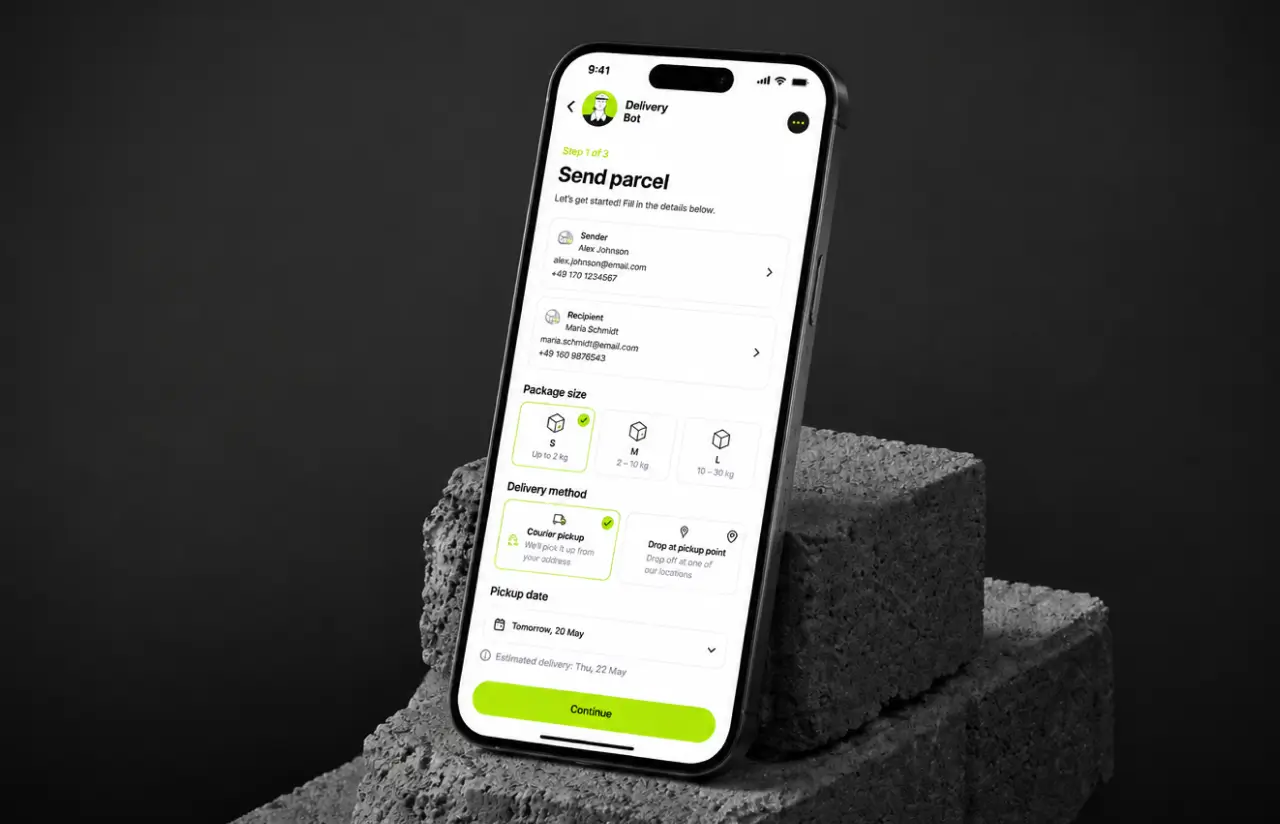
Customers reschedule a drop-off, switch to a pickup point, or correct an address inside the chat. The change writes back to dispatch, and the driver's run updates on the next sync.
Multi-Language Support
Natural language processing covers nine languages at launch, with the same tool set behind each. A customer writes in Portuguese, the bot reads Portuguese, and the carrier API still receives a clean query.
Proactive Delivery Notifications
The assistant messages first when a delivery slips, a customs hold appears, or a driver is 20 minutes out. Keeping customers informed before they ask took a visible bite out of inbound status traffic.
Driver and Dispatcher Integration
Drivers query the same virtual assistant about the next stop, an access code, or a failed attempt. Dispatchers check load status across a region, so all four user types read one source of truth.
Smart Query Understanding
The bot extracts tracking IDs, dates, and addresses from free-form text, then asks one clarifying question if anything is missing. No forms, no fixed fields, no “please enter your reference number”.
Escalation and Human Handoff
Claims, disputes, and anything scoring below the confidence threshold reach a human with the full transcript attached. Around 18% of conversations escalate, and the agent starts already briefed.
Agile Development Methodology
Project Journey
Nine months, twelve sprints, three weeks each. The first two sprints went into discovery and a bare prototype that answered exactly one question: status by tracking number. That prototype sat in front of real support agents by week five, setting the pattern for everything that followed. Every sprint ended with a demo against live parcel data rather than fixtures, and the tool list grew from three entries to eleven, driven by the queries that the transcripts kept surfacing.
How the Delivery Service AI Chatbot Works
- A customer asks about a parcel, a delivery change, or a shipping cost. The bot works on websites and inside mobile apps, in whatever words come naturally.
- Natural language processing reads the message, works out what the customer needs, and lifts tracking IDs, dates, and addresses out of it without a form.
- LangChain picks the tools that can answer, then fires queries at the client's REST APIs across eight tracking systems, the tax engine, and the dispatch database.
- GPT turns raw carrier data into a single plain-language response: status, reception venue, opening hours, duty owed, and time left in the delivery window.
- The customer reschedules, redirects to a pickup point, or opens a claim in the same thread, and each change is written back into the delivery process.
- When the status shifts later, the assistant messages the customer first, so customers stay informed without coming back to check.
Scrum process flow
AI chatbot development is hard to specify up front, because nobody can list every way a customer might phrase a complaint about a late parcel. Three-week cycles meant the client read real transcripts 12 times before the full rollout, and 4 of those reviews rewrote the tool list outright.
How we delivered the Logistics Chatbot Development project
- We define the project goal together, agree on priority features, and set a realistic delivery date and budget.
- We build a ranked list of everything the product needs, starting with what matters most to the business.
- Work is broken into 3-week cycles. At the start of each, we select the next set of features to deliver.
- The team builds, tests, and integrates features throughout the sprint.
- At the end of every sprint, you see working software and give feedback that shapes the next cycle.
- Each sprint produces a shippable piece of the product. We review what worked, adjust, and move forward.
UI/UX Design: A Delivery Answer That Fits on One Card
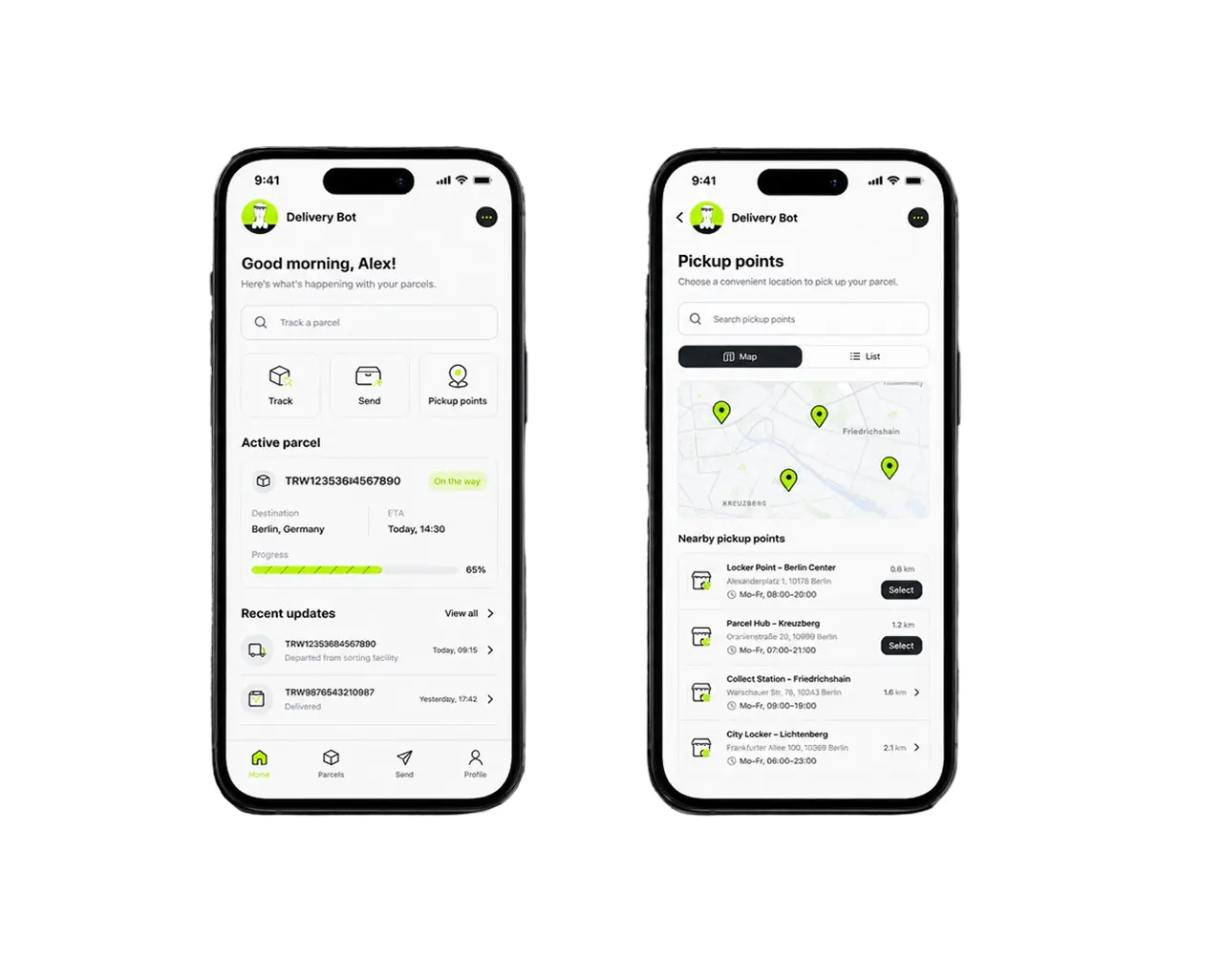
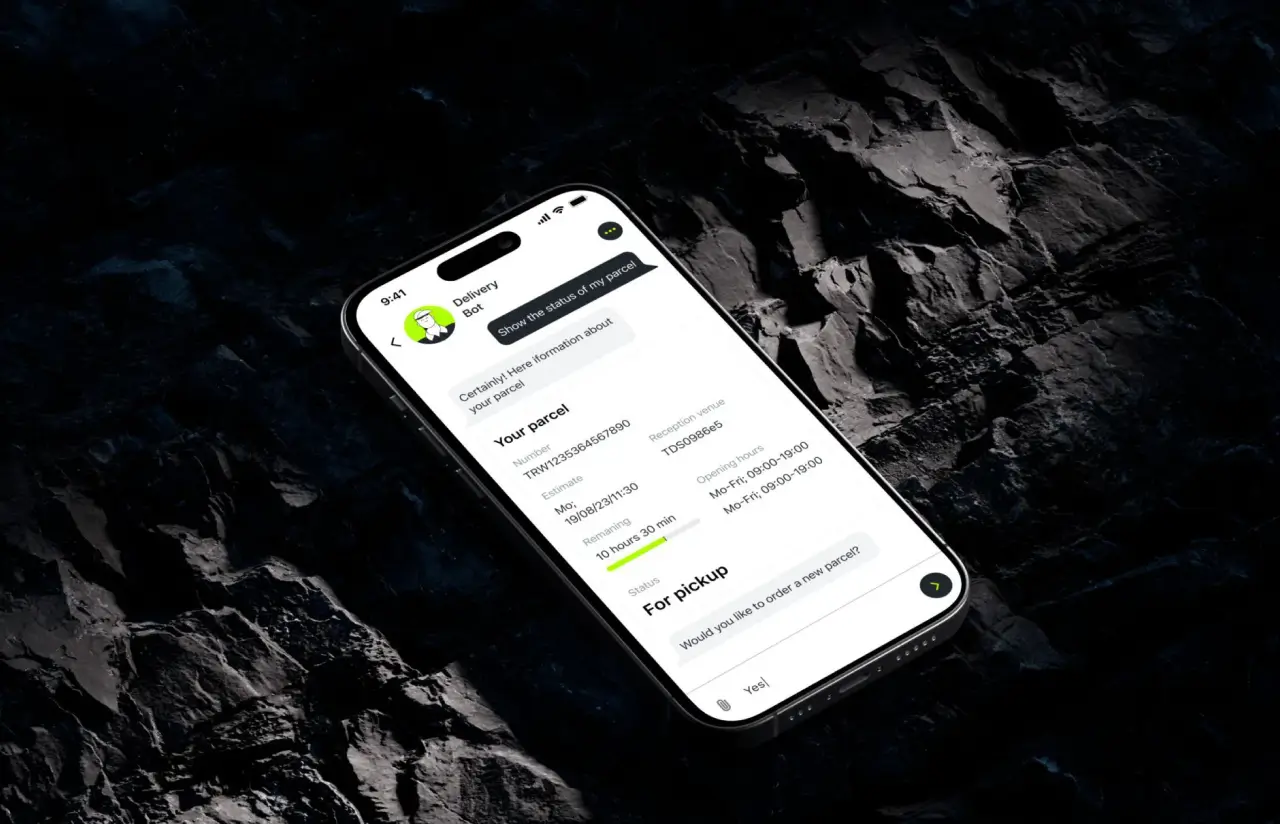
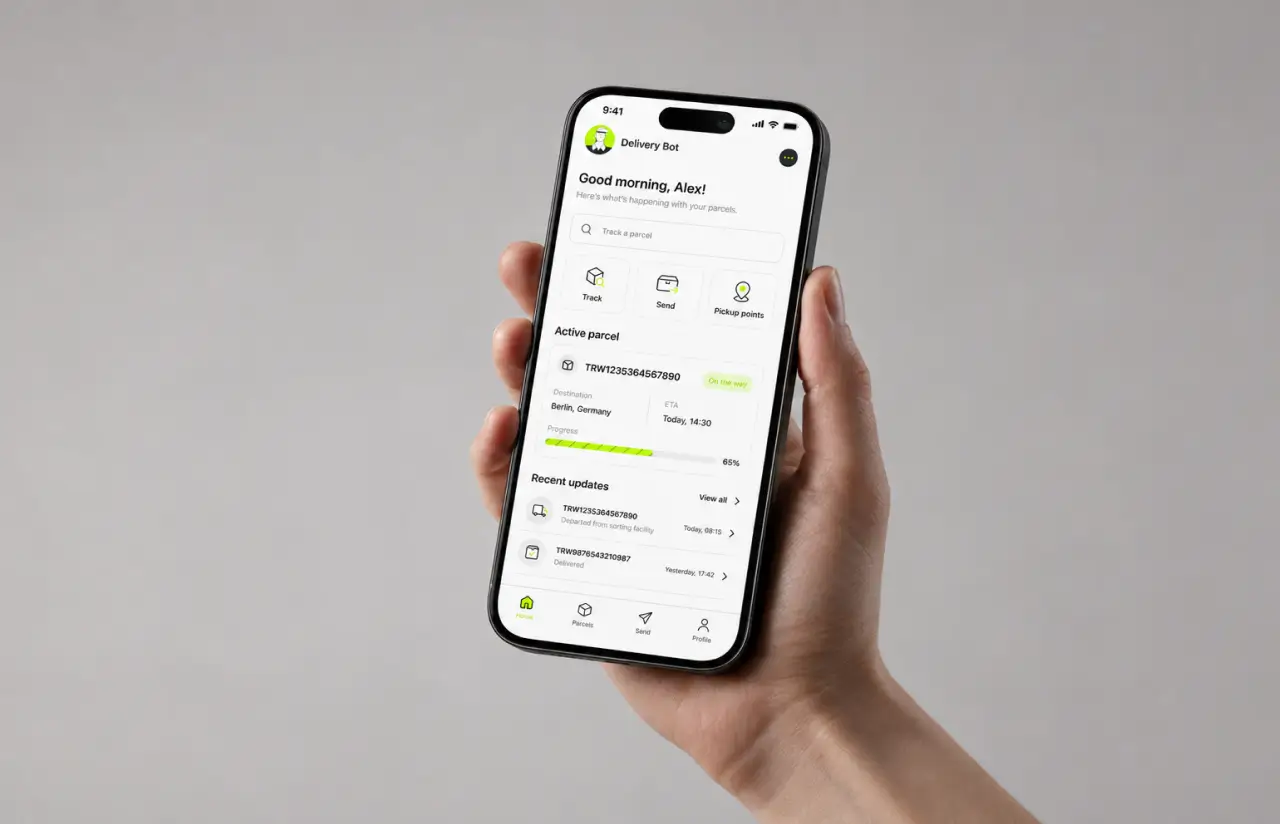
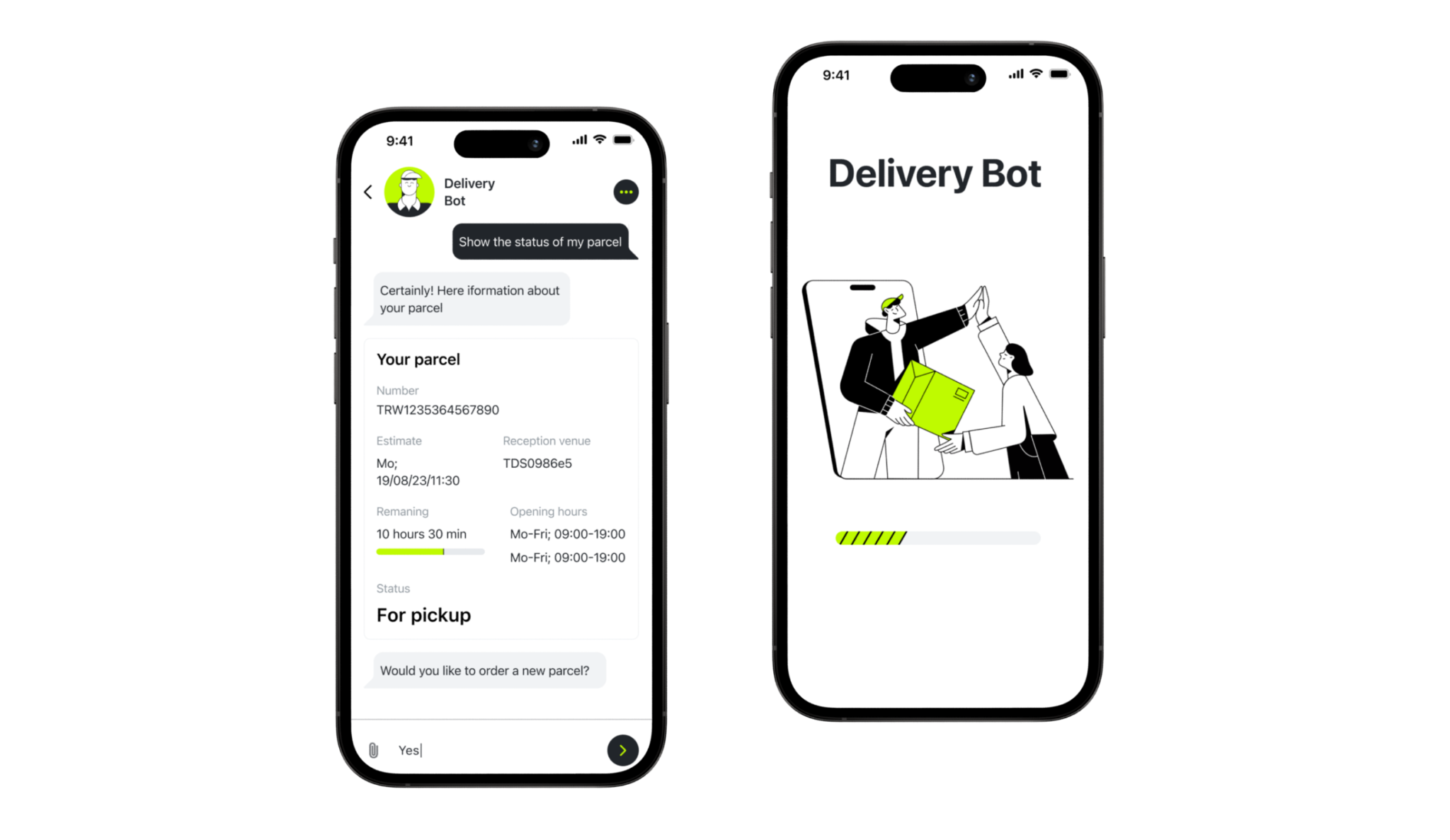
The interface had one job. Make a delivery answer readable at a glance, on a phone held one-handed in a doorway. Quick answers beat pretty ones in that situation. So the parcel answer is not a paragraph. It is a card.
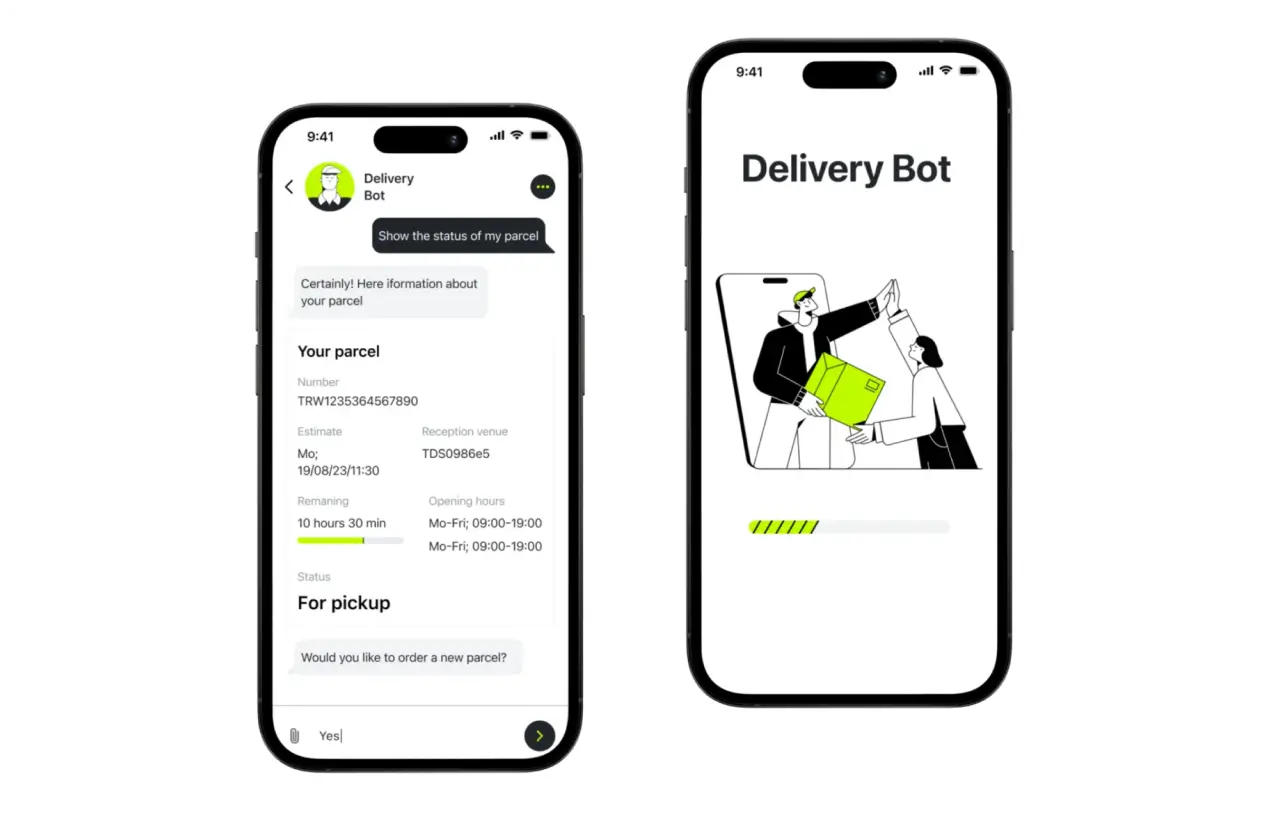
Chat runs across the top; the card sits underneath. Parcel number, estimate with date and time, reception venue, remaining time, opening hours, and status in bold at the bottom: For pickup. A slim progress bar fills as the window closes, which reads faster than “10 hours 30 min” manages on its own.
The palette is near-black type on white with a single acid-green accent, used only on the progress bar, the send button, and the bot avatar. Nothing else competes for attention. Chat bubbles follow the convention every customer already knows: dark bubble on the right for the person, light bubble on the left for the assistant.
The bot closes with a question rather than a dead end. “Would you like to order a new parcel?” sits under the card with the input field ready and an attachment clip for a photo of a damaged box. In testing, customers typed “Yes” more often than they tapped anything, and that feedback is why free text stayed the primary control.
Timeline
Five Phases, Clearly Defined
Discovery & Product Workshop
- Reading about 6,000 past tickets to find the questions that actually repeat
- Mapping eight tracking systems, the tax engine, and the dispatch database
- Agreeing what the bot must never answer on its own
Prompt & Flow Prototyping
- A three-tool prototype answering status questions by week five
- Testing phrasings pulled from real customer inquiries rather than a script
- Setting the confidence threshold that triggers human handoff
Agile Development (Sprints)
- Building the normalization layer across eight carrier formats
- Adding tax calculation, rescheduling, redirects, and claims to the tool list
- Web chat first, then the mobile app, then driver and dispatcher access
QA & Testing
- Roughly 280 conversation test cases replayed against live tool calls
- Load testing at 4x peak, around 20,000 conversations a day
- Red-teaming the bot with vague, angry, and multilingual messages
Launch & Support
- Two regions first, then the rest of the network over 11 weeks
- Weekly review of escalated transcripts to widen coverage
- Prompt and tool updates still shipping on three-week cycles
Results
Before
- ✕~5,000 status questions a day handled by phone lines and a shared inbox
- ✕Six-minute hold times at peak, and email answers in roughly 14 hours
- ✕Support agents spending about 80% of a shift on repeat order tracking
- ✕Parcel data split across eight tracking systems with no single lookup
- ✕Customers repeating a tracking number on every channel they tried
After
- ✔~30 seconds average response on a package status question, at any hour
- ✔72% of conversations resolved without a human agent
- ✔~40% lower cost per customer contact
- ✔CSAT of 4.4 out of 5 on chat, against 3.4 on phone support
- ✔One assistant online around the clock for customers, drivers, dispatchers, and the support team
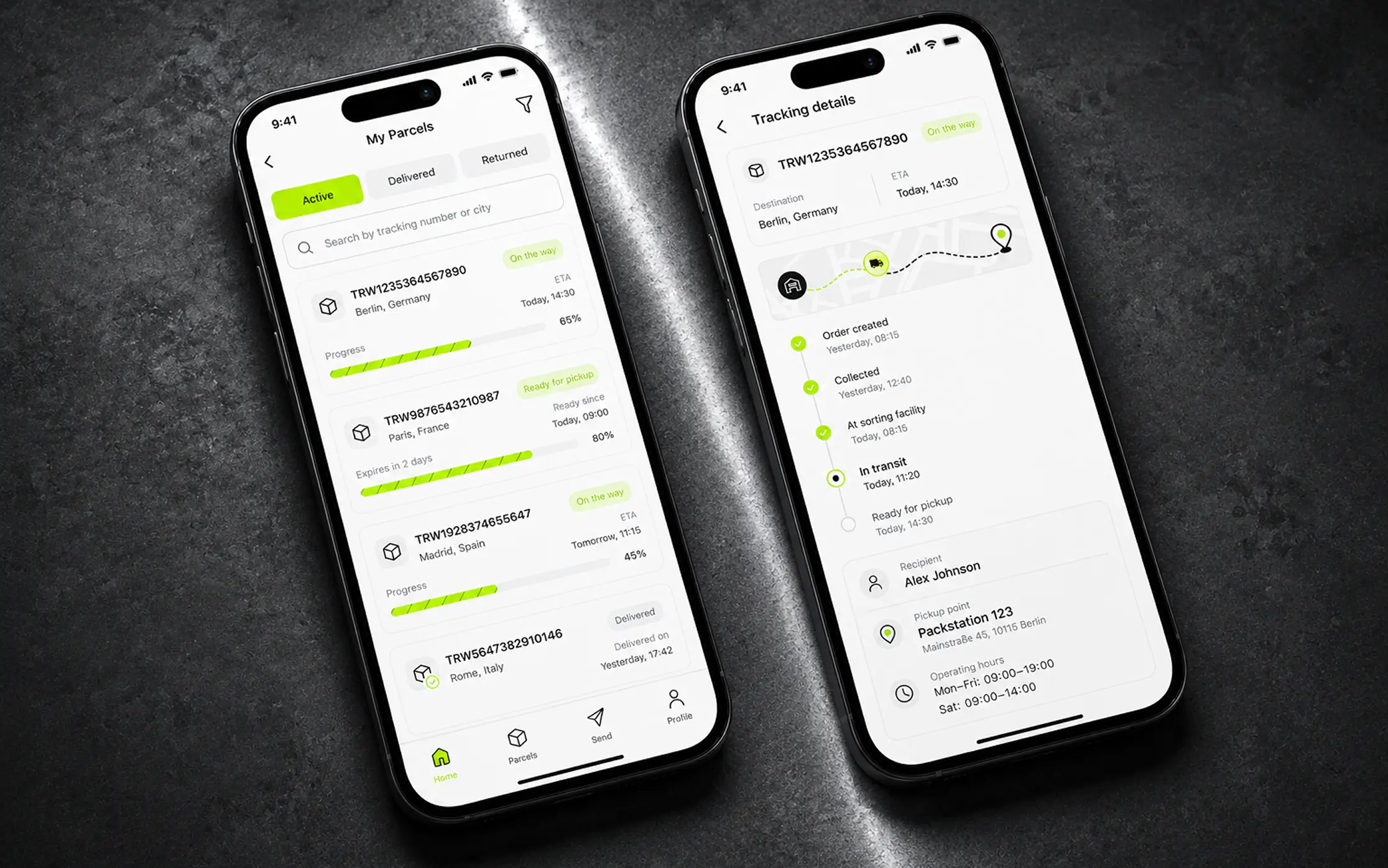
Impact of the Delivery Chatbot After Launch
Verified Reviews
Our Reputation on Top Platforms
LITSLINK holds a 4.8 rating on top platforms. Clients writing about our artificial intelligence development work most often mention technical depth, steady communication across long engagements, and a willingness to say when a requirement will not survive contact with real users.
Have a Delivery Project in Mind?
Need a delivery service chatbot for your own customers, or logistics chatbot development services covering driver and dispatcher workflows? Tell us what the support queue looks like today (volume, channels, tracking systems) and a LITSLINK specialist gets back to you within 48 hours.
Thank you for your message. It has been sent.