





Telemedicine App Development Services
Telemedicine App Development Services
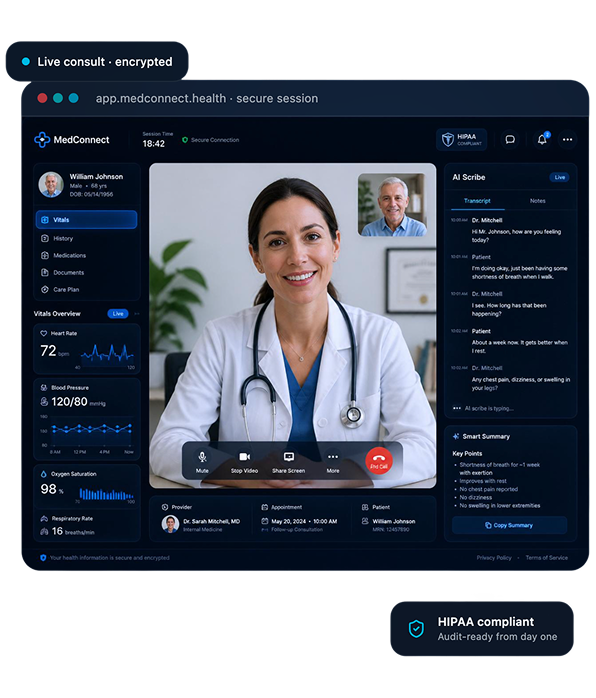
We build telemedicine and telehealth platforms for US healthcare organizations: video consultations that survive a weak 4G signal, AI scribes that chart while the doctor talks, remote patient monitoring, and EHR integration over HL7 FHIR. Compliance goes into the architecture in sprint one. Not into a panic patch six months before your audit.
- HIPAA-compliant by design, not retrofitted
- Video consultation, secure messaging, and an AI scribe in one platform
- EHR/EMR integration: HL7 FHIR, Epic, Cerner
- Remote patient monitoring with wearables integration
- MVP in 10 weeks
- US-based project management, EU engineering
- 9 of 10 clients come back with a second project
- WebRTC
- HIPAA-eligible AWS
- HL7 FHIR R4
- Twilio
- Stripe
Telemedicine & Telehealth App Development Services


Telemedicine MVP in 10 Weeks

Telehealth Mobile App Development

EHR/EMR Integration

Remote Patient Monitoring (RPM) Software

AI Scribe & Ambient Documentation

Legacy Telehealth Modernization

Telemedicine Support & Maintenance
HIPAA Compliance & Data Security by Design
Telemedicine software touches PHI in more places than almost any other healthcare system: live video streams, chat transcripts, device readings, recordings, prescriptions. We treat every one of those as a regulated surface and engineer HIPAA compliance into the architecture itself. Not as a checklist at the end.
HIPAA & HITECH
Technical, physical, and administrative safeguards designed into every layer, from session handling to backup policy. We map your PHI flows before we write code.
End-to-End Encryption
Data encrypted at rest and in transit, keys managed properly, infrastructure that’s BAA-ready on day one. AWS HIPAA-eligible services by default.
Role-Based Access Control
Granular permissions per role: patient, provider, nurse, admin, billing. A front-desk coordinator never sees clinical notes they have no business seeing.
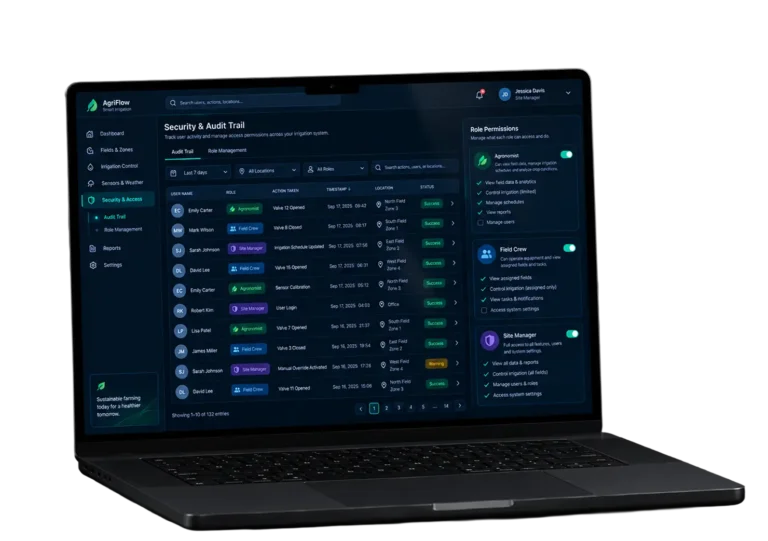
Audit Trails & Logging
Every access, every change, every export logged and traceable. When the auditor asks, you pull a report instead of assembling a war room.
GDPR & CCPA
Consent management and data subject rights for EU and California users, built alongside HIPAA rather than bolted on for a single market later.
Penetration Testing & Secure SDLC
We attack the platform before anyone else gets the chance.
Why Healthcare Organizations Choose LITSLINK for Telemedicine Development
Plenty of vendors can put a video call in a browser. A telemedicine app development company that understands claim denials, EHR politics, and what an OCR audit actually feels like is a rarer thing. Here’s why healthcare teams pick us as a telemedicine software development company and then stay.
HIPAA by Design
Compliance architecture from the first sprint. The alternative (retrofitting safeguards into a finished product) costs more and never fully closes the gaps.
EHR-Ready from Day One
HL7 FHIR, CCD, Epic and Cerner connectors are part of the initial technical design, not a phase-two promise. Integration is where most telehealth projects quietly die. Ours don’t.
Production-Ready AI
AI scribes, LLM chatbots, and diagnostic support that actually deploy to clinicians, with human review loops and audit trails. Not a demo that never leaves staging.
MVP in 10 Weeks
Even in regulated healthcare software. The trick isn’t cutting corners; it’s knowing which decisions can wait and which ones (data model, PHI boundaries, auth) you have to lock early.
9 of 10 Clients Return
Most of our healthcare engagements turn into ongoing partnerships. Clients describe us as a business partner rather than a service provider, and the return rate backs that up.
Telemedicine Challenges We Solve
Healthcare organizations lose patients and revenue to clunky portals, compliance gaps, and platforms that buckle under load. We build telemedicine software aimed at the exact bottlenecks your clinical and operations teams complain about in standups.
- Low patient engagement and no-shows — Automated reminders, self-scheduling, and a patient portal with so little friction that booking a visit takes less effort than ignoring it.
- HIPAA audit anxiety — Compliance by design: audit logs, role-based access, encryption. The audit becomes a report export, not a fire drill.
- Video quality and dropped calls — WebRTC with adaptive bitrate and automatic audio fallback. Consultations keep going on rural 4G.
- EHR disconnect — HL7 FHIR integrations push visit notes, prescriptions, and vitals into your EHR automatically. Nobody re-types anything.
- Clinician time lost to documentation — An AI scribe transcribes the consultation and structures the note in real time, while the visit is still happening.
- Platform can’t handle growth — Elastic cloud architecture, load-tested at peak. From 100 concurrent sessions to 100K without a rewrite.
Must-Have Features of a Telemedicine Platform
Every telehealth platform we scope starts from this list. Which features make your MVP and which wait for version two depends on your specialty, your payer mix, and your patients.
HD Video & Audio Consultation Engine
WebRTC-based, adaptive bitrate, fallback to audio when bandwidth drops. Virtual waiting rooms included.
HIPAA-Compliant Secure Messaging
End-to-end encrypted chat with file sharing and prescription attachments, threaded to the patient record.
Patient Portal & Appointment Management
Self-service appointment scheduling, automated reminders, digital intake forms. The pre-visit experience decides whether the visit happens at all.
EHR/EMR Integration & Clinical Workflows
Automatic note sync, referrals, care coordination. The telehealth visit lives in the same chart as everything else.
E-Prescribing (EPCS)
Electronic prescriptions with DEA-compliant identity verification for controlled substances, plus pharmacy routing and interaction alerts.
AI Scribe & Documentation Automation
Ambient listening, structured SOAP output, clinician sign-off. Charting shrinks from the biggest time sink of the day to a review step.
Billing, Insurance & Revenue Cycle
Claims with correct telehealth CPT modifiers, copay collection, EOB access, real-time insurance eligibility checks.
Remote Patient Monitoring & Wearables
RPM devices feeding a real-time vitals dashboard, with alerts when a reading crosses a threshold. Chronic care between visits, not just during them.
Analytics & Reporting Dashboard
Population health views, provider performance, visit volume, no-show trends. The numbers your operations lead currently rebuilds in a spreadsheet every Monday.
Benefits of Custom Telemedicine Software
Custom telemedicine software gives your organization clinical efficiency and room to grow, without per-provider fees or vendor lock-in. Here’s what changes in practice.
Less clinician time on documentation
- AI scribes turn charting from the biggest time sink of the day into a quick review step – the clinician signs off on a structured note instead of writing it from scratch. Multiply that across a full schedule, and you’ve returned hours to patient care.
Higher engagement, fewer no-shows
- Self-scheduling and automated reminders measurably reduce no-show rates. Empty slots are the most expensive thing in a clinic.
Faster, cleaner billing
- Automated claims and coding reduce denials and revenue leakage. Fewer resubmissions, faster reimbursement.
Always audit-ready HIPAA compliance
- Controls are built in, not assembled the week before an audit. Your compliance officer sleeps better. So does your CFO.
Scales with patient volume
- Elastic architecture absorbs 10x traffic spikes without downtime. Flu season stops being an infrastructure event.
Full ownership of platform and data
- Your code, your data, your audit scope. No vendor lock-in and no per-provider license fees stretching to the horizon.
AI Technologies for Telemedicine Software
AI in telehealth is past the pilot phase. These are the four applications we deploy most, with the stacks behind them.
LLM transcription and SOAP note generation with clinician review before anything touches the chart. For PHI workloads, we deploy LLMs through HIPAA-eligible services under BAA — Azure OpenAI or self-hosted models, never a consumer API.
Tech
- OpenAI
- LangChain
Virtual Medical Assistant & LLM Chatbot
Symptom checking, triage, and appointment booking handled conversationally, with hard escalation rules to human staff.
Tech
- LLM APIs
- RAG
AI-Driven Remote Patient Monitoring
Anomaly detection across incoming vitals and predictive alerts before a reading becomes an admission.
Tech
- TensorFlow
- custom ML models
Predictive Analytics & Population Health
Risk stratification, readmission prevention, and AI diagnostic support surfaced to care teams as ranked worklists rather than raw scores.
Tech
- Python
- forecasting models
Telemedicine Projects We’ve Delivered
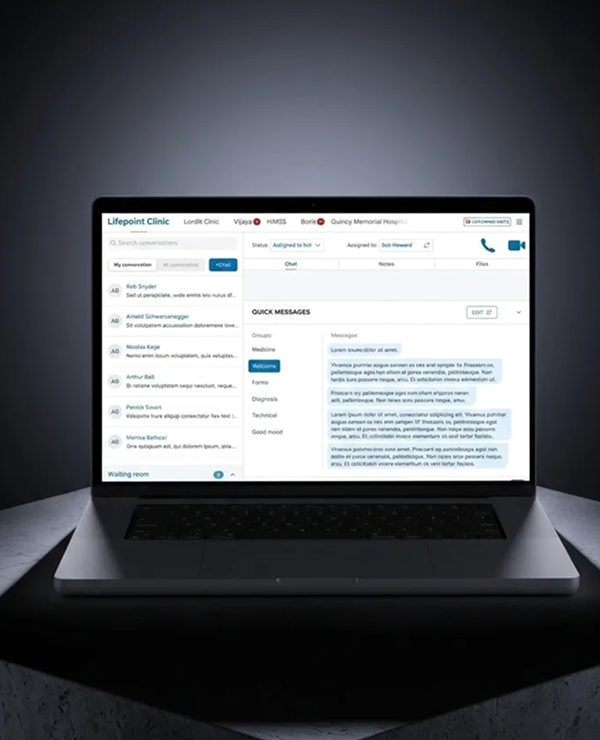
Lifepoint Clinic — HIPAA-Compliant Patient-Doctor Communication Platform
Challenge
A multi-clinic platform needed HIPAA-compliant messaging and video consultation between patients and doctors, with capacity for 1M+ users across several independent clinic networks at once.
Solution
We customized a CI/CD pipeline for the Ruby application across dev, staging, and production, then deployed to AWS HIPAA-eligible infrastructure that met strict medical data security requirements. The build included chat and video consultation UI plus multi-tenant support across 5+ independent clinic networks.
Key results
- Capacity for 1M+ users on cloud infrastructure sized for real load
- Strict HIPAA data security requirements met across 5+ independent clinic networks
- Deployment costs reduced through a streamlined CI/CD pipeline
Stack
Ruby · GitLab CI/CD · AWS HIPAA-eligible
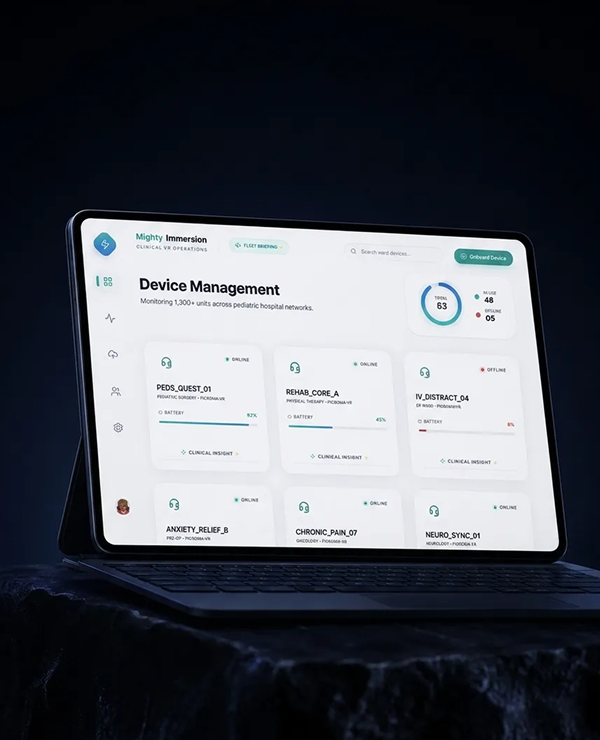
VR Healthcare Solution – Mighty Immersion
Challenge
Mighty Immersion had 1,300 VR headsets live across 200+ children’s hospitals, but tracking device status and pushing content updates relied on manual checks and disconnected workflows. Adding each new hospital partner meant repetitive setup and pulled engineers into support instead of product.
Solution
We built a browser-based device management portal on Firebase: centralized visibility of every headset, fleet-wide content updates pushed in one action, and a standardized zero-IT-support onboarding flow for new hospitals.
Key results:
- 50+ VR units monitored in real time from a single dashboard
- Fleet-wide updates with no physical device access
- New hospitals onboarded in minutes
- Engineering team freed to build product, not manage logistics
Stack
Web · Firebase
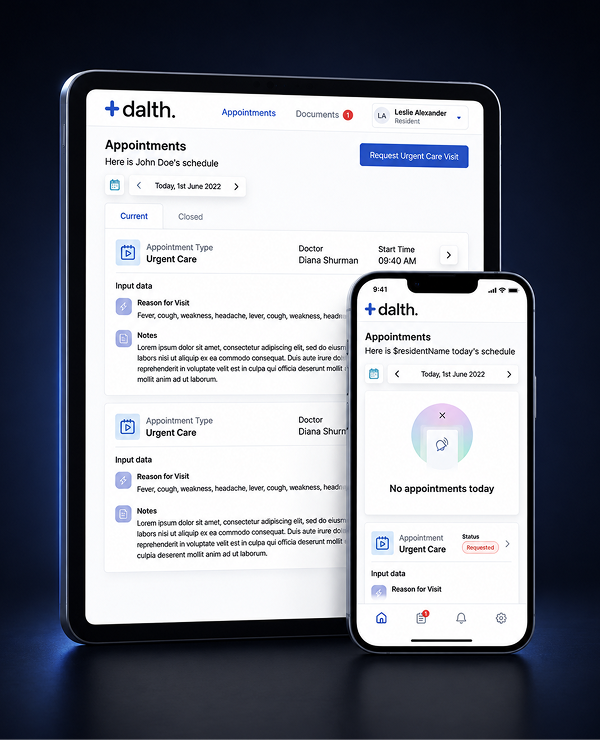
SaaS Patient Engagement Platform — Dalth
Challenge
Patient data sat fragmented across providers; Dalth needed to aggregate EHR data, serve six distinct user roles, and route urgent care requests in real time.
Solution
The team built a unified healthcare CRM consolidating every patient touchpoint, with role-aware architecture giving each of the six user types its own interface, permissions, and workflows. EHR data aggregates from multiple providers in real time.
Result
- QR-triggered urgent care requests routed to the right responder within minutes
- Digital consent workflow eliminated printing, scanning, and manual filing
- Real-time record aggregation from multiple EHR sources
Stack
Vue.js · HIPAA-compliant infrastructure · EHR APIs
How Much Does Telemedicine App Development Cost?
Cost depends on features, integrations, compliance scope, and scale, and the telemedicine app development timeline moves with the same variables. Most projects land in one of three tiers. Every engagement starts with a free scoping call and a fixed-scope discovery phase, so the number you sign is the number you planned for.
Telehealth MVP
$40K–$80K
6–10 weeks
- Video consultation
- patient portal
- 1 EHR integration
- HIPAA foundations
- web or mobile
- QA
Best for: Startups, single-specialty clinics
Get estimate Full Platform
$80K–$250K
4–8 months
- Video + RPM
- AI scribe + billing
- EHR
- mobile apps
- analytics
- 6 months of support
Best for: Multi-specialty practices, hospital systems
Get estimate Enterprise Telehealth
$250K+
8+ months
- Everything above
- AI diagnostics
- multi-tenant architecture
- legacy migration
- 24/7 SLA
- dedicated team
Best for: Large health systems, payers, national platforms
See Full Case StudyAll estimates are project-specific. Final scope is set after discovery.
Monetization Models for Telemedicine Apps
Building the platform is half the plan. Here’s how our clients make telemedicine pay for itself.
- Subscription / SaaS model — Recurring revenue, predictable growth. Our SaaS development team builds the billing, plans, and tenant management behind it.
- Per-visit / pay-per-use — Patients pay per consultation. Lowest barrier to first use, popular with urgent care and single-specialty products.
- Insurance billing integration — Claims-based revenue with eligibility checks and telehealth CPT coding automated in the platform.
- Freemium + premium features — Free symptom checker or basic booking; paid consultations, RPM programs, and priority access on top.
- White-label licensing — Build the platform once, license it to clinic networks under their own brands.
How We Build Your Telemedicine Platform
Our telemedicine app development process is built around one idea: surface the risky decisions early, then execute in short, visible increments.
Step 1 of 6
Discovery & Compliance Mapping
Clinical workflows, HIPAA scope, integration requirements. Deliverables: scope document, roadmap, estimate.
Step 2 of 6
UX & Clinical Flow Design
Patient and provider flows, prototype, accessibility review. Deliverables: clickable prototype, validated flows.
Step 3 of 6
Architecture & Integration Design
WebRTC setup, HL7 interfaces, security design, infrastructure as code. Deliverable: technical design document.
Step 4 of 6
Agile Development & QA
Sprints with demos every two weeks, integration testing running in parallel. Deliverables: working increments, sprint reports.
Step 5 of 6
Penetration Testing & HIPAA Audit
Security testing, BAA signing, compliance verification. Deliverables: test reports, security audit.
Step 6 of 6
Launch, Training & Support
Phased go-live, staff onboarding, then an ongoing SLA. Deliverables: runbooks, support plan.
Step 1 of 6
Clinical workflows, HIPAA scope, integration requirements. Deliverables: scope document, roadmap, estimate.
Step 2 of 6
Patient and provider flows, prototype, accessibility review. Deliverables: clickable prototype, validated flows.
Step 3 of 6
WebRTC setup, HL7 interfaces, security design, infrastructure as code. Deliverable: technical design document.
Step 4 of 6
Sprints with demos every two weeks, integration testing running in parallel. Deliverables: working increments, sprint reports.
Step 5 of 6
Security testing, BAA signing, compliance verification. Deliverables: test reports, security audit.
Step 6 of 6
Phased go-live, staff onboarding, then an ongoing SLA. Deliverables: runbooks, support plan.
What Healthcare Clients Say About Working With Us
LITSLINK is recognized across leading industry platforms for delivering high-quality software solutions. See what clients and the design community say about our work.
Frequently Asked Questions About Telemedicine App Development
Most projects fall between $40K and $250K+. A focused MVP with video consultation, a patient portal, and one EHR integration starts around $40K–$80K. A full platform with RPM, an AI scribe, and billing typically runs $80K–$250K. Enterprise builds with multi-tenancy and AI diagnostics start at $250K. Scope drives everything, which is why we begin with a free estimate.
The telemedicine app development timeline runs 6–10 weeks for an MVP, 4–8 months for a full platform, and 8+ months for enterprise systems. Integrations and compliance scope are the two biggest schedule variables, so we pin both down during discovery.
We map PHI flows before writing code, build on HIPAA-eligible cloud services under a signed BAA, encrypt data at rest and in transit, enforce role-based access, and log every touch of patient data. Third-party penetration testing runs before launch. Compliance is an architectural property here, not a document.
Yes. We integrate through HL7 FHIR R4 and vendor APIs with Epic, Cerner, Allscripts, and others, covering visit notes, e-prescribing data, and vitals. Where a legacy system lacks a modern API, we build the interface layer.
WebRTC is the foundation, delivered either directly or through Twilio or Agora under a HIPAA BAA. We add adaptive bitrate and audio fallback so consultations keep running on poor connections. The choice between providers comes down to your session volume and budget, and we’ll walk you through the math.
Yes, and we do it regularly. The 10-week MVP covers video consultation, appointment scheduling, a patient portal, one EHR integration, and HIPAA foundations. The discipline is deciding early which features wait for version two
Yes. Medicare covers a broad set of telehealth services. Coverage for behavioral and mental health telehealth — including visits from the patient’s home and audio-only sessions — is permanent. Coverage for non-behavioral services (primary care, specialist visits, and similar) is set by Congress through recurring extensions and periodic shifts, so the exact rules on geography, eligible providers, and audio-only depend on the current extension in effect. Two things stay constant when you build: Medicare requires a HIPAA-compliant audio-video platform under a signed BAA, and place-of-service coding differs for care delivered in the patient’s home versus elsewhere. Because the non-behavioral rules change, we build your billing logic against current CMS guidance at launch and structure it to adapt when the rules change again — so a coverage update becomes a configuration change, not a rebuild. Last reviewed: July 2026 — non-behavioral flexibilities currently extended through Dec 31, 2027. For the latest status, see CMS.gov telehealth guidance.
Elastic cloud infrastructure with auto-scaling media servers, geographic load distribution, and load testing at projected peak before launch. A platform sized for 100 sessions and one sized for 100,000 differ in architecture, not just server count, so we design for your growth curve from the start.
Yes. The AI scribe integrates as a service alongside your current stack: it consumes the audio stream, produces a structured SOAP note, and pushes it to your EHR after clinician sign-off. No platform rewrite required.
Depends on your stage. Off-the-shelf tools are fine for testing whether patients will show up to virtual visits. Once you need deep EHR integration, your own branding, native AI, or freedom from per-provider fees, custom wins on total cost within a couple of years. A telemedicine app development company worth hiring will tell you honestly when off-the-shelf is still the right call. Sometimes it is.
Have a Telemedicine Project in Mind?
Tell us what you’re building and get a scoped estimate with a realistic timeline, not a templated reply from a sales funnel. A 30-minute call with an engineer who has shipped telehealth app development services before, and a follow-up within one business day. If we’re not the right fit, we’ll say so on the call.
Next steps
1
A LITSLINK specialist reviews your request and reaches out to discuss the details.
2
If needed, we can sign an NDA before moving forward.
3
We send a project proposal — estimates, timeline, and team CVs included.
4
After launch, we stay on for any updates your product needs.
Clutch 12+ years in software development healthcare among our deepest verticals HIPAA-compliant delivery Trusted by US telehealth providers
Thank you! Your request has been sent — our team will get back to you within 48 hours.
From the blog
Related Insights
Artificial Intelligence in Telemedicine: A Transformational Perspective
5 min read
AI in Medical Education: Empowering Medical Professionals with AI Training
5 min read
