







Key takeaways:
- Some AI tools that support different types of insurance workflows include Zywave AI, Planck AI, Gradient AI, Cytora, Convr, Indico Data, Snapsheet AI, Shift Technology, EvolutionIQ, and Roots Automation / Bevaya.
- AI tools for insurance agents can automate document reviews, submission intake, underwriting support, claims updates, fraud detection, policy servicing, and insurance data processing.
- The purpose of AI tools is to support the roles of insurance agents and not to replace their human judgment when making complex decisions involving policy, risk, regulatory compliance, the handling of claims, and building relationships with clients.
- Insurance businesses with complex workflows, legacy systems, or strict security requirements may need to implement a custom AI solution rather than use an off-the-shelf SaaS product.
Insurance agents use AI tools to save time by automating document reviews, expediting underwriting and fraud detection, improving risk assessment, and processing claims faster. As insurers manage growing volumes of submissions, claims, and customer requests, AI helps improve operational efficiency.
When determining which type of platform will benefit your company most, you should first define the bottleneck in your internal processes that requires an AI solution. For organizations with unique workflows or legacy software, a custom solution may be a better fit than an off-the-shelf product. In those cases, businesses often consider custom AI development services to build automation around their specific insurance processes.
This article provides an overview of AI tools for insurance agents and teams, rather than general-purpose writing tools, generic CRM systems, or broad customer support software.
What Are AI Tools in Insurance
AI tools used by insurance agents are often API-based or custom software solutions created to assist with the daily operations of an insurance company. They use artificial intelligence (AI), machine learning (ML), predictive analytics, document intelligence, and workflow automation.
Insurance professionals like insurance brokers, agents, and carriers use these AI tools to process underwriting submissions, manage policy servicing, handle claims, assess risk, identify and detect fraud, manage policy renewals, and improve communication with clients. Many insurance-specific AI tools also assist these professionals in organizing and consolidating all the insurance data that may be stored across several scattered locations, including emails, PDFs, spreadsheets, and policy systems.
Efficiency is the most significant benefit of using these tools. Insurance teams can dedicate time and energy to their client relationships, decision-making, and generating revenue rather than wasting hours reviewing documents or entering data manually. The repetitive work is taken care of by AI, while the oversight and final decisions remain the responsibility of humans.
Top AI Tools for Insurance Agents: Quick Comparison
| Tool | Primary Use Case | Best For |
|---|---|---|
| Zywave AI | Agency operations and client engagement | Agencies and brokers |
| Planck AI | Underwriting intelligence | Commercial insurance teams |
| Gradient AI | Risk assessment and predictive analytics | Underwriters and carriers |
| Cytora | Risk digitization | Large commercial insurers |
| Convr | Submission intake and underwriting | Commercial P&C teams |
| Indico Data | Document processing | Document-heavy operations |
| Snapsheet AI | Claims automation | Claims departments |
| Shift Technology | Fraud detection | Claims and investigation teams |
| EvolutionIQ | Claims guidance | Disability and workers’ compensation |
| Roots Automation / Bevaya | Agentic insurance workflows | Organizations pursuing AI-first operations |
10 Best AI Tools for Insurance Agents
Below is a list of the best 10 tools for insurance agencies. We will provide details about how each tool works, what insurance process it improves, and what type of insurance company each tool is a good fit for.
1. Zywave AI
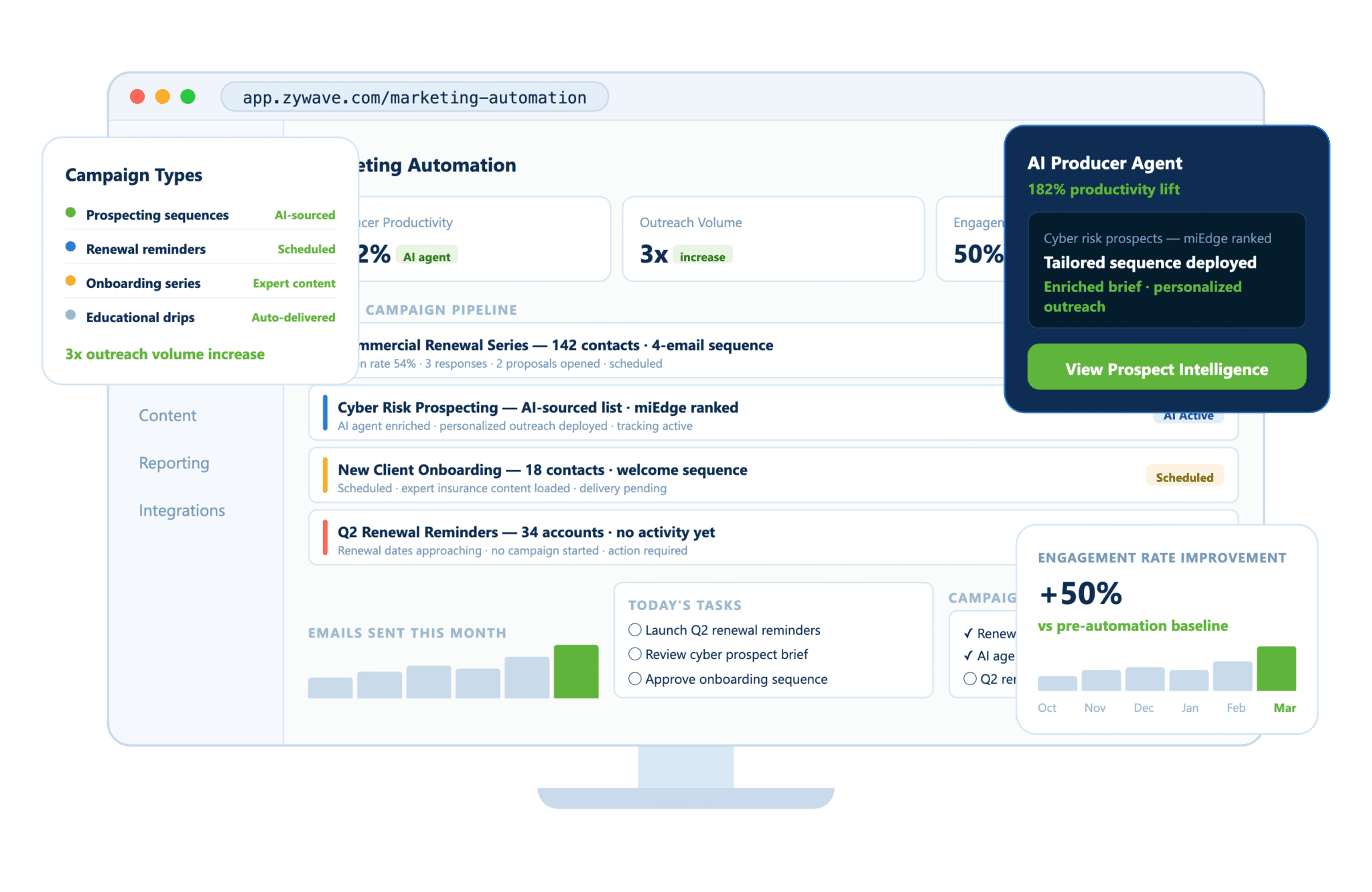
Zywave AI is a comprehensive solution for insurance companies, agents, carriers, and MGAs. Instead of being another generic CRM solution, it is uniquely focused on the insurance industry in sales, policy servicing, client interactions, and operational efficiency. That is why it seamlessly integrates with agency management systems, CRM platforms, rating tools, and other insurance software.
The platform enables companies to personalize their outreach using customer data and behavioral insights. Additionally, it provides support for policy reviews, quoting workflows, renewals, and customer interactions. Many insurance companies utilize it to identify cross-selling opportunities and retain their existing clients.
Zywave is now considered one of the premier systems for independent insurance agencies that don’t have to force-fit their workflows into software designed for another industry. Firms wishing to improve renewals, client engagement, and service processes without increasing their administrative burden should consider using Zywave. Stronger renewals can also help improve customer retention, while using AI-powered tools can improve customer relationships and client retention rates by 15% to 20%.
Zywave’s subscriptions are custom-based, but plans begin at $600 for a year. While there is no free trial, you get a 30-45 minute demo walkthrough. The 2026 winter release introduced four AI agents for insurance tasks. This includes tasks like identification, outreach automation, quoting support, and client engagement workflows.
2. Planck AI
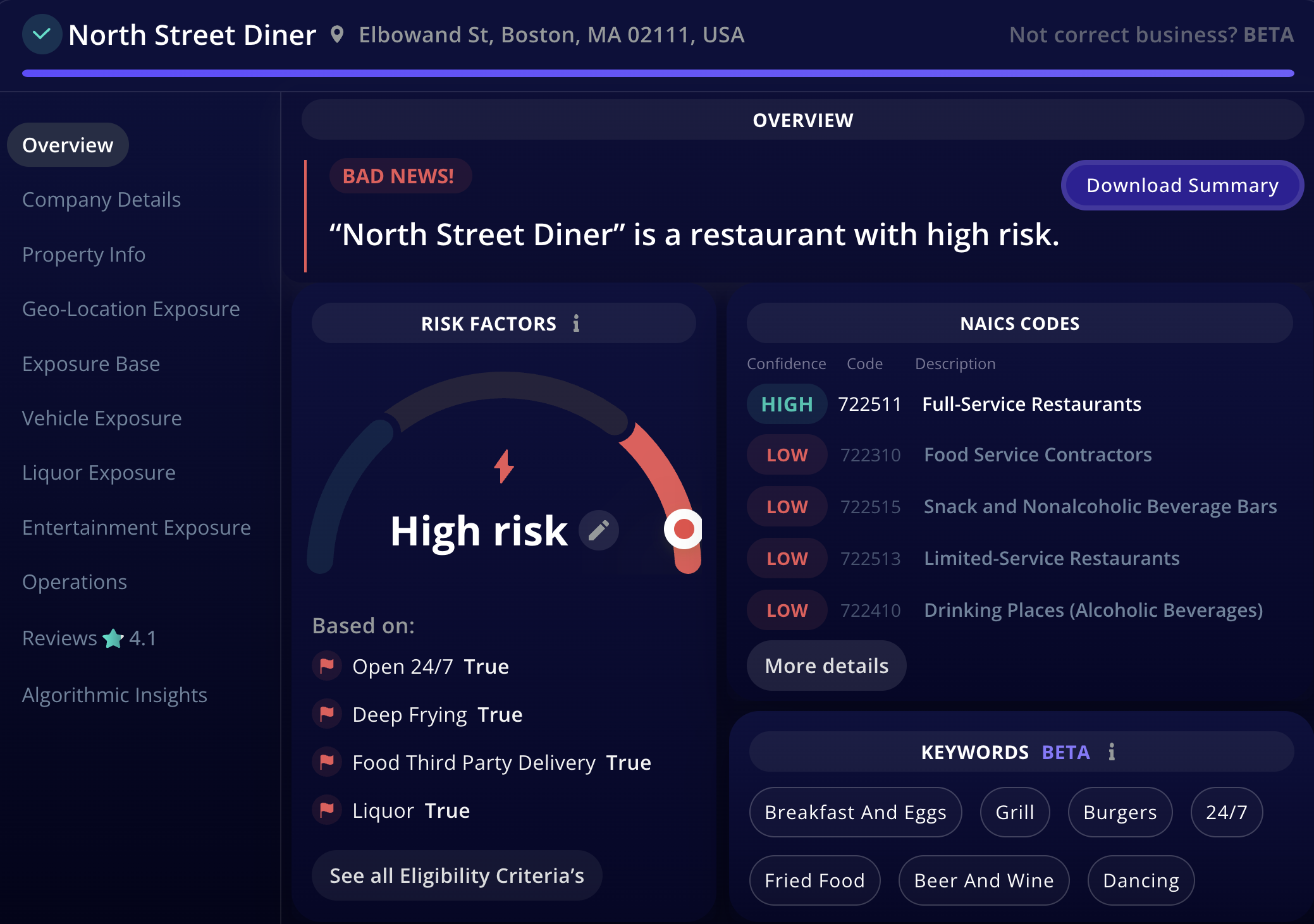
Planck AI specializes in providing commercial insurance underwriting assistance. It uses AI capabilities to gather and analyze data and business information from both publicly available and proprietary data sources. It also enhances submissions, classifies risks, and provides underwriting data-driven insights before human review begins.
Underwriters in the commercial insurance industry generally spend too much of their valuable time collecting information before they can even evaluate potential risks. Planck AI helps solve this problem by enabling insurers to automatically compile business intelligence. This reduces the amount of time needed to review this information.
Industry reports have indicated that AI-assisted underwriting reduces decision times from days to minutes in certain workflows. Better data collection also improves the accuracy of risk assessment processes. Planck AI is best suited for commercial insurance agencies, brokers, managing general agents (MGAs), and insurance carriers that need better underwriting intelligence before making coverage decisions.
Planck AI ricing is available by custom quote only. That means you’ll have to contact them to find out how much your project will cost. The provider does not have a free trial. In 2026, Planck AI continues to improve its services to serve clients better.
3. Gradient AI
Gradient AI harnesses the power of machine learning to enhance risk assessment, underwriting, pricing, and claims analysis. Large volumes of historical insurance data are analyzed to identify relationships and patterns that may not be immediately apparent through manual review. It is great for AI underwriting, claims analytics, and risk prediction.
Predictive modeling allows insurers to better estimate loss exposure, identify new or emerging risks, and make more informed pricing decisions. Businesses that handle workers’ compensation, group health, and property and casualty products often use this tool for assistance in making successful underwriting decisions.
Insurance organizations that want to make data-driven decisions and develop stronger predictive modeling across their underwriting and claims operations will benefit the most from using this AI platform.
Companies that are considering building similar predictive capabilities in-house can unlock the power of custom machine learning services for insurance applications.
Gradient pricing is only available upon request, and there is no free trial. It integrates with insurance systems and underwriting platforms. The company’s major focus in 2026 is predictive risk modeling and turnaround improvements.
4. Cytora
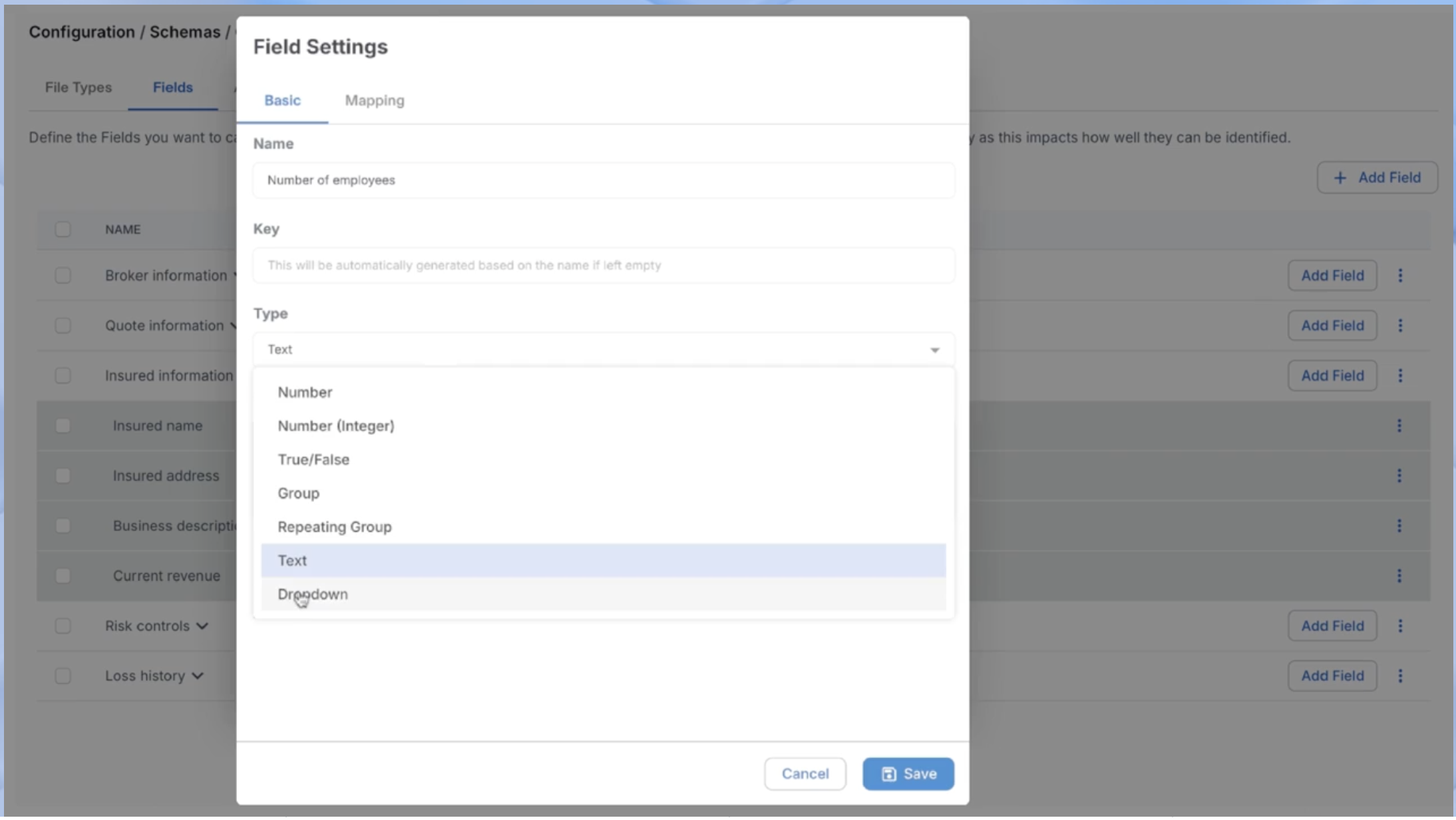
Cytora focuses on commercial insurance risk digitization and underwriting automation. The platform converts unstructured submissions into structured data that can be leveraged immediately by underwriting personnel. These submissions are gathered from emails, PDFs, spreadsheets, reports, and any other supporting documents.
The platform eliminates the delays associated with the manual review of all submitted materials. Automation will significantly reduce the time required to process applications and create effective workflows for underwriting processes.
Cytora is designed to integrate with agency management systems and downstream insurance applications. Larger insurance organizations handling high submission volumes often gain the most value because even small improvements in intake efficiency can save significant time across underwriting teams.
Cytora offers no free trial, and you need to request a quote to find out how much your project would cost. In 2026, Cytora partnered with LexisNexis Risk Solutions and Treefera. This allowed the platform to expand its ecosystem.
5. Convr
Convr is an AI-powered underwriting workbench built for commercial insurance. It can integrate with policy administration systems, agency management platforms, and underwriting workflows. Its primary purpose is to transform fragmented submissions into structured, actionable information.
The platform automates submission intake, extracts key details, prioritizes opportunities, and helps underwriters prepare quotes faster. Instead of manually reviewing stacks of documents, teams receive organized data ready for evaluation. Convr states that its platform can help insurers reduce submission-to-quote time by up to 70%.
Commercial property and casualty insurance teams often struggle with submission overload. Convr helps address that problem by reducing manual review requirements and speeding up underwriting workflows. Organizations looking to improve quote turnaround times frequently place Convr on their shortlist.
Convr has no free trial, and its pricing follows a custom enterprise model. In 2026, it positions itself as a submission-to-quote acceleration solution for commercial P&C insurers.
6. Indico Data
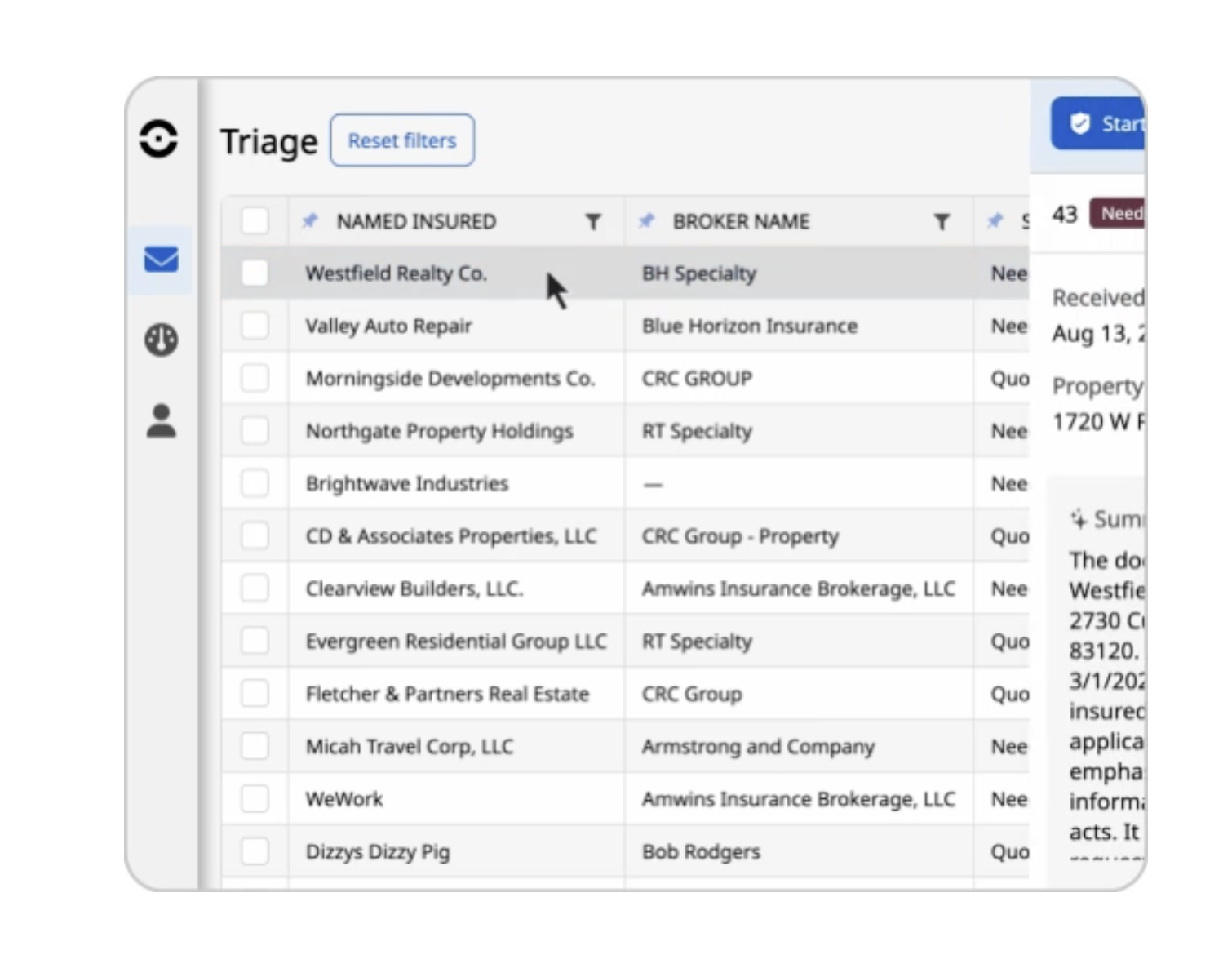
Indico Data specializes in document intake and workflow orchestration. It classifies and organizes complex document types, including emails, PDF files, spreadsheets, ACORD forms, loss runs, and claim packets. When these documents are processed manually, it often creates many bottlenecks in the submission process.
Indico Data uses machine learning to automatically classify these documents, extract meaningful information, and route structured data into the relevant downstream systems. Automating manual processes leads to faster processing and fewer manual data entry and repetitive tasks. It supports these workflows through integrations with document repositories, claims systems, underwriting systems, and enterprise workflow platforms.
Document-heavy insurance operations can see major efficiency gains from this type of automation. It has been reported that some companies have cut their SOV and loss run processing time to under 30 seconds and have reduced processing costs by 40% using AI-driven document handling. Indico addresses a very specific and expensive issue for agencies that are inundated with paperwork.
Indico Data’s enterprise pricing is available upon request. The tool has no free version or trial. In 2026, the platform continues to invest more in the areas it’s already well-known for.
7. Snapsheet AI
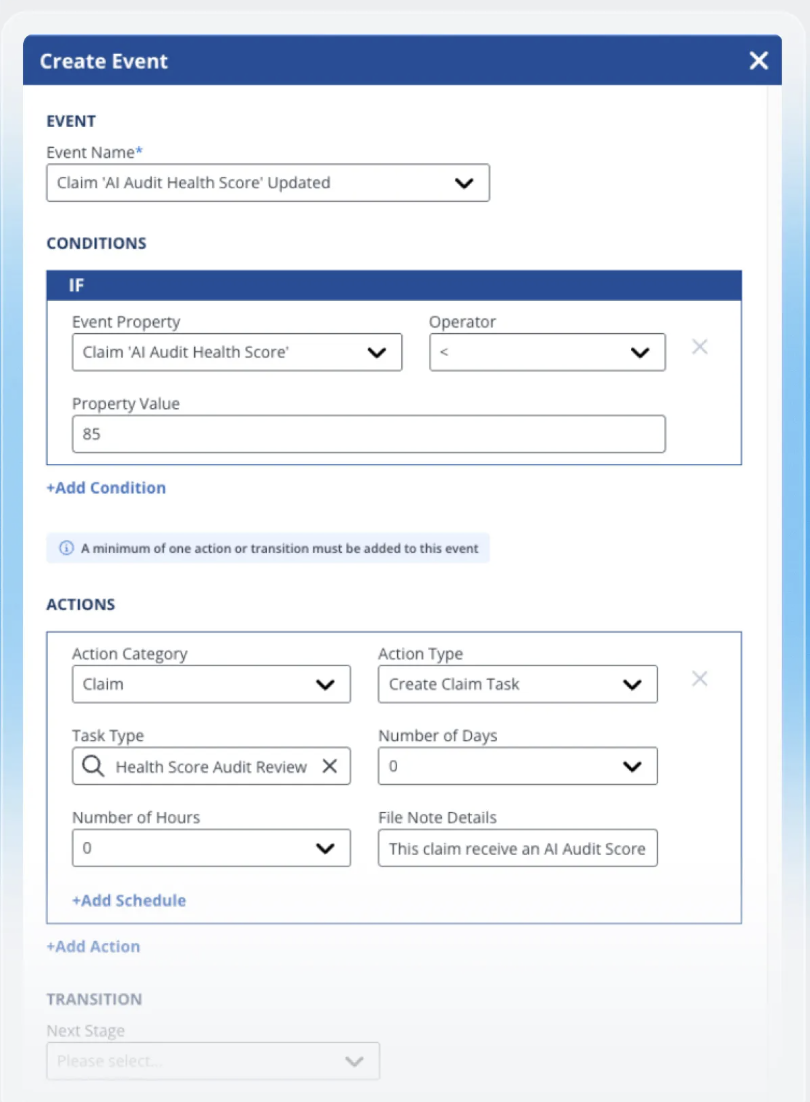
Snapsheet AI focuses on claims management and automating claims. Claims processing is still one of the most resource-intensive areas of insurance. This is especially true with fragmented communication between multiple systems. Carrier systems, claims management platforms, policy administration systems, and customer communication tools are some systems it is integrated into.
The platform helps insurance businesses collect claim information, automate workflows, track the progress of claims, and enhance communication during the claim lifecycle. It also enhances customer interactions by helping teams respond faster to customer questions.
With modern claims operations, the use of voice AI and conversational automation is rapidly becoming the norm. These AI-powered chatbots and customer service chatbots can summarize client calls, capture critical information, and assist customer service teams in responding to routine customer questions and initial client inquiries. Faster servicing also improves customer satisfaction by cutting policy renewal processing time by 4 to 5 hours per client. Snapsheet is an excellent solution for insurers whose biggest operational challenge is improving the efficiency of their claims processing systems.
You can get a Snapsheet AI quote by request, but there are no free trials. As for pricing, it is custom-based on your claims volume and the kind of implementation you want. In 2026, it continues to expand its automation around claims management.
8. Shift Technology
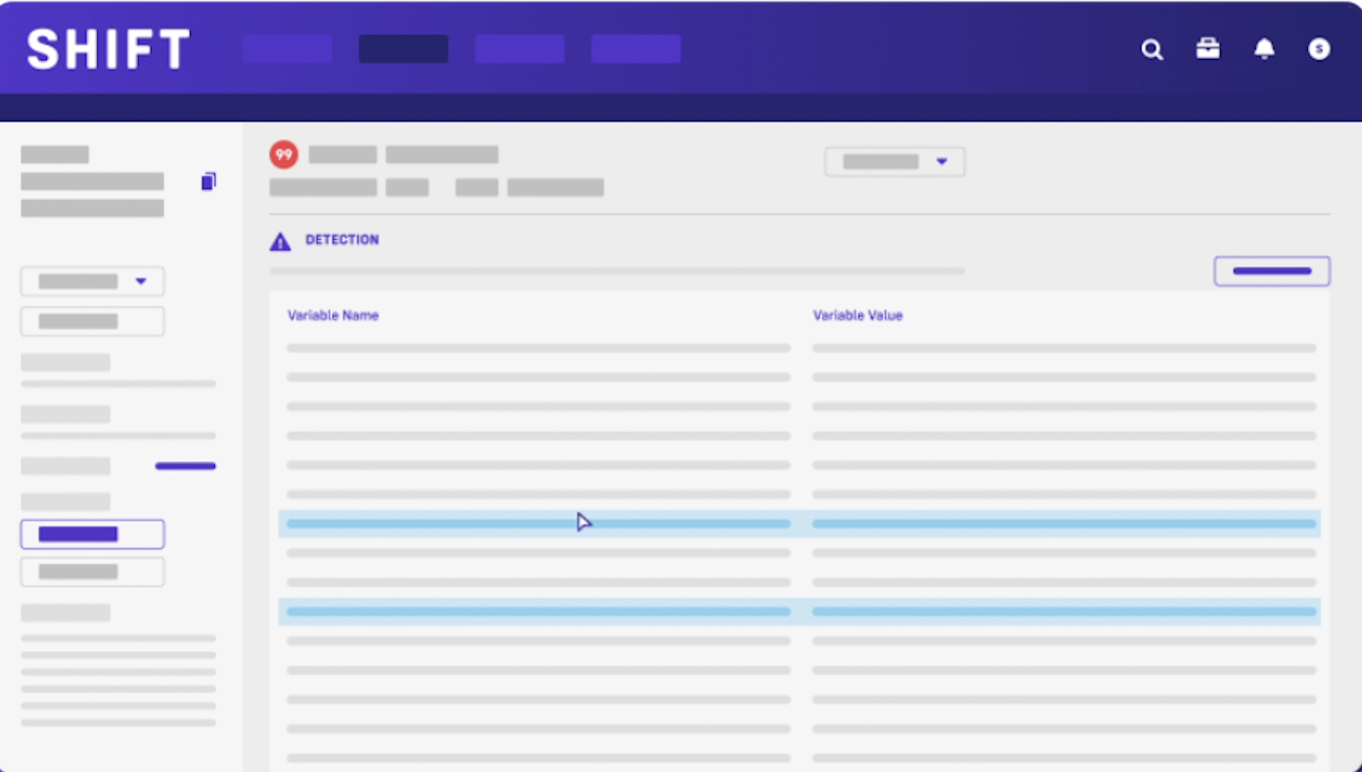
Shift Technology has developed one of the most recognized platforms in AI fraud detection and claims intelligence in the insurance space. By analyzing claims data, the platform identifies suspicious claim patterns and assists insurance teams in prioritizing those claims requiring attention. This streamlines processing time and improves decision support.
One challenge to effective fraud detection is that most fraudulent activity does not follow easily identifiable patterns. Shift utilizes machine learning models to identify anomalies and relationships within the data that may indicate possible fraud. It is able to accomplish this because of its API-based integration and embedded deployment within insurer claims environments.
The platform also helps with claims automation and decision support. Rather than reviewing each claim with the same intensity, insurers can allocate their resources where the risk seems the greatest. Organizations with a large volume of claims often use Shift to strengthen their fraud prevention efforts while minimizing unnecessary investigative work.
Shift offers no free trial, but you can get a demo on request. Pricing follows a custom enterprise model. In 2026, Shift continues to push the boundaries of effective fraud detection and financial crime prevention.
9. EvolutionIQ
EvolutionIQ uses AI-driven claims guidance to enable adjusters to prioritize claims at the right time. Unlike other technologies, EvolutionIQ provides decision support to assist claims professionals rather than replacing them. It works with claims management systems and adjuster workflows.
The system highlights opportunities for intervention and helps teams optimize their use of resources by prioritizing claims requiring attention. This will improve the overall outcome while reducing delay in the claims process.
Workers’ compensation, disability insurance, and income protection claims are areas where timing can significantly affect the outcome. Carriers looking for better ways to manage workload and prioritize claims often consider EvolutionIQ due to its ability to guide adjusters toward the areas where their expertise matters most.
EvolutionIQ’s enterprise pricing is available upon request, and there is no free trial. The company continues to focus on claims triage in 2026.
10. Roots Automation / Bevaya
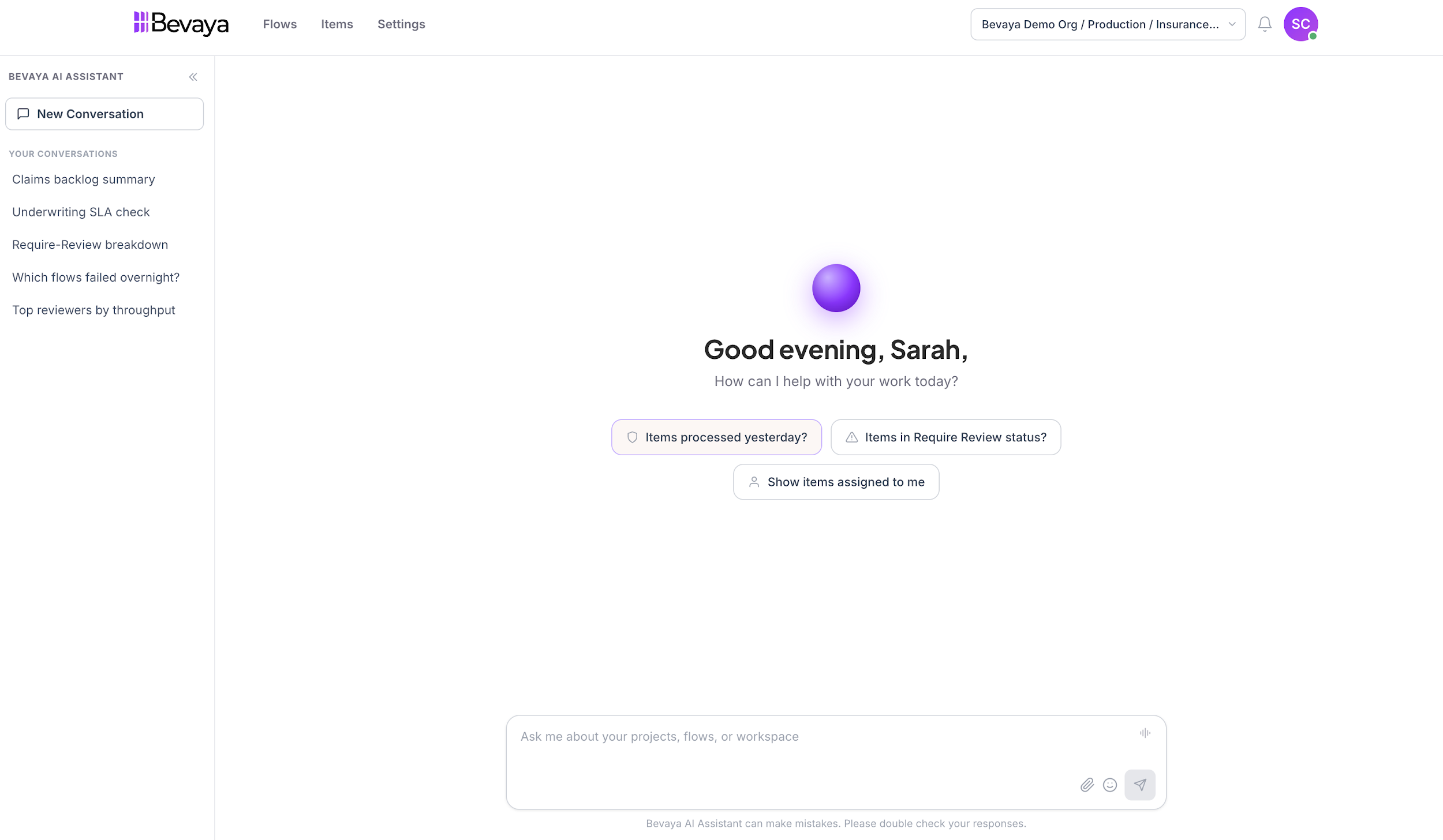
Roots Automation’s Bevaya represents a newer category of insurance technology: agentic AI, built specifically to support direct insurance workflows. The tool can connect with underwriting systems, claims platforms, policy administration software, and document processing workflows.
The platform provides support for underwriting, claims processing, policy servicing, document review, triage, coverage analysis, recommendations, and human-in-the-loop decision-making. Every repetitive task you would typically expect from an insurance company, agent, or broker will be handled by AI insurance agents or virtual assistants, while licensed professionals remain responsible for final decisions.
For many insurers, agentic AI models represent a logical evolution from conventional workflow automation. Rather than automate single tasks within a workflow, agentic AI enables multiple tasks to be managed across entire workflows. This can bring 85% less manual processing, significantly reducing operational costs. Organizations interested in building similar solutions may also investigate AI agents as part of a broader automation strategy.
Bevaya offers clients an interactive tour to get to understand the tool, but the pricing model is a custom enterprise. In 2026, Bevaya is one of the companies actively pushing the shift towards AI agents.
How to Choose the Right AI Tools for Small Insurance Agencies
When choosing the right AI tools, you should begin by identifying your specific business issue. That could be lead generation, customer servicing, claims support, handling policy documents, underwriting support, or automating internal workflows. Then you begin measuring results and calculating your ROI for that single process before considering expanding adoption based on real business outcomes instead of assumptions.
When searching for an AI tool, you must ensure that it works seamlessly with your existing workflows and operational goals. For example, if your agency receives lots of customer inquiries, then you might benefit from implementing AI-powered chatbots to streamline your response time and improve service levels. If your agency deals with too much paperwork, then you might want to consider using a tool to help extract and process those documents. If you are an agency that does a lot of claims processing, you may benefit from claims automation solutions.
And if you are an agency that is primarily looking for ways to grow your business, invest in solutions that would help qualify leads and engage with customers. According to industry research, health insurers (84%) and personal automobile insurance companies (88%) use AI/ML to some extent, including customer relations and lead generation. This means that many insurance organizations have recognized that using automation tools can improve not only workflows but also sales.
LITSLINK is a reliable partner that can assist agencies that require more adaptability than a standard off-the-shelf solution provides. In addition to AI-as-a-service solutions and custom AI development, the company provides chatbots, machine learning, SaaS development, and cloud-based software solutions, helping businesses implement AI technology based on their specific operational requirements. LITSLINK is especially useful for insurance units that wish to develop or incorporate AI into their lead management, customer support, document processing, underwriting assistance, claims automation, policy servicing, and other insurance workflow processes.
Ultimately, small insurance agencies should evaluate which AI tools provide measurable operational benefits. The objective is not to use AI to meet some unquantifiable business goal, but rather to resolve a clearly defined business issue. When tied to a specific workflow and implemented effectively, the right AI tools can save operational costs by 40% to 60%. However, results vary by workflow and should be measured against a clear baseline. They can also enhance service quality while freeing employees to focus on higher-value activities that benefit clients and the business.
Data Security and Insurance Risks When Using AI
Ensuring data security is essential to all insurance companies that want to implement AI. Insurance companies are responsible for handling sensitive information, including personally identifiable information (PII), protected health information (PHI), policyholder information, claims records, financial data, health information, business records, and risk documentation. Protecting this data is not only a business priority but also a legal and regulatory obligation.
Therefore, before adopting AI, insurance companies must perform a detailed security review of the AI platform. During this review, they will need to take into consideration several security controls: encryption standards, access controls, audit trails, user permissions, data retention policies, compliance certifications, and vendor reliability. If the AI solution processes health information, organizations should also determine whether it supports HIPAA compliance and meets other applicable privacy requirements.
While AI provides an efficient way to process large amounts of information, there is still a need for human oversight in decision-making processes to ensure compliance with laws and regulations. This includes maintaining auditability and model explainability so insurers can understand, review, and justify AI-assisted decisions.
Human review should remain part of high-impact decisions involving underwriting, claims processing, fraud detection, or policy eligibility. Organizations should also regularly evaluate AI systems for bias and fairness to reduce the risk of discriminatory outcomes and maintain regulatory compliance.
Successful implementation of an AI platform requires an equal balance between automating processes and ensuring accountability within the organization. Insurance companies should also stay informed about evolving state-level insurance AI regulations, which increasingly require insurers to establish AI governance frameworks, monitor algorithmic bias, and document how AI systems are developed, tested, and used.
Final Thoughts
There is no perfect AI platform that will fit every insurance company. The best choice depends on your organization’s workflow.
Zywave focuses on agency operations and client engagement. Planck AI and Convr are commercial underwriting tools. Gradient AI supports machine learning and risk assessment. Cytora digitizes risk data, and Indico Data helps companies to streamline document processing. Snapsheet and EvolutionIQ both improve claims processing, and Shift Technology strengthens businesses’ ability to detect fraudulent claims. Bevaya from Roots Automation helps insurance companies create an agent-centric workflow.
The best practice for utilizing AI tools is to start with one high-friction process, measure the results, train the team, and then expand AI adoption gradually.
If you want examples for the implementation of AI solutions in regulated sectors, reviewing healthcare case studies can provide useful insight into real-world approaches.
FAQ About AI Tools for Insurance Agents
How AI Tools Improve the Insurance Business?
AI tools can help automate repetitive tasks, streamline document processing, improve risk assessment, support underwriting decisions, simplify claims processing, and help insurance companies identify possible fraud sooner. By utilizing AI tools in this manner, teams are free to spend less time performing administrative duties and more time serving their customers.
How AI Helps Insurance Agencies Make Faster Decisions?
AI can collect information, analyze large amounts of data, recognize patterns, and sort through documents much faster than traditional methods of processing documents. Once this information is received by underwriters, claims personnel, and agency support staff, they are able to make faster decisions.
How to Build an AI-Powered Insurance Agency?
Pick one workflow area, such as lead management, claims handling, underwriting support, or document processing, to implement AI. Measure the results of implementing AI in that area and identify if AI should be applied to other activities.
How Machine Learning Supports Risk Assessment?
Machine learning models use historical data from previous policies and claims to identify patterns that relate directly to potential outcomes in the future. These models enable insurers to assess risk more reliably, accurately evaluate pricing decisions, prioritize underwriting reviews, and identify emerging trends that could impact profitability.