
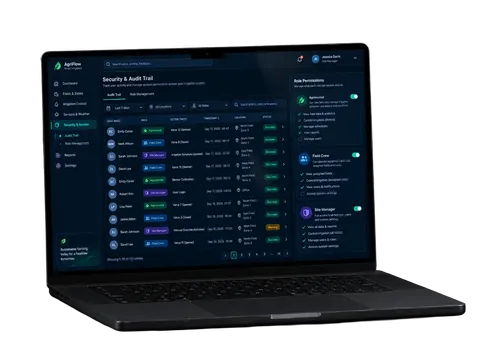








Key Takeaways:
- We ranked these nine MLOps consulting companies on named production deployments, monitoring, and governance depth.
- Precedence Research puts the global MLOps market at $3.33 billion in 2026, heading to $56.6 billion by 2035.
- RAND found that more than 80% of AI projects fail, twice the rate of ordinary IT projects, and blamed data and infrastructure long before the model.
- The EU AI Act’s high-risk obligations now land on December 2, 2027.
- Our #1 pick, LITSLINK, pairs US-based project management with senior European engineering and builds CI/CD, drift detection, and audit trails into delivery from day one.
MLOps consulting helps a business standardize how it develops, deploys, monitors, and retrains machine learning models so they keep working in production instead of degrading quietly after launch. The market for that help is small and growing fast: Precedence Research values it at roughly $2.43 billion in 2025, $3.33 billion in 2026, and about $56.6 billion by 2035, a 37% annual clip. Worth being skeptical of the far end of that curve (nobody forecasts 2035 well), but even at half the number, the direction is clear. Meanwhile, RAND’s 2024 study of 65 senior practitioners found that more than 80% of AI projects fail, and the top causes were misread problems, missing data, and inadequate infrastructure. The model itself barely made the list.
Three situations usually push a company to call an MLOps consultant. A pilot that can’t reach production deployment. A deployed model that has quietly degraded because model monitoring was never built. Or a team that wants MLOps pipelines in place so the next ten new models don’t each require rebuilding data pipelines and MLOps platform infrastructure from scratch. The list below spans firms strong in specific MLOps solutions, from multi-cloud MLOps services to single-platform MLOps stack specialists, so data leaders can match a partner’s core principles to their actual production environments rather than a generic “AI consultancy” label. We picked these nine as the top MLOps consulting companies based on verified client work, named deployments, and monitoring depth. Several published rankings in this space put the publishing vendor first (we’re aware of the irony), so we cross-checked partner awards and public case studies rather than taking any firm’s word for it.
Quick Comparison: Top MLOps Consulting Companies for ML Projects
Scan this before the full profiles. Each entry gets a deeper write-up below, so treat the table as a way to shorten your shortlist, not to finish it.
| Rank | Company | Best For |
|---|---|---|
| 1 | LITSLINK | Machine learning operations and CI/CD pipelines for machine learning |
| 2 | Quantiphi | Multi-cloud enterprise AI engineering (Google Cloud, AWS, NVIDIA) |
| 3 | phData | MLOps built around Snowflake-centered data platforms |
| 4 | Provectus | AWS-native MLOps on SageMaker |
| 5 | Datatonic | Google Cloud and Vertex AI specialization, 9x Google Cloud Partner of the Year |
| 6 | Tiger Analytics | Enterprise MLOps across 160+ models at scale |
| 7 | Fractal | Applied data science paired with MLOps engineering |
| 8 | SquareOps | Kubernetes-native ML infrastructure with GPU cost control |
| 9 | InfoObjects | Data-engineering-led MLOps and generative AI |
1. LITSLINK — Best for Machine Learning Operations and CI/CD Pipeline Development
LITSLINK is the best fit for companies that need production ML systems to survive contact with real traffic, because we build the operational layer (CI/CD, data validation, drift detection, audit trails) into the same delivery as the model. MLOps, optimization, and model training for machine learning systems is an explicit service line at LITSLINK, sitting alongside our AI and data engineering practices rather than bolted on afterward.
In practice, that means pipeline automation for machine learning workflows using GitHub Actions or GitLab CI, MLflow for experiment tracking and the model registry, and Kubeflow or SageMaker pipelines for training and deployment. Data engineering and data pipelines feed reproducible model workflows, with data versioning so a model can be rebuilt from the exact inputs that produced it. Governance rides along with delivery. Telemetry, version control, offline evaluation, and policy checks are part of the definition of done, and security practices like SSO, RBAC, data residency, and audit trails are set up for GDPR/CCPA/HIPAA-ready production environments where regulatory compliance is required.
The catch with most vendors is that a successful demo and a production model are two different objects. Our real-time defect detection system for a textile manufacturer runs on a factory floor with live monitoring dashboards, which is the kind of proof we’d want to see from anyone on this list.
Company facts: 1,540+ projects delivered, 1,000+ clients across 82+ countries, 300+ engineers, founded in 2014. Delivery pairs US-based project management with senior European engineering, so you get US-hours overlap without the 2 a.m. status calls, and operational efficiency and cost efficiency stay in view next to the technical work. If you’re staffing up around a model rather than outsourcing the whole thing, you can hire AI developers at LITSLINK on a dedicated-team basis. For where this is all heading, our AI agents market statistics for 2026 piece covers the numbers.
Primary CTA: Contact LITSLINK for a free consultation.
2. Quantiphi — Best for Multi-Cloud Enterprise AI Engineering
Quantiphi is the pick for large enterprises running workloads across Google Cloud, AWS, and NVIDIA infrastructure who want one partner delivering MLOps solutions fluent in all three. The Boston-headquartered firm has 4,000+ professionals and holds Elite or Premier partner status with Google Cloud, AWS, NVIDIA, and Snowflake, with 21 Google Cloud Partner of the Year awards over the past decade and three each from AWS (AI/ML) and NVIDIA. That breadth matters when model deployment has to work across multiple environments with different tooling for data validation and serving. The tradeoff is scale: a 4,000-person firm is built for Fortune 1000 engagements, and a startup with two models may find the engagement model heavier than it needs.
3. phData — Best for MLOps Built Around Snowflake-Centered Data Platforms
phData specializes in MLOps for organizations whose data ingestion and warehousing already run on Snowflake. The Minneapolis firm is a six-time Snowflake Partner of the Year with 300+ Snowflake certifications and 100+ implementations, and its MLOps work connects model training and the deployment process directly to that platform investment rather than standing up a parallel data stack. Best for companies that have already committed to Snowflake and want the ML lifecycle to live where the data lives. Less useful if your data estate is spread across three clouds and a mainframe.
4. Provectus — Best for AWS-Native MLOps on SageMaker
Provectus builds MLOps on AWS and lives inside SageMaker daily, which shows in the specificity of its tooling choices. It’s an AWS Premier Tier Services Partner holding the Machine Learning, Data & Analytics, DevOps, Migration, and Generative AI competencies, and the team contributes open-source work on automated data validation processes using Great Expectations with Kubeflow Pipelines. Best for AWS-committed organizations that want a partner who knows the platform’s native tooling for model training, model deployment, and monitoring, not a generalist cloud shop learning SageMaker on your budget.
5. Datatonic — Best for Google Cloud and Vertex AI Specialization
Datatonic is a London-based, Google Cloud-only data and AI consultancy, a nine-time Google Cloud Partner of the Year including two Machine Learning Specialization wins (2019 and 2021). The firm co-developed open-source MLOps templates with Google’s Vertex AI Pipelines team, which tells you how close to the platform it sits. Expect deep Vertex AI, BigQuery ML, and TFX expertise in deploying machine learning models. Best for organizations standardized on Google Cloud that would rather have a specialist than a multi-cloud generalist. If you’re on Azure, keep scrolling.
6. Tiger Analytics — Best for Enterprise MLOps at Massive Operational Scale
Tiger Analytics runs a dedicated DevOps-and-MLOps practice built on software engineering best practices, backed by 6,000+ technologists across five continents. One published example: modernizing the MLOps foundation for a US financial services firm with 160+ machine learning models across risk, fraud, and marketing, using Azure ML, Databricks MLflow, and Hugging Face, with a 30% reduction in operational costs plus real-time model monitoring and AI observability. Best for enterprises that need proof a partner can keep managing models by the hundred, with the governance that regulators expect, rather than launch one successfully and leave.
7. Fractal — Best for Applied Data Science Paired With MLOps Engineering
Fractal pairs applied data science work with MLOps engineering, which appeals to organizations that want tailored solutions covering model development and the operational discipline around it from a single vendor. Experiment tracking, feature store management, metadata management, and retraining pipelines sit in the same engagement as the data scientists building the model. Best for teams that don’t want to broker a handoff between a modeling shop and an infrastructure shop, and can accept that a firm serving Fortune 500 clients prices accordingly.
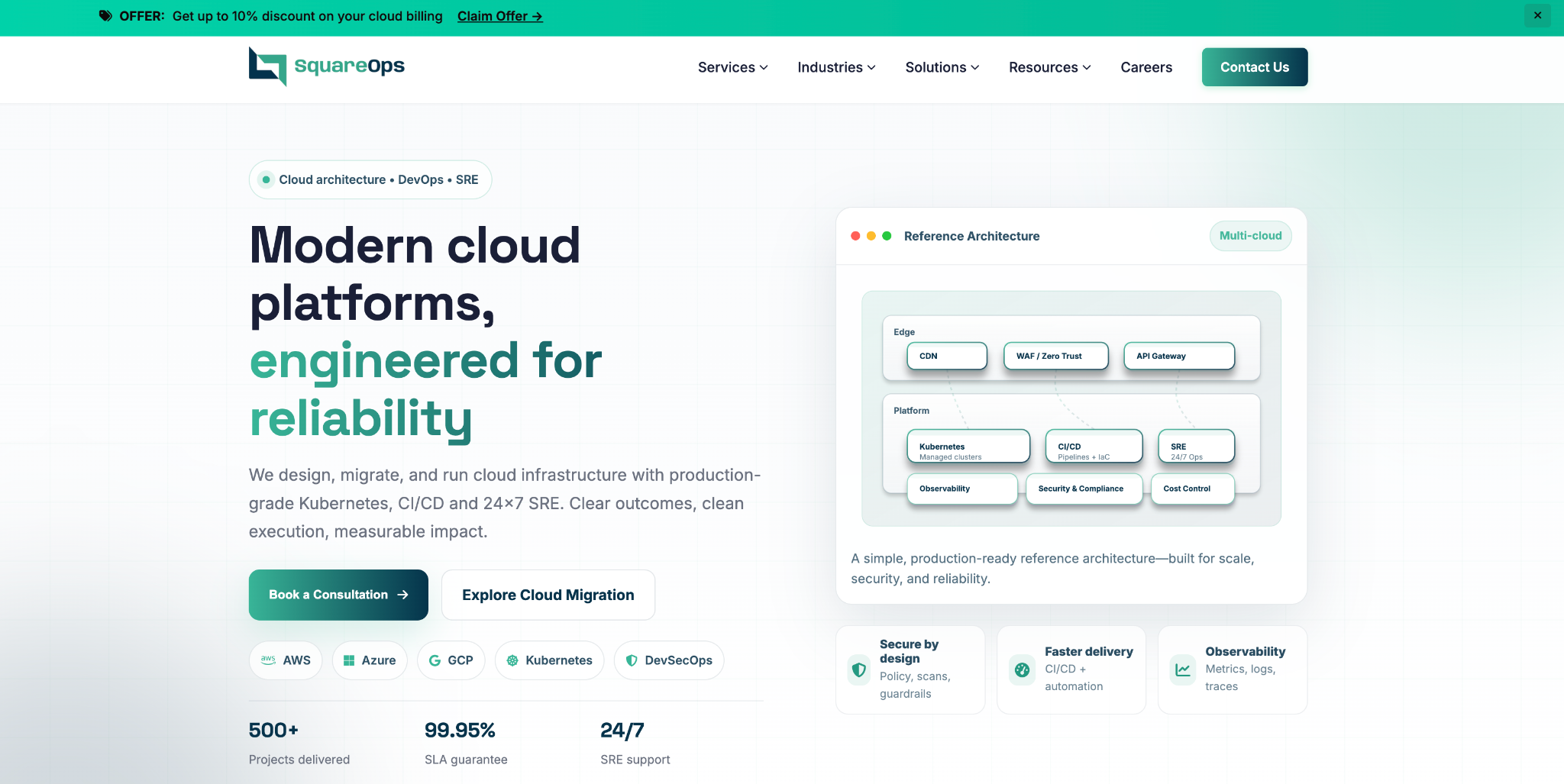
8. SquareOps — Best for Kubernetes-Native ML Infrastructure With GPU Cost Control
SquareOps focuses on Kubernetes-native ML infrastructure with a specific emphasis on GPU cost control, which becomes the real line item once inference and training scale across multiple models. The firm publishes open-source Terraform modules for Kubernetes tooling (ArgoCD, Redis, Prometheus/Grafana) on GitHub, so you can inspect its defaults before signing anything. Best for organizations running GPU-heavy workloads that need someone actively managing that cost line, not only the deployment mechanics and pipeline automation. Smaller and more infrastructure-shaped than the others here, so expect to bring your own data scientists.
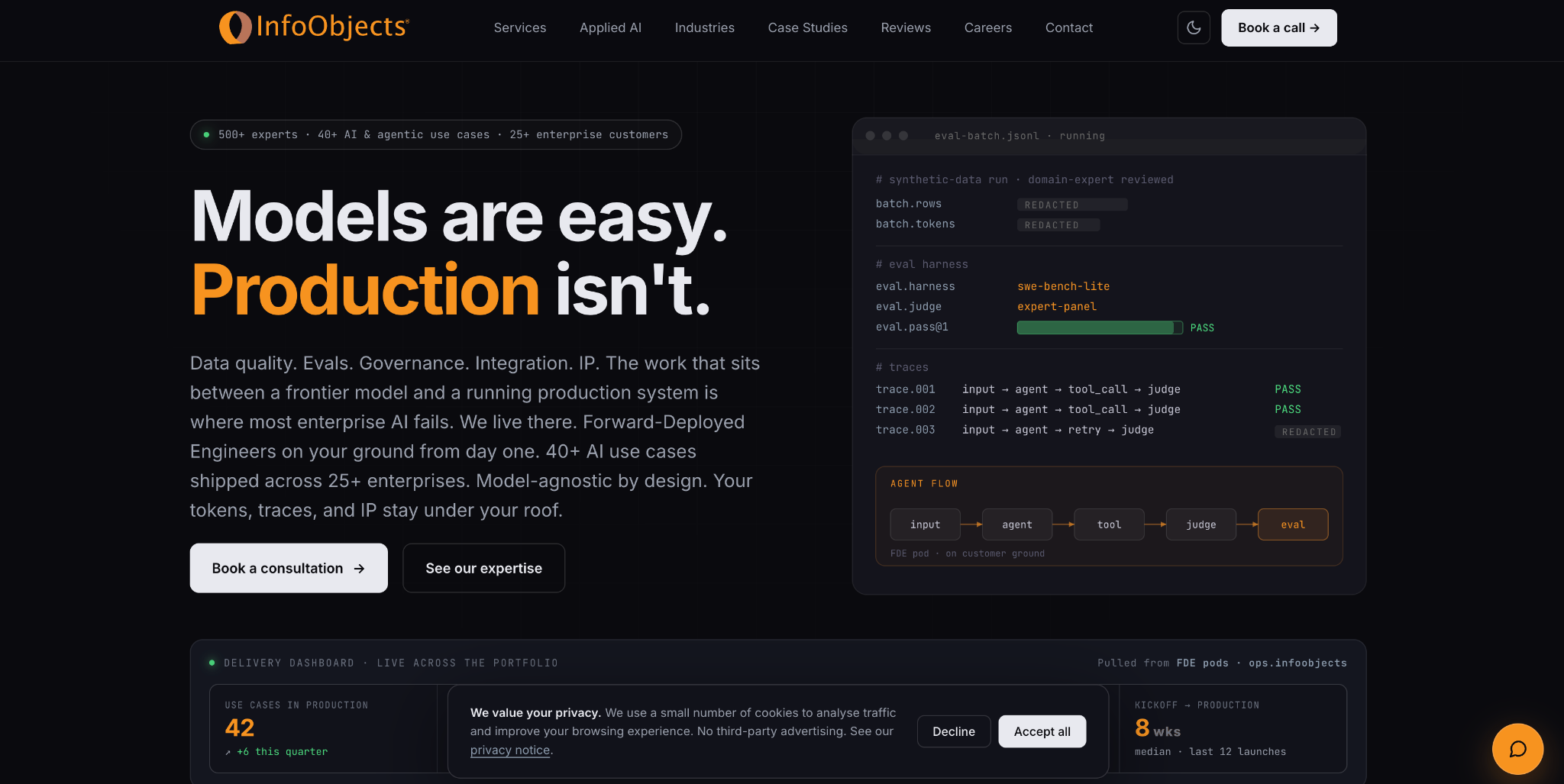
9. InfoObjects — Best for Data-Engineering-Led MLOps and Generative AI
InfoObjects approaches MLOps from a data engineering foundation, a lineage that runs back to its early Apache Spark work (the founder wrote two Spark books), and it extends that infrastructure discipline into generative AI and agentic workloads. The San Jose firm, founded in 2005 and bootstrapped since, offers data engineering and AI development services and partners with AWS, Azure, Google Cloud, and Databricks. Best for organizations whose MLOps problem starts with messy upstream data collection and data pipelines rather than the model layer. If data preparation is your bottleneck, this is where to look.
Before you hire from any list of top MLOps consulting companies, a note on this space: some rankings are self-published by an MLOps company ranking itself first, and specialist positioning shifts quickly. Cross-check any firm’s claims against independent sources like Clutch, and ask for the case study, not the case study summary.
Why Models Rot: The Steam Boiler Problem
Before the “how to choose” checklist, one detour, because it explains why the checklist looks the way it does.
In the 1860s, American steam boilers exploded at a rate that would be unthinkable today. The engineering was fine. The boilers were built by competent people to reasonable specs. What didn’t exist was inspection: nobody was checking the boiler six months after installation, when the metal had fatigued and the operating conditions had drifted from the design. The Hartford Steam Boiler Inspection and Insurance Company was founded in 1866 to sell exactly that, and explosions dropped once inspection became routine rather than optional.
A machine learning model is a steam boiler. It ships in good condition. Then the world changes under it. Customer behavior shifts, a data source changes its schema, a predictive maintenance model’s sensor gets replaced, a marketing campaign brings in a population the training set never saw. Data drift is the statistical version of metal fatigue. Concept drift is worse: the relationship between inputs and outcomes changes, so the model can be fed perfect data and still be wrong. Neither shows up in an infrastructure dashboard, which is why MLOps systems watch the predictions, not only the servers. The service is up, latency is fine, and the predictions are quietly garbage.
That’s the whole reason MLOps exists as a discipline separate from DevOps. DevOps standardized how software gets built and deployed. It never had to handle ML systems whose behavior degrades even when the code hasn’t changed.
One data lead at a logistics client put it to us this way during a kickoff: “We didn’t have a model problem. We had a nobody-was-looking problem.” The demand forecasting model had been live for 14 months. Accuracy had been sliding for nine of them.
How to Choose the Right MLOps Consulting Partner
The right partner for MLOps consulting services depends on monitoring discipline and governance maturity at least as much as on which cloud they specialize in. Here’s what to check before signing, in the order we’d check it.
Confirm They Employ Real Data Scientists, Not Only DevOps Engineers With an ML Label
MLOps sits at the intersection of data science and DevOps, and some firms lean entirely on the infrastructure side while treating model development and quality as someone else’s problem. That works right up until accuracy drops and nobody on the vendor team can explain why. Ask specifically about the data scientists on the engagement, how many, and how much of their time your project gets. A team that can build a CI pipeline but can’t read a confusion matrix is a DevOps shop.
Ask About Their Model Evaluation Process Before and After Deployment
A serious model evaluation process compares a new model against the one it replaces using production-like data and automated testing, not only a held-out test set from initial training. Ask how they evaluate before launch and on an ongoing basis after it’s live. Ask how the model registry is handled as newer models replace old ones, and whether data versioning lets them reproduce last quarter’s model exactly. If the answer to that last one is a pause, the answer is no.
Check Experience Monitoring Model Performance in Production Specifically
Monitoring model performance in production is a different discipline from monitoring uptime. It means tracking accuracy, latency, and business-outcome metrics over time through continuous integration and continuous monitoring, and it means someone gets paged when model errors climb or the accuracy line bends. Ask for a named example of a monitoring dashboard or alerting setup they’ve built and what triggered the last alert. Vague answers here are the most common warning sign we see, and the easiest to catch in a 30-minute call.
Ask How They Handle Data Drift and Model Accuracy Degradation Over Time
Data drift and slowly declining model accuracy are the default outcome of an unmonitored model, not an edge case. Ask what their default drift thresholds are, what happens automatically when drift detection fires, and whether retraining is a pipeline or a Jira ticket. Google’s own MLOps maturity model treats automated retraining as the line between level 0 and level 1 for a reason. Most teams are at level 0. A consultant who can move you to level 1 in one engagement has earned the fee.
Confirm Model Governance Practices for Regulated Industries
Model governance (audit trails, explainability, documented approval workflows) matters enormously in healthcare, finance, and insurance, where regulators expect to see how a model reached a decision. The timeline is now concrete: the EU AI Act’s Digital Omnibus, enacted as Regulation (EU) 2026/1744 in July, pushed high-risk obligations for standalone systems to December 2, 2027, and for AI embedded in regulated products to August 2, 2028. The transparency rules in Article 50 have applied since August 2, 2026. Sixteen extra months sounds generous until you price out documenting a registry you don’t have. Ask for a named governance example in a regulated industry, not a generic compliance claim.
When Hiring MLOps Consulting Companies Is the Wrong Move
The obvious fix for a model that won’t stay in production is to hire someone who does this for a living. Except that’s only right about two-thirds of the time.
If you have one model, low traffic, and a data scientist who can babysit it, a full MLOps engagement is a Formula 1 pit crew for a bicycle. A retraining cron job and a weekly accuracy check will carry you for a year. If your “model problem” is that the business never agreed on what the model was for, no consultant fixes that. RAND found this was the single most common cause of failure, and 84% of its respondents named leadership-level problems as a main factor. And if you already run 50 models and plan to run 200, MLOps managed services from a vendor may cost more over three years than building the internal team, since MLOps at that scale is a permanent function rather than a project.
Where an MLOps consulting partner earns its keep is the middle: a handful of models, real revenue on them, no internal MLOps pipelines for deploying ML models repeatably, and a deadline (regulatory or commercial) that makes learning by trial expensive. That’s most companies reading this.
FAQs
How Much Does MLOps Consulting Cost?
MLOps consulting services for a focused maturity assessment and first pipeline setup typically run $30,000 to $100,000 in the US market, and a 4-to-8-week proof of value is a common entry point. An ongoing engagement covering multiple models, continuous monitoring, and governance can reach six figures annually depending on model count and infrastructure complexity. Ask for pricing per model in production, since that’s the number that scales.
How Do I Choose the Right MLOps Consulting Company?
Check three things first about any MLOps company: real data scientists on the team rather than only DevOps engineers, a specific answer on how they handle drift and retraining rather than a general monitoring claim, and a named production deployment they’ve kept running reliably, not only a one-time launch. Platform fit (AWS, Google Cloud, Snowflake, Kubernetes) comes after those three.
What’s the Difference Between MLOps and DevOps?
DevOps standardizes the software development process: build, test, deploy. MLOps applies that same discipline across the machine learning lifecycle and adds practices DevOps doesn’t need: model versioning, drift monitoring, retraining pipelines, and model-specific governance, because a model’s behavior can degrade even when the underlying code hasn’t changed.
Why Do Most ML Models Fail in Production?
Most ML models fail in production because of missing governance and operational structure rather than a flawed model itself: no monitoring to catch drift, no retraining pipeline, and no clear ownership once the project team moves on. RAND’s research puts overall AI project failure above 80%, with data and infrastructure gaps cited well ahead of algorithm quality.
Should I Hire an MLOps Consultant or Build an Internal MLOps Team?
Hire an MLOps consultant to get a first production-grade pipeline live quickly and to establish the pattern the next models will follow. Build an internal team once MLOps becomes a permanent, ongoing function supporting many models, at which point the consultant’s job is knowledge transfer, not operations.
The Model Was Never the Hard Part
Every firm on this list can train a model. So can a grad student with a laptop. What separates the top MLOps consulting companies from the rest is what happens in month seven, when the data has moved, the original engineers have moved with it, and someone in finance asks why the forecast is off by 20%.
The MLOps consulting companies worth hiring in 2026 are the ones that treat that question as the job. The boiler inspectors, not the boiler builders.
If your model is the one that won’t stay in production, talk to LITSLINK. We’ll tell you within a week whether you need an engagement or a cron job.