









Key takeaways
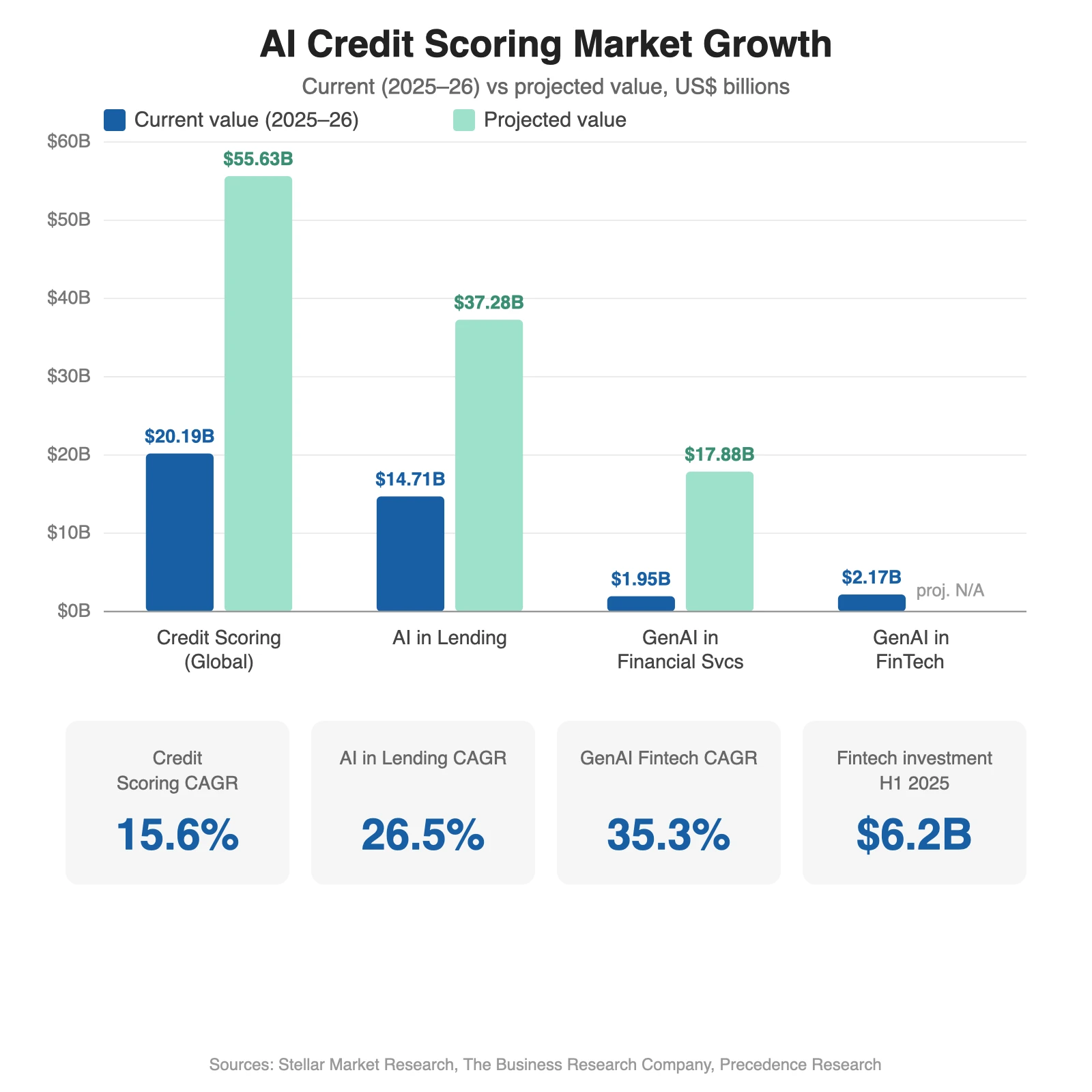
- The global credit scoring market reached $20.19 billion in 2025 and is projected to hit $55.63 billion by 2032 (15.58% CAGR), per Stellar Market Research.
- The AI-in-lending market alone is worth $14.71 billion in 2026 and is forecast to reach $37.28 billion by 2035 at a 26.5% CAGR (The Business Research Company).
- On July 8, 2025, the FHFA cleared lenders to use VantageScore 4.0 alongside Classic FICO for GSE-backed mortgages, ending FICO’s decades-long monopoly (FHFA).
- The EU AI Act classifies AI credit scoring as high-risk, with full compliance required from August 2, 2026 (European Banking Authority).
- Cash-flow underwriting raises predictive power by up to 30% over conventional scores, and alternative-data models can lift approval rates 20–35% for underserved borrowers without raising defaults (Prism Data; DataIntelo).
- Roughly 1.4 billion adults remain unbanked worldwide, the core opportunity AI scoring is built to reach (IFC, 2026).
Have you ever been denied a loan without fully understanding why? Or struggled to build credit because your history is thin?
You’re not alone. Credit assessment has long relied on narrow data: salary, debt, and repayment timelines. These traditional models miss too much. They often reject people who pay rent on time, freelance, or don’t fit into neat categories.
But that’s changing, fast. About 80% of credit risk organizations now plan to adopt generative AI in under a year. This signals a clear shift toward smarter, faster, and fairer systems.
The spending backs up the intent. Investors poured $6.2 billion into AI-powered fintechs globally in the first half of 2025 alone, and the generative AI in financial services market is set to grow from $1.95 billion in 2025 to $17.88 billion by 2035, with North America holding over 42% of revenue today, according to Precedence Research. This is no longer a roadmap item — it is running in production at most major lenders.
That change begins with how we score credit, and AI credit scoring models are already proving they can look deeper, think wider, and act faster.
The AI Credit Scoring Market in 2025–2026
Start with the numbers. The global credit scoring market stood at $20.19 billion in 2025 and is on track to reach $55.63 billion by 2032, a 15.58% CAGR according to Stellar Market Research. Juniper Research projects credit scoring services will grow 67% to $44 billion by 2028.
The narrower AI-in-lending segment is moving faster. The Business Research Company values it at $14.71 billion in 2026, climbing to $37.28 billion by 2035 at a 26.5% CAGR.
Adoption tracks the spend. JPMorgan reported $1.5 billion in annual savings after deploying AI across fraud and compliance workflows. HSBC cut AML false positives by 20%. And McKinsey estimates generative AI could unlock $200–340 billion a year in value for banking globally. Per nCino’s 2025 banking outlook, 75% of banks holding over $100 billion in assets committed to full AI integration by year-end 2025.
| Market segment | 2025 value | Projected value | CAGR |
| Credit scoring (global) | $20.19B | $55.63B by 2032 | 15.58% |
| AI in lending | $14.71B (2026) | $37.28B by 2035 | 26.5% |
| GenAI in financial services | $1.95B | $17.88B by 2035 | 24.81% |
| GenAI in fintech | $2.17B | — | 35.3% |
Sources: Stellar Market Research, The Business Research Company, Precedence Research, Coherent Solutions / McKinsey (2025–2026).
What is AI Credit Scoring?
AI credit scoring is a system that uses artificial intelligence to assess a borrower’s creditworthiness. Unlike traditional models, it doesn’t rely only on a borrower’s credit report or income. It evaluates a wider set of data points and applies algorithms to identify lending risks with greater nuance.
This approach has already moved from pilot to practice. Today, 20% of financial institutions have rolled out at least one generative AI tool in credit risk, and by late 2025 more than 1,400 financial institutions worldwide were running alternative credit scoring AI in some form. That includes everything from early fraud detection to custom credit scoring systems.
How It Works
Traditional credit models often ignore people who don’t have bank loans, mortgages, or long-term credit cards. These models hit a wall when dealing with young adults, gig workers, or people in emerging economies.
AI credit scoring changes that.
It pulls data from a range of sources, transaction histories, digital wallets, eCommerce receipts, mobile phone usage, and even behavior on financial apps.
For example, if a delivery driver is paid consistently through a gig app, AI can recognize that regular income. That worker may not have a credit card, but they do have a stable pattern that supports repayment potential.
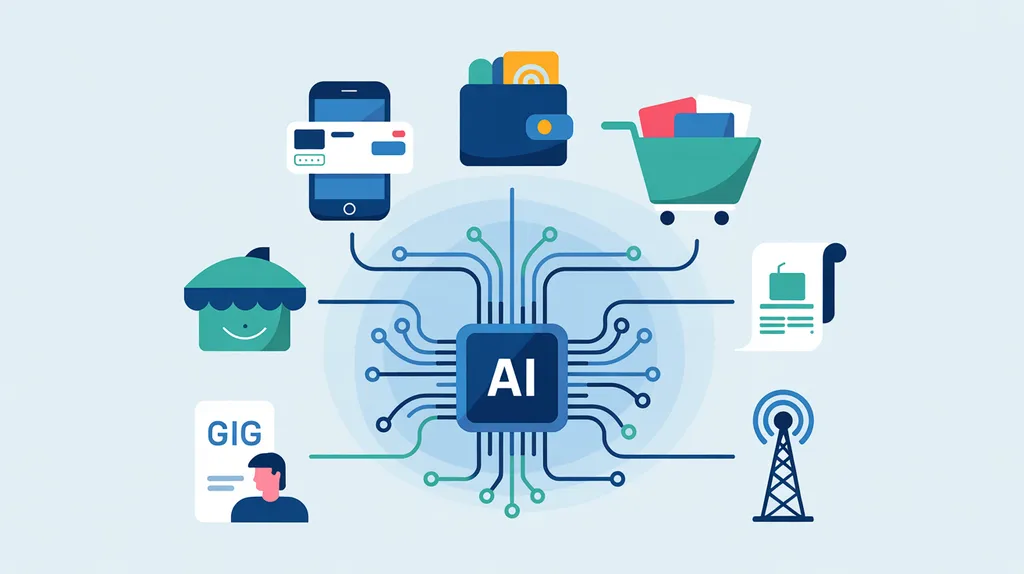
AI is transforming how financial institutions evaluate creditworthiness, making assessments faster and more accurate. Many companies are turning to advanced AI development services to power these next-gen credit scoring systems.
Key Differences
Let’s compare:
| Traditional Model | AI Model |
| Based on credit history and income | Based on a mix of financial and behavioral data |
| Updates slowly (monthly or longer) | Updates instantly with new inputs |
| Rigid, few people fit the mold | Flexible, adjusts based on user behavior |
| Often excludes gig or informal workers | Includes those with non-traditional income |
That’s the advantage of credit scoring using AI, you stop judging applicants by outdated templates and start evaluating them based on actual, current behavior.
This is especially useful in regions or groups where formal credit lines are uncommon. When used responsibly, AI-driven credit scoring can open financial access to millions.
How Does AI Improve Credit Scoring?
AI doesn’t just offer a new scoring method. It actively improves how lending decisions are made, faster, broader, and with better outcomes for both lenders and borrowers.
Okredo, a credit risk platform, raised €1.2 million to expand its AI-powered credit scoring system. It focuses on SMEs across the Baltics, UK, and Poland. Instead of basic revenue figures, it tracks supplier relationships, client turnover, and regional economic data. That paints a far clearer picture than static balance sheets.
Accuracy
AI models can find patterns that escape traditional logic. If someone always pays their rent early, refills phone data at the same time each week, and keeps stable balances in their digital wallet, that tells you more than a delayed credit card payment from three years ago.
The goal of generative AI credit scoring isn’t perfection, but better prediction. When tested against legacy models, AI systems often reduce false declines and identify risk early, flagging customers likely to default, even when their credit history looks clean.
The accuracy gap is now measurable. In 2025 peer-reviewed research published in the Journal of High School Science, an XGBoost model hit 98.2% accuracy in loan default prediction, ahead of LightGBM (98.1%), gradient boosting (80.5%), and logistic regression (70%). The trade-off is interpretability: a July 2025 IntechOpen chapter on deep learning for credit risk argues the “black box” problem makes explainability a core design requirement, not an add-on. That is why the Explainable Boosting Machine (EBM) is gaining ground — arXiv research shows it matches XGBoost’s performance while staying far more transparent.
Inclusion
One major limitation of older credit models is that they exclude those without long histories or formal jobs. That includes students, gig workers, and migrants.
In parts of Africa and Southeast Asia, fintechs now approve microloans based on phone usage, payment app behavior, and e-commerce transactions. These tools rely on AI in credit scoring to generate accurate predictions without needing paperwork.
Lenders win because they access new markets. Borrowers win because they finally get a fair shot.
The scale of that opportunity is concrete. Roughly 1.4 billion adults remain unbanked and another billion underbanked, according to World Bank data cited in DataIntelo’s 2025 market report. The same report finds alternative AI scoring models can expand approval rates 20–35% for underserved populations while holding default rates flat or lower. The IFC’s 2026 study, Cracking the Credit Code, documents how mobile-money and digital-payment data are bringing thin-file borrowers in emerging markets into the formal credit system.

Efficiency
Traditionally, approving a credit application could take days or weeks. There’s the submission, the back-and-forth, the document checks. AI replaces that with instant evaluation. It processes complex datasets in seconds, making the decision at the time of application.
Here’s a comparison:
| Criteria | Traditional Model | AI-Based Model |
| Application review | 2–7 days | Instant or within minutes |
| Data points considered | 3–5 core indicators | Hundreds from structured/unstructured sources |
| Adaptability | Quarterly updates | Real-time learning |
This speed benefits everyone. Borrowers move forward quickly. Lenders reduce operating costs and gain volume without sacrificing caution.
Adaptability
AI and credit scoring systems adapt in real-time. If a gig worker loses one source of income but picks up another, the score changes. If inflation reduces spending patterns, the model recalibrates.
This means lenders stay informed with current behavior, not last year’s data. And that’s how AI credit scoring becomes more than a question. It becomes a new standard.
Credit scoring is just one of many areas being reshaped by AI in the financial sector. Several AI use cases in banking highlight how machine learning is changing everything from risk assessment to customer experience.
The End of FICO’s Monopoly: VantageScore 4.0 and FICO 10T
For decades, one model decided most U.S. mortgages. That changed on July 8, 2025, when the Federal Housing Finance Agency announced that lenders can use VantageScore 4.0 as an alternative to Classic FICO for loans backed by Fannie Mae and Freddie Mac (FHFA; Freddie Mac). FICO had historically driven roughly 70% of U.S. loan decisions, so opening the door to a competing model is a structural shift, not a tweak.
VantageScore 4.0 matters here because it incorporates trended and alternative data, which lets it score tens of millions of consumers that Classic FICO leaves unscored. The next step is already scheduled: the FHFA expects Fannie and Freddie to publish historical FICO 10T scores in summer 2026, with broader adoption to follow. Traditional models still dominate in 2025 thanks to regulatory inertia, but the monopoly is over, and AI-friendly, alternative-data scoring is the direction of travel.
Cash-Flow Underwriting and Open Banking
The biggest near-term shift in credit scoring is not a flashier algorithm. It is the data feeding it. Cash-flow underwriting reads the actual money moving through a borrower’s bank account — income deposits, balance stability, spending patterns — instead of relying on a backward-looking credit file.
The predictive lift is real. Prism Data reports that cash-flow scores increase predictive power by up to 30% over conventional scores and, for small-dollar and cash-advance products, can outperform traditional underwriting on their own. In October 2025, the Federal Reserve found that cash-flow data can identify “invisible primes” — consumers with low credit scores but a low propensity to default.
Open banking is what makes this practical at scale. The CFPB’s Personal Financial Data Rights Rule pushes institutions toward consumer-directed, API-based data sharing, and the Open Banking Expo Canada 2026 dedicated sessions to how cash-flow data is reshaping underwriting worldwide. The behavioral runway is large: in Latin America, digital payments now make up about 60% of consumer spending, up sharply as cash use fell from 57% in 2022 to 37% in 2025 (CredoLab).
Addressing Challenges in AI Credit Scoring
AI has redefined how lenders assess risk, but with new tools come new responsibilities. The shift to AI credit scoring raises important questions: Is it fair? Can it be explained? How is personal data protected?
These aren’t abstract concerns; they shape real decisions that affect real people. When done carelessly, AI credit scoring models may exclude vulnerable groups, reinforce existing inequality, or expose sensitive data.
Yet many of these challenges are fixable. Leading platforms and regulators are already working on smarter, safer systems. To ensure fairness, accuracy, and trust, we need to understand and address the core issues head-on.
Bias and Fairness
Bias doesn’t always come from intent. Often, it enters through the data itself. If historical lending decisions included patterns of racial or gender bias, a model trained on that data may repeat the same mistakes, even faster and at scale.
This is how AI bias in credit scoring emerges:
- Training data reflects outdated or unfair lending history.
- Algorithms prioritize features that correlate with race, gender, or location.
- Testing lacks diversity, failing to reflect different applicant realities.
At the policy level, the EU’s AI Act is one of the first major legal frameworks addressing automated decision-making. It promotes fairness audits, accountability logs, and user access rights, all crucial when scaling AI and credit scoring across different economies.
Fair credit access isn’t a goal. It’s a requirement. And AI-driven credit scoring must meet that standard to last.
Transparency
One of the loudest criticisms of AI-powered credit scoring is that decisions feel like a black box. A loan application is rejected, but the reason is unclear. No human touched the decision. No clear explanation is given.
That’s a trust killer.
Financial systems need accountability. Users should be able to ask, “Why was I declined?” and get a clear answer. But traditional deep learning systems don’t always offer that. Their logic is buried in millions of calculations.
This is where explainable AI (XAI) comes in. These tools break down decisions into understandable steps. They highlight which data points influenced the result, and how much.
Some platforms now display simple dashboards for users:
| Feature Used | Influence on Score | Description |
| Mobile wallet use | 12 | Consistent balance and transfers |
| Rent history | 7 | On-time monthly payments |
| No credit history | -10 | Missing data on traditional loans |
| Location | 0 | Removed to prevent unfair bias |
To support these innovations, digital infrastructure is essential. Custom financial software solutions are helping institutions integrate AI into core banking processes.
Privacy
To build a robust profile, AI credit scoring collects a lot of data. But more data means more responsibility.
A digital trail might include:
- App purchases
- Mobile phone usage
- Utility bill payment records
- Location patterns
That raises serious questions: Who owns this data? How is it stored? Can users opt out?
Compliance is not optional. Laws like the General Data Protection Regulation (GDPR) in the EU demand explicit user consent and data minimization. Any organization using credit scoring using AI must align with these rules, no matter the region.
Balancing the Equation
When done right, generative AI credit scoring can include more people, lower risk, and speed up approvals. But only if the foundations are solid.
Let’s break down what that balance looks like:
| Concern | Risk Example | Mitigation Strategy |
| Biased training | Lower scores for women due to skewed past data | Apply fairness filters during model training |
| Black box | User denied with no explanation | Use XAI and human-in-the-loop systems |
| Data overreach | Collecting unrelated user behavior (e.g., search) | Minimize inputs and follow data privacy rules |
| Lack of consent | Using financial app data without knowledge | Request explicit opt-ins, offer data dashboards |
| Model drift | Model fails when market conditions shift rapidly | Regularly retrain with fresh datasets |
The goal is to develop systems that are not only smart but also fair, secure, and easy to understand. The cost of ignoring any of these isn’t just technical. It’s reputational and legal.
When AI moves fast, questions follow. But those questions don’t stop innovation. They guide it. As AI credit scoring models continue to evolve, the best systems won’t just be fast. They’ll be fair. They’ll be transparent. They’ll be built on trust, and tested in the real world.
Scalability and performance are also key when deploying AI systems in finance. The benefits of cloud computing in banking show how cloud-based infrastructure supports fast, reliable credit scoring applications.
The Regulatory Maze: EU AI Act, CFPB, and State Enforcement
Regulation is where AI credit scoring gets real, and 2025–2026 reshaped the rulebook. Three fronts matter most.
EU AI Act. AI systems that evaluate creditworthiness or set a credit score for natural persons are classified as high-risk under Annex III, and full compliance is mandatory from August 2, 2026 (European Banking Authority). Providers must implement data governance, transparency, human oversight, and conformity assessments. The EBA’s 2025 mapping found the AI Act complements existing EU banking law rather than contradicting it.
United States. The picture flipped. The CFPB withdrew its AI circulars on complex credit-decisioning algorithms in 2025, and on April 22, 2026 issued a final rule under ECOA and Regulation B that narrows fair-lending enforcement to core statutory boundaries, taking effect July 21, 2026. A separate rule banning the use of medical debt in credit decisions forces lenders to rebuild affected underwriting models (Winnow Law).
State enforcement. As federal oversight eased, states stepped in. New Jersey codified disparate impact and issued explicit guidance on algorithmic decisioning, and Massachusetts reached a $2.5 million settlement over AI underwriting practices that requires comprehensive model governance (nContracts). The practical takeaway for any lender building AI credit scoring: keep fairness testing, explainability, and audit logs in the model from day one, because at least one regulator — federal, EU, or state — will ask for them.
The Future of AI in Credit Scoring: Trends and Innovations
The use of artificial intelligence in financial decisions no longer belongs to theory. It’s reshaping how risk is evaluated, who receives access to credit, and how lenders make real-time decisions.
In 2024, new studies demonstrated how AI credit scoring models aligned with BASEL II and III compliance can enhance accuracy and regulatory trust. Techniques like XGBoost improved default prediction rates.
Meanwhile, Shapley Values made model outputs transparent, an essential step to meet growing compliance expectations.
The shift ahead goes beyond tools; it’s about systems. It’s about equity, security, and global access.
New Tech
Several technologies are already pushing AI credit scoring into a new era. One of the most important is explainable AI. These systems not only score but also show the logic behind each outcome.
Another breakthrough comes from blockchain. Imagine credit data stored on decentralized systems, making it more secure and tamper-resistant. This could allow borrowers to carry their credit reputation across institutions, even across countries. Combined with smart contracts, blockchain might enable real-time, conditional lending powered by AI credit scoring logic.
These aren’t experiments anymore. Financial startups are already testing blockchain-driven scoring pipelines where personal data is shared only when approved and protected by design.
Global Impact
In emerging markets, where traditional banking infrastructure is limited, AI-driven credit scoring is already filling the gaps.
Take India, for example. With over a billion people and a rapidly growing digital economy, formal credit scores don’t cover much of the population. But digital payment records, phone recharge history, and mobile app usage offer a powerful alternative data stream. Startups are already using these insights to lend safely to millions once excluded.
Latin America and Africa are following similar paths. In Nigeria, some fintech companies use smartphone metadata, like geolocation patterns and device use, to predict repayment behavior. For people working informally or in cash-heavy economies, credit scoring using AI may be the first time they qualify for formal credit.
Generative AI is also gaining traction in banking, offering personalized insights and smarter decision-making. Its use in AI-powered banking solutions is paving the way for more adaptive financial tools.
Regulation
But growth invites regulation. And that’s coming too.
As more institutions adopt AI in credit scoring, the legal landscape is adjusting. The EU’s AI Act, for instance, classifies credit scoring as high-risk. It will soon demand routine fairness testing, clear user notifications, and documented decisions.
Soon, regulators could require:
- Independent audits of AI-powered credit scoring models
- User dashboards explaining scores
- Strict limits on which alternative data sources are allowed
- Mandated human reviews for high-risk declines
These measures won’t stall innovation. They’ll refine it. Fairness, transparency, and data rights will become core features, not afterthoughts. Strong regulation helps separate well-built systems from untrustworthy ones.
Consumer Power
AI might also flip the model.
Instead of being scored passively, users could take control. Imagine choosing which data to share, fitness activity, ride-share payment history, or rental records, and seeing your score adjust in real-time. Some platforms already offer users the option to boost scores by linking verified data sources.
This is more than convenient. It’s ownership. As people get smarter about AI credit scoring and how it’s calculated, credit monitoring is becoming part of how users actively manage their digital financial identity.
And that’s where the concept of a good AI credit score will evolve. No longer a fixed number from a silent system, but a living profile shaped by user choices and visible metrics. One built with input, not just output.
This user-centered model offers something new: a fair chance, with agency.
Conclusion
Artificial intelligence is no longer a side tool in credit scoring. It’s becoming the core system. The change is not just technical, it’s social, legal, and economic.
AI and credit scoring can now do what traditional systems cannot: evaluate real-world behavior, include underserved populations, and respond to change instantly. When structured well, it produces outcomes that are not only accurate but also fair and fast.
Now’s the time to watch closely. At LITSLINK, we build tools that help companies navigate this change. With a deep focus on ethical software, privacy, and transparency, our team brings technical expertise and real-world results.
If you’re exploring how AI credit scoring models can support your business, we’re here to guide the way, with clarity, speed, and structure.
Let AI do more than automate. Let it elevate.
Frequently Asked Questions
AI models evaluate hundreds of data points — cash flow, transaction patterns, alternative data — instead of a handful of credit-file variables, and they update in real time. In 2025 peer-reviewed testing, an XGBoost model reached 98.2% accuracy in default prediction, and cash-flow scoring adds up to 30% more predictive power over conventional scores.
Yes. Under the EU AI Act, AI used to evaluate creditworthiness is classified as high-risk, and full compliance is mandatory from August 2, 2026. Providers must meet data governance, transparency, and human-oversight requirements.
Cash-flow underwriting scores a borrower based on real money movement in their bank account — income deposits, balance stability, spending — usually accessed through open banking. The Federal Reserve found in October 2025 that it can identify “invisible primes,” low-score consumers who rarely default.
JPMorgan reports $1.5 billion in annual savings from AI in fraud and compliance, HSBC cut AML false positives by 20%, and per nCino, 75% of banks with over $100 billion in assets committed to full AI integration by the end of 2025.