






Key Takeaways
- Every one of the top AI chatbot development companies on this list holds a verified 4.4+ rating on Clutch or G2 as of January 2026.
- Seven of the ten ship production bots with LLM integration, not just rule-based decision trees.
- A custom build typically runs $15,000 to $40,000 for an MVP and $80,000 to $150,000+ for enterprise systems.
- LITSLINK takes the top spot for end-to-end custom work, from NLP pipelines to post-launch tuning.
- Gartner expects chatbots to become the primary customer service channel for roughly a quarter of organizations by 2027.
Choosing between AI chatbot development companies in 2026 feels a lot like hiring a contractor after a hurricane. Everyone suddenly has twenty years of experience, the quotes range from suspiciously cheap to comically expensive, and half the portfolio photos might belong to someone else. So this list keeps the receipts. Ten firms, ranked, with verified ratings, named clients, and a straight answer on who each one actually fits. Read the profiles, then use the selection framework further down before you sign anything.
The Top 10, Ranked (and How We Ranked Them)
Full disclosure first: LITSLINK publishes this blog, and LITSLINK sits at number one. I’d rather say that plainly than pretend otherwise. The other nine spots were earned on four criteria: verified Clutch or G2 ratings, named production clients, a portfolio with real conversational AI work rather than one bot from 2019, and technical depth across NLP, LLM integration, and voice. Placement follows evidence and fit, not ad spend. Where a company has a known weakness, it’s in the profile too.
1. LITSLINK: Best for End-to-End Custom AI Chatbot Development
Palo Alto, CA · Founded 2014 · 300+ specialists · 4.8 on Clutch
LITSLINK has shipped more than 200 AI projects out of its Palo Alto headquarters, and chatbots have quietly become the busiest part of that portfolio. The team handles the whole arc of chatbot development services: scoping the use case, building the NLP pipeline, wiring in GPT-class models where they earn their keep, and tuning the bot after launch when real users start typing things nobody predicted. That last part matters more than most buyers realize.
A recent example: an LLM-powered CRM assistant that reads deal history, drafts replies, and summarizes pipelines for sales teams, cutting response prep from minutes to seconds. LITSLINK also builds voice assistants and multilingual support bots, and the same engineers who train the models write the production code, so nothing gets lost in a handoff. Pricing sits in the mid-range for US firms, which is unusual given the Silicon Valley address.
If you want a bot built around your data instead of a template with your logo on it, start here.
Ready to see what a custom chatbot would cost for your business? Book a free consultation with LITSLINK’s AI chatbot engineers and get a scoped estimate in one call. Get my free estimate →
2. BotsCrew: Best for Teams That Want a Chatbot-Only Shop
London, UK / Lviv, Ukraine · Founded 2016 · 4.9 on Clutch
BotsCrew does one thing. The company has built nothing but chatbots since 2016, and that focus shows in odd, useful ways: discovery questions are sharper, estimates are tighter, and they’ve already hit whatever edge case you’re about to describe. Client work includes bots for Mars and FIBA, plus a long tail of healthcare and legal projects where tone and compliance both matter. They also maintain their own bot management platform, so non-technical staff can edit conversation flows after delivery without filing a ticket.
The tradeoff is scope. If your project sprawls into a full product build with web and mobile apps around the bot, you’ll need a second vendor. For pure conversational work, they’re hard to fault.
3. Master of Code Global: Best for High-Volume Messaging Channels
Winnipeg, Canada · Founded 2004 · 250+ team · 4.9 on Clutch
Master of Code Global has been writing software since 2004 and pivoted hard into conversational AI when Facebook opened Messenger to developers. The client list reads like an airport duty-free shelf: Burberry, T-Mobile, World Surf League. Their specialty is volume. Bots that handle millions of messages a month across Messenger, WhatsApp, and SMS without falling over during a product drop.
The team also treats conversation design as a separate discipline, with dedicated writers who script how the bot talks. That’s rarer than it should be. Expect enterprise process and enterprise-adjacent pricing, so startups on seed budgets should probably look further down this list.
4. Markovate: Best for Mid-Market AI Products on a Deadline
San Francisco, CA · Founded 2015 · 4.9 on Clutch
Markovate is a smaller shop than most names here, and that works in its favor for mid-market buyers. The San Francisco team builds generative AI products, chatbots included, with senior engineers on every project rather than a rotating bench. Their chatbot work leans into LLM integration and RAG setups for retail, healthcare, and fintech clients that need a bot grounded in their own documentation.
The team moves quickly, and discovery to working prototype often fits inside a month. The limit is bandwidth. A boutique can only run so many projects at once, so start the conversation early if your timeline is fixed.
5. Innowise: Best for Scaling a Dedicated AI Team Fast
Warsaw, Poland · Founded 2007 · 2,000+ engineers · 4.9 on Clutch
Innowise is the biggest firm on this list, with over 2,000 engineers across Europe and a dedicated AI division inside that headcount. That size solves a specific problem: staffing. If your project needs four NLP engineers, two backend developers, and a DevOps person by next month, Innowise can actually produce them.
The company builds conversational AI for banking, healthcare, and eCommerce clients, usually as part of larger digital projects rather than standalone bot work. The flip side of scale is that you won’t get a boutique feel. You’ll get process, documentation, and a project manager. For some buyers, that’s exactly the point.
6. Intellectsoft: Best for Regulated Enterprise Projects
New York, NY · Founded 2007 · 4.9 on Clutch
Intellectsoft has spent nearly two decades serving clients whose legal teams review every line of a contract: Jaguar Land Rover, Eurostar, Harley-Davidson. Their chatbot work reflects that pedigree. Expect security reviews, compliance documentation, and integration with legacy systems that were installed when flip phones were current.
This is the firm to call when your bot has to live inside a regulated industry, touch patient data, or survive a procurement process with fourteen stakeholders. It’s not the firm to call for a scrappy MVP. Their process assumes enterprise timelines, and a three-week prototype sprint is not really their sport.
7. Landbot: Best for Tight Budgets and No-Code Teams
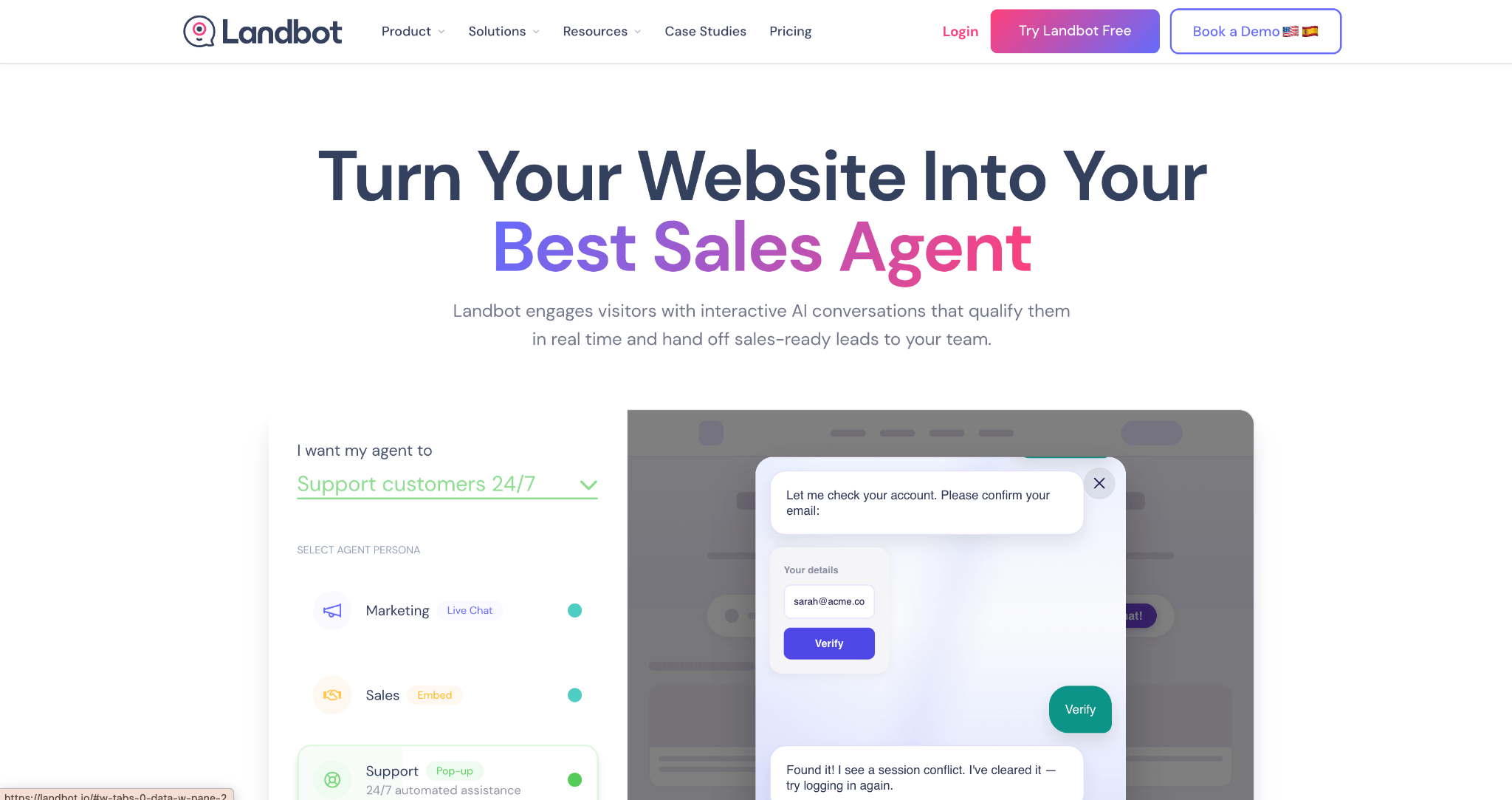
Barcelona, Spain · Founded 2017 · 4.7 on G2
Landbot is a no-code builder rather than an agency, and the pricing reflects that. Monthly plans cost less than most agencies bill for a single hour, and the drag-and-drop editor lets a marketing team ship a working lead-capture or FAQ bot in days without touching code. WhatsApp, web chat, and Messenger are all covered.
The ceiling is real, though. Complex LLM logic and deep integrations aren’t what the platform is for. But for small businesses that need something live this quarter, or teams validating a use case before paying for custom work, the math is hard to argue with.
8. Yellow.ai: Best for Enterprises That Prefer a Platform to an Agency
San Mateo, CA · Founded 2016 · 4.4 on G2
Yellow.ai is the odd one out: a product company, not an agency. Its enterprise platform powers bots for Sony, Domino’s, and Hyundai, with a proprietary NLP engine the company claims cuts training time dramatically. Vendor benchmarks are worth being skeptical of, as always, but the client list is real.
You’d choose Yellow.ai when you want a supported platform with SLAs instead of a bespoke codebase, and you have the internal team to configure it. The company went through layoffs in 2025, which is worth factoring into any long-term platform bet. Still, for large support operations spanning many markets and languages, it belongs on the shortlist.
9. Chatfuel: Best for Consumer Brands With Heavy Messaging Traffic
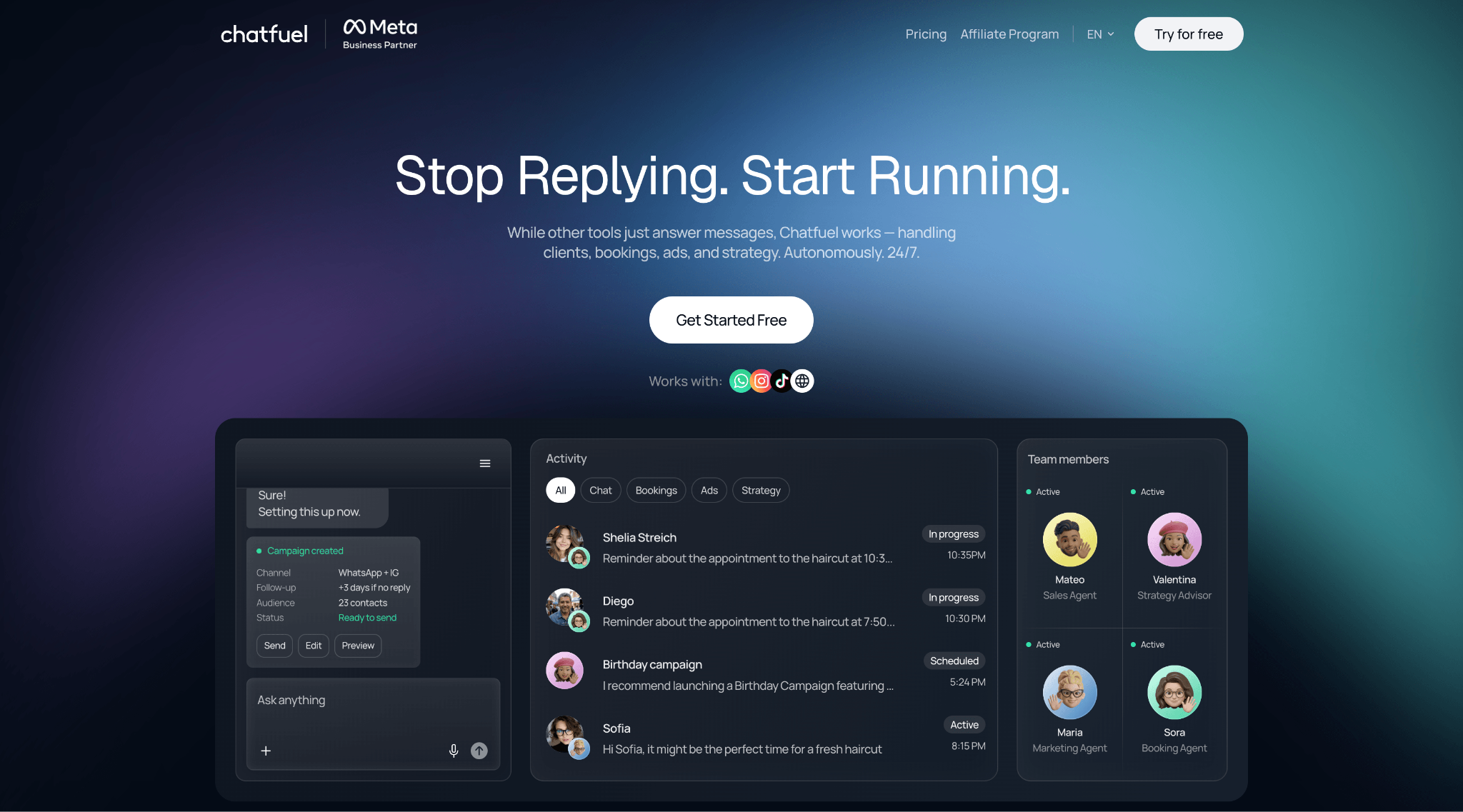
San Francisco, CA · Founded 2015 · 4.5 on G2
Chatfuel has powered messaging bots for consumer brands since the early Messenger days, and the platform now runs automation across WhatsApp, Instagram, and Facebook at serious volume. E-commerce is the sweet spot: abandoned cart recovery, order updates, and product quizzes that feed straight into the sales funnel.
Like any platform, it trades depth for speed. You configure rather than engineer. Buyers focused on website chat may want a custom build instead, but for social-first commerce where customers already live in messaging apps, Chatfuel has more production mileage than almost anyone.
10. Acropolium: Best for Logistics and Hospitality Niches
Tallinn, Estonia · Operating since 2003 · 4.9 on Clutch
Acropolium has been shipping software since 2003 and now runs a subscription model that’s unusual for the industry: a flat monthly fee instead of open-ended hourly billing, which makes budgeting a chatbot project refreshingly boring. The firm focuses on logistics, hospitality, and healthcare, and its bots tend to be operational rather than flashy. Freight status updates, booking changes, patient intake.
Nobody writes press releases about these bots. Operations managers love them anyway. If your project sits in one of their focus industries and you value predictable invoices, Acropolium earns its spot.
The Shortlist at a Glance
| Company | HQ | Best for | Rating |
| LITSLINK | Palo Alto, CA | End-to-end custom AI chatbot builds | 4.9 (Clutch) |
| BotsCrew | London / Lviv | Chatbot-only specialist work | 4.9 (Clutch) |
| Master of Code Global | Winnipeg, Canada | High-volume messaging channels | 4.9 (Clutch) |
| Markovate | San Francisco, CA | Mid-market LLM and RAG builds | 4.9 (Clutch) |
| Innowise | Warsaw, Poland | Rapid AI team scaling | 4.9 (Clutch) |
| Intellectsoft | New York, NY | Regulated enterprise projects | 4.9 (Clutch) |
| Landbot | Barcelona, Spain | Budget no-code bots | 4.7 (G2) |
| Yellow.ai | San Mateo, CA | Enterprise platform deployments | 4.4 (G2) |
| Chatfuel | San Francisco, CA | Messaging-first consumer brands | 4.5 (G2) |
| Acropolium | Tallinn, Estonia | Logistics and hospitality bots | 4.9 (Clutch) |
How to Actually Choose (Hint: It’s Not the Ratings)
Here’s the uncomfortable part. Nine of these ten firms have ratings between 4.4 and 4.9, which means ratings alone tell you almost nothing. Everyone above 4.5 has happy clients. The real question is whether they have happy clients like you.
The chatbot market is growing fast. Grand View Research projects it will reach roughly $27 billion by 2030, and that growth has pulled in every kind of vendor: template shops, platform resellers, and genuine engineering teams. Our own chatbot statistics roundup shows the same pattern from the adoption side. A vendor that shines in a Fortune 500 procurement process may be a terrible match for a seed-stage startup, and the reverse is just as true. Actually, let me sharpen that: the most common mistake I see isn’t picking a bad vendor. It’s picking a good vendor built for a different kind of buyer.
Before you shortlist any AI chatbot development companies, ask each one these questions:
- Show me a bot in production that solves my type of problem. Not a demo. A live deployment you can interact with today.
- Who owns the code and the training data after launch? If the answer takes more than one sentence, that’s your answer.
- What happens in month three, when users break the bot in ways nobody scripted? Post-launch chatbot training and tuning is where projects live or die.
- Which model stack do you recommend for my case, and why? A team that jumps straight to “GPT for everything” hasn’t thought about your costs.
If a vendor handles those four questions well, ratings become a tiebreaker rather than a decision.
Not sure your use case is chatbot-shaped yet? LITSLINK’s AI development specialists run free scoping sessions that put numbers on the idea before you talk to anyone’s sales team. Book a scoping session →
What This Means for Your Budget and Timeline
Money talk, because most listicles dodge it. Based on published rates and our own delivery data, here’s what building a chatbot actually costs in 2026:
- Template or platform setup: $3,000 to $10,000. Live in two to four weeks. Fine for FAQ bots and lead capture, limiting for anything else.
- Custom MVP: $15,000 to $40,000. Six to ten weeks. A bot trained on your data with one or two integrations, enough to prove value.
- Full custom system: $80,000 to $150,000+. Three to six months. LLM integration, voice, multiple channels, analytics, and the machine learning services work behind them.
Want a number for your exact case instead of a range? Run your project through LITSLINK’s free AI Cost Calculator and get an estimate in about two minutes. Calculate my chatbot cost →
What moves the price at custom AI chatbot development companies isn’t the conversation flow. It’s the plumbing: CRM integrations, security requirements, data cleanup, and how many languages the bot has to survive in. One insurance client’s data preparation ran longer than the bot build itself, and that’s not unusual. If you want to see what each stage involves before talking to vendors, this guide on how to create an AI chatbot walks through the full build.
For startups, the practical play is a custom MVP with a vendor who can scale it later. For mid-market teams, the deciding factor is usually integrations, so pick whoever has connected to your exact stack before. Enterprise buyers should weigh platform against agency: a platform like Yellow.ai brings SLAs and speed, while a development partner brings ownership and precision. There’s no universal right answer, only a right answer for your data, your channels, and your compliance situation.
Frequently Asked Questions
Which are the best companies for AI chatbot development?
It depends on the use case. LITSLINK, BotsCrew, and Master of Code Global lead for custom builds, while platforms like Yellow.ai fit enterprises that prefer configuration over code. The comparison table above maps each vendor to its strongest scenario.
What does an AI chatbot development company do?
It designs, builds, trains, and maintains chatbots for businesses. Full-service firms handle everything from conversation design and NLP model training to integrations with your CRM and post-launch performance tuning.
How much does it cost to build a custom AI chatbot?
Expect $15,000 to $40,000 for an MVP and $80,000 to $150,000 or more for an enterprise system with LLM integration. Platform-based setups start around $3,000 but limit customization.
How long does chatbot development take?
A custom MVP takes six to ten weeks. Enterprise deployments with multiple integrations typically run three to six months, with data preparation often being the slowest stage.
Should I use a chatbot platform or hire a development team?
Platforms win on speed and cost for standard use cases. Custom development wins when your workflows, data, or compliance needs don’t fit a template. Many companies start on a platform and move to custom once the bot proves ROI.
Do I need RAG for my chatbot?
If the bot has to answer from your own content, such as documentation, policies, or product data, then yes. Retrieval-augmented generation grounds the model in your sources and sharply reduces made-up answers. Simple FAQ bots with a few dozen fixed responses can skip it.
How do development companies handle compliance for AI chatbots?
Serious vendors design for it from day one: data encryption, access controls, audit logs, and hosting that meets HIPAA, GDPR, or SOC 2 requirements depending on your industry. Before signing, ask where conversation logs are stored and who can access them.
Where This Market Goes Next
The gap between the best and worst chatbot vendors is widening, not shrinking. LLMs made a mediocre bot easy to build, which means the buyers who win over the next two years won’t be the ones who bought a chatbot. They’ll be the ones who picked a partner that understood their data. The best AI chatbot development companies on this list have all earned a place on a serious shortlist, and one of them is a call away.
Tell LITSLINK what you’re trying to automate. You’ll get a working plan, a timeline, and a real number by the end of the week. Contact the team →