








Key Takeaways
- The dynamic pricing model automatically adjusts prices based on market changes rather than using fixed price lists.
- AI and automation enable businesses to respond more quickly to changes in market demand, competitor pricing, and inventory levels.
- Successful dynamic pricing depends on accurate data, clear pricing rules, and integrated systems within your business.
- Different pricing models suit different industries, products, and customer segments.
- Dynamic pricing improves profit, inventory turnover, and pricing efficiency when implemented correctly.
Fixed pricing models fail to keep up with the ever-changing demand, supply, and competitor activity. What is priced on Monday may be too high by Wednesday or priced too low by Friday, and by the time manual evaluations occur, it will be too late to take action. Dynamic pricing eliminates this issue by enabling businesses to set prices automatically in real time based on changing circumstances.
This guide is for startup founders, business executives, and CTOs who want an easy-to-understand reference on what dynamic pricing is, how companies use it, and how to implement it in your own company.
What Is Dynamic Pricing
Dynamic pricing technology has been around since the late 1980s, yet most companies still do not incorporate it into their pricing practices. Research indicates that only one out of five companies in the US and Europe has advanced dynamic pricing systems in place. The rest still rely on manual processes to make pricing decisions, which is disadvantageous in a competitive market.
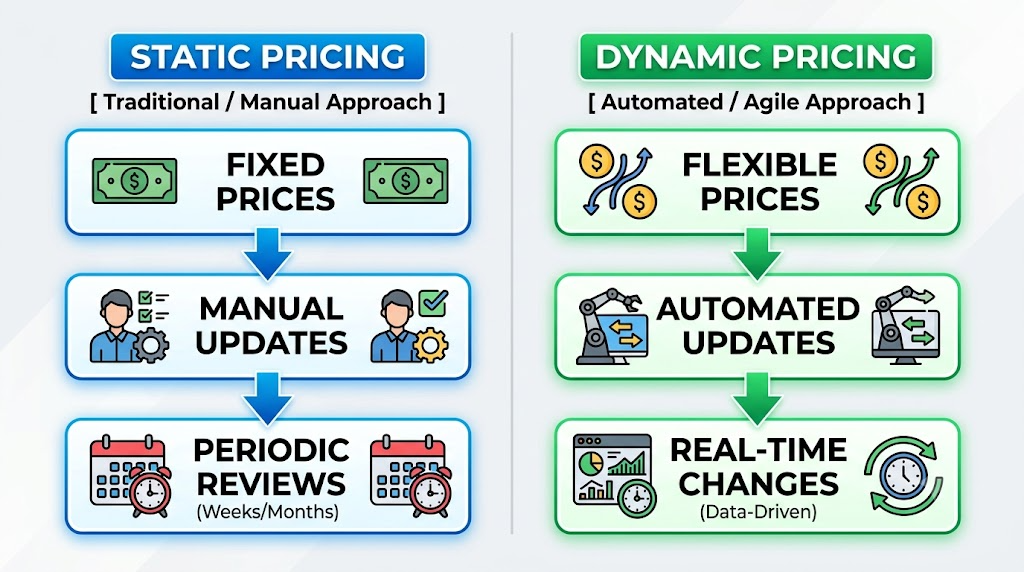
Dynamic pricing is a pricing strategy that adjusts prices based on market conditions or the company’s operations. With dynamic pricing, instead of setting a single price for the entire selling period (typically weeks to months), businesses use pricing software. This software continuously evaluates the following metrics: customer demand, inventory levels, competitor prices, market trends, sales performance, seasonal changes, and operating costs.
The goal of this model is to help businesses sell products at the right time and at the right price. When demand for a product increases, the retailer can raise the price and increase its margins. Conversely, when demand decreases or inventory builds up, the retailer can reduce prices to boost sales and reduce excess stock as part of proper inventory management.
The successful implementation of dynamic pricing depends on reliable business data, well-defined pricing rules, and automation that consistently applies pricing updates.
Key Factors That Influence Dynamic Pricing Strategy
Dynamic pricing is influenced by multiple variables simultaneously rather than relying on a single variable.
Market Conditions
Of the various characteristics used to determine price, supply and demand are the greatest influences. In most cases, when goods become scarce and demand increases, the dynamic pricing system automatically adjusts prices according to market conditions.
The company will typically raise its prices to maintain its profit margins and to slow inventory depletion. Conversely, if a company has excess stock levels and slow sales, it can lower its prices to stimulate sales and increase sales volume. This allows businesses to adjust their prices almost immediately, without waiting for an executive to approve changes.
W.W. Grainger is a good example of how dynamic pricing has enabled one distributor in the B2B space to respond rapidly to competitive changes. When Amazon Business entered the industrial and MRO supply space, Grainger quickly responded by lowering prices across its catalog to remain as competitive as possible.
Customer Behavior
Customers differ in price sensitivity: some buy frequently without checking prices, others wait for sales, buy in bulk, or purchase only occasionally.
Modern pricing systems collect and analyze customer behavioral data, such as purchase history, loyalty status, order frequency, average order value, geographic location, and purchasing patterns. The insights gained from this information help a business develop pricing strategies that improve customer retention and increase profits.
Amazon applies this approach through Prime: members typically get exclusive discounts, early access to deals, and special offer pricing not available to non-Prime members. Rather than lowering prices for everyone, Amazon targets groups within its customer base more likely to respond positively to certain promotional offers. This allows Amazon to continue benefiting from customer loyalty while increasing overall profitability.
Competitor Pricing
In the past, businesses conducted competitor price analysis every few weeks, which took too long. Modern pricing software continuously monitors competitors’ prices and alerts businesses to significant price changes. The goal of any business is not necessarily to become the cheapest seller, but rather to identify and compete more aggressively while maintaining its profit margins.
Dynamic pricing is effectively illustrated through Amazon’s strategy. Its pricing systems constantly monitor competitors’ prices across millions of products. Pricing adjustments are made based on multiple factors, such as demand, shipping costs, inventory levels, and projected sales volume, rather than simply matching a competitor’s lower price. The net effect of this approach allows for competitive pricing without unnecessary margin loss.
Inventory Levels
Inventory levels affect pricing flexibility. Inventory incurs storage costs and ties up working capital when products sit in warehouses for several months. When stock runs low, prices may rise until new inventory arrives.
Therefore, a dynamic pricing algorithm can help retailers maintain a balance in both situations. Large retailers regularly utilize inventory-driven pricing throughout the year.
For example, after peak demand for furniture, outdoor equipment, and holiday decorations, retail prices for those items will gradually decline as inventory remains unsold. At the same time, if an item is selling at a higher rate than originally anticipated, there is a possibility of moderate price increases while inventory remains limited. So, retailers can improve their overall inventory turnover while protecting profitability across thousands of different items.
How Dynamic Pricing Works
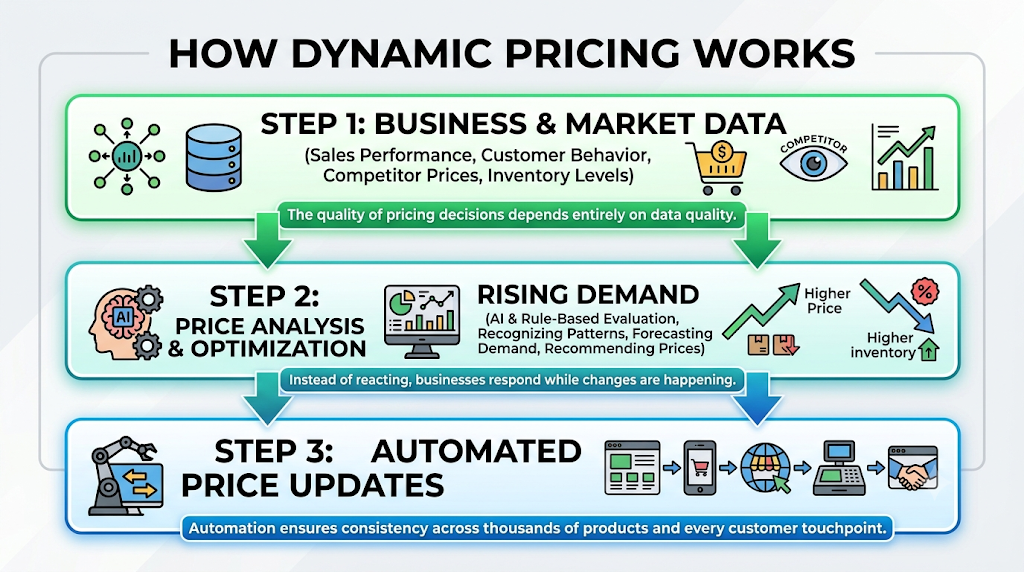
Most dynamic pricing algorithms have at least three stages before prices can be adjusted.
Collecting Market and Customer Data
Collecting data is the first step in making any pricing decision. Modern pricing systems aggregate data from multiple business systems to make pricing judgments. This includes ecommerce platforms, ERP systems, CRM systems, inventory databases, competitor monitoring tools, and customer data.
Common types of data gathered include sales performance, customer behavior, website activity, available inventory, competitor pricing, seasonal demand, market trends, and promotional performance.
If inventory information is outdated or competitor prices are inaccurate, the pricing engine may produce poor pricing recommendations. That’s why integrating operational systems should come before automating pricing.
Price Analysis & Optimization
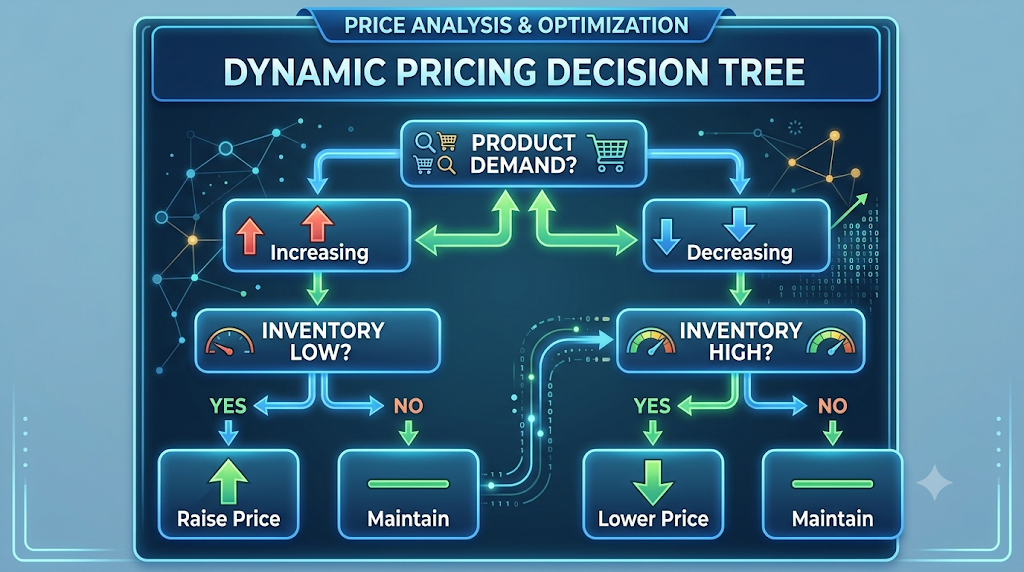
The pricing software will evaluate thousands of variables simultaneously after data collection. In many cases, traditional rule-based systems rely on predefined conditions, while AI-powered pricing systems go further by identifying trends and forecasting market demand, enabling them to recommend prices that align with business objectives.
For example, when a product goes viral on social media and demand suddenly increases, the system may recommend raising prices to ensure there is enough product available for future purchases and to increase margins. Conversely, if demand slows down and warehouse inventory continues to rise, the pricing software may recommend a series of gradual discounts to sell the merchandise more quickly without creating price wars.
Automating Pricing Execution
Once pricing decisions are approved, manually or automatically, based on predefined rules, the engine publishes updates to all connected sales channels. This includes ecommerce websites, mobile applications, online marketplaces, POS systems, and partner portals.
Automation through dynamic pricing enables businesses to eliminate the need to manually update prices for thousands of products daily while maintaining consistent pricing across all customer touchpoints.
Benefits of Dynamic Pricing in Ecommerce
A dynamic pricing algorithm provides ecommerce businesses with several advantages:
- Time savings: Automated price updates save team members countless hours that would otherwise be spent checking and making manual changes across the catalog.
- Profit margin protection: In the event of unexpected cost increases, pricing adjustments can be made before any negative margin impact occurs, rather than waiting until the next quarterly review.
- Scalability: Optimal prices are applied consistently across large catalogs, so businesses do not have to make manual updates to thousands of SKUs one at a time.
- Better inventory turnover: Pricing that responds to stock levels will help clear slow-selling items while also protecting margins on items running low.
- Alignment with business objectives: Depending on your existing business needs, pricing engines can be programmed to focus on margin growth, inventory clearance, or order volume.
Common Dynamic Pricing Models in Ecommerce
Not all businesses use the same pricing model, and the appropriate one will vary with external factors such as consumer behavior, industry conditions, and product demand, as well as business objectives.
| Pricing Model | What It Uses | Best For | Example |
|---|---|---|---|
| Demand-Based Pricing | Demand signals, sales trends, customer activity | Products with fluctuating demand | Airline tickets, event tickets |
| Time-Based Pricing | Time of day, seasonality, holidays | Predictable demand patterns | Hotels, seasonal travel |
| Segmented Pricing | Customer segments, loyalty, purchase history | Different customer groups | Retail loyalty programs |
| Location-Based Pricing | Geography, local competition, regional costs | Multi-region businesses | Global ecommerce brands |
| Competition-Based Pricing | Competitor pricing data | Highly competitive markets | Electronics retailers |
Demand-Based Pricing
Demand-based pricing adjusts a product’s price based on customer demand. When demand increases, the product’s price rises, resulting in higher profit. Conversely, if demand decreases, the price falls, which encourages additional purchases.
This pricing strategy relies heavily on sales history, consumer activity, seasonal trends, and demand forecasting. For example, in the airline and event ticketing industries, demand for a single seat can change by the hour.
Time-Based Pricing
Time-based pricing changes a product’s price based on predictable periods, such as weekends, holidays, special occasions, or specific times of day.
For example, hotels generally charge higher rates during holidays and busy travel seasons but charge lower rates during slow or off-peak periods to attract guests.
Business owners use historical sales data, seasonal patterns, booking trends, and calendar events to shape this pricing strategy.
Segmented Pricing
The segmented approach is the opposite of uniform pricing. The business identifies customer groups with different buying behaviors and willingness to pay, and then sets an appropriate price for each group.
Some common factors used to segment customers include loyalty membership, purchase frequency, total order amount, business versus retail customers, and whether they have a subscription.
Sephora gives exclusive discounts and promotional pricing to Beauty Insider members, while other customers receive standard prices. By doing this, it encourages its Beauty Insider members to make repeat purchases without reducing prices for all customers.
Location-Based Pricing
Location-based pricing considers regional differences when determining optimal prices. Operating costs, taxes, local competition, shipping expenses, purchasing power, and regulations all influence pricing across different markets.
An international ecommerce retailer may sell the same item at different prices in North America, Europe, and Asia because of significant differences in the cost of doing business in each market. The goal is not price discrimination but staying competitive and profitable in each region.
Competition-Based Pricing
Competition-based pricing means continuously monitoring competitors’ prices and adjusting pricing in response. Modern dynamic pricing software helps companies track competitors’ pricing and notify them of significant price changes.
Companies will not always set their prices to match their competitors’ lowest prices. Instead, they determine which prices most affect their competitiveness and where there are sufficient profits for them to operate successfully.
For example, electronics retailers use this pricing strategy. Because similar products in a category are available across competing retailers, price is the main differentiating factor.
How to Implement Dynamic Pricing Successfully
Implementation typically follows five steps, from data preparation to continuous monitoring.
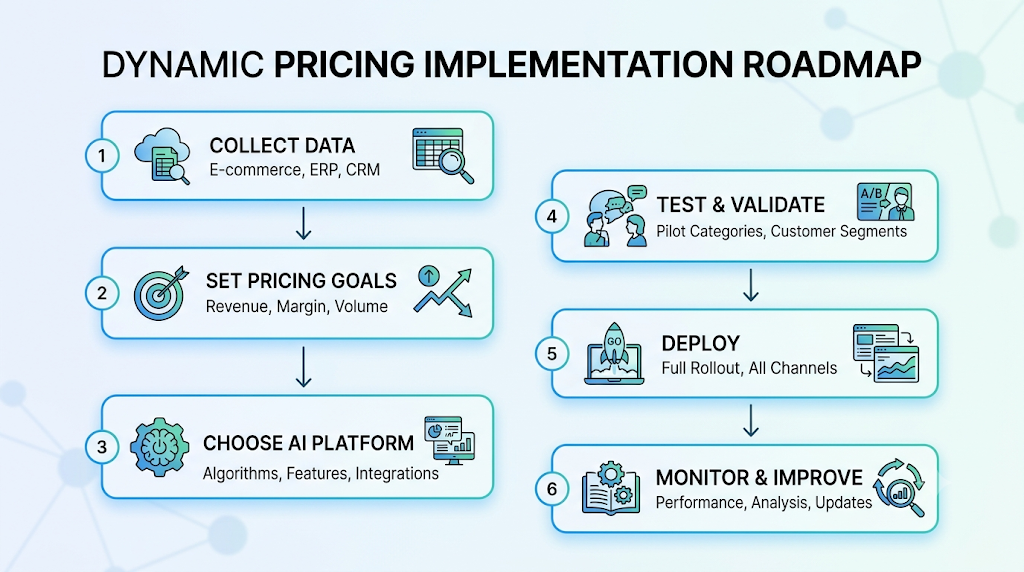
1. Collect the Right Data
Dynamic pricing relies on accurate pricing information. That’s why businesses should gather all data that affects pricing decisions, including sales performance, customer behavior, web analytics, inventory records, competitor pricing, supplier costs, and market trends.
Disconnected systems often create inconsistent pricing recommendations. Connecting ecommerce platforms, CRM systems, ERP software, and inventory management tools creates a single source of truth for pricing decisions.
2. Define Pricing Goals and Rules
All pricing strategies need to align with measurable business goals. Such goals may include increasing profit, speeding up inventory turnover, increasing revenue, broadening market share, or enhancing customer loyalty. These goals become the basis for establishing your pricing rules.
When businesses establish clear rules for profitability targets, inventory goals, seasonality, customer segments, and price elasticity, pricing automation can make decisions that align with business priorities.
3. Choose the Right Pricing Technology
Dynamic pricing software should fit the business’s existing work processes and not impose a new workflow. While evaluating potential pricing technology, it is important to review AI capabilities, machine learning models, automation features, integration with your ERP and CRM systems, forecasting capabilities, competitor monitoring, and reporting and analytics.
AI in ecommerce pricing continues to advance. Rather than relying solely on predefined parameters, modern systems learn from historical pricing performance, customer behavior, and market trends to recommend accurate prices.
4. Test and Refine the Pricing Strategy
No business should roll out pricing automation for all items at one time. Validation testing should be conducted using A/B testing, pilot product categories, selected customer segments, and limited regional rollouts. This will enable the company to identify unexpected customer reactions and address them before a full rollout.
Metrics such as revenue, conversion rates, gross margins, and customer satisfaction will help determine whether further refinement of the pricing rules would improve results.
5. Monitor Results and Adapt
Dynamic pricing is a continuous process for businesses. As markets change, competitors adjust their approaches, and customer behavior evolves, pricing strategies need to adapt accordingly.
Successful businesses conduct regular reviews of competitor activity, pricing performance, inventory movement, and customer feedback to make better pricing decisions over time.
Common Dynamic Pricing Mistakes to Avoid
Cross-functional alignment is a major challenge for the success of dynamic pricing. Sales, finance, and marketing departments often pull in different directions. For instance, sales resists changes that could strain client relationships, finance pushes for margin, and marketing focuses on volume. Without shared goals and clear governance, establishing a proper pricing strategy will be nearly impossible.
Reviewing pricing rules is also essential. Pricing strategies should be audited regularly, especially in relation to market fluctuations. With regular audits, companies can ensure that their pricing strategy aligns with current demand, supply costs, and competitor behavior.
Even though machines are excellent at analyzing large amounts of data, it is still very important to have human oversight. Errors can occur if a pricing algorithm lacks context about business relationships. A common error might be the algorithm increasing the price for a long-standing customer because the model flagged rising demand. Such errors can quickly erode consumer trust.
Automation should support human judgment and not completely replace it. Someone should always be reviewing exceptions, establishing reasonable price floors and ceilings, and intervening when a rule produces a result that technically makes sense on paper but wouldn’t hold up in a real conversation with a customer.
Trust and transparency deserve the same attention: unexplained or frequent price changes can leave customers confused and spark real backlash. There is no quicker way to destroy a brand’s value than to make customers feel as though they were charged an arbitrary or unfair price.
Clear pricing logic, communicating honestly with customers about why prices fluctuate, and ensuring customer-friendly implementation of price changes (e.g., avoiding sudden spikes on items that customers are actively considering) will help to preserve long-term consumer trust.
Why Choose LITSLINK for Dynamic Pricing Solutions
Building an effective dynamic pricing system is much more than just writing pricing algorithms. It requires deep expertise in ecommerce architecture as well as artificial intelligence, business automation, and enterprise system integration.
LITSLINK brings this expertise to every project. The company has completed over 1,540 projects for more than 1,000 clients across 82 countries. It helps businesses build custom software, AI solutions, ecommerce platforms, and intelligent automation systems.
LITSLINK develops AI-driven pricing solutions that analyze data from multiple sources simultaneously. This includes customer behavior, inventory availability, demand signals, competitor pricing, sales performance, market trends, and seasonal patterns. These systems can evaluate pricing patterns in relation to changing industry conditions in real time and either recommend or automatically apply the best-fit pricing.
Depending on business models and implementation size, AI-powered pricing solutions can increase gross margins by 5-15%, reduce excess inventory by 10-30%, accelerate pricing decisions by up to 90%, and grow revenue by 3-10% through greater responsiveness.
LITSLINK also offers businesses a seamless way to integrate their pricing engines with existing ecommerce platforms, ERP systems, CRM software, warehouse management systems, and inventory systems. This way, pricing is embedded in everyday processes rather than being an isolated process or tool.
A retailer with a multi-region ecommerce presence could not maintain competitive prices across over 80,000 products. Competitor pricing changed several times per day, and the retailer’s price updates were based on manual reviews that took several days each week to complete.
LITSLINK built an AI-powered pricing engine that monitored competitors, current inventory, and customer demand in real time. As a result, the system automatically provided pricing recommendations based on predefined business rules while integrating directly with the retailer’s ERP and ecommerce platform. Within six months, the retailer achieved 8% revenue growth, an 11% increase in gross margins, a 24% reduction in excess inventory, and the ability to make pricing decisions within minutes rather than days.
LITSLINK can deliver a Proof of Concept (PoC) within 4-6 weeks and a complete production-ready solution in approximately 3-6 months, depending on complexity and integration requirements. Businesses that are planning AI projects can use LITSLINK’s AI Cost Calculator to estimate their project budgets before commencing implementation.
Dynamic Pricing as a Long-Term Growth Strategy
Dynamic pricing is not just for airlines or ride-sharing; it has become a viable option for ecommerce companies, where customer expectations, supply chains, and competitors’ product prices are constantly changing. By leveraging connected data, AI, and operational automation, businesses can respond to changes in the marketplace almost instantly rather than in weeks.
Dynamic pricing is not only a better pricing optimization tool but also enables improved stock management, helps protect profits, reduces manual work, and helps companies make faster commercial decisions.
The numbers back this up. Amazon makes roughly 2.5 million price adjustments every day, a feat that would not be possible without automation. Individual case studies show what’s possible at a smaller scale, too: one solar and renewable-energy firm using CPQ and dynamic pricing tools saw revenue grow by 20% and quotes generated 30% faster, while a power tool retailer saw a 9% lift in quarterly revenue after adopting demand- and competitor-based pricing.
With advancements in AI-driven forecasting, demand prediction, and customer segmentation, dynamic pricing models will also produce more accurate results. Businesses that make early investments in connected data, automated processes, and intelligent pricing systems will find it easier to adapt to rapidly changing industry conditions than those that have not.
FAQ
What Is Static vs Dynamic Pricing?
Static pricing applies fixed prices that do not change until someone manually changes them. Dynamic pricing operates automatically and adjusts prices based on demand, inventory levels, competitor pricing, seasonality, and other conditions.
Does Dynamic Pricing Affect Customer Trust?
Dynamic pricing can affect customer trust if businesses change prices too frequently or without explanation. Customers will more readily accept dynamic pricing when businesses provide reasons behind pricing changes, such as promotions, seasonal demand, or limited inventory.
Which Dynamic Pricing Tools Are the Best in the Market?
The best dynamic pricing tool depends on the company’s size, industry, and pricing complexity. Some of the most popular dynamic pricing solutions include Competera, Pricefx, Prisync, PROS, and Omnia. Each of these pricing tools offers features such as AI-powered pricing optimization, competitor monitoring, price forecasting, automation, and pricing analytics.
Read more about pricing tools here.
What Is the Difference Between Dynamic Pricing and Personalized Pricing?
Dynamic pricing constantly adjusts prices based on changes to market conditions such as demand, inventory, competitor activity, and seasonality. Personalized pricing goes further by offering different prices to individual customers or customer segments based on purchase history, loyalty status, geographic location, and purchasing behavior.
How Can Businesses Use Dynamic Pricing to Support a Competitive Pricing Strategy?
Dynamic pricing enables businesses to remain competitive without having to become the lowest-priced seller. By monitoring competitors, customer demand, inventory levels, and overall market trends, businesses can adjust prices to protect profit while simultaneously reducing the risk of losing customers.