








Key Takeaways
- The global software development market will reach $0.64 trillion in 2026. The projections indicate growth to $1.11 trillion by 2031.
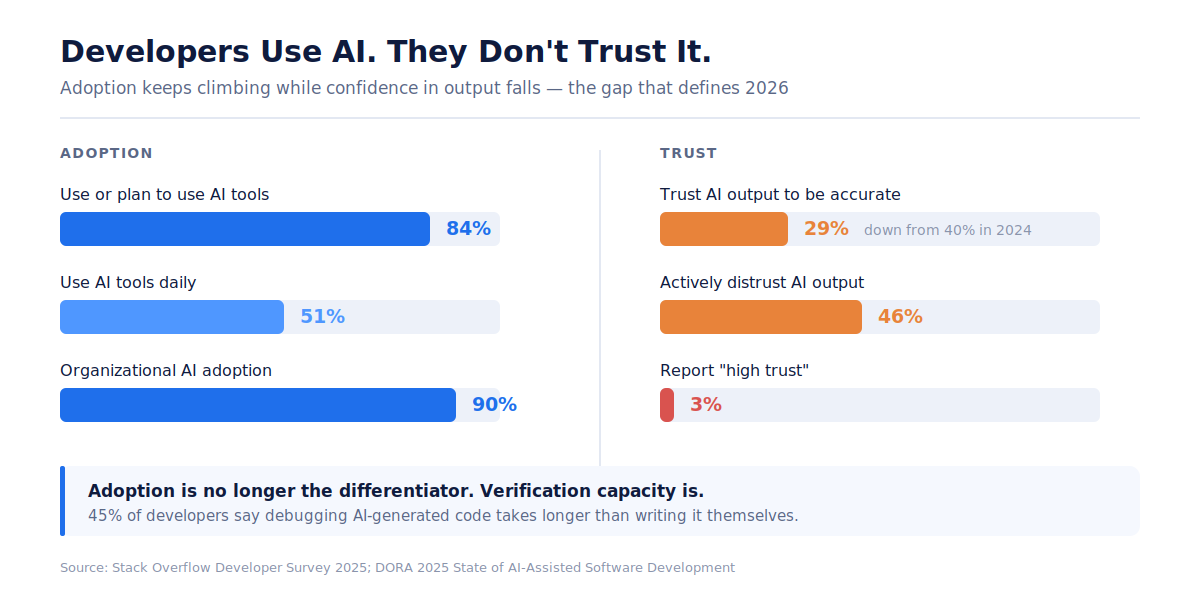
- 84% of developers use or plan to implement AI tools, and 51% work with them daily.
- 87% of organizations operate across multiple cloud environments, so spending on public clouds will reach $850 billion this year.
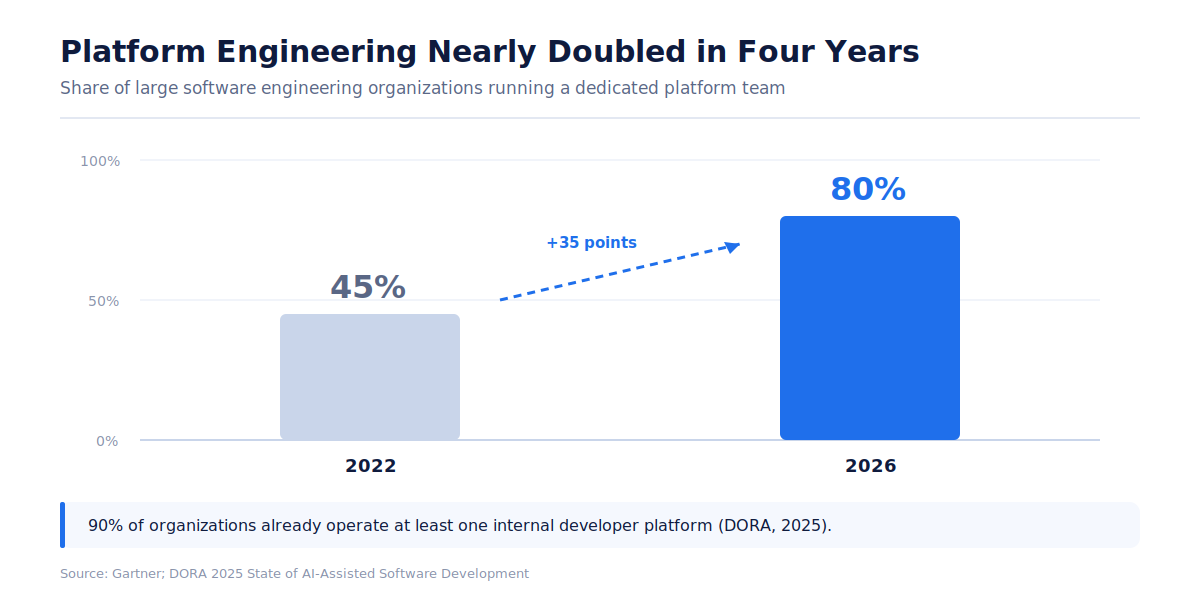
- By the end of 2026, 80% of large IT companies will have platform engineering teams, compared to 45% in 2022.
- By 2034, demand for developers and QA engineers will reach 15%, making approximately 288,000 new jobs in the U.S.
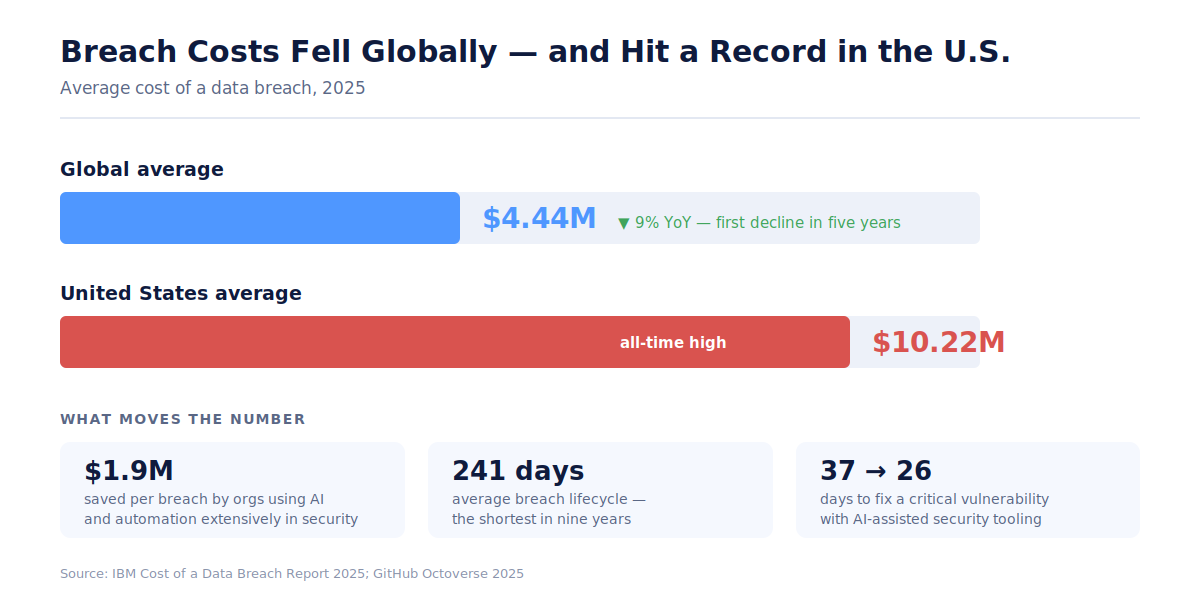
- The average cost of a data breach worldwide has fallen to $4.44 million. Meanwhile, in the U.S., it has reached a record $10.22 million (IBM).
If you read the business press in 2026, the headlines are making one thing clear: natural language prompts are replacing line-by-line coding. It all sounds simple: describe an idea, let the model generate the application, ship faster, and reduce engineering costs.
But open Jira and talk to your tech leads, and the picture becomes more complicated. Engineering teams are seeing a different reality. While AI adoption is growing, trust remains limited: 45% of developers report that fixing AI-generated code can take more time than writing code themselves.
Given the hype, this article could easily become another prediction that AI will replace traditional software development. The reality is more nuanced. AI is already accelerating feature delivery, but in enterprise, fintech, and healthcare, production software still depends on security reviews, compliance requirements, and engineering oversight.
Rolling out AI is only one piece of the puzzle. It works alongside platform engineering, cloud strategy, and access to specialized talent. The data in this article matters because it directly impacts four strategic decisions CTOs are making right now:
- Where AI can safely accelerate development.
- What to standardize.
- Where to invest in infrastructure.
- What expertise to build or source externally.
Key Software Development Statistics for 2026
Several major indicators point in the same direction: the market is growing, AI has become the default, and cloud spend keeps climbing. Here’s the data:
| Metric | 2026 Figure | Source |
|---|---|---|
| Global software development market | $0.64 trillion in 2026, growing to $1.11 trillion by 2031 (11.74% CAGR) | Mordor Intelligence, 2026 |
| Developers using AI-assisted coding tools | 84% use or plan to use AI tools; 51% use them daily | Stack Overflow Developer Survey, 2025 |
| Organizations running more than one cloud environment | 73% hybrid, plus 14% multi-cloud without private | Flexera 2026 State of the Cloud Report |
| Public cloud end-user spending | $850 billion in 2026, +21.3% YoY | Gartner (2026 forecast) |
| Average enterprise cloud/software spend | No single average exists — ranges from under $50K/month (SMB) to $200K–500K/month (typical enterprise) to $5M+/month (large enterprise) | Flexera 2026 State of the Cloud Report |
| U.S. developer employment growth | +15% from 2024 to 2034; roughly 287,900 new jobs | U.S. Bureau of Labor Statistics, 2025 |
| Global developer workforce size | 20.8 million by one count, ~47.2 million by another — estimates vary sharply by methodology | JetBrains, 2025; SlashData, 2025 |
| Low-code development market | $44.5 billion, ~19% CAGR | Gartner (2026 forecast) |
| Average cost of a data breach | $4.44M globally (-9% YoY); $10.22M in the U.S. (all-time high) | IBM Cost of a Data Breach Report, 2025 |
Several of the figures above are drawn from primary reports (Gartner, Stack Overflow, IBM) rather than secondary write-ups. Where only a secondary aggregation was available, that’s flagged in the relevant section below rather than presented as a first-hand figure.
Top Development Trends Reshaping Software Delivery in 2026
Five shifts are doing most of the work in reshaping how software gets built and shipped this year, each backed by its own number. Platform teams are absorbing infrastructure complexity. Low-code is moving into serious production use cases. Sustainability is becoming a tracked engineering metric. Delivery cycles are compressing further under DevOps maturity. And security is shifting left into the build process itself. In 2026, mainstream low-code and rising cloud costs are forcing teams to deliver more efficiently. For the startup-specific angle on some of these same shifts, see LITSLINK’s Top Startup Trends report.
Platform Engineering and Internal Developer Platforms Go Mainstream
By the end of 2026, 80% of large IT companies will have established dedicated platform engineering teams to develop internal platforms (IDPs). Their mission consists of two main tasks: deploying self-service infrastructure and standardizing CI/CD pipelines. As a result, product teams no longer waste time struggling with server configurations. Google’s 2025 DORA research adds a second data point: 90% of organizations already operate at least one internal platform. Platform engineering is a distinct field that shouldn’t be confused with AI for writing code. Businesses are simply trying to cope with the extreme complexity of modern infrastructure.
Low-Code/No-Code Platforms Expanding Beyond Simple Apps
Gartner forecasts the low-code development technologies market to reach $44.5 billion in 2026, growing at 19% annually. Broader market-research aggregators peg the wider “platform” category higher, up to $65 billion at nearly 26% CAGR. They’re measuring a different, broader scope than Gartner’s own technologies segment. 75% of new enterprise applications are expected to use low-code or no-code tools by this year, up from under 25% in 2023. What’s changed isn’t the existence of low-code; it’s its ambition. These platforms have moved from internal tools into full web development projects, mobile apps, and even progressive web apps. That’s well beyond the simple web-based solutions low-code was known for a few years ago. They’re often paired with automation capabilities like RPA. For a deeper look at when low-code is the right call, see LITSLINK’s No-Code Software Development: When No-Code Really Works.
Sustainable Software Engineering and Green Cloud Practices
According to Gartner’s forecasts, by 2026, half of all companies will implement environmental monitoring systems for their hybrid clouds. The goal is to closely track energy consumption and carbon footprints.
The ICT sector already accounts for an estimated 2.1-3.9% of global greenhouse gas emissions. Three main factors are currently driving this transition. The first and most influential is regulatory pressure. Since the CSRD directive took effect in 2024, large companies operating in the EU market have been required to strictly report on Scope 3 emissions related to software. Second is cloud cost optimization, which naturally overlaps with energy efficiency. Third is the rise of carbon-tracking tools built around the Green Software Foundation’s ISO-accredited SCI standard.
Agile/DevOps Maturity and Faster Release Cycles
DORA’s 2025 research changed how engineering performance should be discussed. Instead of ranking teams on a single Elite-to-Low ladder, it identified seven team archetypes. Each combines delivery throughput with system stability, team friction, burnout and product performance.
Faster deployment is not evidence of a healthy delivery organization by itself. Consider two teams shipping several times a day. One is burning out its engineers and accumulating instability. The other ships at the same cadence sustainably. DORA now places them in different archetypes. CI/CD maturity still separates the two ends of the spectrum in practice. Automated testing gates, smaller batch sizes, and trunk-based development let teams ship continuously. The difference in 2026 is that speed alone no longer counts as the scorecard.
Rising Focus on Security by Design
In 2025, the average global cost of a data breach fell by 9% to $4.44 million. Accuse AI, which reduced the incident lifecycle to 241 days. However, this overall figure masks a sharp regional contrast: in the U.S., average losses reached a historic high of $10.22 million.
As the same IBM report shows, companies that have deeply integrated AI and automation into their security processes save an average of $1.9 million per breach. This result is achieved through specific technical steps: implementing Shift -left security with automatic scanning of every pull request for vulnerabilities, configuring CI/CD to catch exposed secrets and configuration errors before release, and continuous attack surface monitoring (ASM) that tracks every vulnerable endpoint the moment it is created. Today, it is precisely this combination of practices that draws a clear line between organizations whose costs associated with cyber incidents are falling and those whose losses continue to rise rapidly.
Source: IBM Cost of a Data Breach Report 2025
AI-Assisted Code Development: Adoption Statistics
According to a recent Stack Overflow survey of nearly 49,000 developers across 177 countries, 84% of professionals are already using AI assistants for coding or plan to start in the near future. A year ago, that figure was 76%. Among professional developers, one in two (51%) uses these tools every day. When four out of five teams have the same tooling, having it stops being an advantage. What separates teams now is how fast and reliably they can check what the tools produce.
GitHub Copilot alone crossed 20 million users by July 2025, with 5 million of those users joining in just three months. 90% of Fortune 100 companies are now using it, per Microsoft’s Q4 FY2025 earnings call. GitHub reported back in 2023 that Copilot was writing about 46% of the code for its active users, up from 27% the previous year. That was an early signal of how fast the share shifted. It is not a current 2026 measurement.
Coding agents are the newer development worth separating out. These tools take a task, plan many steps, and execute across files. Stack Overflow’s 2025 data is measured on this point: AI agents had not yet reached mainstream use among developers. Treating agentic development as already universal would be wrong. The transition is underway. It changes the verification question from “is this line correct” to “did this agent do the right thing across twelve files.”
| Development Stage | Adoption Signal | Reported Impact |
|---|---|---|
| Code generation/completion | 84% of developers use or plan to use AI tools | Developers completed tasks up to 55% faster in a controlled GitHub/Accenture study; average PR cycle time fell from 9.6 to 2.4 days |
| Code review | GitHub’s AI review agent performs millions of automated reviews monthly platform-wide | Faster review turnaround, though adoption data is reported in scale, not percentage terms |
| Testing | Developers name this as one of the areas they plan to expand AI use into next | Still an emerging use case relative to code generation (Stack Overflow, 2025) |
| Documentation | Same pattern as testing — more planned than actively scaled today | Adoption expected to catch up as teams move past code-generation-only workflows |
| Autonomous coding agents | Not yet mainstream among developers (Stack Overflow, 2025) | Early adoption; shifts verification from line-level review to task-level oversight |
Code Quality and AI: What the Data Shows
Source: Stack Overflow Developer Survey 2025; DORA 2025
Integration is on the rise, but trust is falling. According to Stack Overflow (2025), only 29% of developers believe that generated code is error-free. In contrast, 46% openly distrust it, and barely 3% report “high trust.”
The DORA report (2025) shows that only 30% of professionals rely on AI very little. The reason for this skepticism is simple: code quality. Veracode tested over 100 different models and found that 45% of AI-generated code contains vulnerabilities. On top of that, 88% of developers complain that AI generation has actively increased their technical debt (SonarSource, 2026).
But there’s one big “but.” While AI is poor at writing new code, it’s excellent at fixing old code. The GitHub Octoverse report (2025) shows that AI security tools have reduced the time to fix vulnerabilities from 37 to 26 days. As a result, the number of problematic repositories decreased by 26% over the course of a year.
Most developers report saving real time with AI, often an hour or more a week. Reviewing AI-generated code has become its own time sink, though, running to a reported median above 11 hours a week. The friction shows up downstream too. 66% of developers say AI answers are “almost right but not quite.” Another 45% say debugging AI-generated code takes longer than writing it themselves. So teams are buying a second layer of tooling to catch what the first layer misses. Automated review, test generation, and static analysis now sit inside the development process.
Cloud Services, Data, and Infrastructure Trends
Infrastructure remains the primary arena where AI and platform engineering converge. Here’s what lies ahead for computing, storage, and database technologies in 2026, and how this will impact what companies will be able to develop in practice.
Multi-Cloud Adoption and Market Share Statistics
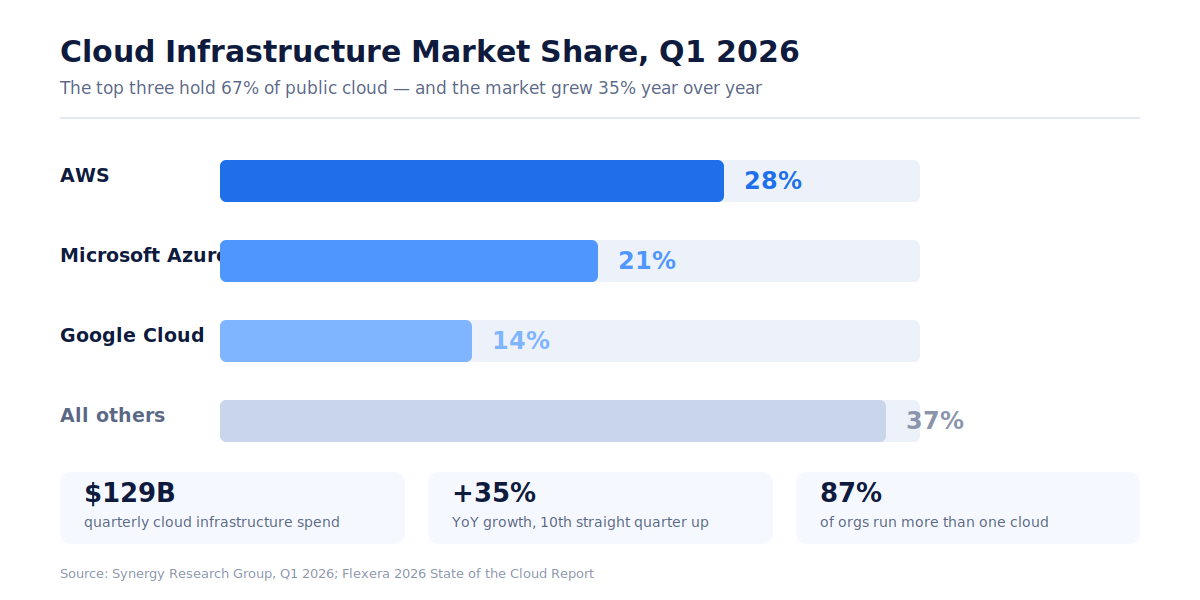
Source: Synergy Research Group; Flexera 2026 State of the Cloud Report
Cloud computing adoption has moved past the yes-or-no question entirely — the live question now is how many providers, not whether to use one. Flexera’s 2026 State of the Cloud Report puts hybrid cloud adoption at 73% of companies, with a further 14% running multi-cloud without a private-cloud component. That means roughly 87% of companies now combine more than one cloud environment in some form, up from the prior year. Gartner forecasts global public cloud end-user spending will reach $850 billion in 2026, a 21.3% jump year over year, on top of $6.15 trillion in total worldwide IT spending (+10.8%).
| Provider | Global Market Share (Q1 2026) |
|---|---|
| AWS | 28% |
| Microsoft Azure | 21% |
| Google Cloud | 14% |
Source: Synergy Research Group, Q1 2026.
Amazon holds a clear lead, but Microsoft and Google are both growing substantially faster. The market itself grew 35% year over year in Q1 2026, the tenth consecutive quarter of accelerating growth. Asia Pacific is the fastest-growing region both for cloud spend and for the software market overall. Mordor Intelligence puts its growth at roughly 12.5% CAGR, ahead of every other geography. Multi-cloud is increasingly a deliberate architectural choice rather than accidental sprawl — companies are matching specific providers to specific workloads (AI, analytics, enterprise integration) rather than defaulting to a single vendor.
For more on this shift, see LITSLINK’s Cloud Services overview, Benefits of Engaging a Cloud Managed Services Provider, which speaks directly to why companies outsource cloud management, and Data Security in Cloud Computing: Strategies for Maximum Protection, since security concerns are a top driver of multi-cloud strategy decisions.
Data Analytics Integration in Modern Software Projects
Advanced analytics has stopped being a bolt-on feature and become a default expectation in new software products — the global market for it is set to more than double, from $69.52 billion in 2026 to $178.93 billion by 2031 (20.82% CAGR), according to Mordor Intelligence. Other common patterns include customer experience personalization and embedded business intelligence. The cost and complexity impact varies widely by project scope, which is precisely why this is an area where a specific project estimate is more useful than an industry-wide average.
Enterprise Software Development Emerging Trends
Gartner projects worldwide IT spending to hit $6.15 trillion in 2026 (+10.8%), with software expenses alone crossing $1.4 trillion (+14.7%). Growth is driven heavily by AI-related spending, infrastructure and generative AI alike, which Gartner expects to grow 80.8% this year.Custom software development specifically is growing faster than the broader market. One estimate puts the segment at $53.02 billion in 2025, expanding at roughly 22.7% CAGR.
Within the enterprise software market, a few categories are growing fastest: enterprise resource planning modernization, cloud solutions, AI-powered tools, and service management platforms. The driver is consistent across all four: digital transformation initiatives, operational efficiency goals, and risk management needs that used to get deferred are now funded directly. That’s reshaping business objectives and business functions at the budget-approval level.
| Company Size | Typical Monthly Public Cloud Spend |
|---|---|
| Small and mid-sized businesses | Under $50,000 |
| Enterprise (most common bracket) | $200,001–$500,000 |
| Large enterprise | Over $5,000,000 |
Workforce and Industry Statistics
From technology investment to the people building it. Talent supply, in-demand skills, and how companies are sourcing development capacity all shifted materially in 2026.
Developers Worldwide: Talent and Skills Statistics
Look at the U.S. market. The U.S. Bureau of Labor Statistics expects a massive 15% spike in developer and QA roles by 2034. Normal job growth? Barely 3%. We are looking at 287,900 net new jobs. Isolate software developers, and it hits 16%. Factoring in standard turnover, that means roughly 129,200 open roles every single year.
Global numbers are a completely different story. Nobody agrees on a single baseline. JetBrains pegs the 2025 headcount at 20.8 million worldwide. Three countries hold the bulk of them: China (4.04M), India (3.85M), and the U.S. (3.18M). But ask SlashData, and you get totally different numbers. Both estimates are actually fine. It depends on how strictly your methodology.
| Region/Methodology | Estimated Developer Population (2025) | Source |
|---|---|---|
| Global (JetBrains methodology) | 20.8 million | JetBrains |
| China | 4.04 million | JetBrains |
| India | 3.85 million | JetBrains |
| The United States | 3.18 million | JetBrains |
| Global (SlashData methodology) | ~47.2 million | SlashData |
Precise population counts matter less for hiring decisions than which skills are growing. On that front, three categories are absorbing most of the growth:
| Skill Category | Growth Signal |
|---|---|
| AI/ML | U.S. job postings up 163% from 2024 to 2025, reaching roughly 49,200 openings (LinkedIn data) |
| Cloud specialization | Job postings naming specific providers (AWS, Azure, Google Cloud) all climbed year over year as multi-cloud skills became table stakes |
| Low-code/no-code | Tracks the ~19% CAGR platform growth covered earlier in this report — platform adoption and developer demand are rising together |
Python’s adoption accelerated by 7 percentage points from 2024 to 2025 alone (Stack Overflow, 2025) — one of the fastest-moving programming languages in the survey — reflecting its central role in AI and data science work, alongside continued high demand for senior developers with cloud and AI/ML specialization. Universities pump out about 65,000 computer science grads a year. The actual market demand? We need 180,000 AI-fluent engineers right now. It simply does not add up.
Outsourcing and Global Delivery Trends
Deloitte found that 80% of companies are either protecting or growing their third-party budgets. Yet they aren’t chasing cheap labor anymore. Back in 2020, 70% of execs outsourced strictly to cut costs. Today, that number sits at 34%. Cost is secondary now. Companies are just desperate to find people who can actually ship a product.
This shift in priorities changes where companies hire. Ease of communication now beats maximum cost savings. Eastern Europe (Ukraine, Poland, Romania) and Latin America are booming because overlapping time zones enable seamless collaboration—Mexico’s outsourcing market jumped 22% in 2026 alone. While Asia Pacific remains the dominant player by volume, its growth rates are slowing as companies aggressively diversify their global teams.
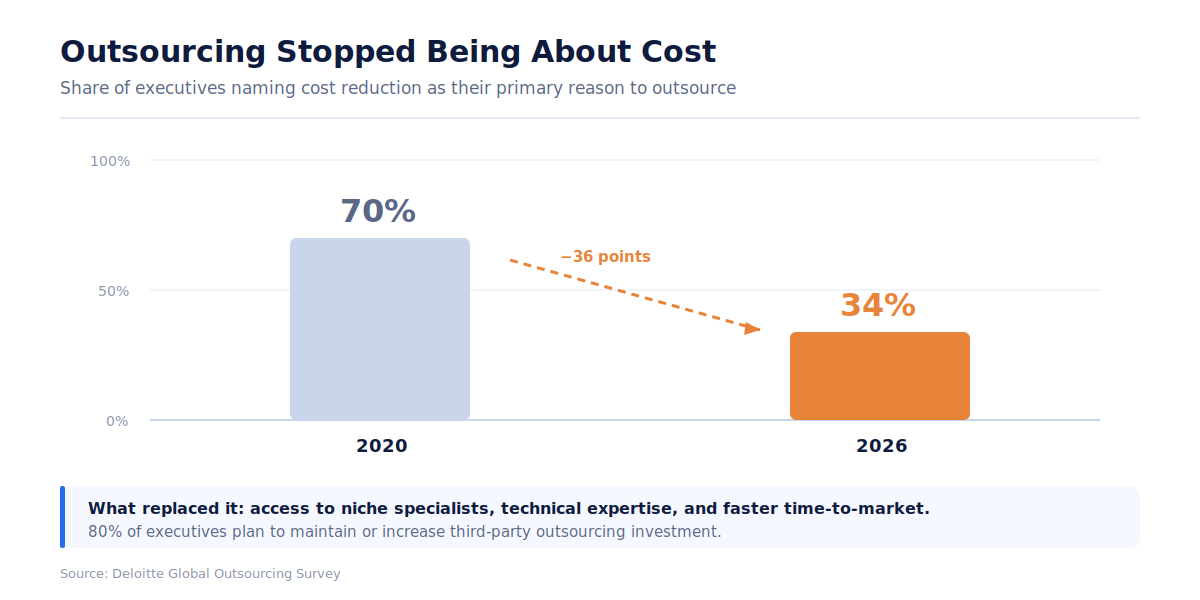
Source: Deloitte Global Outsourcing Survey
Software development outsourcing quickly fills staffing gaps and accelerates product releases, itself a response to rising customer expectations for faster launches. That reframes the internal conversation. The question to bring to management is no longer whether outsourcing is cheaper, but which specific capability gap it closes faster than hiring would.
What These Trends Mean for Your Business
Not all the trends in software described need the same immediate response from CTOs and business leaders. Platform engineering and AI tools have already reached the 80–90% mark. So, monitoring sustainability and DORA metrics can safely be included in the plan for the next 12-18 months. These areas are growing (with about 50% adoption), but they haven’t yet become a universal standard, so they should be implemented.
Although 84-90% of software developers use AI assistants, only 29–30% trust the generated code. The budget for code quality assurance tools should be allocated at the same time as the buy of AI licenses, not sometime later. Implementing artificial intelligence without strengthening controls leads to rework, as shown by data from DORA and Stack Overflow.
Custom software development is growing twice as fast as the software market (22.7% CAGR). Low-code platforms are showing similar growth rates for teams. You should only build from scratch what forms the core and competitive advantage of the product. The rest is better off purchased or built using low-code.
Outsourcing priorities have flipped. Four out of five executives plan to hold or grow their third-party investments, with access to niche talent as the main driver. For most CTOs, asking “Should we outsource?” misses the point. The much better question is, “What specific expertise gap will this partnership close?” The classic lowest-price bidding process is being replaced by a strict focus on building well-coordinated teams.
How LITSLINK Helps Businesses Stay Ahead of Software Development Trends
LITSLINK works with businesses across the software industry to act on these trends. It builds software solutions that span AI-assisted development, cloud migration, and enterprise software development. AI agents specifically are where LITSLINK is investing most heavily right now. LITSLINK is one of a growing number of AI-focused companies treating agent-based systems as the core deliverable. Our AI in Supply Chain: Use Cases in LITSLINK’s Case Study walks through how this looks in practice for supply chain and logistics clients.
LITSLINK’s track record includes 1,540+ completed software projects and 1,000+ clients across 82 countries. The team has grown to 300+ engineers and technology specialists, with MVP delivery in as little as 10 weeks.
Does your technology roadmap need to account for shifts like AI tooling adoption, platform investment, cloud strategy, or a build-vs-outsource decision? Get in touch with LITSLINK to talk through how these trends apply to your specific situation.
FAQs
What are the biggest software development trends in 2026?
Five trends are currently setting the tone in the market. First, there’s platform engineering (by the end of the year, 80% of large companies will have dedicated teams for this). Second is AI-assisted development. Besides, companies are migrating complex tasks to low-code platforms and implementing environmental monitoring of cloud resources.
How many companies are using AI-assisted coding tools?
In short — almost all of them. Enterprise adoption is at 90% (DORA). Among developers, 84% use or plan to use them, and 51% use them daily (Stack Overflow, 2025).
Is cloud computing still growing in 2026, or has adoption plateaued?
It’s growing. Public cloud spend will reach $850 billion this year. Companies are done with initial migration. They are now scaling multi-cloud (87% adoption) and buying compute for AI.
What percentage of companies outsource custom software development?
Per a Deloitte survey, 80% of executives plan to maintain or increase investment in third-party outsourcing. No single reliable figure isolates software development specifically.
What’s the outlook for no-code and low-code development platforms?
In 2023, less than 25% of new enterprise apps used low-code. In 2026, that figure will reach 75%. The market is currently at $44.5 billion, growing 19% annually (Gartner).